


MECHANICAL INJURIES(BLUNT FORCE)DR. ANIL KUMAR MITTAL                       DR.MONISHA PRADHAN  DR.ANAND PAWAR
INJURY Definition            Under section 44 of the Indian Penal code, Denotes any harm whatever illegally caused to any person, in body mind, reputation or property.
CLASSIFICATION
A.DEPENDING UPON CAUSATIVE FACTOR.I.Mechanicalor Physical injuries. (a)Those caused by blunt force. . 1) Abrasion 2) Lacerations 3) Contusions ( Bruises)
A.DEPENDING UPON CAUSATIVE FACTOR.I.Mechanical or Physical injuries. (b) Those caused by sharp force. (1) Incisions (2) Stab(3)Punctures incised punctures or lacerated punctures
I . Mechanical or Physical injuries. (c) Caused by Fire Arms.Rifled FirearmsSmooth Bore Firearms.country made Firearms.A.DEPENDING UPON CAUSATIVE FACTOR.
A.DEPENDING UPON CAUSATIVE FACTOR.I . Thermal injuries. Due to heat: Generalized effects of heat. i.e.A)Heat Hyperpyrexia. ( heat stroke)B)Heat Exhaustion ( Heat collapse)C)Heat Cramps ( Miners cramps
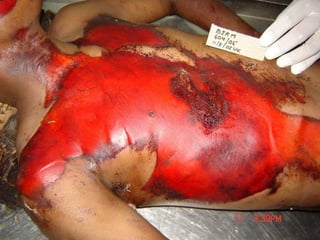
A.DEPENDING UPON CAUSATIVE FACTOR. I . Thermal injuries. Due to heat: Localized effects of heat. i.e. A)Burns ( Due to application of dry heat) B)Scalds ( Due to application of moist heat)
A.DEPENDING UPON CAUSATIVE FACTOR.I . Thermal injuries. (b) Due to Cold Generalized effects of cold i.e. Hypothermia Localized effects of cold. i.e.Frost Bite (due to dry cold)Trench TrenchFoot ( Due to wet cold)
A.DEPENDING UPON CAUSATIVE FACTOR.CAUSED BY CHEMICAL AGENTS. Corrosions ( Due to strong Acids or Alkalies) Irritation ( Due to weak acids, alkalies, vegetables or animal extracts
A. DEPENDING UPON CAUSATIVE FACTOR.MISCELLANEOUS A)LightingB)ElectricityC)Radiation ( X-ray, U-V rays, radioactive)D)Blast Injuries
Simple Grievous DangerousB) DEPENDING UPON GRAVITY
C) DEPENDING UPON TIME OF INFLECTIONAntemortemPostmortemPerimortem
D.DEPENDING UPON THE MANNER OF INFLICTIONSuicidal AccidentalHomicidal Defence Wounds Self- Inflicted Fabricated / Fictitious Injuries
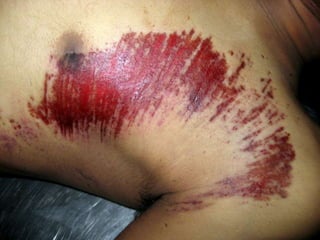
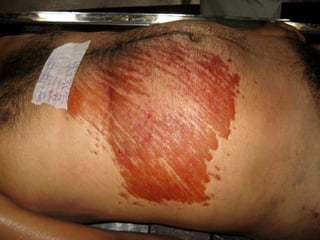
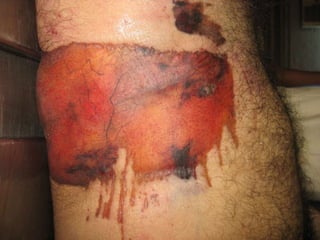
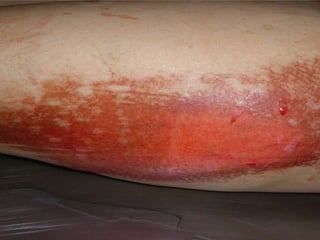
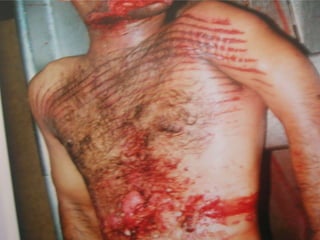
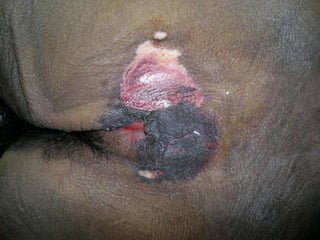
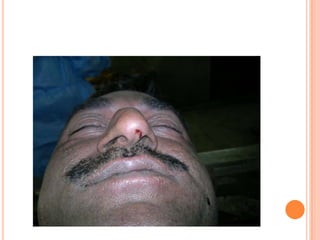
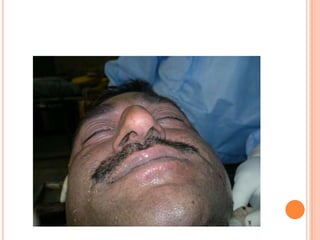
ABRASIONSDEFINITION : Abrasions are the injuries involving superficial layers of the skin the epidermis or mucus membrane, due to impact against some hard, blunt, & rough object/ weapon.
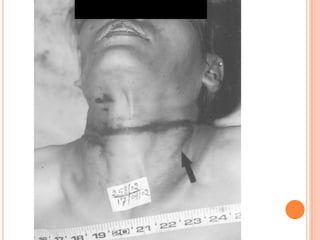
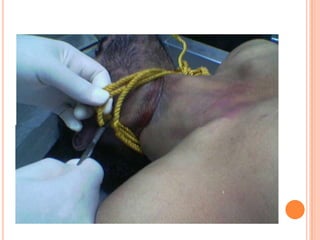
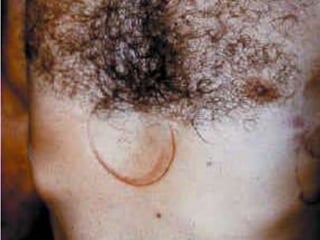
ABRASION-  1. Scratches or Linear Abrasions Nails, Thorn, Needle 2. Grazes ( Sliding/ Tangential Brush Abrasions)3. Pressure Abrasions / Crushing Abrasions /   Imprint AbrasionsEg : Hanging, Manual Strangulation, RTA- Radiator grill, Tyre tread mark .4.Patterned Abrasions Eg: RTA- Rubber Tread, Cycle Chain, Necklace 5. Atypical Abrasions
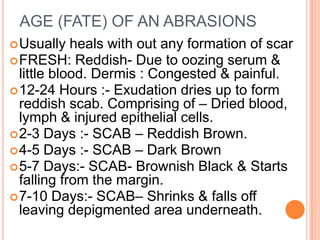
AGE (FATE) OF AN ABRASIONS Usually heals with out any formation of scarFRESH: Reddish- Due to oozing serum & little blood. Dermis : Congested & painful.12-24 Hours :- Exudation dries up to form reddish scab. Comprising of – Dried blood, lymph & injured epithelial cells.2-3 Days :- SCAB – Reddish Brown.4-5 Days :- SCAB – Dark Brown 5-7 Days:- SCAB- Brownish Black & Starts falling from the margin.7-10 Days:- SCAB– Shrinks & falls off leaving depigmented area underneath.
MEDICOLEGAL IMPORTANCE:-Only external visible signs of a severe or even fatal internal injury. 1.Point of impact of the blunt force. 2.Pattern- Nature of force.3.Site & Distributions over the body. 4. Direction of application 5. Presence of material like mud, grit, coal- dust, cement etc. denotes site.6. Various stages of healing.7. AM / PM 8. Fabricated
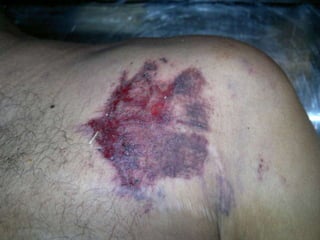
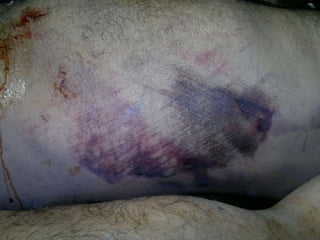
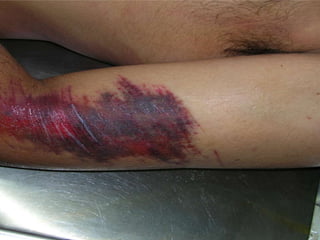
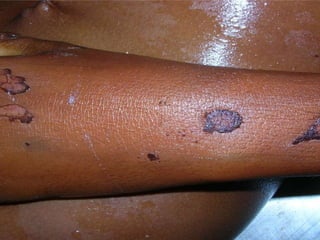
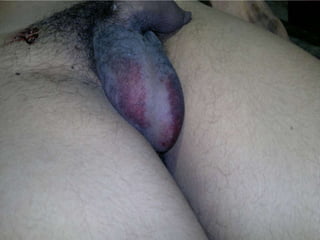
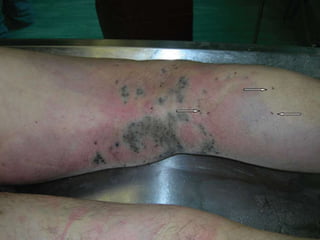
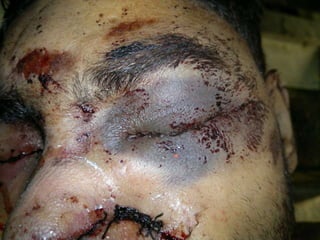
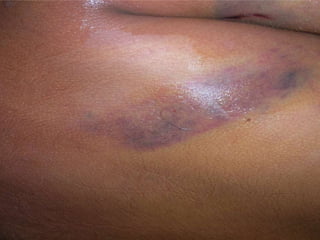
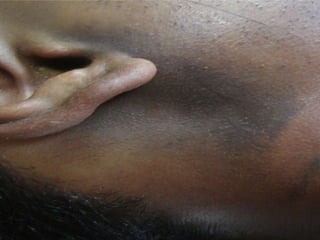
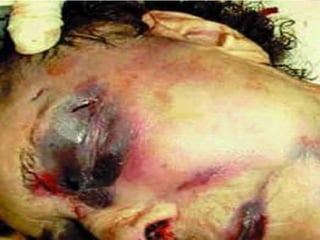
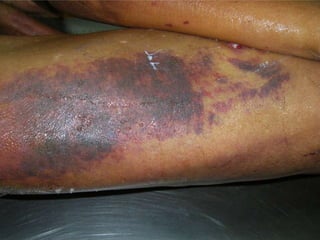
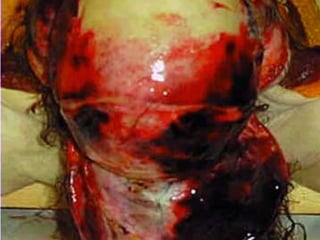
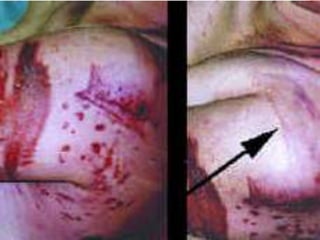
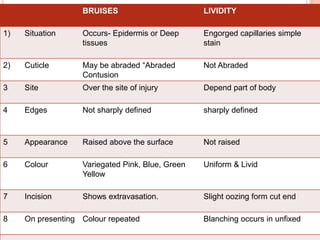
Contusion/bruiseAre characterized by infiltration of extravassated blood in the subcutaneous and/ or sub epithelial tissues resulting from the rupture of small blood vessels due to application of blunt force.
Factors affecting bruise formationAMOUNT OF FORCE:-    Greater the force of violence, the more extensive will be the bruises.CHILDERN- Bruise more rapidly than adult. OLD PERSON – Easily owing to loss of flesh & CVS changes CHRONIC ALCOHOLICS – Easily bruises – Cutaneous vasodilatation. BOXERS & ATHLETES – Less bruising due to good muscle tone. WOMEN – Bruises more easily- Delicacy of skin. Greater amount of subcutaneous fat. STRONG HEALTHY PERSON –Stand considerable force without bruising.
OBESE FLABBY- bruise easily from lesser amount of violence. DISEASE EXAGGERATED BRUISING – Scurvy, vitamin- k & Prothrombin deficiency, Haemophilia, Leukemia & Atherosclerosis VASCULARITY OF THE AREA: Amount of blood extravasations vascularity – varies from area to area. So more over face, genitalia, scrotum RESILIENCY OF THE AREA    Such as abdominal wall, buttocks.
Migratory/ectopic bruisesThese deep bruises may not only take a long time to become visible but may not appear against the actual point of impact. Blood escaping from the damaged blood vessels tracks along the fascial OR muscular planes & following the path of least resistance, may make its appearance hours or even days after the impact, at a place where the tissue layers become superficial.
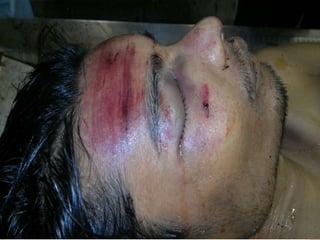
Another Factor : Haemolysis – When freed the haemoglobin is able to stain the tissues. Well known P.M phenomenon of bruising becoming more prominent after Death : Examples :-1.Black eye – Spectacle haematoma.2.Fracture pelvis – Bruise thigh .3.Kick on muscle calf- Bruise over ankle
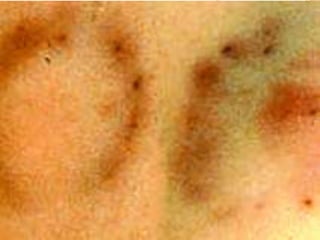
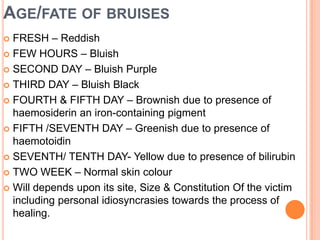
Age/fate of bruisesFRESH – Reddish FEW HOURS – Bluish SECOND DAY – Bluish Purple THIRD DAY – Bluish Black FOURTH & FIFTH DAY – Brownish due to presence of haemosiderin an iron-containing pigment FIFTH /SEVENTH DAY – Greenish due to presence of haemotoidinSEVENTH/ TENTH DAY- Yellow due to presence of bilirubinTWO WEEK – Normal skin colour Will depends upon its site, Size & Constitution Of the victim including personal idiosyncrasies towards the process of healing.
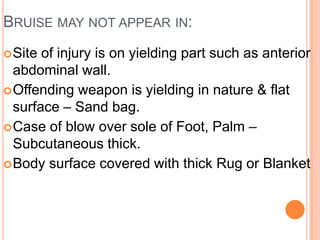
Bruise may not appear in:Site of injury is on yielding part such as anterior abdominal wall. Offending weapon is yielding in nature & flat surface – Sand bag.Case of blow over sole of Foot, Palm – Subcutaneous thick.Body surface covered with thick Rug or Blanket
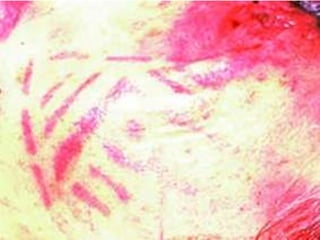
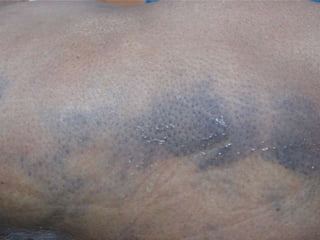
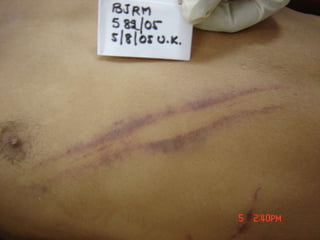
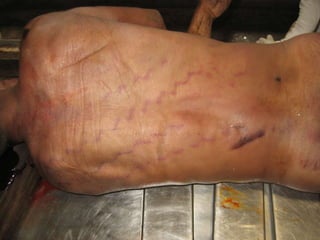
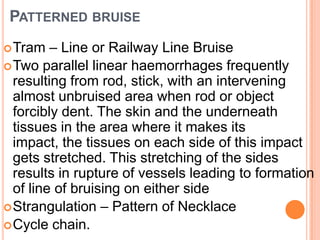
Patterned bruiseTram – Line or Railway Line Bruise Two parallel linear haemorrhages frequently resulting from rod, stick, with an intervening almost unbruised area when rod or object forcibly dent. The skin and the underneath tissues in the area where it makes its impact, the tissues on each side of this impact gets stretched. This stretching of the sides results in rupture of vessels leading to formation of line of bruising on either side Strangulation – Pattern of Necklace Cycle chain.
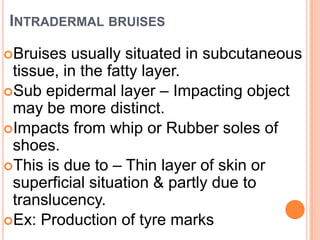
Intradermal bruisesBruises usually situated in subcutaneous tissue, in the fatty layer. Sub epidermal layer – Impacting object may be more distinct. Impacts from whip or Rubber soles of shoes.This is due to – Thin layer of skin or superficial situation & partly due to translucency. Ex: Production of tyre marks
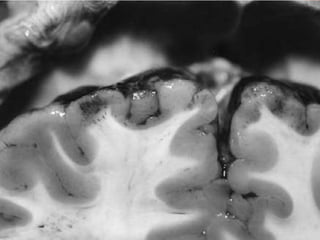
mli1. Evidence of application of blunt force. Accidental Homicidal Suicidal – Unusual ARTIFICIAL BRUISES 2. Though in itself a trivial injury, Lies in the site & the organs involved. Contusion of vital organs heart and brain.Caused marked derangement of functions & even death
3. Volume of blood- Circulating Diminished – Due to Extravasation4. Patterned Bruising Nature of agent used.5. Healing – Determination of age.6. Bruising- Scalp- It is better. 7. Bruising over the particular part of the body-Indicate some peculiar offence Ex : On the Neck Inner Side of Thigh – FemalesIndicate Sexual Assault    small bruises The so called “six Penny Bruises”8.Character & manner of injury may be known from its distribution.
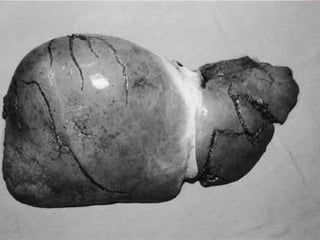
complications1. Contusion contain 20- 30 ml of blood or even more. Multiple contusion can cause death from shock & internal haemorrhages.2. Gangrene & death of tissue.3.Good site for Bacterial growth.
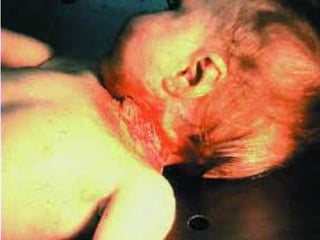
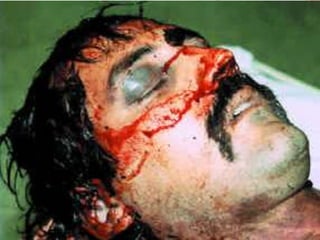
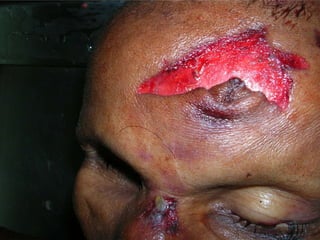
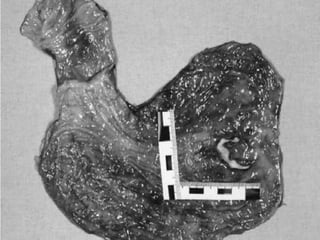
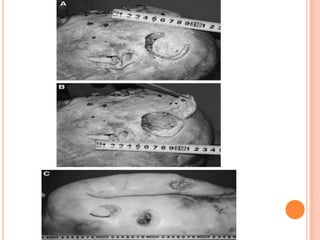
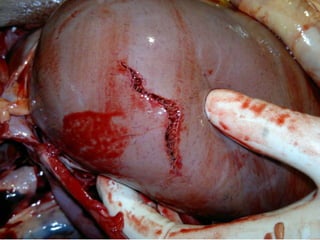
LACERATED WOUND A Laceration is a rupture or tear or split in the skin, mucus membrane, muscle or any internal organ, involving depth more than the covering epithelium of the skin or that of an organ & are produced by application of blunt force.Laceration may be produced by any one or more of the following means.Passive agent like groundVehiclesBlunt weapons.
typesCONTUSED LACERTION OR BRUISED TEAR :   If the impact produces bleeding into the surrounding tissues termed asABRADED LACERATION OR SCRAPED TEAR :Margins of the laceration are denude of the epitheliumMany factors influences the formation & appearances of laceration such as the Configuration of the object delivering the forceType of the tissueAreas of the body involvedVelocity of the offending weapon
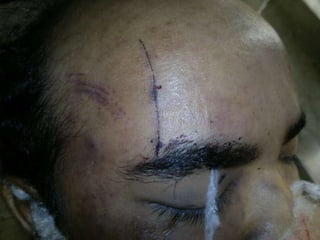
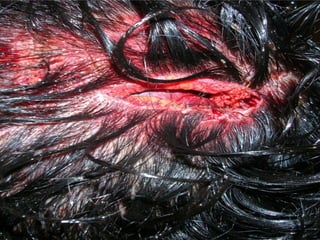
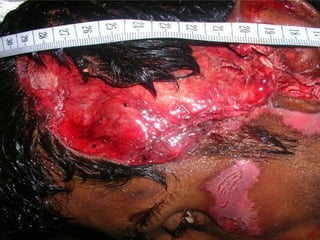
INCISED LOOKING LACERATION WOUNDWhen skin is closely applied to the bone & the subcutaneous tissue is scanty, blunt force may produce a wound which by linear splitting of the tissue resembles an incised wound.The sites for production of such wound are ScalpFace EyebrowIliac crestshin
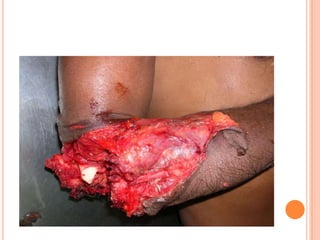
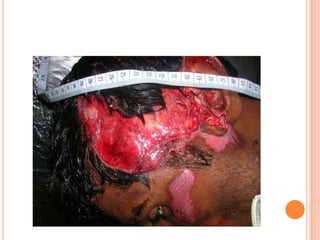
 AVULSED LACERATIONS    Grinding compression by heavy weight such as a wheel of a heavy vehicle, SPLIT LACERATIONSplit laceration occur when the soft tissues are ‘sandwiched’ between a hard underlying deeper structure & the agent applying the force. Example blunt Injury to the scalp.
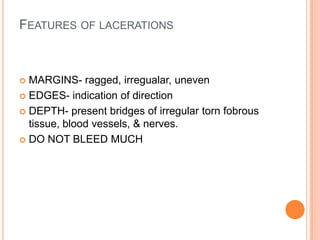
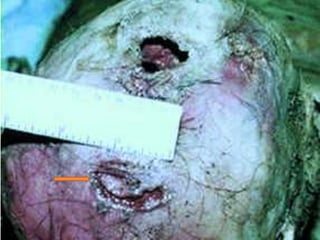
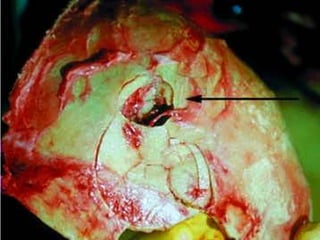
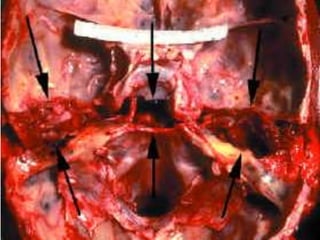
Features of lacerationsMARGINS- ragged, irregualar, unevenEDGES- indication of directionDEPTH- present bridges of irregular torn fobrous tissue, blood vessels, & nerves.DO NOT BLEED MUCH
Self Inflicted/Fabricated woundsSelf inflicted are caused by a person on his own body. Fabricated/Fictitious/Forged-caused by the person or accomplice-To charge their enemy-Simple to Grievous for gain-To pretend self defense to escape charge of assault-Prisoners, military recruits, rape charges
ANTEMORTEM / POSTMORTEM LACERTIONSEversion or gaping of the margins is usually seen in when it has been inflicted during the life
Injury Sec 44 IPCHurt Sec 319 IPCSimple & GrievousSec 320 IPCAssault Sec 351 IPCBatteryHomicide; Lawful, UnlawfulCulpable Homicide sec 299IPCMurder Sec300 IPCPunishment for Murder Sec 302 IPCAttempt to murder 307 IPCSec321,322,323,324, 325,326,327,328304A IPC Rash and negligent actMedico Legal Aspects of Injuries
Injury(S 44 IPC); any Harm whatever illegally caused to any person in body, mind, reputation or property.Injury is an act contrary to lawThe term Illegal is applicable to everything which is an offence or, prohibited by law. It furnishes ground for legal action
HURTHurt (S 319 IPC) Who ever causes bodily pain, disease or infirmity to any person is said to cause hurtAct neither intended nor likely to cause death is hurt, even though death is caused. (Kicking, causing death in presence of splenomegaly)Many hurts can also be classed under assault. Hurt can also be caused by acts that are not assaults (lacing tea with poison)
Assault(S.351 IPC): Whoever makes any gesture, or any preparation intending or knowing it to be likely that such gesture or preparation will cause any person present to apprehend that he who makes that gesture or preparation is about to use criminal force to that person, is said to commit an assault.
•Battery: It is the assault brought to execution. It is the actual injury to a person•Simple Hurt: Which is neither extensive nor serious and heals without leaving a permanent scar.
Aggravated forms of HurtBy dangerous weaponsTo extort property or to constrain to do illegal actBy means of poison to commit offenceTo extort confessionTo deter public servant from his duty
Grievous Hurt, 320 IPC1. Emasculation; Loss of Masculine Power.2. Permanent Privation of sight of either eye; (Like corneal scarring, retinal detachment)3. Permanent Privation of hearing of either ear. (Permanent loss of hearing. TM rupture)4. Privation of any member or any joint; (Member is any organ or tissue capable of independent function)5. Destruction or permanent impairing of power of any member or joint
6. Permanent disfiguration of Head or Face7. Fracture Dislocation of Bone or tooth8. Any Hurt which endangers life                             or which causes the sufferer to be during the space of 20 days in severe bodily pain,                            or  unable to follow his ordinary pursuits. Any dangerous hurt is grievous. An act neither intended nor likely to cause death is hurt even though death is caused.
Homicide, Culpable HomicideCausing death by Human AgencyLawful; Excusable and JustifiableCH (s 299 IPC): Who ever causes death by doing an act with the intention of causing death, or with the intention of causing such bodily injury as is likely to cause death, or with the knowledge that he is likely by such an act to cause death, commits CH
Explanation 1: A person who causes death of another labouring under disorder, disease, infirmity which accelerates his death, is deemed to have caused his death.
•Expl 2; Where death is caused by bodily injury the person who causes such bodily injury shall be deemed to have caused the death although death would have been prevented by skillful treatment.•Expl 3; Causing the death of a child in the mothers womb is not homicide. It may amount to homicide to cause the death of a living child if any part of the child has been brought forth, though the child may not have breathed or completely born.
Unlawful Homicide•Culpable Homicide not amounting to Murder (S. 299 IPC)•Murder (S. 300 IPC)•Rash and Negligent Homicide(304 A)•Dowry Death (304 B)•Suicide (305, 306)
Culpable Homicide is Murder..•CH is murder if the act by which the death is caused with the intention of causing death, •or it is done with the intention of causing such bodily injury as the offender knows to be likely to cause death of the person•or it is done with the intension of causing bodily injury inflicted is sufficient in the ordinary course of nature to cause death.•That the person committing the act knows that it is so imminently dangerous that it must in all probabilities cause death, or such bodily injury as is likely to cause death, commits CH amounting to Murder
CH is not Murder..•Exception1: The offender while deprived of self control by grave sudden provocation, causes the death of another person who gave the provocation, more any other by mistake /accident provided the provocation is not voluntarily sought.Ex•2. If the offender exercising good faith in right of private defense exceeds the powers given to him and causes the death of the person without premeditation.Ex 3: If the offender being public servant in advancing of public justice exceeds the powers given to him and causes death without ill will towards the person whose death is caused.Ex 4: If committed without premeditation in fight, in heat of passion without taking undue advantage and acting in a cruel mannerEx 5: If person whose death is caused being above the age of 18 years suffers death or takes the risk of death with his own consent
Punishment for Murder•Sec 302 IPC: Punishment for Murder. Whoever commits murder shall be punished with death, imprisonment for life or shall also be liable to fine.•304A IPC: Rash and Negligent Act. Whoever causes death of any person by doing rash and negligent act not amounting to homicide will be punished with imprisonment of either description for a term which may extend to 2 yrs or fine or both. (No intention/knowledge to cause death)S 304 B IPC (1), (2)•Dowry Death: (1) Death of a woman caused by burns or bodily injury or occurs otherwise than normal circumstances within seven years of her marriage and it is shown that before her death she was subjected to cruelty or harassment by her husband or relative of her husband in connection with demand for Dowry, shall be deemed to have caused the death.•(2) Whoever commits Dowry death shall be punished with imprisonment of not less than 7 yrs, may extend to life imprisonment.
Sec 321-328 IPC321- Voluntarily causing hurt322- Voluntarily causing greivous hurt323- Punishment for voluntarily causing Hurt (1 year +/- Rs 1000/-)324- Voluntarily causing hurt by dangerous weapons or means (shooting, stabbing cutting or any weapon of offence or means i.e. fire, heated substance, poison, corrosive or explosive)325- Punishment for voluntarily causing GH (7 years +/- fine)326- Punishment for voluntarily causing GH by dangerous weapon or means (10 year +/- fine)327- Voluntarily causing hurt to extort property or constrain to an illegal act (10 years)328- Causing hurt by means of poison with intent to commit an offence (10 years)
The following points are to be  discussed:Type of injuries – Simple or grievousAntemortem or PostmortemAge of injuriesManner of injuries – accidental, suicidal or homicidalType of weapon
Injury report : Name , Age, Sex, Address.DatePlace of examinationName of the police , number, name of the police stationBrief historyExamination proper
Examination proper:Number SiteSizeType – Simple or Grievousopinion
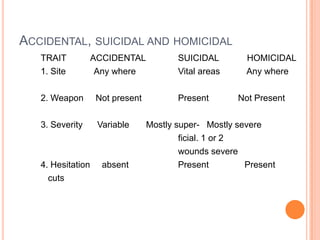
Accidental, suicidal and homicidalTRAIT          ACCIDENTAL	     SUICIDAL	       HOMICIDAL1. Site 	          Any where	     Vital areas	       Any where2. Weapon     Not present	     Present            Not Present3. Severity      Variable	     Mostly super-   Mostly severeficial. 1 or 2 				     wounds severe 4. Hesitation	absent		     Present	      Present    cuts
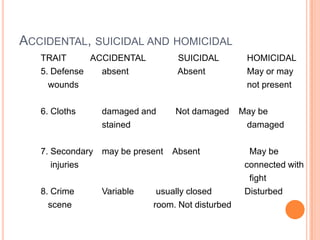
Accidental, suicidal and homicidalTRAIT          ACCIDENTAL	     SUICIDAL	       HOMICIDAL5. Defense 	absent		     Absent	       May or may          wounds					       not present6. Cloths 	damaged and	    Not damaged    May be		stained				       damaged7. Secondary	may be present    Absent	        May be     injuries					      connected with 						        fight8. Crime	Variable         usually closed	      Disturbed   scene		        room. Not disturbed
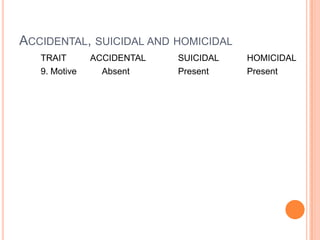
Accidental, suicidal and homicidalTRAIT          ACCIDENTAL	     SUICIDAL	       HOMICIDAL9. Motive	Absent		     Present	       Present
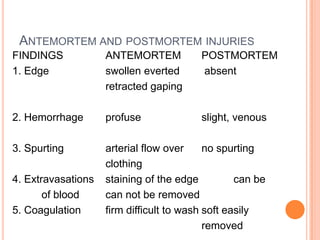
Antemortem and postmortem injuries FINDINGS		ANTEMORTEM	POSTMORTEM1. Edge 		swollen everted    	 absent			retracted gaping2. Hemorrhage	profuse		slight, venous3. Spurting		arterial flow over	no spurting			clothing	4. Extravasations 	staining of the edge 	can be	of blood	can not be removed5. Coagulation	firm difficult to wash	soft easily 						removed
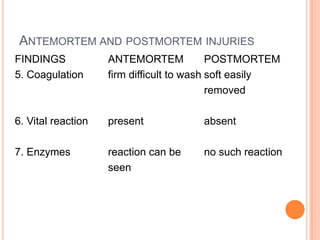
Antemortem and postmortem injuries FINDINGS		ANTEMORTEM	POSTMORTEM5. Coagulation	firm difficult to wash	soft easily 						removed6. Vital reaction	present		absent7. Enzymes		reaction can be 	no such reaction			seen
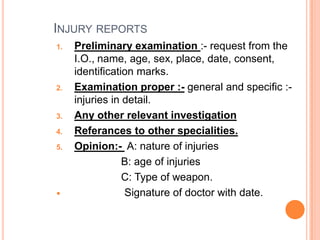
Injury reports Preliminary examination :- request from the I.O., name, age, sex, place, date, consent, identification marks.Examination proper :- general and specific :- injuries in detail. Any other relevant investigationReferances to other specialities.Opinion:-  A: nature of injuries                                    B: age of injuries                      C: Type of weapon.                  Signature of doctor with date.Causes of death due in injury
Immediate :: destruction of vital organs.Causes of death due to injury:
Early causes :Shock : Profuse hemorrhage
Severe trauma
BurnsPrimary OR Neurogenic shockSecondary OR hematogenic shockHypovolemic OR Oligaemic shockCauses of death due to injury:
Early causes :Thromboembolism: 1. External embolism: 	- Foreign Body (bullet from firearm)- Foreign Material like air, solid particle2. Internal embolism:- Fat Embolism- Bone Marrow Embolism- Amniotic Fluid EmbolsmCauses of death due to injury:
Early causes :Thromboembolism: 3. Pulmonary Air embolism:	- Thrombi formed in the walls of pelvic 	  leg veins.	- Most Common sites of thrombosis 	  	  are deep femoral vein, posterior tibial	  vein and popliteal vein. Causes of death due to injury:
Early causes :Thromboembolism: 3. Pulmonary Air embolism:	-Dating of Pulmonary embolus:	First day: Purplish strands of fibrin	four days: Thicker strands and sheets			of fibrin	Twenty Fifth day: Fibrin begins to be 			absorbed. Causes of death due to injury:
Early causes :Haemorrhage : Externally through lacerated or incised wound.
Internal bleeding due to ruptures of vessels and bleeding into body cavities – like pericardium, peritoneum, pleura and cranium.  Causes of death due to injury:
Late causes: Infection : Purulent infection form gram positive cocci, gram negative bacilli, anaerobes like Clostridium Perfringens. tetanus and Anthrax are more dangerous. Medicolegal issue:  failure to give or delay in giving antibiotics which have both civil and criminal consequences. Causes of death due to injury:
Late causes: Adult respiratory distress syndrome: Following severe lung injury
aspiration of gastric contents
Infection
Toxins
Systemic shock
Irritant gases - Lung epithelium suffer diffuse alveolar damage. Causes of death due to injury:
Late causes: Respirator lung : Similar to ARDS.Develop when a patient dies after an appreciable period of mechanical ventilationUsually after many days or weeks. Causes of death due to injury:
Late causes: Renal failure: Consequent to extensive muscle damageBurnsPoison such as Mercuric salts, Carbon Tetrachloride. In burn and muscle damage, tubules may be blocked with brown casts of myoglobin. Causes of death due to injury:
Late causes: Disseminated Intravascular Coagulation:Follows whole range of traumatic, infective and other acute events. Abnormal activation of coagulation process.Brain and placenta are particularly potent. Causes of death due to injury:
Late causes: Subendocardial Haemorrhage: Specially studied by Sheehan in 1930. Found in abortion, acute haemorrhage associated with pregnancy, and severe trauma. Well marked haemorrhages under endocardium of left ventricle. Flame shaped, confluent, non petecheal.  Causes of death due to injury:
Trauma and Disease:This assumes importance mainly for two reasons: 1. CompensationUnder the Workman's Compensation Act, provision is made for disabilities suffered as a result of occupationally acquired diseases or industrial accidents while at work. Trauma and Disease:2. Insurance :A person who has insured himself for accident only.
Some include a double indemnity policy; the sum payable is doubled if death is due to accident. Trauma and Disease:Most important aspect is evaluation of whether the disabilities claimed and observed are consistent with the injury received.Malingering means a deliberate attempt on the part of the patient to deceive the doctor.
Trauma and Disease:Trauma and InfectionWounds associated with extensive crushing of tissue are more likely to be infected.
Whether the infection occurred in coincidence with the original trauma (primary infection)
Whether the infection occurred subsequently to original trauma as a result of accidental implant of bacteria (Secondary)Trauma and Disease:Trauma and Heart DiseaseTwo basic situations are most likely to find access to the Courts of Law: Direct injury to heart.Indirect heart injury : 	- It is more difficult to prove.	   -More difficult to assess is heart failure or any 	other cardiac disorder occurring in an 	individual with antecedent history of heart 	disease as an indirect effect of trauma.
Trauma and Disease:Occupational trauma: occupational trauma can precipitate death by giving rise to circulatory overloading or by aggravating previously existing disease such as coronary atherosclerosis, or aortic aneurysm. Trauma and Disease:Trauma and nervous system:direct cause and effect relationship between: (i) Head injury and meningitis (ii) Head injury and epilepsy (iii) Head injury and psychosis (iv) Head injury including occupational stress and rupture of a congenital cerebral aneurysm.
Trauma and Disease:Trauma and pulmonary embolism:almost always due to impaction of thrombus.
A well known complication traumaTrauma and Disease:Trauma and Alimentary system:Whenever a history is obtained of blow to the abdomen, the patient should be kept under observation until all likelihood of a ruptured abdominal viscous can be dismissed.

Blunt force injuries

  • 1.
    MECHANICAL INJURIES(BLUNT FORCE)DR.ANIL KUMAR MITTAL DR.MONISHA PRADHAN DR.ANAND PAWAR
  • 2.
    INJURY Definition Under section 44 of the Indian Penal code, Denotes any harm whatever illegally caused to any person, in body mind, reputation or property.
  • 3.
  • 4.
    A.DEPENDING UPON CAUSATIVEFACTOR.I.Mechanicalor Physical injuries. (a)Those caused by blunt force. . 1) Abrasion 2) Lacerations 3) Contusions ( Bruises)
  • 5.
    A.DEPENDING UPON CAUSATIVEFACTOR.I.Mechanical or Physical injuries. (b) Those caused by sharp force. (1) Incisions (2) Stab(3)Punctures incised punctures or lacerated punctures
  • 6.
    I . Mechanicalor Physical injuries. (c) Caused by Fire Arms.Rifled FirearmsSmooth Bore Firearms.country made Firearms.A.DEPENDING UPON CAUSATIVE FACTOR.
  • 7.
    A.DEPENDING UPON CAUSATIVEFACTOR.I . Thermal injuries. Due to heat: Generalized effects of heat. i.e.A)Heat Hyperpyrexia. ( heat stroke)B)Heat Exhaustion ( Heat collapse)C)Heat Cramps ( Miners cramps
  • 8.
    A.DEPENDING UPON CAUSATIVEFACTOR. I . Thermal injuries. Due to heat: Localized effects of heat. i.e. A)Burns ( Due to application of dry heat) B)Scalds ( Due to application of moist heat)
  • 9.
    A.DEPENDING UPON CAUSATIVEFACTOR.I . Thermal injuries. (b) Due to Cold Generalized effects of cold i.e. Hypothermia Localized effects of cold. i.e.Frost Bite (due to dry cold)Trench TrenchFoot ( Due to wet cold)
  • 10.
    A.DEPENDING UPON CAUSATIVEFACTOR.CAUSED BY CHEMICAL AGENTS. Corrosions ( Due to strong Acids or Alkalies) Irritation ( Due to weak acids, alkalies, vegetables or animal extracts
  • 11.
    A. DEPENDING UPONCAUSATIVE FACTOR.MISCELLANEOUS A)LightingB)ElectricityC)Radiation ( X-ray, U-V rays, radioactive)D)Blast Injuries
  • 12.
    Simple Grievous DangerousB)DEPENDING UPON GRAVITY
  • 13.
    C) DEPENDING UPONTIME OF INFLECTIONAntemortemPostmortemPerimortem
  • 14.
    D.DEPENDING UPON THEMANNER OF INFLICTIONSuicidal AccidentalHomicidal Defence Wounds Self- Inflicted Fabricated / Fictitious Injuries
  • 15.
    ABRASIONSDEFINITION : Abrasionsare the injuries involving superficial layers of the skin the epidermis or mucus membrane, due to impact against some hard, blunt, & rough object/ weapon.
  • 16.
    ABRASION- 1.Scratches or Linear Abrasions Nails, Thorn, Needle 2. Grazes ( Sliding/ Tangential Brush Abrasions)3. Pressure Abrasions / Crushing Abrasions / Imprint AbrasionsEg : Hanging, Manual Strangulation, RTA- Radiator grill, Tyre tread mark .4.Patterned Abrasions Eg: RTA- Rubber Tread, Cycle Chain, Necklace 5. Atypical Abrasions
  • 37.
    AGE (FATE) OFAN ABRASIONS Usually heals with out any formation of scarFRESH: Reddish- Due to oozing serum & little blood. Dermis : Congested & painful.12-24 Hours :- Exudation dries up to form reddish scab. Comprising of – Dried blood, lymph & injured epithelial cells.2-3 Days :- SCAB – Reddish Brown.4-5 Days :- SCAB – Dark Brown 5-7 Days:- SCAB- Brownish Black & Starts falling from the margin.7-10 Days:- SCAB– Shrinks & falls off leaving depigmented area underneath.
  • 38.
    MEDICOLEGAL IMPORTANCE:-Only externalvisible signs of a severe or even fatal internal injury. 1.Point of impact of the blunt force. 2.Pattern- Nature of force.3.Site & Distributions over the body. 4. Direction of application 5. Presence of material like mud, grit, coal- dust, cement etc. denotes site.6. Various stages of healing.7. AM / PM 8. Fabricated
  • 41.
    Contusion/bruiseAre characterized byinfiltration of extravassated blood in the subcutaneous and/ or sub epithelial tissues resulting from the rupture of small blood vessels due to application of blunt force.
  • 42.
    Factors affecting bruiseformationAMOUNT OF FORCE:- Greater the force of violence, the more extensive will be the bruises.CHILDERN- Bruise more rapidly than adult. OLD PERSON – Easily owing to loss of flesh & CVS changes CHRONIC ALCOHOLICS – Easily bruises – Cutaneous vasodilatation. BOXERS & ATHLETES – Less bruising due to good muscle tone. WOMEN – Bruises more easily- Delicacy of skin. Greater amount of subcutaneous fat. STRONG HEALTHY PERSON –Stand considerable force without bruising.
  • 43.
    OBESE FLABBY- bruiseeasily from lesser amount of violence. DISEASE EXAGGERATED BRUISING – Scurvy, vitamin- k & Prothrombin deficiency, Haemophilia, Leukemia & Atherosclerosis VASCULARITY OF THE AREA: Amount of blood extravasations vascularity – varies from area to area. So more over face, genitalia, scrotum RESILIENCY OF THE AREA Such as abdominal wall, buttocks.
  • 44.
    Migratory/ectopic bruisesThese deepbruises may not only take a long time to become visible but may not appear against the actual point of impact. Blood escaping from the damaged blood vessels tracks along the fascial OR muscular planes & following the path of least resistance, may make its appearance hours or even days after the impact, at a place where the tissue layers become superficial.
  • 45.
    Another Factor :Haemolysis – When freed the haemoglobin is able to stain the tissues. Well known P.M phenomenon of bruising becoming more prominent after Death : Examples :-1.Black eye – Spectacle haematoma.2.Fracture pelvis – Bruise thigh .3.Kick on muscle calf- Bruise over ankle
  • 65.
    Age/fate of bruisesFRESH– Reddish FEW HOURS – Bluish SECOND DAY – Bluish Purple THIRD DAY – Bluish Black FOURTH & FIFTH DAY – Brownish due to presence of haemosiderin an iron-containing pigment FIFTH /SEVENTH DAY – Greenish due to presence of haemotoidinSEVENTH/ TENTH DAY- Yellow due to presence of bilirubinTWO WEEK – Normal skin colour Will depends upon its site, Size & Constitution Of the victim including personal idiosyncrasies towards the process of healing.
  • 66.
    Bruise may notappear in:Site of injury is on yielding part such as anterior abdominal wall. Offending weapon is yielding in nature & flat surface – Sand bag.Case of blow over sole of Foot, Palm – Subcutaneous thick.Body surface covered with thick Rug or Blanket
  • 67.
    Patterned bruiseTram –Line or Railway Line Bruise Two parallel linear haemorrhages frequently resulting from rod, stick, with an intervening almost unbruised area when rod or object forcibly dent. The skin and the underneath tissues in the area where it makes its impact, the tissues on each side of this impact gets stretched. This stretching of the sides results in rupture of vessels leading to formation of line of bruising on either side Strangulation – Pattern of Necklace Cycle chain.
  • 68.
    Intradermal bruisesBruises usuallysituated in subcutaneous tissue, in the fatty layer. Sub epidermal layer – Impacting object may be more distinct. Impacts from whip or Rubber soles of shoes.This is due to – Thin layer of skin or superficial situation & partly due to translucency. Ex: Production of tyre marks
  • 71.
    mli1. Evidence ofapplication of blunt force. Accidental Homicidal Suicidal – Unusual ARTIFICIAL BRUISES 2. Though in itself a trivial injury, Lies in the site & the organs involved. Contusion of vital organs heart and brain.Caused marked derangement of functions & even death
  • 72.
    3. Volume ofblood- Circulating Diminished – Due to Extravasation4. Patterned Bruising Nature of agent used.5. Healing – Determination of age.6. Bruising- Scalp- It is better. 7. Bruising over the particular part of the body-Indicate some peculiar offence Ex : On the Neck Inner Side of Thigh – FemalesIndicate Sexual Assault small bruises The so called “six Penny Bruises”8.Character & manner of injury may be known from its distribution.
  • 73.
    complications1. Contusion contain20- 30 ml of blood or even more. Multiple contusion can cause death from shock & internal haemorrhages.2. Gangrene & death of tissue.3.Good site for Bacterial growth.
  • 74.
    LACERATED WOUND ALaceration is a rupture or tear or split in the skin, mucus membrane, muscle or any internal organ, involving depth more than the covering epithelium of the skin or that of an organ & are produced by application of blunt force.Laceration may be produced by any one or more of the following means.Passive agent like groundVehiclesBlunt weapons.
  • 75.
    typesCONTUSED LACERTION ORBRUISED TEAR : If the impact produces bleeding into the surrounding tissues termed asABRADED LACERATION OR SCRAPED TEAR :Margins of the laceration are denude of the epitheliumMany factors influences the formation & appearances of laceration such as the Configuration of the object delivering the forceType of the tissueAreas of the body involvedVelocity of the offending weapon
  • 76.
    INCISED LOOKING LACERATIONWOUNDWhen skin is closely applied to the bone & the subcutaneous tissue is scanty, blunt force may produce a wound which by linear splitting of the tissue resembles an incised wound.The sites for production of such wound are ScalpFace EyebrowIliac crestshin
  • 83.
     AVULSED LACERATIONS Grinding compression by heavy weight such as a wheel of a heavy vehicle, SPLIT LACERATIONSplit laceration occur when the soft tissues are ‘sandwiched’ between a hard underlying deeper structure & the agent applying the force. Example blunt Injury to the scalp.
  • 87.
    Features of lacerationsMARGINS-ragged, irregualar, unevenEDGES- indication of directionDEPTH- present bridges of irregular torn fobrous tissue, blood vessels, & nerves.DO NOT BLEED MUCH
  • 95.
    Self Inflicted/Fabricated woundsSelfinflicted are caused by a person on his own body. Fabricated/Fictitious/Forged-caused by the person or accomplice-To charge their enemy-Simple to Grievous for gain-To pretend self defense to escape charge of assault-Prisoners, military recruits, rape charges
  • 96.
    ANTEMORTEM / POSTMORTEMLACERTIONSEversion or gaping of the margins is usually seen in when it has been inflicted during the life
  • 97.
    Injury Sec 44IPCHurt Sec 319 IPCSimple & GrievousSec 320 IPCAssault Sec 351 IPCBatteryHomicide; Lawful, UnlawfulCulpable Homicide sec 299IPCMurder Sec300 IPCPunishment for Murder Sec 302 IPCAttempt to murder 307 IPCSec321,322,323,324, 325,326,327,328304A IPC Rash and negligent actMedico Legal Aspects of Injuries
  • 98.
    Injury(S 44 IPC);any Harm whatever illegally caused to any person in body, mind, reputation or property.Injury is an act contrary to lawThe term Illegal is applicable to everything which is an offence or, prohibited by law. It furnishes ground for legal action
  • 99.
    HURTHurt (S 319IPC) Who ever causes bodily pain, disease or infirmity to any person is said to cause hurtAct neither intended nor likely to cause death is hurt, even though death is caused. (Kicking, causing death in presence of splenomegaly)Many hurts can also be classed under assault. Hurt can also be caused by acts that are not assaults (lacing tea with poison)
  • 100.
    Assault(S.351 IPC): Whoevermakes any gesture, or any preparation intending or knowing it to be likely that such gesture or preparation will cause any person present to apprehend that he who makes that gesture or preparation is about to use criminal force to that person, is said to commit an assault.
  • 101.
    •Battery: It isthe assault brought to execution. It is the actual injury to a person•Simple Hurt: Which is neither extensive nor serious and heals without leaving a permanent scar.
  • 102.
    Aggravated forms ofHurtBy dangerous weaponsTo extort property or to constrain to do illegal actBy means of poison to commit offenceTo extort confessionTo deter public servant from his duty
  • 103.
    Grievous Hurt, 320IPC1. Emasculation; Loss of Masculine Power.2. Permanent Privation of sight of either eye; (Like corneal scarring, retinal detachment)3. Permanent Privation of hearing of either ear. (Permanent loss of hearing. TM rupture)4. Privation of any member or any joint; (Member is any organ or tissue capable of independent function)5. Destruction or permanent impairing of power of any member or joint
  • 104.
    6. Permanent disfigurationof Head or Face7. Fracture Dislocation of Bone or tooth8. Any Hurt which endangers life or which causes the sufferer to be during the space of 20 days in severe bodily pain, or unable to follow his ordinary pursuits. Any dangerous hurt is grievous. An act neither intended nor likely to cause death is hurt even though death is caused.
  • 105.
    Homicide, Culpable HomicideCausingdeath by Human AgencyLawful; Excusable and JustifiableCH (s 299 IPC): Who ever causes death by doing an act with the intention of causing death, or with the intention of causing such bodily injury as is likely to cause death, or with the knowledge that he is likely by such an act to cause death, commits CH
  • 106.
    Explanation 1: Aperson who causes death of another labouring under disorder, disease, infirmity which accelerates his death, is deemed to have caused his death.
  • 107.
    •Expl 2; Wheredeath is caused by bodily injury the person who causes such bodily injury shall be deemed to have caused the death although death would have been prevented by skillful treatment.•Expl 3; Causing the death of a child in the mothers womb is not homicide. It may amount to homicide to cause the death of a living child if any part of the child has been brought forth, though the child may not have breathed or completely born.
  • 108.
    Unlawful Homicide•Culpable Homicidenot amounting to Murder (S. 299 IPC)•Murder (S. 300 IPC)•Rash and Negligent Homicide(304 A)•Dowry Death (304 B)•Suicide (305, 306)
  • 109.
    Culpable Homicide isMurder..•CH is murder if the act by which the death is caused with the intention of causing death, •or it is done with the intention of causing such bodily injury as the offender knows to be likely to cause death of the person•or it is done with the intension of causing bodily injury inflicted is sufficient in the ordinary course of nature to cause death.•That the person committing the act knows that it is so imminently dangerous that it must in all probabilities cause death, or such bodily injury as is likely to cause death, commits CH amounting to Murder
  • 110.
    CH is notMurder..•Exception1: The offender while deprived of self control by grave sudden provocation, causes the death of another person who gave the provocation, more any other by mistake /accident provided the provocation is not voluntarily sought.Ex•2. If the offender exercising good faith in right of private defense exceeds the powers given to him and causes the death of the person without premeditation.Ex 3: If the offender being public servant in advancing of public justice exceeds the powers given to him and causes death without ill will towards the person whose death is caused.Ex 4: If committed without premeditation in fight, in heat of passion without taking undue advantage and acting in a cruel mannerEx 5: If person whose death is caused being above the age of 18 years suffers death or takes the risk of death with his own consent
  • 111.
    Punishment for Murder•Sec302 IPC: Punishment for Murder. Whoever commits murder shall be punished with death, imprisonment for life or shall also be liable to fine.•304A IPC: Rash and Negligent Act. Whoever causes death of any person by doing rash and negligent act not amounting to homicide will be punished with imprisonment of either description for a term which may extend to 2 yrs or fine or both. (No intention/knowledge to cause death)S 304 B IPC (1), (2)•Dowry Death: (1) Death of a woman caused by burns or bodily injury or occurs otherwise than normal circumstances within seven years of her marriage and it is shown that before her death she was subjected to cruelty or harassment by her husband or relative of her husband in connection with demand for Dowry, shall be deemed to have caused the death.•(2) Whoever commits Dowry death shall be punished with imprisonment of not less than 7 yrs, may extend to life imprisonment.
  • 112.
    Sec 321-328 IPC321-Voluntarily causing hurt322- Voluntarily causing greivous hurt323- Punishment for voluntarily causing Hurt (1 year +/- Rs 1000/-)324- Voluntarily causing hurt by dangerous weapons or means (shooting, stabbing cutting or any weapon of offence or means i.e. fire, heated substance, poison, corrosive or explosive)325- Punishment for voluntarily causing GH (7 years +/- fine)326- Punishment for voluntarily causing GH by dangerous weapon or means (10 year +/- fine)327- Voluntarily causing hurt to extort property or constrain to an illegal act (10 years)328- Causing hurt by means of poison with intent to commit an offence (10 years)
  • 113.
    The following pointsare to be discussed:Type of injuries – Simple or grievousAntemortem or PostmortemAge of injuriesManner of injuries – accidental, suicidal or homicidalType of weapon
  • 114.
    Injury report :Name , Age, Sex, Address.DatePlace of examinationName of the police , number, name of the police stationBrief historyExamination proper
  • 115.
    Examination proper:Number SiteSizeType– Simple or Grievousopinion
  • 116.
    Accidental, suicidal andhomicidalTRAIT ACCIDENTAL SUICIDAL HOMICIDAL1. Site Any where Vital areas Any where2. Weapon Not present Present Not Present3. Severity Variable Mostly super- Mostly severeficial. 1 or 2 wounds severe 4. Hesitation absent Present Present cuts
  • 117.
    Accidental, suicidal andhomicidalTRAIT ACCIDENTAL SUICIDAL HOMICIDAL5. Defense absent Absent May or may wounds not present6. Cloths damaged and Not damaged May be stained damaged7. Secondary may be present Absent May be injuries connected with fight8. Crime Variable usually closed Disturbed scene room. Not disturbed
  • 118.
    Accidental, suicidal andhomicidalTRAIT ACCIDENTAL SUICIDAL HOMICIDAL9. Motive Absent Present Present
  • 119.
    Antemortem and postmorteminjuries FINDINGS ANTEMORTEM POSTMORTEM1. Edge swollen everted absent retracted gaping2. Hemorrhage profuse slight, venous3. Spurting arterial flow over no spurting clothing 4. Extravasations staining of the edge can be of blood can not be removed5. Coagulation firm difficult to wash soft easily removed
  • 120.
    Antemortem and postmorteminjuries FINDINGS ANTEMORTEM POSTMORTEM5. Coagulation firm difficult to wash soft easily removed6. Vital reaction present absent7. Enzymes reaction can be no such reaction seen
  • 121.
    Injury reports Preliminaryexamination :- request from the I.O., name, age, sex, place, date, consent, identification marks.Examination proper :- general and specific :- injuries in detail. Any other relevant investigationReferances to other specialities.Opinion:- A: nature of injuries B: age of injuries C: Type of weapon. Signature of doctor with date.Causes of death due in injury
  • 122.
    Immediate :: destructionof vital organs.Causes of death due to injury:
  • 123.
    Early causes :Shock: Profuse hemorrhage
  • 124.
  • 125.
    BurnsPrimary OR NeurogenicshockSecondary OR hematogenic shockHypovolemic OR Oligaemic shockCauses of death due to injury:
  • 126.
    Early causes :Thromboembolism:1. External embolism: - Foreign Body (bullet from firearm)- Foreign Material like air, solid particle2. Internal embolism:- Fat Embolism- Bone Marrow Embolism- Amniotic Fluid EmbolsmCauses of death due to injury:
  • 127.
    Early causes :Thromboembolism:3. Pulmonary Air embolism: - Thrombi formed in the walls of pelvic leg veins. - Most Common sites of thrombosis are deep femoral vein, posterior tibial vein and popliteal vein. Causes of death due to injury:
  • 128.
    Early causes :Thromboembolism:3. Pulmonary Air embolism: -Dating of Pulmonary embolus: First day: Purplish strands of fibrin four days: Thicker strands and sheets of fibrin Twenty Fifth day: Fibrin begins to be absorbed. Causes of death due to injury:
  • 129.
    Early causes :Haemorrhage: Externally through lacerated or incised wound.
  • 130.
    Internal bleeding dueto ruptures of vessels and bleeding into body cavities – like pericardium, peritoneum, pleura and cranium. Causes of death due to injury:
  • 131.
    Late causes: Infection: Purulent infection form gram positive cocci, gram negative bacilli, anaerobes like Clostridium Perfringens. tetanus and Anthrax are more dangerous. Medicolegal issue: failure to give or delay in giving antibiotics which have both civil and criminal consequences. Causes of death due to injury:
  • 132.
    Late causes: Adultrespiratory distress syndrome: Following severe lung injury
  • 133.
  • 134.
  • 135.
  • 136.
  • 137.
    Irritant gases -Lung epithelium suffer diffuse alveolar damage. Causes of death due to injury:
  • 138.
    Late causes: Respiratorlung : Similar to ARDS.Develop when a patient dies after an appreciable period of mechanical ventilationUsually after many days or weeks. Causes of death due to injury:
  • 139.
    Late causes: Renalfailure: Consequent to extensive muscle damageBurnsPoison such as Mercuric salts, Carbon Tetrachloride. In burn and muscle damage, tubules may be blocked with brown casts of myoglobin. Causes of death due to injury:
  • 140.
    Late causes: DisseminatedIntravascular Coagulation:Follows whole range of traumatic, infective and other acute events. Abnormal activation of coagulation process.Brain and placenta are particularly potent. Causes of death due to injury:
  • 141.
    Late causes: SubendocardialHaemorrhage: Specially studied by Sheehan in 1930. Found in abortion, acute haemorrhage associated with pregnancy, and severe trauma. Well marked haemorrhages under endocardium of left ventricle. Flame shaped, confluent, non petecheal. Causes of death due to injury:
  • 142.
    Trauma and Disease:Thisassumes importance mainly for two reasons: 1. CompensationUnder the Workman's Compensation Act, provision is made for disabilities suffered as a result of occupationally acquired diseases or industrial accidents while at work. Trauma and Disease:2. Insurance :A person who has insured himself for accident only.
  • 143.
    Some include adouble indemnity policy; the sum payable is doubled if death is due to accident. Trauma and Disease:Most important aspect is evaluation of whether the disabilities claimed and observed are consistent with the injury received.Malingering means a deliberate attempt on the part of the patient to deceive the doctor.
  • 144.
    Trauma and Disease:Traumaand InfectionWounds associated with extensive crushing of tissue are more likely to be infected.
  • 145.
    Whether the infectionoccurred in coincidence with the original trauma (primary infection)
  • 146.
    Whether the infectionoccurred subsequently to original trauma as a result of accidental implant of bacteria (Secondary)Trauma and Disease:Trauma and Heart DiseaseTwo basic situations are most likely to find access to the Courts of Law: Direct injury to heart.Indirect heart injury : - It is more difficult to prove. -More difficult to assess is heart failure or any other cardiac disorder occurring in an individual with antecedent history of heart disease as an indirect effect of trauma.
  • 147.
    Trauma and Disease:Occupationaltrauma: occupational trauma can precipitate death by giving rise to circulatory overloading or by aggravating previously existing disease such as coronary atherosclerosis, or aortic aneurysm. Trauma and Disease:Trauma and nervous system:direct cause and effect relationship between: (i) Head injury and meningitis (ii) Head injury and epilepsy (iii) Head injury and psychosis (iv) Head injury including occupational stress and rupture of a congenital cerebral aneurysm.
  • 148.
    Trauma and Disease:Traumaand pulmonary embolism:almost always due to impaction of thrombus.
  • 149.
    A well knowncomplication traumaTrauma and Disease:Trauma and Alimentary system:Whenever a history is obtained of blow to the abdomen, the patient should be kept under observation until all likelihood of a ruptured abdominal viscous can be dismissed.