12/15/16 1
Presented by Tracy O’Rourke
Managing Partner & Executive Advisor
at GoLeanSixSigma.com
How to Create a Strategic Plan for a
Lean Six Sigma Program Office
1
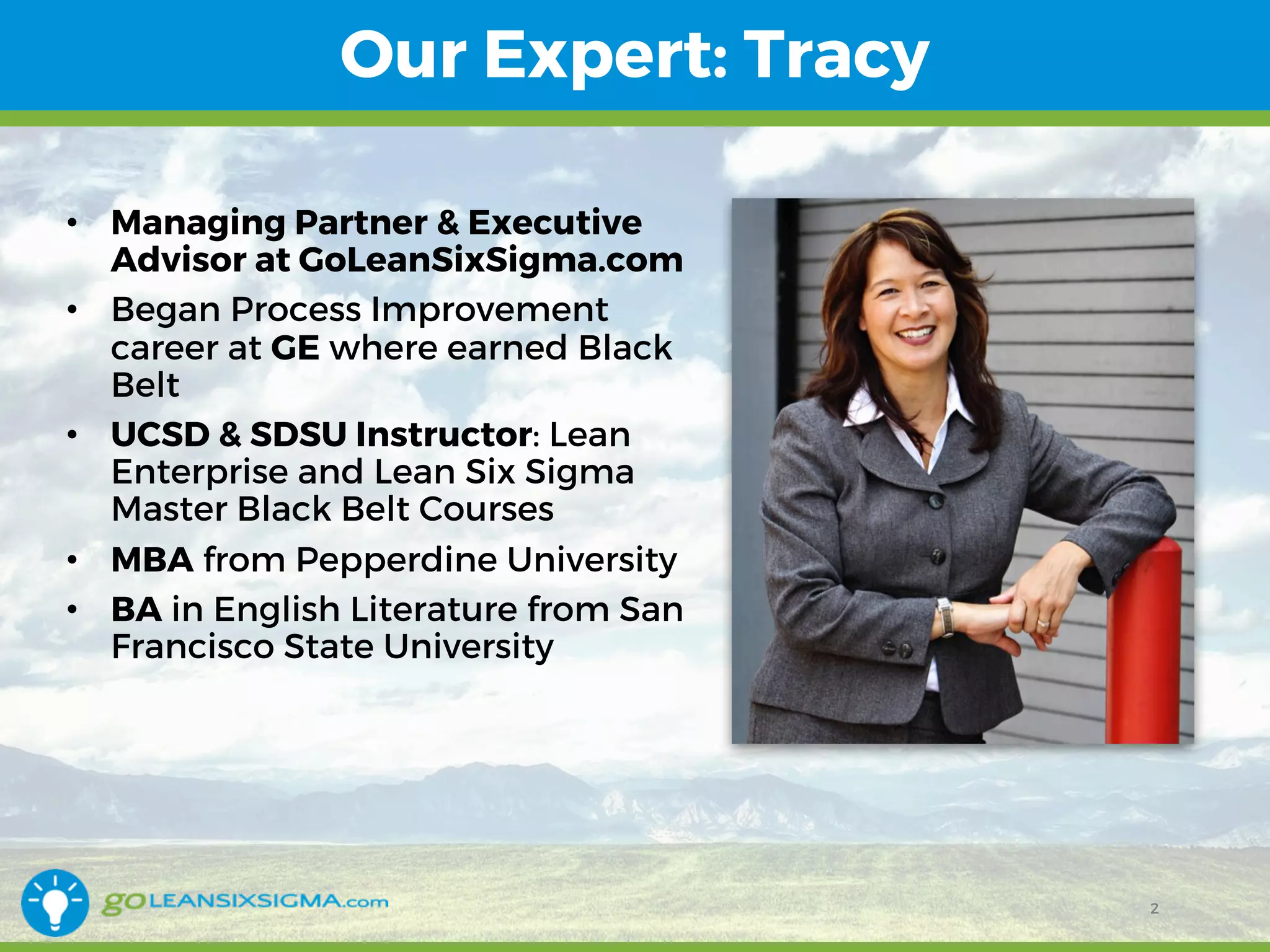
Our Expert: Tracy
• Managing Partner & Executive
Advisor at GoLeanSixSigma.com
• Began Process Improvement
career at GE where earned Black
Belt
• UCSD & SDSU Instructor: Lean
Enterprise and Lean Six Sigma
Master Black Belt Courses
• MBA from Pepperdine University
• BA in English Literature from San
Francisco State University
2
12/15/16 3
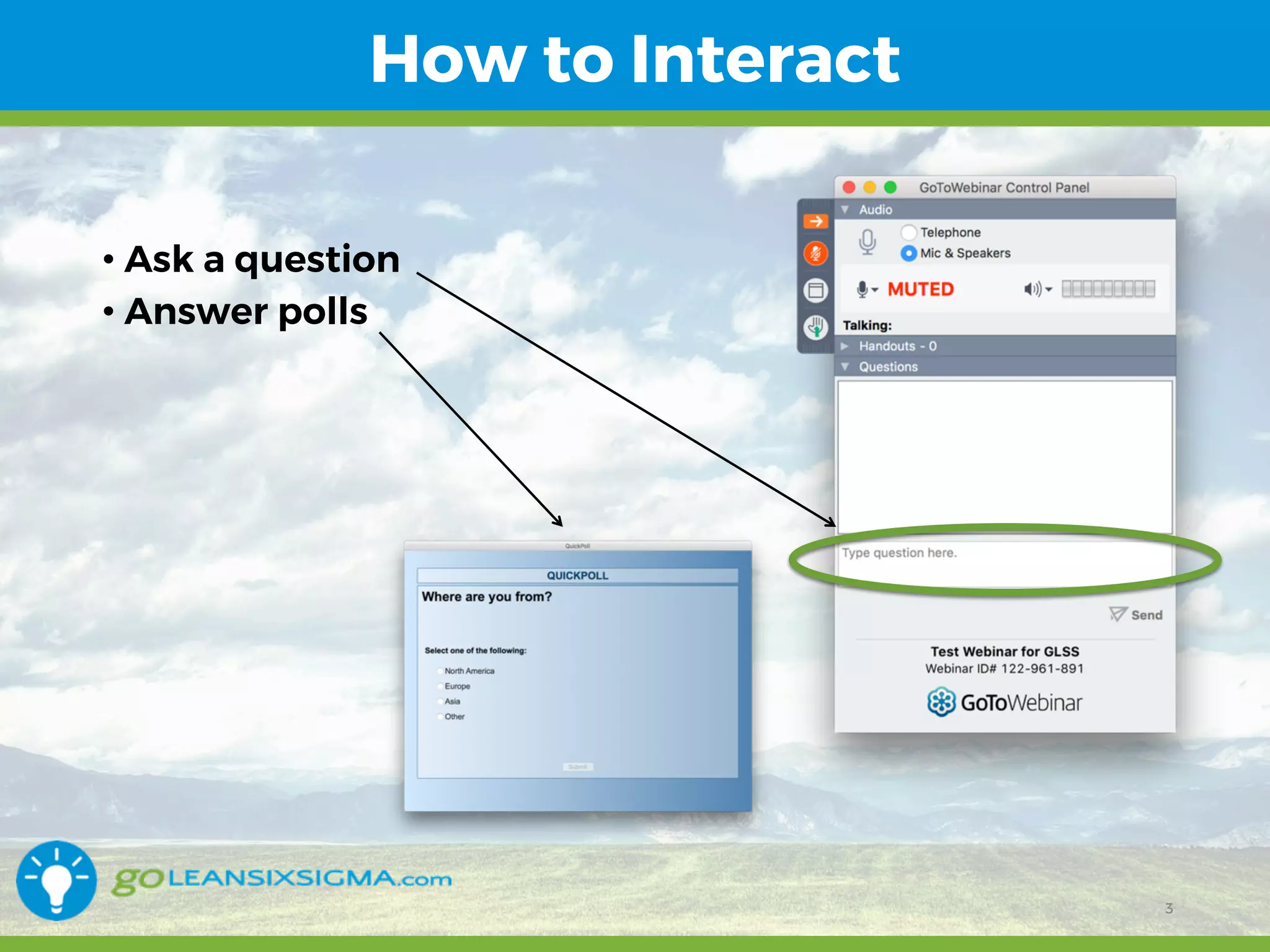
How to Interact
• Ask a question
• Answer polls
3
12/15/16 4
Let’s Interact!
Where are you from?
Share your location in the Questions area in your Control Panel!
4
12/15/16 5
Who Is GoLeanSixSigma.com?
GoLeanSixSigma.com makes
it easy for everyone
everywhere to build their
problem-solving muscles.
We provide the most
practical, easy to understand
and enjoyable Lean and Six
Sigma resources available.
5
Building a Strategic Plan for a Lean Six Sigma Program Office
• Why Strategic Planning is important
• Gathering Inputs
• Creating A Vision, A Mission, Goals & Objectives
• Developing Measures of Success
• Determining Roles, Responsibilities and Resource Allocation
• Building and Executing a Workplan
• Checking Workplan progress
6
Today’s Agenda
• .
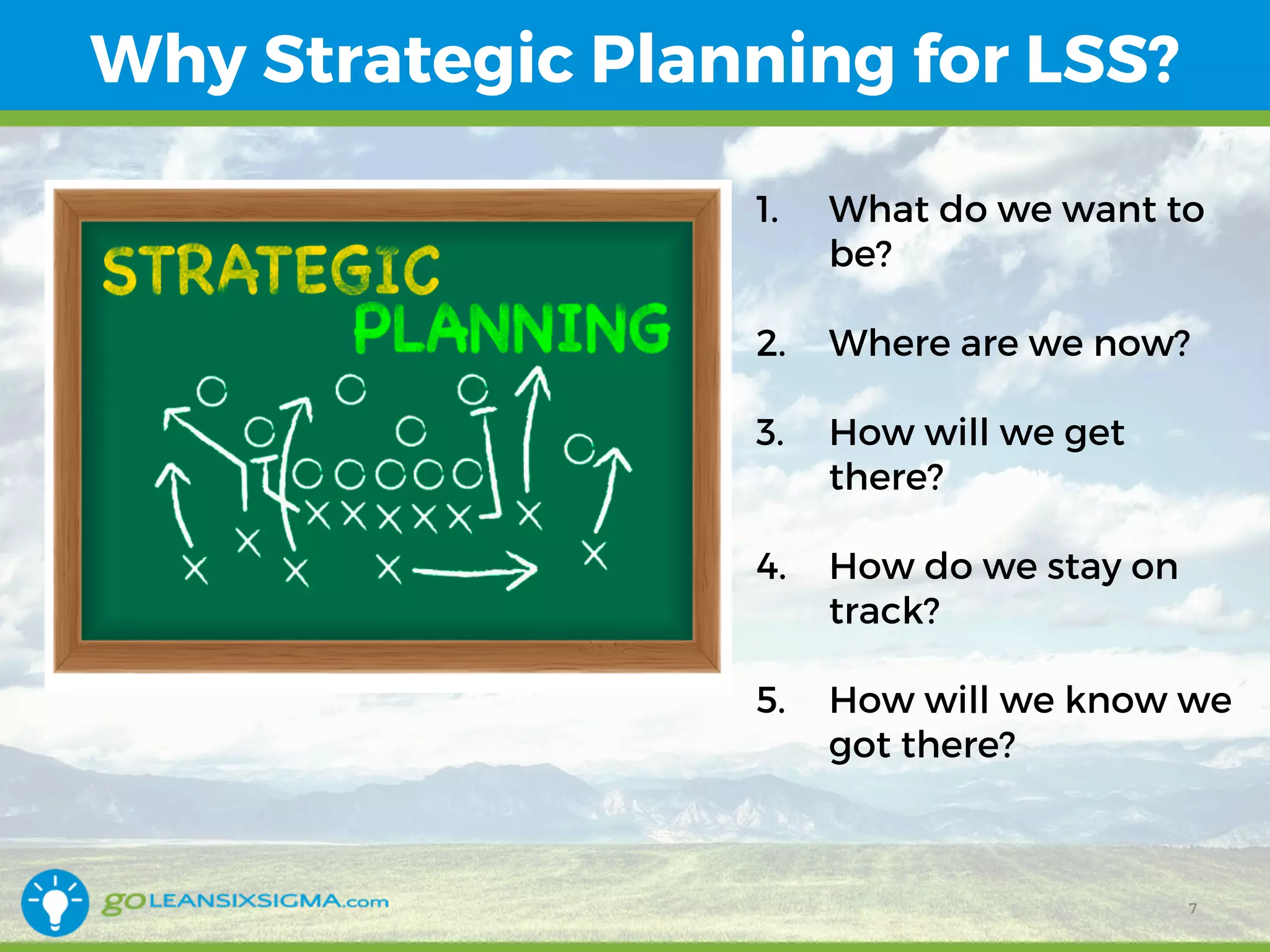
Why Strategic Planning for LSS?
1. What do we want to
be?
2. Where are we now?
3. How will we get
there?
4. How do we stay on
track?
5. How will we know we
got there?
7
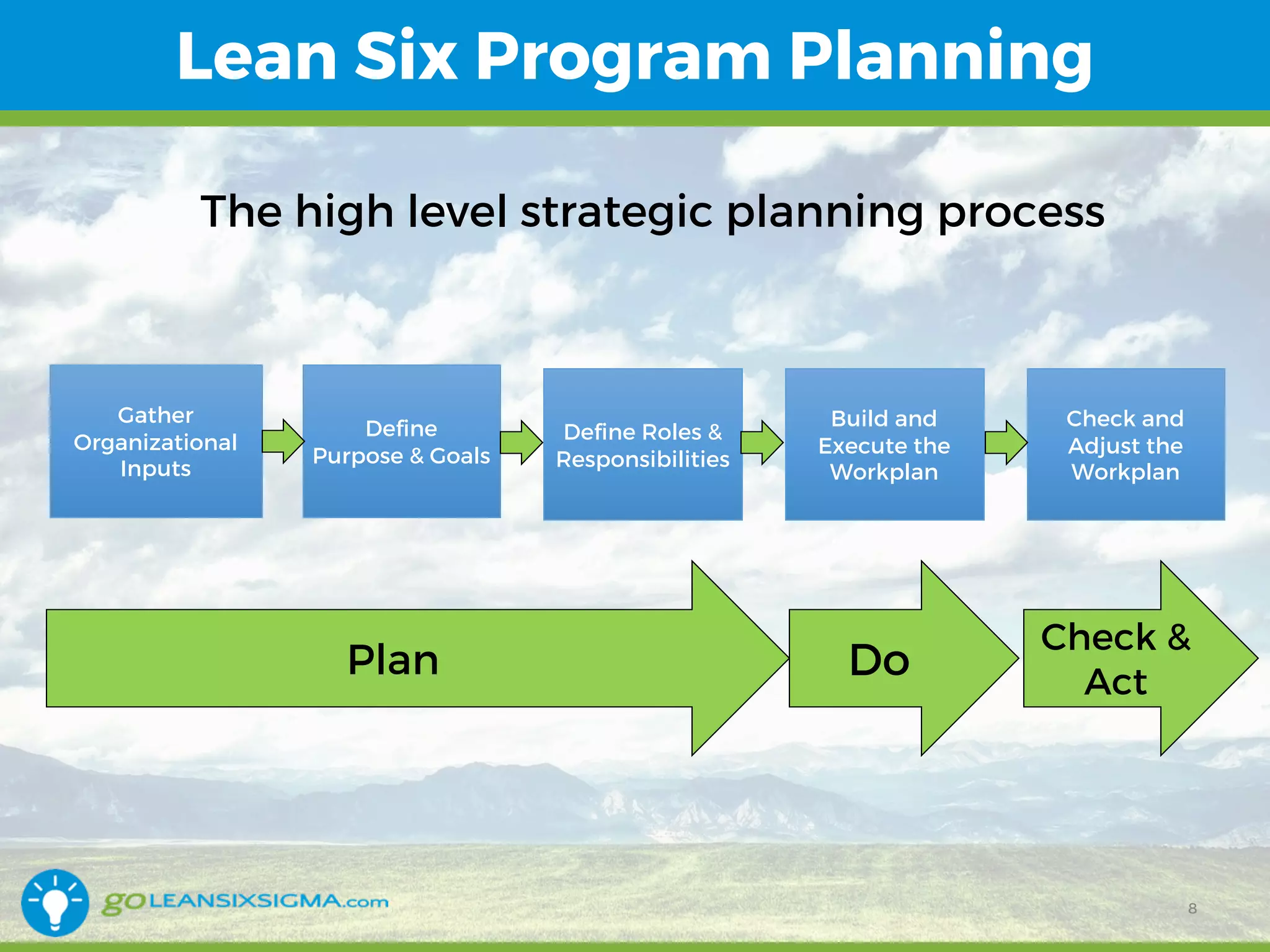
Lean Six Program Planning
Gather
Organizational
Inputs
Define
Purpose & Goals
Define Roles &
Responsibilities
Build and
Execute the
Workplan
Check and
Adjust the
Workplan
The high level strategic planning process
Plan Do
Check &
Act
8
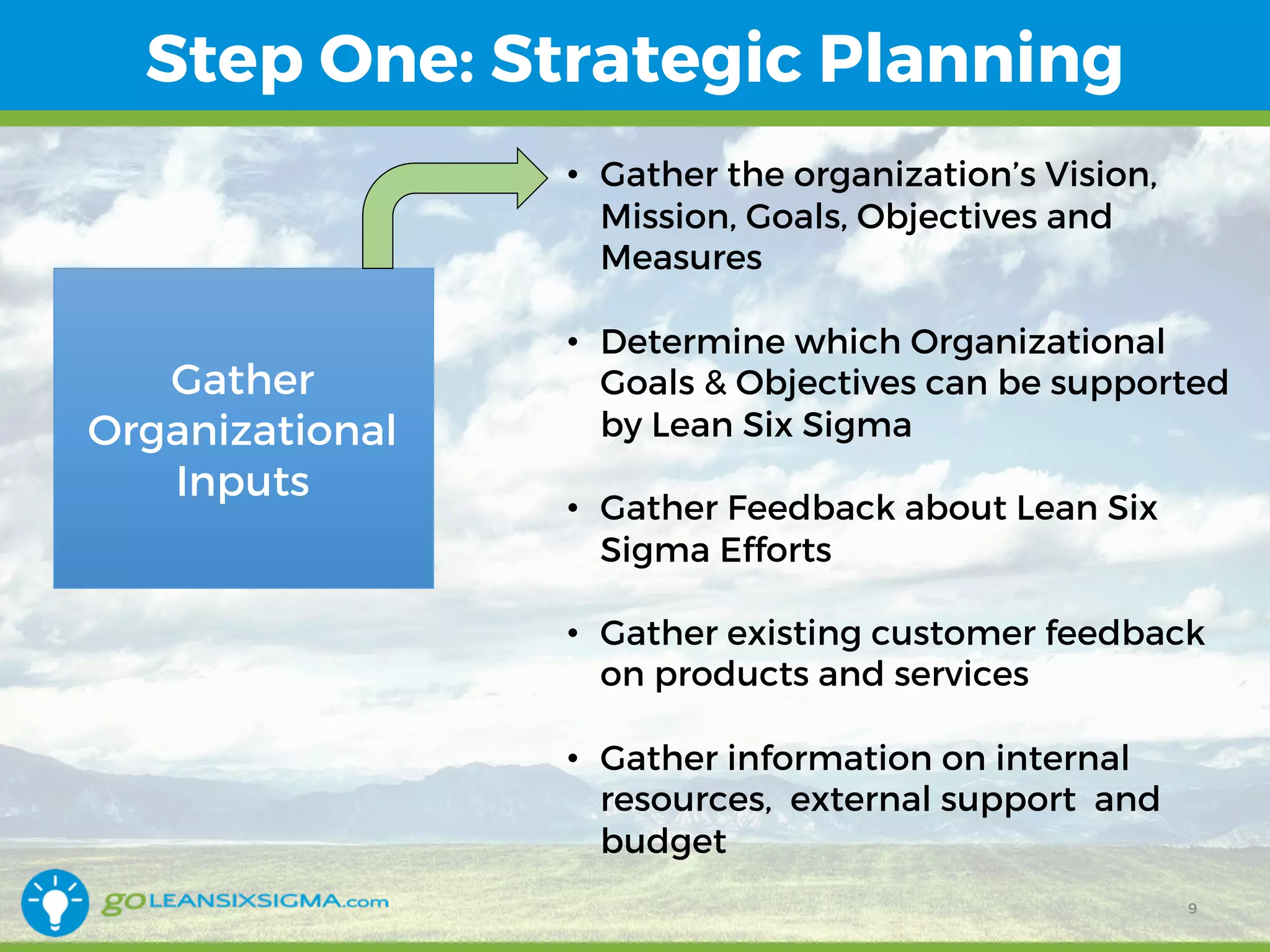
Step One: Strategic Planning
• Gather the organization’s Vision,
Mission, Goals, Objectives and
Measures
• Determine which Organizational
Goals & Objectives can be supported
by Lean Six Sigma
• Gather Feedback about Lean Six
Sigma Efforts
• Gather existing customer feedback
on products and services
• Gather information on internal
resources, external support and
budget
Gather
Organizational
Inputs
9
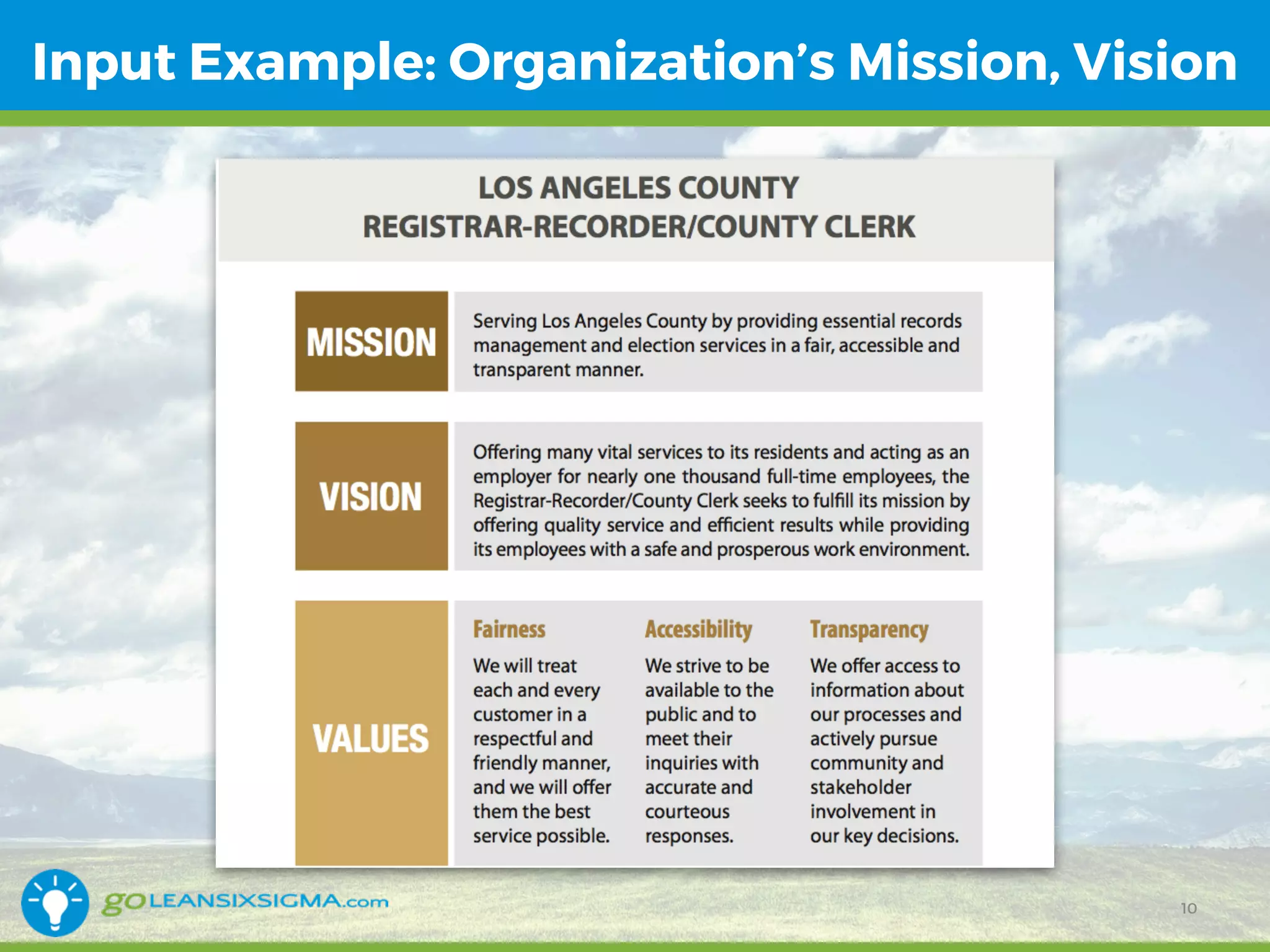
Input Example: Organization’s Mission, Vision
10
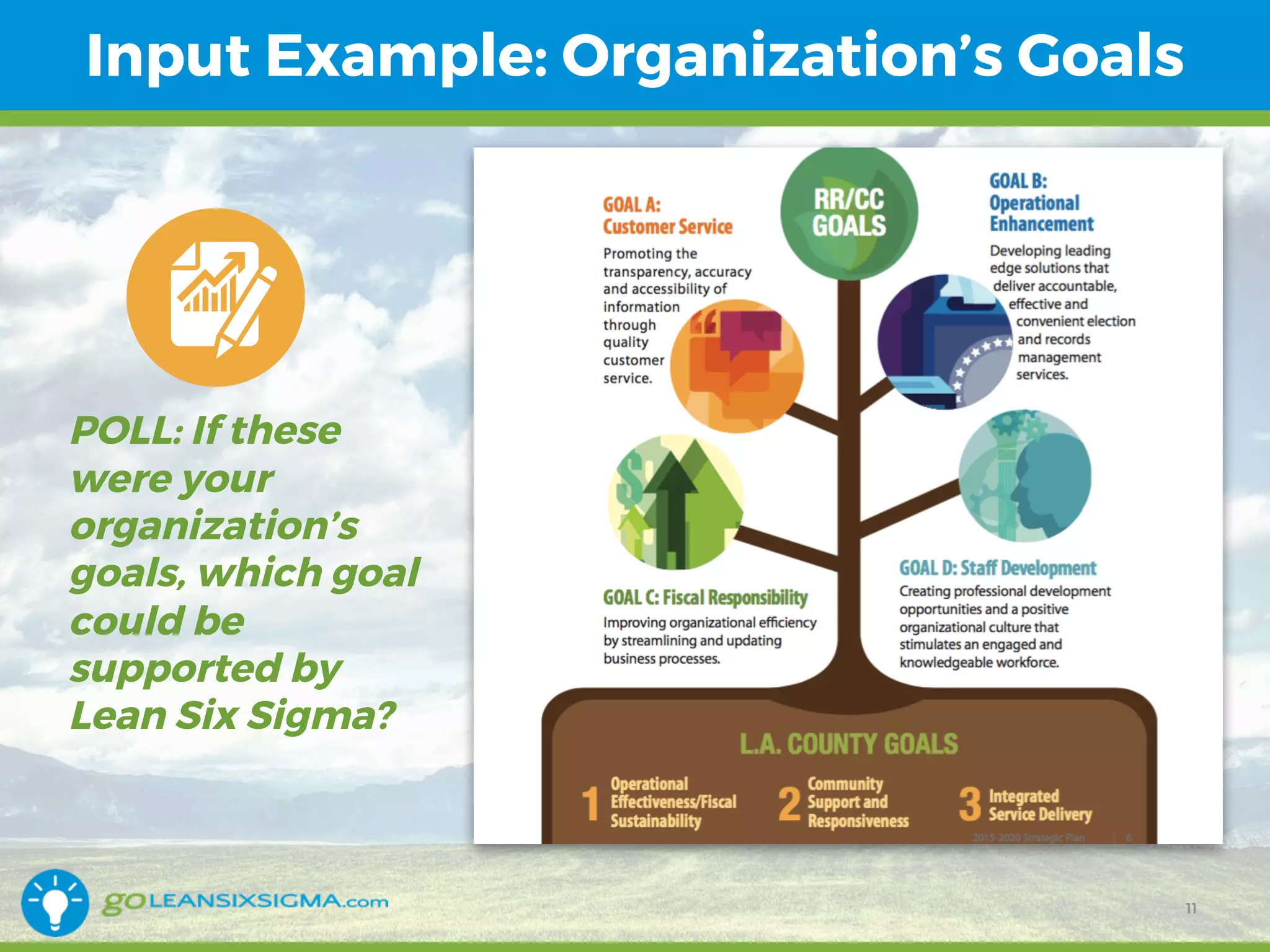
Input Example: Organization’s Goals
POLL: If these
were your
organization’s
goals, which goal
could be
supported by
Lean Six Sigma?
11
Poll #1:
If these were your organization’s
goals, which goal could be supported
by Lean Six Sigma?
A. Goal A: Customer Service
B. Goal A & B: Customer Service and Operational Enhancement
C. Goal C: Fiscal Responsibility
D. Goal D: Staff Development
E. All of the goals
12
13
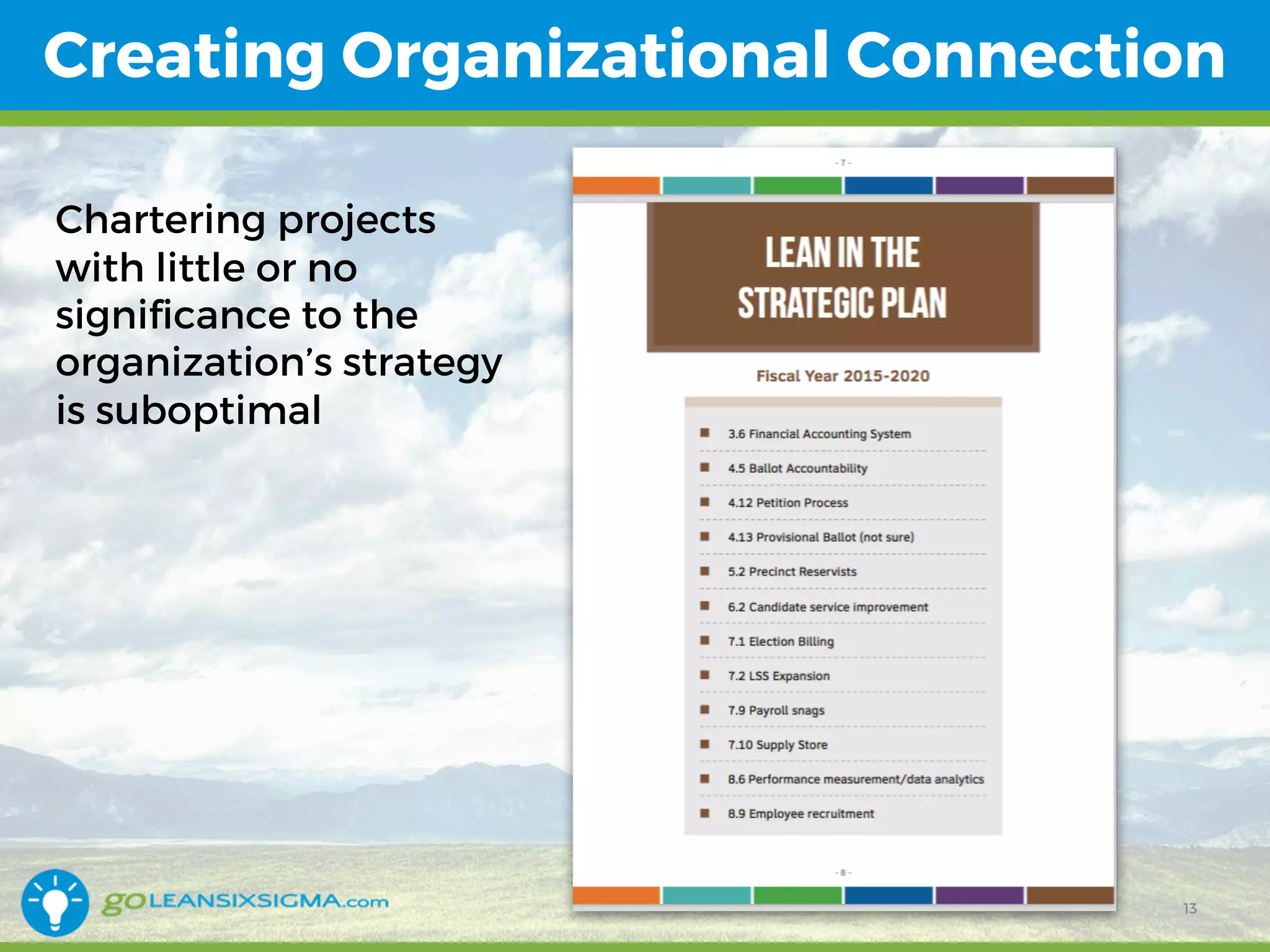
Creating Organizational Connection
Chartering projects
with little or no
significance to the
organization’s strategy
is suboptimal
Poll #2:
Do you have a clear idea how your
process improvement efforts fit into
the strategy of your organization?
A. No, it is not clear how my efforts align to our strategy.
B. Sort of. I know the strategy, but not sure what I can do daily or
weekly to support it.
C. Yes, but there is still confusion.
D. Yes, it’s clear and our team meets regularly to discuss it.
14
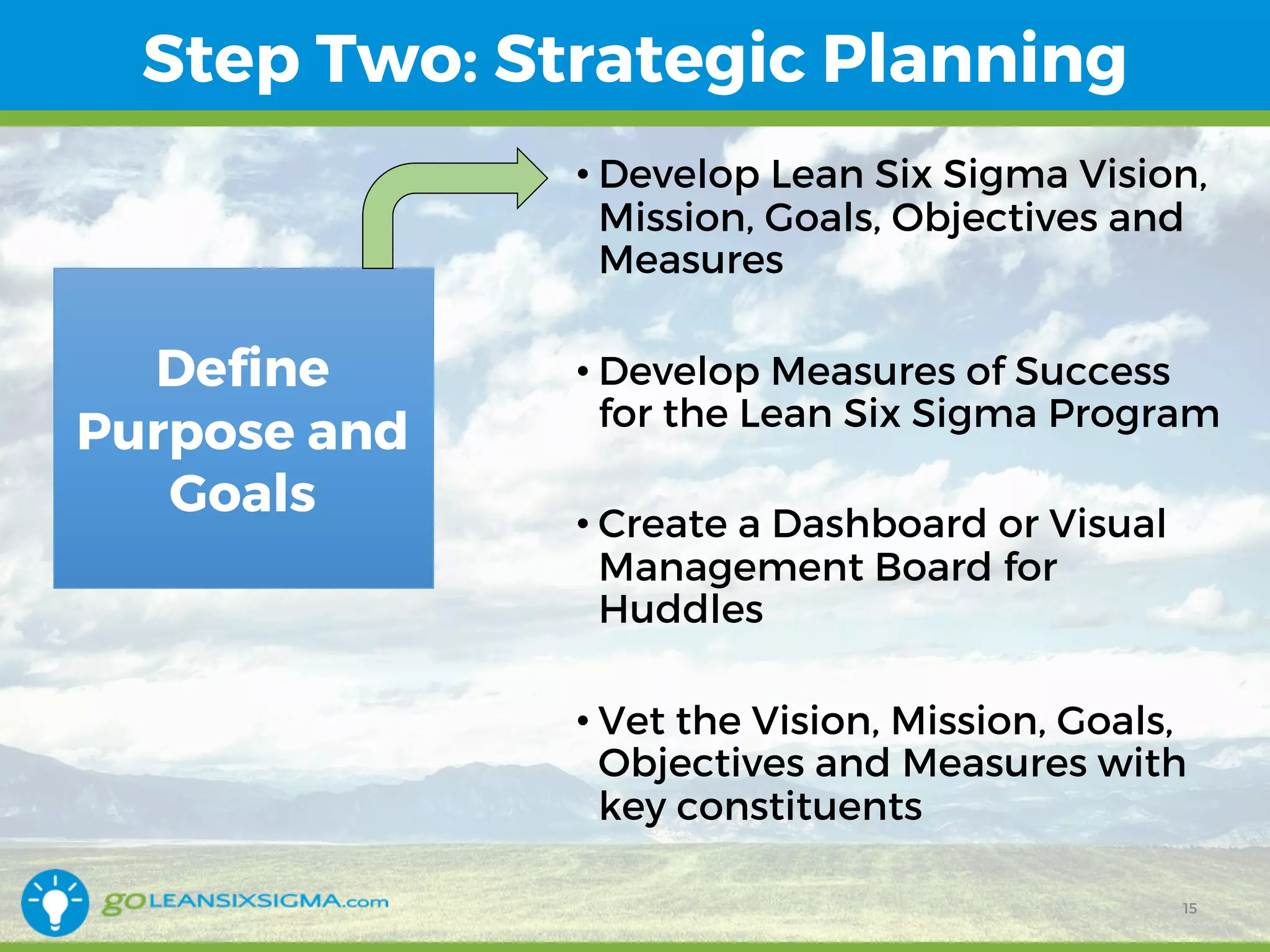
Step Two: Strategic Planning
Define
Purpose and
Goals
• Develop Lean Six Sigma Vision,
Mission, Goals, Objectives and
Measures
• Develop Measures of Success
for the Lean Six Sigma Program
• Create a Dashboard or Visual
Management Board for
Huddles
• Vet the Vision, Mission, Goals,
Objectives and Measures with
key constituents
15
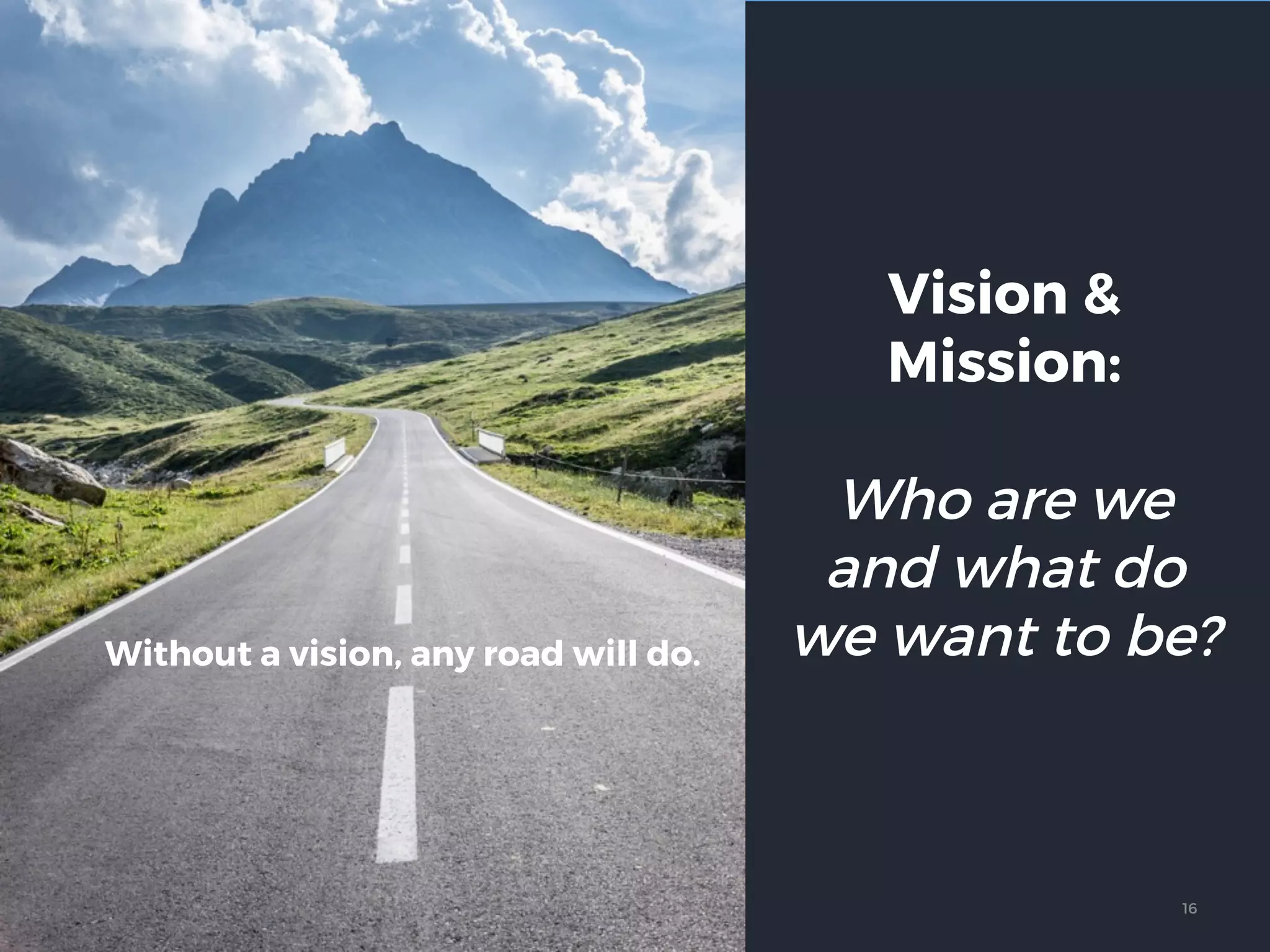
Vision &
Mission:
Who are we
and what do
we want to be?Without a vision, any road will do.
16
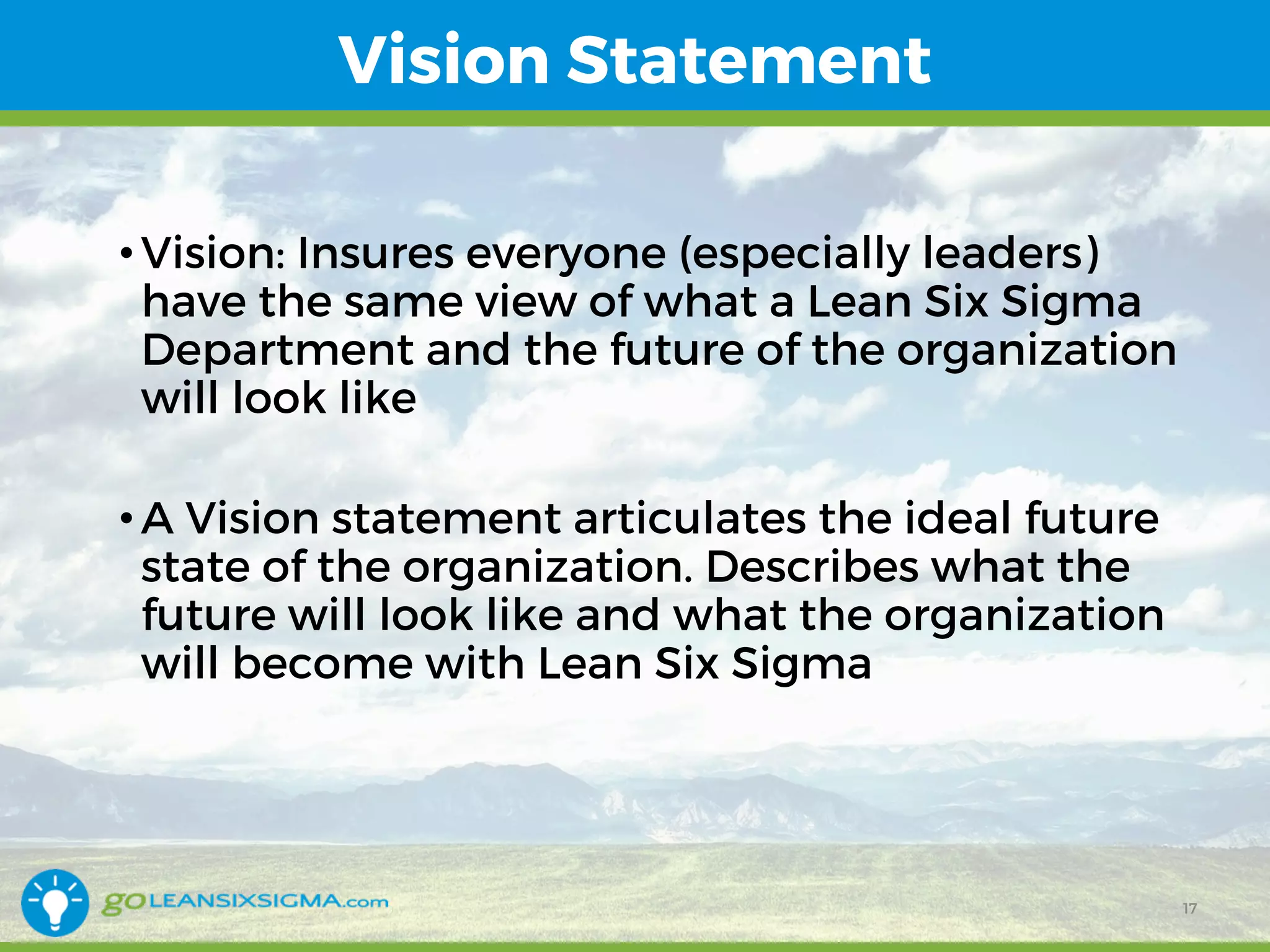
Vision Statement
• Vision: Insures everyone (especially leaders)
have the same view of what a Lean Six Sigma
Department and the future of the organization
will look like
• A Vision statement articulates the ideal future
state of the organization. Describes what the
future will look like and what the organization
will become with Lean Six Sigma
17
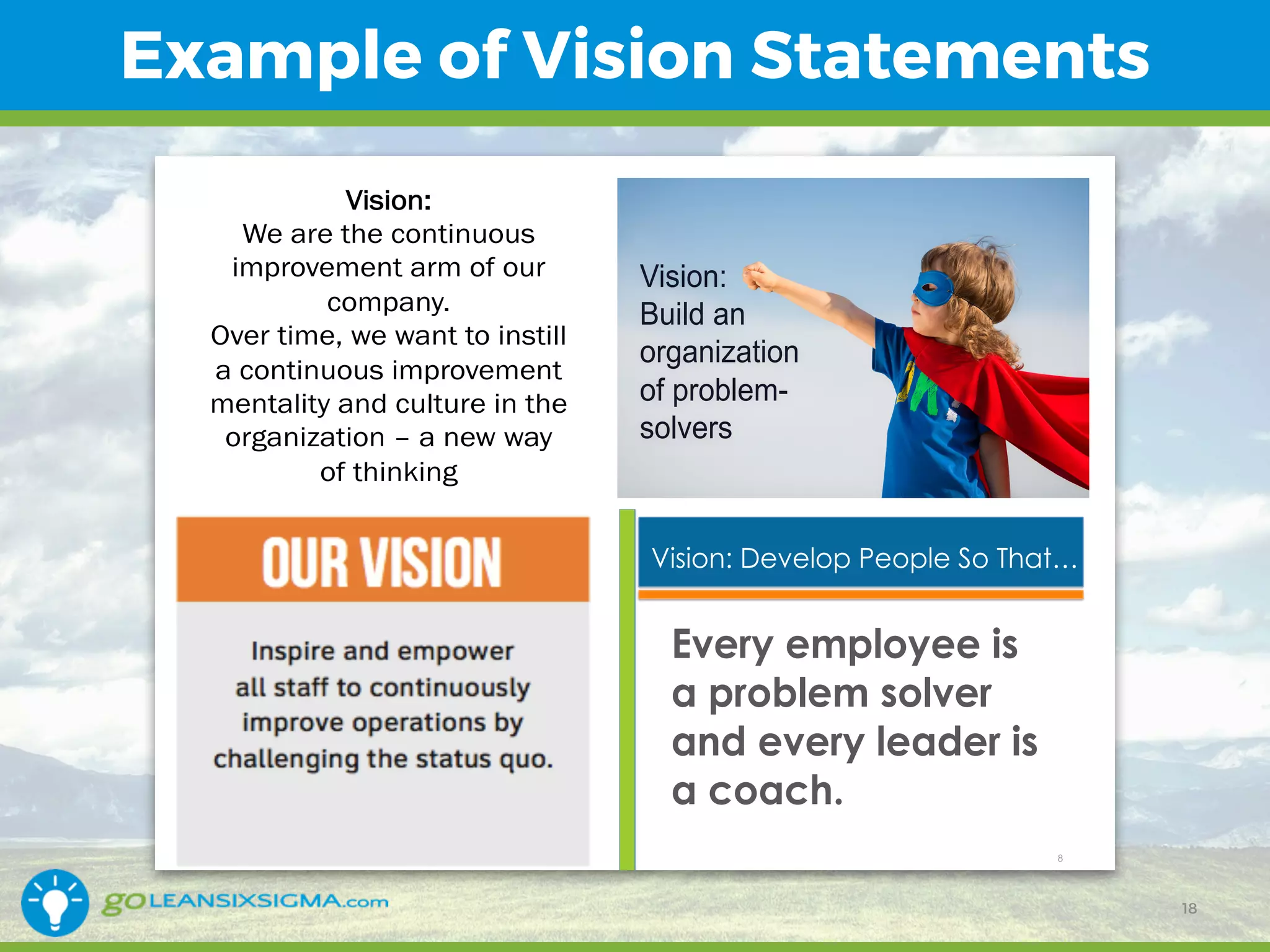
Example of Vision Statements
1
32
Mission:
§  We will design an organization and governance
model that will enable our company to build
continuous improvement capability
§  We will demonstrate the value of continuous
improvement through a series of projects that
show tangible results for our stakeholders and
external customers
§  We will build a toolkit for CPI practitioners that can
be re-used in projects and used to train new team
members
§  We will define a roadmap to scale up continuous
improvement efforts enterprise wide
§  We will support practitioners when they need
assistance in applying CPI methodologies
Vision:
We are the continuous
improvement arm of our
company.
Over time, we want to instill
a continuous improvement
mentality and culture in the
organization – a new way
of thinking
Every employee is
a problem solver
and every leader is
a coach.
Vision: Develop People So That…	
8
22
Vision:
Build an
organization
of problem-
solvers
18
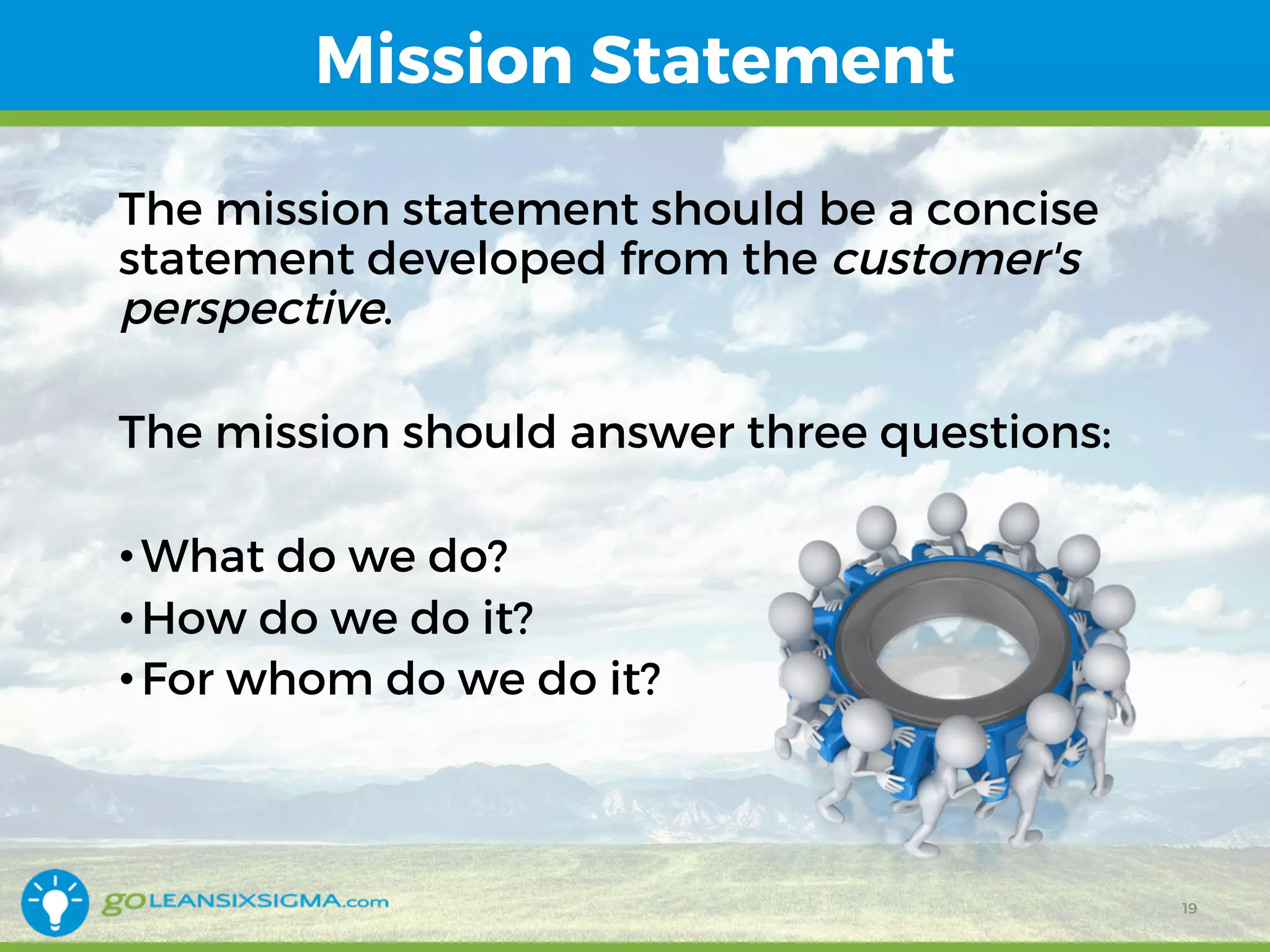
Mission Statement
The mission statement should be a concise
statement developed from the customer's
perspective.
The mission should answer three questions:
•What do we do?
•How do we do it?
•For whom do we do it?
19
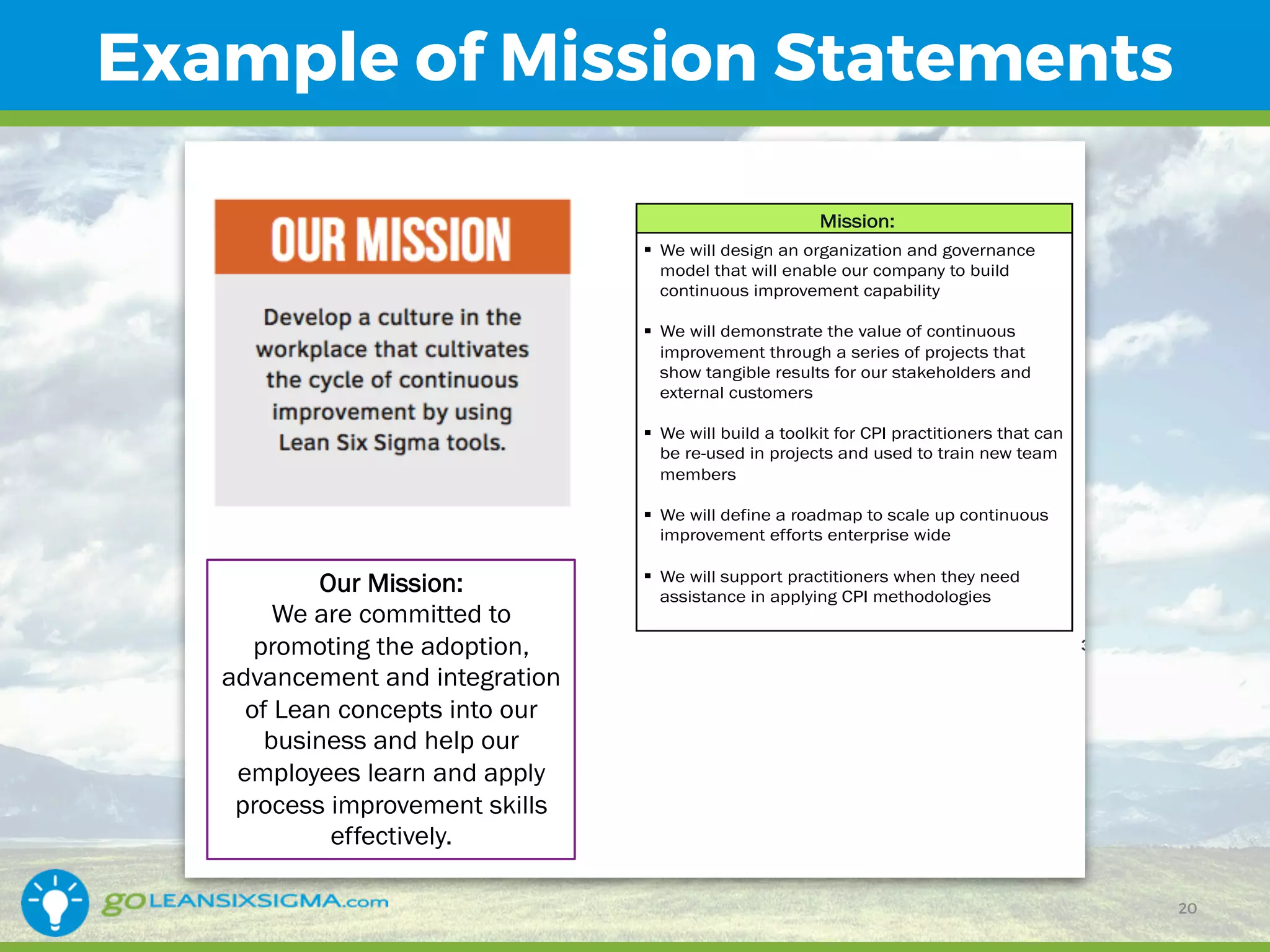
Example of Mission Statements
2
32
Mission:
§  We will design an organization and governance
model that will enable our company to build
continuous improvement capability
§  We will demonstrate the value of continuous
improvement through a series of projects that
show tangible results for our stakeholders and
external customers
§  We will build a toolkit for CPI practitioners that can
be re-used in projects and used to train new team
members
§  We will define a roadmap to scale up continuous
improvement efforts enterprise wide
§  We will support practitioners when they need
assistance in applying CPI methodologies
Vision:
We are the continuous
improvement arm of our
company.
Over time, we want to instill
a continuous improvement
mentality and culture in the
organization – a new way
of thinking
Our Mission:
We are committed to
promoting the adoption,
advancement and integration
of Lean concepts into our
business and help our
employees learn and apply
process improvement skills
effectively.
20
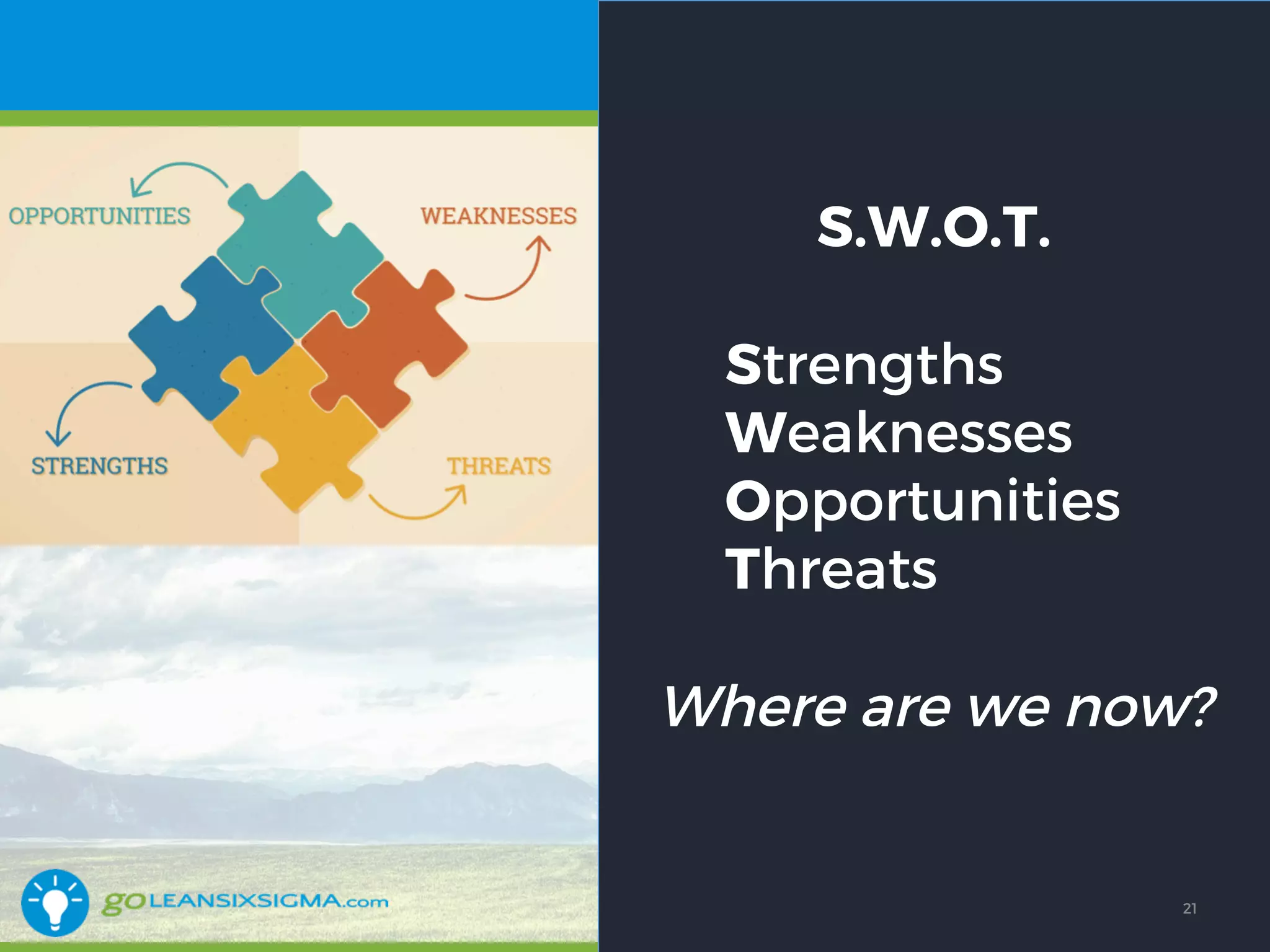
S.W.O.T.
Strengths
Weaknesses
Opportunities
Threats
Where are we now?
21
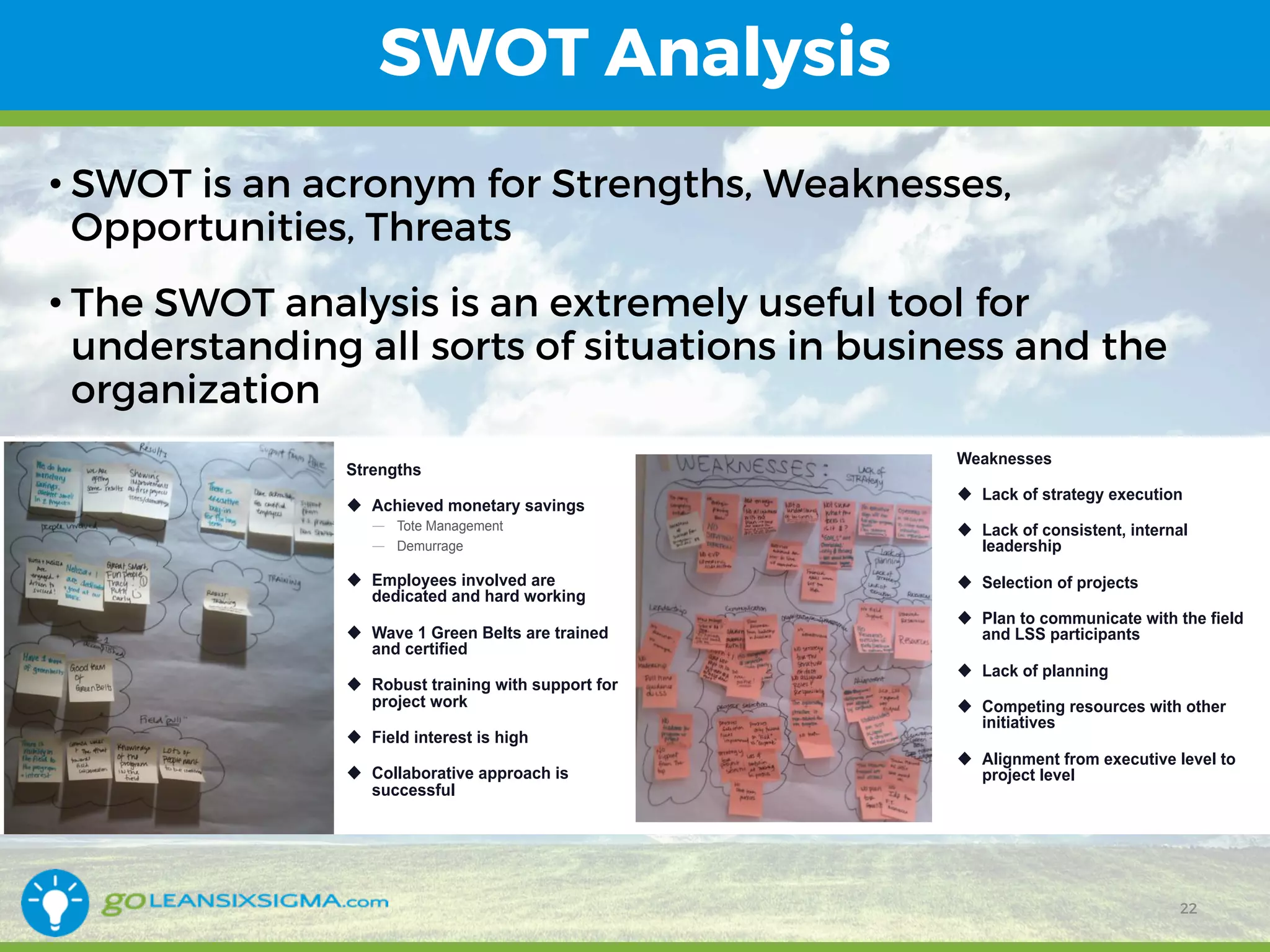
SWOT Analysis
• SWOT is an acronym for Strengths, Weaknesses,
Opportunities, Threats
• The SWOT analysis is an extremely useful tool for
understanding all sorts of situations in business and the
organization
22
38
OPEX Program Strengths
Strengths
u  Achieved monetary savings
—  Tote Management
—  Demurrage
u  Employees involved are
dedicated and hard working
u  Wave 1 Green Belts are trained
and certified
u  Robust training with support for
project work
u  Field interest is high
u  Collaborative approach is
successful
39
OPEX Program Weaknesses
Weaknesses
u  Lack of strategy execution
u  Lack of consistent, internal
leadership
u  Selection of projects
u  Plan to communicate with the field
and LSS participants
u  Lack of planning
u  Competing resources with other
initiatives
u  Alignment from executive level to
project level
SWOT: Questions to Ask
• What Lean Six Sigma strengths does the organization
have that will help achieve our vision?
• What Lean Six Sigma weaknesses does the Program
Office have that might be a barrier to achieve our
vision?
• What strengths can we leverage?
• What weaknesses should be prioritized?
• What opportunities should we accept?
• What threats should be addressed?
• How can we support the organization in their CI goals?
• Where do we need to develop organizational skills?
• What skills do we need to develop in our department?
23
Lean Six Sigma
Program Office
Goals & Objectives
How will we get
there?
24
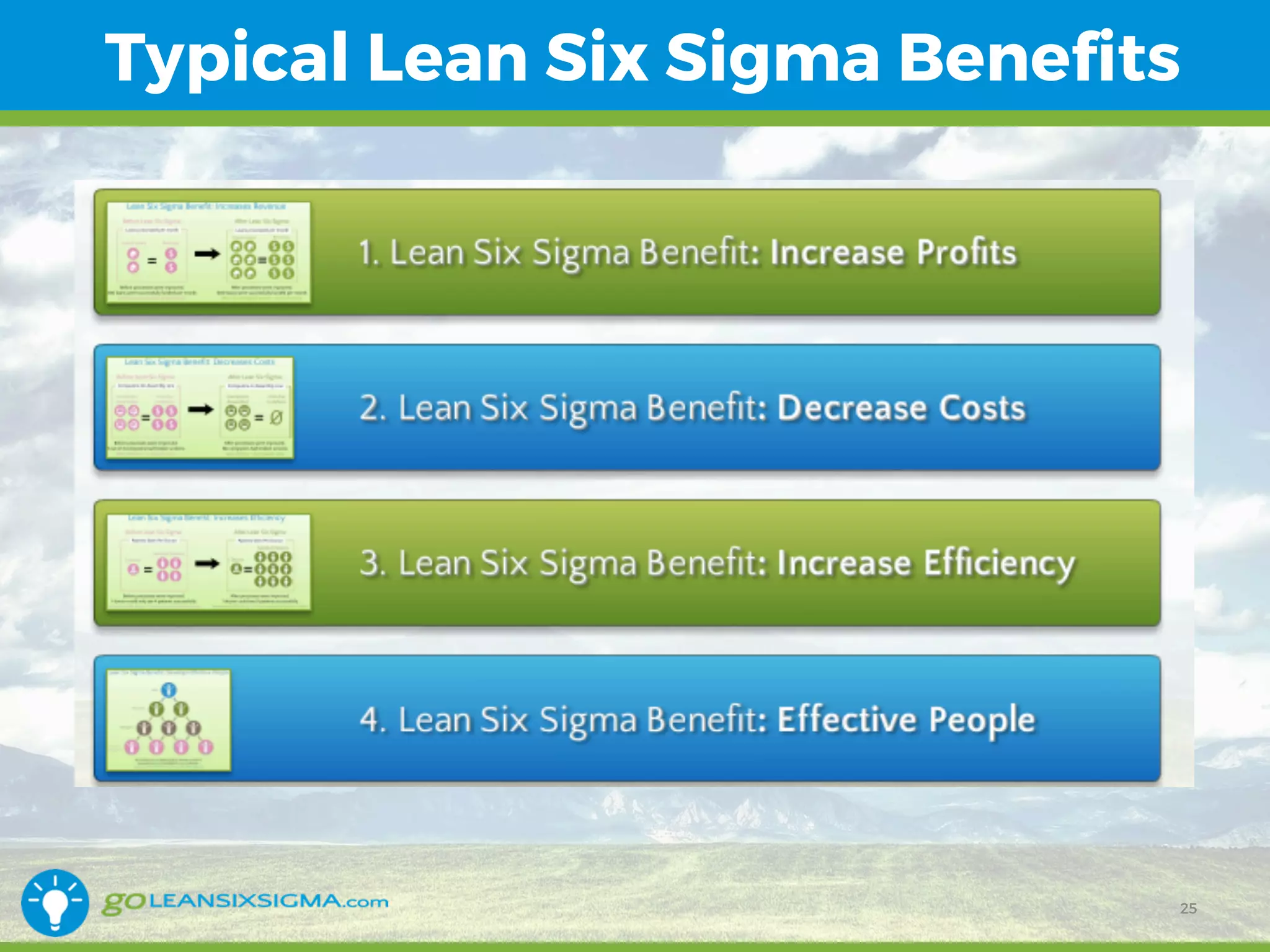
Typical Lean Six Sigma Benefits
25
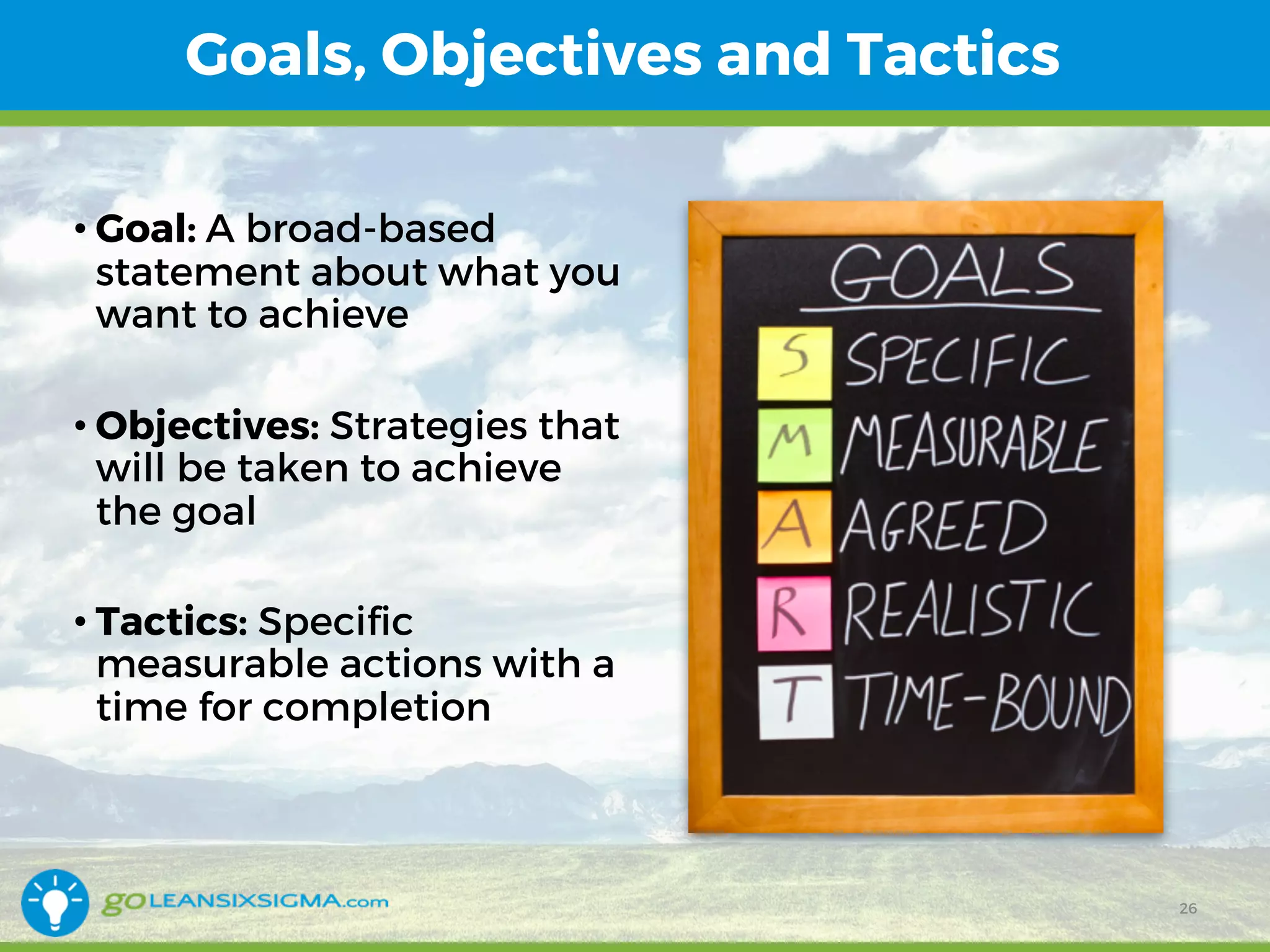
Goals, Objectives and Tactics
• Goal: A broad-based
statement about what you
want to achieve
• Objectives: Strategies that
will be taken to achieve
the goal
• Tactics: Specific
measurable actions with a
time for completion
26
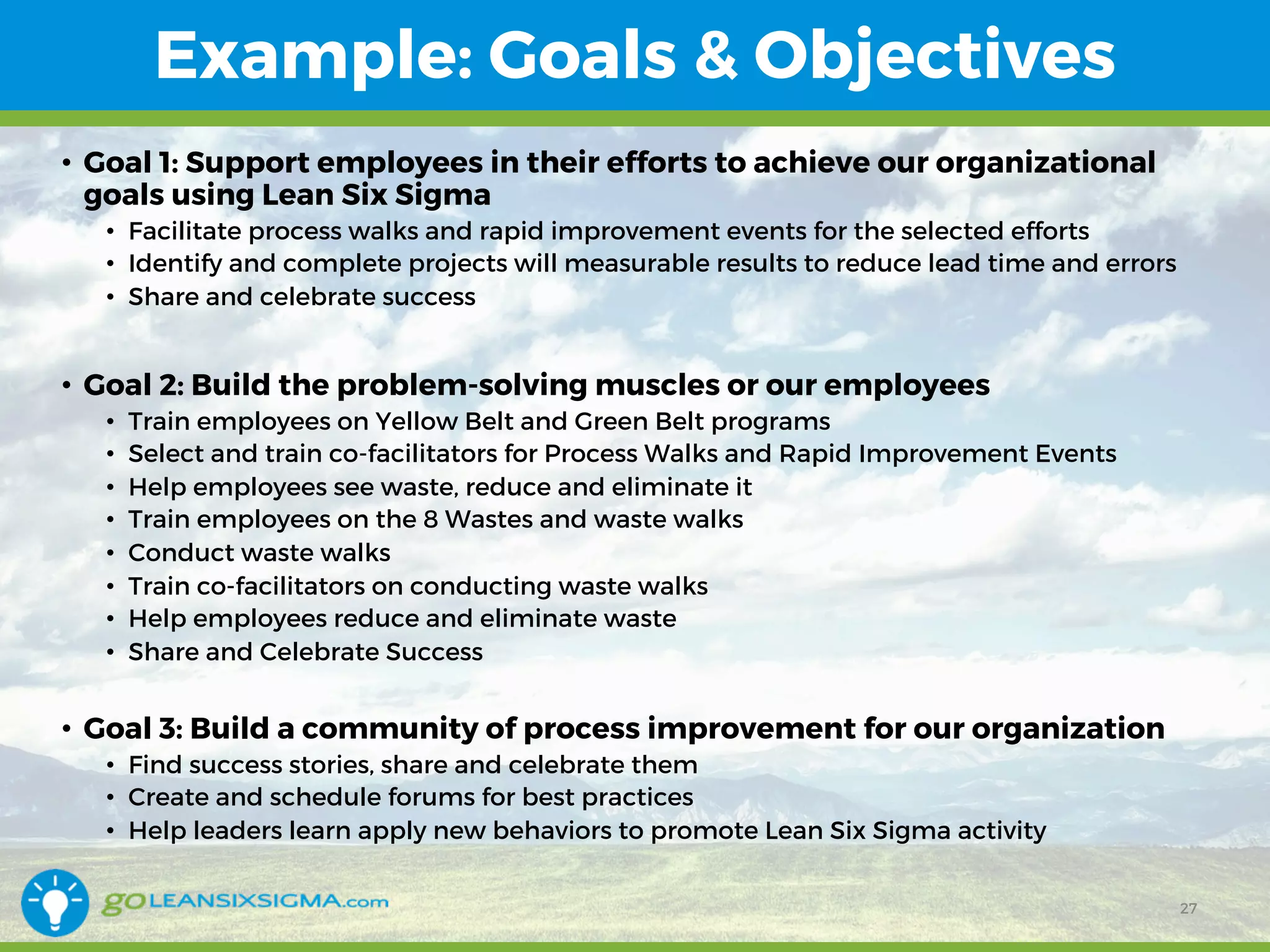
Example: Goals & Objectives
• Goal 2: Build the problem-solving muscles or our employees
• Train employees on Yellow Belt and Green Belt programs
• Select and train co-facilitators for Process Walks and Rapid Improvement Events
• Help employees see waste, reduce and eliminate it
• Train employees on the 8 Wastes and waste walks
• Conduct waste walks
• Train co-facilitators on conducting waste walks
• Help employees reduce and eliminate waste
• Share and Celebrate Success
27
• Goal 1: Support employees in their efforts to achieve our organizational
goals using Lean Six Sigma
• Facilitate process walks and rapid improvement events for the selected efforts
• Identify and complete projects will measurable results to reduce lead time and errors
• Share and celebrate success
• Goal 3: Build a community of process improvement for our organization
• Find success stories, share and celebrate them
• Create and schedule forums for best practices
• Help leaders learn apply new behaviors to promote Lean Six Sigma activity
Determine Success
Measures
How will we know
we got there?
28
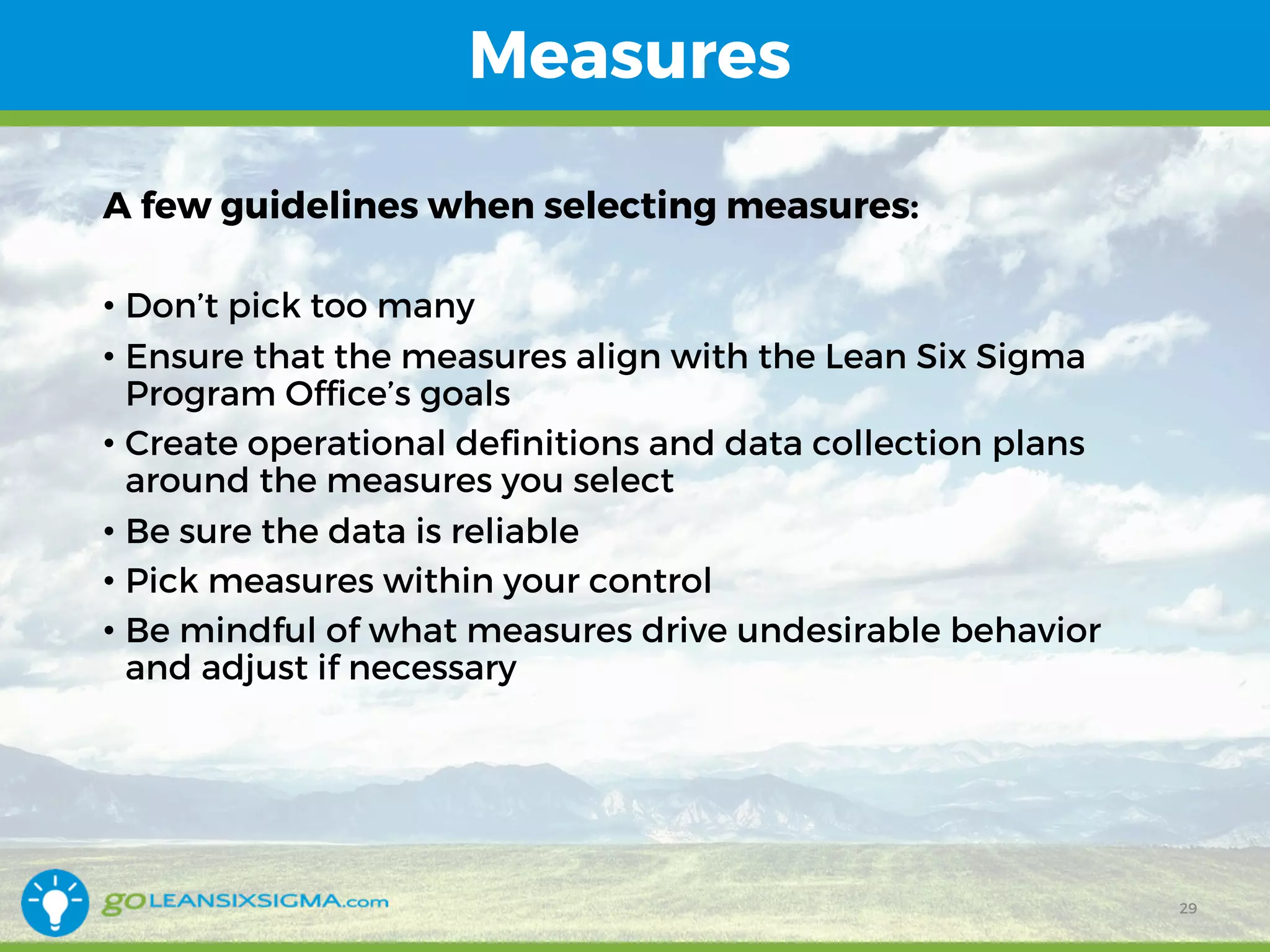
Measures
A few guidelines when selecting measures:
• Don’t pick too many
• Ensure that the measures align with the Lean Six Sigma
Program Office’s goals
• Create operational definitions and data collection plans
around the measures you select
• Be sure the data is reliable
• Pick measures within your control
• Be mindful of what measures drive undesirable behavior
and adjust if necessary
29
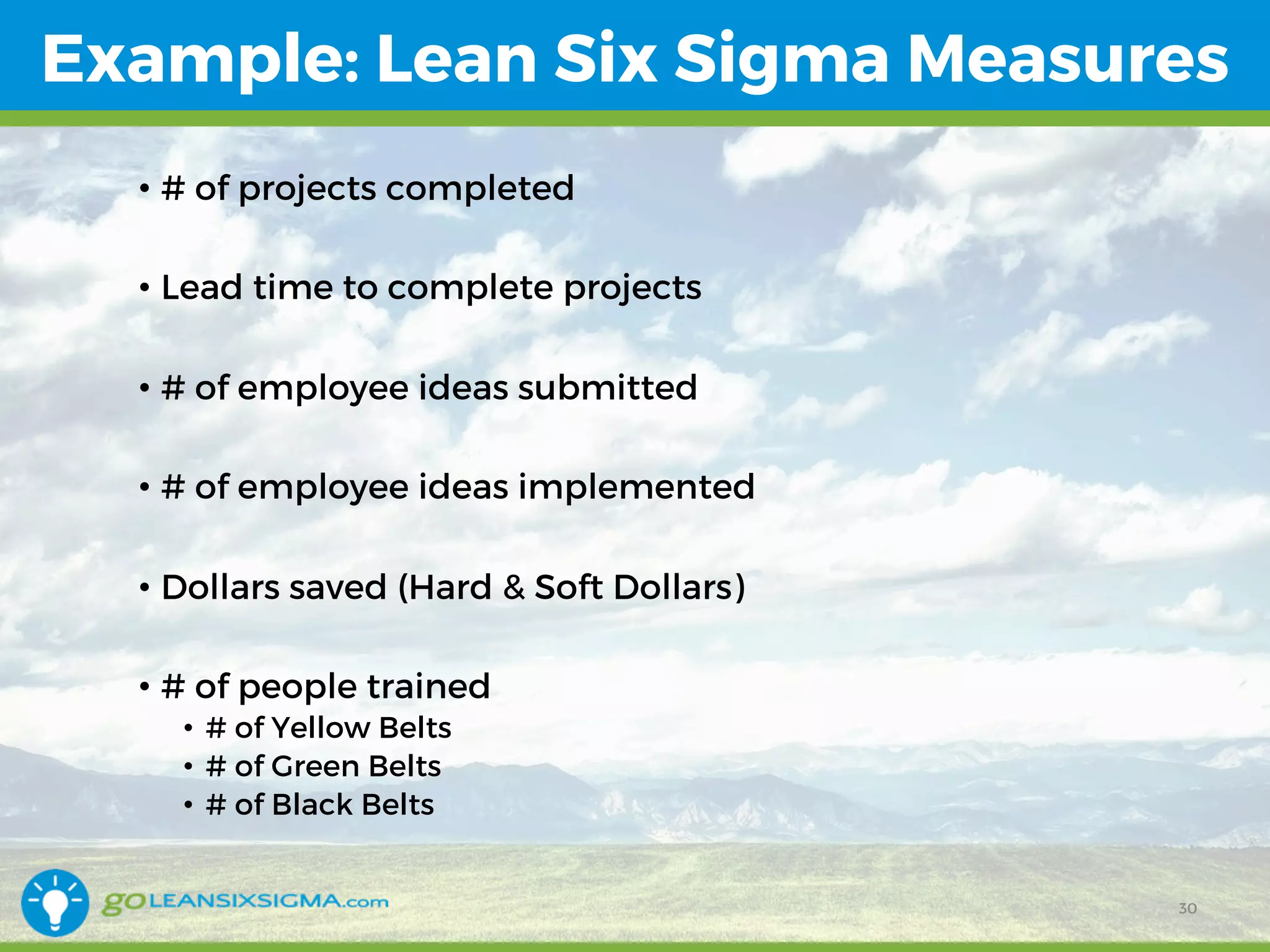
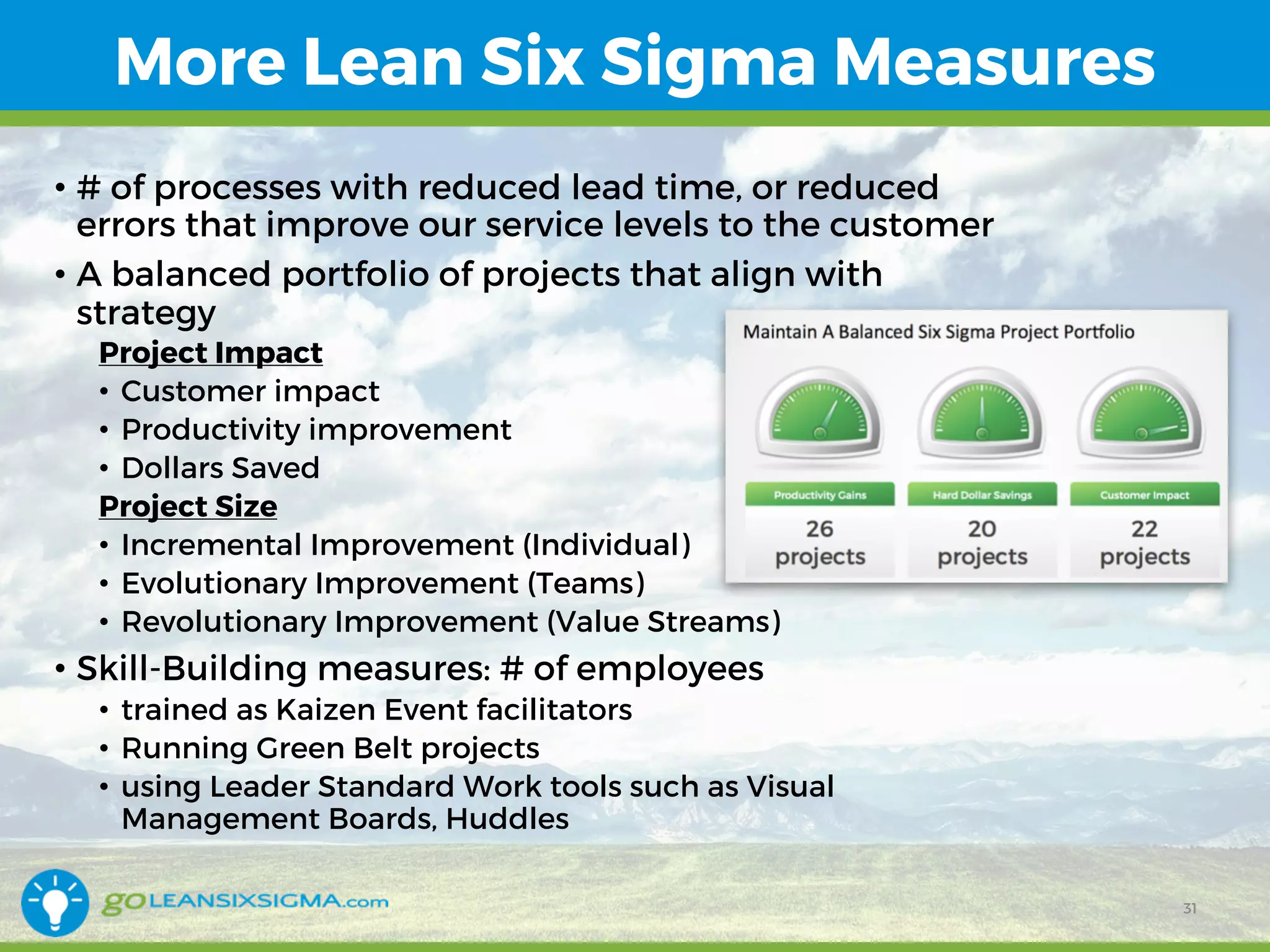
Example: Lean Six Sigma Measures
• # of projects completed
• Lead time to complete projects
• # of employee ideas submitted
• # of employee ideas implemented
• Dollars saved (Hard & Soft Dollars)
• # of people trained
• # of Yellow Belts
• # of Green Belts
• # of Black Belts
30
More Lean Six Sigma Measures
• # of processes with reduced lead time, or reduced
errors that improve our service levels to the customer
• A balanced portfolio of projects that align with
strategy
Project Impact
• Customer impact
• Productivity improvement
• Dollars Saved
Project Size
• Incremental Improvement (Individual)
• Evolutionary Improvement (Teams)
• Revolutionary Improvement (Value Streams)
• Skill-Building measures: # of employees
• trained as Kaizen Event facilitators
• Running Green Belt projects
• using Leader Standard Work tools such as Visual
Management Boards, Huddles
31
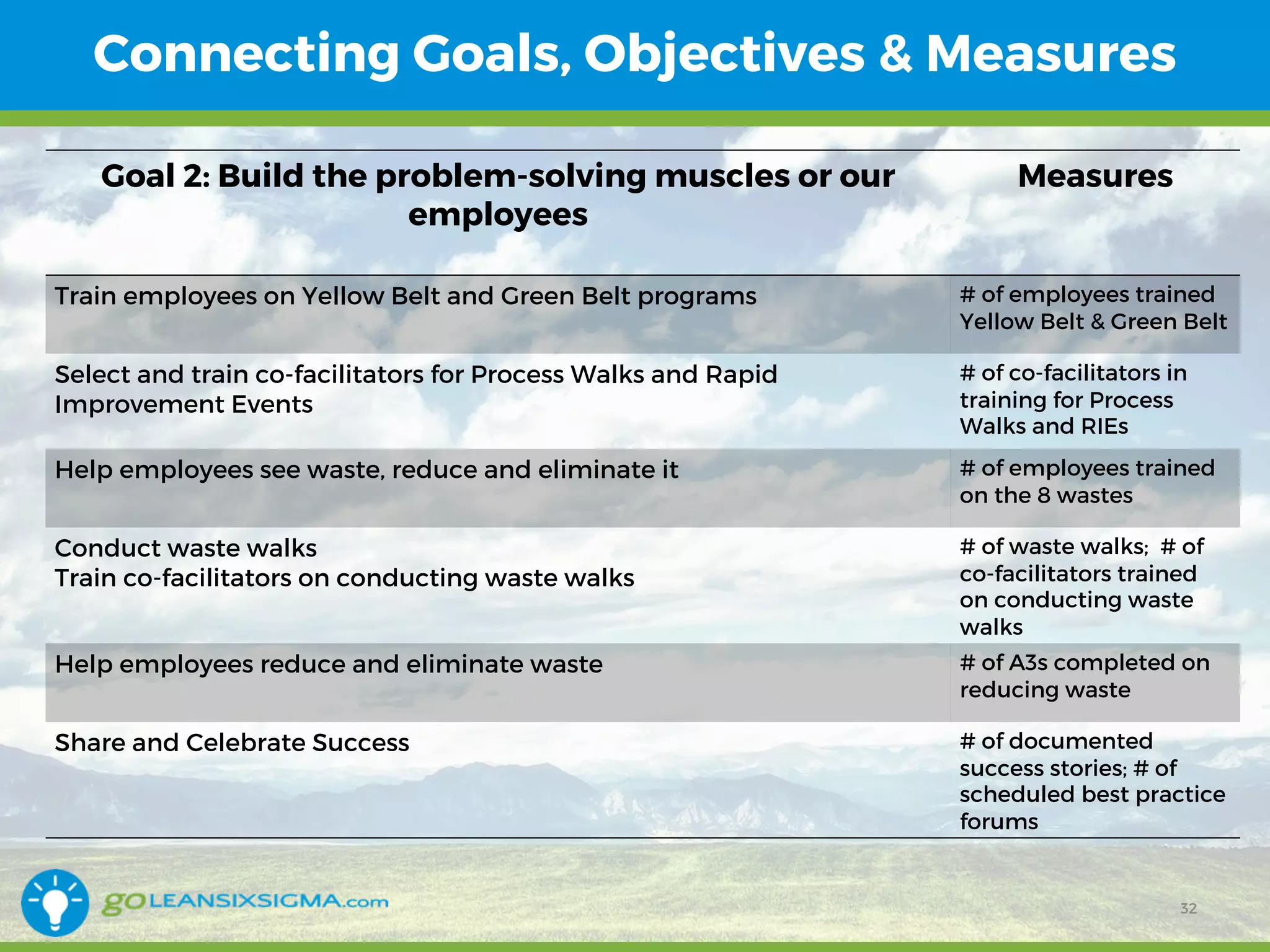
Connecting Goals, Objectives & Measures
32
Goal 2: Build the problem-solving muscles or our
employees
Measures
Train employees on Yellow Belt and Green Belt programs # of employees trained
Yellow Belt & Green Belt
Select and train co-facilitators for Process Walks and Rapid
Improvement Events
# of co-facilitators in
training for Process
Walks and RIEs
Help employees see waste, reduce and eliminate it # of employees trained
on the 8 wastes
Conduct waste walks
Train co-facilitators on conducting waste walks
# of waste walks; # of
co-facilitators trained
on conducting waste
walks
Help employees reduce and eliminate waste # of A3s completed on
reducing waste
Share and Celebrate Success # of documented
success stories; # of
scheduled best practice
forums
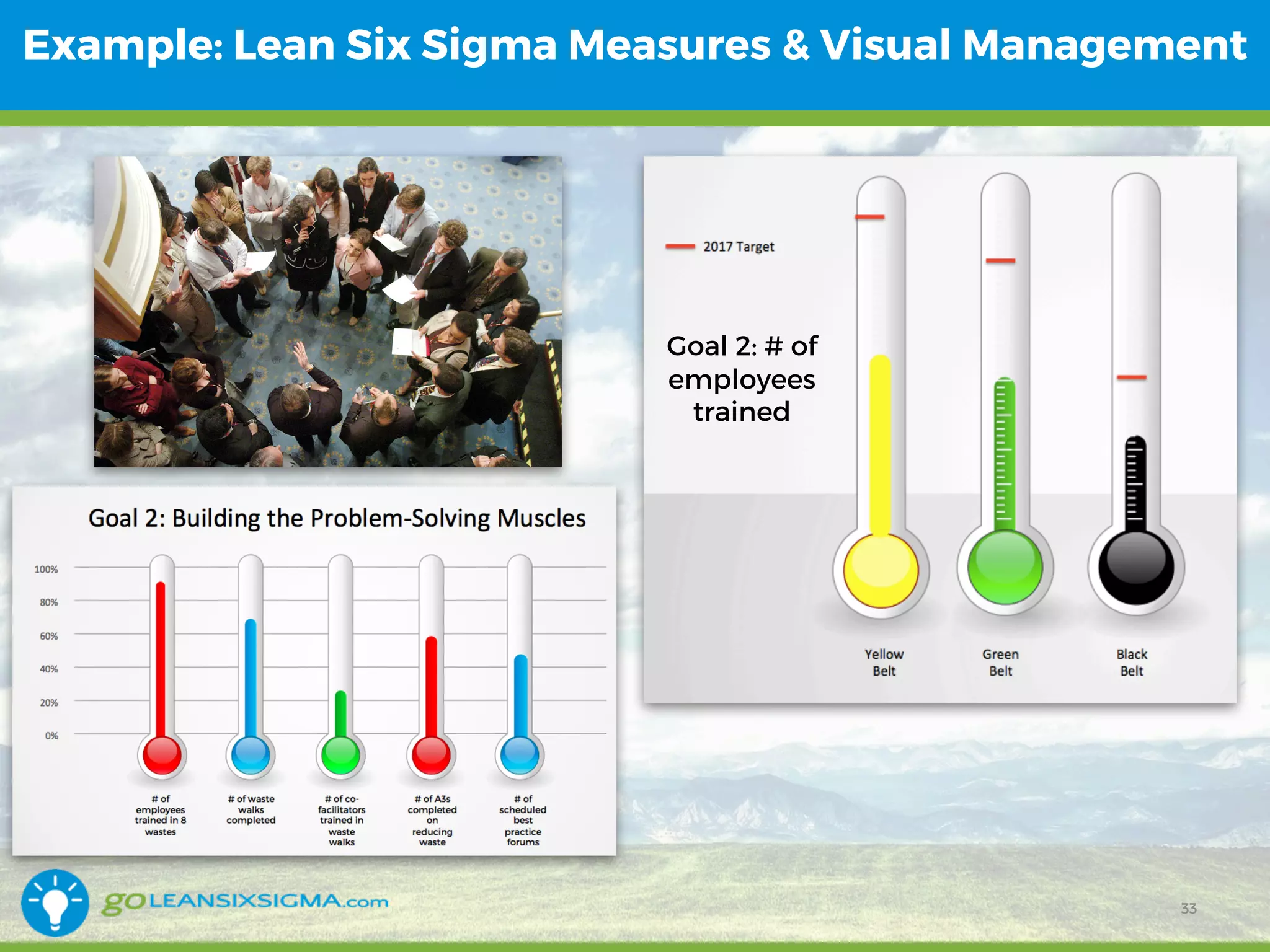
Example: Lean Six Sigma Measures & Visual Management
Goal 2: # of
employees
trained
33
Poll #3:
Which of these measures does your
organization use?
A. Dollars saved
B. # of projects completed
C. # of ideas submitted or implemented
D. Skill Building Measures
E. A combination of all of the above
34
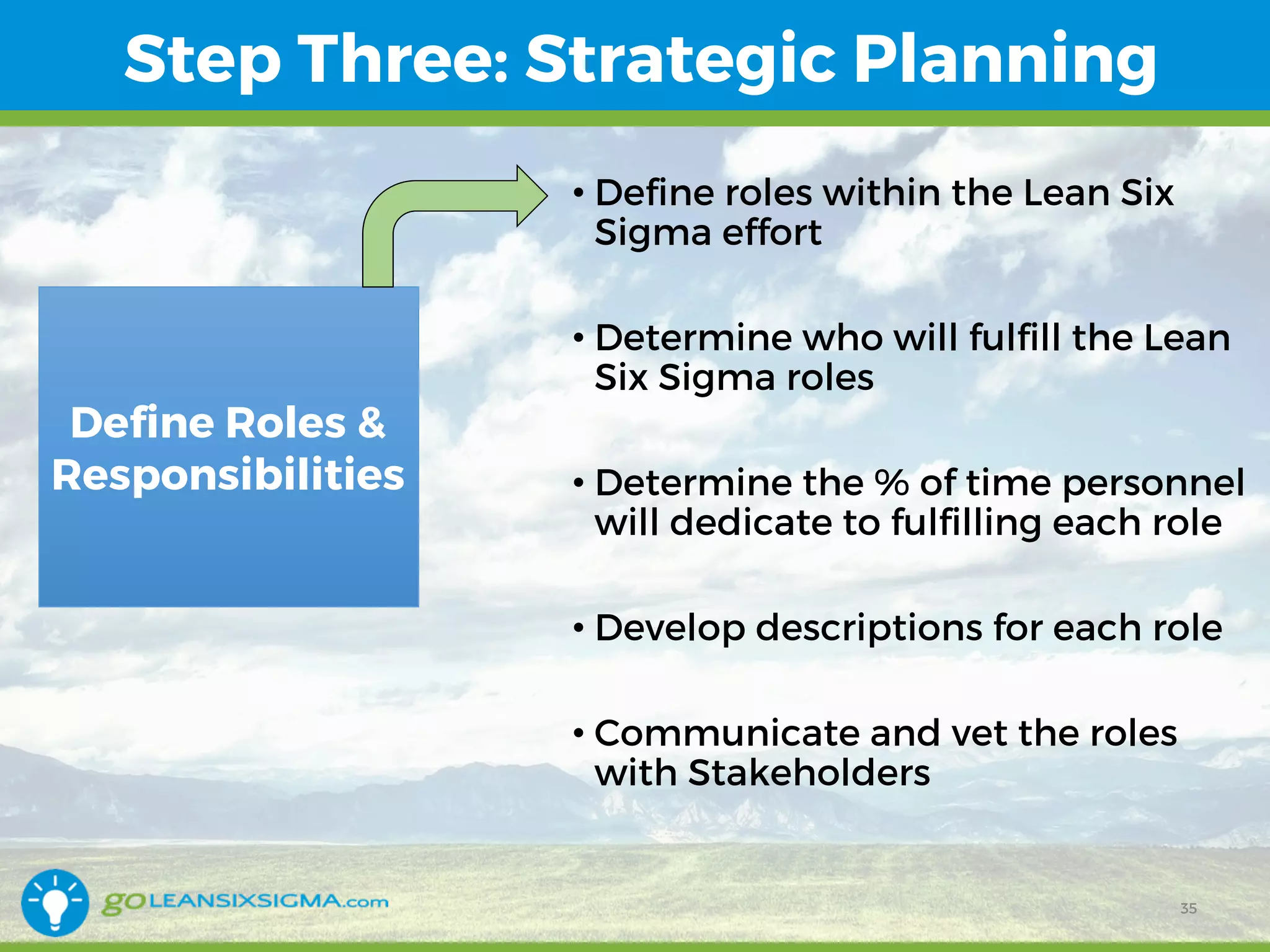
Step Three: Strategic Planning
Define Roles &
Responsibilities
• Define roles within the Lean Six
Sigma effort
• Determine who will fulfill the Lean
Six Sigma roles
• Determine the % of time personnel
will dedicate to fulfilling each role
• Develop descriptions for each role
• Communicate and vet the roles
with Stakeholders
35
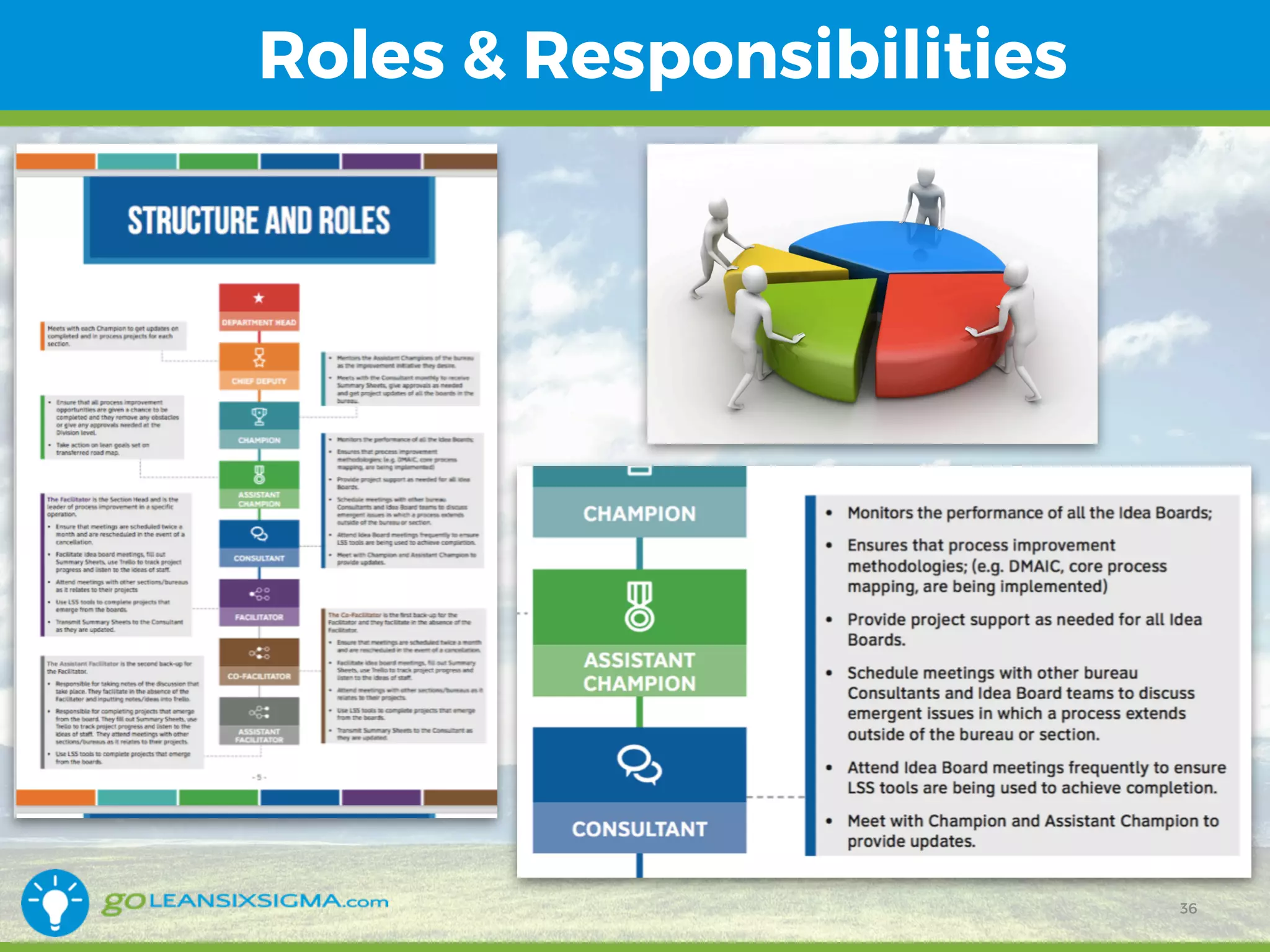
Roles & Responsibilities
36
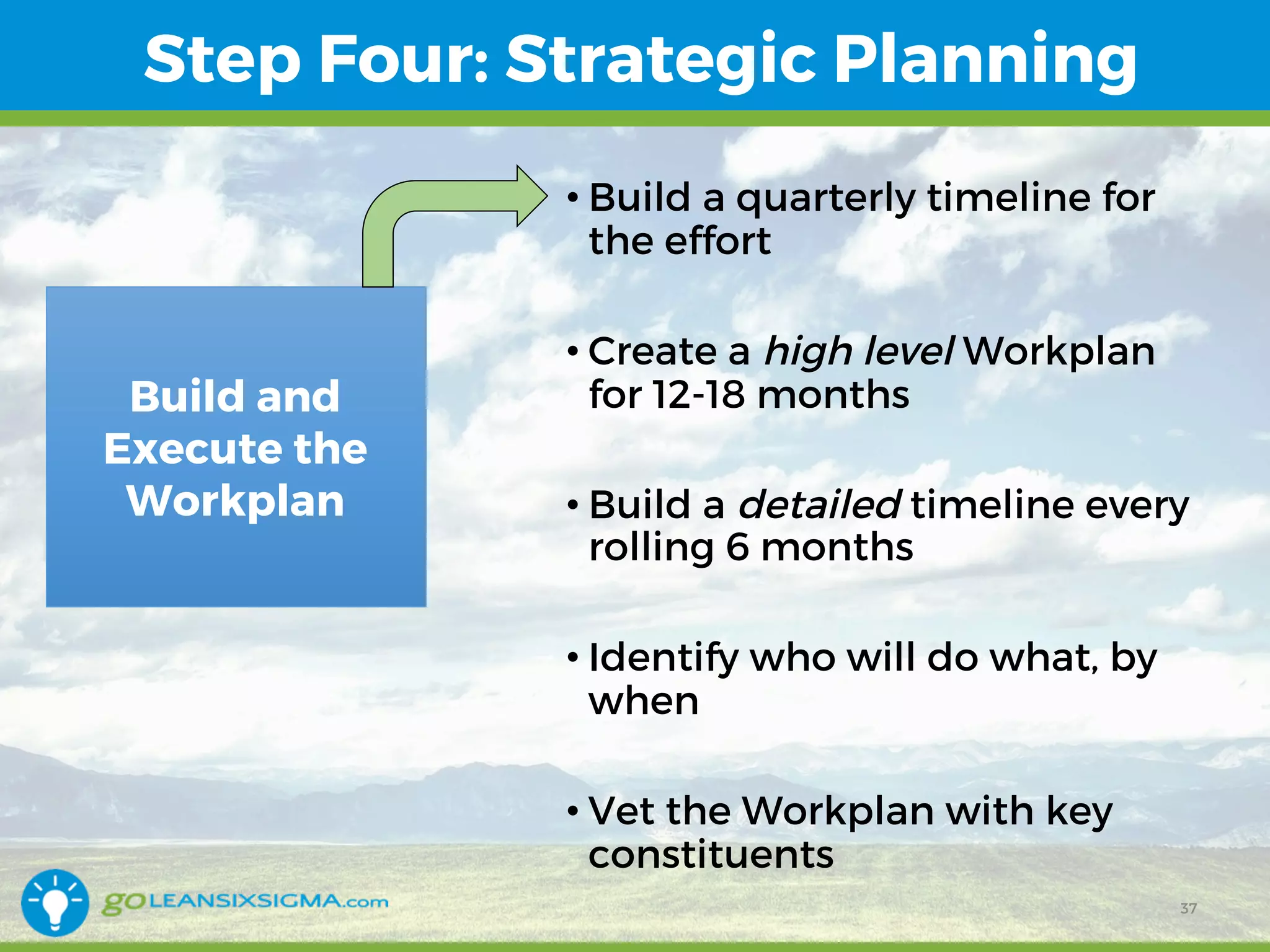
Step Four: Strategic Planning
Build and
Execute the
Workplan
• Build a quarterly timeline for
the effort
• Create a high level Workplan
for 12-18 months
• Build a detailed timeline every
rolling 6 months
• Identify who will do what, by
when
• Vet the Workplan with key
constituents
37
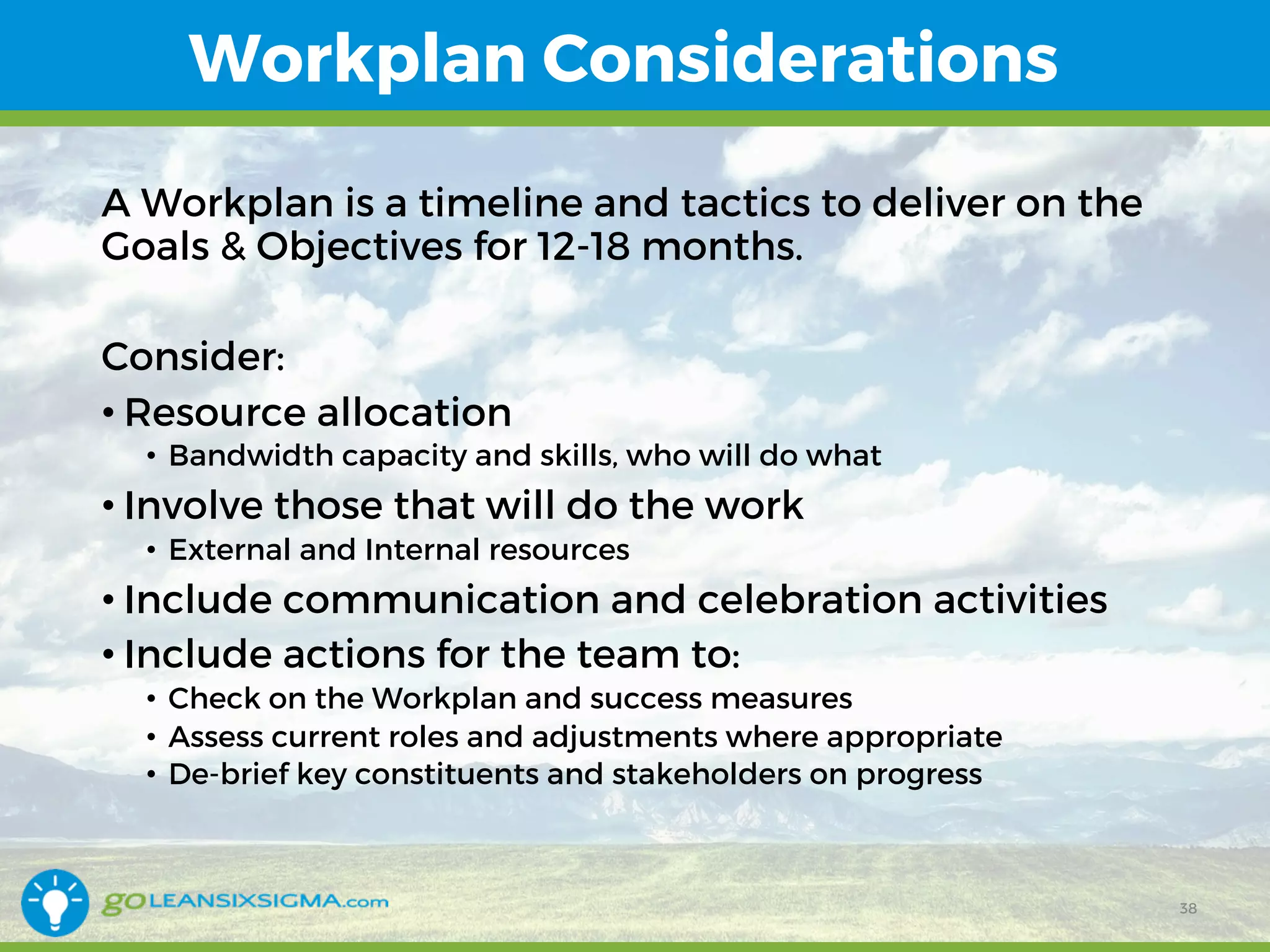
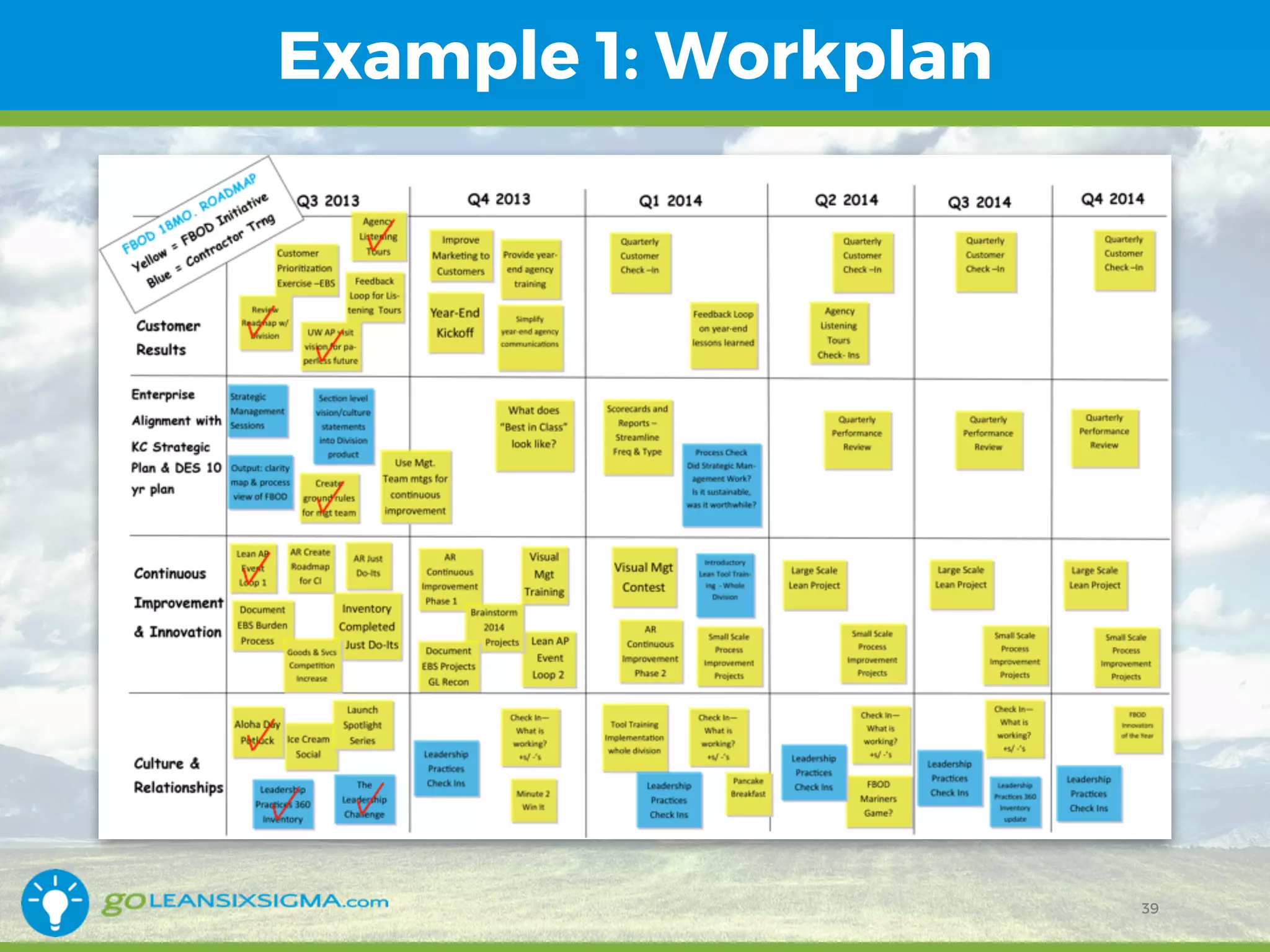
Workplan Considerations
A Workplan is a timeline and tactics to deliver on the
Goals & Objectives for 12-18 months.
Consider:
• Resource allocation
• Bandwidth capacity and skills, who will do what
• Involve those that will do the work
• External and Internal resources
• Include communication and celebration activities
• Include actions for the team to:
• Check on the Workplan and success measures
• Assess current roles and adjustments where appropriate
• De-brief key constituents and stakeholders on progress
38
Example 1: Workplan
39
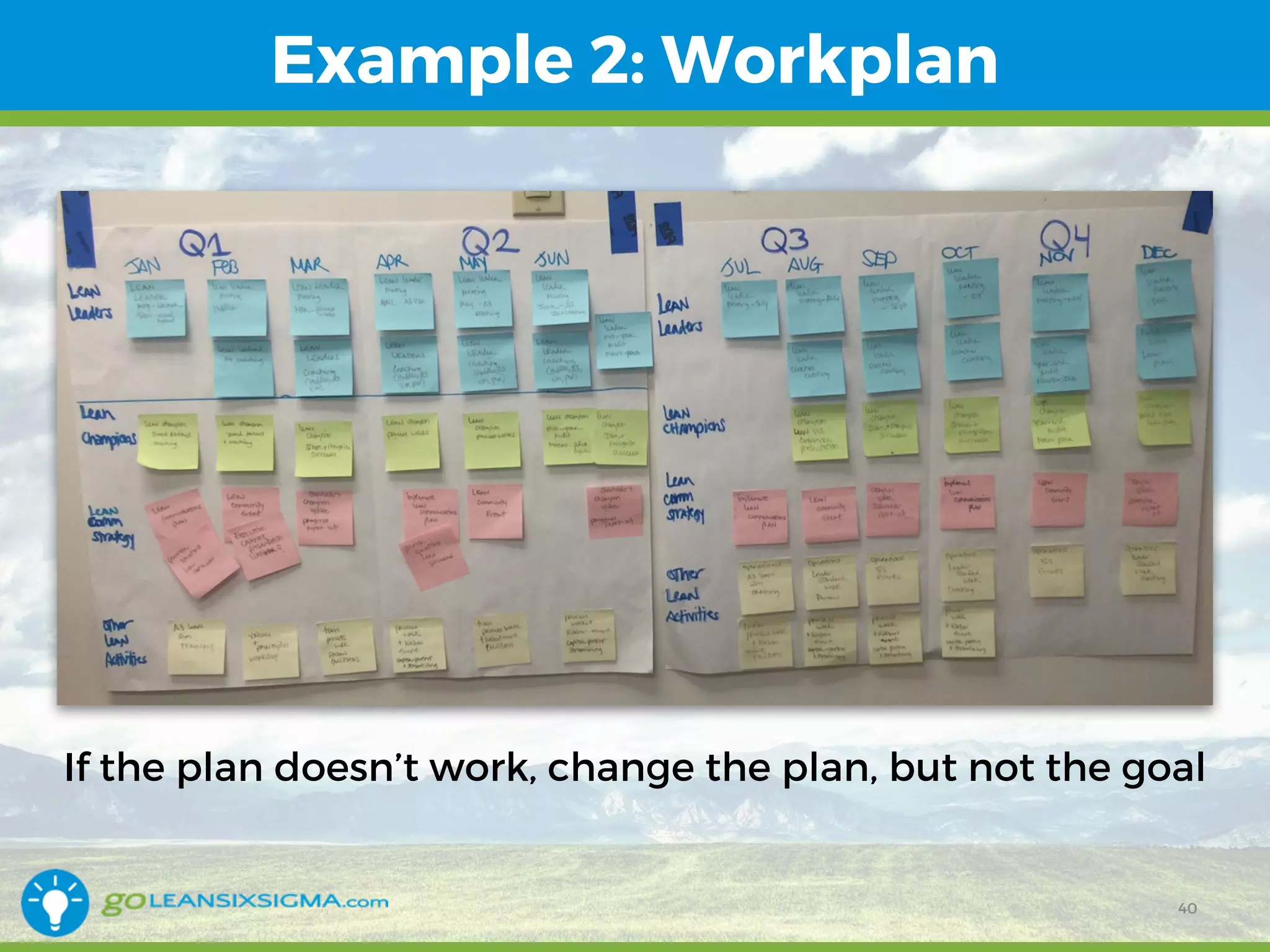
Example 2: Workplan
40
If the plan doesn’t work, change the plan, but not the goal
Lean Six Sigma Training Rollout Kit
https://goleansixsigma.com/webinar-rollout-lean-six-sigma-training/
41
Check Progress
on the Lean Six
Sigma Workplan
How do we stay
on track?
42
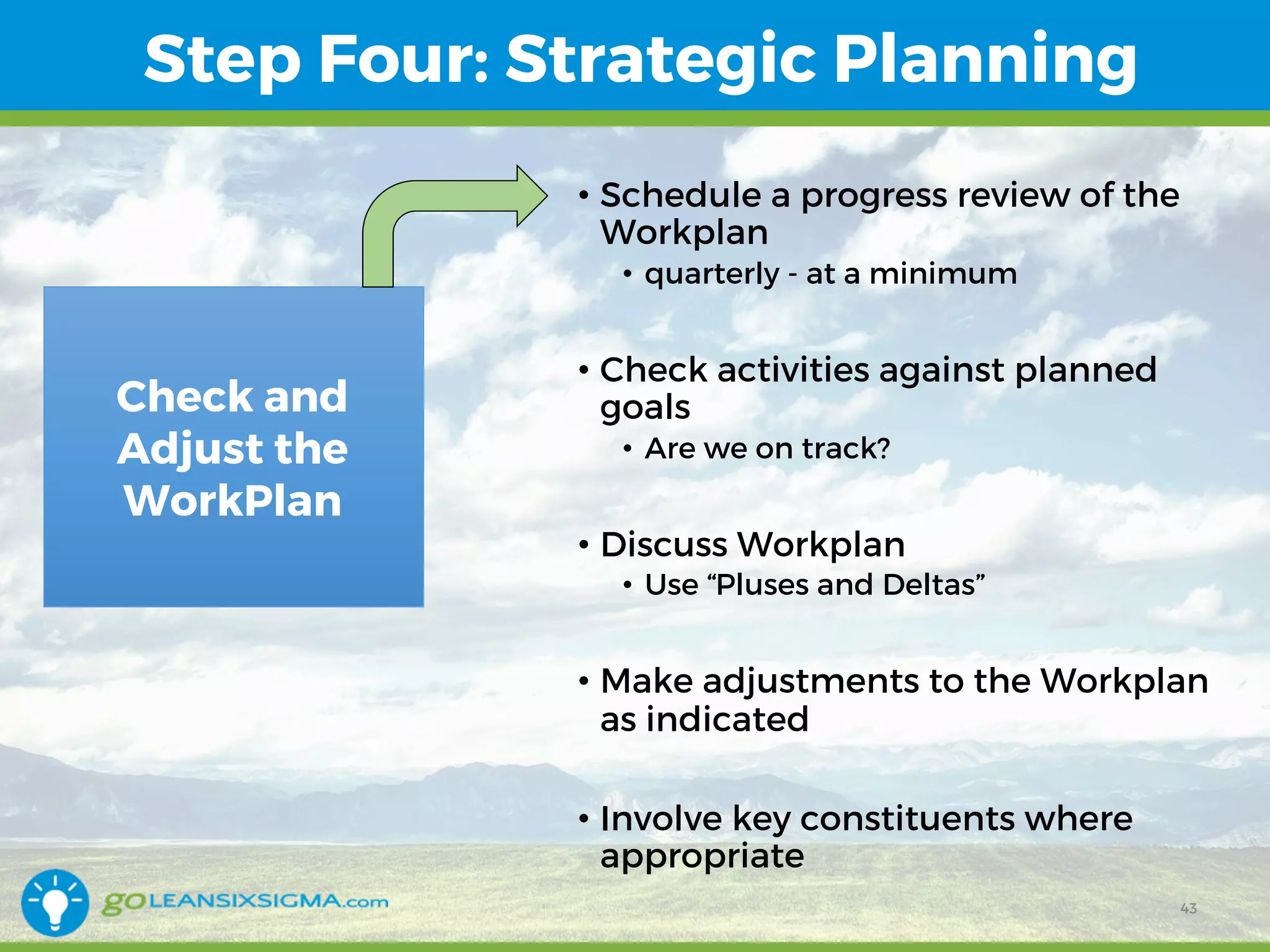
Step Four: Strategic Planning
Check and
Adjust the
WorkPlan
• Schedule a progress review of the
Workplan
• quarterly - at a minimum
• Check activities against planned
goals
• Are we on track?
• Discuss Workplan
• Use “Pluses and Deltas”
• Make adjustments to the Workplan
as indicated
• Involve key constituents where
appropriate
43
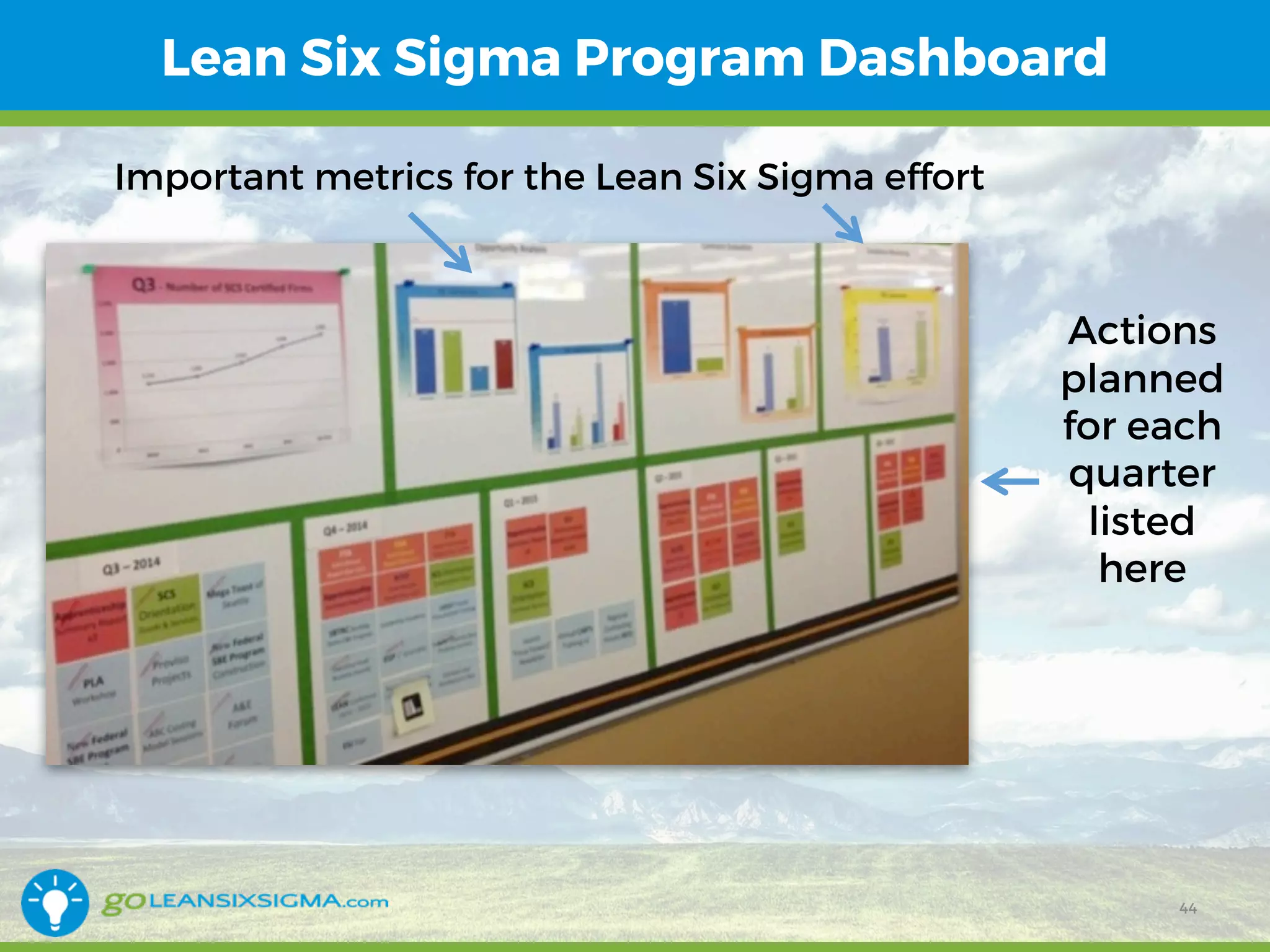
Lean Six Sigma Program Dashboard
Important metrics for the Lean Six Sigma effort
Actions
planned
for each
quarter
listed
here
44
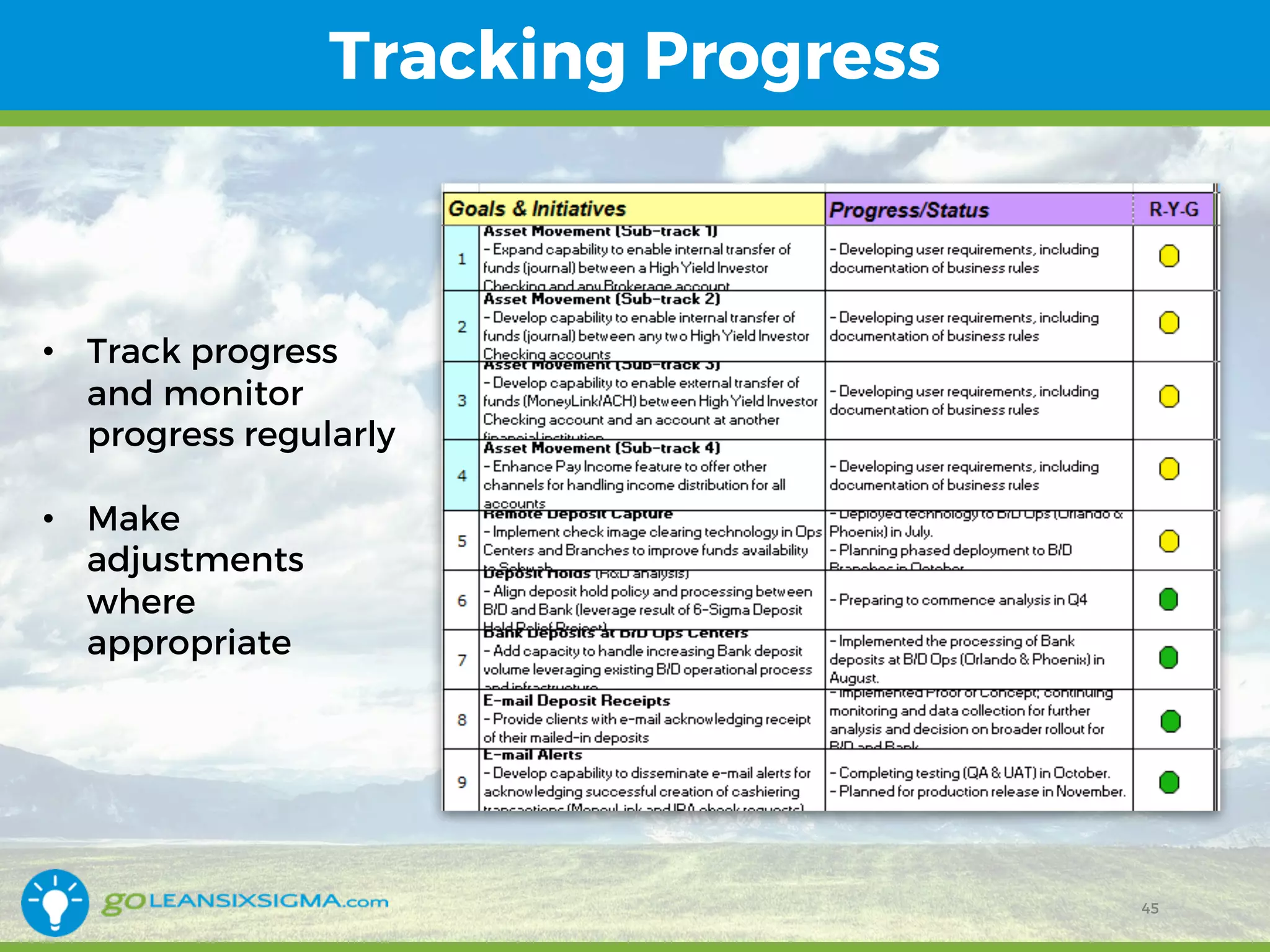
Tracking Progress
• Track progress
and monitor
progress regularly
• Make
adjustments
where
appropriate
45
12/15/16 46
Today We Covered
Building a Strategic Plan for a Lean Six Sigma Program Office
• Why Strategic Planning is important
• Gathering Inputs
• Creating a Vision, a Mission, Goals & Objectives
• Developing Measures of Success
• Determining Roles, Responsibilities and Resource Allocation
• Building and executing a Workplan
• Checking Workplan progress
46
Strategic Planning Process
• Gather inputs for
organizational
Vision, Mission,
Goals, Objectives
and Measures
• Determine which
Organizational
Goals & Objectives
are supported by
Lean Six Sigma
• Gather C-Suite
and Sponsor
Feedback on Lean
Six Sigma
Program Goals
and Objectives
• Gather
information on
internal resources,
external support
and budget
Gather
Organizational
Inputs
Define
Purpose and
Goals
Define Roles &
Time
Commitments
Build and
Execute the
Workplan
Check and
Adjust the
Workplan
• Develop Lean Six
Sigma Vision,
Mission, Goals,
Objectives and
Measures
• Conduct a SWOT
Analysis on the
organization and
Lean Six Sigma
department
• Create a
Dashboard or
Visual
Management
Board for Huddles
• Vet the Vision,
Mission, Goals,
Objectives and
Measures with
Stakeholders
• Define roles of
within Lean Six
Sigma effort
• Determine who
will fulfill the
Lean Six Sigma
roles
• Determine the %
of time personnel
will dedicate to
fulfilling each role
• Develop
descriptions for
each role
• Communicate
and vet the roles
with Stakeholders
• Build a quarterly
timeline for the
effort
• Create a high level
Workplan for 12-18
months
• Build a detailed
timeline every
rolling 6 months
• Identify who will
do what, by when
• Vet the Workplan
with stakeholders
• Revisit the
Workplan
quarterly - at a
minimum
• Check activities
and against
planned goals
• Discuss
Workplan pluses
and deltas
• Make
adjustments to
the Workplan as
indicated
• Involve
Stakeholders
where
appropriate
47
12/15/16 48
Q & A
48
12/15/16 49
Getting Started
Learn more by starting some more
training!
• Yellow Belt training is FREE at
GoLeanSixSigma.com
• Green Belt Training &
Certification
• Black Belt Training &
Certification
• Lean Training & Certification
49
12/15/16 50
Upcoming Webinars
Register today at GoLeanSixSigma.com/webinars
We’ll select upcoming webinars based on your feedback,
so please share your feedback on the survey at the end of close of this webinar.
50
12/15/16 51
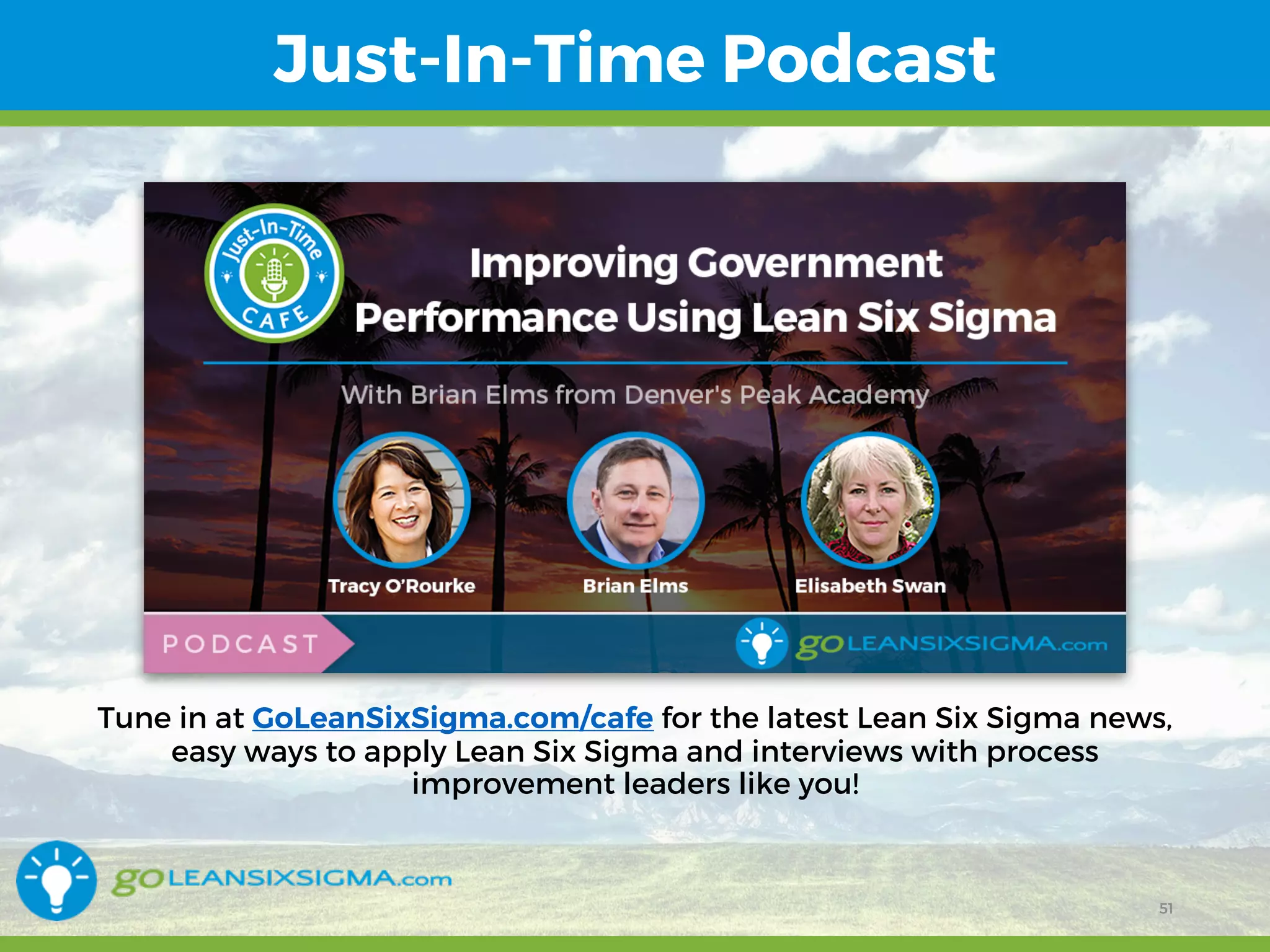
Just-In-Time Podcast
Tune in at GoLeanSixSigma.com/cafe for the latest Lean Six Sigma news,
easy ways to apply Lean Six Sigma and interviews with process
improvement leaders like you!
51
12/15/16 52
Q & A
52
12/15/16 53
Thank you for joining us!
More Questions?
Ask us at contact@goleansixsigma.com!
Click here to download
free tools, templates, infographics and more!
53

How to Create a Strategic Plan for a Lean Six Sigma Program Office

  • 1.
    12/15/16 1 Presented byTracy O’Rourke Managing Partner & Executive Advisor at GoLeanSixSigma.com How to Create a Strategic Plan for a Lean Six Sigma Program Office 1
  • 2.
    Our Expert: Tracy •Managing Partner & Executive Advisor at GoLeanSixSigma.com • Began Process Improvement career at GE where earned Black Belt • UCSD & SDSU Instructor: Lean Enterprise and Lean Six Sigma Master Black Belt Courses • MBA from Pepperdine University • BA in English Literature from San Francisco State University 2
  • 3.
    12/15/16 3 How toInteract • Ask a question • Answer polls 3
  • 4.
    12/15/16 4 Let’s Interact! Whereare you from? Share your location in the Questions area in your Control Panel! 4
  • 5.
    12/15/16 5 Who IsGoLeanSixSigma.com? GoLeanSixSigma.com makes it easy for everyone everywhere to build their problem-solving muscles. We provide the most practical, easy to understand and enjoyable Lean and Six Sigma resources available. 5
  • 6.
    Building a StrategicPlan for a Lean Six Sigma Program Office • Why Strategic Planning is important • Gathering Inputs • Creating A Vision, A Mission, Goals & Objectives • Developing Measures of Success • Determining Roles, Responsibilities and Resource Allocation • Building and Executing a Workplan • Checking Workplan progress 6 Today’s Agenda
  • 7.
    • . Why StrategicPlanning for LSS? 1. What do we want to be? 2. Where are we now? 3. How will we get there? 4. How do we stay on track? 5. How will we know we got there? 7
  • 8.
    Lean Six ProgramPlanning Gather Organizational Inputs Define Purpose & Goals Define Roles & Responsibilities Build and Execute the Workplan Check and Adjust the Workplan The high level strategic planning process Plan Do Check & Act 8
  • 9.
    Step One: StrategicPlanning • Gather the organization’s Vision, Mission, Goals, Objectives and Measures • Determine which Organizational Goals & Objectives can be supported by Lean Six Sigma • Gather Feedback about Lean Six Sigma Efforts • Gather existing customer feedback on products and services • Gather information on internal resources, external support and budget Gather Organizational Inputs 9
  • 10.
  • 11.
    Input Example: Organization’sGoals POLL: If these were your organization’s goals, which goal could be supported by Lean Six Sigma? 11
  • 12.
    Poll #1: If thesewere your organization’s goals, which goal could be supported by Lean Six Sigma? A. Goal A: Customer Service B. Goal A & B: Customer Service and Operational Enhancement C. Goal C: Fiscal Responsibility D. Goal D: Staff Development E. All of the goals 12
  • 13.
    13 Creating Organizational Connection Charteringprojects with little or no significance to the organization’s strategy is suboptimal
  • 14.
    Poll #2: Do youhave a clear idea how your process improvement efforts fit into the strategy of your organization? A. No, it is not clear how my efforts align to our strategy. B. Sort of. I know the strategy, but not sure what I can do daily or weekly to support it. C. Yes, but there is still confusion. D. Yes, it’s clear and our team meets regularly to discuss it. 14
  • 15.
    Step Two: StrategicPlanning Define Purpose and Goals • Develop Lean Six Sigma Vision, Mission, Goals, Objectives and Measures • Develop Measures of Success for the Lean Six Sigma Program • Create a Dashboard or Visual Management Board for Huddles • Vet the Vision, Mission, Goals, Objectives and Measures with key constituents 15
  • 16.
    Vision & Mission: Who arewe and what do we want to be?Without a vision, any road will do. 16
  • 17.
    Vision Statement • Vision:Insures everyone (especially leaders) have the same view of what a Lean Six Sigma Department and the future of the organization will look like • A Vision statement articulates the ideal future state of the organization. Describes what the future will look like and what the organization will become with Lean Six Sigma 17
  • 18.
    Example of VisionStatements 1 32 Mission: §  We will design an organization and governance model that will enable our company to build continuous improvement capability §  We will demonstrate the value of continuous improvement through a series of projects that show tangible results for our stakeholders and external customers §  We will build a toolkit for CPI practitioners that can be re-used in projects and used to train new team members §  We will define a roadmap to scale up continuous improvement efforts enterprise wide §  We will support practitioners when they need assistance in applying CPI methodologies Vision: We are the continuous improvement arm of our company. Over time, we want to instill a continuous improvement mentality and culture in the organization – a new way of thinking Every employee is a problem solver and every leader is a coach. Vision: Develop People So That… 8 22 Vision: Build an organization of problem- solvers 18
  • 19.
    Mission Statement The missionstatement should be a concise statement developed from the customer's perspective. The mission should answer three questions: •What do we do? •How do we do it? •For whom do we do it? 19
  • 20.
    Example of MissionStatements 2 32 Mission: §  We will design an organization and governance model that will enable our company to build continuous improvement capability §  We will demonstrate the value of continuous improvement through a series of projects that show tangible results for our stakeholders and external customers §  We will build a toolkit for CPI practitioners that can be re-used in projects and used to train new team members §  We will define a roadmap to scale up continuous improvement efforts enterprise wide §  We will support practitioners when they need assistance in applying CPI methodologies Vision: We are the continuous improvement arm of our company. Over time, we want to instill a continuous improvement mentality and culture in the organization – a new way of thinking Our Mission: We are committed to promoting the adoption, advancement and integration of Lean concepts into our business and help our employees learn and apply process improvement skills effectively. 20
  • 21.
  • 22.
    SWOT Analysis • SWOTis an acronym for Strengths, Weaknesses, Opportunities, Threats • The SWOT analysis is an extremely useful tool for understanding all sorts of situations in business and the organization 22 38 OPEX Program Strengths Strengths u  Achieved monetary savings —  Tote Management —  Demurrage u  Employees involved are dedicated and hard working u  Wave 1 Green Belts are trained and certified u  Robust training with support for project work u  Field interest is high u  Collaborative approach is successful 39 OPEX Program Weaknesses Weaknesses u  Lack of strategy execution u  Lack of consistent, internal leadership u  Selection of projects u  Plan to communicate with the field and LSS participants u  Lack of planning u  Competing resources with other initiatives u  Alignment from executive level to project level
  • 23.
    SWOT: Questions toAsk • What Lean Six Sigma strengths does the organization have that will help achieve our vision? • What Lean Six Sigma weaknesses does the Program Office have that might be a barrier to achieve our vision? • What strengths can we leverage? • What weaknesses should be prioritized? • What opportunities should we accept? • What threats should be addressed? • How can we support the organization in their CI goals? • Where do we need to develop organizational skills? • What skills do we need to develop in our department? 23
  • 24.
    Lean Six Sigma ProgramOffice Goals & Objectives How will we get there? 24
  • 25.
    Typical Lean SixSigma Benefits 25
  • 26.
    Goals, Objectives andTactics • Goal: A broad-based statement about what you want to achieve • Objectives: Strategies that will be taken to achieve the goal • Tactics: Specific measurable actions with a time for completion 26
  • 27.
    Example: Goals &Objectives • Goal 2: Build the problem-solving muscles or our employees • Train employees on Yellow Belt and Green Belt programs • Select and train co-facilitators for Process Walks and Rapid Improvement Events • Help employees see waste, reduce and eliminate it • Train employees on the 8 Wastes and waste walks • Conduct waste walks • Train co-facilitators on conducting waste walks • Help employees reduce and eliminate waste • Share and Celebrate Success 27 • Goal 1: Support employees in their efforts to achieve our organizational goals using Lean Six Sigma • Facilitate process walks and rapid improvement events for the selected efforts • Identify and complete projects will measurable results to reduce lead time and errors • Share and celebrate success • Goal 3: Build a community of process improvement for our organization • Find success stories, share and celebrate them • Create and schedule forums for best practices • Help leaders learn apply new behaviors to promote Lean Six Sigma activity
  • 28.
    Determine Success Measures How willwe know we got there? 28
  • 29.
    Measures A few guidelineswhen selecting measures: • Don’t pick too many • Ensure that the measures align with the Lean Six Sigma Program Office’s goals • Create operational definitions and data collection plans around the measures you select • Be sure the data is reliable • Pick measures within your control • Be mindful of what measures drive undesirable behavior and adjust if necessary 29
  • 30.
    Example: Lean SixSigma Measures • # of projects completed • Lead time to complete projects • # of employee ideas submitted • # of employee ideas implemented • Dollars saved (Hard & Soft Dollars) • # of people trained • # of Yellow Belts • # of Green Belts • # of Black Belts 30
  • 31.
    More Lean SixSigma Measures • # of processes with reduced lead time, or reduced errors that improve our service levels to the customer • A balanced portfolio of projects that align with strategy Project Impact • Customer impact • Productivity improvement • Dollars Saved Project Size • Incremental Improvement (Individual) • Evolutionary Improvement (Teams) • Revolutionary Improvement (Value Streams) • Skill-Building measures: # of employees • trained as Kaizen Event facilitators • Running Green Belt projects • using Leader Standard Work tools such as Visual Management Boards, Huddles 31
  • 32.
    Connecting Goals, Objectives& Measures 32 Goal 2: Build the problem-solving muscles or our employees Measures Train employees on Yellow Belt and Green Belt programs # of employees trained Yellow Belt & Green Belt Select and train co-facilitators for Process Walks and Rapid Improvement Events # of co-facilitators in training for Process Walks and RIEs Help employees see waste, reduce and eliminate it # of employees trained on the 8 wastes Conduct waste walks Train co-facilitators on conducting waste walks # of waste walks; # of co-facilitators trained on conducting waste walks Help employees reduce and eliminate waste # of A3s completed on reducing waste Share and Celebrate Success # of documented success stories; # of scheduled best practice forums
  • 33.
    Example: Lean SixSigma Measures & Visual Management Goal 2: # of employees trained 33
  • 34.
    Poll #3: Which ofthese measures does your organization use? A. Dollars saved B. # of projects completed C. # of ideas submitted or implemented D. Skill Building Measures E. A combination of all of the above 34
  • 35.
    Step Three: StrategicPlanning Define Roles & Responsibilities • Define roles within the Lean Six Sigma effort • Determine who will fulfill the Lean Six Sigma roles • Determine the % of time personnel will dedicate to fulfilling each role • Develop descriptions for each role • Communicate and vet the roles with Stakeholders 35
  • 36.
  • 37.
    Step Four: StrategicPlanning Build and Execute the Workplan • Build a quarterly timeline for the effort • Create a high level Workplan for 12-18 months • Build a detailed timeline every rolling 6 months • Identify who will do what, by when • Vet the Workplan with key constituents 37
  • 38.
    Workplan Considerations A Workplanis a timeline and tactics to deliver on the Goals & Objectives for 12-18 months. Consider: • Resource allocation • Bandwidth capacity and skills, who will do what • Involve those that will do the work • External and Internal resources • Include communication and celebration activities • Include actions for the team to: • Check on the Workplan and success measures • Assess current roles and adjustments where appropriate • De-brief key constituents and stakeholders on progress 38
  • 39.
  • 40.
    Example 2: Workplan 40 Ifthe plan doesn’t work, change the plan, but not the goal
  • 41.
    Lean Six SigmaTraining Rollout Kit https://goleansixsigma.com/webinar-rollout-lean-six-sigma-training/ 41
  • 42.
    Check Progress on theLean Six Sigma Workplan How do we stay on track? 42
  • 43.
    Step Four: StrategicPlanning Check and Adjust the WorkPlan • Schedule a progress review of the Workplan • quarterly - at a minimum • Check activities against planned goals • Are we on track? • Discuss Workplan • Use “Pluses and Deltas” • Make adjustments to the Workplan as indicated • Involve key constituents where appropriate 43
  • 44.
    Lean Six SigmaProgram Dashboard Important metrics for the Lean Six Sigma effort Actions planned for each quarter listed here 44
  • 45.
    Tracking Progress • Trackprogress and monitor progress regularly • Make adjustments where appropriate 45
  • 46.
    12/15/16 46 Today WeCovered Building a Strategic Plan for a Lean Six Sigma Program Office • Why Strategic Planning is important • Gathering Inputs • Creating a Vision, a Mission, Goals & Objectives • Developing Measures of Success • Determining Roles, Responsibilities and Resource Allocation • Building and executing a Workplan • Checking Workplan progress 46
  • 47.
    Strategic Planning Process •Gather inputs for organizational Vision, Mission, Goals, Objectives and Measures • Determine which Organizational Goals & Objectives are supported by Lean Six Sigma • Gather C-Suite and Sponsor Feedback on Lean Six Sigma Program Goals and Objectives • Gather information on internal resources, external support and budget Gather Organizational Inputs Define Purpose and Goals Define Roles & Time Commitments Build and Execute the Workplan Check and Adjust the Workplan • Develop Lean Six Sigma Vision, Mission, Goals, Objectives and Measures • Conduct a SWOT Analysis on the organization and Lean Six Sigma department • Create a Dashboard or Visual Management Board for Huddles • Vet the Vision, Mission, Goals, Objectives and Measures with Stakeholders • Define roles of within Lean Six Sigma effort • Determine who will fulfill the Lean Six Sigma roles • Determine the % of time personnel will dedicate to fulfilling each role • Develop descriptions for each role • Communicate and vet the roles with Stakeholders • Build a quarterly timeline for the effort • Create a high level Workplan for 12-18 months • Build a detailed timeline every rolling 6 months • Identify who will do what, by when • Vet the Workplan with stakeholders • Revisit the Workplan quarterly - at a minimum • Check activities and against planned goals • Discuss Workplan pluses and deltas • Make adjustments to the Workplan as indicated • Involve Stakeholders where appropriate 47
  • 48.
  • 49.
    12/15/16 49 Getting Started Learnmore by starting some more training! • Yellow Belt training is FREE at GoLeanSixSigma.com • Green Belt Training & Certification • Black Belt Training & Certification • Lean Training & Certification 49
  • 50.
    12/15/16 50 Upcoming Webinars Registertoday at GoLeanSixSigma.com/webinars We’ll select upcoming webinars based on your feedback, so please share your feedback on the survey at the end of close of this webinar. 50
  • 51.
    12/15/16 51 Just-In-Time Podcast Tunein at GoLeanSixSigma.com/cafe for the latest Lean Six Sigma news, easy ways to apply Lean Six Sigma and interviews with process improvement leaders like you! 51
  • 52.
  • 53.
    12/15/16 53 Thank youfor joining us! More Questions? Ask us at contact@goleansixsigma.com! Click here to download free tools, templates, infographics and more! 53