Six Sigma Management
Contents :
• Six Sigma : An Overview
• What is Six Sigma?
• Why Six Sigma?
• Six Sigma Phases : Define, Measure, Analyze, Improve and
Control
• Tools and Key Roles for Six Sigma
Why Six Sigma?
What is Sigma ?
Sigma
A term used in statistics to represent
standard deviation, an indicator of the
degree of variation in a set of a process
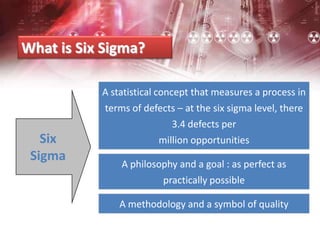
What is Six Sigma?
Six
Sigma
A statistical concept that measures a process in
terms of defects – at the six sigma level, there
3.4 defects per
million opportunities
A philosophy and a goal : as perfect as
practically possible
A methodology and a symbol of quality
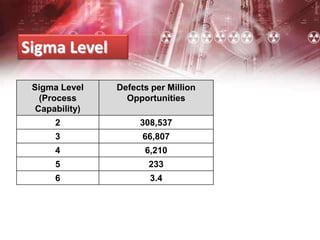
Sigma Level
Sigma Level
(Process
Capability)
Defects per Million
Opportunities
2 308,537
3 66,807
4 6,210
5 233
6 3.4
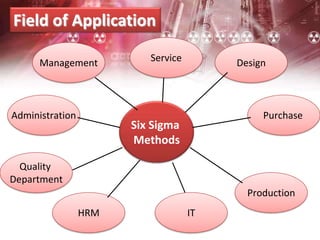
Administration
Field of Application
Six Sigma =
99,9997%
Six Sigma
Methods
Management
HRM IT
Production
Purchase
DesignService
Quality
Department
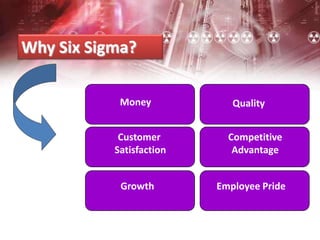
Why Six Sigma?
Money
Customer
Satisfaction
Growth
Quality
Competitive
Advantage
Employee Pride
• At GE, Six Sigma added more than $ 2 billion to the bottom
line in 1999 alone
• Motorola saved more than $ 15 billion in the first 10 years of
its Six Sigma effort
• AlliedSignal reports saving $ 1,5 billion through Six Sigma.
Why Six Sigma?
Why Six Sigma?
Six Sigma is about practices that help you
eliminate defects and always deliver products
and services that meet customer specifications
Cost of Poor Quality
What is cost of scrap?
What is cost of rework?
What is cost of excessive cycle times and delays?
Cost of Poor Quality
What is cost of business lost because customers are
dissatisfied with your products or services?
What is cost of opportunities lost because you
didn’t have time or the resources to take advantage
of them?
Critical-to-Quality (CTQ)
Elements of a process that significantly affect the
output of that process. Identifying these elements is
figuring out how to make improvements that can
dramatically reduce costs and enhance quality.
Companies Implemented Six Sigma
o 3M
o Air Canada
o Amazon.Com
o Bank of America
o Boeing
o Caterpillar, Inc.
o Corning
o Dell
o DHL
o Eastman Kodak Company
o Ford
o General Electric
o GlaxoSmithKline
o HSBC Group
o LG Group
o Motorola
o Samsung Group
o Siemens AG
o McGraw-Hill Companies
o US Air Force, US Navy, US Marine Corps
o Vodafone
o Whirlpool
o Xerox
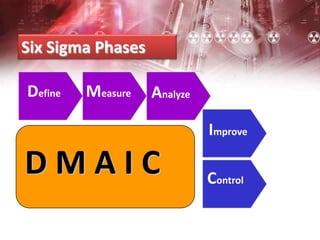
Six Sigma Phases
Define Measure Analyze
Improve
Control
Six Sigma Phases
D M A I C
Define
Measure
Analyze
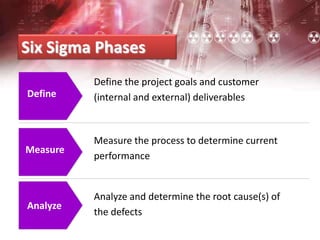
Six Sigma Phases
Define the project goals and customer
(internal and external) deliverables
Measure the process to determine current
performance
Analyze and determine the root cause(s) of
the defects
Improve
Control
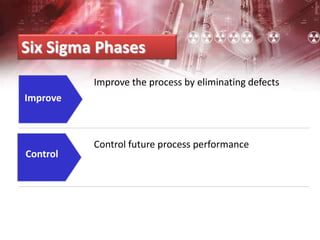
Six Sigma Phases
Control future process performance
Improve the process by eliminating defects
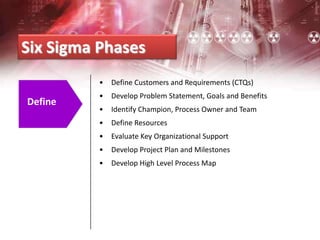
Six Sigma Phases
Define
• Define Customers and Requirements (CTQs)
• Develop Problem Statement, Goals and Benefits
• Identify Champion, Process Owner and Team
• Define Resources
• Evaluate Key Organizational Support
• Develop Project Plan and Milestones
• Develop High Level Process Map
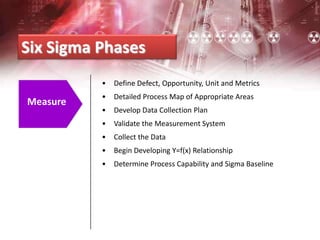
Six Sigma Phases
Measure
• Define Defect, Opportunity, Unit and Metrics
• Detailed Process Map of Appropriate Areas
• Develop Data Collection Plan
• Validate the Measurement System
• Collect the Data
• Begin Developing Y=f(x) Relationship
• Determine Process Capability and Sigma Baseline
Six Sigma Phases
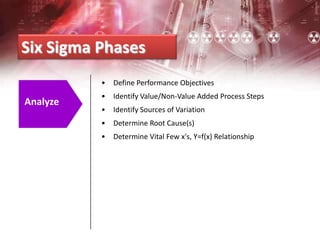
Analyze
• Define Performance Objectives
• Identify Value/Non-Value Added Process Steps
• Identify Sources of Variation
• Determine Root Cause(s)
• Determine Vital Few x's, Y=f(x) Relationship
Six Sigma Phases
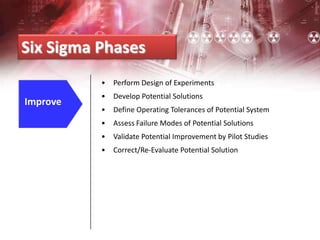
Improve
• Perform Design of Experiments
• Develop Potential Solutions
• Define Operating Tolerances of Potential System
• Assess Failure Modes of Potential Solutions
• Validate Potential Improvement by Pilot Studies
• Correct/Re-Evaluate Potential Solution
Six Sigma Phases
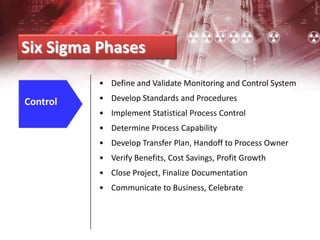
Control
• Define and Validate Monitoring and Control System
• Develop Standards and Procedures
• Implement Statistical Process Control
• Determine Process Capability
• Develop Transfer Plan, Handoff to Process Owner
• Verify Benefits, Cost Savings, Profit Growth
• Close Project, Finalize Documentation
• Communicate to Business, Celebrate
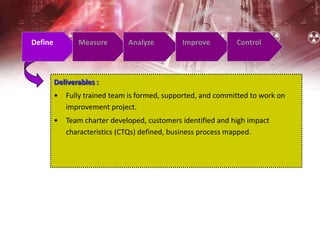
Define Measure Analyze Improve Control
Deliverables :
• Fully trained team is formed, supported, and committed to work on
improvement project.
• Team charter developed, customers identified and high impact
characteristics (CTQs) defined, business process mapped.
Checkpoints for Readiness
Team Readiness :
• Team is sponsored by a champion or business leader.
• Team formed and team leaders assigned.
• Improvement team members fully trained on Six Sigma and DMAIC.
Define Measure Analyze Improve Control
Team Charter :
• Completed project management charter, including business case, problem
and goal statements, project scope, milestones, roles and
responsibilities, communication plan.
Define Measure Analyze Improve Control
Checkpoints for Readiness
Customers
• Customer(s) identified and segmented according to their different needs
and requirements.
• Data collected and displayed to better understand customer(s) critical needs
and requirements.
Business Process Mapping
• Completed, verified, and validated high-level 'as is' (not 'should be' or 'could
be') business process map.
• Completed SIPOC representation, describing the
Suppliers, Inputs, Process, Outputs, and Customers.
Define Measure Analyze Improve Control
Deliverables :
• Key measures identified, data collection planned and executed, process
variation displayed and communicated, performance baselined, sigma level
calculated.
Define Measure Analyze Improve Control
Checkpoints for Readiness
Key Measures Identified
• Key measures identified and agreed upon.
• High impact defects defined and identified in the business process.
Data Collection Planned and Executed
• Solid data collection plan established that includes measurement
systems analysis.
• Data collected on key measures that were identified.
Define Measure Analyze Improve Control
Checkpoints for Readiness
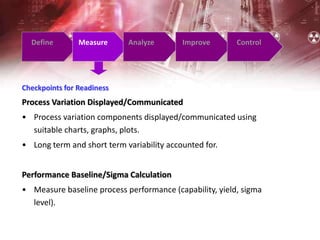
Process Variation Displayed/Communicated
• Process variation components displayed/communicated using
suitable charts, graphs, plots.
• Long term and short term variability accounted for.
Performance Baseline/Sigma Calculation
• Measure baseline process performance (capability, yield, sigma
level).
Define Measure Analyze Improve Control
Deliverables :
• Data and process analysis, root cause analysis, quantifying the
gap/opportunity.
Define Measure Analyze Improve Control
Checkpoints for Readiness
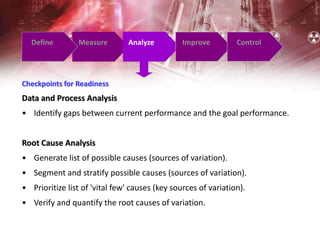
Data and Process Analysis
• Identify gaps between current performance and the goal performance.
Root Cause Analysis
• Generate list of possible causes (sources of variation).
• Segment and stratify possible causes (sources of variation).
• Prioritize list of 'vital few' causes (key sources of variation).
• Verify and quantify the root causes of variation.
Define Measure Analyze Improve Control
Checkpoints for Readiness
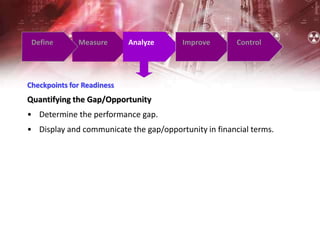
Quantifying the Gap/Opportunity
• Determine the performance gap.
• Display and communicate the gap/opportunity in financial terms.
Define Measure Analyze Improve Control
Deliverables :
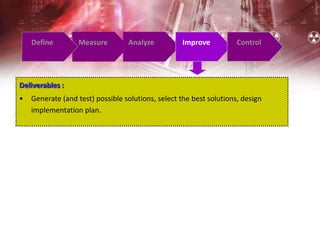
• Generate (and test) possible solutions, select the best solutions, design
implementation plan.
Define Measure Analyze Improve Control
Checkpoints for Readiness
Generating (and Testing) Possible Solutions
• Possible solutions generated and tested.
Define Measure Analyze Improve Control
Checkpoints for Readiness
Selecting The Best Solution(s)
• Optimal solution selected based on testing and analysis.
• New and improved process ('should be') maps developed.
• Cost/benefit analysis of optimal solution(s).
• Small-scale pilot for proposed improvement(s).
• Pilot data collected and analyzed.
• Improved process ('should be') maps modified based on pilot data and
analysis.
• Project impact on utilizing the best solution(s).
Define Measure Analyze Improve Control
Checkpoints for Readiness
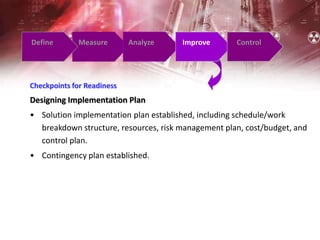
Designing Implementation Plan
• Solution implementation plan established, including schedule/work
breakdown structure, resources, risk management plan, cost/budget, and
control plan.
• Contingency plan established.
Define Measure Analyze Improve Control
Deliverables :
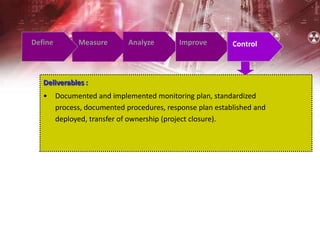
• Documented and implemented monitoring plan, standardized
process, documented procedures, response plan established and
deployed, transfer of ownership (project closure).
Define Measure Analyze Improve Control
Checkpoints for Readiness
Monitoring Plan
• Control plan in place for sustaining improvements (short and long-term).
Process Standardization
• New process steps, standards, and documentation are ingrained into
normal operations.
Documented Procedures
• Operating procedures are consistent.
• Knowledge gained on process is shared and institutionalized.
Define Measure Analyze Improve Control
Checkpoints for Readiness
Response Plan
• Response plans established, understood, and deployed.
Transfer of Ownership (Project Closure)
• Transfer ownership and knowledge to process owner and process team
tasked with the responsibilities.
Tools and Roles for
Six Sigma
• Creating flowcharts of the step in a process –
operations, decision
points, delays, movements, handoffs, rework, loops, and
controls or inspections.
• A process map is illustrated description of how a process
work.
Tools for Six Sigma
Process Mapping
• DOE is a structured, organized method for determining
the relationship between factors (Xs) affecting a process
and the output of that process (Y).
Tools for Six Sigma
Design of
Experiments or
DOE
• A group of rows and columns, with one set of increments
marked along the X (horizontal) axis and another set of
increments marked along the Y (vertical) axis.
• The purpose of using XY matrix is to study and understand
the relationship between what you are putting into a
process and what your customer is getting out of it.
• The XY matrix allows the team to identify gaps, areas for
improvement.
Tools for Six Sigma
XY Matrix
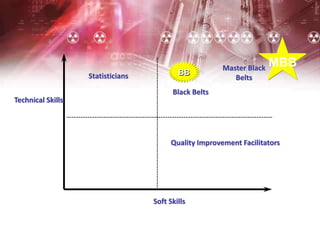
Technical Skills
Soft Skills
Statisticians
Master Black
Belts
Black Belts
Quality Improvement Facilitators
BB
MBB
• The goal of this tool is to ensure that your measurement
system is statically confident – that it’s both accurate and
precise each and every time it is used.
• Undertaken during Measure phase, your MSA determines
whether or not you can take a certain measurement and
repeat or reproduce it among different people who take
the same measurement.
Tools for Six Sigma
Measurement
System Analysis
• Process capability tool is the measure of a process being
able to meet specification requirements and fulfill
customer CTQ needs on a long term basis.
Tools for Six Sigma
Process
Capability Tool
• Investigating a theory about the suspected cause (s) of a
particular effect in a process to determine if it is correct.
• It’s a compass that points you directly to the vital few
factors that are most affecting your process.
Tools for Six Sigma
Hypothesis
Testing
• The manner in which a part or process can fail to meet a
specification, creating a defect or non-conformance, and
the impact on the customer if that failure mode is not
prevented or corrected.
Tools for Six Sigma
Failure Mode
Effect Analysis
• A detailed assessment and guide for maintaining all the
positive changes you, your black belt, and the project
team have made.
• It ensures that all your analysis and efforts stay in effect
and that you have information at your disposal to prevent
backsliding or a return to less than optimal performance
standard.
Tools for Six Sigma
Control
Plan
Champions Are responsible for the Six Sigma implementation across the
organization in an integrated manner. Champions also act as
mentor to Black Belts.
Includes CEO and other key top management team members.
They are responsible for setting up a vision for Six Sigma
implementation.
Key Roles for Six Sigma
Executive
Leadership
Black Belts Operate under Master Black Belts to apply Six Sigma
methodology to specific projects. They primarily focus on Six
Sigma project execution.
Identified by champions, act as in-house expert coach for the
organization on Six Sigma. They devote 100% of their time to Six
Sigma.
Key Roles for Six Sigma
Master Black
Belts
Are the employees who take up Six Sigma implementation along
with their other job responsibilities. They operate under the
guidance of Black Belts and support them in achieving the overall
results.
Key Roles for Six Sigma
Green Belts
Six Sigma Do’s
• Do communicate the commitment company-wide
• Do demonstrate the commitment of company
leaders
• Do empower your key human resources
• Do provide on-site mentoring for black belts
Six Sigma Do’s
• Do be patient at the inception of you six Sigma
initiative
• Do claim and advertise early “wins”
• Do benchmark
• Do establish project baseline and goals
Recommended Further Readings:
1. Greg Brue, Six Sigma for Managers, McGraw Hill
2. George Eckes, Six Sigma for Everyone, John Wiley and Sons
Thank you...!!!!

Six sigma

  • 1.
  • 2.
    Contents : • SixSigma : An Overview • What is Six Sigma? • Why Six Sigma? • Six Sigma Phases : Define, Measure, Analyze, Improve and Control • Tools and Key Roles for Six Sigma
  • 3.
  • 4.
    What is Sigma? Sigma A term used in statistics to represent standard deviation, an indicator of the degree of variation in a set of a process
  • 5.
    What is SixSigma? Six Sigma A statistical concept that measures a process in terms of defects – at the six sigma level, there 3.4 defects per million opportunities A philosophy and a goal : as perfect as practically possible A methodology and a symbol of quality
  • 6.
    Sigma Level Sigma Level (Process Capability) Defectsper Million Opportunities 2 308,537 3 66,807 4 6,210 5 233 6 3.4
  • 7.
    Administration Field of Application SixSigma = 99,9997% Six Sigma Methods Management HRM IT Production Purchase DesignService Quality Department
  • 8.
  • 9.
    • At GE,Six Sigma added more than $ 2 billion to the bottom line in 1999 alone • Motorola saved more than $ 15 billion in the first 10 years of its Six Sigma effort • AlliedSignal reports saving $ 1,5 billion through Six Sigma. Why Six Sigma?
  • 10.
    Why Six Sigma? SixSigma is about practices that help you eliminate defects and always deliver products and services that meet customer specifications
  • 11.
    Cost of PoorQuality What is cost of scrap? What is cost of rework? What is cost of excessive cycle times and delays?
  • 12.
    Cost of PoorQuality What is cost of business lost because customers are dissatisfied with your products or services? What is cost of opportunities lost because you didn’t have time or the resources to take advantage of them?
  • 13.
    Critical-to-Quality (CTQ) Elements ofa process that significantly affect the output of that process. Identifying these elements is figuring out how to make improvements that can dramatically reduce costs and enhance quality.
  • 14.
    Companies Implemented SixSigma o 3M o Air Canada o Amazon.Com o Bank of America o Boeing o Caterpillar, Inc. o Corning o Dell o DHL o Eastman Kodak Company o Ford o General Electric o GlaxoSmithKline o HSBC Group o LG Group o Motorola o Samsung Group o Siemens AG o McGraw-Hill Companies o US Air Force, US Navy, US Marine Corps o Vodafone o Whirlpool o Xerox
  • 15.
  • 16.
  • 17.
    Define Measure Analyze Six Sigma Phases Definethe project goals and customer (internal and external) deliverables Measure the process to determine current performance Analyze and determine the root cause(s) of the defects
  • 18.
    Improve Control Six Sigma Phases Controlfuture process performance Improve the process by eliminating defects
  • 19.
    Six Sigma Phases Define •Define Customers and Requirements (CTQs) • Develop Problem Statement, Goals and Benefits • Identify Champion, Process Owner and Team • Define Resources • Evaluate Key Organizational Support • Develop Project Plan and Milestones • Develop High Level Process Map
  • 20.
    Six Sigma Phases Measure •Define Defect, Opportunity, Unit and Metrics • Detailed Process Map of Appropriate Areas • Develop Data Collection Plan • Validate the Measurement System • Collect the Data • Begin Developing Y=f(x) Relationship • Determine Process Capability and Sigma Baseline
  • 21.
    Six Sigma Phases Analyze •Define Performance Objectives • Identify Value/Non-Value Added Process Steps • Identify Sources of Variation • Determine Root Cause(s) • Determine Vital Few x's, Y=f(x) Relationship
  • 22.
    Six Sigma Phases Improve •Perform Design of Experiments • Develop Potential Solutions • Define Operating Tolerances of Potential System • Assess Failure Modes of Potential Solutions • Validate Potential Improvement by Pilot Studies • Correct/Re-Evaluate Potential Solution
  • 23.
    Six Sigma Phases Control •Define and Validate Monitoring and Control System • Develop Standards and Procedures • Implement Statistical Process Control • Determine Process Capability • Develop Transfer Plan, Handoff to Process Owner • Verify Benefits, Cost Savings, Profit Growth • Close Project, Finalize Documentation • Communicate to Business, Celebrate
  • 24.
    Define Measure AnalyzeImprove Control Deliverables : • Fully trained team is formed, supported, and committed to work on improvement project. • Team charter developed, customers identified and high impact characteristics (CTQs) defined, business process mapped.
  • 25.
    Checkpoints for Readiness TeamReadiness : • Team is sponsored by a champion or business leader. • Team formed and team leaders assigned. • Improvement team members fully trained on Six Sigma and DMAIC. Define Measure Analyze Improve Control Team Charter : • Completed project management charter, including business case, problem and goal statements, project scope, milestones, roles and responsibilities, communication plan.
  • 26.
    Define Measure AnalyzeImprove Control Checkpoints for Readiness Customers • Customer(s) identified and segmented according to their different needs and requirements. • Data collected and displayed to better understand customer(s) critical needs and requirements. Business Process Mapping • Completed, verified, and validated high-level 'as is' (not 'should be' or 'could be') business process map. • Completed SIPOC representation, describing the Suppliers, Inputs, Process, Outputs, and Customers.
  • 27.
    Define Measure AnalyzeImprove Control Deliverables : • Key measures identified, data collection planned and executed, process variation displayed and communicated, performance baselined, sigma level calculated.
  • 28.
    Define Measure AnalyzeImprove Control Checkpoints for Readiness Key Measures Identified • Key measures identified and agreed upon. • High impact defects defined and identified in the business process. Data Collection Planned and Executed • Solid data collection plan established that includes measurement systems analysis. • Data collected on key measures that were identified.
  • 29.
    Define Measure AnalyzeImprove Control Checkpoints for Readiness Process Variation Displayed/Communicated • Process variation components displayed/communicated using suitable charts, graphs, plots. • Long term and short term variability accounted for. Performance Baseline/Sigma Calculation • Measure baseline process performance (capability, yield, sigma level).
  • 30.
    Define Measure AnalyzeImprove Control Deliverables : • Data and process analysis, root cause analysis, quantifying the gap/opportunity.
  • 31.
    Define Measure AnalyzeImprove Control Checkpoints for Readiness Data and Process Analysis • Identify gaps between current performance and the goal performance. Root Cause Analysis • Generate list of possible causes (sources of variation). • Segment and stratify possible causes (sources of variation). • Prioritize list of 'vital few' causes (key sources of variation). • Verify and quantify the root causes of variation.
  • 32.
    Define Measure AnalyzeImprove Control Checkpoints for Readiness Quantifying the Gap/Opportunity • Determine the performance gap. • Display and communicate the gap/opportunity in financial terms.
  • 33.
    Define Measure AnalyzeImprove Control Deliverables : • Generate (and test) possible solutions, select the best solutions, design implementation plan.
  • 34.
    Define Measure AnalyzeImprove Control Checkpoints for Readiness Generating (and Testing) Possible Solutions • Possible solutions generated and tested.
  • 35.
    Define Measure AnalyzeImprove Control Checkpoints for Readiness Selecting The Best Solution(s) • Optimal solution selected based on testing and analysis. • New and improved process ('should be') maps developed. • Cost/benefit analysis of optimal solution(s). • Small-scale pilot for proposed improvement(s). • Pilot data collected and analyzed. • Improved process ('should be') maps modified based on pilot data and analysis. • Project impact on utilizing the best solution(s).
  • 36.
    Define Measure AnalyzeImprove Control Checkpoints for Readiness Designing Implementation Plan • Solution implementation plan established, including schedule/work breakdown structure, resources, risk management plan, cost/budget, and control plan. • Contingency plan established.
  • 37.
    Define Measure AnalyzeImprove Control Deliverables : • Documented and implemented monitoring plan, standardized process, documented procedures, response plan established and deployed, transfer of ownership (project closure).
  • 38.
    Define Measure AnalyzeImprove Control Checkpoints for Readiness Monitoring Plan • Control plan in place for sustaining improvements (short and long-term). Process Standardization • New process steps, standards, and documentation are ingrained into normal operations. Documented Procedures • Operating procedures are consistent. • Knowledge gained on process is shared and institutionalized.
  • 39.
    Define Measure AnalyzeImprove Control Checkpoints for Readiness Response Plan • Response plans established, understood, and deployed. Transfer of Ownership (Project Closure) • Transfer ownership and knowledge to process owner and process team tasked with the responsibilities.
  • 40.
    Tools and Rolesfor Six Sigma
  • 41.
    • Creating flowchartsof the step in a process – operations, decision points, delays, movements, handoffs, rework, loops, and controls or inspections. • A process map is illustrated description of how a process work. Tools for Six Sigma Process Mapping
  • 42.
    • DOE isa structured, organized method for determining the relationship between factors (Xs) affecting a process and the output of that process (Y). Tools for Six Sigma Design of Experiments or DOE
  • 43.
    • A groupof rows and columns, with one set of increments marked along the X (horizontal) axis and another set of increments marked along the Y (vertical) axis. • The purpose of using XY matrix is to study and understand the relationship between what you are putting into a process and what your customer is getting out of it. • The XY matrix allows the team to identify gaps, areas for improvement. Tools for Six Sigma XY Matrix
  • 44.
    Technical Skills Soft Skills Statisticians MasterBlack Belts Black Belts Quality Improvement Facilitators BB MBB
  • 45.
    • The goalof this tool is to ensure that your measurement system is statically confident – that it’s both accurate and precise each and every time it is used. • Undertaken during Measure phase, your MSA determines whether or not you can take a certain measurement and repeat or reproduce it among different people who take the same measurement. Tools for Six Sigma Measurement System Analysis
  • 46.
    • Process capabilitytool is the measure of a process being able to meet specification requirements and fulfill customer CTQ needs on a long term basis. Tools for Six Sigma Process Capability Tool
  • 47.
    • Investigating atheory about the suspected cause (s) of a particular effect in a process to determine if it is correct. • It’s a compass that points you directly to the vital few factors that are most affecting your process. Tools for Six Sigma Hypothesis Testing
  • 48.
    • The mannerin which a part or process can fail to meet a specification, creating a defect or non-conformance, and the impact on the customer if that failure mode is not prevented or corrected. Tools for Six Sigma Failure Mode Effect Analysis
  • 49.
    • A detailedassessment and guide for maintaining all the positive changes you, your black belt, and the project team have made. • It ensures that all your analysis and efforts stay in effect and that you have information at your disposal to prevent backsliding or a return to less than optimal performance standard. Tools for Six Sigma Control Plan
  • 50.
    Champions Are responsiblefor the Six Sigma implementation across the organization in an integrated manner. Champions also act as mentor to Black Belts. Includes CEO and other key top management team members. They are responsible for setting up a vision for Six Sigma implementation. Key Roles for Six Sigma Executive Leadership
  • 51.
    Black Belts Operateunder Master Black Belts to apply Six Sigma methodology to specific projects. They primarily focus on Six Sigma project execution. Identified by champions, act as in-house expert coach for the organization on Six Sigma. They devote 100% of their time to Six Sigma. Key Roles for Six Sigma Master Black Belts
  • 52.
    Are the employeeswho take up Six Sigma implementation along with their other job responsibilities. They operate under the guidance of Black Belts and support them in achieving the overall results. Key Roles for Six Sigma Green Belts
  • 53.
    Six Sigma Do’s •Do communicate the commitment company-wide • Do demonstrate the commitment of company leaders • Do empower your key human resources • Do provide on-site mentoring for black belts
  • 54.
    Six Sigma Do’s •Do be patient at the inception of you six Sigma initiative • Do claim and advertise early “wins” • Do benchmark • Do establish project baseline and goals
  • 55.
    Recommended Further Readings: 1.Greg Brue, Six Sigma for Managers, McGraw Hill 2. George Eckes, Six Sigma for Everyone, John Wiley and Sons
  • 56.