How to Use A
Fishbone Diagram
Presented by Elisabeth Swan
1
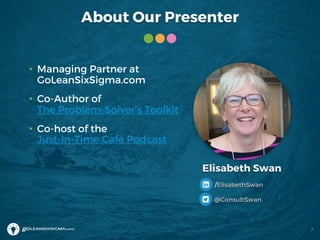
About Our Presenter
• Managing Partner at
GoLeanSixSigma.com
• Co-Author of
The Problem-Solver’s Toolkit
• Co-host of the
Just-In-Time Café Podcast
Elisabeth Swan
/ElisabethSwan
@ConsultSwan
2
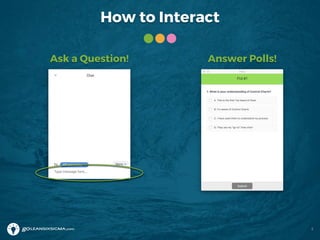
How to Interact
Answer Polls!Ask a Question!
3
Where Are You From?
Share your location in the Chat area!
4
Our Mission and Core Values
Mission: Revolutionize the way people learn process
improvement—making it easy for everyone everywhere
to build their problem-solving muscles
5
Cultivating Community
We create an inclusive and
positive space where
people around the world
connect with each other to
learn and grow.
Servant’s Heart
At our core we are here
to be of service to
others as guides and
teachers to encourage
people’s success.
Trailblazing Spirit
We have the courage to
challenge and inspire each
other to create a constant
state of awesomeness.
Learning Objectives
After attending this webinar you’ll be able to:
• Define a Fishbone Diagram
• Describe when and where to use Fishbone Diagrams
• Outline the sources of root cause ideas to populate
Fishbone Diagrams
• List the challenges encountered when using
Fishbone Diagrams
• Recognize best practices for building
Fishbone Diagrams
6
Today’s Agenda
• What is a Fishbone (aka Cause & Effect or Ishikawa)
Diagram?
• Why and when should we use a Fishbone Diagram?
• What is the source of ideas for a Fishbone Diagram?
• What are the 3 biggest Fishbone Challenges?
• Tips & tricks for Fishbone Diagrams
7
Mission Accomplished
8
Done!
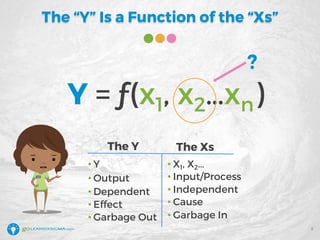
The “Y” Is a Function of the “Xs”
Y = ƒ(x1, x2…xn)
?
• X1, X2…
• Input/Process
• Independent
• Cause
• Garbage In
The Y
• Y
• Output
• Dependent
• Effect
• Garbage Out
The Xs
9
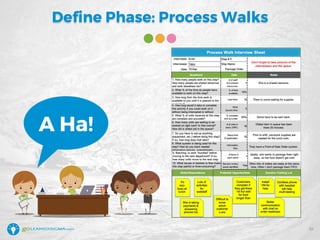
Define Phase: Process Walks
10
A Ha!
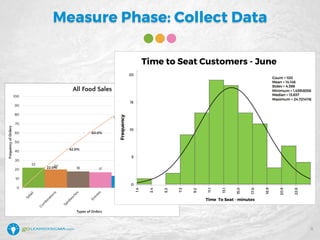
Measure Phase: Collect Data
Time to Seat Customers - June
11
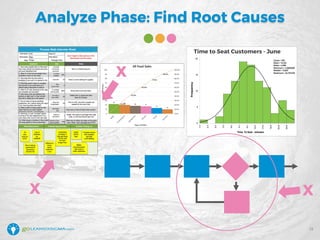
Analyze Phase: Find Root Causes
Time to Seat Customers - June
12
X
X
X
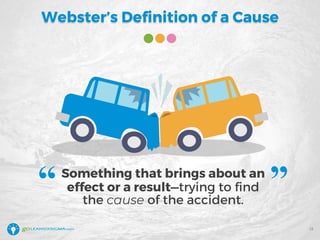
Webster’s Definition of a Cause
Something that brings about an
effect or a result—trying to find
the cause of the accident.
“ ”
13
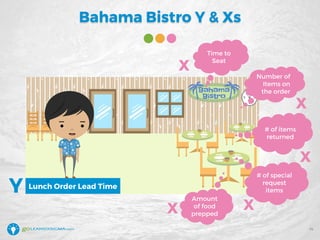
Bahama Bistro Y & Xs
14
Time to
Seat
Number of
Items on
the order
# of items
returned
# of special
request
items
Lunch Order Lead Time
Y
X
X
X
X X
Amount
of food
prepped
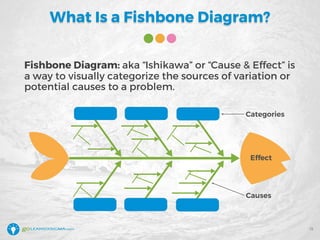
What Is a Fishbone Diagram?
Fishbone Diagram: aka “Ishikawa” or “Cause & Effect” is
a way to visually categorize the sources of variation or
potential causes to a problem.
15
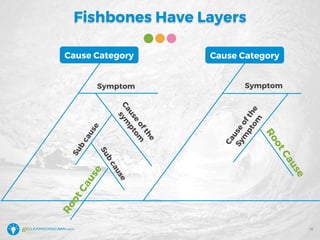
Fishbones Have Layers
Cause
ofthe
sym
ptom
Sub
cause
Symptom
Cause
ofthe
Sym
ptom
RootCause
Cause CategoryCause Category
Symptom
RootCauseSub
cause
16
Poll #1
Question: What’s your experience with
Fishbone Diagrams?
A. Totally new to me
B. I use them but not sure I’m using them
effectively
C. I know about them but don’t use them
D. I use them all the time—great tools!
17
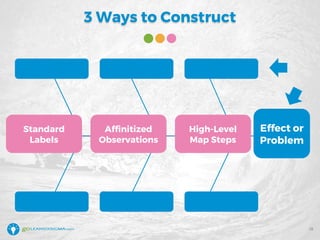
3 Ways to Construct
Effect or
Problem
Standard
Labels
Affinitized
Observations
High-Level
Map Steps
18
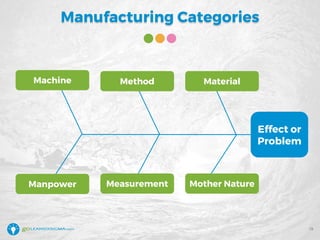
Manufacturing Categories
Machine Method Material
Effect or
Problem
Manpower Measurement Mother Nature
19
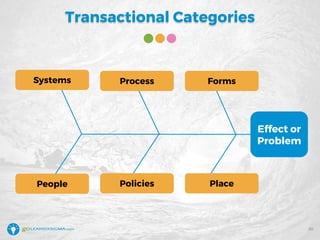
Transactional Categories
Systems Process Forms
Effect or
Problem
People Policies Place
20
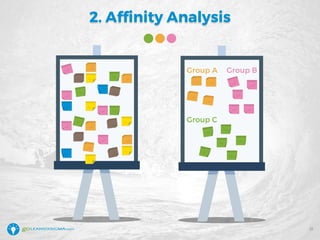
2. Affinity Analysis
Group A Group B
Group C
21
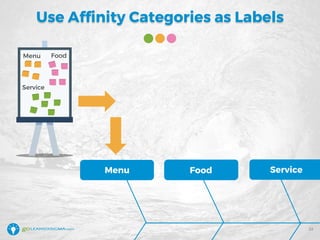
Use Affinity Categories as Labels
Menu Food
Service
22
Category Food CategoryMenu CategoryFood Service
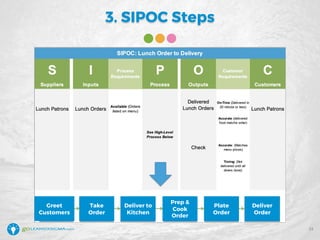
3. SIPOC Steps
Greet
Customers
Take
Order
Deliver to
Kitchen
Prep &
Cook
Order
Plate
Order
Deliver
Order
23
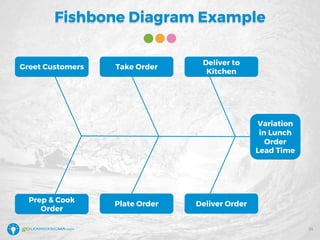
Fishbone Diagram Example
Greet Customers Take Order
Deliver to
Kitchen
Variation
in Lunch
Order
Lead Time
Plate Order Deliver Order
Prep & Cook
Order
24
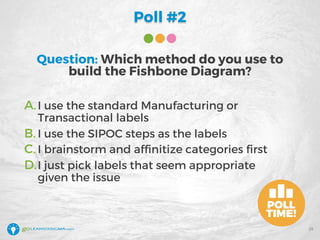
Poll #2
Question: Which method do you use to
build the Fishbone Diagram?
A.I use the standard Manufacturing or
Transactional labels
B. I use the SIPOC steps as the labels
C. I brainstorm and affinitize categories first
D.I just pick labels that seem appropriate
given the issue
25
Good Fishbones Gone Bad
Top 3 Issues:
1. Causes invented from thin air
2. Solutions masquerading as problems
3. Symptoms instead of causes
26
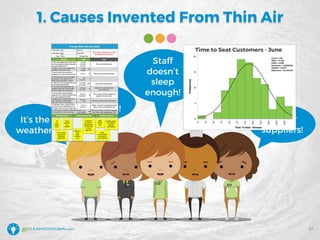
1. Causes Invented From Thin Air
Staff
doesn’t
sleep
enough!
It’s the
weather!
It’s new
employees!
It’s our
suppliers!
The stove
is old!
Time to Seat Customers - June
27
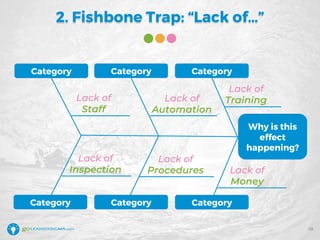
2. Fishbone Trap: “Lack of…”
Lack of
TrainingLack of
Automation
Lack of
Staff
Lack of
Inspection
Lack of
Procedures
Category Category Category
Lack of
Money
Why is this
effect
happening?
28
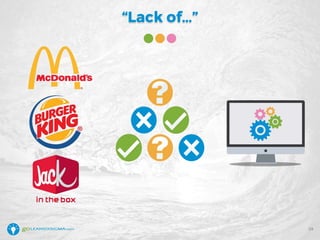
“Lack of…”
29
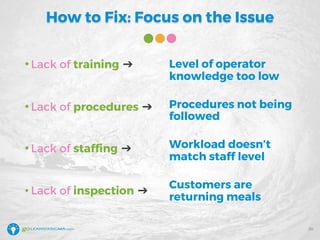
How to Fix: Focus on the Issue
•Lack of training ➔
•Lack of procedures ➔
•Lack of staffing ➔
• Lack of inspection ➔
Level of operator
knowledge too low
Procedures not being
followed
Workload doesn’t
match staff level
Customers are
returning meals
30
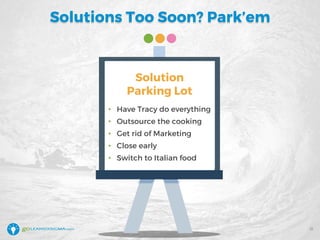
Solutions Too Soon? Park’em
Solution
Parking Lot
• Have Tracy do everything
• Outsource the cooking
• Get rid of Marketing
• Close early
• Switch to Italian food
31
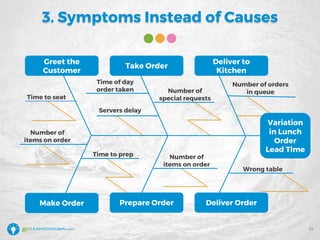
3. Symptoms Instead of Causes
Greet the
Customer
Take Order
Deliver to
Kitchen
Variation
in Lunch
Order
Lead Time
Prepare Order Deliver OrderMake Order
Time of day
order taken Number of
special requests
Number of orders
in queue
Number of
items on order
Number of
items on order
Servers delay
Time to prep
Time to seat
Wrong table
32
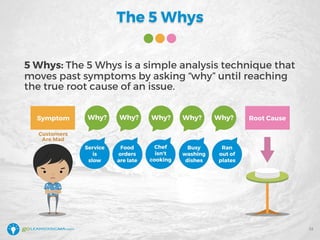
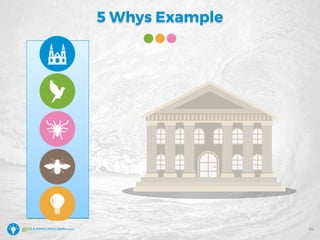
The 5 Whys
33
5 Whys: The 5 Whys is a simple analysis technique that
moves past symptoms by asking “why” until reaching
the true root cause of an issue.
5 Whys Example
34
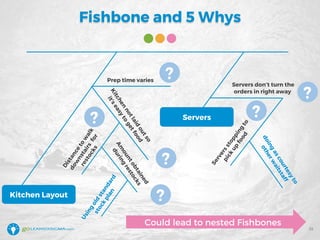
Fishbone and 5 Whys
Distanceto
w
alk
dow
nstairs
for
restocks
Kitchen
notlaid
outso
it’seasyto
getfood
Am
ountobtained
during
restocks
Serversstopping
to
pick
up
food
doingascourtesyto
otherw
aitstaff
Servers
Kitchen Layout
Could lead to nested Fishbones
Prep time varies
Servers don’t turn the
orders in right away
?
?
?
?
Using
old
standard
stock
plan
?
?
35
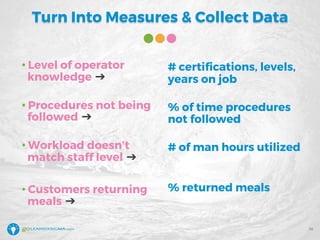
Turn Into Measures & Collect Data
• Level of operator
knowledge ➔
• Procedures not being
followed ➔
• Workload doesn’t
match staff level ➔
• Customers returning
meals ➔
# certifications, levels,
years on job
% of time procedures
not followed
# of man hours utilized
% returned meals
36
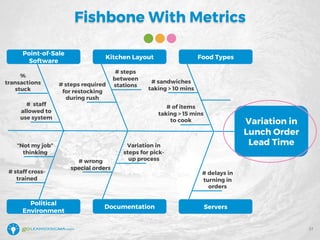
# steps
between
stations
Fishbone With Metrics
# sandwiches
taking > 10 mins
Variation in
steps for pick-
up process
# delays in
turning in
orders
# of items
taking > 15 mins
to cook
%
transactions
stuck
# staff
allowed to
use system
“Not my job”
thinking
# wrong
special orders
# of steps to
prep
# steps required
for restocking
during rush
Documentation
Political
Environment
Servers
Point-of-Sale
Software
Kitchen Layout Food Types
Variation in
Lunch Order
Lead Time
# staff cross-
trained
37
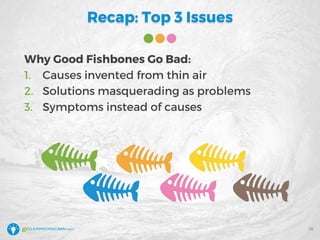
Recap: Top 3 Issues
Why Good Fishbones Go Bad:
1. Causes invented from thin air
2. Solutions masquerading as problems
3. Symptoms instead of causes
38
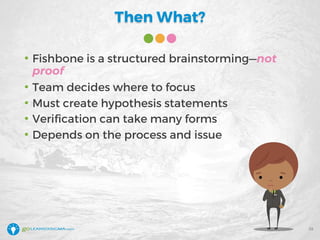
Then What?
• Fishbone is a structured brainstorming—not
proof
• Team decides where to focus
• Must create hypothesis statements
• Verification can take many forms
• Depends on the process and issue
39
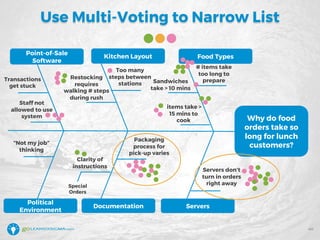
Too many
steps between
stations
# items take
too long to
prepareSandwiches
take > 10 mins
Packaging
process for
pick-up varies
Servers don’t
turn in orders
right away
items take >
15 mins to
cook
Transactions
get stuck
Staff not
allowed to use
system
“Not my job”
thinking
Clarity of
instructions
Special
Orders
# of steps to
prep
Restocking
requires
walking # steps
during rush
Documentation
Political
Environment
Servers
Point-of-Sale
Software
Kitchen Layout Food Types
Why do food
orders take so
long for lunch
customers?
Use Multi-Voting to Narrow List
40
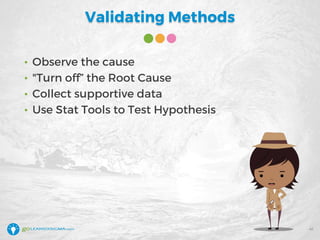
Validating Methods
• Observe the cause
• "Turn off” the Root Cause
• Collect supportive data
• Use Stat Tools to Test Hypothesis
41
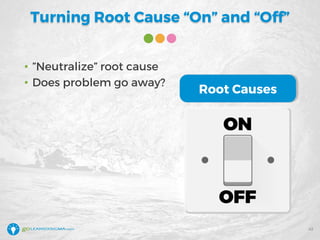
Turning Root Cause “On” and “Off”
• ”Neutralize” root cause
• Does problem go away?
Root Causes
42
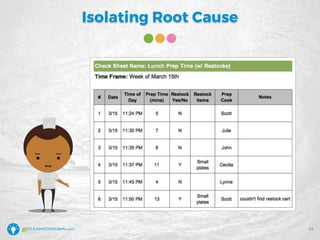
Isolating Root Cause
43
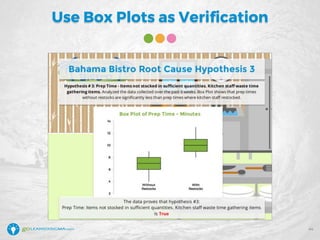
Use Box Plots as Verification
44
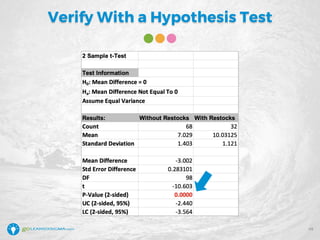
Verify With a Hypothesis Test
45
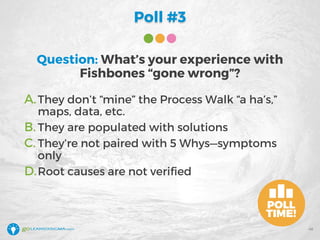
Poll #3
Question: What’s your experience with
Fishbones “gone wrong”?
A.They don’t “mine” the Process Walk “a ha’s,”
maps, data, etc.
B. They are populated with solutions
C. They’re not paired with 5 Whys—symptoms
only
D.Root causes are not verified
46
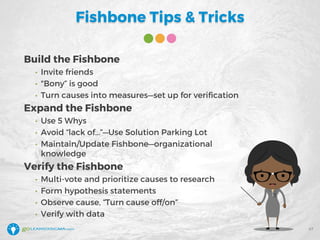
Fishbone Tips & Tricks
Build the Fishbone
• Invite friends
• "Bony” is good
• Turn causes into measures—set up for verification
Expand the Fishbone
• Use 5 Whys
• Avoid “lack of…”—Use Solution Parking Lot
• Maintain/Update Fishbone—organizational
knowledge
Verify the Fishbone
• Multi-vote and prioritize causes to research
• Form hypothesis statements
• Observe cause, “Turn cause off/on”
• Verify with data
47
Today We Covered
48
• What is a Fishbone (aka Cause & Effect or Ishikawa)
Diagram?
• Why and when should we use a Fishbone Diagram?
• What is the source of ideas for a Fishbone Diagram?
• What are the 3 biggest Fishbone Challenges?
• Tips & tricks for Fishbone Diagrams
Call to Action—Fishbone Party!
• Download the Fishbone Diagram Template
(or use a flip chart or a white board)
• Gather your team and relevant process
participants (Get all the brains in the room)
• Gather helpful information (Process Walk
results, maps, data, charts and graphs)
• Populate the Fishbone together—
keep building
• Use the 5 Whys to dig to root
cause and verify!
49
Questions?
50
Lean Training & Certification
Coupon Code: 20FISHBONE
20% discount on all courses!
*Expires October 18, 2019
51
Go-Getter Membership
52
• Access to all Single Modules ($337 value)
• Access to Go-Getter Exclusive Webinars
• Support Tools ($226 value)
• 20% discount on ALL
of your purchases!
• Current course access
extended (additional year)
$199 for 1 year access
The Problem-Solver’s Toolkit
53
• Paperback and Kindle
versions available on
Amazon
• The Problem-Solver’s
Toolkit
Upcoming Webinar: October 17, 11am PT
Register today at GoLeanSixSigma.com/webinars
We’ll select upcoming webinars based on your feedback,
so please share your feedback on the survey at the end of
close of this webinar.
54
Questions?
58
Thank You for Joining Us!
More questions? Ask us at
contact@goleansixsigma.com
Click here to download free tools,
templates, infographics and more!
@GoLeanSixSigma/company/GoLeanSixSigma-com /GoLeanSixSigma 59

Webinar: How to Use a Fishbone Diagram (Encore!)

  • 1.
    How to UseA Fishbone Diagram Presented by Elisabeth Swan 1
  • 2.
    About Our Presenter •Managing Partner at GoLeanSixSigma.com • Co-Author of The Problem-Solver’s Toolkit • Co-host of the Just-In-Time Café Podcast Elisabeth Swan /ElisabethSwan @ConsultSwan 2
  • 3.
    How to Interact AnswerPolls!Ask a Question! 3
  • 4.
    Where Are YouFrom? Share your location in the Chat area! 4
  • 5.
    Our Mission andCore Values Mission: Revolutionize the way people learn process improvement—making it easy for everyone everywhere to build their problem-solving muscles 5 Cultivating Community We create an inclusive and positive space where people around the world connect with each other to learn and grow. Servant’s Heart At our core we are here to be of service to others as guides and teachers to encourage people’s success. Trailblazing Spirit We have the courage to challenge and inspire each other to create a constant state of awesomeness.
  • 6.
    Learning Objectives After attendingthis webinar you’ll be able to: • Define a Fishbone Diagram • Describe when and where to use Fishbone Diagrams • Outline the sources of root cause ideas to populate Fishbone Diagrams • List the challenges encountered when using Fishbone Diagrams • Recognize best practices for building Fishbone Diagrams 6
  • 7.
    Today’s Agenda • Whatis a Fishbone (aka Cause & Effect or Ishikawa) Diagram? • Why and when should we use a Fishbone Diagram? • What is the source of ideas for a Fishbone Diagram? • What are the 3 biggest Fishbone Challenges? • Tips & tricks for Fishbone Diagrams 7
  • 8.
  • 9.
    The “Y” Isa Function of the “Xs” Y = ƒ(x1, x2…xn) ? • X1, X2… • Input/Process • Independent • Cause • Garbage In The Y • Y • Output • Dependent • Effect • Garbage Out The Xs 9
  • 10.
    Define Phase: ProcessWalks 10 A Ha!
  • 11.
    Measure Phase: CollectData Time to Seat Customers - June 11
  • 12.
    Analyze Phase: FindRoot Causes Time to Seat Customers - June 12 X X X
  • 13.
    Webster’s Definition ofa Cause Something that brings about an effect or a result—trying to find the cause of the accident. “ ” 13
  • 14.
    Bahama Bistro Y& Xs 14 Time to Seat Number of Items on the order # of items returned # of special request items Lunch Order Lead Time Y X X X X X Amount of food prepped
  • 15.
    What Is aFishbone Diagram? Fishbone Diagram: aka “Ishikawa” or “Cause & Effect” is a way to visually categorize the sources of variation or potential causes to a problem. 15
  • 16.
  • 17.
    Poll #1 Question: What’syour experience with Fishbone Diagrams? A. Totally new to me B. I use them but not sure I’m using them effectively C. I know about them but don’t use them D. I use them all the time—great tools! 17
  • 18.
    3 Ways toConstruct Effect or Problem Standard Labels Affinitized Observations High-Level Map Steps 18
  • 19.
    Manufacturing Categories Machine MethodMaterial Effect or Problem Manpower Measurement Mother Nature 19
  • 20.
    Transactional Categories Systems ProcessForms Effect or Problem People Policies Place 20
  • 21.
    2. Affinity Analysis GroupA Group B Group C 21
  • 22.
    Use Affinity Categoriesas Labels Menu Food Service 22 Category Food CategoryMenu CategoryFood Service
  • 23.
    3. SIPOC Steps Greet Customers Take Order Deliverto Kitchen Prep & Cook Order Plate Order Deliver Order 23
  • 24.
    Fishbone Diagram Example GreetCustomers Take Order Deliver to Kitchen Variation in Lunch Order Lead Time Plate Order Deliver Order Prep & Cook Order 24
  • 25.
    Poll #2 Question: Whichmethod do you use to build the Fishbone Diagram? A.I use the standard Manufacturing or Transactional labels B. I use the SIPOC steps as the labels C. I brainstorm and affinitize categories first D.I just pick labels that seem appropriate given the issue 25
  • 26.
    Good Fishbones GoneBad Top 3 Issues: 1. Causes invented from thin air 2. Solutions masquerading as problems 3. Symptoms instead of causes 26
  • 27.
    1. Causes InventedFrom Thin Air Staff doesn’t sleep enough! It’s the weather! It’s new employees! It’s our suppliers! The stove is old! Time to Seat Customers - June 27
  • 28.
    2. Fishbone Trap:“Lack of…” Lack of TrainingLack of Automation Lack of Staff Lack of Inspection Lack of Procedures Category Category Category Category Category Category Lack of Money Why is this effect happening? 28
  • 29.
  • 30.
    How to Fix:Focus on the Issue •Lack of training ➔ •Lack of procedures ➔ •Lack of staffing ➔ • Lack of inspection ➔ Level of operator knowledge too low Procedures not being followed Workload doesn’t match staff level Customers are returning meals 30
  • 31.
    Solutions Too Soon?Park’em Solution Parking Lot • Have Tracy do everything • Outsource the cooking • Get rid of Marketing • Close early • Switch to Italian food 31
  • 32.
    3. Symptoms Insteadof Causes Greet the Customer Take Order Deliver to Kitchen Variation in Lunch Order Lead Time Prepare Order Deliver OrderMake Order Time of day order taken Number of special requests Number of orders in queue Number of items on order Number of items on order Servers delay Time to prep Time to seat Wrong table 32
  • 33.
    The 5 Whys 33 5Whys: The 5 Whys is a simple analysis technique that moves past symptoms by asking “why” until reaching the true root cause of an issue.
  • 34.
  • 35.
    Fishbone and 5Whys Distanceto w alk dow nstairs for restocks Kitchen notlaid outso it’seasyto getfood Am ountobtained during restocks Serversstopping to pick up food doingascourtesyto otherw aitstaff Servers Kitchen Layout Could lead to nested Fishbones Prep time varies Servers don’t turn the orders in right away ? ? ? ? Using old standard stock plan ? ? 35
  • 36.
    Turn Into Measures& Collect Data • Level of operator knowledge ➔ • Procedures not being followed ➔ • Workload doesn’t match staff level ➔ • Customers returning meals ➔ # certifications, levels, years on job % of time procedures not followed # of man hours utilized % returned meals 36
  • 37.
    # steps between stations Fishbone WithMetrics # sandwiches taking > 10 mins Variation in steps for pick- up process # delays in turning in orders # of items taking > 15 mins to cook % transactions stuck # staff allowed to use system “Not my job” thinking # wrong special orders # of steps to prep # steps required for restocking during rush Documentation Political Environment Servers Point-of-Sale Software Kitchen Layout Food Types Variation in Lunch Order Lead Time # staff cross- trained 37
  • 38.
    Recap: Top 3Issues Why Good Fishbones Go Bad: 1. Causes invented from thin air 2. Solutions masquerading as problems 3. Symptoms instead of causes 38
  • 39.
    Then What? • Fishboneis a structured brainstorming—not proof • Team decides where to focus • Must create hypothesis statements • Verification can take many forms • Depends on the process and issue 39
  • 40.
    Too many steps between stations #items take too long to prepareSandwiches take > 10 mins Packaging process for pick-up varies Servers don’t turn in orders right away items take > 15 mins to cook Transactions get stuck Staff not allowed to use system “Not my job” thinking Clarity of instructions Special Orders # of steps to prep Restocking requires walking # steps during rush Documentation Political Environment Servers Point-of-Sale Software Kitchen Layout Food Types Why do food orders take so long for lunch customers? Use Multi-Voting to Narrow List 40
  • 41.
    Validating Methods • Observethe cause • "Turn off” the Root Cause • Collect supportive data • Use Stat Tools to Test Hypothesis 41
  • 42.
    Turning Root Cause“On” and “Off” • ”Neutralize” root cause • Does problem go away? Root Causes 42
  • 43.
  • 44.
    Use Box Plotsas Verification 44
  • 45.
    Verify With aHypothesis Test 45
  • 46.
    Poll #3 Question: What’syour experience with Fishbones “gone wrong”? A.They don’t “mine” the Process Walk “a ha’s,” maps, data, etc. B. They are populated with solutions C. They’re not paired with 5 Whys—symptoms only D.Root causes are not verified 46
  • 47.
    Fishbone Tips &Tricks Build the Fishbone • Invite friends • "Bony” is good • Turn causes into measures—set up for verification Expand the Fishbone • Use 5 Whys • Avoid “lack of…”—Use Solution Parking Lot • Maintain/Update Fishbone—organizational knowledge Verify the Fishbone • Multi-vote and prioritize causes to research • Form hypothesis statements • Observe cause, “Turn cause off/on” • Verify with data 47
  • 48.
    Today We Covered 48 •What is a Fishbone (aka Cause & Effect or Ishikawa) Diagram? • Why and when should we use a Fishbone Diagram? • What is the source of ideas for a Fishbone Diagram? • What are the 3 biggest Fishbone Challenges? • Tips & tricks for Fishbone Diagrams
  • 49.
    Call to Action—FishboneParty! • Download the Fishbone Diagram Template (or use a flip chart or a white board) • Gather your team and relevant process participants (Get all the brains in the room) • Gather helpful information (Process Walk results, maps, data, charts and graphs) • Populate the Fishbone together— keep building • Use the 5 Whys to dig to root cause and verify! 49
  • 50.
  • 51.
    Lean Training &Certification Coupon Code: 20FISHBONE 20% discount on all courses! *Expires October 18, 2019 51
  • 52.
    Go-Getter Membership 52 • Accessto all Single Modules ($337 value) • Access to Go-Getter Exclusive Webinars • Support Tools ($226 value) • 20% discount on ALL of your purchases! • Current course access extended (additional year) $199 for 1 year access
  • 53.
    The Problem-Solver’s Toolkit 53 •Paperback and Kindle versions available on Amazon • The Problem-Solver’s Toolkit
  • 54.
    Upcoming Webinar: October17, 11am PT Register today at GoLeanSixSigma.com/webinars We’ll select upcoming webinars based on your feedback, so please share your feedback on the survey at the end of close of this webinar. 54
  • 55.
  • 56.
    Thank You forJoining Us! More questions? Ask us at contact@goleansixsigma.com Click here to download free tools, templates, infographics and more! @GoLeanSixSigma/company/GoLeanSixSigma-com /GoLeanSixSigma 59