6sSIX SIGMA
Continuous improvement Lean
Importance of CI & Lean
methodologies in Logistics
Kesavakrishnan (Kesava)
Keysight Technologies (formerly known as Agilent Electronic Measurement
Group)
6sSIX SIGMA
Continuous improvement Lean
Agenda
• Quick glance of various Quality
methodologies (CI, Lean, 6sigma)
• Why its important?
• Difference between Lean and CI
• Useful quality tools (5S & VSM)
• Real examples
• Q & A
6sSIX SIGMA
Continuous improvement Lean
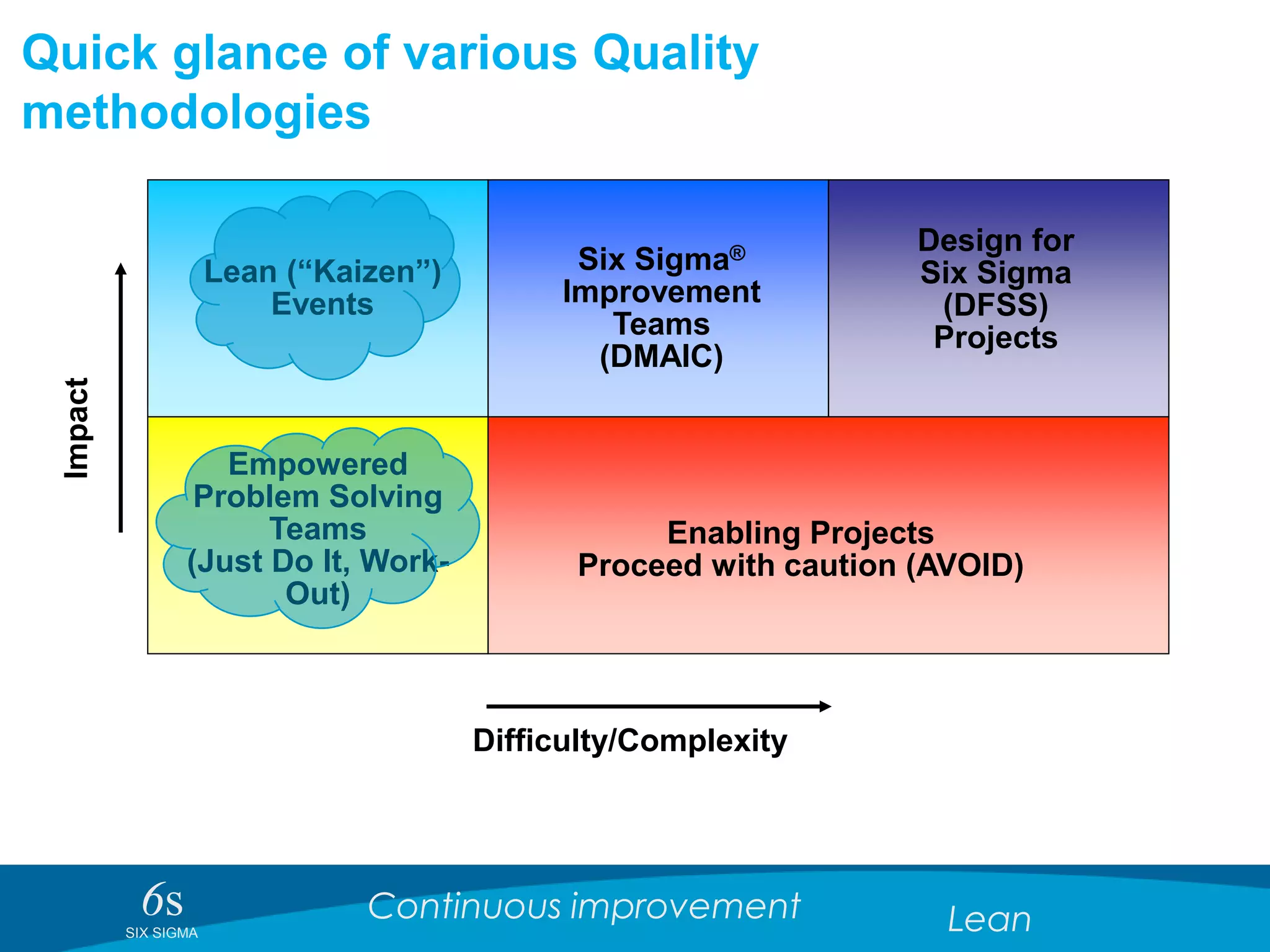
Difficulty/Complexity
Impact
Breakthrough
Workout
Teams
Lean (“Kaizen”)
Events
Enabling Projects
Proceed with caution (AVOID)
Empowered
Problem Solving
Teams
(Just Do It, Work-
Out)
Six Sigma®
Improvement
Teams
(DMAIC)
Design for
Six Sigma
(DFSS)
Projects
Quick glance of various Quality
methodologies
6sSIX SIGMA
Continuous improvement Lean
Why it is important?
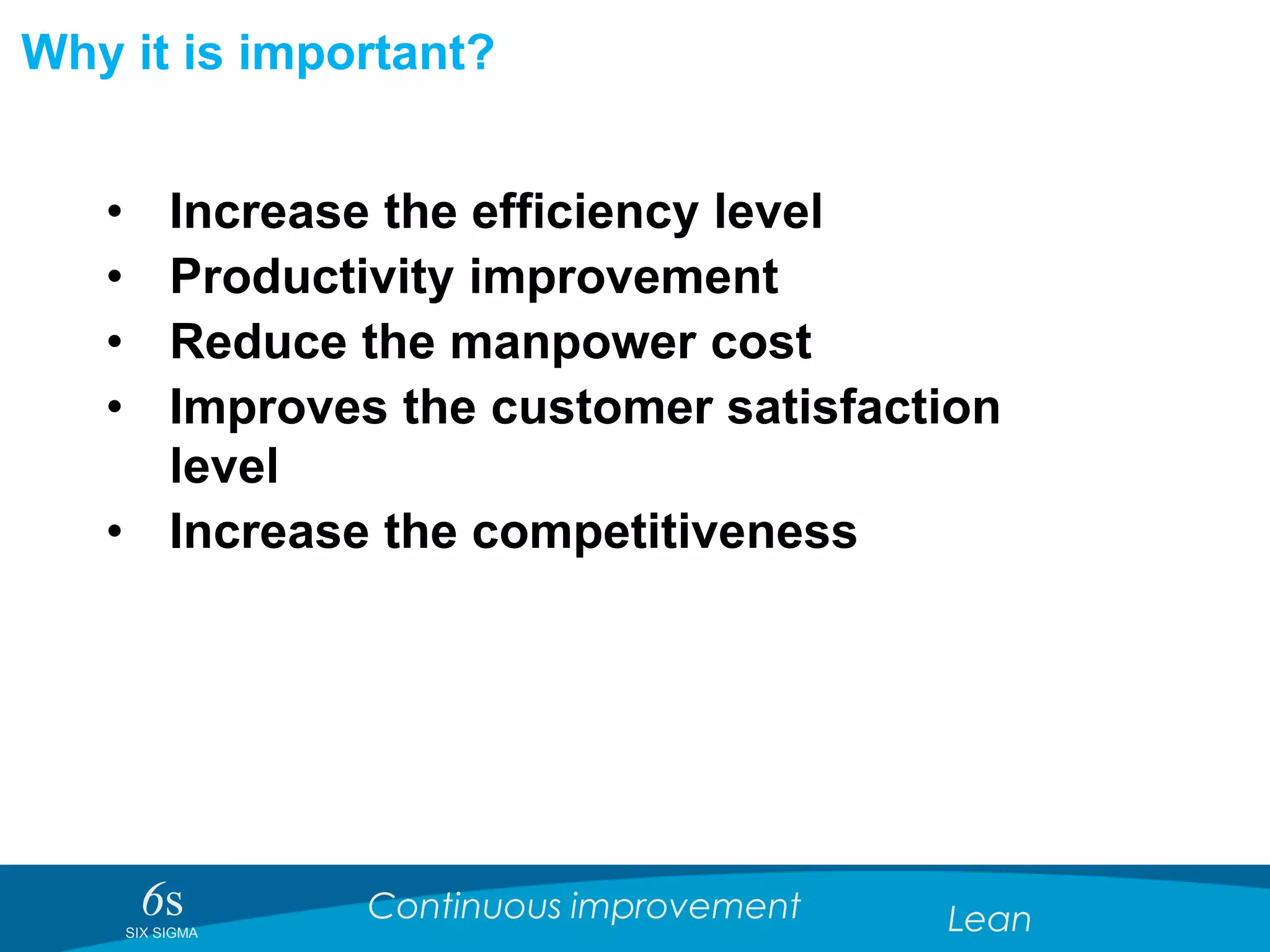
• Increase the efficiency level
• Productivity improvement
• Reduce the manpower cost
• Improves the customer satisfaction
level
• Increase the competitiveness
6sSIX SIGMA
Continuous improvement Lean
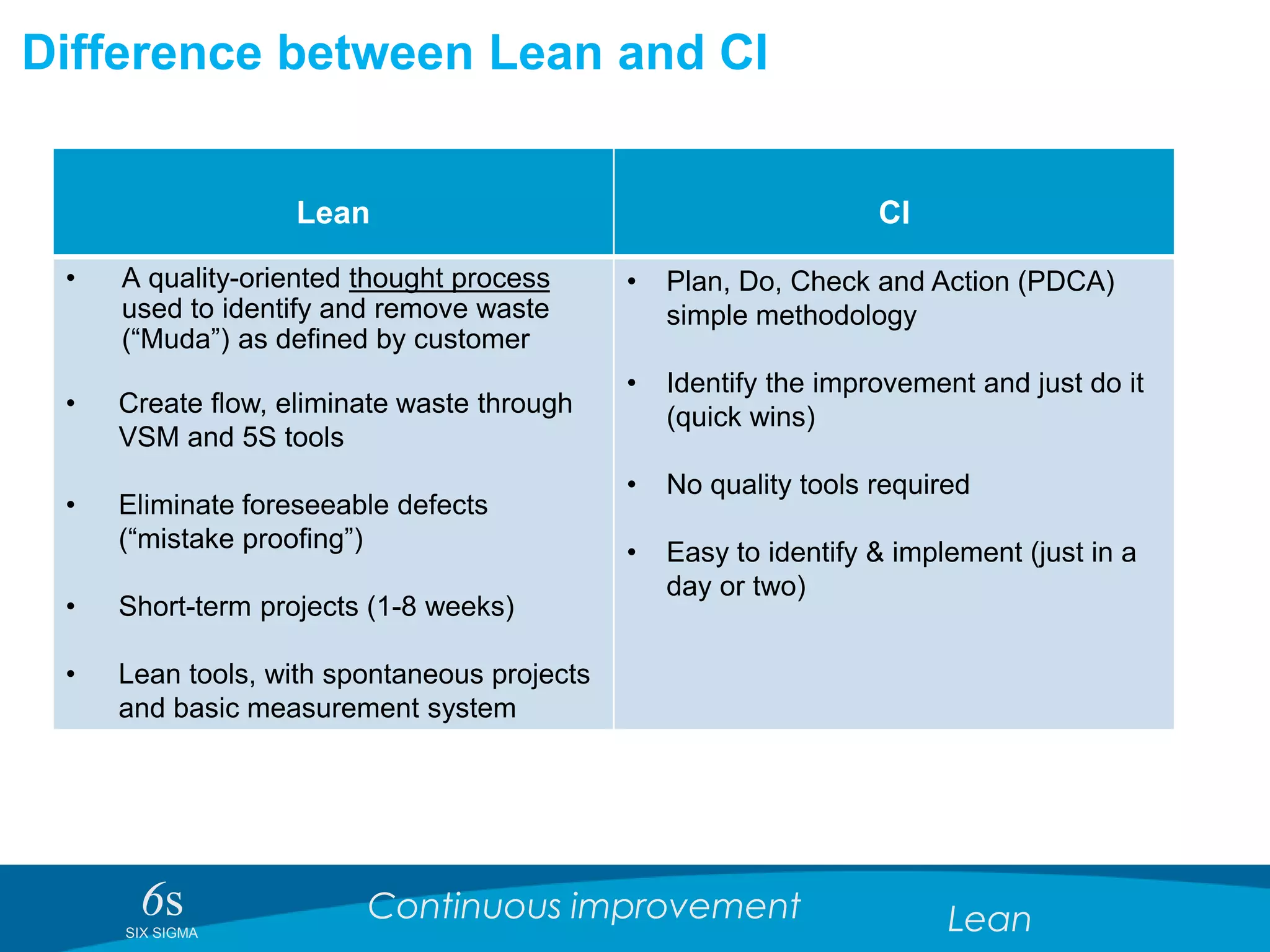
Difference between Lean and CI
Lean CI
• A quality-oriented thought process
used to identify and remove waste
(“Muda”) as defined by customer
• Create flow, eliminate waste through
VSM and 5S tools
• Eliminate foreseeable defects
(“mistake proofing”)
• Short-term projects (1-8 weeks)
• Lean tools, with spontaneous projects
and basic measurement system
• Plan, Do, Check and Action (PDCA)
simple methodology
• Identify the improvement and just do it
(quick wins)
• No quality tools required
• Easy to identify & implement (just in a
day or two)
6sSIX SIGMA
Continuous improvement Lean
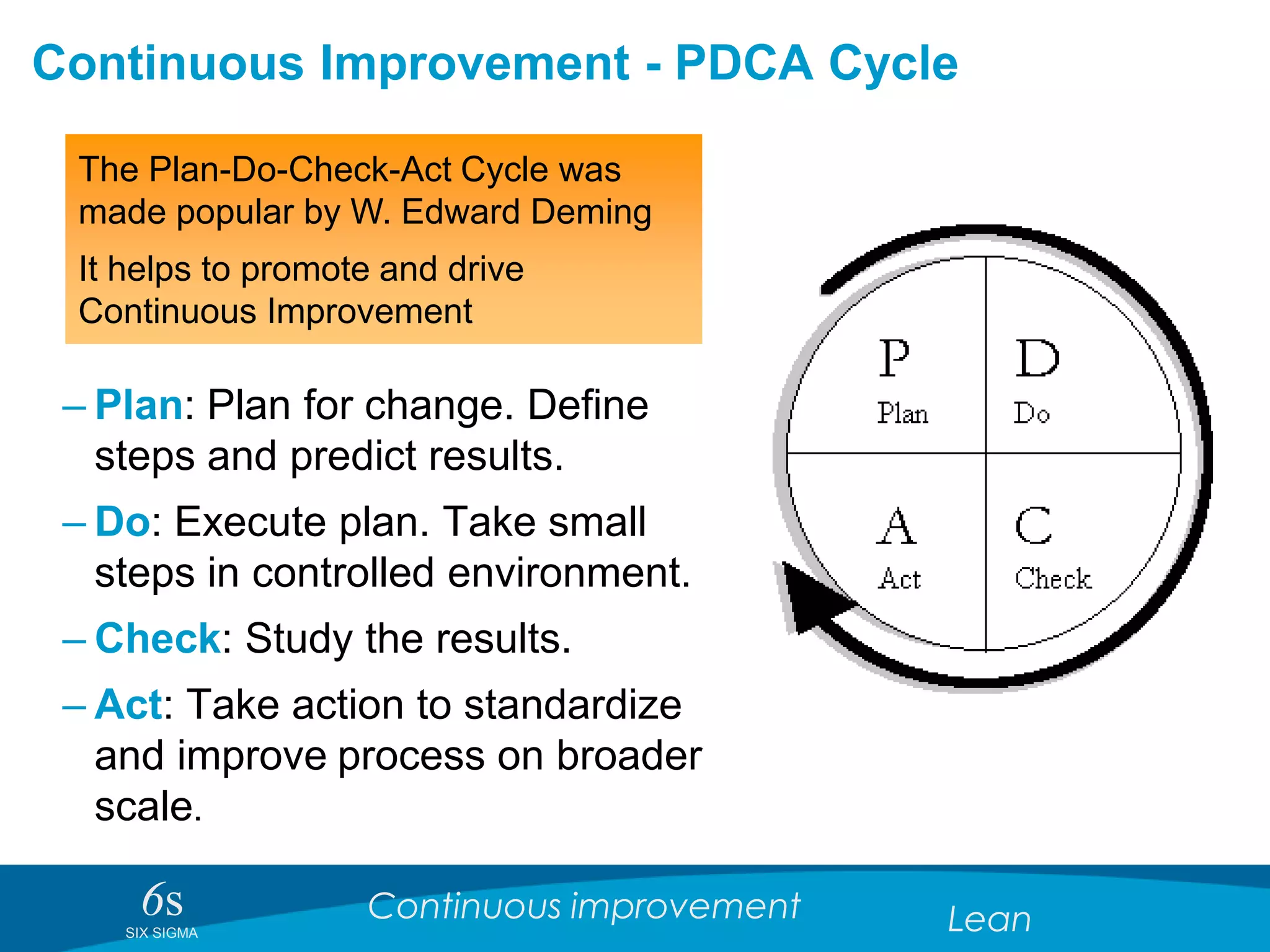
Continuous Improvement - PDCA Cycle
– Plan: Plan for change. Define
steps and predict results.
– Do: Execute plan. Take small
steps in controlled environment.
– Check: Study the results.
– Act: Take action to standardize
and improve process on broader
scale.
The Plan-Do-Check-Act Cycle was
made popular by W. Edward Deming
It helps to promote and drive
Continuous Improvement
6sSIX SIGMA
Continuous improvement Lean
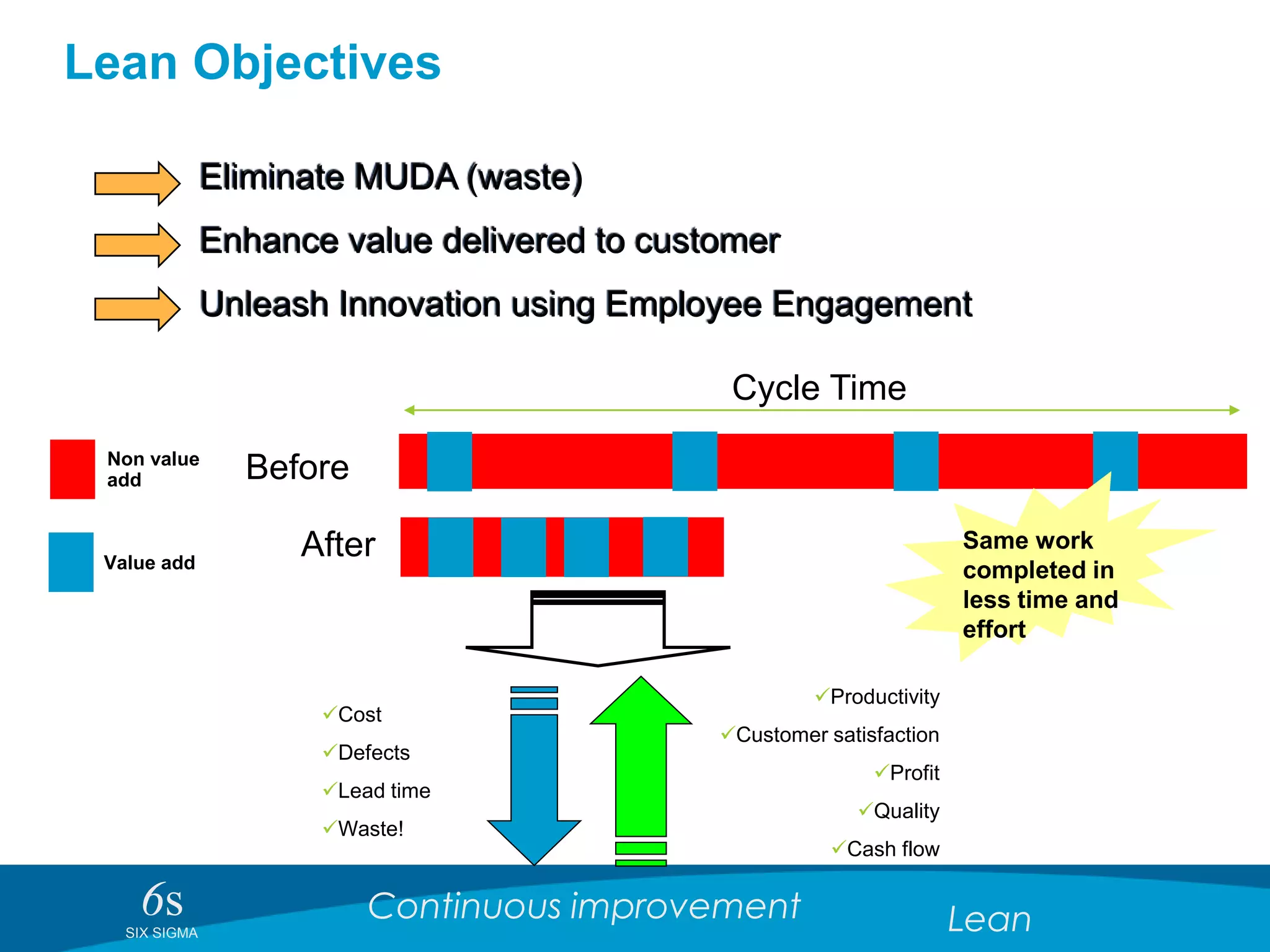
Lean Objectives
Eliminate MUDA (waste)
Enhance value delivered to customer
Unleash Innovation using Employee Engagement
Cost
Defects
Lead time
Waste!
Productivity
Customer satisfaction
Profit
Quality
Cash flow
Cycle Time
Value add
Before
After
Non value
add
Same work
completed in
less time and
effort
6sSIX SIGMA
Continuous improvement Lean
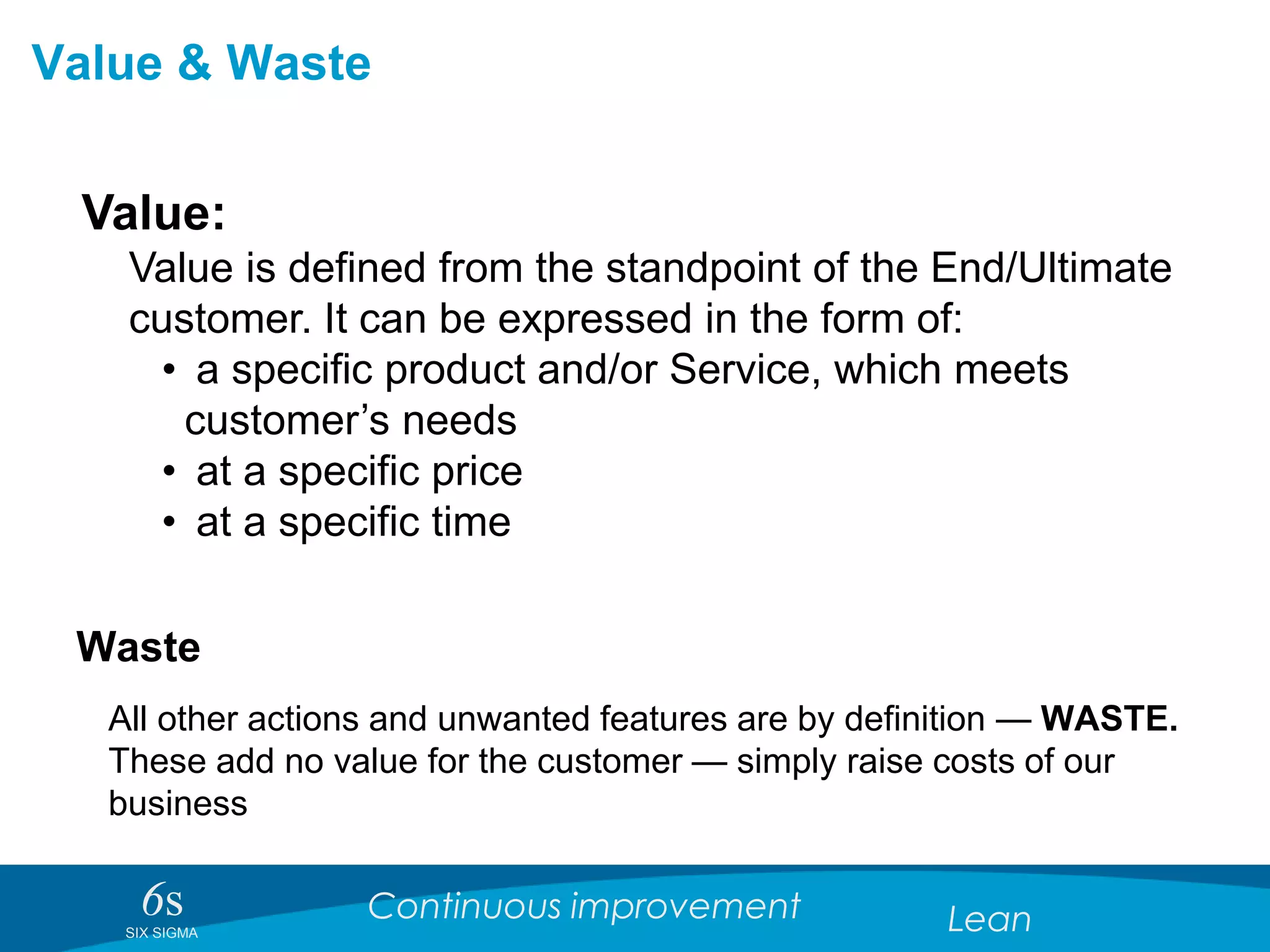
Value & Waste
Value:
Value is defined from the standpoint of the End/Ultimate
customer. It can be expressed in the form of:
• a specific product and/or Service, which meets
customer’s needs
• at a specific price
• at a specific time
Waste
All other actions and unwanted features are by definition — WASTE.
These add no value for the customer — simply raise costs of our
business
6sSIX SIGMA
Continuous improvement Lean
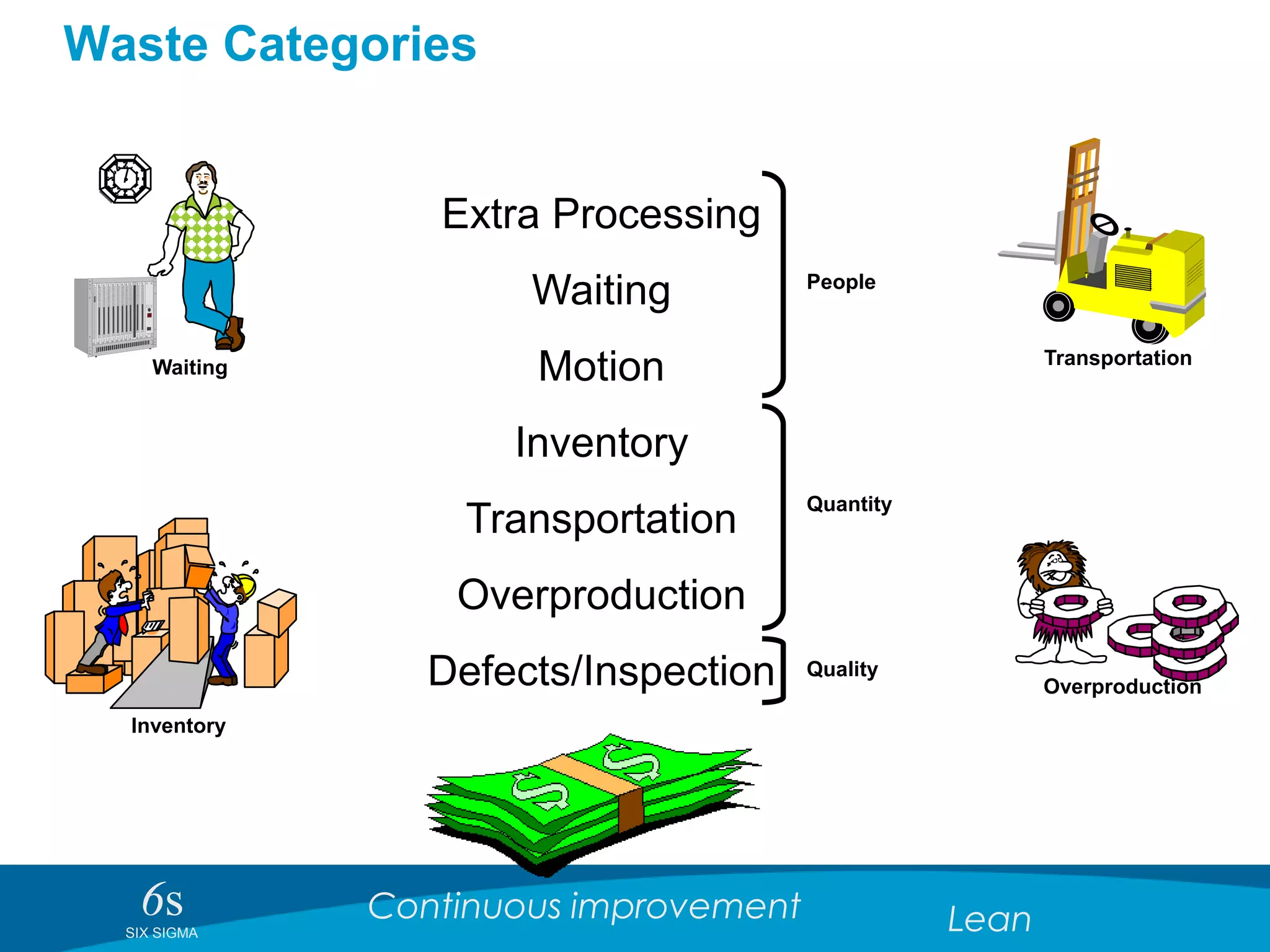
Waste Categories
Extra Processing
Waiting
Motion
Inventory
Transportation
Overproduction
Defects/Inspection
Waiting Transportation
Overproduction
Inventory
People
Quantity
Quality
6sSIX SIGMA
Continuous improvement Lean
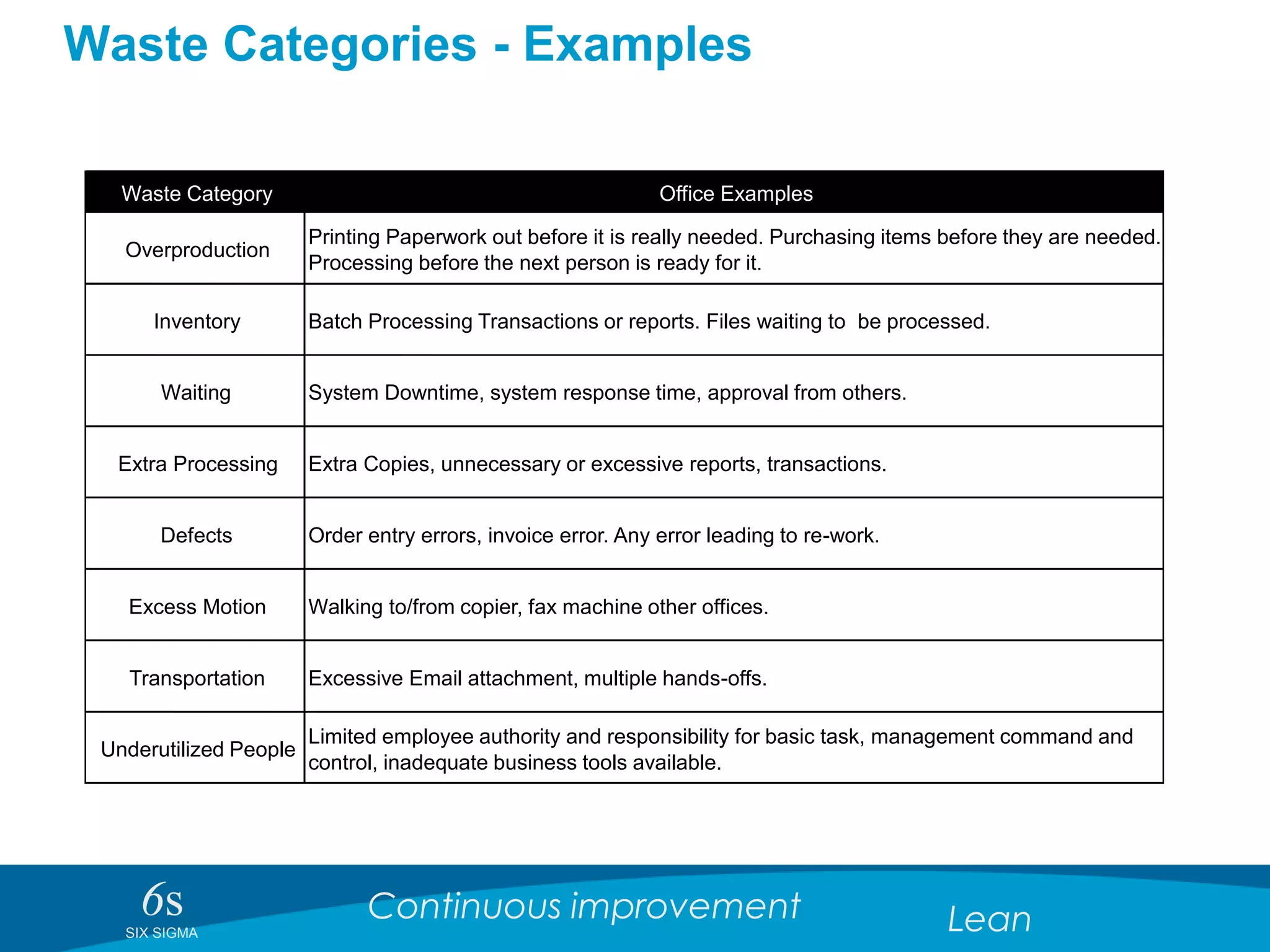
Waste Categories - Examples
Waste Category Office Examples
Overproduction
Printing Paperwork out before it is really needed. Purchasing items before they are needed.
Processing before the next person is ready for it.
Inventory Batch Processing Transactions or reports. Files waiting to be processed.
Waiting System Downtime, system response time, approval from others.
Extra Processing Extra Copies, unnecessary or excessive reports, transactions.
Defects Order entry errors, invoice error. Any error leading to re-work.
Excess Motion Walking to/from copier, fax machine other offices.
Transportation Excessive Email attachment, multiple hands-offs.
Underutilized People
Limited employee authority and responsibility for basic task, management command and
control, inadequate business tools available.
6sSIX SIGMA
Continuous improvement Lean
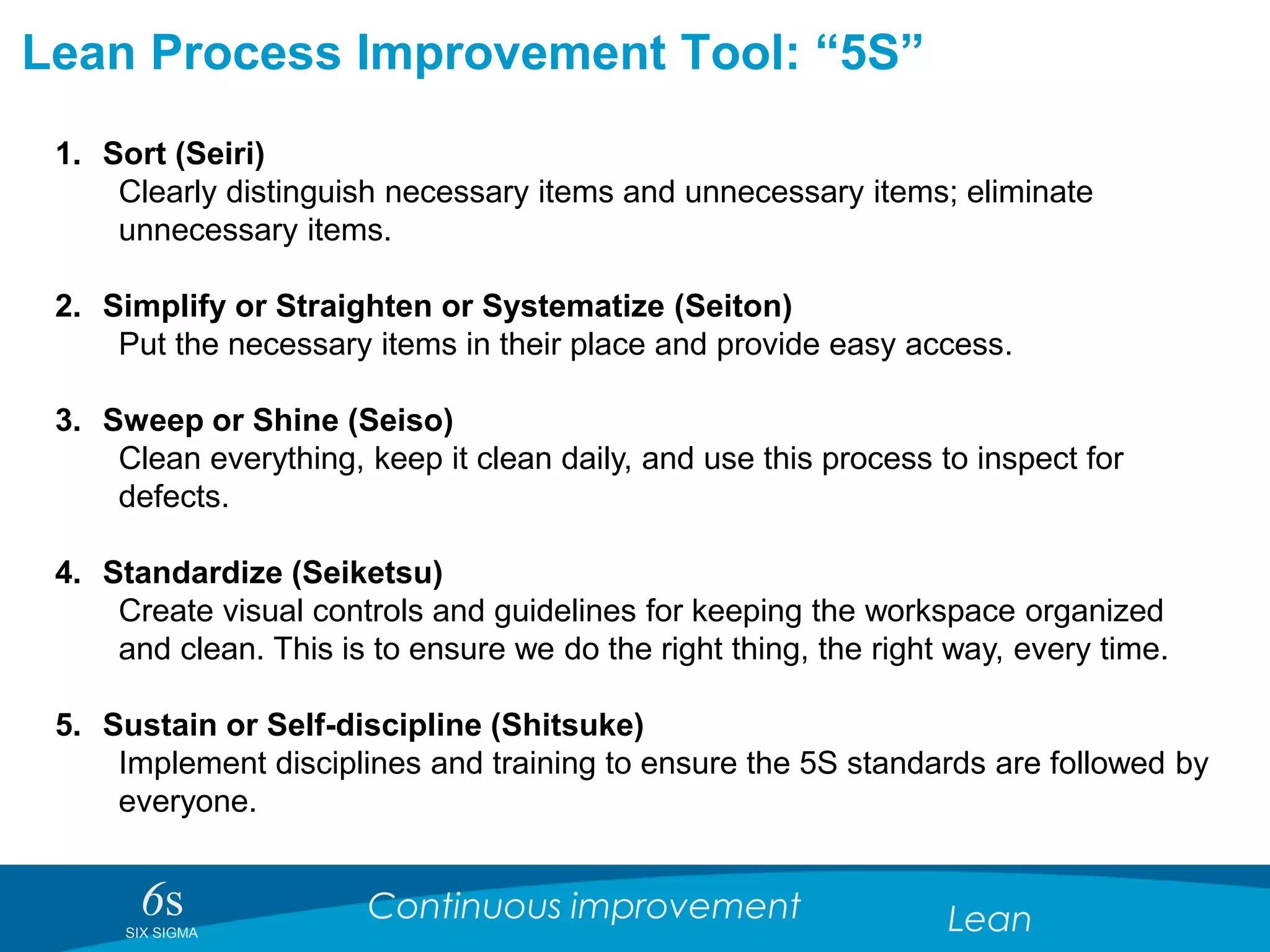
Lean Process Improvement Tool: “5S”
1. Sort (Seiri)
Clearly distinguish necessary items and unnecessary items; eliminate
unnecessary items.
2. Simplify or Straighten or Systematize (Seiton)
Put the necessary items in their place and provide easy access.
3. Sweep or Shine (Seiso)
Clean everything, keep it clean daily, and use this process to inspect for
defects.
4. Standardize (Seiketsu)
Create visual controls and guidelines for keeping the workspace organized
and clean. This is to ensure we do the right thing, the right way, every time.
5. Sustain or Self-discipline (Shitsuke)
Implement disciplines and training to ensure the 5S standards are followed by
everyone.
6sSIX SIGMA
Continuous improvement Lean
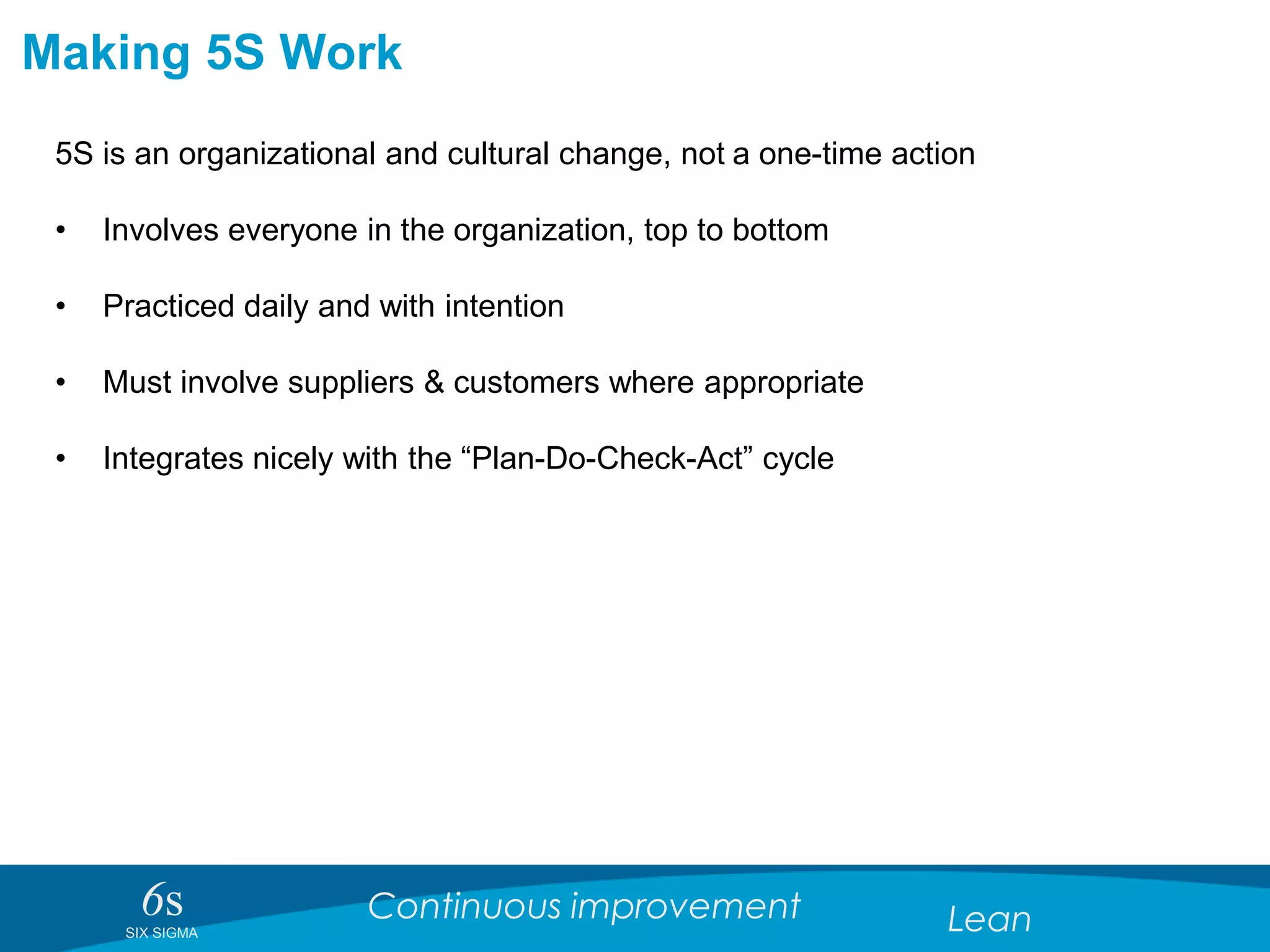
Making 5S Work
5S is an organizational and cultural change, not a one-time action
• Involves everyone in the organization, top to bottom
• Practiced daily and with intention
• Must involve suppliers & customers where appropriate
• Integrates nicely with the “Plan-Do-Check-Act” cycle
6sSIX SIGMA
Continuous improvement Lean
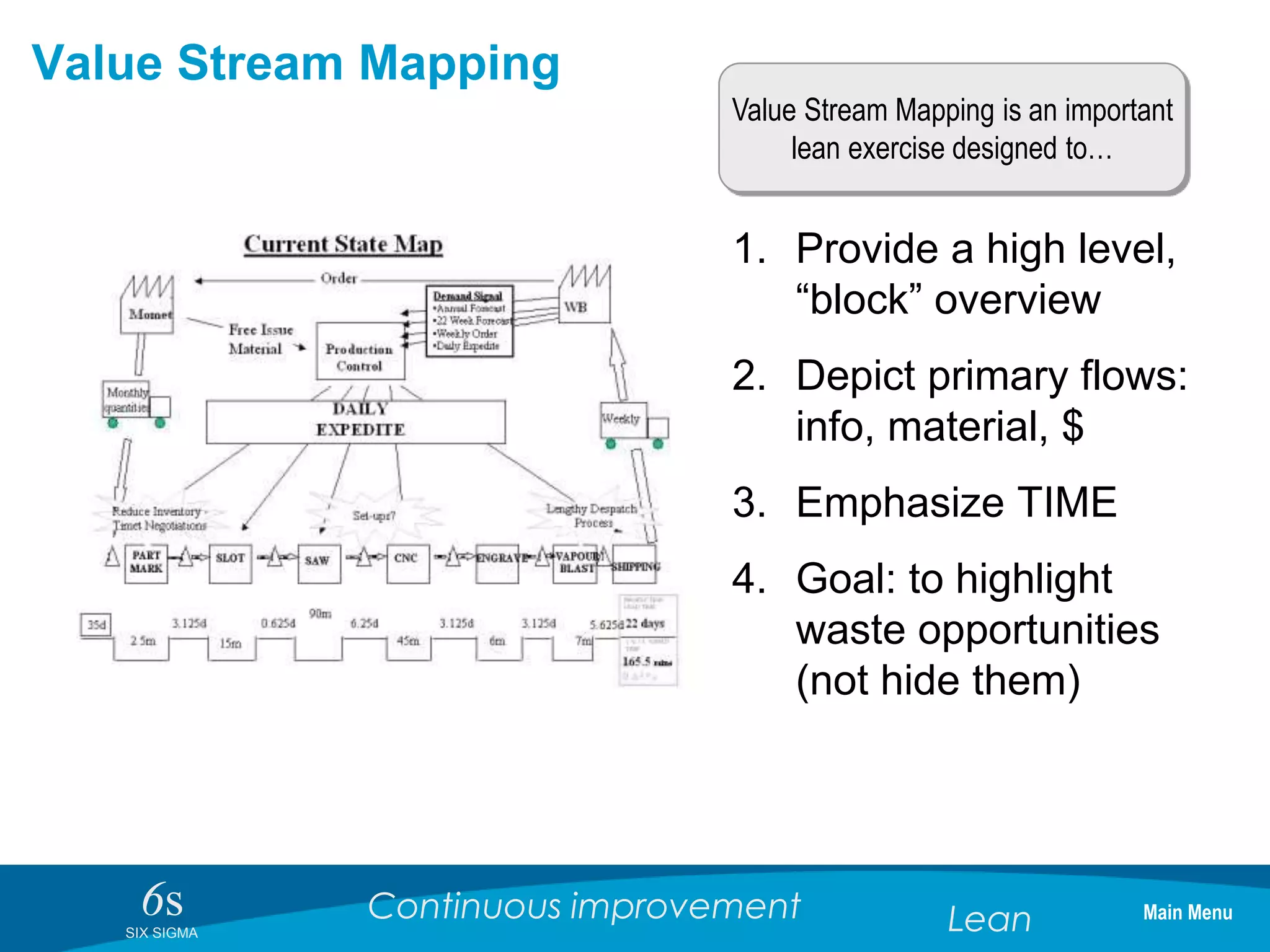
Value Stream Mapping
1. Provide a high level,
“block” overview
2. Depict primary flows:
info, material, $
3. Emphasize TIME
4. Goal: to highlight
waste opportunities
(not hide them)
Value Stream Mapping is an important
lean exercise designed to…
Main Menu
6sSIX SIGMA
Continuous improvement Lean
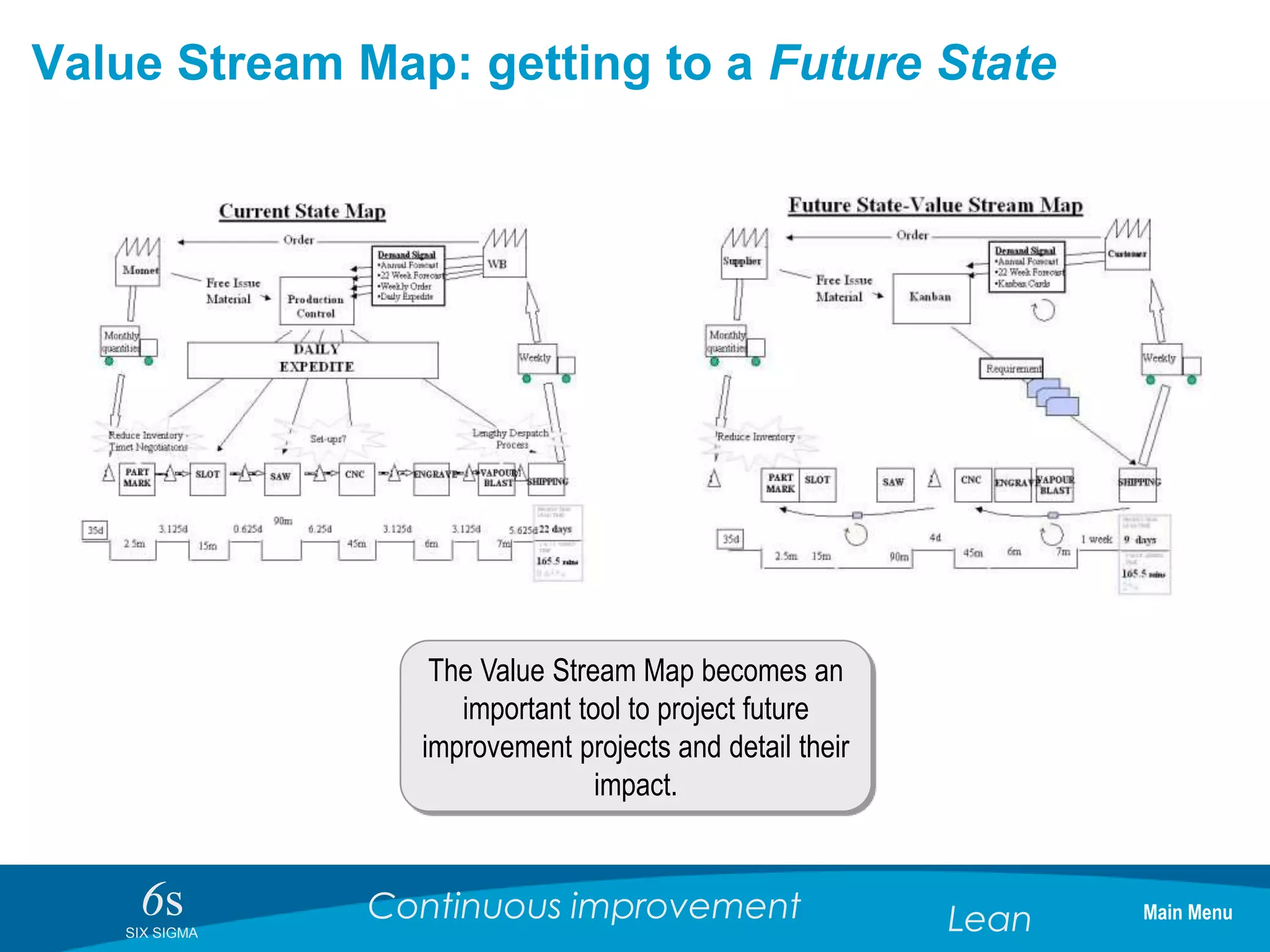
Value Stream Map: getting to a Future State
The Value Stream Map becomes an
important tool to project future
improvement projects and detail their
impact.
Main Menu
6sSIX SIGMA
Continuous improvement Lean
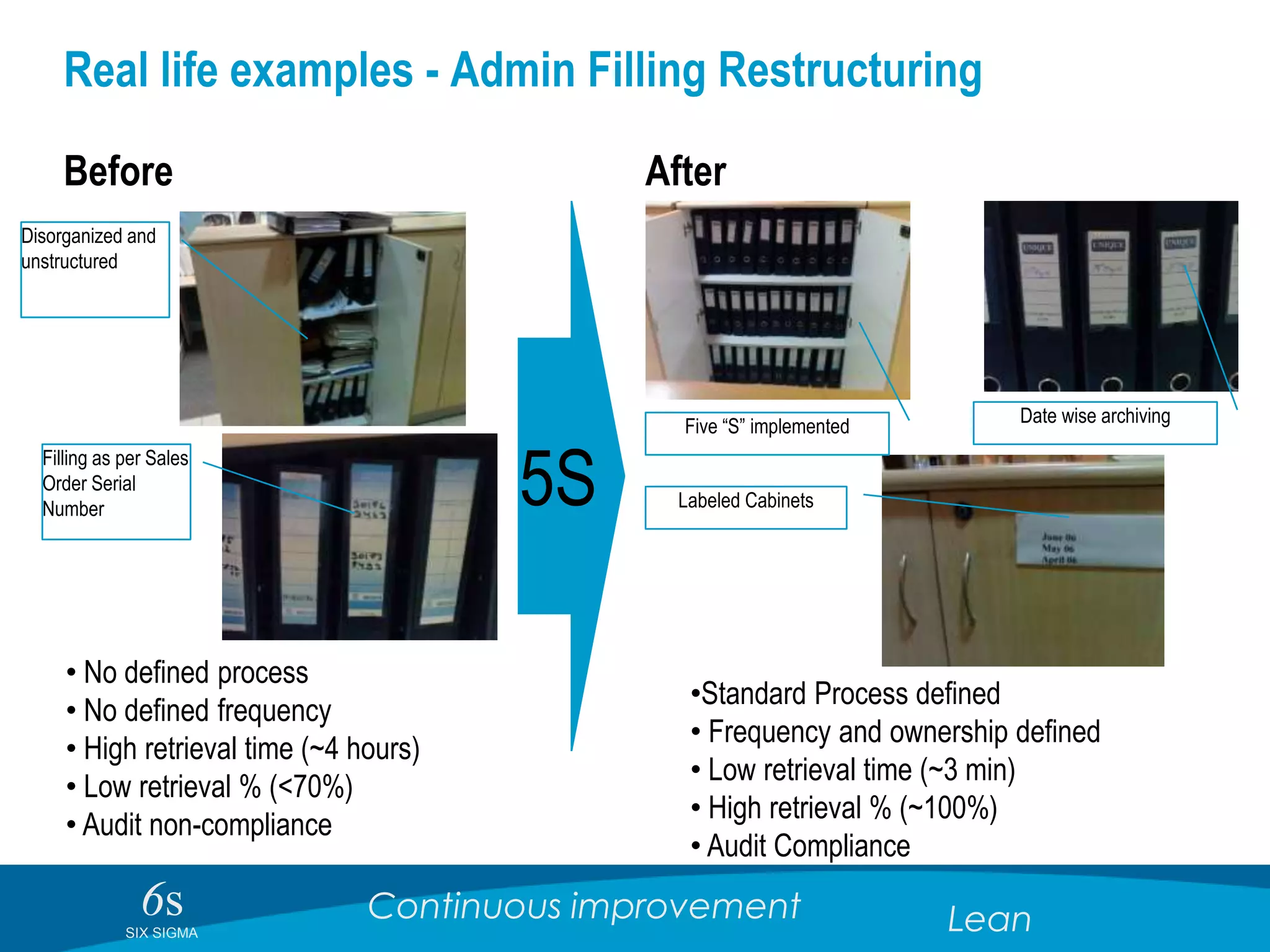
Real life examples - Admin Filling Restructuring
Before After
Disorganized and
unstructured
Filling as per Sales
Order Serial
Number
• No defined process
• No defined frequency
• High retrieval time (~4 hours)
• Low retrieval % (<70%)
• Audit non-compliance
Labeled Cabinets
Five “S” implemented
Date wise archiving
•Standard Process defined
• Frequency and ownership defined
• Low retrieval time (~3 min)
• High retrieval % (~100%)
• Audit Compliance
5S
6sSIX SIGMA
Continuous improvement Lean
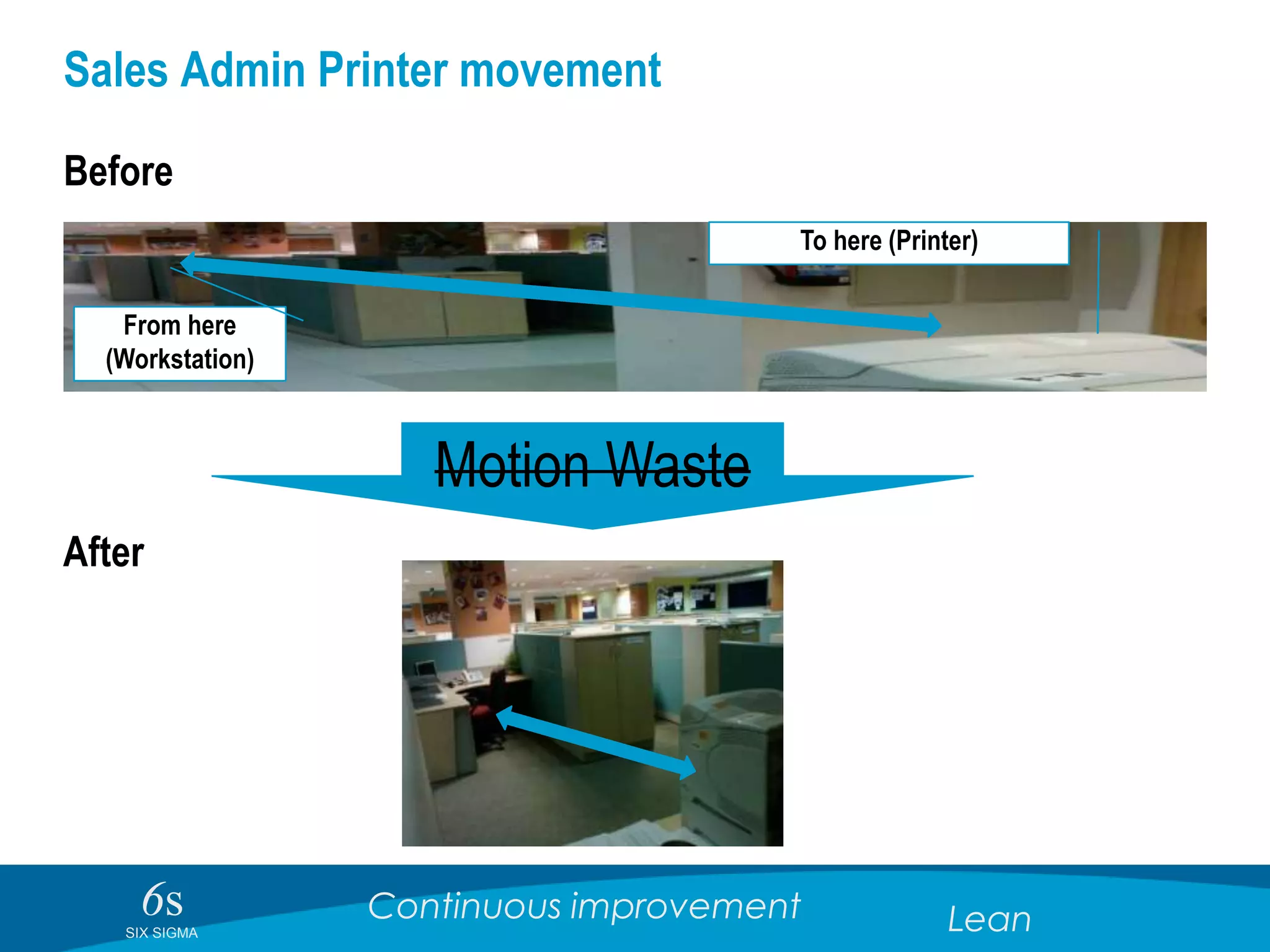
Sales Admin Printer movement
Before
After
To here (Printer)
Motion Waste
From here
(Workstation)
6sSIX SIGMA
Continuous improvement Lean
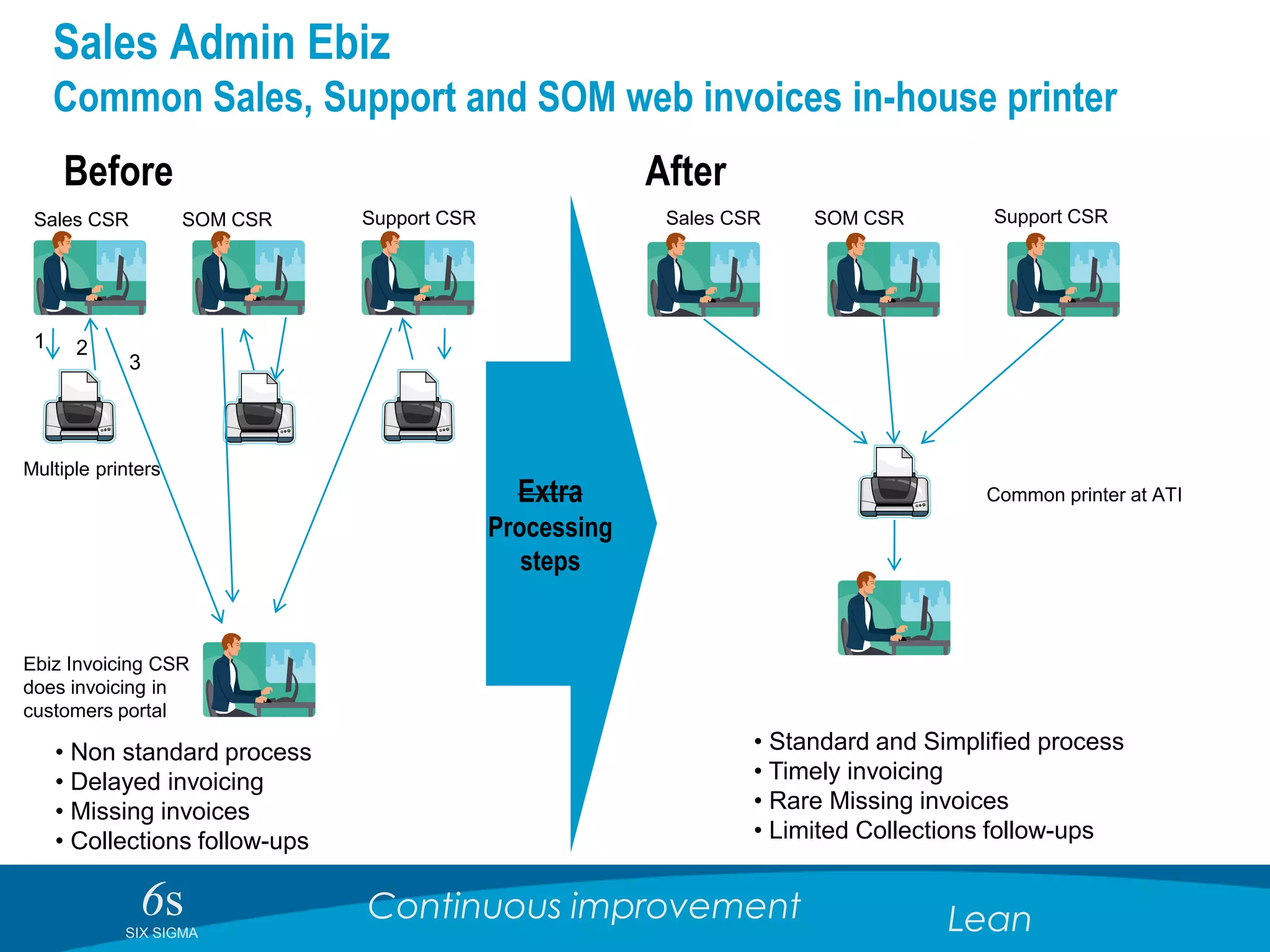
Sales Admin Ebiz
Common Sales, Support and SOM web invoices in-house printer
Before After
Extra
Processing
steps
Sales CSR SOM CSR Support CSR
Ebiz Invoicing CSR
does invoicing in
customers portal
Multiple printers
Common printer at ATI
Sales CSR SOM CSR Support CSR
• Non standard process
• Delayed invoicing
• Missing invoices
• Collections follow-ups
• Standard and Simplified process
• Timely invoicing
• Rare Missing invoices
• Limited Collections follow-ups
1 2
3
6sSIX SIGMA
Continuous improvement Lean
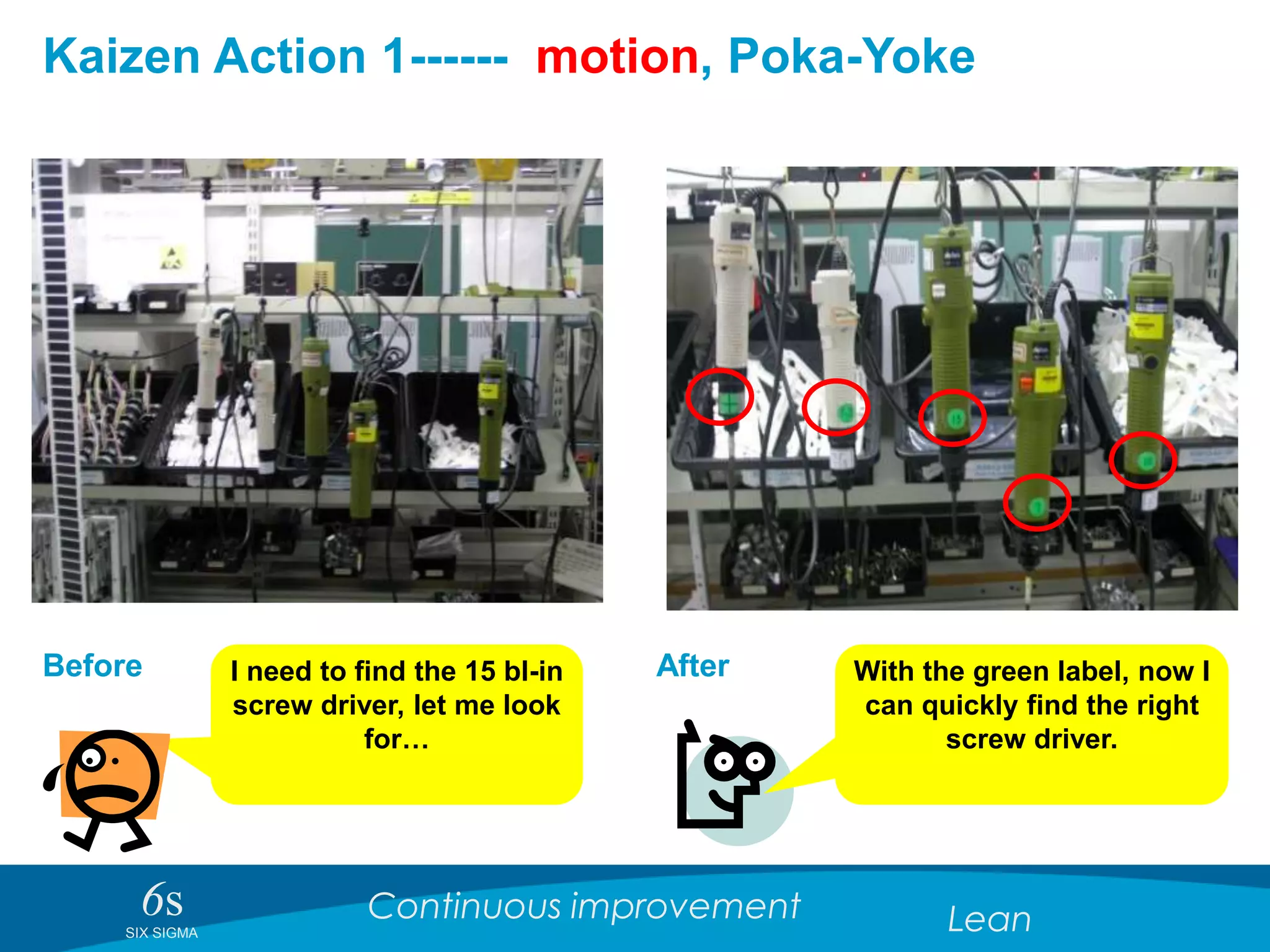
Kaizen Action 1------ motion, Poka-Yoke
Before AfterI need to find the 15 bl-in
screw driver, let me look
for…
With the green label, now I
can quickly find the right
screw driver.
6sSIX SIGMA
Continuous improvement Lean
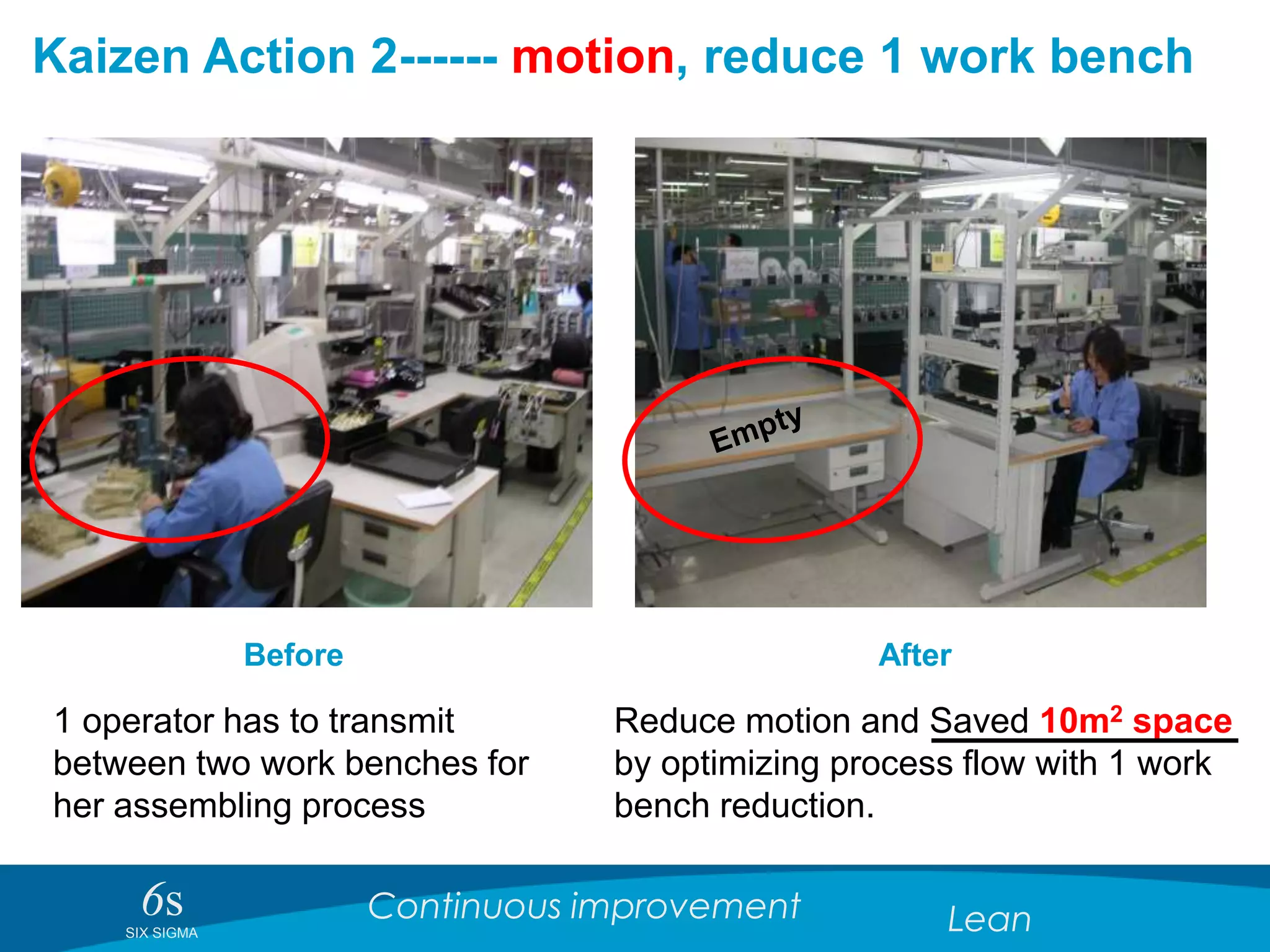
Kaizen Action 2------ motion, reduce 1 work bench
Before After
1 operator has to transmit
between two work benches for
her assembling process
Reduce motion and Saved 10m2 space
by optimizing process flow with 1 work
bench reduction.
6sSIX SIGMA
Continuous improvement Lean
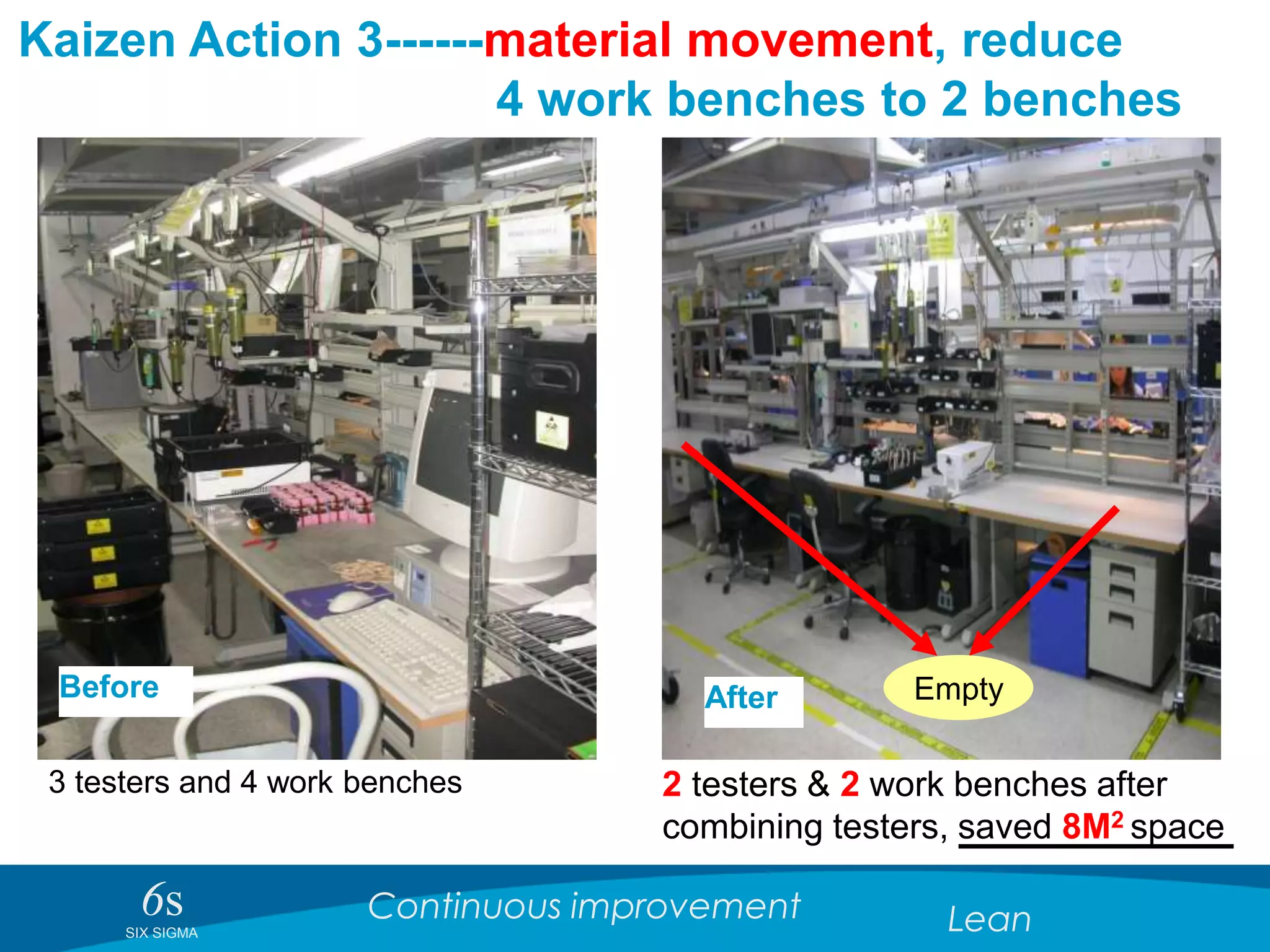
Kaizen Action 3------material movement, reduce
4 work benches to 2 benches
Before After
3 testers and 4 work benches 2 testers & 2 work benches after
combining testers, saved 8M2 space
Empty
6sSIX SIGMA
Continuous improvement LeanGroup/Presentatio
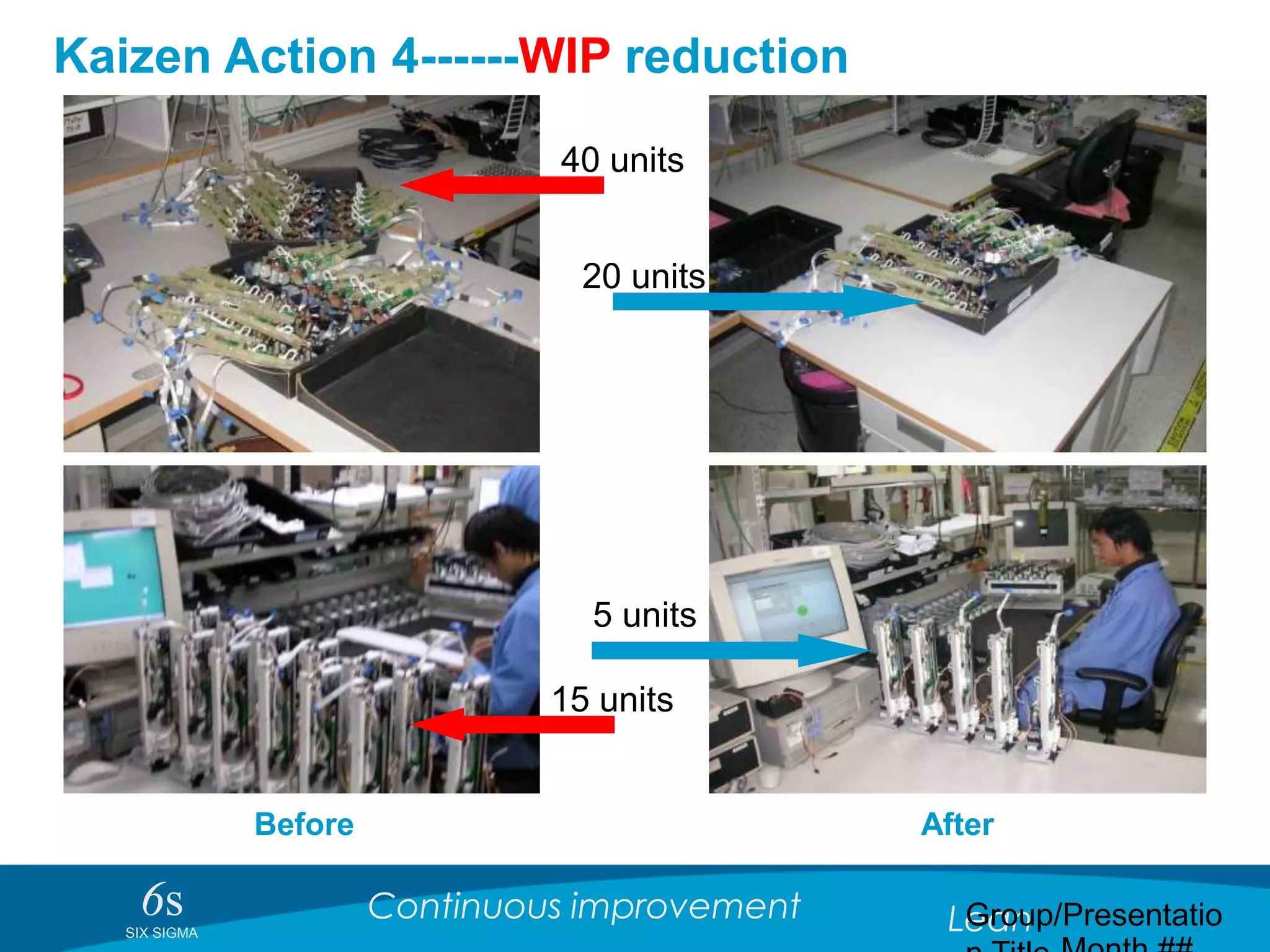
Kaizen Action 4------WIP reduction
Before After
40 units
20 units
15 units
5 units
6sSIX SIGMA
Continuous improvement Lean
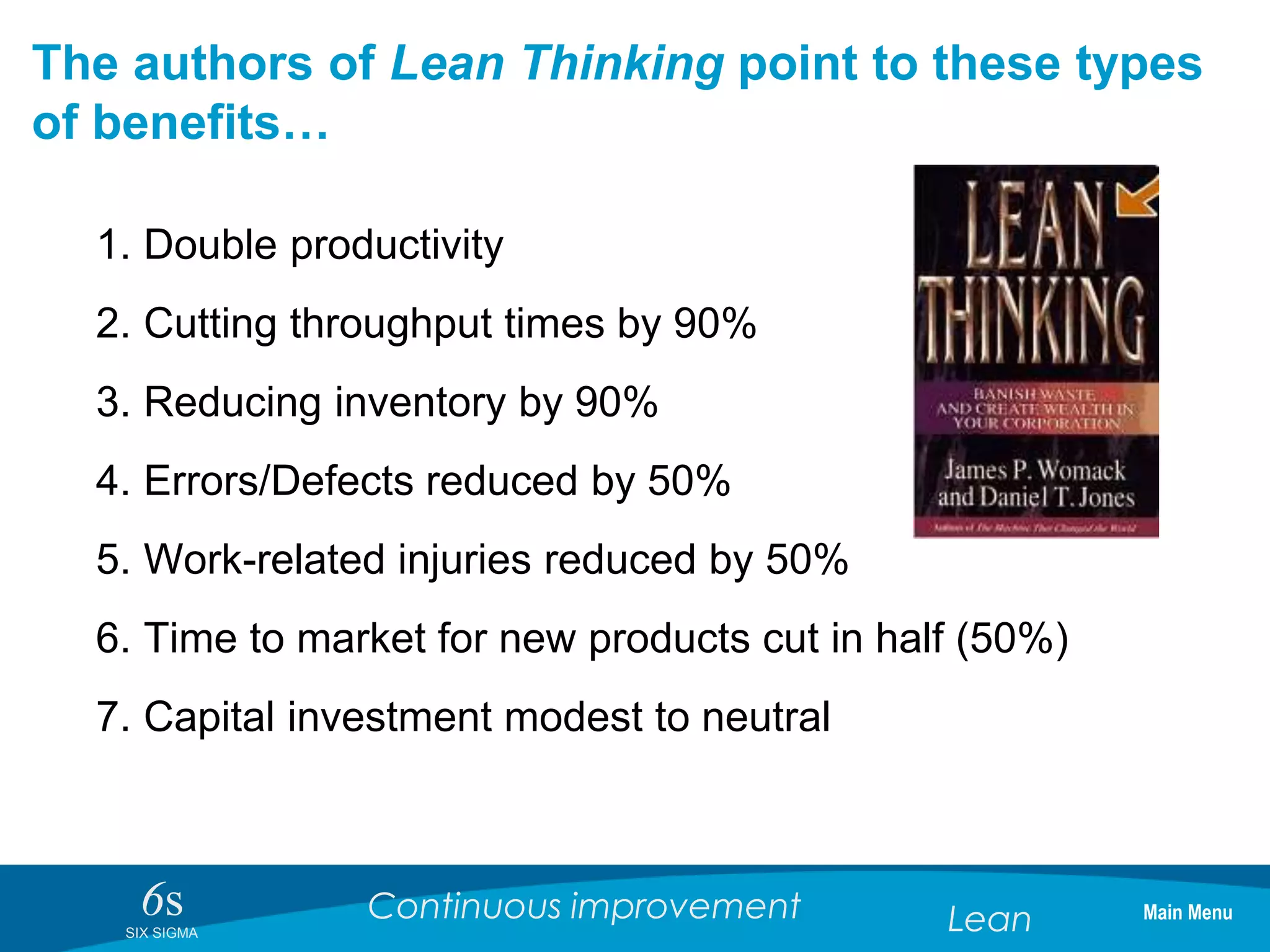
The authors of Lean Thinking point to these types
of benefits…
1. Double productivity
2. Cutting throughput times by 90%
3. Reducing inventory by 90%
4. Errors/Defects reduced by 50%
5. Work-related injuries reduced by 50%
6. Time to market for new products cut in half (50%)
7. Capital investment modest to neutral
Main Menu
6sSIX SIGMA
Continuous improvement Lean
Q & A

Importance of CI & Lean methodologies in Logistics - Kesavakrishnan (Agilent Technologies)

  • 1.
    6sSIX SIGMA Continuous improvementLean Importance of CI & Lean methodologies in Logistics Kesavakrishnan (Kesava) Keysight Technologies (formerly known as Agilent Electronic Measurement Group)
  • 2.
    6sSIX SIGMA Continuous improvementLean Agenda • Quick glance of various Quality methodologies (CI, Lean, 6sigma) • Why its important? • Difference between Lean and CI • Useful quality tools (5S & VSM) • Real examples • Q & A
  • 3.
    6sSIX SIGMA Continuous improvementLean Difficulty/Complexity Impact Breakthrough Workout Teams Lean (“Kaizen”) Events Enabling Projects Proceed with caution (AVOID) Empowered Problem Solving Teams (Just Do It, Work- Out) Six Sigma® Improvement Teams (DMAIC) Design for Six Sigma (DFSS) Projects Quick glance of various Quality methodologies
  • 4.
    6sSIX SIGMA Continuous improvementLean Why it is important? • Increase the efficiency level • Productivity improvement • Reduce the manpower cost • Improves the customer satisfaction level • Increase the competitiveness
  • 5.
    6sSIX SIGMA Continuous improvementLean Difference between Lean and CI Lean CI • A quality-oriented thought process used to identify and remove waste (“Muda”) as defined by customer • Create flow, eliminate waste through VSM and 5S tools • Eliminate foreseeable defects (“mistake proofing”) • Short-term projects (1-8 weeks) • Lean tools, with spontaneous projects and basic measurement system • Plan, Do, Check and Action (PDCA) simple methodology • Identify the improvement and just do it (quick wins) • No quality tools required • Easy to identify & implement (just in a day or two)
  • 6.
    6sSIX SIGMA Continuous improvementLean Continuous Improvement - PDCA Cycle – Plan: Plan for change. Define steps and predict results. – Do: Execute plan. Take small steps in controlled environment. – Check: Study the results. – Act: Take action to standardize and improve process on broader scale. The Plan-Do-Check-Act Cycle was made popular by W. Edward Deming It helps to promote and drive Continuous Improvement
  • 7.
    6sSIX SIGMA Continuous improvementLean Lean Objectives Eliminate MUDA (waste) Enhance value delivered to customer Unleash Innovation using Employee Engagement Cost Defects Lead time Waste! Productivity Customer satisfaction Profit Quality Cash flow Cycle Time Value add Before After Non value add Same work completed in less time and effort
  • 8.
    6sSIX SIGMA Continuous improvementLean Value & Waste Value: Value is defined from the standpoint of the End/Ultimate customer. It can be expressed in the form of: • a specific product and/or Service, which meets customer’s needs • at a specific price • at a specific time Waste All other actions and unwanted features are by definition — WASTE. These add no value for the customer — simply raise costs of our business
  • 9.
    6sSIX SIGMA Continuous improvementLean Waste Categories Extra Processing Waiting Motion Inventory Transportation Overproduction Defects/Inspection Waiting Transportation Overproduction Inventory People Quantity Quality
  • 10.
    6sSIX SIGMA Continuous improvementLean Waste Categories - Examples Waste Category Office Examples Overproduction Printing Paperwork out before it is really needed. Purchasing items before they are needed. Processing before the next person is ready for it. Inventory Batch Processing Transactions or reports. Files waiting to be processed. Waiting System Downtime, system response time, approval from others. Extra Processing Extra Copies, unnecessary or excessive reports, transactions. Defects Order entry errors, invoice error. Any error leading to re-work. Excess Motion Walking to/from copier, fax machine other offices. Transportation Excessive Email attachment, multiple hands-offs. Underutilized People Limited employee authority and responsibility for basic task, management command and control, inadequate business tools available.
  • 11.
    6sSIX SIGMA Continuous improvementLean Lean Process Improvement Tool: “5S” 1. Sort (Seiri) Clearly distinguish necessary items and unnecessary items; eliminate unnecessary items. 2. Simplify or Straighten or Systematize (Seiton) Put the necessary items in their place and provide easy access. 3. Sweep or Shine (Seiso) Clean everything, keep it clean daily, and use this process to inspect for defects. 4. Standardize (Seiketsu) Create visual controls and guidelines for keeping the workspace organized and clean. This is to ensure we do the right thing, the right way, every time. 5. Sustain or Self-discipline (Shitsuke) Implement disciplines and training to ensure the 5S standards are followed by everyone.
  • 12.
    6sSIX SIGMA Continuous improvementLean Making 5S Work 5S is an organizational and cultural change, not a one-time action • Involves everyone in the organization, top to bottom • Practiced daily and with intention • Must involve suppliers & customers where appropriate • Integrates nicely with the “Plan-Do-Check-Act” cycle
  • 13.
    6sSIX SIGMA Continuous improvementLean Value Stream Mapping 1. Provide a high level, “block” overview 2. Depict primary flows: info, material, $ 3. Emphasize TIME 4. Goal: to highlight waste opportunities (not hide them) Value Stream Mapping is an important lean exercise designed to… Main Menu
  • 14.
    6sSIX SIGMA Continuous improvementLean Value Stream Map: getting to a Future State The Value Stream Map becomes an important tool to project future improvement projects and detail their impact. Main Menu
  • 15.
    6sSIX SIGMA Continuous improvementLean Real life examples - Admin Filling Restructuring Before After Disorganized and unstructured Filling as per Sales Order Serial Number • No defined process • No defined frequency • High retrieval time (~4 hours) • Low retrieval % (<70%) • Audit non-compliance Labeled Cabinets Five “S” implemented Date wise archiving •Standard Process defined • Frequency and ownership defined • Low retrieval time (~3 min) • High retrieval % (~100%) • Audit Compliance 5S
  • 16.
    6sSIX SIGMA Continuous improvementLean Sales Admin Printer movement Before After To here (Printer) Motion Waste From here (Workstation)
  • 17.
    6sSIX SIGMA Continuous improvementLean Sales Admin Ebiz Common Sales, Support and SOM web invoices in-house printer Before After Extra Processing steps Sales CSR SOM CSR Support CSR Ebiz Invoicing CSR does invoicing in customers portal Multiple printers Common printer at ATI Sales CSR SOM CSR Support CSR • Non standard process • Delayed invoicing • Missing invoices • Collections follow-ups • Standard and Simplified process • Timely invoicing • Rare Missing invoices • Limited Collections follow-ups 1 2 3
  • 18.
    6sSIX SIGMA Continuous improvementLean Kaizen Action 1------ motion, Poka-Yoke Before AfterI need to find the 15 bl-in screw driver, let me look for… With the green label, now I can quickly find the right screw driver.
  • 19.
    6sSIX SIGMA Continuous improvementLean Kaizen Action 2------ motion, reduce 1 work bench Before After 1 operator has to transmit between two work benches for her assembling process Reduce motion and Saved 10m2 space by optimizing process flow with 1 work bench reduction.
  • 20.
    6sSIX SIGMA Continuous improvementLean Kaizen Action 3------material movement, reduce 4 work benches to 2 benches Before After 3 testers and 4 work benches 2 testers & 2 work benches after combining testers, saved 8M2 space Empty
  • 21.
    6sSIX SIGMA Continuous improvementLeanGroup/Presentatio Kaizen Action 4------WIP reduction Before After 40 units 20 units 15 units 5 units
  • 22.
    6sSIX SIGMA Continuous improvementLean The authors of Lean Thinking point to these types of benefits… 1. Double productivity 2. Cutting throughput times by 90% 3. Reducing inventory by 90% 4. Errors/Defects reduced by 50% 5. Work-related injuries reduced by 50% 6. Time to market for new products cut in half (50%) 7. Capital investment modest to neutral Main Menu
  • 23.