

1
Lean-Insight.com
Lean Six Sigma Training
Part 13
Training Centers: Bangalore, Chennai and Hyderabad
2
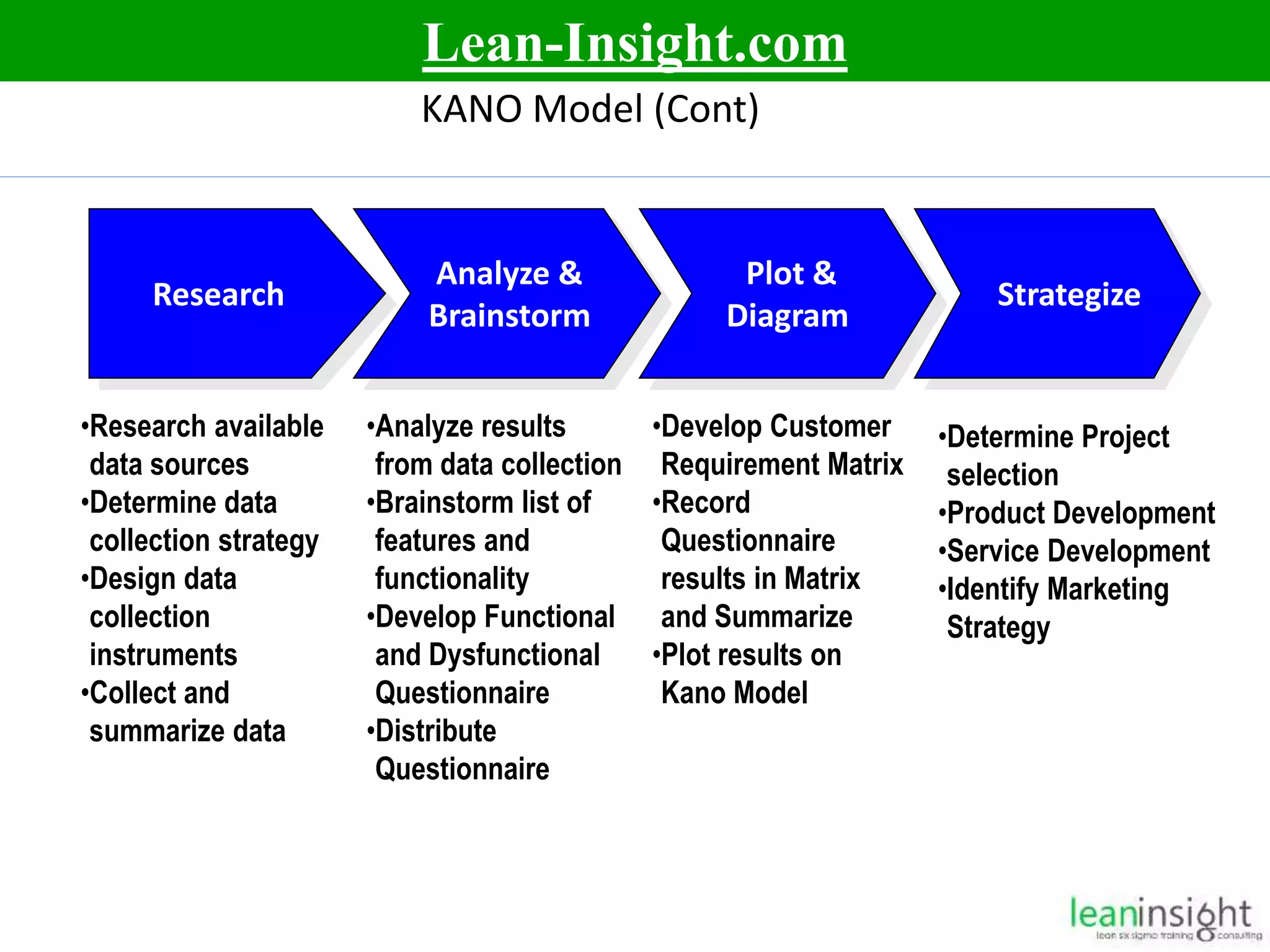
KANO Model (Cont)
Analyze &
Brainstorm
Research
Plot &
Diagram
Strategize
•Research available
data sources
•Determine data
collection strategy
•Design data
collection
instruments
•Collect and
summarize data
•Analyze results
from data collection
•Brainstorm list of
features and
functionality
•Develop Functional
and Dysfunctional
Questionnaire
•Distribute
Questionnaire
•Develop Customer
Requirement Matrix
•Record
Questionnaire
results in Matrix
and Summarize
•Plot results on
Kano Model
•Determine Project
selection
•Product Development
•Service Development
•Identify Marketing
Strategy
Lean-Insight.com
3
KANO Model (Cont)
Must Be’s - Focus Groups, Lawsuits and Regulations, Buzz on
Internet
Satisfiers - Competitive Analysis, Interviews, Surveys, Search
Logs, Usablity Testing, Customer Forums
Delighters - Field Research, Marketing/Branding Vision,
Industrial Design, Packaging, Call Center Data, Site Logs
Lean-Insight.com
4
5 Whys?????
Lean-Insight.com
5
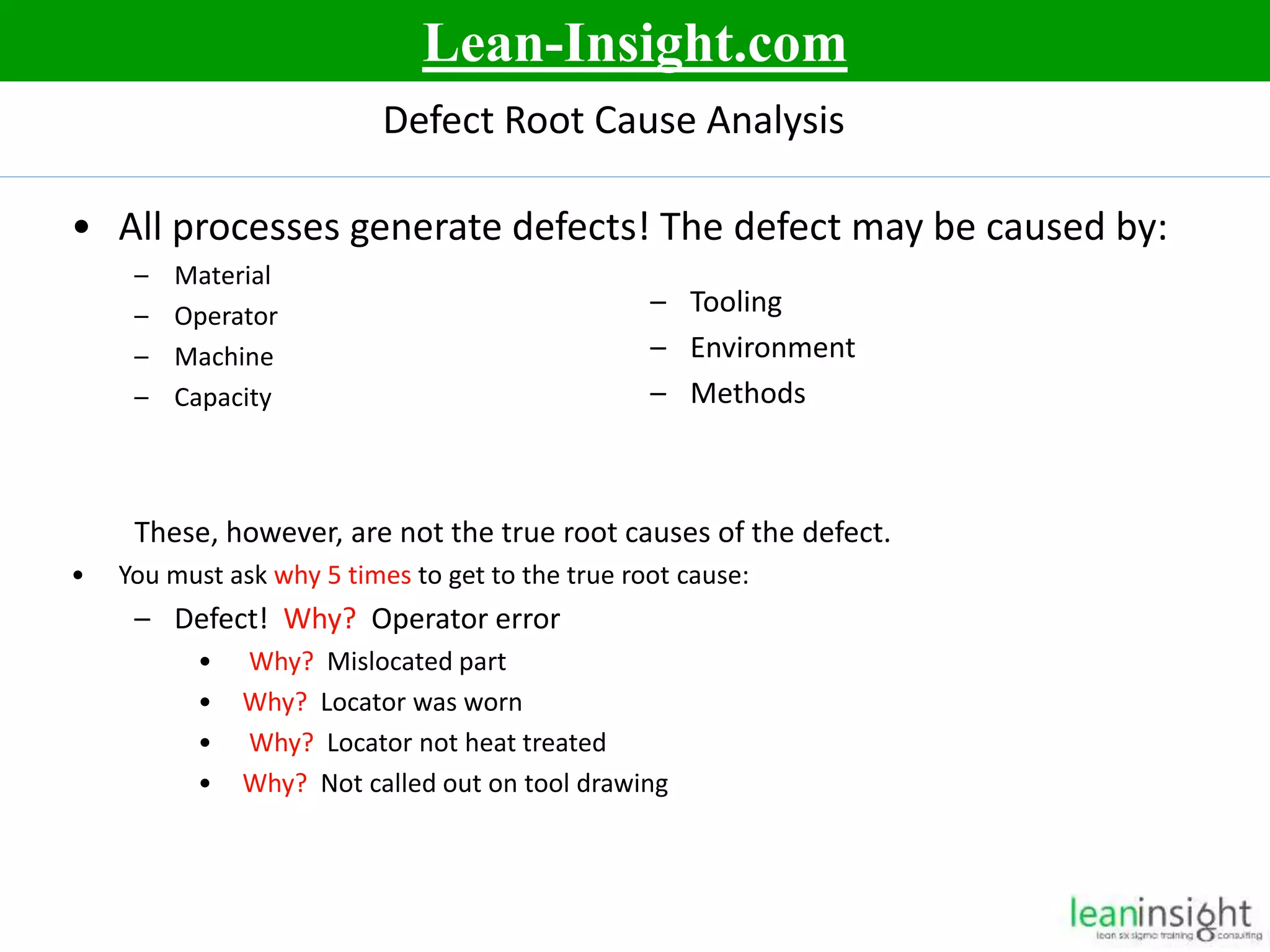
Defect Root Cause Analysis
• All processes generate defects! The defect may be caused by:
– Material
– Operator
– Machine
– Capacity
These, however, are not the true root causes of the defect.
• You must ask why 5 times to get to the true root cause:
– Defect! Why? Operator error
• Why? Mislocated part
• Why? Locator was worn
• Why? Locator not heat treated
• Why? Not called out on tool drawing
– Tooling
– Environment
– Methods
Lean-Insight.com
6
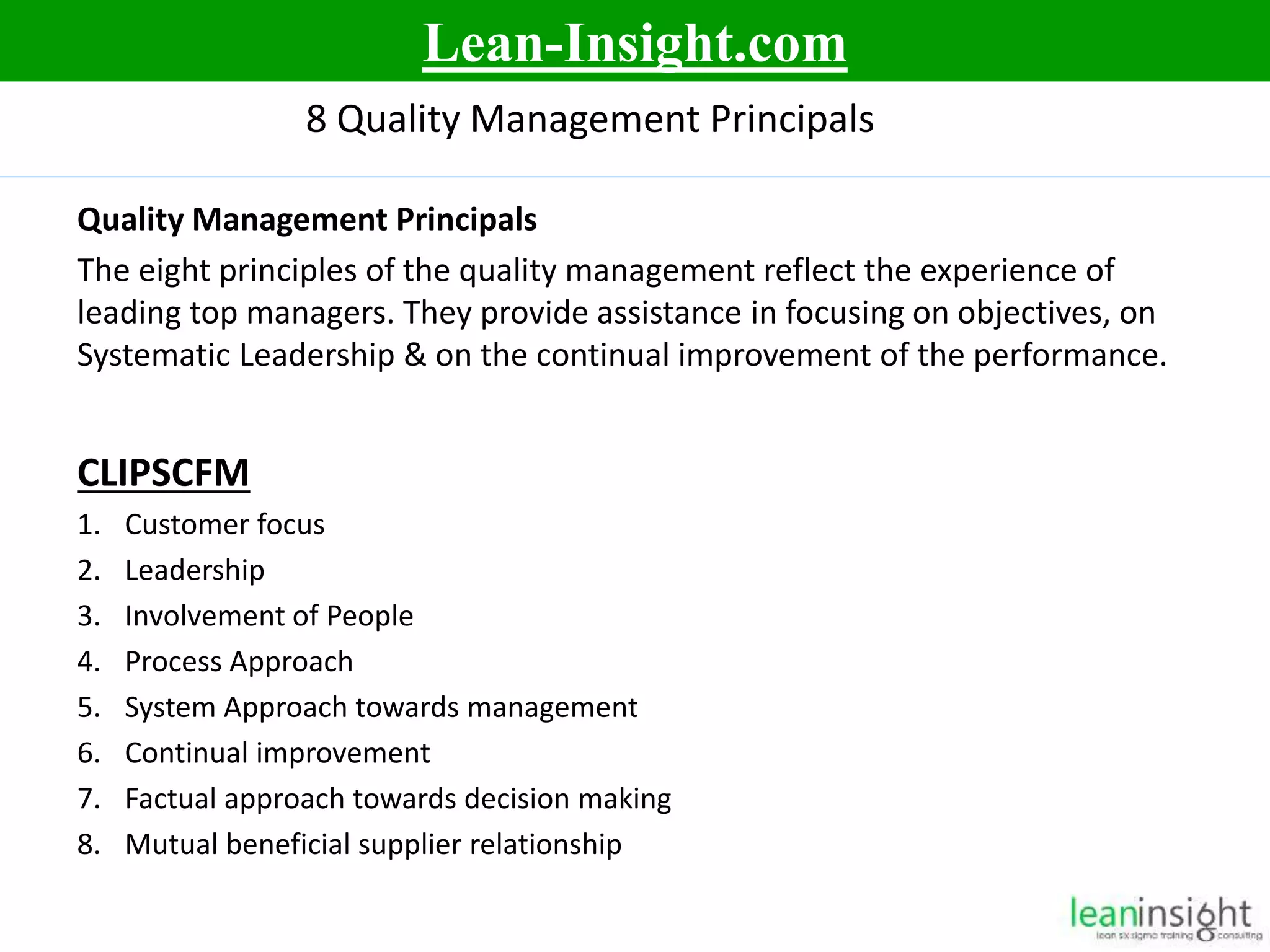
8 Quality Management Principals
Quality Management Principals
The eight principles of the quality management reflect the experience of
leading top managers. They provide assistance in focusing on objectives, on
Systematic Leadership & on the continual improvement of the performance.
CLIPSCFM
1. Customer focus
2. Leadership
3. Involvement of People
4. Process Approach
5. System Approach towards management
6. Continual improvement
7. Factual approach towards decision making
8. Mutual beneficial supplier relationship
Lean-Insight.com
7
1. Customer Focus
Consistent customer focus is the single most essential factor of the every
business success. Being “Best in class” means predicting and exceeding
customer expectation. The whole company organization needs to be aligned
accordingly.
1. Your customers needs are understood throughout the company
2. Your internal company is directly linked to customer expectations
3. You improve your company’s ability to fulfill customer needs in day-to
day activities
4. You ensure that your employees have the necessary knowledge & skills
to satisfy your customers
Lean-Insight.com
8
2. Leadership
The degree to which the purpose, focus and internal environment of an
organization fit together is a question of Leadership. Managers create the
internal environment in which people develop their skills and apply them for
the benefit of the entire organization. Important tools to achieve this are
management by example, the consideration of involved stakeholders inside
& outside the organization & the development of a clear vision of the
organization’s future.
1. You develop & communicate a clear vision of your organization's future
2. You translate your vision into measurable goals for the Organization
3. You involve your employees in the realization of your company goals
4. You have a motivated, competent & stable staff
Lean-Insight.com
9
3. Involvement of People
Every organization is only as good as its employees. To allow them to apply
their abilities & release their potential, its necessary to involve them in the
decision making process. Doing that requires promoting commitment &
problem solving skills on all levels and to encourage the employees to take
the initiative in seeking opportunities for the improvement.
1. Your employees contribute actively to the improvement of your
business strategy
2. Your employees adopt the organizations goals as their own goals
3. Your employees are involved in decision making & improvement of the
processes
4. Your employees are more satisfied with their work & devote their
individual development potential to the service of your organization
Lean-Insight.com
10
4. Process Approach
Results can be achieved more efficiently if necessary activities and resources
are bundled and managed as a process. For this purpose, individual process
steps needs to be defined, inputs & outputs determined and the interfaces
with the organizations function identified. Finally, in order to ensure the
smooth running of organizational processes , possible error causes need to
be identified and responsibilities determined.
1. Your processes ensure achievement of planned results and efficient use
of resources
2. You take advantages of improvement potentials because you are aware
of the essential success factors
3. Consistent emphasis on process orientation helps you to reduce cost &
prevent errors
Lean-Insight.com
11
5. System approach to management
Each organization is the complex entity; that is why it is important to
identify, manage & understand individual processes & their interaction
within the organizational workflow. This is the only way for organizations to
establish objectives effectively & efficiently.
1. You develop extensive and ambitious business plans, which combine
functional & process aspects
2. Sub goals of individual processes become aligned with the main goals of
your Organization
3. Monitoring the effectiveness of individual processes allows you to
better identify error causes and improvement potential
4. You co-ordinate competencies and responsibility for superordinate
goals, avoid any overlapping of competencies and stimulate teamwork
Lean-Insight.com
12
6. Continual Improvement
“If you cease to improve, you cease to be good”. “Behind this simple
statement lies the realization that competence and quality are not static, but
dynamic values; that applies to organizations as well as to the people
working there. That is why it is important for the success of an organization
that continuous improvement of product & system becomes the ultimate
goal of each employee.
1. You combine continuous improvement & strategic planning for more
competitive business plans
2. You set realistic measurable and ambitious goals for the improvement &
provide any necessary resources
3. Your employees become involved in the process of continual
improvement
4. All employees of your organization are capable of improving products,
processes & systems
Lean-Insight.com
13
7. Factual approach to decision making
Efficient decision are bases on the analysis of the data & information.
Appropriate decisions, bases on experience and entrepreneurial intuition,
can only be reached when these data and information are reviewed &
verified continuously.
1. You develop your company strategies bases on facts & information
2. Taking into account relevant comparative data, you pursue more
realistic & more ambitious goals
3. You make use of recognize methods for data analysis, making result
available where appropriate. You optimize your company processes &
system performance, taking into account data & information, manage
improvement processes & prevent future problems.
Lean-Insight.com
14
8. Mutually beneficial supplier relationship
All things are interdependent; organizations particularly depend on good
business relationships with their suppliers. This is the only way for both parties
to make the maximum contribution to the creation of mutual value.
Indispensable to that end is transparent communication, agreement on common
goals while taking account of the customer interests, & cooperation in the
development & improvement of products.
1. You increase your competitive advantage through the develop of strategic
partnerships with suppliers
2. You develop more ambitious goals by including your suppliers in your
planning at an early stage
3. Through improved relationship with suppliers, you ensure reliability,
punctuality & error free compliance of incoming goods
4. You develop & strengthen the performance capability of your suppliers
through training activities & joint efforts towards continuous improvement
Lean-Insight.com
15
Lean-Insight.com
If you are looking for Six Sigma training in Bangalore along with certification visit:
http://lean-insight.com/six-sigma-training-bangalore/

Lean Six Sigma Course Training Part 13

  • 1.
    1 Lean-Insight.com Lean Six SigmaTraining Part 13 Training Centers: Bangalore, Chennai and Hyderabad
  • 2.
    2 KANO Model (Cont) Analyze& Brainstorm Research Plot & Diagram Strategize •Research available data sources •Determine data collection strategy •Design data collection instruments •Collect and summarize data •Analyze results from data collection •Brainstorm list of features and functionality •Develop Functional and Dysfunctional Questionnaire •Distribute Questionnaire •Develop Customer Requirement Matrix •Record Questionnaire results in Matrix and Summarize •Plot results on Kano Model •Determine Project selection •Product Development •Service Development •Identify Marketing Strategy Lean-Insight.com
  • 3.
    3 KANO Model (Cont) MustBe’s - Focus Groups, Lawsuits and Regulations, Buzz on Internet Satisfiers - Competitive Analysis, Interviews, Surveys, Search Logs, Usablity Testing, Customer Forums Delighters - Field Research, Marketing/Branding Vision, Industrial Design, Packaging, Call Center Data, Site Logs Lean-Insight.com
  • 4.
  • 5.
    5 Defect Root CauseAnalysis • All processes generate defects! The defect may be caused by: – Material – Operator – Machine – Capacity These, however, are not the true root causes of the defect. • You must ask why 5 times to get to the true root cause: – Defect! Why? Operator error • Why? Mislocated part • Why? Locator was worn • Why? Locator not heat treated • Why? Not called out on tool drawing – Tooling – Environment – Methods Lean-Insight.com
  • 6.
    6 8 Quality ManagementPrincipals Quality Management Principals The eight principles of the quality management reflect the experience of leading top managers. They provide assistance in focusing on objectives, on Systematic Leadership & on the continual improvement of the performance. CLIPSCFM 1. Customer focus 2. Leadership 3. Involvement of People 4. Process Approach 5. System Approach towards management 6. Continual improvement 7. Factual approach towards decision making 8. Mutual beneficial supplier relationship Lean-Insight.com
  • 7.
    7 1. Customer Focus Consistentcustomer focus is the single most essential factor of the every business success. Being “Best in class” means predicting and exceeding customer expectation. The whole company organization needs to be aligned accordingly. 1. Your customers needs are understood throughout the company 2. Your internal company is directly linked to customer expectations 3. You improve your company’s ability to fulfill customer needs in day-to day activities 4. You ensure that your employees have the necessary knowledge & skills to satisfy your customers Lean-Insight.com
  • 8.
    8 2. Leadership The degreeto which the purpose, focus and internal environment of an organization fit together is a question of Leadership. Managers create the internal environment in which people develop their skills and apply them for the benefit of the entire organization. Important tools to achieve this are management by example, the consideration of involved stakeholders inside & outside the organization & the development of a clear vision of the organization’s future. 1. You develop & communicate a clear vision of your organization's future 2. You translate your vision into measurable goals for the Organization 3. You involve your employees in the realization of your company goals 4. You have a motivated, competent & stable staff Lean-Insight.com
  • 9.
    9 3. Involvement ofPeople Every organization is only as good as its employees. To allow them to apply their abilities & release their potential, its necessary to involve them in the decision making process. Doing that requires promoting commitment & problem solving skills on all levels and to encourage the employees to take the initiative in seeking opportunities for the improvement. 1. Your employees contribute actively to the improvement of your business strategy 2. Your employees adopt the organizations goals as their own goals 3. Your employees are involved in decision making & improvement of the processes 4. Your employees are more satisfied with their work & devote their individual development potential to the service of your organization Lean-Insight.com
  • 10.
    10 4. Process Approach Resultscan be achieved more efficiently if necessary activities and resources are bundled and managed as a process. For this purpose, individual process steps needs to be defined, inputs & outputs determined and the interfaces with the organizations function identified. Finally, in order to ensure the smooth running of organizational processes , possible error causes need to be identified and responsibilities determined. 1. Your processes ensure achievement of planned results and efficient use of resources 2. You take advantages of improvement potentials because you are aware of the essential success factors 3. Consistent emphasis on process orientation helps you to reduce cost & prevent errors Lean-Insight.com
  • 11.
    11 5. System approachto management Each organization is the complex entity; that is why it is important to identify, manage & understand individual processes & their interaction within the organizational workflow. This is the only way for organizations to establish objectives effectively & efficiently. 1. You develop extensive and ambitious business plans, which combine functional & process aspects 2. Sub goals of individual processes become aligned with the main goals of your Organization 3. Monitoring the effectiveness of individual processes allows you to better identify error causes and improvement potential 4. You co-ordinate competencies and responsibility for superordinate goals, avoid any overlapping of competencies and stimulate teamwork Lean-Insight.com
  • 12.
    12 6. Continual Improvement “Ifyou cease to improve, you cease to be good”. “Behind this simple statement lies the realization that competence and quality are not static, but dynamic values; that applies to organizations as well as to the people working there. That is why it is important for the success of an organization that continuous improvement of product & system becomes the ultimate goal of each employee. 1. You combine continuous improvement & strategic planning for more competitive business plans 2. You set realistic measurable and ambitious goals for the improvement & provide any necessary resources 3. Your employees become involved in the process of continual improvement 4. All employees of your organization are capable of improving products, processes & systems Lean-Insight.com
  • 13.
    13 7. Factual approachto decision making Efficient decision are bases on the analysis of the data & information. Appropriate decisions, bases on experience and entrepreneurial intuition, can only be reached when these data and information are reviewed & verified continuously. 1. You develop your company strategies bases on facts & information 2. Taking into account relevant comparative data, you pursue more realistic & more ambitious goals 3. You make use of recognize methods for data analysis, making result available where appropriate. You optimize your company processes & system performance, taking into account data & information, manage improvement processes & prevent future problems. Lean-Insight.com
  • 14.
    14 8. Mutually beneficialsupplier relationship All things are interdependent; organizations particularly depend on good business relationships with their suppliers. This is the only way for both parties to make the maximum contribution to the creation of mutual value. Indispensable to that end is transparent communication, agreement on common goals while taking account of the customer interests, & cooperation in the development & improvement of products. 1. You increase your competitive advantage through the develop of strategic partnerships with suppliers 2. You develop more ambitious goals by including your suppliers in your planning at an early stage 3. Through improved relationship with suppliers, you ensure reliability, punctuality & error free compliance of incoming goods 4. You develop & strengthen the performance capability of your suppliers through training activities & joint efforts towards continuous improvement Lean-Insight.com
  • 15.
    15 Lean-Insight.com If you arelooking for Six Sigma training in Bangalore along with certification visit: http://lean-insight.com/six-sigma-training-bangalore/