OBJECTIVES:
• Explain howfossil records, comparative anatomy, and
genetic information provide evidence for evolution
(S10LT-IIIf 39).
• Explain the occurrence of evolution.
• Give the importance of understanding the origin of life.
• Discuss how natural selection promotes expression and
propagation of traits and species that adapt with the
changing environment.
5.
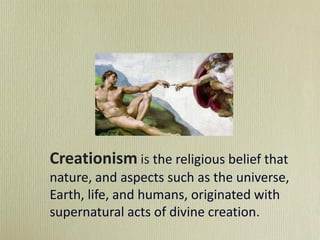
Creationism is thereligious belief that
nature, and aspects such as the universe,
Earth, life, and humans, originated with
supernatural acts of divine creation.
6.
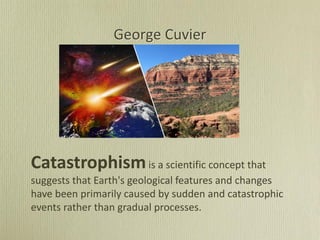
George Cuvier
Catastrophismis ascientific concept that
suggests that Earth's geological features and changes
have been primarily caused by sudden and catastrophic
events rather than gradual processes.
7.
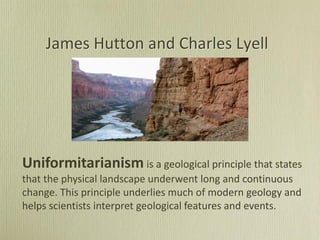
James Hutton andCharles Lyell
Uniformitarianism is a geological principle that states
that the physical landscape underwent long and continuous
change. This principle underlies much of modern geology and
helps scientists interpret geological features and events.
8.
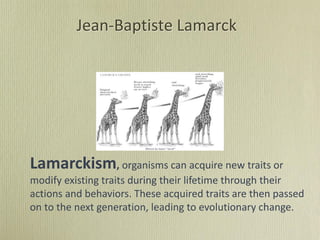
Jean-Baptiste Lamarck
Lamarckism, organismscan acquire new traits or
modify existing traits during their lifetime through their
actions and behaviors. These acquired traits are then passed
on to the next generation, leading to evolutionary change.
9.
I. What isEvolution?
• The slow, gradual change in a species over time.
• ‘Slow’ means thousands to millions of years (in most cases)...
• Species with short reproductive rates; like bacteria, evolve quickly.
Bacteria reproduce about every 20 minutes.
• Just in the last few millions of years, hundreds of species have
become extinct- while hundreds of others have developed.
• How do we know evolution is happening? Let’s look at the
evidence…
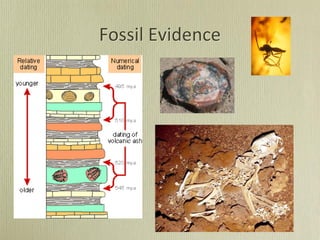
II. Fossil Evidence
•Definition: Any trace or remains of an organism that has
been preserved by natural processes.
• Studying fossils allows scientists to compare the remains
of ancient organisms with present day species to
determine evolutionary relationships.
• Fossils form from amber, ice, tar, petrification, bones
buried under sedimentary rock.
• The older the fossil, the deeper it will be buried.
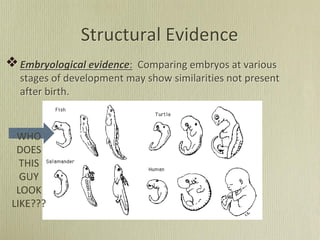
Embryological evidence: Comparingembryos at various
stages of development may show similarities not present
after birth.
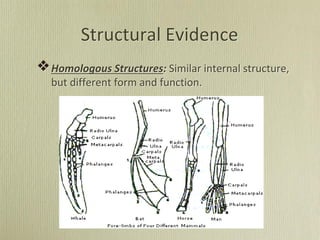
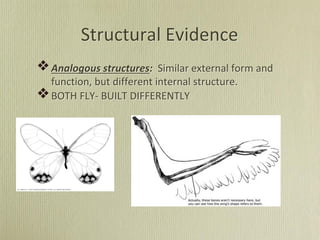
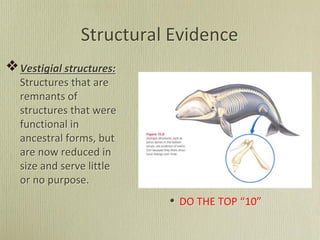
Structural Evidence
WHO
DOES
THIS
GUY
LOOK
LIKE???
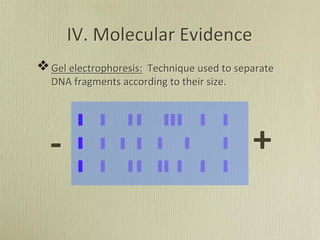
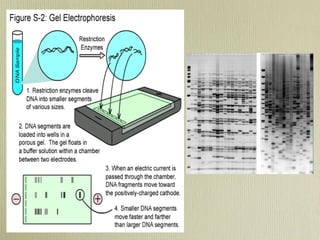
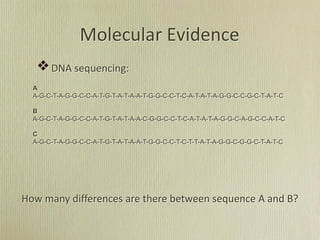
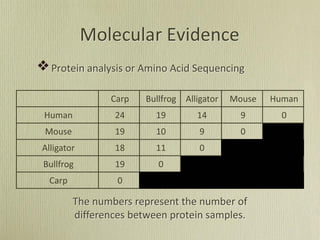
Protein analysis orAmino Acid Sequencing
Molecular Evidence
Carp Bullfrog Alligator Mouse Human
Human 24 19 14 9 0
Mouse 19 10 9 0
Alligator 18 11 0
Bullfrog 19 0
Carp 0
The numbers represent the number of
differences between protein samples.
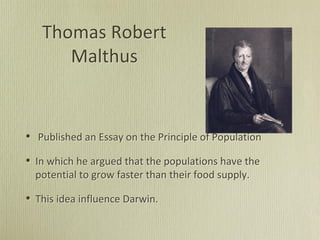
Thomas Robert
Malthus
• Publishedan Essay on the Principle of Population
• In which he argued that the populations have the
potential to grow faster than their food supply.
• This idea influence Darwin.
26.
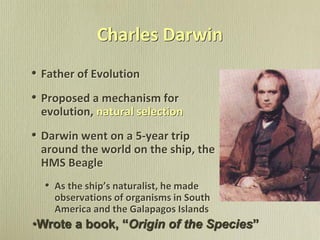
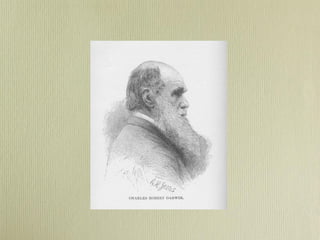
Charles Darwin
• Fatherof Evolution
• Proposed a mechanism for
evolution, natural selection
• Darwin went on a 5-year trip
around the world on the ship, the
HMS Beagle
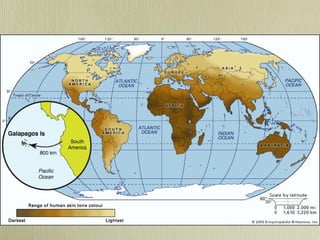
• As the ship’s naturalist, he made
observations of organisms in South
America and the Galapagos Islands
•Wrote a book, “Origin of the Species”
28.
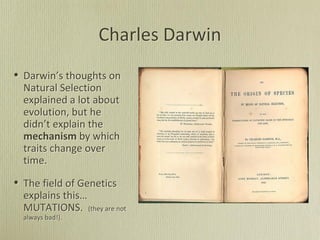
Charles Darwin
• Darwin’sthoughts on
Natural Selection
explained a lot about
evolution, but he
didn’t explain the
mechanism by which
traits change over
time.
• The field of Genetics
explains this…
MUTATIONS. (they are not
always bad!).
29.
Darwin’s and HisTheory of
Evolution (summarized in 5 major points)
1. OVERPRODUCTION: Most species
produce far more offspring than can
survive. Those that die are
considered ‘weak.’ These weak
organisms do not live long enough to
reproduce. Therefore, weak traits are
weeded out of the species.
30.
Darwin’s Points…
2. COMPETITION:Since living space and
food are limited (limited resources),
offspring must compete for resources.
Those who are good at competition
survive long enough to reproduce.
31.
Darwin’s Points…
3.VARIATIONS &ADAPTATIONS: The
characteristics of the individuals in any
species are not exactly alike. Those
individuals that have favorable
variations (adaptations), will have a
greater chance of living long enough to
reproduce.
32.
Why is VariationImportant?
• Because the environment changes.
• The more variation within a species, the more
likely it will survive
• EX: If everyone is the same, they are all
vulnerable to the same environmental changes
or diseases
• The more variation of types of species in an
habitat, the more likely at least some will survive
• EX: Dinosaurs replaced by mammals
33.
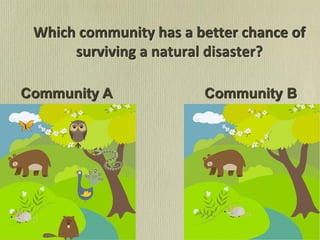
Which community hasa better chance of
surviving a natural disaster?
Community A Community B
34.
Darwin’s Points…
4.NATURAL SELECTION:Organisms with
variations that make them better
adapted to their environment survive
and reproduce; passing on these
favorable traits to their offspring.
35.
Natural Selection
• NaturalSelection: Organisms that are best
adapted to an environment survive and
reproduce more than others
• “survival of the fittest”
36.
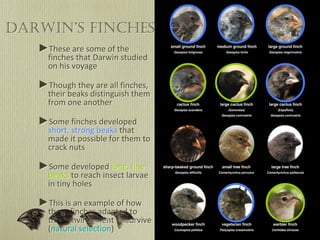
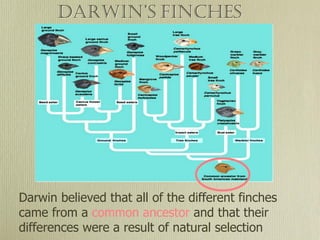
Darwin’s Finches
►These aresome of the
finches that Darwin studied
on his voyage
►Though they are all finches,
their beaks distinguish them
from one another
►Some finches developed
short, strong beaks that
made it possible for them to
crack nuts
►Some developed long, fine
beaks to reach insect larvae
in tiny holes
►This is an example of how
these finches adapted to
their environment to survive
(natural selection)
37.
Darwin’s Finches
Darwin believedthat all of the different finches
came from a common ancestor and that their
differences were a result of natural selection
38.
Darwin’s Points…
5.SPECIATION: Overmany generations,
favorable adaptations gradually
accumulate in the species and bad traits
disappear. Eventually, the accumulated
changes become so big that the result is
a new species.
39.
VII. Sources of
GeneticVariation
• MUTATIONS: Random changes in the genetic makeup of an
organism. (Actually a rare event, but causes new traits to arise).
• GENETIC RECOMBINATION: Gametes uniting during fertilization.
(Included within this is concept are meiosis and crossing over).
• MIGRATION: New traits being brought into a population or taking
traits out of a population. Has the greatest effect on small
populations.
• GENETIC DRIFT: Affects small populations; changes in the gene pool
due to storms, a catastrophe, etc. Harmful because it tends to
decrease the gene pool. Not significant in large populations.
40.
VIII. The Modern
Theoryof Evolution
• Focuses on the population rather than the individual.
• Population Genetics: The study of changes in the genetic
makeup of populations.
• Frequencies: how often a particular allele (trait) is found
within a population.
• Gene Pool: the total of all the alleles present in a population.
• Mathematically explained by Hardy- Weinberg. See Packet.
41.
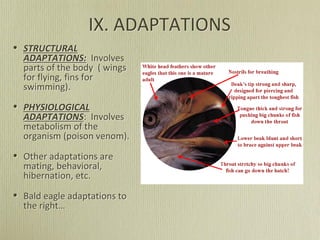
IX. ADAPTATIONS
• STRUCTURAL
ADAPTATIONS:Involves
parts of the body ( wings
for flying, fins for
swimming).
• PHYSIOLOGICAL
ADAPTATIONS: Involves
metabolism of the
organism (poison venom).
• Other adaptations are
mating, behavioral,
hibernation, etc.
• Bald eagle adaptations to
the right…
42.
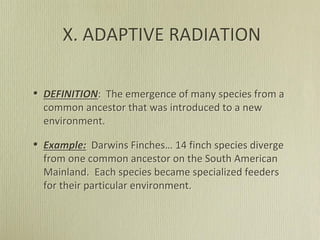
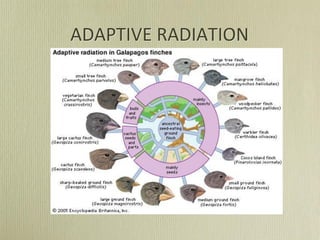
X. ADAPTIVE RADIATION
•DEFINITION: The emergence of many species from a
common ancestor that was introduced to a new
environment.
• Example: Darwins Finches… 14 finch species diverge
from one common ancestor on the South American
Mainland. Each species became specialized feeders
for their particular environment.
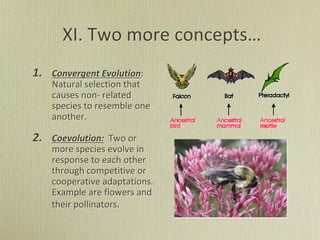
XI. Two moreconcepts…
1. Convergent Evolution:
Natural selection that
causes non- related
species to resemble one
another.
2. Coevolution: Two or
more species evolve in
response to each other
through competitive or
cooperative adaptations.
Example are flowers and
their pollinators.