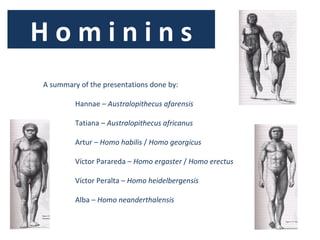
H o m i n i n s A summary of the presentations done by: Hannae –  Australopithecus   afarensis   Tatiana –  Australopithecus   africanus    Artur –  Homo habilis  /  Homo georgicus   Víctor Parareda –  Homo ergaster  /  Homo erectus   Víctor Peralta –  Homo heidelbergensis   Alba –  Homo neanderthalensis
AUSTRALOPHITEUS AFRICANUS
The first fossil remains: the cranium of a child known as the child of Taung. They were discovered in 1924 ,in Taung, South Africa.
His cranial capacity is 480 cm³ to 520 cm³, far below the human current being. The face is shorter. The mandible is advanced with respect to the jaw.
A. africanus had a bipedal running, but still retained arboreal habits. His weight ranged between 33 and 67 kg with a height of 1.50 m.   The absolute ages are difficult to identify the characteristics of the deposits. It is believed than 2 to 3 m.a.
Australopithecus afarensis   The species name is  Australopithecus afarensis . Australopithecus afarensis  is an extinct hominid of the subtribe hominin that lived between 3.9 and 3 million years ago.  Texture was thin and graceful, and is believed to live only in East Africa. Remains of this species have been found in Africa. East Africa was its distribution area.
Australopithecus afarensis
The  Australopithecus afarensis  was living in closed forests. Cranial volume was small (500 cubic inches).
Height Height of the females to 1 m
Height Height of the males to 1,5 m
Map distribution area
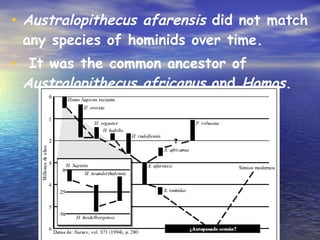
Australopithecus afarensis  did not match any species of hominids over time. It was the common ancestor of  Australopithecus africanus  and  Homos .
Homo habilis   (2.5-1.4 million years).
Fossils  Fossils found in Africa between 1962 and 1964. The remains have been found in Kenya in the town of Koobi Foraand Tanzania, in the famous Olduvai Gorge .
Ecosystem where they lived They lived in the African savannah. The climate was tropical. The vegetation was mainly  shrubs and the trees were lees than 10 per square meter.
Cranial volume.  Homo habilis skull had a volume of approximately 650-800 cma ³. It was 44% bigger than any  Australopithecus.  This represents a huge boost for the brain in Relation to the body.
Height and other anatomical features.  Its height was about 1.5 m  The pelvis is much more modern.
Diet.  Their diet was completely omnivorous.  Sat fat and animal protein allowed the development of the brain at the expense of other energetically expensive organs.
Lithic industry.  The size of stones was a simple mechanical process: holding on with one hand, a stone, harder than you wanted to carve, and on the other hand, they wanted to shape. Thus, removing the stone hit on number of slices. Thus, it was creating a kind of tip, which was used to cut or nailing 
Other species which they lived with  The Homo habilis coexisted with  Homo erectus  and  Paranthropus  ( Australophitecus ).
HOMO ERGASTER
They lived in… Africa,  and they also lived in Europe and Asia.
INDUSTRIA LÍTICA Homo Ergaster  developed type 2 of stone tools industry.  Bifacial axes are typicall tools obtained using these techniques. This type of industry was very succesful  and humans used it during a long period of time.
SKULL Around 850 cm³.
Where they at the same type in Earth with other humans? Yes, with  Homo erectus . In fact, some scientsist considered them to be african  Homo erectus .
Links http://www.slideshare.net/EvolutivosClan/homo-ergaster
HOMO ERECTUS
Where did they live? Homo erectus  were the first great human explorers. Scientist find evidences of this species from Spain to Asia.
FIRE Their greatest achivement was the use of fire.
SKULL Between 800 and 1200 cm³ (mean size increased along their evolution)
FUENTES: Wikipedia Quo SlideShare.net Portalciencia.net Atapuerca.org Espaciociencia.com
   This species is called  Homo heidelbergensis .  They were alive from 500,000 years ago to, at least, 250,000 years ago.
Where remains have been found and what was their distribution?. Its distribution was, for Europe and Africa.
Anatomic Caracteristics. The jaws also had a large force. The skull has superciliary arches.  The skull has superciliary arches
What was the ecosystem where it lived?. The ecosystem where they lived was of forests, steppes and plains.
What is your brain volume?. Its cranial capacity is 1100 to 1400 cubic centimeters.
What was his height?. Homo heidelbergensis  height is 1.70 meters.
Homo heilderbengesis diet was omnivorous. There are remains from more than 30 individuals of  Homo heidelbergensis  .
What other hominid species coincided in time? Homo helderbengensis  evolved to  Homo Neardentalensis  in Europe.
Homo neanthertalensis
      Where have remains found? What is the area distribution? - The oldest remains are found in Africa. Neanderthal skulls were first discovered in Engis (Belgium)  and in Forbes' Quarry (Gibraltar).   Is an extinct member of the Homo genus that is known from Pleistocene specimens found in Europe and parts of western and central Asia.
The area of distribution Atapuerca site
What was the ecosystem where they lived? It was a species well adapted to cold weather thanks to its broad and elongated skulls, their robustness, short and broad nose.  It is known that they lived in organized groups that were composed of about 30 members.
Cranial volume/ Height/ Features Characteristics: strong skeleton, wide pelvis, short legs, barrel chest, low forehead, jaws without menthol and  large cranial capacity  —1.500 cm³—
                 Diet Fossil remains provide evidence that they moved in small groups possibly occupying areas seasonally and subsisting by hunting big-game such as reindeer. Animal bones found with Neanderthal remains are mostly cold adapted species such as reindeer, bison, elk, arctic fox, lemming and mammoth . These Neanderthals had diets similar to nonhuman carnivore.
         Industry type lithic 
          Period existed It appears about 200,000 years and disappeared 35,000 years ago, during the Pleistocene.  His disappearance could be due to lack of adaptation to the  Homo sapiens. They coexisted with  Homo sapiens .

Human evolution

  • 1.
    H o mi n i n s A summary of the presentations done by: Hannae – Australopithecus afarensis   Tatiana – Australopithecus africanus   Artur – Homo habilis / Homo georgicus   Víctor Parareda – Homo ergaster / Homo erectus   Víctor Peralta – Homo heidelbergensis   Alba – Homo neanderthalensis
  • 2.
  • 3.
    The first fossilremains: the cranium of a child known as the child of Taung. They were discovered in 1924 ,in Taung, South Africa.
  • 4.
    His cranial capacityis 480 cm³ to 520 cm³, far below the human current being. The face is shorter. The mandible is advanced with respect to the jaw.
  • 5.
    A. africanus hada bipedal running, but still retained arboreal habits. His weight ranged between 33 and 67 kg with a height of 1.50 m.   The absolute ages are difficult to identify the characteristics of the deposits. It is believed than 2 to 3 m.a.
  • 6.
    Australopithecus afarensis The species name is Australopithecus afarensis . Australopithecus afarensis is an extinct hominid of the subtribe hominin that lived between 3.9 and 3 million years ago. Texture was thin and graceful, and is believed to live only in East Africa. Remains of this species have been found in Africa. East Africa was its distribution area.
  • 7.
  • 8.
    The Australopithecusafarensis was living in closed forests. Cranial volume was small (500 cubic inches).
  • 9.
    Height Height ofthe females to 1 m
  • 10.
    Height Height ofthe males to 1,5 m
  • 11.
  • 12.
    Australopithecus afarensis did not match any species of hominids over time. It was the common ancestor of Australopithecus africanus and Homos .
  • 13.
    Homo habilis (2.5-1.4 million years).
  • 14.
    Fossils Fossils found in Africa between 1962 and1964. The remains have been found in Kenya in the town of Koobi Foraand Tanzania, in the famous Olduvai Gorge .
  • 15.
    Ecosystem where they livedThey lived in the African savannah. The climate was tropical. The vegetation was mainly shrubs and the trees were lees than 10 per square meter.
  • 16.
    Cranial volume. Homo habilis skull had a volume of approximately 650-800 cma ³. It was 44% bigger than any Australopithecus. This represents a huge boost for the brain in Relation to the body.
  • 17.
    Height and other anatomical features. Its height was about 1.5 m The pelvis is much more modern.
  • 18.
    Diet. Theirdiet was completely omnivorous. Sat fat and animal protein allowed the development of the brain at the expense of other energetically expensive organs.
  • 19.
    Lithic industry. Thesize of stones was a simple mechanical process: holding on with one hand, a stone, harder than you wanted to carve, and on the other hand, they wanted to shape. Thus, removing the stone hit on number of slices. Thus, it was creating a kind of tip, which was used to cut or nailing 
  • 20.
    Other species which they lived with The Homo habilis coexisted with  Homo erectus and Paranthropus ( Australophitecus ).
  • 21.
  • 22.
    They lived in…Africa, and they also lived in Europe and Asia.
  • 23.
    INDUSTRIA LÍTICA HomoErgaster developed type 2 of stone tools industry. Bifacial axes are typicall tools obtained using these techniques. This type of industry was very succesful and humans used it during a long period of time.
  • 24.
  • 25.
    Where they atthe same type in Earth with other humans? Yes, with Homo erectus . In fact, some scientsist considered them to be african Homo erectus .
  • 26.
  • 27.
  • 28.
    Where did theylive? Homo erectus were the first great human explorers. Scientist find evidences of this species from Spain to Asia.
  • 29.
    FIRE Their greatestachivement was the use of fire.
  • 30.
    SKULL Between 800and 1200 cm³ (mean size increased along their evolution)
  • 31.
    FUENTES: Wikipedia QuoSlideShare.net Portalciencia.net Atapuerca.org Espaciociencia.com
  • 32.
      Thisspecies is called Homo heidelbergensis . They were alive from 500,000 years ago to, at least, 250,000 years ago.
  • 33.
    Where remains havebeen found and what was their distribution?. Its distribution was, for Europe and Africa.
  • 34.
    Anatomic Caracteristics. Thejaws also had a large force. The skull has superciliary arches. The skull has superciliary arches
  • 35.
    What was theecosystem where it lived?. The ecosystem where they lived was of forests, steppes and plains.
  • 36.
    What is yourbrain volume?. Its cranial capacity is 1100 to 1400 cubic centimeters.
  • 37.
    What was hisheight?. Homo heidelbergensis height is 1.70 meters.
  • 38.
    Homo heilderbengesis dietwas omnivorous. There are remains from more than 30 individuals of Homo heidelbergensis .
  • 39.
    What other hominidspecies coincided in time? Homo helderbengensis evolved to Homo Neardentalensis in Europe.
  • 40.
  • 41.
         Where have remains found? What is the area distribution? - The oldest remains are found in Africa. Neanderthal skulls were first discovered in Engis (Belgium)  and in Forbes' Quarry (Gibraltar).   Is an extinct member of the Homo genus that is known from Pleistocene specimens found in Europe and parts of western and central Asia.
  • 42.
    The area ofdistribution Atapuerca site
  • 43.
    What was theecosystem where they lived? It was a species well adapted to cold weather thanks to its broad and elongated skulls, their robustness, short and broad nose.  It is known that they lived in organized groups that were composed of about 30 members.
  • 44.
    Cranial volume/ Height/Features Characteristics: strong skeleton, wide pelvis, short legs, barrel chest, low forehead, jaws without menthol and  large cranial capacity  —1.500 cm³—
  • 45.
                    Diet Fossil remains provide evidence that they moved in small groups possibly occupying areas seasonally and subsisting by hunting big-game such as reindeer. Animal bones found with Neanderthal remains are mostly cold adapted species such as reindeer, bison, elk, arctic fox, lemming and mammoth . These Neanderthals had diets similar to nonhuman carnivore.
  • 46.
            Industry type lithic 
  • 47.
            Period existed It appears about 200,000 years and disappeared 35,000 years ago, during the Pleistocene. His disappearance could be due to lack of adaptation to the Homo sapiens. They coexisted with Homo sapiens .