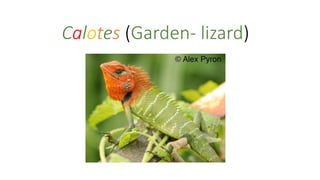
Calotes (Garden- lizard)
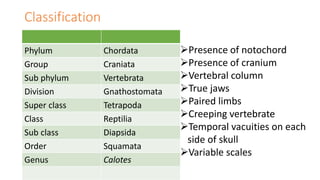
Classification
Phylum Chordata
Group Craniata
Sub phylum Vertebrata
Division Gnathostomata
Super class Tetrapoda
Class Reptilia
Sub class Diapsida
Order Squamata
Genus Calotes
Presence of notochord
Presence of cranium
Vertebral column
True jaws
Paired limbs
Creeping vertebrate
Temporal vacuities on each
side of skull
Variable scales
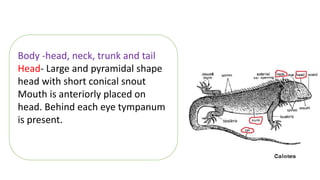
Body -head, neck, trunk and tail
Head- Large and pyramidal shape
head with short conical snout
Mouth is anteriorly placed on
head. Behind each eye tympanum
is present.
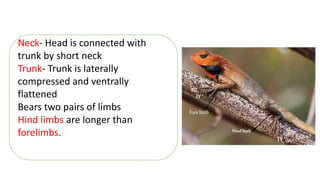
Neck- Head is connected with
trunk by short neck
Trunk- Trunk is laterally
compressed and ventrally
flattened
Bears two pairs of limbs
Hind limbs are longer than
forelimbs.
Body is covered with
imbricate epidermal horny
scales
A crest of sharp spines is present
on the dorsal surface of the neck
and back
Skin is rough and dry
without glands
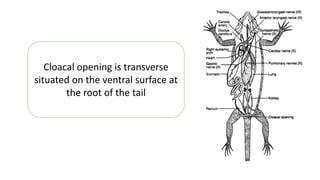
Cloacal opening is transverse
situated on the ventral surface at
the root of the tail
Tail
long and cylindrical with
alternate light and dark annuli
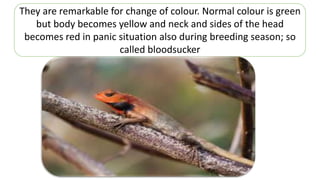
They are remarkable for change of colour. Normal colour is green
but body becomes yellow and neck and sides of the head
becomes red in panic situation also during breeding season; so
called bloodsucker
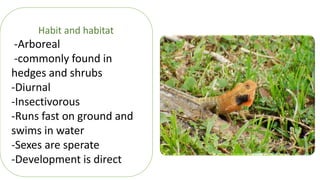
Habit and habitat
-Arboreal
-commonly found in
hedges and shrubs
-Diurnal
-Insectivorous
-Runs fast on ground and
swims in water
-Sexes are sperate
-Development is direct
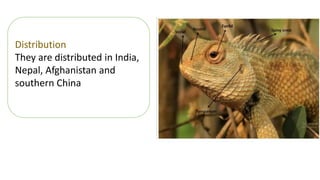
Distribution
They are distributed in India,
Nepal, Afghanistan and
southern China
Economic Importance
• Calotes is non- poisonous and helpful to farmers because it mainly
feeds on the insects
• Used as study material in the laboratories
References
• https://www.britannica.com/animal/Calotes
• https://www.youtube.com/watch?v=woe6VFKiGjE
• https://www.youtube.com/watch?v=3jzR4P7KFEs
• https://www.notesonzoology.com/reptilia/nervous-system-of-
calotes-with-diagram-zoology/3902

Calotes (garden lizard)