How
DNA
Works
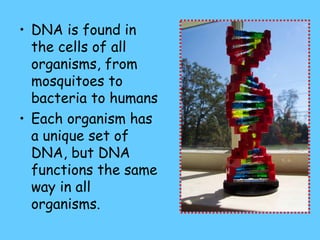
• DNA is found in
  the cells of all
  organisms, from
  mosquitoes to
  bacteria to humans
• Each organism has
  a unique set of
  DNA, but DNA
  functions the same
  way in all
  organisms.
Unraveling DNA
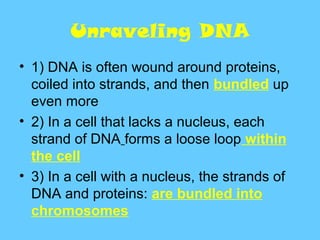
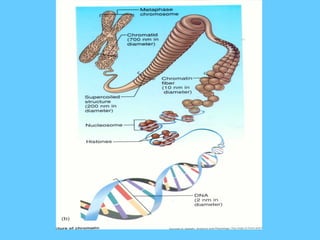
• 1) DNA is often wound around proteins,
  coiled into strands, and then bundled up
  even more
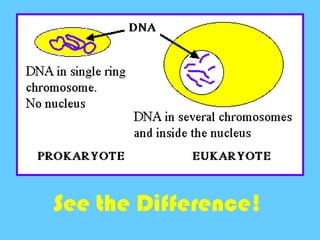
• 2) In a cell that lacks a nucleus, each
  strand of DNA forms a loose loop within
  the cell
• 3) In a cell with a nucleus, the strands of
  DNA and proteins: are bundled into
  chromosomes
See the Difference!
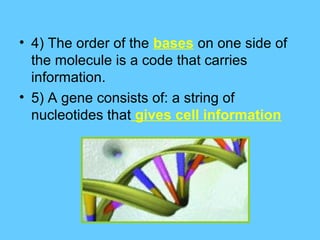
• 4) The order of the bases on one side of
  the molecule is a code that carries
  information.
• 5) A gene consists of: a string of
  nucleotides that gives cell information
Genes and Proteins
1) DNA code reads like a book—from 1
   end to the other, in 1 direction
2) Bases form the alphabet of the code.
   Groups of 3 bases are the codes for
   specific amino acids.
3) Example: 3 bases CCA form proline.
4) A long string of amino acids forms a
   protein. Thus, each gene is usually a: set
   of instructions for making a protein.
Proteins and Traits
1) Proteins are found throughout cells
   and cause: most differences you
   see.
2) Proteins act as chemical triggers
   and messengers.
3) A single organism may have
   thousands of genes that code for
   thousands of proteins.
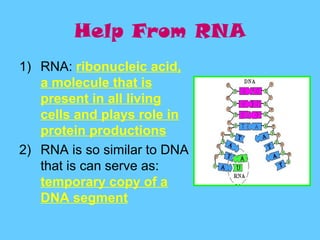
Help From RNA
1) RNA: ribonucleic acid,
   a molecule that is
   present in all living
   cells and plays role in
   protein productions
2) RNA is so similar to DNA
   that is can serve as:
   temporary copy of a
   DNA segment
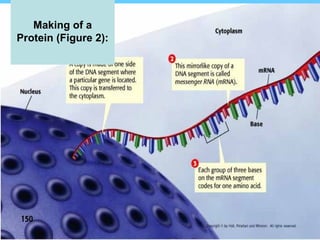
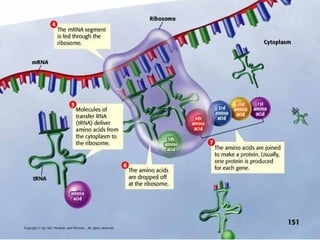
Making of a
Protein (Figure 2):
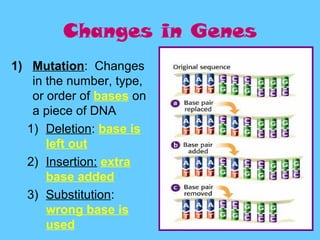
Changes in Genes
1) Mutation: Changes
   in the number, type,
   or order of bases on
   a piece of DNA
  1) Deletion: base is
      left out
  2) Insertion: extra
      base added
  3) Substitution:
      wrong base is
      used
Do Mutations Matter?
•   Three possible consequences to
    changes in DNA:
    1)   An improved trait
    2)   No change
    3)   Harmful trait
    •    When error is found, it is usually fixed
    •    If the mutation occurs in the sex cells, the
         changed gene can be passed from one
         generation to the next.
How Do Mutations Happen?

1) Mutations happen regularly because of:
  random errors when DNA is copied
2) Also, damage to DNA can be caused by
  abnormal things that happen to cells
3) Any physical or chemical agent that can
  cause a mutation in DNA is called a
  mutagen.
4) Examples of mutagens: X-rays, UV
  radiation, cigarette smoke
Uses of Genetic
      Knowledge
•  Genetic Engineering
1) Genetic engineering:
   when scientists
   manipulate individual
   genes within an
   organism
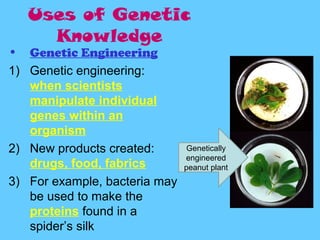
2) New products created:        Genetically
                               engineered
   drugs, food, fabrics        peanut plant
3) For example, bacteria may
   be used to make the
   proteins found in a
   spider’s silk
• Genetic
   Identification
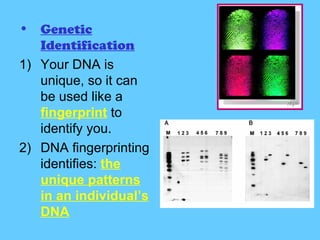
1) Your DNA is
   unique, so it can
   be used like a
   fingerprint to
   identify you.
2) DNA fingerprinting
   identifies: the
   unique patterns
   in an individual’s
   DNA
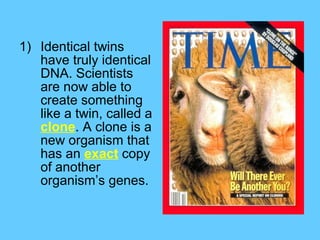
1) Identical twins
   have truly identical
   DNA. Scientists
   are now able to
   create something
   like a twin, called a
   clone. A clone is a
   new organism that
   has an exact copy
   of another
   organism’s genes.

How dna works

  • 1.
  • 2.
    • DNA isfound in the cells of all organisms, from mosquitoes to bacteria to humans • Each organism has a unique set of DNA, but DNA functions the same way in all organisms.
  • 3.
    Unraveling DNA • 1)DNA is often wound around proteins, coiled into strands, and then bundled up even more • 2) In a cell that lacks a nucleus, each strand of DNA forms a loose loop within the cell • 3) In a cell with a nucleus, the strands of DNA and proteins: are bundled into chromosomes
  • 4.
  • 5.
    • 4) Theorder of the bases on one side of the molecule is a code that carries information. • 5) A gene consists of: a string of nucleotides that gives cell information
  • 7.
    Genes and Proteins 1)DNA code reads like a book—from 1 end to the other, in 1 direction 2) Bases form the alphabet of the code. Groups of 3 bases are the codes for specific amino acids. 3) Example: 3 bases CCA form proline. 4) A long string of amino acids forms a protein. Thus, each gene is usually a: set of instructions for making a protein.
  • 8.
    Proteins and Traits 1)Proteins are found throughout cells and cause: most differences you see. 2) Proteins act as chemical triggers and messengers. 3) A single organism may have thousands of genes that code for thousands of proteins.
  • 9.
    Help From RNA 1)RNA: ribonucleic acid, a molecule that is present in all living cells and plays role in protein productions 2) RNA is so similar to DNA that is can serve as: temporary copy of a DNA segment
  • 10.
  • 12.
    Changes in Genes 1)Mutation: Changes in the number, type, or order of bases on a piece of DNA 1) Deletion: base is left out 2) Insertion: extra base added 3) Substitution: wrong base is used
  • 13.
    Do Mutations Matter? • Three possible consequences to changes in DNA: 1) An improved trait 2) No change 3) Harmful trait • When error is found, it is usually fixed • If the mutation occurs in the sex cells, the changed gene can be passed from one generation to the next.
  • 14.
    How Do MutationsHappen? 1) Mutations happen regularly because of: random errors when DNA is copied 2) Also, damage to DNA can be caused by abnormal things that happen to cells 3) Any physical or chemical agent that can cause a mutation in DNA is called a mutagen. 4) Examples of mutagens: X-rays, UV radiation, cigarette smoke
  • 15.
    Uses of Genetic Knowledge • Genetic Engineering 1) Genetic engineering: when scientists manipulate individual genes within an organism 2) New products created: Genetically engineered drugs, food, fabrics peanut plant 3) For example, bacteria may be used to make the proteins found in a spider’s silk
  • 16.
    • Genetic Identification 1) Your DNA is unique, so it can be used like a fingerprint to identify you. 2) DNA fingerprinting identifies: the unique patterns in an individual’s DNA
  • 17.
    1) Identical twins have truly identical DNA. Scientists are now able to create something like a twin, called a clone. A clone is a new organism that has an exact copy of another organism’s genes.