


Camel Evolution
Presented by : Sana Haroon
Zoogeography & Paleontology
C a m e l s
THE MOST UNDERVALUED INVALUABLE CREATURE
EVOLUTIONARY HISTORY
Lets begin..
When you picture camels, what do you
think of these animals?
you might think;
• humped inhabitants of deserts
But here is a little more to know
• Camels didn’t always have humps or traverse sand dunes.
• They started off the size of a beagle.
• With much longer legs and neck, and had no humps or bumps.
Introduction
• The dromedary camel, commonly known as the one-humped camel, is one of
the species in the genus Camelus , which also contains the Bactrian, two-
humped camel.
• Camels are in the family Camelidae.
• Dromedaries account for approximately 90% of all the camels in the modern
worl.
• Camel’s ancestors have developed extensively over time, and the modern camel
shares the same ancestors as other modern species, as well.
History
• First appeared in subtropical forests in North America, during the Eocene
Epoch.
• From there, early camels traveled long journeys, with growing bodies and
changing feet, until they became two distinct evolutionary lines.
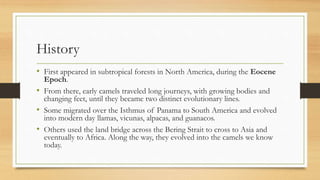
• Some migrated over the Isthmus of Panama to South America and evolved
into modern day llamas, vicunas, alpacas, and guanacos.
• Others used the land bridge across the Bering Strait to cross to Asia and
eventually to Africa. Along the way, they evolved into the camels we know
today.
History
• 46 MYA
From 46 million to six million years ago, camels originated and only lived in North America.
6 MYA
Six million years ago camels crossed the Bering Bridge to Asia and migrated as far south as Africa.
• 3 MYA
Three million years ago camels (llamas) crossed the Isthmus of Panama to South America.
• TODAY
Today camels are extinct except for parts of Asia, the Middle East, Africa and South America.
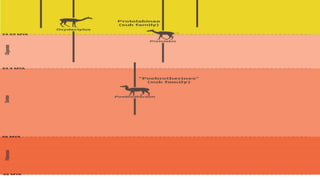
The Camel Evolutionary Tree
• Let’s see how a small, hump-less rabbit-like animal became “the ship of the
desert” as the camel evolved to its modern form.
History
Protylopus - Eocene
Scientists search on the camels and also its ancestral genus.
They search on camels from modern camels to the Protylopus.
Protylopus present on the earth about 50 million years ago in North
America during Eocene period
In modern day South Dakota like they founded in the dense forested
area and they comprised the size of rabbit.
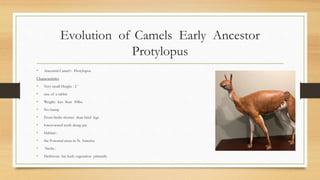
Evolution of Camels Early Ancestor
Protylopus
• Ancestral Camel= Protylopus
Characteristics
• Very small Height : 2 ’
• size of a rabbit
• Weight: less than 50lbs.
• No hump
• Front limbs shorter than hind legs
• lowcrowned teeth along jaw
• Habitat :
• the Forested areas in N. America
• Niche :
• Herbivore Ate leafy vegetation primarily
Camelus-Pleistocene
• About 11,700 years ago and one humped developed from dromedaries
• and live in desserts and 6 feet height.
• Larger fatty acids containing the rope like tail. At the time Bactrian entered in
Asia along variations.
• The Bactrian is thought to have evolved into the dromedary because
• modern dromedary camel’s fetus, during prenatal development,
• have two humps, and also a vestigial hind hump in adult dromedaries.
• Given this evidence, it has been speculated.
Evolution of a Camel- Modern
Characteristics:
• Height-6’
• Weight- 1500lb.
• Brown to beige fur
• Hump- fatty tissue
• Rope like tail
• Long, thin powerful
legs
• Large “doe-like”
eyes
• Long neck
• Hot, dry, desert conditions
• Low precipitation
• Little vegetation
• Niche:
• Herbivores- eat
Evolution of a Camel- Modern
Habitat:
Evolution of a Camel- Modern
Adaptations :
• Hump- fatty tissue used for energy reserve (does not store water)
• Double row of eyelashes-protect eye from sand
• Unique internal thermostat- body temp. lower than air temp which
• helps them conserve water
• Domesticated-assists survival in harsh environment
Variations of the Genus & Distribution
Scientific Classification
• Kingdom
• Phylum
• Class
• Order
• Family
• Genus
• Species
• Animalia
• Chordata
• Vertebrata
• Mammalia
• Camelidae
• Camelus
• Dromedarius
 Camel Evolution by @Sana_Haroon

Camel Evolution by @Sana_Haroon

  • 1.
    Camel Evolution Presented by: Sana Haroon Zoogeography & Paleontology
  • 2.
    C a me l s THE MOST UNDERVALUED INVALUABLE CREATURE EVOLUTIONARY HISTORY
  • 3.
    Lets begin.. When youpicture camels, what do you think of these animals? you might think; • humped inhabitants of deserts
  • 4.
    But here isa little more to know • Camels didn’t always have humps or traverse sand dunes. • They started off the size of a beagle. • With much longer legs and neck, and had no humps or bumps.
  • 5.
    Introduction • The dromedarycamel, commonly known as the one-humped camel, is one of the species in the genus Camelus , which also contains the Bactrian, two- humped camel. • Camels are in the family Camelidae. • Dromedaries account for approximately 90% of all the camels in the modern worl. • Camel’s ancestors have developed extensively over time, and the modern camel shares the same ancestors as other modern species, as well.
  • 6.
    History • First appearedin subtropical forests in North America, during the Eocene Epoch. • From there, early camels traveled long journeys, with growing bodies and changing feet, until they became two distinct evolutionary lines. • Some migrated over the Isthmus of Panama to South America and evolved into modern day llamas, vicunas, alpacas, and guanacos. • Others used the land bridge across the Bering Strait to cross to Asia and eventually to Africa. Along the way, they evolved into the camels we know today.
  • 7.
    History • 46 MYA From46 million to six million years ago, camels originated and only lived in North America. 6 MYA Six million years ago camels crossed the Bering Bridge to Asia and migrated as far south as Africa. • 3 MYA Three million years ago camels (llamas) crossed the Isthmus of Panama to South America. • TODAY Today camels are extinct except for parts of Asia, the Middle East, Africa and South America.
  • 8.
    The Camel EvolutionaryTree • Let’s see how a small, hump-less rabbit-like animal became “the ship of the desert” as the camel evolved to its modern form.
  • 11.
  • 12.
    Protylopus - Eocene Scientistssearch on the camels and also its ancestral genus. They search on camels from modern camels to the Protylopus. Protylopus present on the earth about 50 million years ago in North America during Eocene period In modern day South Dakota like they founded in the dense forested area and they comprised the size of rabbit.
  • 13.
    Evolution of CamelsEarly Ancestor Protylopus • Ancestral Camel= Protylopus Characteristics • Very small Height : 2 ’ • size of a rabbit • Weight: less than 50lbs. • No hump • Front limbs shorter than hind legs • lowcrowned teeth along jaw • Habitat : • the Forested areas in N. America • Niche : • Herbivore Ate leafy vegetation primarily
  • 14.
    Camelus-Pleistocene • About 11,700years ago and one humped developed from dromedaries • and live in desserts and 6 feet height. • Larger fatty acids containing the rope like tail. At the time Bactrian entered in Asia along variations. • The Bactrian is thought to have evolved into the dromedary because • modern dromedary camel’s fetus, during prenatal development, • have two humps, and also a vestigial hind hump in adult dromedaries. • Given this evidence, it has been speculated.
  • 15.
    Evolution of aCamel- Modern Characteristics: • Height-6’ • Weight- 1500lb. • Brown to beige fur • Hump- fatty tissue • Rope like tail • Long, thin powerful legs • Large “doe-like” eyes • Long neck
  • 16.
    • Hot, dry,desert conditions • Low precipitation • Little vegetation • Niche: • Herbivores- eat Evolution of a Camel- Modern Habitat:
  • 17.
    Evolution of aCamel- Modern Adaptations : • Hump- fatty tissue used for energy reserve (does not store water) • Double row of eyelashes-protect eye from sand • Unique internal thermostat- body temp. lower than air temp which • helps them conserve water • Domesticated-assists survival in harsh environment Variations of the Genus & Distribution
  • 18.
    Scientific Classification • Kingdom •Phylum • Class • Order • Family • Genus • Species • Animalia • Chordata • Vertebrata • Mammalia • Camelidae • Camelus • Dromedarius