EVOLUTION
Multiple Choice Questions
MARCH 25, 2018
YOUSAF RAFIQUE
Yousaf1438@gmail.com
Evolution
1) The main word “Evolution” is
a) To mature
b) To adapt
c) To evolve
d) All above
2) Evolution can be defined as
a) The change over time in specie.
b) Descent with modification
c) Slow and continuous process in which changes in form and behavior occur over successive
generation in a population
d) All above
3) Evolution has occurred from
a) Descendent to ascendant
b) Ascendant to descendent
c) Specie to population
d) Population to population
4) Evolution can be
a) Micro
b) Macro
c) Mega
d) All above
5) Ancestor to descendent is
a) A series of populations
b) A series of species
c) A series of generations
d) A series of organisms
6) Evolution take placebetween the
a) Two populations
b) Two generations
c) Ascendant and descendent
d) Organisms and populations
7) Descent is the way evolutionary modification takeplacein a series of populations thatare
a) Ascendant from one another
b) Descendent from one another
c) Descendent to ascendant
d) None of them
8) Changes which caused evolution can be of _____ types.
a) Two
b) Three
c) Four
d) Unlimited
9) Changes which are compulsory to causeevolution are
a) External or environmental
b) Internal or genetical
c) Ecological changes
d) Both a & b
10) Adaptation refers to ______
a) Change in life
b) Design in life
c) Evolve in life
d) Fashion in life
11) Adaptation refers to the style of properties of livingorganisms which enablethem to _______
&________ in nature.
a) Run, survive
b) Survive, reproduce
c) Change, fertilize
d) Eat, grow
12) Adaptation causes the
a) Survival
b) Safety
c) Evolution
d) Reproduction
13) Common example of adaptation is evolution of
a) Beak of woodpecker
b) Developmental changes in an embryo
c) Dinosaurs extinction
d) None of them
14) Camouflage makes an organism
a) Less visible
b) More visible
c) Completely invisible
d) Completely visible
15) Camouflage is due to
a) Behavioral
b) Color pigmentation
c) Heavy jaws and muscles
d) Smellingand unpalatable
16) The most complicated question of all timeis
a) Origin of universe
b) Origin of galaxy
c) Origin of life
d) Noe of them
17) According to mechanistic mechanism,lifeoriginates from_________ under the natural forces.
a) Complex substances
b) Organic substances
c) Radioactivesubstances
d) Inorganic substances
18) Accordingto materialisticmechanism,there were _________ which formed the lifeon Earth.
a) Complex substances
b) Organic substances
c) Inorganic substances
d) Radioactivesubstances
19) Special Creation theory was proposed by
a) Halton
b) Aristotle
c) Father SuĂĄrez
d) Richter
20) In special creation theory, world formed in
a) 5 days
b) 6 days
c) 7 days
d) 8 days
21) 1st day, a matter _________ was produced who made universal things.
a) Dark matter
b) Red matter
c) Media prima
d) Prima media
22) On the very 3rd day,ancestor of all________ came into being.
a) Livingorganisms
b) Non-livingorganisms
c) Livingplants
d) Livinginsects
23) On the 4th and 5th day, the ancestor of all_______ came into being.
a) Livingorganisms
b) Non-livingorganisms
c) Livingplants
d) Livinginsects
24) On the 6th day, ______ came into existence.
a) Man
b) Woman
c) Baby
d) Old couple
25) Till ___________, this theory was acceptablethen sortout.
a) 18th century
b) 19th century
c) 20th century
d) 21st century
26) Accordingto Theory of Spontaneous generation or Abiogenesis, lifeoriginated from_________
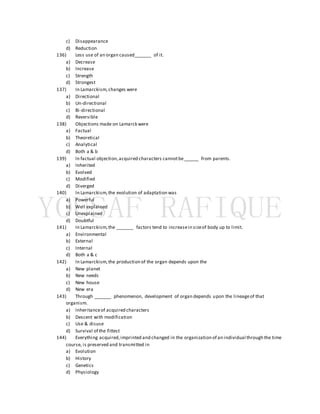
abiogenetically.
a) Livingmatter
b) Non-livingmatter
c) Media prima
d) Organic matter
27) Theory of Eternity of Life was proposed by
a) Father saurezi
b) Halton
c) Richter
d) Aristotle
28) Accordingto this theory, we have no vestige of ______ and no prospectof________.
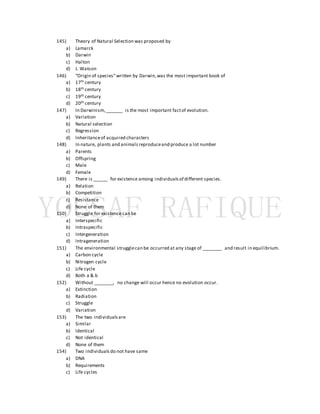
a) Life, death
b) Life, earth
c) Beginning, end of life
d) Living,non-living
29) Cosmozoic theory or theory of panspermis was proposed by
a) Richter
b) Arrhenius
c) Helmholtz
d) All above
30) Accordingto Richter, the ________reached the earth in the form of sperms, spores or any other
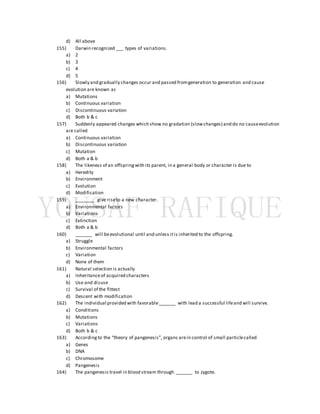
simpleparticles fromother________.
a) Spaceship,galaxy
b) UFO, planet
c) Protoplasm,planet
d) Protoplasm,galaxy
31) Accordingto Arrhenius, the lifeexisted throughout the universeand their ________ could freely
travel through the spacefrom one ______ to other.
a) Spores, planet
b) Particles,planet
c) Meteorites, planet
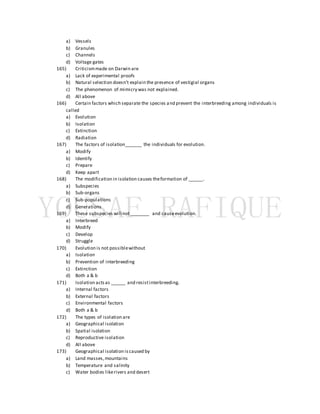
d) Ovaries,planet
32) Accordingto Helmholtz, the lifewas brought to the earth with the drops of falling________.
a) Rain
b) Sperms
c) Spores
d) Meteorites
33) In theory of catastrophism,the lifewas destroyed by visited _______ and created new lifewith
modification and special ________.
a) Aliens,forces
b) Men, army
c) Catastrophes,forces
d) Strom, pressure
34) Modern concept about chemical origin of lifewas given by
a) Halton
b) Oparin
c) Arrhenius
d) Darwin
35) Accordingto this concept, lifeconsists of small chemicals called_________.
a) Amino acids
b) Carbohydrates
c) Nucleic acids
d) Lipids
36) Nucleic acids areof two types i.e.
a) Amino acids & proteins
b) DNA & RNA
c) Nucleotides & sugars
d) ATP & DNA
37) The functional sequence of nucleotides which encodes proteins in DNA is called _______.
a) Gene
b) RNA
c) Protein
d) Intron
38) The factors which causeevolution are
a) Mutation
b) Recombination
c) Transformation
d) All above
39) Mutation can be due to
a) Chemical
b) Physical
c) Environmental
d) a & b both
40) Physical mutation may be further due to
a) Temperature & pressure
b) Rays & pressure
c) Rays & temperature
d) Temperature & volume
41) Mutation can be at
a) Molecular level & genetic level
b) Genetic & protein level
c) Molecular & protein level
d) None of them
42) Speciation is origin of new ________.
a) Organisms
b) Species
c) Populations
d) Generations
43) In evolution in caseof speciation,new species
a) Can interbreed freely ancestor
b) Cannot interbreed with ancestor
c) Produce infertileoffspring
d) Cannot interbreed with each other
44) If specie can interbreed with ancestor after speciation successfully is called
a) Modification
b) Evolution
c) Inheritance
d) Regeneration
45) Accordingto Oparin,earth came into existence about
a) 3-4 billion years ago
b) 4-5 billion years ago
c) 5-6 billion years ago
d) 6-7 billion years ago
46) Origin of earth has _______ hypothesis.
a) 2
b) 3
c) 4
d) 5
47) Accordingto Nebular hypothesis,__________, which make up the solar system,a part of it
condensed to form earth.
a) Black hole
b) Nebula
c) Interstellar dust
d) Stars
48) Accordingto Planetesimal hypothesis,earth is the broken part of
a) Frozen Mars
b) Frozen sun
c) Molten Mars
d) Molten sun
49) Earth was a spinningfiery ball havinghot____________ at__________
a) Water and snow,50-60C
b) Gases and vapors of element, 500-600C
c) Gases and vapors of element, 5000-6000C
d) Water and snow, 500-600C
50) After the coolingof this molten mass,___________ occur.
a) Evolution
b) Stratification
c) Modification
d) All above
51) In early stages of high temperature, followingelements were present on earth.
a) Carbon as C2 and Nitrogen as cyanogen
b) Methane, metal carbideoxides of aluminum
c) Boron and hydrogen
d) All above
52) Earth, when itwas at high temperature, is known as
a) Super cooled earth
b) Super molten earth
c) Super-heated earth
d) Super frozen earth
53) Metal nitrides reacted with super-heated hydrogen to form
a) Ammonium oxide
b) Ammonia
c) Nitrite
d) N2
54) Nitrogen reacted with carbides to form
a) Ammonia
b) CO2
c) Calciumcyanides
d) CaCO3
55) _________ on elements caused the condensation to form the organic compounds.
a) Chemical charge
b) Electrical charge
c) Potential charge
d) None of them
56) Organic compounds consistof
a) Simple & complex molecules
b) Saturated & unsaturated hydrocarbons
c) Polar substances
d) A & b both
57) When origin of organic compounds occur,temperature was about
a) 500C
b) 1000C
c) 1500C
d) 2000C
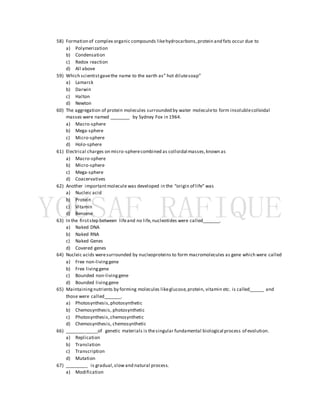
58) Formation of complex organic compounds likehydrocarbons,protein and fats occur due to
a) Polymerization
b) Condensation
c) Redox reaction
d) All above
59) Which scientistgavethe name to the earth as” hot dilutesoap”
a) Lamarck
b) Darwin
c) Halton
d) Newton
60) The aggregation of protein molecules surrounded by water moleculeto form insolublecolloidal
masses were named ________ by Sydney Fox in 1964.
a) Macro-sphere
b) Mega-sphere
c) Micro-sphere
d) Holo-sphere
61) Electrical charges on micro-spherecombined as colloidal masses,known as
a) Macro-sphere
b) Micro-sphere
c) Mega-sphere
d) Coacervatives
62) Another importantmolecule was developed in the “origin of life” was
a) Nucleic acid
b) Protein
c) Vitamin
d) Benzene
63) In the firststep between lifeand no life,nucleotides were called_______.
a) Naked DNA
b) Naked RNA
c) Naked Genes
d) Covered genes
64) Nucleic acids weresurrounded by nucleoproteins to form macromolecules as gene which were called
a) Free non-livinggene
b) Free livinggene
c) Bounded non-livinggene
d) Bounded livinggene
65) Maintainingnutrients by forming molecules likeglucose,protein, vitamin etc. is called______ and
those were called_______.
a) Photosynthesis,photosynthetic
b) Chemosynthesis, photosynthetic
c) Photosynthesis,chemosynthetic
d) Chemosynthesis, chemosynthetic
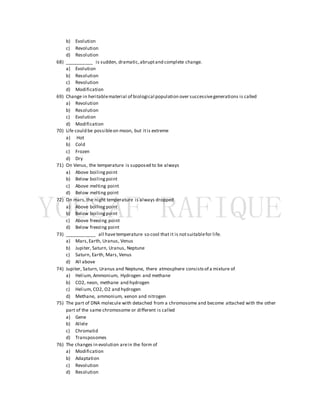
66) _____________of genetic materials is thesingular fundamental biological process of evolution.
a) Replication
b) Translation
c) Transcription
d) Mutation
67) _________ is gradual,slow and natural process.
a) Modification
b) Evolution
c) Revolution
d) Resolution
68) ___________ is sudden, dramatic,abruptand complete change.
a) Evolution
b) Resolution
c) Revolution
d) Modification
69) Change in heritablematerial of biological population over successivegenerations is called
a) Revolution
b) Resolution
c) Evolution
d) Modification
70) Life could be possibleon moon, but itis extreme
a) Hot
b) Cold
c) Frozen
d) Dry
71) On Venus, the temperature is supposed to be always
a) Above boilingpoint
b) Below boilingpoint
c) Above melting point
d) Below melting point
72) On mars,the night temperature is always dropped
a) Above boilingpoint
b) Below boilingpoint
c) Above freezing point
d) Below freezing point
73) ____________ all havetemperature so cool that it is notsuitablefor life.
a) Mars,Earth, Uranus, Venus
b) Jupiter, Saturn, Uranus, Neptune
c) Saturn, Earth, Mars,Venus
d) All above
74) Jupiter, Saturn, Uranus and Neptune, there atmosphere consistsof a mixture of
a) Helium, Ammonium, Hydrogen and methane
b) CO2, neon, methane and hydrogen
c) Helium, CO2, O2 and hydrogen
d) Methane, ammonium, xenon and nitrogen
75) The part of DNA molecule with detached from a chromosome and become attached with the other
part of the same chromosome or different is called
a) Gene
b) Allele
c) Chromatid
d) Transposomes
76) The changes in evolution arein the form of
a) Modification
b) Adaptation
c) Revolution
d) Resolution
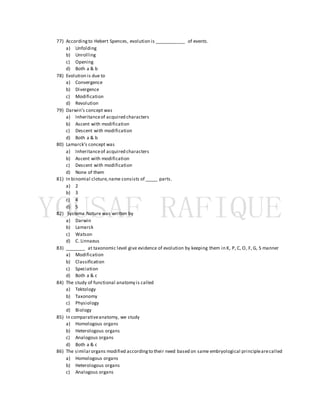
77) Accordingto Hebert Spences, evolution is ____________ of events.
a) Unfolding
b) Unrolling
c) Opening
d) Both a & b
78) Evolution is due to
a) Convergence
b) Divergence
c) Modification
d) Revolution
79) Darwin’s concept was
a) Inheritanceof acquired characters
b) Ascent with modification
c) Descent with modification
d) Both a & b
80) Lamarck’s concept was
a) Inheritanceof acquired characters
b) Ascent with modification
c) Descent with modification
d) None of them
81) In binomial cloture,name consists of _____ parts.
a) 2
b) 3
c) 4
d) 5
82) Systema Nature was written by
a) Darwin
b) Lamarck
c) Watson
d) C. Linnaeus
83) ________ at taxonomic level give evidence of evolution by keeping them in K, P, C, O, F, G, S manner
a) Modification
b) Classification
c) Speciation
d) Both a & c
84) The study of functional anatomy is called
a) Tektology
b) Taxonomy
c) Physiology
d) Biology
85) In comparativeanatomy, we study
a) Homologous organs
b) Heterologous organs
c) Analogous organs
d) Both a & c
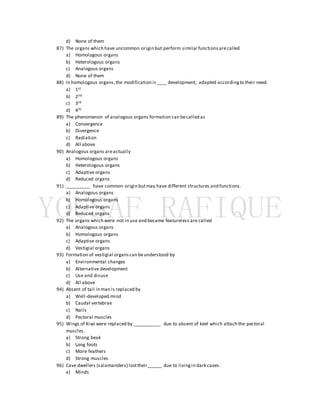
86) The similarorgans modified accordingto their need based on same embryological principlearecalled
a) Homologous organs
b) Heterologous organs
c) Analogous organs
d) None of them
87) The organs which have uncommon origin but perform similar functionsarecalled
a) Homologous organs
b) Heterologous organs
c) Analogous organs
d) None of them
88) In homologous organs,the modification is ____ development, adapted accordingto their need.
a) 1st
b) 2nd
c) 3rd
d) 4th
89) The phenomenon of analogous organs formation can becalled as
a) Convergence
b) Divergence
c) Radiation
d) All above
90) Analogous organs areactually
a) Homologous organs
b) Heterologous organs
c) Adaptive organs
d) Reduced organs
91) __________ have common origin butmay have different structures and functions.
a) Analogous organs
b) Homologous organs
c) Adaptive organs
d) Reduced organs
92) The organs which were not in use and became featureless are called
a) Analogous organs
b) Homologous organs
c) Adaptive organs
d) Vestigial organs
93) Formation of vestigial organscan beunderstood by
a) Environmental changes
b) Alternative development
c) Use and disuse
d) All above
94) Absent of tail in man is replaced by
a) Well-developed mind
b) Caudal vertebrae
c) Nails
d) Pectoral muscles
95) Wings of Kiwi were replaced by ___________ due to absent of keel which attach the pectoral
muscles.
a) Strong beak
b) Long foots
c) More feathers
d) Strong muscles
96) Cave dwellers (salamanders) losttheir______ due to livingin dark caves.
a) Minds
b) Hydro skeleton
c) Eyes
d) Nose
97) _______________ improved to well-developed cutaneous sensory cells.
a) Fish
b) Man
c) Kiwi
d) Cave dwellers
98) _________ is connectivelink between fish and amphibians.
a) Crocodile
b) Lung fish
c) Snake
d) Blue whale
99) _______________ were connective link between birds and reptiles.
a) Dinosaurs
b) Apes
c) Archaeopteryx
d) Monkeys
100) _________ were connective link between reptiles and mammals.
a) Lung fish
b) Archaeopteryx
c) Seymouria
d) Prototherian
101) __________ were connective links between amphibians and reptiles.
a) Prototherian
b) Seymourian
c) Dinosaurs
d) Apes
102) The sudden appearanceof certain characters which may be related to their ancestors is called
a) Atavism
b) Reversion
c) Conversion
d) Both a & b
103) The development of an individual fromegg to adultis called
a) Embryology
b) Ontogeny
c) Cosmology
d) Growth
104) Phylogeny is the series of stages through which that particular _______ passed in its evolution.
a) Organism
b) Species
c) Population
d) Generation
105) Accordingto Haeckel, the _________ corresponds to the ancestral adults.
a) Embryonic stages
b) Developmental stages
c) Growth
d) All above
106) The same developmental process among the embryo development shows
a) Regression
b) Extinction
c) Evolution
d) Modification
107) Haldanestates that our final theory of evolution is __________ process.
a) Biological
b) Biochemical
c) Biopotential
d) All above
108) The biochemical process contains
a) Protoplasm& chromosomal chemistry
b) Excretion, Metabolic & hormonal chemistry
c) Serology, hemoglobin and blood pressure
d) All above
109) The study of pastlifewith the help of fossils iscalled______.
a) Geology
b) Tektology
c) Paleontology
d) Archeology
110) Fossil isa Latin word, derived from
a) Fossilica
b) Fossilium
c) Fossilia
d) Fossilinae
111) Fossil word stands for
a) Something thrown up
b) Something dug up
c) Something buried up
d) Something burnt up
112) Fossilsarethe actual________ of pastlife.
a) Remains
b) Memory
c) Pictures
d) All above
113) _______ is the relation between pasttime and present time study.
a) Zoological period
b) Jurassicperiod
c) Geological period
d) Tektological period
114) Some plants and animals weredecomposed by
a) Algae and fungi
b) Fungi and bacteria
c) Amoeba and bacteria
d) All above
115) Bodies of some animals and plantswere _______ in the iceas fossil.
a) Pictured
b) Preserved
c) Melted
d) Inserted
116) Bodies were fossilized into
a) Petrified fossils
b) Dead and preserved bodies
c) Casts,impression and footprints
d) All above
117) History dates back about________, evolution of horseoccur.
a) 30 million years ago
b) 40 million years ago
c) 50 million years ago
d) 60 million years ago
118) Hyracotherium passed through ______ generations.
a) 20
b) 30
c) 40
d) 50
119) Accordingto WallaceTheory, whole earth was divided into___ biogeological region.
a) 3
b) 4
c) 5
d) 6
120) Division of largecontinentgave riseto
a) Radiation
b) Regression
c) Extinction
d) All above
121) Isolation or separation was caused by
a) Human
b) Government
c) Barriers
d) None of them
122) The horizontal distribution was caused by
a) Environment & temperature
b) Availability of food
c) Enemies and barriers
d) All above
123) _______ of cells makeup livingthings.
a) Aggregation
b) Destruction
c) Management
d) History
124) The process of cell cycles,division of interphaseand all processes aresimilarin all
a) Plant
b) Animals
c) Men
d) All above
125) DNA & RNA show _______ in all livingorganisms givingproof of evolution.
a) Resistance
b) Dissimilarities
c) Similarities
d) Modification
126) Genetics concerned with
a) Inheritance
b) Variation
c) Aggregation
d) Both a & b
127) Variations arein resultof
a) Recombination
b) Mutation
c) Evolution
d) Both a & b
128) Mutation can be
a) Micro
b) Mega
c) Non-mega
d) Both a & b
129) Recombination is becauseof hybridization of
a) Interspecific
b) Intraspecific
c) Intergeneration
d) Both a & b
130) Intraspecificbreedingmeans
a) Within species
b) With different species
c) Within population
d) With different population
131) Interspecific means
a) Within samespecies
b) With different species
c) Within samepopulation
d) With different population
132) Recombination is most common in
a) Reptile & amphibian
b) Reptile & birds
c) Birds & amphibian
d) Birds & mammals
133) Mutation give new______ for evolution.
a) Weapons
b) Raw material
c) Evidences
d) Proof
134) In Lamarckism,adaptation is based on
a) Incrediblechanges
b) Heritablechanges
c) Non-heritable changes
d) Survival of the fittest
135) More usageof an organ caused ______ of it.
a) Decrease
b) Increase
c) Disappearance
d) Reduction
136) Less use of an organ caused_______ of it.
a) Decrease
b) Increase
c) Strength
d) Strongest
137) In Lamarckism,changes were
a) Directional
b) Un-directional
c) Bi-directional
d) Reversible
138) Objections made on Lamarck were
a) Factual
b) Theoretical
c) Analytical
d) Both a & b
139) In factual objection,acquired characters cannotbe______ from parents.
a) Inherited
b) Evolved
c) Modified
d) Diverged
140) In Lamarckism,the evolution of adaptation was
a) Powerful
b) Well explained
c) Unexplained
d) Doubtful
141) In Lamarckism,the _______ factors tend to increasein sizeof body up to limit.
a) Environmental
b) External
c) Internal
d) Both a & c
142) In Lamarckism,the production of the organ depends upon the
a) New planet
b) New needs
c) New house
d) New era
143) Through _______ phenomenon, development of organ depends upon the lineageof that
organism.
a) Inheritanceof acquired characters
b) Descent with modification
c) Use & disuse
d) Survival of the fittest
144) Everything acquired,imprinted and changed in the organization of an individual through the time
course, is preserved and transmitted in
a) Evolution
b) History
c) Genetics
d) Physiology
145) Theory of Natural Selection was proposed by
a) Lamarck
b) Darwin
c) Halton
d) J. Watson
146) “Origin of species”written by Darwin,was the most important book of
a) 17th century
b) 18th century
c) 19th century
d) 20th century
147) In Darwinism,_______ is the most important factof evolution.
a) Variation
b) Natural selection
c) Regression
d) Inheritanceof acquired characters
148) In nature, plants and animalsreproduceand produce a lot number
a) Parents
b) Offspring
c) Male
d) Female
149) There is ______ for existence among individualsof different species.
a) Relation
b) Competition
c) Resistance
d) None of them
150) Struggle for existence can be
a) Interspecific
b) Intraspecific
c) Intergeneration
d) Intrageneration
151) The environmental strugglecan be occurred at any stage of ________ and result in equilibrium.
a) Carbon cycle
b) Nitrogen cycle
c) Life cycle
d) Both a & b
152) Without ________, no change will occur hence no evolution occur.
a) Extinction
b) Radiation
c) Struggle
d) Variation
153) The two individualsare
a) Similar
b) Identical
c) Not identical
d) None of them
154) Two individuals do not have same
a) DNA
b) Requirements
c) Life cycles
d) All above
155) Darwin recognized ___ types of variations.
a) 2
b) 3
c) 4
d) 5
156) Slowly and gradually changes occur and passed fromgeneration to generation and cause
evolution are known as
a) Mutations
b) Continuous variation
c) Discontinuous variation
d) Both b & c
157) Suddenly appeared changes which show no gradation (slowchanges) and do no causeevolution
are called
a) Continuous variation
b) Discontinuous variation
c) Mutation
d) Both a & b
158) The likeness of an offspringwith its parent, in a general body or character is due to
a) Heredity
b) Environment
c) Evolution
d) Modification
159) ________ give riseto a new character.
a) Environmental factors
b) Variations
c) Extinction
d) Both a & b
160) _______ will beevolutional until and unless itis inherited to the offspring.
a) Struggle
b) Environmental factors
c) Variation
d) None of them
161) Natural selection is actually
a) Inheritanceof acquired characters
b) Use and disuse
c) Survival of the fittest
d) Descent with modification
162) The individual provided with favorable_______ with lead a successful lifeand will survive.
a) Conditions
b) Mutations
c) Variations
d) Both b & c
163) Accordingto the “theory of pangenesis”, organs arein control of small particlecalled
a) Genes
b) DNA
c) Chromosome
d) Pangenesis
164) The pangenesis travel in blood stream through _______ to zygote.
a) Vessels
b) Granules
c) Channels
d) Voltage gates
165) Criticismmade on Darwin are
a) Lack of experimental proofs
b) Natural selection doesn’t explain the presence of vestigial organs
c) The phenomenon of mimicry was not explained.
d) All above
166) Certain factors which separate the species and prevent the interbreeding among individuals is
called
a) Evolution
b) Isolation
c) Extinction
d) Radiation
167) The factors of isolation_______ the individuals for evolution.
a) Modify
b) Identify
c) Prepare
d) Keep apart
168) The modification in isolation causes theformation of ______.
a) Subspecies
b) Sub-organs
c) Sub-populations
d) Generations
169) These subspecies will not________ and causeevolution.
a) Interbreed
b) Modify
c) Develop
d) Struggle
170) Evolution is not possiblewithout
a) Isolation
b) Prevention of interbreeding
c) Extinction
d) Both a & b
171) Isolation actsas ______ and resistinterbreeding.
a) Internal factors
b) External factors
c) Environmental factors
d) Both a & b
172) The types of isolation are
a) Geographical isolation
b) Spatial isolation
c) Reproductive isolation
d) All above
173) Geographical isolation iscaused by
a) Land masses, mountains
b) Temperature and salinity
c) Water bodies likerivers and desert
d) All above
174) Isolation of anopheles was caused by
a) Geographical isolation
b) Reproductive isolation
c) Spatial isolation
d) All above
175) Spatial isolation iscaused by
a) Temperature
b) Salinity
c) Smear distance
d) mountains
176) Wrens in America, isolated due to change in color is an exampleof
a) Geographical isolation
b) Spatial isolation
c) Reproductive isolation
d) All above
177) Reproductive isolation isdivided into
a) Pre-zygotic mechanism
b) Post-zygotic mechanism
c) Inter-zygotic mechanism
d) Both a & b
178) In pre-zygotic mechanism,problem at _______ occur.
a) Gamete level
b) Zygote level
c) Embryo level
d) Fetus level
179) This mechanismprevents the specific breedingor fertilization and zygote formation.
a) Pre-zygotic
b) Post-zygotic
c) Inter-zygotic
d) None of them
180) Pre-zygotic mechanismis caused by
a) Habitatisolation
b) Temporal/seasonal isolation
c) Ethological and mechanical isolation
d) All above
181) In ________ mechanism,mating takes place,but sperms are not delivered.
a) Pre-zygotic
b) Inter-zygotic
c) Post-zygotic
d) None of them
182) In post-zygotic mechanism, zygote formed as _______.
a) Dead
b) Infertile
c) Inviable
d) All above
183) In _______ mechanism, transfer of sperm and fertilization occur butegg is not fertilized.
a) Pre-zygotic
b) Inter-zygotic
c) Post-zygotic
d) All above
184) In post-zygotic mechanism, __________, __________ and ______ occur.
a) Gamete mortality
b) Zygote mortality
c) Hybrid mortality
d) All above
185) Difference structureof reproductiveorgan occur in ____________isolation.
a) Ethological
b) Mechanical
c) Habitat
d) Temporal
186) In post-zygotic mechanism, _____ breaks down before its completion.
a) Mitosis
b) Meiosis
c) Interphase
d) Cell cycle
187) In _______ mechanism, F1 is normal generation but F2 is infertile.
a) Pre-zygotic
b) Inter-zygotic
c) Post-zygotic
d) None of them
188) Theory of sexual selection is based on struggleor competition for
a) Food
b) Existence
c) Mating
d) Territory
189) Sexual characters can be
a) Primary characters
b) Secondary characters
c) Tertiary characters
d) Both a & b
190) Accordingto theory of sexual character,_____ choosethe most competent ______ to become
her partner.
a) Male, female
b) Female, male
c) Wife, husband
d) Mother, sister
191) ___________ rejects the theory of natural selection and survival of the fittest.
a) Inheritanceof acquired characters
b) Descent with modification
c) Theory of orthogenesis
d) Theory of sexual selection
192) Accordingto theory of Orthogenesis,” organismhave__________ to evolve towards goals.”
a) External tendencies
b) External vacancies
c) Internal tendencies
d) Internal vacancies
193) In orthogenesis, the evolutionary changes areproduced in _________ line.
a) Straight
b) Bend
c) Circular
d) Invisible
194) Orthogenesis is also called
a) Direction evolution
b) Progressiveevolution
c) Orthogenesis evolution or evolutionary progressive
d) All above
195) Organismhave_________ behavior which have power to causevariation or evolutionary change
in forward direction.
a) Territorial
b) Aggressive
c) Motivational
d) Feeding
196) For achievingbasicrequirements likegainingenergy, food, shelter and safety, _______ occur.
a) Modification
b) Adaptation
c) Extinction
d) Speciation
197) Based on condition,adaptation can be
a) Structural and physiological
b) Protective
c) Animal associative
d) All above
198) Adaptation can be
a) Desert adaptation
b) Aquatic and deep-sea adaptation
c) Parasitic adaptation
d) All above
199) The evolution of plantor animals into widevariety of types specialized to different environments
is called
a) Regression
b) Extinction
c) Adaptive radiation
d) Revolution
200) Mimicry word is derived from Greek word “Mimiko’s” means “________” and from Latin word
“mimicus”stands for _____________.
a) Stimulate, imitate closely
b) Imitate closely,stimulate
c) Copy, stimulate
d) Copy, imitateclosely
201) Resemblance of external appearancelikesize,shapeand color to the external environment is
called
a) Camouflage
b) Mimicry
c) Parody
d) Both a & b
202) Mimicry is superficial resemblancefor a _____ time but occur only in livingorganismnot dead.
a) Long
b) Short
c) Intermediate
d) Life
203) Mimicry can be
a) Protective and aggressive
b) Conscious and batesian
c) Mullerian
d) All above
204) Type of mimicry in which an organismcopies accordingto desireor will to resemble with another
thing.
a) Batesian mimicry
b) Conscious mimicry
c) Mullerian mimicry
d) Aggressive mimicry
205) Type of mimicry in which an organismreleases bad smell,odor and taste for its survival is known
as
a) Batesian mimicry
b) Mullerian mimicry
c) Conscious mimicry
d) Aggressive mimicry
206) In Mullerian mimicry,an animal changeitself likeanother animal to become _____ l ikehim.
a) Un-drinkable
b) Unpalatable
c) Un-smeltable
d) Immortal
207) Number of genes or alleles presentin a population is called
a) Multiplealleles
b) Gene frequency
c) Population frequency
d) Specie frequency
208) Changinggene frequency is due to ______ becauseit is not constant.
a) Environment
b) Gene
c) Organelles
d) Cells distribution
209) Gene frequency is caused by
a) Mutation & migration
b) Selection
c) Genetic drift
d) All above
210) Gene frequency is caused due to
a) Multiplealleles mechanism
b) Variation
c) Mimicry
d) All above
211) Darwin-Wallaceconceptabout was that evolution took placedue to
a) Over production and strugglefor existence
b) Variation and natural selection
c) Speciation or origin of new species
d) All above
212) Variation may be
a) Useless
b) Harmful
c) Useful
d) Both b & c
213) Speciation can be
a) Allopatric
b) Sympatric
c) Both a & b
d) None of them
214) When the population of a species sharethe same ______ and are reproductively isolated is
called _________ speciation.
a) Environment, allopatric
b) Environment, sympatric
c) Habitat,allopatric
d) Habitat,sympatric
215) The most common speciation in which population aregeographically ________ is called ______
speciation.
a) Joined, allopatric
b) Joined, sympatric
c) Isolated,allopatric
d) Isolated,sympatric
216) New Darwinismand modern theory of synthesis is based on the
a) Mutation
b) Genetic drift
c) Gene flow
d) All above
217) When gene frequency is changed in a small population by chanceis called
a) Gene flow
b) Genetic drift
c) Speciation
d) Mutation
218) When a ________ migrate from one geographical area to another geographical area and become
adapted to that area is called _______.
a) Specie, gene flow
b) Specie, genetic drift
c) Population,gene flow
d) Population,genetic drift
219) When sudden, by chanceand variation appear,they will either spread and adapted or through
_________ mutation will disappear.
a) Point
b) Forward
c) Reverse
d) Gene
220) Evolution is caused by
a) Mutation, recombination and migration
b) Natural selection,over production and survival of the fittest
c) Isolation,each individual could equally reproduce,and all matingshould occur randomly.
d) All above
Answer Keys
1) C 47) C 93) D
2) D 48) D 94) B 139) A 184) D
3) B 49) C 95) D 140) C 185) B
4) D 50) B 96) C 141) C 186) B
5) A 51) D 97) D 142) B 187) C
6) C 52) C 98) B 143) C 188) C
7) B 53) B 99) C 144) C 189) D
8) A 54) C 100) D 145) B 190) B
9) D 55) B 101) B 146) C 191) D
10) B 56) C 102) D 147) B 192) C
11) B 57) B 103) B 148) B 193) A
12) C 58) D 104) B 149) B 194) D
13) A 59) C 105) A 150) D 195) C
14) A 60) C 106) C 151) C 196) B
15) B 61) D 107) B 152) D 197) D
16) C 62) A 108) D 153) C 198) D
17) D 63) C 109) C 154) D 199) C
18) B 64) B 110) B 155) A 200) A
19) C 65) D 111) B 156) B 201) B
20) B 66) A 112) A 157) B 202) B
21) C 67) B 113) C 158) A 203) D
22) C 68) C 114) B 159) B 204) B
23) A 69) C 115) B 160) C 205) A
24) A 70) D 116) D 161) C 206) B
25) B 71) A 117) D 162) D 207) B
26) B 72) D 118) A 163) D 208) B
27) B 73) B 119) D 164) B 209) D
28) C 74) A 120) D 165) D 210) B
29) D 75) D 121) C 166) B 211) D
30) C 76) B 122) D 167) A 212) D
31) B 77) D 123) A 168) A 213) C
32) D 78) B 124) D 169) A 214) D
33) C 79) C 125) C 170) D 215) C
34) B 80) A 126) D 171) B 216) D
35) C 81) A 127) D 172) D 217) B
36) B 82) D 128) D 173) D 218) A
37) A 83) B 129) D 174) A 219) C
38) D 84) A 130) A 175) C 220) D
39) D 85) D 131) B 176) B
40) C 86) A 132) B 177) D
41) B 87) C 133) B 178) A
42) B 88) D 134) B 179) A
43) B 89) A 135) B 180) D
44) A 90) C 136) A 181) C
45) C 91) B 137) A 182) A
46) A 92) D 138) D 183) C

Multiple Choice Questions about Evolution

  • 1.
    EVOLUTION Multiple Choice Questions MARCH25, 2018 YOUSAF RAFIQUE Yousaf1438@gmail.com
  • 2.
    Evolution 1) The mainword “Evolution” is a) To mature b) To adapt c) To evolve d) All above 2) Evolution can be defined as a) The change over time in specie. b) Descent with modification c) Slow and continuous process in which changes in form and behavior occur over successive generation in a population d) All above 3) Evolution has occurred from a) Descendent to ascendant b) Ascendant to descendent c) Specie to population d) Population to population 4) Evolution can be a) Micro b) Macro c) Mega d) All above 5) Ancestor to descendent is a) A series of populations b) A series of species c) A series of generations d) A series of organisms 6) Evolution take placebetween the a) Two populations b) Two generations c) Ascendant and descendent d) Organisms and populations 7) Descent is the way evolutionary modification takeplacein a series of populations thatare a) Ascendant from one another b) Descendent from one another c) Descendent to ascendant d) None of them 8) Changes which caused evolution can be of _____ types. a) Two b) Three c) Four d) Unlimited 9) Changes which are compulsory to causeevolution are a) External or environmental b) Internal or genetical c) Ecological changes d) Both a & b 10) Adaptation refers to ______
  • 3.
    a) Change inlife b) Design in life c) Evolve in life d) Fashion in life 11) Adaptation refers to the style of properties of livingorganisms which enablethem to _______ &________ in nature. a) Run, survive b) Survive, reproduce c) Change, fertilize d) Eat, grow 12) Adaptation causes the a) Survival b) Safety c) Evolution d) Reproduction 13) Common example of adaptation is evolution of a) Beak of woodpecker b) Developmental changes in an embryo c) Dinosaurs extinction d) None of them 14) Camouflage makes an organism a) Less visible b) More visible c) Completely invisible d) Completely visible 15) Camouflage is due to a) Behavioral b) Color pigmentation c) Heavy jaws and muscles d) Smellingand unpalatable 16) The most complicated question of all timeis a) Origin of universe b) Origin of galaxy c) Origin of life d) Noe of them 17) According to mechanistic mechanism,lifeoriginates from_________ under the natural forces. a) Complex substances b) Organic substances c) Radioactivesubstances d) Inorganic substances 18) Accordingto materialisticmechanism,there were _________ which formed the lifeon Earth. a) Complex substances b) Organic substances c) Inorganic substances d) Radioactivesubstances 19) Special Creation theory was proposed by a) Halton b) Aristotle c) Father SuĂĄrez
  • 4.
    d) Richter 20) Inspecial creation theory, world formed in a) 5 days b) 6 days c) 7 days d) 8 days 21) 1st day, a matter _________ was produced who made universal things. a) Dark matter b) Red matter c) Media prima d) Prima media 22) On the very 3rd day,ancestor of all________ came into being. a) Livingorganisms b) Non-livingorganisms c) Livingplants d) Livinginsects 23) On the 4th and 5th day, the ancestor of all_______ came into being. a) Livingorganisms b) Non-livingorganisms c) Livingplants d) Livinginsects 24) On the 6th day, ______ came into existence. a) Man b) Woman c) Baby d) Old couple 25) Till ___________, this theory was acceptablethen sortout. a) 18th century b) 19th century c) 20th century d) 21st century 26) Accordingto Theory of Spontaneous generation or Abiogenesis, lifeoriginated from_________ abiogenetically. a) Livingmatter b) Non-livingmatter c) Media prima d) Organic matter 27) Theory of Eternity of Life was proposed by a) Father saurezi b) Halton c) Richter d) Aristotle 28) Accordingto this theory, we have no vestige of ______ and no prospectof________. a) Life, death b) Life, earth c) Beginning, end of life d) Living,non-living 29) Cosmozoic theory or theory of panspermis was proposed by a) Richter
  • 5.
    b) Arrhenius c) Helmholtz d)All above 30) Accordingto Richter, the ________reached the earth in the form of sperms, spores or any other simpleparticles fromother________. a) Spaceship,galaxy b) UFO, planet c) Protoplasm,planet d) Protoplasm,galaxy 31) Accordingto Arrhenius, the lifeexisted throughout the universeand their ________ could freely travel through the spacefrom one ______ to other. a) Spores, planet b) Particles,planet c) Meteorites, planet d) Ovaries,planet 32) Accordingto Helmholtz, the lifewas brought to the earth with the drops of falling________. a) Rain b) Sperms c) Spores d) Meteorites 33) In theory of catastrophism,the lifewas destroyed by visited _______ and created new lifewith modification and special ________. a) Aliens,forces b) Men, army c) Catastrophes,forces d) Strom, pressure 34) Modern concept about chemical origin of lifewas given by a) Halton b) Oparin c) Arrhenius d) Darwin 35) Accordingto this concept, lifeconsists of small chemicals called_________. a) Amino acids b) Carbohydrates c) Nucleic acids d) Lipids 36) Nucleic acids areof two types i.e. a) Amino acids & proteins b) DNA & RNA c) Nucleotides & sugars d) ATP & DNA 37) The functional sequence of nucleotides which encodes proteins in DNA is called _______. a) Gene b) RNA c) Protein d) Intron 38) The factors which causeevolution are a) Mutation b) Recombination
  • 6.
    c) Transformation d) Allabove 39) Mutation can be due to a) Chemical b) Physical c) Environmental d) a & b both 40) Physical mutation may be further due to a) Temperature & pressure b) Rays & pressure c) Rays & temperature d) Temperature & volume 41) Mutation can be at a) Molecular level & genetic level b) Genetic & protein level c) Molecular & protein level d) None of them 42) Speciation is origin of new ________. a) Organisms b) Species c) Populations d) Generations 43) In evolution in caseof speciation,new species a) Can interbreed freely ancestor b) Cannot interbreed with ancestor c) Produce infertileoffspring d) Cannot interbreed with each other 44) If specie can interbreed with ancestor after speciation successfully is called a) Modification b) Evolution c) Inheritance d) Regeneration 45) Accordingto Oparin,earth came into existence about a) 3-4 billion years ago b) 4-5 billion years ago c) 5-6 billion years ago d) 6-7 billion years ago 46) Origin of earth has _______ hypothesis. a) 2 b) 3 c) 4 d) 5 47) Accordingto Nebular hypothesis,__________, which make up the solar system,a part of it condensed to form earth. a) Black hole b) Nebula c) Interstellar dust d) Stars 48) Accordingto Planetesimal hypothesis,earth is the broken part of
  • 7.
    a) Frozen Mars b)Frozen sun c) Molten Mars d) Molten sun 49) Earth was a spinningfiery ball havinghot____________ at__________ a) Water and snow,50-60C b) Gases and vapors of element, 500-600C c) Gases and vapors of element, 5000-6000C d) Water and snow, 500-600C 50) After the coolingof this molten mass,___________ occur. a) Evolution b) Stratification c) Modification d) All above 51) In early stages of high temperature, followingelements were present on earth. a) Carbon as C2 and Nitrogen as cyanogen b) Methane, metal carbideoxides of aluminum c) Boron and hydrogen d) All above 52) Earth, when itwas at high temperature, is known as a) Super cooled earth b) Super molten earth c) Super-heated earth d) Super frozen earth 53) Metal nitrides reacted with super-heated hydrogen to form a) Ammonium oxide b) Ammonia c) Nitrite d) N2 54) Nitrogen reacted with carbides to form a) Ammonia b) CO2 c) Calciumcyanides d) CaCO3 55) _________ on elements caused the condensation to form the organic compounds. a) Chemical charge b) Electrical charge c) Potential charge d) None of them 56) Organic compounds consistof a) Simple & complex molecules b) Saturated & unsaturated hydrocarbons c) Polar substances d) A & b both 57) When origin of organic compounds occur,temperature was about a) 500C b) 1000C c) 1500C d) 2000C
  • 8.
    58) Formation ofcomplex organic compounds likehydrocarbons,protein and fats occur due to a) Polymerization b) Condensation c) Redox reaction d) All above 59) Which scientistgavethe name to the earth as” hot dilutesoap” a) Lamarck b) Darwin c) Halton d) Newton 60) The aggregation of protein molecules surrounded by water moleculeto form insolublecolloidal masses were named ________ by Sydney Fox in 1964. a) Macro-sphere b) Mega-sphere c) Micro-sphere d) Holo-sphere 61) Electrical charges on micro-spherecombined as colloidal masses,known as a) Macro-sphere b) Micro-sphere c) Mega-sphere d) Coacervatives 62) Another importantmolecule was developed in the “origin of life” was a) Nucleic acid b) Protein c) Vitamin d) Benzene 63) In the firststep between lifeand no life,nucleotides were called_______. a) Naked DNA b) Naked RNA c) Naked Genes d) Covered genes 64) Nucleic acids weresurrounded by nucleoproteins to form macromolecules as gene which were called a) Free non-livinggene b) Free livinggene c) Bounded non-livinggene d) Bounded livinggene 65) Maintainingnutrients by forming molecules likeglucose,protein, vitamin etc. is called______ and those were called_______. a) Photosynthesis,photosynthetic b) Chemosynthesis, photosynthetic c) Photosynthesis,chemosynthetic d) Chemosynthesis, chemosynthetic 66) _____________of genetic materials is thesingular fundamental biological process of evolution. a) Replication b) Translation c) Transcription d) Mutation 67) _________ is gradual,slow and natural process. a) Modification
  • 9.
    b) Evolution c) Revolution d)Resolution 68) ___________ is sudden, dramatic,abruptand complete change. a) Evolution b) Resolution c) Revolution d) Modification 69) Change in heritablematerial of biological population over successivegenerations is called a) Revolution b) Resolution c) Evolution d) Modification 70) Life could be possibleon moon, but itis extreme a) Hot b) Cold c) Frozen d) Dry 71) On Venus, the temperature is supposed to be always a) Above boilingpoint b) Below boilingpoint c) Above melting point d) Below melting point 72) On mars,the night temperature is always dropped a) Above boilingpoint b) Below boilingpoint c) Above freezing point d) Below freezing point 73) ____________ all havetemperature so cool that it is notsuitablefor life. a) Mars,Earth, Uranus, Venus b) Jupiter, Saturn, Uranus, Neptune c) Saturn, Earth, Mars,Venus d) All above 74) Jupiter, Saturn, Uranus and Neptune, there atmosphere consistsof a mixture of a) Helium, Ammonium, Hydrogen and methane b) CO2, neon, methane and hydrogen c) Helium, CO2, O2 and hydrogen d) Methane, ammonium, xenon and nitrogen 75) The part of DNA molecule with detached from a chromosome and become attached with the other part of the same chromosome or different is called a) Gene b) Allele c) Chromatid d) Transposomes 76) The changes in evolution arein the form of a) Modification b) Adaptation c) Revolution d) Resolution
  • 10.
    77) Accordingto HebertSpences, evolution is ____________ of events. a) Unfolding b) Unrolling c) Opening d) Both a & b 78) Evolution is due to a) Convergence b) Divergence c) Modification d) Revolution 79) Darwin’s concept was a) Inheritanceof acquired characters b) Ascent with modification c) Descent with modification d) Both a & b 80) Lamarck’s concept was a) Inheritanceof acquired characters b) Ascent with modification c) Descent with modification d) None of them 81) In binomial cloture,name consists of _____ parts. a) 2 b) 3 c) 4 d) 5 82) Systema Nature was written by a) Darwin b) Lamarck c) Watson d) C. Linnaeus 83) ________ at taxonomic level give evidence of evolution by keeping them in K, P, C, O, F, G, S manner a) Modification b) Classification c) Speciation d) Both a & c 84) The study of functional anatomy is called a) Tektology b) Taxonomy c) Physiology d) Biology 85) In comparativeanatomy, we study a) Homologous organs b) Heterologous organs c) Analogous organs d) Both a & c 86) The similarorgans modified accordingto their need based on same embryological principlearecalled a) Homologous organs b) Heterologous organs c) Analogous organs
  • 11.
    d) None ofthem 87) The organs which have uncommon origin but perform similar functionsarecalled a) Homologous organs b) Heterologous organs c) Analogous organs d) None of them 88) In homologous organs,the modification is ____ development, adapted accordingto their need. a) 1st b) 2nd c) 3rd d) 4th 89) The phenomenon of analogous organs formation can becalled as a) Convergence b) Divergence c) Radiation d) All above 90) Analogous organs areactually a) Homologous organs b) Heterologous organs c) Adaptive organs d) Reduced organs 91) __________ have common origin butmay have different structures and functions. a) Analogous organs b) Homologous organs c) Adaptive organs d) Reduced organs 92) The organs which were not in use and became featureless are called a) Analogous organs b) Homologous organs c) Adaptive organs d) Vestigial organs 93) Formation of vestigial organscan beunderstood by a) Environmental changes b) Alternative development c) Use and disuse d) All above 94) Absent of tail in man is replaced by a) Well-developed mind b) Caudal vertebrae c) Nails d) Pectoral muscles 95) Wings of Kiwi were replaced by ___________ due to absent of keel which attach the pectoral muscles. a) Strong beak b) Long foots c) More feathers d) Strong muscles 96) Cave dwellers (salamanders) losttheir______ due to livingin dark caves. a) Minds
  • 12.
    b) Hydro skeleton c)Eyes d) Nose 97) _______________ improved to well-developed cutaneous sensory cells. a) Fish b) Man c) Kiwi d) Cave dwellers 98) _________ is connectivelink between fish and amphibians. a) Crocodile b) Lung fish c) Snake d) Blue whale 99) _______________ were connective link between birds and reptiles. a) Dinosaurs b) Apes c) Archaeopteryx d) Monkeys 100) _________ were connective link between reptiles and mammals. a) Lung fish b) Archaeopteryx c) Seymouria d) Prototherian 101) __________ were connective links between amphibians and reptiles. a) Prototherian b) Seymourian c) Dinosaurs d) Apes 102) The sudden appearanceof certain characters which may be related to their ancestors is called a) Atavism b) Reversion c) Conversion d) Both a & b 103) The development of an individual fromegg to adultis called a) Embryology b) Ontogeny c) Cosmology d) Growth 104) Phylogeny is the series of stages through which that particular _______ passed in its evolution. a) Organism b) Species c) Population d) Generation 105) Accordingto Haeckel, the _________ corresponds to the ancestral adults. a) Embryonic stages b) Developmental stages c) Growth d) All above 106) The same developmental process among the embryo development shows
  • 13.
    a) Regression b) Extinction c)Evolution d) Modification 107) Haldanestates that our final theory of evolution is __________ process. a) Biological b) Biochemical c) Biopotential d) All above 108) The biochemical process contains a) Protoplasm& chromosomal chemistry b) Excretion, Metabolic & hormonal chemistry c) Serology, hemoglobin and blood pressure d) All above 109) The study of pastlifewith the help of fossils iscalled______. a) Geology b) Tektology c) Paleontology d) Archeology 110) Fossil isa Latin word, derived from a) Fossilica b) Fossilium c) Fossilia d) Fossilinae 111) Fossil word stands for a) Something thrown up b) Something dug up c) Something buried up d) Something burnt up 112) Fossilsarethe actual________ of pastlife. a) Remains b) Memory c) Pictures d) All above 113) _______ is the relation between pasttime and present time study. a) Zoological period b) Jurassicperiod c) Geological period d) Tektological period 114) Some plants and animals weredecomposed by a) Algae and fungi b) Fungi and bacteria c) Amoeba and bacteria d) All above 115) Bodies of some animals and plantswere _______ in the iceas fossil. a) Pictured b) Preserved c) Melted d) Inserted
  • 14.
    116) Bodies werefossilized into a) Petrified fossils b) Dead and preserved bodies c) Casts,impression and footprints d) All above 117) History dates back about________, evolution of horseoccur. a) 30 million years ago b) 40 million years ago c) 50 million years ago d) 60 million years ago 118) Hyracotherium passed through ______ generations. a) 20 b) 30 c) 40 d) 50 119) Accordingto WallaceTheory, whole earth was divided into___ biogeological region. a) 3 b) 4 c) 5 d) 6 120) Division of largecontinentgave riseto a) Radiation b) Regression c) Extinction d) All above 121) Isolation or separation was caused by a) Human b) Government c) Barriers d) None of them 122) The horizontal distribution was caused by a) Environment & temperature b) Availability of food c) Enemies and barriers d) All above 123) _______ of cells makeup livingthings. a) Aggregation b) Destruction c) Management d) History 124) The process of cell cycles,division of interphaseand all processes aresimilarin all a) Plant b) Animals c) Men d) All above 125) DNA & RNA show _______ in all livingorganisms givingproof of evolution. a) Resistance b) Dissimilarities c) Similarities
  • 15.
    d) Modification 126) Geneticsconcerned with a) Inheritance b) Variation c) Aggregation d) Both a & b 127) Variations arein resultof a) Recombination b) Mutation c) Evolution d) Both a & b 128) Mutation can be a) Micro b) Mega c) Non-mega d) Both a & b 129) Recombination is becauseof hybridization of a) Interspecific b) Intraspecific c) Intergeneration d) Both a & b 130) Intraspecificbreedingmeans a) Within species b) With different species c) Within population d) With different population 131) Interspecific means a) Within samespecies b) With different species c) Within samepopulation d) With different population 132) Recombination is most common in a) Reptile & amphibian b) Reptile & birds c) Birds & amphibian d) Birds & mammals 133) Mutation give new______ for evolution. a) Weapons b) Raw material c) Evidences d) Proof 134) In Lamarckism,adaptation is based on a) Incrediblechanges b) Heritablechanges c) Non-heritable changes d) Survival of the fittest 135) More usageof an organ caused ______ of it. a) Decrease b) Increase
  • 16.
    c) Disappearance d) Reduction 136)Less use of an organ caused_______ of it. a) Decrease b) Increase c) Strength d) Strongest 137) In Lamarckism,changes were a) Directional b) Un-directional c) Bi-directional d) Reversible 138) Objections made on Lamarck were a) Factual b) Theoretical c) Analytical d) Both a & b 139) In factual objection,acquired characters cannotbe______ from parents. a) Inherited b) Evolved c) Modified d) Diverged 140) In Lamarckism,the evolution of adaptation was a) Powerful b) Well explained c) Unexplained d) Doubtful 141) In Lamarckism,the _______ factors tend to increasein sizeof body up to limit. a) Environmental b) External c) Internal d) Both a & c 142) In Lamarckism,the production of the organ depends upon the a) New planet b) New needs c) New house d) New era 143) Through _______ phenomenon, development of organ depends upon the lineageof that organism. a) Inheritanceof acquired characters b) Descent with modification c) Use & disuse d) Survival of the fittest 144) Everything acquired,imprinted and changed in the organization of an individual through the time course, is preserved and transmitted in a) Evolution b) History c) Genetics d) Physiology
  • 17.
    145) Theory ofNatural Selection was proposed by a) Lamarck b) Darwin c) Halton d) J. Watson 146) “Origin of species”written by Darwin,was the most important book of a) 17th century b) 18th century c) 19th century d) 20th century 147) In Darwinism,_______ is the most important factof evolution. a) Variation b) Natural selection c) Regression d) Inheritanceof acquired characters 148) In nature, plants and animalsreproduceand produce a lot number a) Parents b) Offspring c) Male d) Female 149) There is ______ for existence among individualsof different species. a) Relation b) Competition c) Resistance d) None of them 150) Struggle for existence can be a) Interspecific b) Intraspecific c) Intergeneration d) Intrageneration 151) The environmental strugglecan be occurred at any stage of ________ and result in equilibrium. a) Carbon cycle b) Nitrogen cycle c) Life cycle d) Both a & b 152) Without ________, no change will occur hence no evolution occur. a) Extinction b) Radiation c) Struggle d) Variation 153) The two individualsare a) Similar b) Identical c) Not identical d) None of them 154) Two individuals do not have same a) DNA b) Requirements c) Life cycles
  • 18.
    d) All above 155)Darwin recognized ___ types of variations. a) 2 b) 3 c) 4 d) 5 156) Slowly and gradually changes occur and passed fromgeneration to generation and cause evolution are known as a) Mutations b) Continuous variation c) Discontinuous variation d) Both b & c 157) Suddenly appeared changes which show no gradation (slowchanges) and do no causeevolution are called a) Continuous variation b) Discontinuous variation c) Mutation d) Both a & b 158) The likeness of an offspringwith its parent, in a general body or character is due to a) Heredity b) Environment c) Evolution d) Modification 159) ________ give riseto a new character. a) Environmental factors b) Variations c) Extinction d) Both a & b 160) _______ will beevolutional until and unless itis inherited to the offspring. a) Struggle b) Environmental factors c) Variation d) None of them 161) Natural selection is actually a) Inheritanceof acquired characters b) Use and disuse c) Survival of the fittest d) Descent with modification 162) The individual provided with favorable_______ with lead a successful lifeand will survive. a) Conditions b) Mutations c) Variations d) Both b & c 163) Accordingto the “theory of pangenesis”, organs arein control of small particlecalled a) Genes b) DNA c) Chromosome d) Pangenesis 164) The pangenesis travel in blood stream through _______ to zygote.
  • 19.
    a) Vessels b) Granules c)Channels d) Voltage gates 165) Criticismmade on Darwin are a) Lack of experimental proofs b) Natural selection doesn’t explain the presence of vestigial organs c) The phenomenon of mimicry was not explained. d) All above 166) Certain factors which separate the species and prevent the interbreeding among individuals is called a) Evolution b) Isolation c) Extinction d) Radiation 167) The factors of isolation_______ the individuals for evolution. a) Modify b) Identify c) Prepare d) Keep apart 168) The modification in isolation causes theformation of ______. a) Subspecies b) Sub-organs c) Sub-populations d) Generations 169) These subspecies will not________ and causeevolution. a) Interbreed b) Modify c) Develop d) Struggle 170) Evolution is not possiblewithout a) Isolation b) Prevention of interbreeding c) Extinction d) Both a & b 171) Isolation actsas ______ and resistinterbreeding. a) Internal factors b) External factors c) Environmental factors d) Both a & b 172) The types of isolation are a) Geographical isolation b) Spatial isolation c) Reproductive isolation d) All above 173) Geographical isolation iscaused by a) Land masses, mountains b) Temperature and salinity c) Water bodies likerivers and desert
  • 20.
    d) All above 174)Isolation of anopheles was caused by a) Geographical isolation b) Reproductive isolation c) Spatial isolation d) All above 175) Spatial isolation iscaused by a) Temperature b) Salinity c) Smear distance d) mountains 176) Wrens in America, isolated due to change in color is an exampleof a) Geographical isolation b) Spatial isolation c) Reproductive isolation d) All above 177) Reproductive isolation isdivided into a) Pre-zygotic mechanism b) Post-zygotic mechanism c) Inter-zygotic mechanism d) Both a & b 178) In pre-zygotic mechanism,problem at _______ occur. a) Gamete level b) Zygote level c) Embryo level d) Fetus level 179) This mechanismprevents the specific breedingor fertilization and zygote formation. a) Pre-zygotic b) Post-zygotic c) Inter-zygotic d) None of them 180) Pre-zygotic mechanismis caused by a) Habitatisolation b) Temporal/seasonal isolation c) Ethological and mechanical isolation d) All above 181) In ________ mechanism,mating takes place,but sperms are not delivered. a) Pre-zygotic b) Inter-zygotic c) Post-zygotic d) None of them 182) In post-zygotic mechanism, zygote formed as _______. a) Dead b) Infertile c) Inviable d) All above 183) In _______ mechanism, transfer of sperm and fertilization occur butegg is not fertilized. a) Pre-zygotic b) Inter-zygotic
  • 21.
    c) Post-zygotic d) Allabove 184) In post-zygotic mechanism, __________, __________ and ______ occur. a) Gamete mortality b) Zygote mortality c) Hybrid mortality d) All above 185) Difference structureof reproductiveorgan occur in ____________isolation. a) Ethological b) Mechanical c) Habitat d) Temporal 186) In post-zygotic mechanism, _____ breaks down before its completion. a) Mitosis b) Meiosis c) Interphase d) Cell cycle 187) In _______ mechanism, F1 is normal generation but F2 is infertile. a) Pre-zygotic b) Inter-zygotic c) Post-zygotic d) None of them 188) Theory of sexual selection is based on struggleor competition for a) Food b) Existence c) Mating d) Territory 189) Sexual characters can be a) Primary characters b) Secondary characters c) Tertiary characters d) Both a & b 190) Accordingto theory of sexual character,_____ choosethe most competent ______ to become her partner. a) Male, female b) Female, male c) Wife, husband d) Mother, sister 191) ___________ rejects the theory of natural selection and survival of the fittest. a) Inheritanceof acquired characters b) Descent with modification c) Theory of orthogenesis d) Theory of sexual selection 192) Accordingto theory of Orthogenesis,” organismhave__________ to evolve towards goals.” a) External tendencies b) External vacancies c) Internal tendencies d) Internal vacancies 193) In orthogenesis, the evolutionary changes areproduced in _________ line.
  • 22.
    a) Straight b) Bend c)Circular d) Invisible 194) Orthogenesis is also called a) Direction evolution b) Progressiveevolution c) Orthogenesis evolution or evolutionary progressive d) All above 195) Organismhave_________ behavior which have power to causevariation or evolutionary change in forward direction. a) Territorial b) Aggressive c) Motivational d) Feeding 196) For achievingbasicrequirements likegainingenergy, food, shelter and safety, _______ occur. a) Modification b) Adaptation c) Extinction d) Speciation 197) Based on condition,adaptation can be a) Structural and physiological b) Protective c) Animal associative d) All above 198) Adaptation can be a) Desert adaptation b) Aquatic and deep-sea adaptation c) Parasitic adaptation d) All above 199) The evolution of plantor animals into widevariety of types specialized to different environments is called a) Regression b) Extinction c) Adaptive radiation d) Revolution 200) Mimicry word is derived from Greek word “Mimiko’s” means “________” and from Latin word “mimicus”stands for _____________. a) Stimulate, imitate closely b) Imitate closely,stimulate c) Copy, stimulate d) Copy, imitateclosely 201) Resemblance of external appearancelikesize,shapeand color to the external environment is called a) Camouflage b) Mimicry c) Parody d) Both a & b 202) Mimicry is superficial resemblancefor a _____ time but occur only in livingorganismnot dead.
  • 23.
    a) Long b) Short c)Intermediate d) Life 203) Mimicry can be a) Protective and aggressive b) Conscious and batesian c) Mullerian d) All above 204) Type of mimicry in which an organismcopies accordingto desireor will to resemble with another thing. a) Batesian mimicry b) Conscious mimicry c) Mullerian mimicry d) Aggressive mimicry 205) Type of mimicry in which an organismreleases bad smell,odor and taste for its survival is known as a) Batesian mimicry b) Mullerian mimicry c) Conscious mimicry d) Aggressive mimicry 206) In Mullerian mimicry,an animal changeitself likeanother animal to become _____ l ikehim. a) Un-drinkable b) Unpalatable c) Un-smeltable d) Immortal 207) Number of genes or alleles presentin a population is called a) Multiplealleles b) Gene frequency c) Population frequency d) Specie frequency 208) Changinggene frequency is due to ______ becauseit is not constant. a) Environment b) Gene c) Organelles d) Cells distribution 209) Gene frequency is caused by a) Mutation & migration b) Selection c) Genetic drift d) All above 210) Gene frequency is caused due to a) Multiplealleles mechanism b) Variation c) Mimicry d) All above 211) Darwin-Wallaceconceptabout was that evolution took placedue to a) Over production and strugglefor existence b) Variation and natural selection
  • 24.
    c) Speciation ororigin of new species d) All above 212) Variation may be a) Useless b) Harmful c) Useful d) Both b & c 213) Speciation can be a) Allopatric b) Sympatric c) Both a & b d) None of them 214) When the population of a species sharethe same ______ and are reproductively isolated is called _________ speciation. a) Environment, allopatric b) Environment, sympatric c) Habitat,allopatric d) Habitat,sympatric 215) The most common speciation in which population aregeographically ________ is called ______ speciation. a) Joined, allopatric b) Joined, sympatric c) Isolated,allopatric d) Isolated,sympatric 216) New Darwinismand modern theory of synthesis is based on the a) Mutation b) Genetic drift c) Gene flow d) All above 217) When gene frequency is changed in a small population by chanceis called a) Gene flow b) Genetic drift c) Speciation d) Mutation 218) When a ________ migrate from one geographical area to another geographical area and become adapted to that area is called _______. a) Specie, gene flow b) Specie, genetic drift c) Population,gene flow d) Population,genetic drift 219) When sudden, by chanceand variation appear,they will either spread and adapted or through _________ mutation will disappear. a) Point b) Forward c) Reverse d) Gene 220) Evolution is caused by a) Mutation, recombination and migration b) Natural selection,over production and survival of the fittest
  • 25.
    c) Isolation,each individualcould equally reproduce,and all matingshould occur randomly. d) All above Answer Keys 1) C 47) C 93) D 2) D 48) D 94) B 139) A 184) D 3) B 49) C 95) D 140) C 185) B 4) D 50) B 96) C 141) C 186) B 5) A 51) D 97) D 142) B 187) C 6) C 52) C 98) B 143) C 188) C 7) B 53) B 99) C 144) C 189) D 8) A 54) C 100) D 145) B 190) B 9) D 55) B 101) B 146) C 191) D 10) B 56) C 102) D 147) B 192) C 11) B 57) B 103) B 148) B 193) A 12) C 58) D 104) B 149) B 194) D 13) A 59) C 105) A 150) D 195) C 14) A 60) C 106) C 151) C 196) B 15) B 61) D 107) B 152) D 197) D 16) C 62) A 108) D 153) C 198) D 17) D 63) C 109) C 154) D 199) C 18) B 64) B 110) B 155) A 200) A 19) C 65) D 111) B 156) B 201) B 20) B 66) A 112) A 157) B 202) B 21) C 67) B 113) C 158) A 203) D 22) C 68) C 114) B 159) B 204) B 23) A 69) C 115) B 160) C 205) A 24) A 70) D 116) D 161) C 206) B 25) B 71) A 117) D 162) D 207) B 26) B 72) D 118) A 163) D 208) B 27) B 73) B 119) D 164) B 209) D 28) C 74) A 120) D 165) D 210) B 29) D 75) D 121) C 166) B 211) D 30) C 76) B 122) D 167) A 212) D 31) B 77) D 123) A 168) A 213) C 32) D 78) B 124) D 169) A 214) D 33) C 79) C 125) C 170) D 215) C 34) B 80) A 126) D 171) B 216) D 35) C 81) A 127) D 172) D 217) B 36) B 82) D 128) D 173) D 218) A 37) A 83) B 129) D 174) A 219) C 38) D 84) A 130) A 175) C 220) D 39) D 85) D 131) B 176) B 40) C 86) A 132) B 177) D 41) B 87) C 133) B 178) A 42) B 88) D 134) B 179) A 43) B 89) A 135) B 180) D 44) A 90) C 136) A 181) C 45) C 91) B 137) A 182) A
  • 26.
    46) A 92)D 138) D 183) C