CHAPTER 15 Darwin’s Theory of Evolution
15.1 The Puzzle of Life’s Diversity Evolution: Change over time, is the process by which modern organisms have descended from ancient organisms. Scientific Theory: A well supported testable explanation of phenomena that have occurred in the Natural World.
Voyage of the Beagle Charles Darwin was born in Shrewsbury, England on February 12, 1809  Joined the crew of the H.M.S. Beagle He set sail in 1831 and his voyage took 5 years!
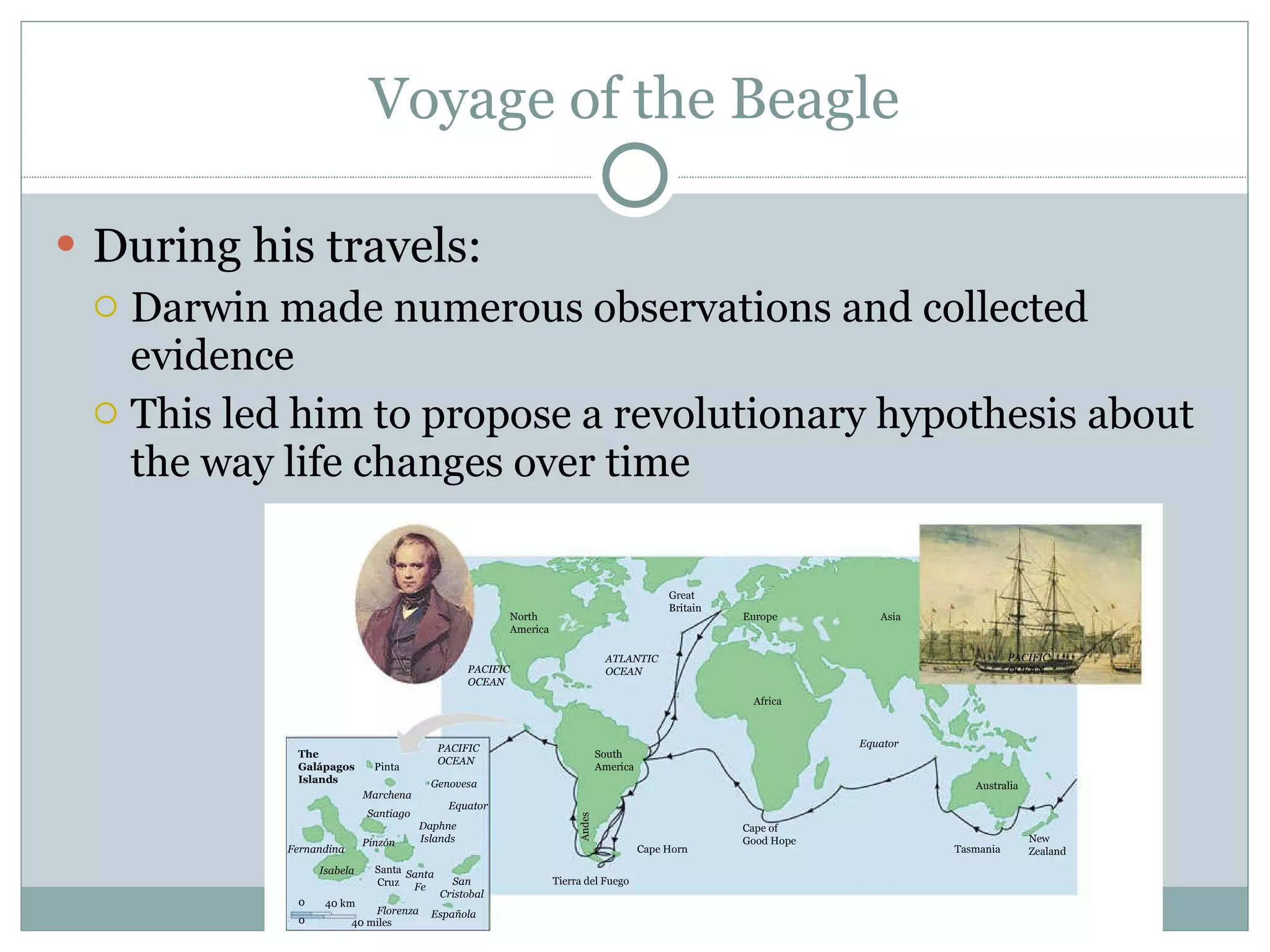
Voyage of the Beagle During his travels: Darwin made numerous observations and collected evidence  This led him to propose a revolutionary hypothesis about the way life changes over time North America Europe Great Britain Africa Equator Asia Australia Tasmania New Zealand PACIFIC OCEAN ATLANTIC OCEAN PACIFIC OCEAN PACIFIC OCEAN The Galápagos Islands South America Tierra del Fuego Cape Horn Cape of Good Hope Andes Pinta Marchena Genovesa Equator Santiago Isabela Fernandina Florenza Española San Cristobal Santa Cruz Santa Fe Pinzón Daphne Islands 40 miles 40 km 0  0
Darwin’s Observations In Brazil, Darwin collected 68 different beetle species.  Patterns of Diversity: Why did some animals grow in some areas and not in others? Why did the same species of animal look different from one another depending on where they lived? Living organisms and Fossils: Preserved remains of Ancient organisms.
Darwin’s Observations The Galápagos Islands: The tortoises varied from Island to Island depending on the vegetation. He also noticed that the birds on each of the islands had different sizes and beak sizes.
The Tortoises! http://www.skeptic.com/eskeptic/06-07-28images/TortoiseonPinzon.jpg http://imagecache01a.allposters.com/images/pic/PTGPOD/OSJOM-00000498-001-FB~Espanola-Saddleback-Tortoise-Adult-Female-Galapagos-Posters.jpg
The Journey Home Darwin observed that the characteristics of many animals and plants varied noticeably among the different islands of the Galápagos
The Tortoises! http://research.unc.edu/internal/galapagos/santa_cruz/turtles_feeding.jpg http://mysite.du.edu/~ttyler/ploughboy/cht102.jpg
15.2 Ideas That Shaped Darwin’s Thinking We need to learn something about the time and world that Darwin lived in.  Most Europeans believed that the Earth and everything in it was created only a few thousand years ago. Therefore, all creatures were the same from when they were first created.
Ideas That Shaped Darwin’s Thinking During the 1800’s explorers were finding many fossil remains of numerous animal types that had no living representatives. This challenged the traditional view point of the time.  After a lot of studying Darwin changed his thinking dramatically.
An Ancient Changing Earth Hutton and Geological Change In 1795, Hutton published his hypothesis about Geological forces that have shaped the Earth.  He proposed that rock layers form very slowly by up pushed earth or by rock layers forming on top of others This meant and he proposed the earth was much more than a few thousand years old.
An Ancient Changing Earth Lyell’s Principles of Geology His first book  Principles of Geology He stressed that scientists must explain past events in terms of processes that they can actually observe, since processes that shaped the Earth millions of years earlier.  Erosion continues to carve out canyons, just as it did in the past Lyell helped Darwin appreciate the significance of geological phenomena that he observed.
The Understanding of Geology Influenced Darwin in 2 Ways If Earth could change over time, might life change as well? He realized that it would have taken a very long time for life to change in the way he suggested.
15.3 Darwin Presents His Case Publication of  On the Origin of Species   In 1858, Darwin received a short essay by Alfred Russel Wallace.  Wallace’s paper talked about his thoughts on evolutionary change that Darwin had been mulling over for 25 years!
Evolution by Natural Selection Nature selects for those traits that will help a species survive. For example: Certain colors, beak strength, etc.
The Struggle for Existence Members of each species complete regularly to obtain: Food  Living space Other necessities of life
Survival of the Fittest Darwin observed how well suited an organism is to its environment  Fitness: Ability of an individual to survive and reproduce in its specific environment Adaptation: Any inherited characteristic that increases an organism’s changes of survival.
Survival of the Fittest Successful adaptations allow an organism to be better suited to their environment thus increasing their rate of survival and ability to reproduce
Natural Selection Over time, natural selection results in changes in the inherited characteristics of a population. These changes increase a species’ fitness in its environment.
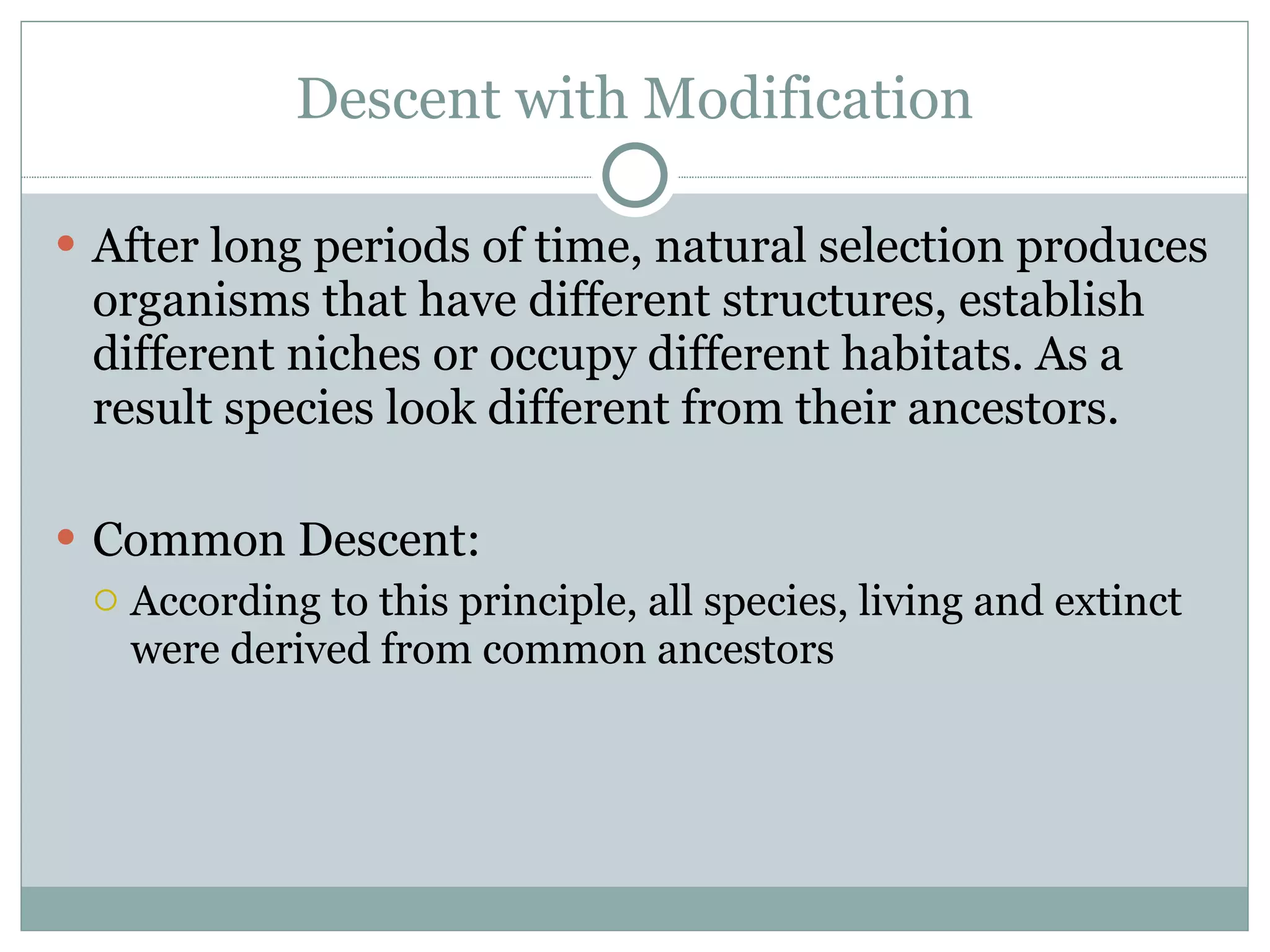
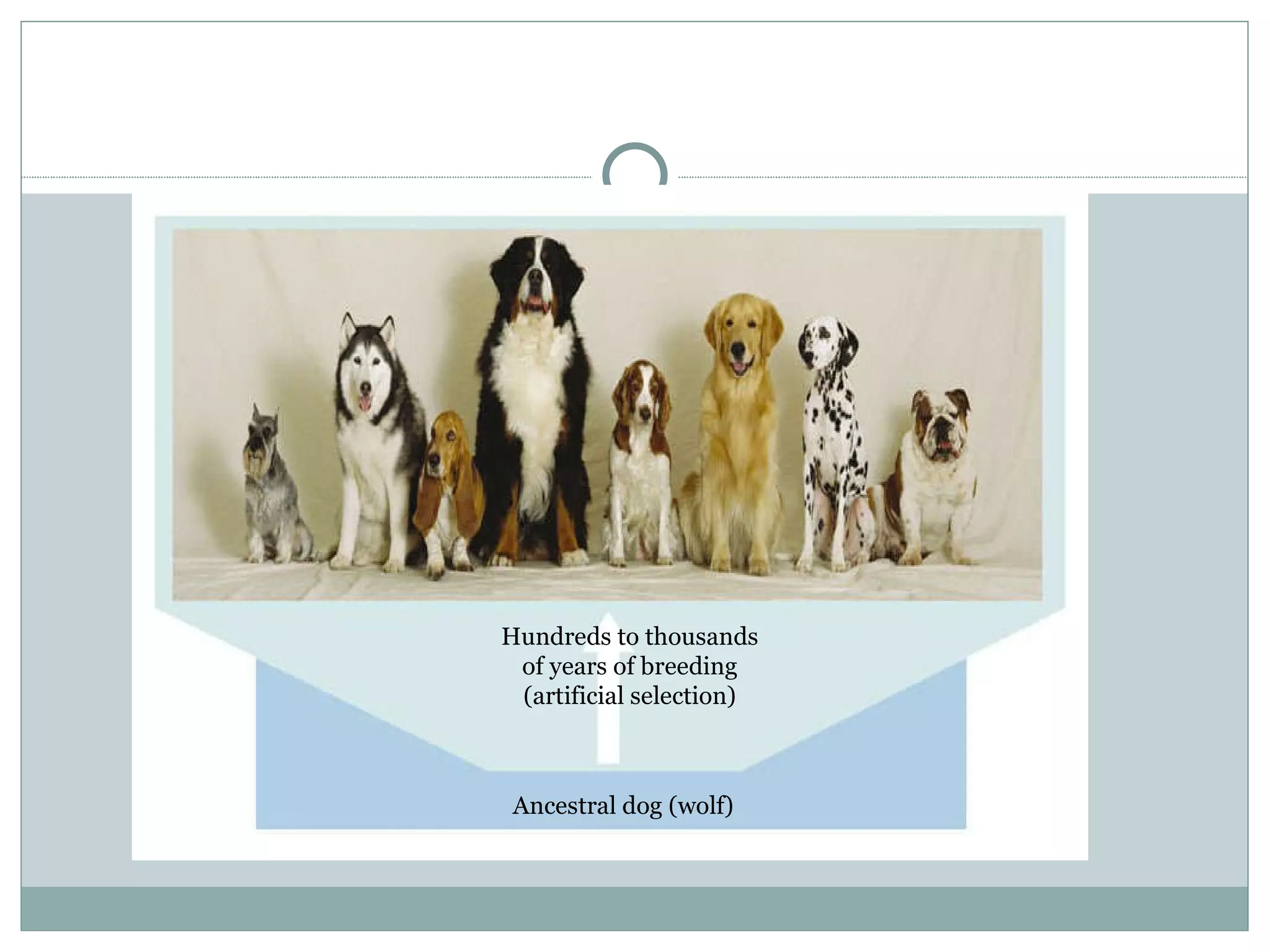
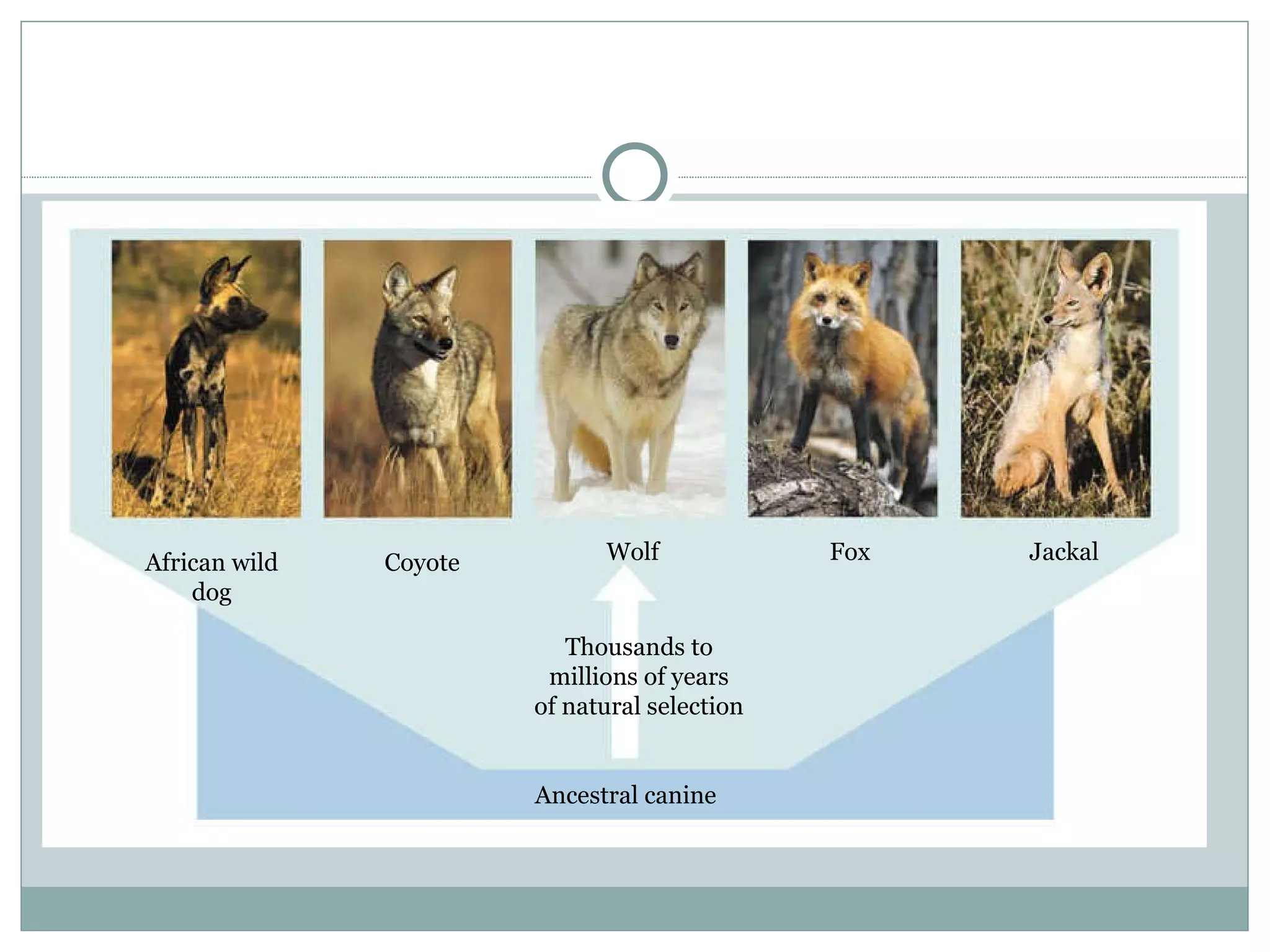
Descent with Modification After long periods of time, natural selection produces organisms that have different structures, establish different niches or occupy different habitats. As a result species look different from their ancestors.  Common Descent: According to this principle, all species, living and extinct were derived from common ancestors
Hundreds to thousands of years of breeding (artificial selection) Ancestral dog (wolf)
Thousands to millions of years of natural selection Ancestral canine African wild dog Coyote Wolf Fox Jackal
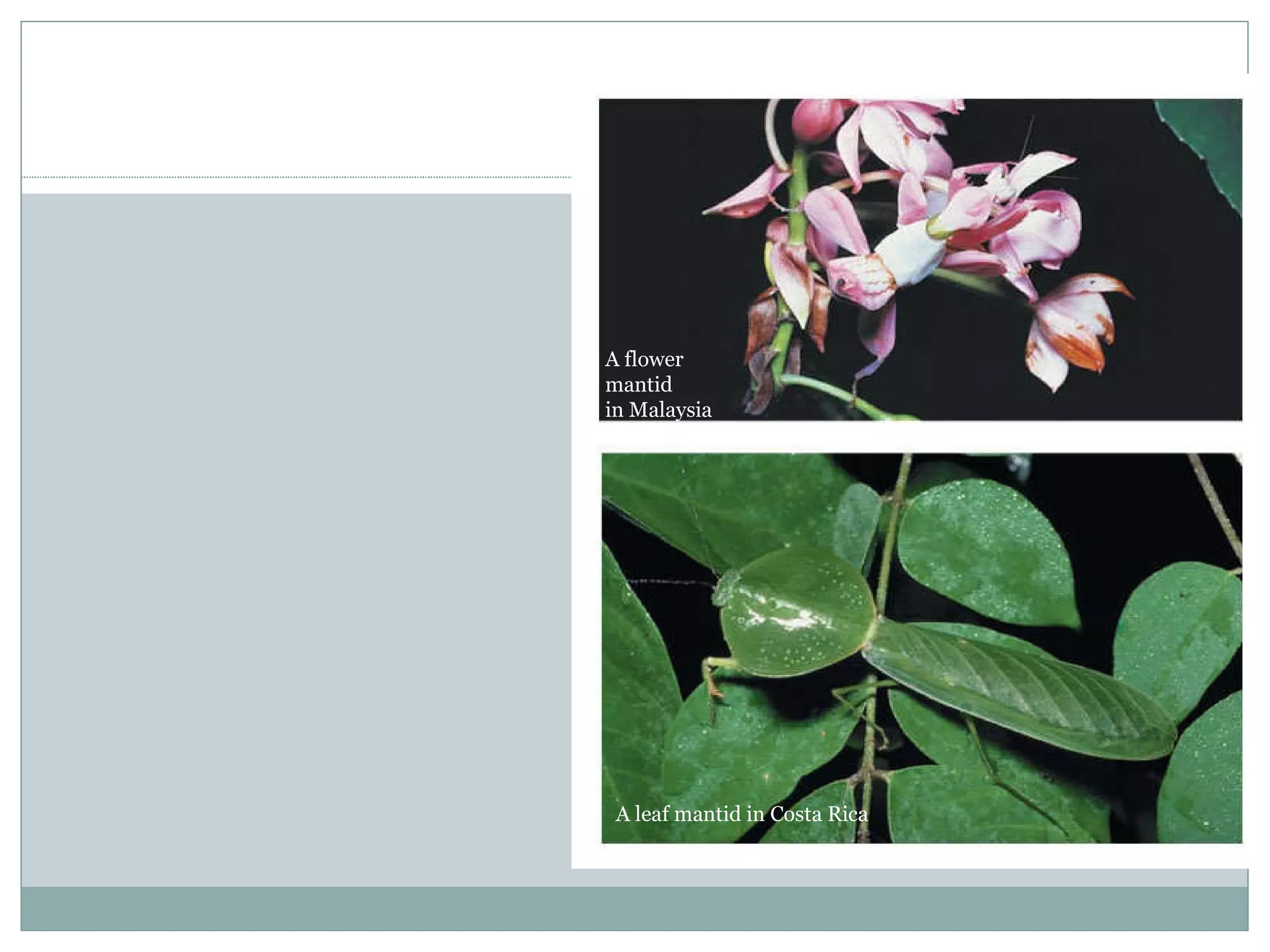
A flower  mantid in Malaysia A leaf mantid in Costa Rica
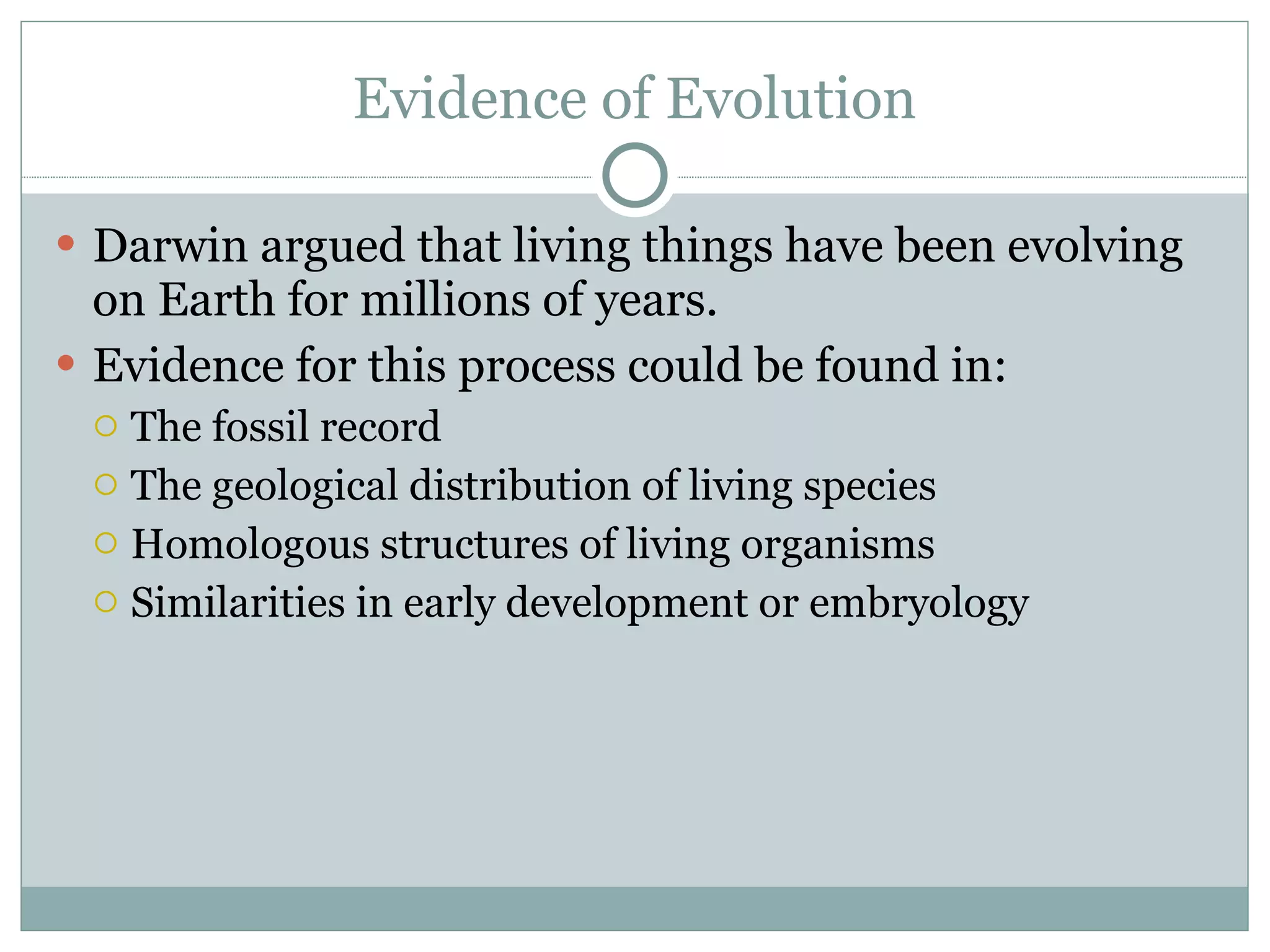
Evidence of Evolution Darwin argued that living things have been evolving on Earth for millions of years. Evidence for this process could be found in:  The fossil record  The geological distribution of living species  Homologous structures of living organisms Similarities in early development or embryology
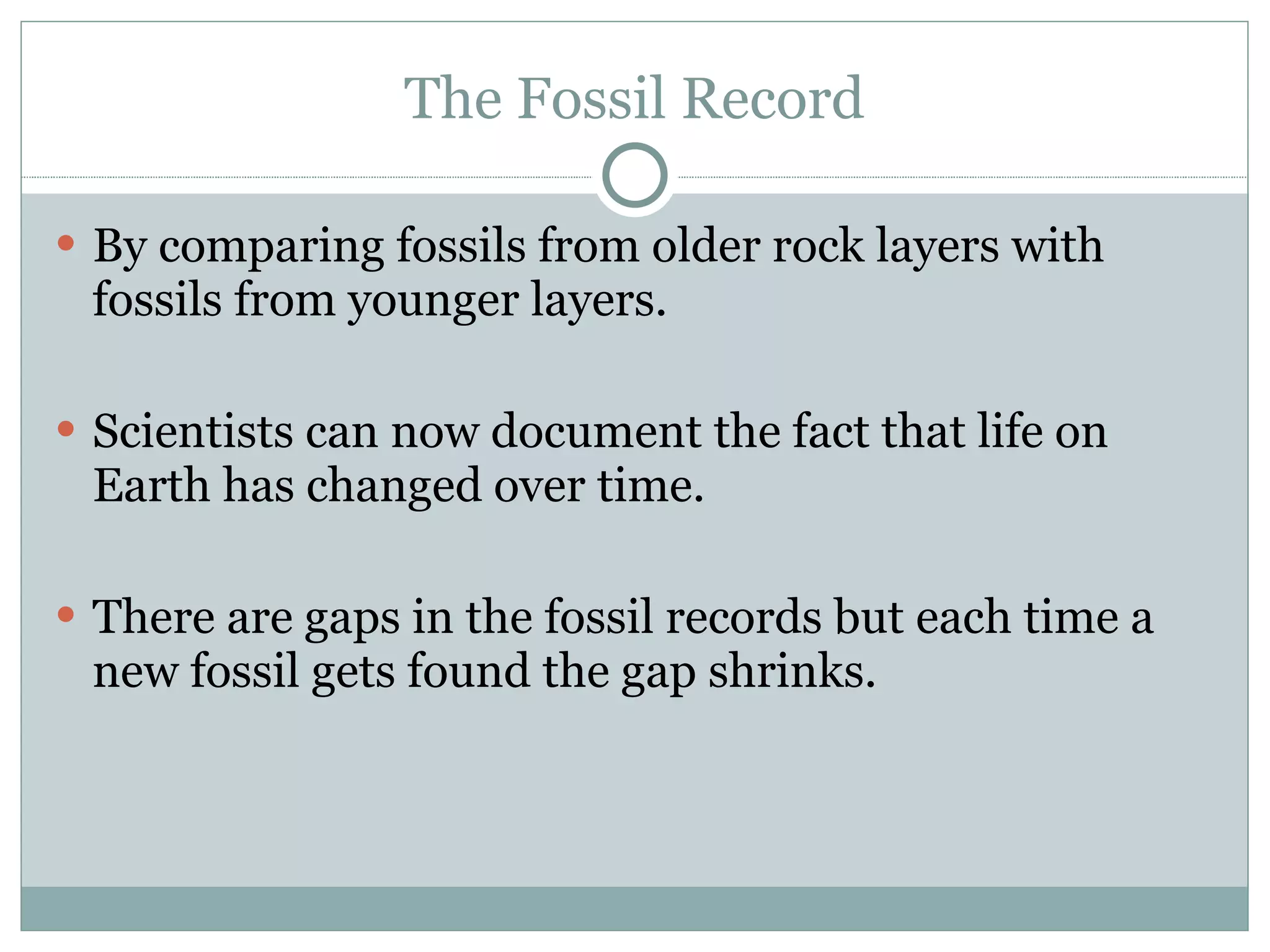
The Fossil Record By comparing fossils from older rock layers with fossils from younger layers.  Scientists can now document the fact that life on Earth has changed over time. There are gaps in the fossil records but each time a new fossil gets found the gap shrinks.
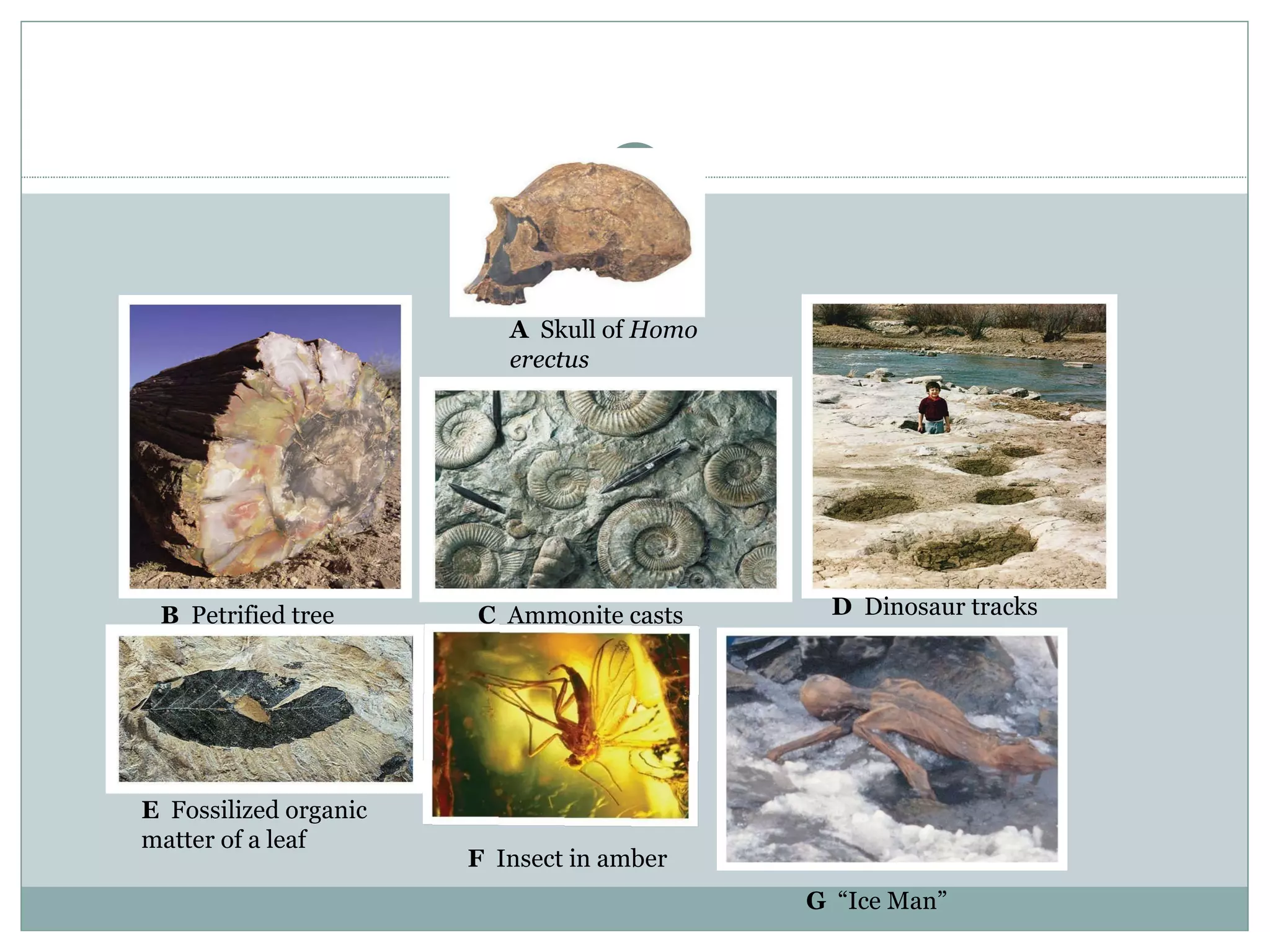
A   Skull of  Homo erectus D   Dinosaur tracks C   Ammonite casts B   Petrified tree E   Fossilized organic matter of a leaf G   “Ice Man” F   Insect in amber
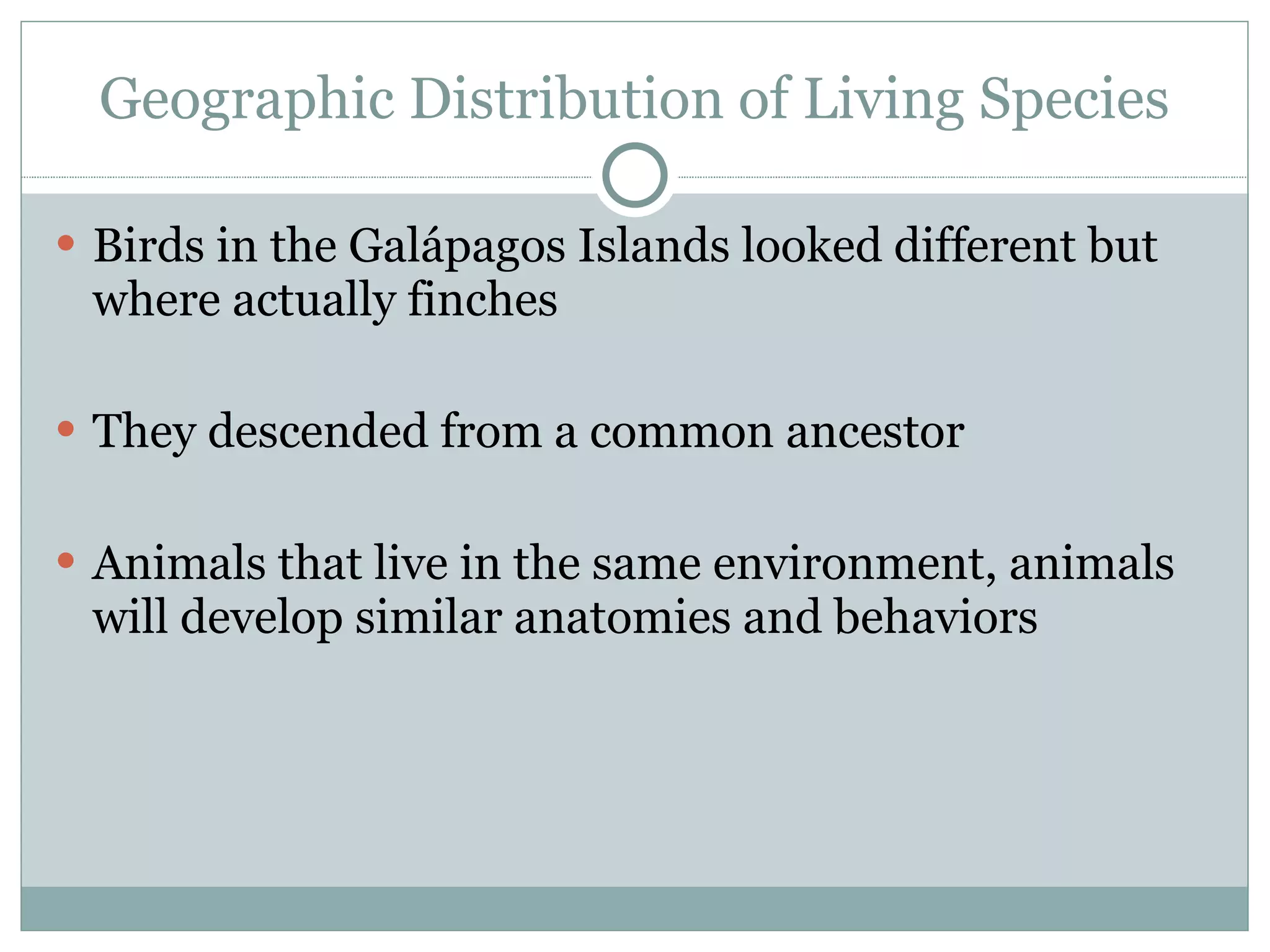
Geographic Distribution of Living Species Birds in the Galápagos Islands looked different but where actually finches They descended from a common ancestor Animals that live in the same environment, animals will develop similar anatomies and behaviors
Homologous Body Structures Limbs vary greatly in form and function However they are all constructed from the same basic bones Homologous Structures: Structures that have different mature forms but develop from the same embryonic tissues Vestigial Organs: Organs that serves no useful function in an organism
Similarities in Embryology In early stages, or embryos, with backbones are very similar Due to the fact that the same groups of embryonic cells develop in the same order and in similar patterns to produce the tissues and organs of all vertebrates.

15 darwin’s theory of evolution (version 2)

  • 1.
    CHAPTER 15 Darwin’sTheory of Evolution
  • 2.
    15.1 The Puzzleof Life’s Diversity Evolution: Change over time, is the process by which modern organisms have descended from ancient organisms. Scientific Theory: A well supported testable explanation of phenomena that have occurred in the Natural World.
  • 3.
    Voyage of theBeagle Charles Darwin was born in Shrewsbury, England on February 12, 1809 Joined the crew of the H.M.S. Beagle He set sail in 1831 and his voyage took 5 years!
  • 4.
    Voyage of theBeagle During his travels: Darwin made numerous observations and collected evidence This led him to propose a revolutionary hypothesis about the way life changes over time North America Europe Great Britain Africa Equator Asia Australia Tasmania New Zealand PACIFIC OCEAN ATLANTIC OCEAN PACIFIC OCEAN PACIFIC OCEAN The Galápagos Islands South America Tierra del Fuego Cape Horn Cape of Good Hope Andes Pinta Marchena Genovesa Equator Santiago Isabela Fernandina Florenza Española San Cristobal Santa Cruz Santa Fe Pinzón Daphne Islands 40 miles 40 km 0 0
  • 5.
    Darwin’s Observations InBrazil, Darwin collected 68 different beetle species. Patterns of Diversity: Why did some animals grow in some areas and not in others? Why did the same species of animal look different from one another depending on where they lived? Living organisms and Fossils: Preserved remains of Ancient organisms.
  • 6.
    Darwin’s Observations TheGalápagos Islands: The tortoises varied from Island to Island depending on the vegetation. He also noticed that the birds on each of the islands had different sizes and beak sizes.
  • 7.
    The Tortoises! http://www.skeptic.com/eskeptic/06-07-28images/TortoiseonPinzon.jpghttp://imagecache01a.allposters.com/images/pic/PTGPOD/OSJOM-00000498-001-FB~Espanola-Saddleback-Tortoise-Adult-Female-Galapagos-Posters.jpg
  • 8.
    The Journey HomeDarwin observed that the characteristics of many animals and plants varied noticeably among the different islands of the Galápagos
  • 9.
  • 10.
    15.2 Ideas ThatShaped Darwin’s Thinking We need to learn something about the time and world that Darwin lived in. Most Europeans believed that the Earth and everything in it was created only a few thousand years ago. Therefore, all creatures were the same from when they were first created.
  • 11.
    Ideas That ShapedDarwin’s Thinking During the 1800’s explorers were finding many fossil remains of numerous animal types that had no living representatives. This challenged the traditional view point of the time. After a lot of studying Darwin changed his thinking dramatically.
  • 12.
    An Ancient ChangingEarth Hutton and Geological Change In 1795, Hutton published his hypothesis about Geological forces that have shaped the Earth. He proposed that rock layers form very slowly by up pushed earth or by rock layers forming on top of others This meant and he proposed the earth was much more than a few thousand years old.
  • 13.
    An Ancient ChangingEarth Lyell’s Principles of Geology His first book Principles of Geology He stressed that scientists must explain past events in terms of processes that they can actually observe, since processes that shaped the Earth millions of years earlier. Erosion continues to carve out canyons, just as it did in the past Lyell helped Darwin appreciate the significance of geological phenomena that he observed.
  • 14.
    The Understanding ofGeology Influenced Darwin in 2 Ways If Earth could change over time, might life change as well? He realized that it would have taken a very long time for life to change in the way he suggested.
  • 15.
    15.3 Darwin PresentsHis Case Publication of On the Origin of Species In 1858, Darwin received a short essay by Alfred Russel Wallace. Wallace’s paper talked about his thoughts on evolutionary change that Darwin had been mulling over for 25 years!
  • 16.
    Evolution by NaturalSelection Nature selects for those traits that will help a species survive. For example: Certain colors, beak strength, etc.
  • 17.
    The Struggle forExistence Members of each species complete regularly to obtain: Food Living space Other necessities of life
  • 18.
    Survival of theFittest Darwin observed how well suited an organism is to its environment Fitness: Ability of an individual to survive and reproduce in its specific environment Adaptation: Any inherited characteristic that increases an organism’s changes of survival.
  • 19.
    Survival of theFittest Successful adaptations allow an organism to be better suited to their environment thus increasing their rate of survival and ability to reproduce
  • 20.
    Natural Selection Overtime, natural selection results in changes in the inherited characteristics of a population. These changes increase a species’ fitness in its environment.
  • 21.
    Descent with ModificationAfter long periods of time, natural selection produces organisms that have different structures, establish different niches or occupy different habitats. As a result species look different from their ancestors. Common Descent: According to this principle, all species, living and extinct were derived from common ancestors
  • 22.
    Hundreds to thousandsof years of breeding (artificial selection) Ancestral dog (wolf)
  • 23.
    Thousands to millionsof years of natural selection Ancestral canine African wild dog Coyote Wolf Fox Jackal
  • 24.
    A flower mantid in Malaysia A leaf mantid in Costa Rica
  • 25.
    Evidence of EvolutionDarwin argued that living things have been evolving on Earth for millions of years. Evidence for this process could be found in: The fossil record The geological distribution of living species Homologous structures of living organisms Similarities in early development or embryology
  • 26.
    The Fossil RecordBy comparing fossils from older rock layers with fossils from younger layers. Scientists can now document the fact that life on Earth has changed over time. There are gaps in the fossil records but each time a new fossil gets found the gap shrinks.
  • 27.
    A Skull of Homo erectus D Dinosaur tracks C Ammonite casts B Petrified tree E Fossilized organic matter of a leaf G “Ice Man” F Insect in amber
  • 28.
    Geographic Distribution ofLiving Species Birds in the Galápagos Islands looked different but where actually finches They descended from a common ancestor Animals that live in the same environment, animals will develop similar anatomies and behaviors
  • 29.
    Homologous Body StructuresLimbs vary greatly in form and function However they are all constructed from the same basic bones Homologous Structures: Structures that have different mature forms but develop from the same embryonic tissues Vestigial Organs: Organs that serves no useful function in an organism
  • 30.
    Similarities in EmbryologyIn early stages, or embryos, with backbones are very similar Due to the fact that the same groups of embryonic cells develop in the same order and in similar patterns to produce the tissues and organs of all vertebrates.