How does electricity affects
our life ?
What is matter?
 Matter is everything around us & it is made up of
very small particles called: Atom
Example:
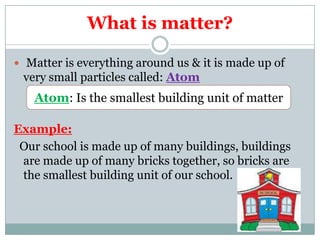
Our school is made up of many buildings, buildings
are made up of many bricks together, so bricks are
the smallest building unit of our school.
: Is the smallest building unit of matterAtom
What’s inside an Atom?
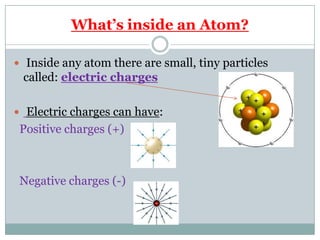
 Inside any atom there are small, tiny particles
called: electric charges
 Electric charges can have:
Positive charges (+)
Negative charges (-)
Properties of electrical charges?
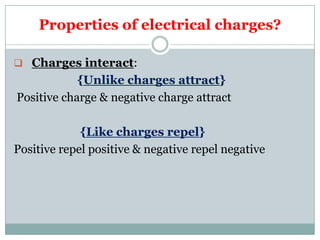
 Charges interact:
{Unlike charges attract}
Positive charge & negative charge attract
{Like charges repel}
Positive repel positive & negative repel negative
Examples
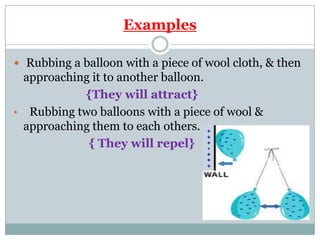
 Rubbing a balloon with a piece of wool cloth, & then
approaching it to another balloon.
{They will attract}
• Rubbing two balloons with a piece of wool &
approaching them to each others.
{ They will repel}
Charges Add up:
- When two objects touch, charges move from one
object to another.
{Negative charges moves faster than positive
charges}
A built up of charges:
- When something have more one kind of
charges than the other
Examples
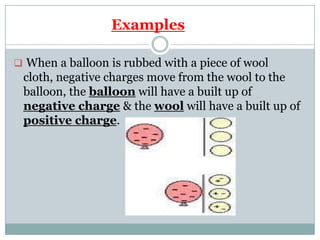
 When a balloon is rubbed with a piece of wool
cloth, negative charges move from the wool to the
balloon, the balloon will have a built up of
negative charge & the wool will have a built up of
positive charge.
Static electricity
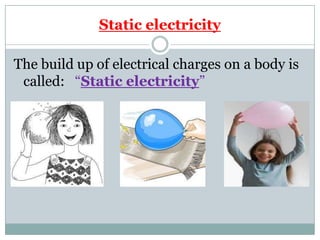
The build up of electrical charges on a body is
called: “Static electricity”
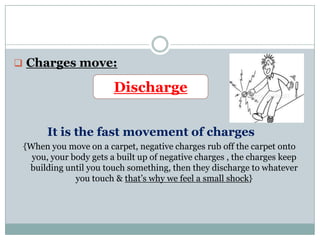
 Charges move:
It is the fast movement of charges
{When you move on a carpet, negative charges rub off the carpet onto
you, your body gets a built up of negative charges , the charges keep
building until you touch something, then they discharge to whatever
you touch & that’s why we feel a small shock}
Discharge
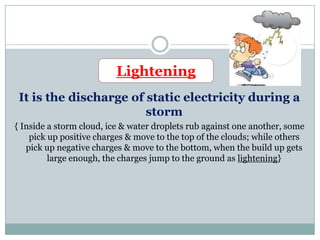
It is the discharge of static electricity during a
storm
{ Inside a storm cloud, ice & water droplets rub against one another, some
pick up positive charges & move to the top of the clouds; while others
pick up negative charges & move to the bottom, when the build up gets
large enough, the charges jump to the ground as lightening}
Lightening
Electric current
It is the flow of electric charges
{ To make an electric current, you need a path that
carry it, the path through which the electric current
flow is called: A circuit}
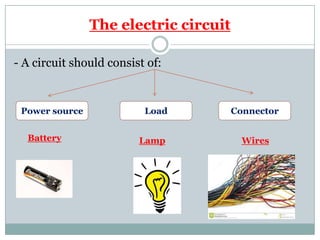
The electric circuit
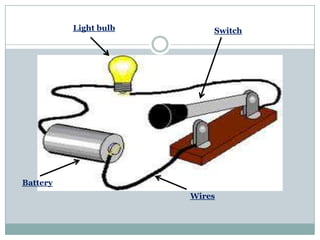
- A circuit should consist of:
Power source Load Connector
Battery Lamp Wires
Light bulb Switch
Battery
Wires
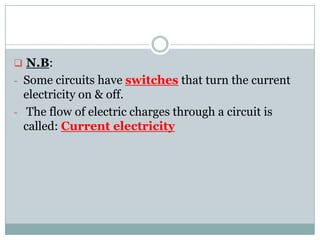
 N.B:
- Some circuits have switches that turn the current
electricity on & off.
- The flow of electric charges through a circuit is
called: Current electricity
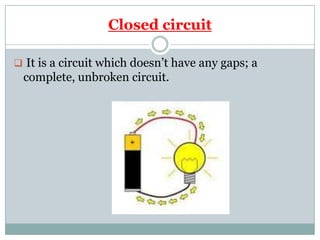
Closed circuit
 It is a circuit which doesn’t have any gaps; a
complete, unbroken circuit.
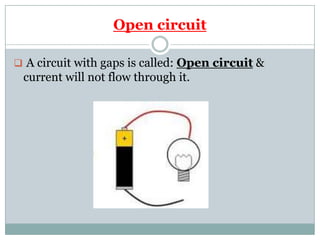
Open circuit
 A circuit with gaps is called: Open circuit &
current will not flow through it.
Types of circuits
Series circuit
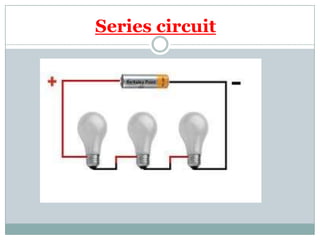
In a series circuit, the electric
current flows in the same direction
along a single path.
The same current goes through
all the loads.
Series circuit
Parallel circuit
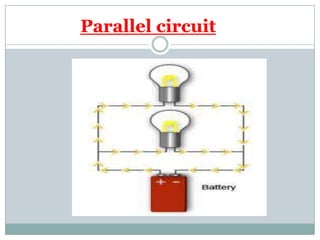
In a parallel circuit, the electric current
flows through more than one path; these
different paths are called: Branches.
-The branches of a parallel circuit
divide the electric current among
them.
Parallel circuit
How to use electricity safely?
 There are certain materials that can affect the flow
of the electric current.
 Some times the current flow is so high, this can
cause dangerous things like: fires
 That’s why we use things to slow down the flow of
electric currents.
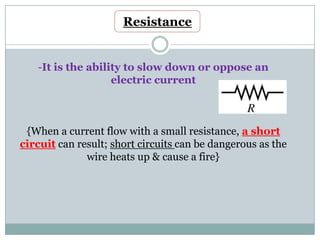
Resistance
-It is the ability to slow down or oppose an
electric current
{When a current flow with a small resistance, a short
circuit can result; short circuits can be dangerous as the
wire heats up & cause a fire}
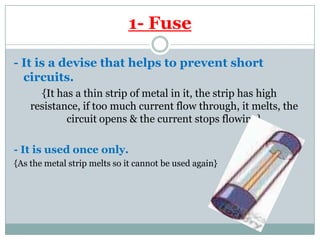
Fuse-1
- It is a devise that helps to prevent short
circuits.
{It has a thin strip of metal in it, the strip has high
resistance, if too much current flow through, it melts, the
circuit opens & the current stops flowing}
- It is used once only.
{As the metal strip melts so it cannot be used again}
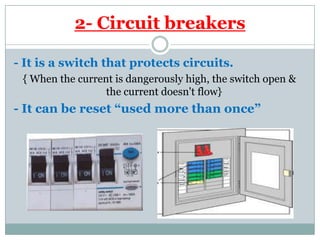
- It is a switch that protects circuits.
{ When the current is dangerously high, the switch open &
the current doesn't flow}
- It can be reset “used more than once”
Circuit breakers-2

How does electricity affects our life

  • 1.
    How does electricityaffects our life ?
  • 2.
    What is matter? Matter is everything around us & it is made up of very small particles called: Atom Example: Our school is made up of many buildings, buildings are made up of many bricks together, so bricks are the smallest building unit of our school. : Is the smallest building unit of matterAtom
  • 3.
    What’s inside anAtom?  Inside any atom there are small, tiny particles called: electric charges  Electric charges can have: Positive charges (+) Negative charges (-)
  • 4.
    Properties of electricalcharges?  Charges interact: {Unlike charges attract} Positive charge & negative charge attract {Like charges repel} Positive repel positive & negative repel negative
  • 5.
    Examples  Rubbing aballoon with a piece of wool cloth, & then approaching it to another balloon. {They will attract} • Rubbing two balloons with a piece of wool & approaching them to each others. { They will repel}
  • 6.
    Charges Add up: -When two objects touch, charges move from one object to another. {Negative charges moves faster than positive charges} A built up of charges: - When something have more one kind of charges than the other
  • 7.
    Examples  When aballoon is rubbed with a piece of wool cloth, negative charges move from the wool to the balloon, the balloon will have a built up of negative charge & the wool will have a built up of positive charge.
  • 8.
    Static electricity The buildup of electrical charges on a body is called: “Static electricity”
  • 9.
     Charges move: Itis the fast movement of charges {When you move on a carpet, negative charges rub off the carpet onto you, your body gets a built up of negative charges , the charges keep building until you touch something, then they discharge to whatever you touch & that’s why we feel a small shock} Discharge
  • 10.
    It is thedischarge of static electricity during a storm { Inside a storm cloud, ice & water droplets rub against one another, some pick up positive charges & move to the top of the clouds; while others pick up negative charges & move to the bottom, when the build up gets large enough, the charges jump to the ground as lightening} Lightening
  • 11.
    Electric current It isthe flow of electric charges { To make an electric current, you need a path that carry it, the path through which the electric current flow is called: A circuit}
  • 12.
    The electric circuit -A circuit should consist of: Power source Load Connector Battery Lamp Wires
  • 13.
  • 14.
     N.B: - Somecircuits have switches that turn the current electricity on & off. - The flow of electric charges through a circuit is called: Current electricity
  • 15.
    Closed circuit  Itis a circuit which doesn’t have any gaps; a complete, unbroken circuit.
  • 16.
    Open circuit  Acircuit with gaps is called: Open circuit & current will not flow through it.
  • 17.
    Types of circuits Seriescircuit In a series circuit, the electric current flows in the same direction along a single path. The same current goes through all the loads.
  • 18.
  • 19.
    Parallel circuit In aparallel circuit, the electric current flows through more than one path; these different paths are called: Branches. -The branches of a parallel circuit divide the electric current among them.
  • 20.
  • 21.
    How to useelectricity safely?  There are certain materials that can affect the flow of the electric current.  Some times the current flow is so high, this can cause dangerous things like: fires  That’s why we use things to slow down the flow of electric currents.
  • 22.
    Resistance -It is theability to slow down or oppose an electric current {When a current flow with a small resistance, a short circuit can result; short circuits can be dangerous as the wire heats up & cause a fire}
  • 23.
    Fuse-1 - It isa devise that helps to prevent short circuits. {It has a thin strip of metal in it, the strip has high resistance, if too much current flow through, it melts, the circuit opens & the current stops flowing} - It is used once only. {As the metal strip melts so it cannot be used again}
  • 24.
    - It isa switch that protects circuits. { When the current is dangerously high, the switch open & the current doesn't flow} - It can be reset “used more than once” Circuit breakers-2