ELECTRICITY AT WORK
Chapter 10.2 & 10.3
Year 9 Science
LESSON OBJECTIVES:
By the end of this lesson you should be able to:
Have an understanding of how electrical circuits
work, how the energy is transferred and what the
symbols stand for
Understand the electrical charge of an object can
be positive or negative
Understand what static electricity is and how it is
caused
ELECTRICITY IN TRANSIT
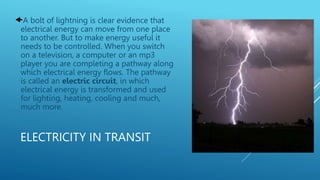
A bolt of lightning is clear evidence that
electrical energy can move from one place
to another. But to make energy useful it
needs to be controlled. When you switch
on a television, a computer or an mp3
player you are completing a pathway along
which electrical energy flows. The pathway
is called an electric circuit, in which
electrical energy is transformed and used
for lighting, heating, cooling and much,
much more.
PATHWAYS FOR ELECTRICITY
electric circuit: a path for electrons to follow, consisting of
a power supply, one or more loads, and conductors joining
the power supply and loads
The movement of electrical energy from one place to
another, whether rapidly in the form of lightning or more
slowly in an electric circuit, depends on the movement
of electric charge.
Electric charge can be positive or negative
WHAT IT MEANS TO BE CHARGED
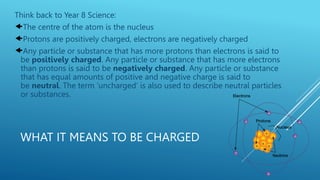
Think back to Year 8 Science:
The centre of the atom is the nucleus
Protons are positively charged, electrons are negatively charged
Any particle or substance that has more protons than electrons is said to
be positively charged. Any particle or substance that has more electrons
than protons is said to be negatively charged. Any particle or substance
that has equal amounts of positive and negative charge is said to
be neutral. The term ‘uncharged’ is also used to describe neutral particles
or substances.
STATIC ELECTRICITY
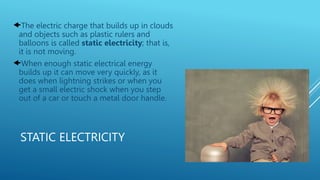
The electric charge that builds up in clouds
and objects such as plastic rulers and
balloons is called static electricity; that is,
it is not moving.
When enough static electrical energy
builds up it can move very quickly, as it
does when lightning strikes or when you
get a small electric shock when you step
out of a car or touch a metal door handle.
HOW DOES STATIC ELECTRICITY WORK?
 Static electricity is the result of an imbalance between
negative and positive charges in an object.
 These charges can build up on the surface of an object until
they find a way to be released or discharged.
 An electrical charge is created when electrons are
transferred to or removed from an object. Because
electrons have a negative charge, when they are added to
an object, it becomes negatively charged. When electrons
are removed from an object, it becomes positively charged.
FOR EXAMPLE
 The rubbing of certain materials against one another can transfer
negative charges, or electrons. For example, if you rub your shoe
on the carpet, your body collects extra electrons. The electrons
cling to your body until they can be released. As you reach and
touch your furry friend, you get a shock. Don’t worry, it is only
the surplus electrons being released from you to your
unsuspecting pet
 When you rub a balloon against your clothes and it sticks to the
wall, you are adding a surplus of electrons (negative charges) to
the surface of the balloon. The wall is now more positively
charged than the balloon. As the two come in contact, the
balloon will stick because of the rule that opposites attract
(positive to negative).
ELECTRIC CIRCUITS
All electric circuits consist of three essential items:
a power supply to provide the electrical energy
a load (or loads) in which electrical energy is converted
into other useful forms of energy
a conducting path that allows electric charge to flow
around the circuit.
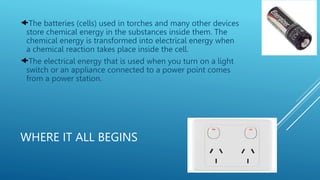
WHERE IT ALL BEGINS
The batteries (cells) used in torches and many other devices
store chemical energy in the substances inside them. The
chemical energy is transformed into electrical energy when
a chemical reaction takes place inside the cell.
The electrical energy that is used when you turn on a light
switch or an appliance connected to a power point comes
from a power station.
CURRENT AND VOLTAGE
The flow of electric charge is called electric current. It is a
measure of the amount of electric charge passing a
particular point in an electric circuit every second.
Even though the electric current in wires and most
electrical devices is caused by the flow of negatively
charged electrons, electric current is defined as the direction
of the movement of positive charge. The electric current is
said to flow through the circuit from the positive terminal of
the power supply to the negative terminal.
CURRENT AND VOLTAGE
Voltage is a measure of the amount of electrical energy
gained or lost by electric charge as it moves through the
circuit.
Voltage is also known as potential difference because it
measures a change in the potential (stored) energy of
charge as it moves between one place and another.
When electric charge moves through a circuit, it gains
electrical energy as it passes through the power supply. It
loses the same amount of energy as it passes through the
rest of the circuit. That is, the voltage gain across the
terminals of the power supply is equal to the total voltage
drop across the rest of the circuit.
WHERE THE ACTION IS
The load in an electric circuit is an energy converter. It is
here that most of the electrical energy carried by electric
charge is transformed into useful forms of energy such as
light, heat, sound and movement.
In a simple torch the load is the filament, a coiled tungsten
wire inside the globe. The filament glows brightly when it
gets hot.
SWITCHED ON
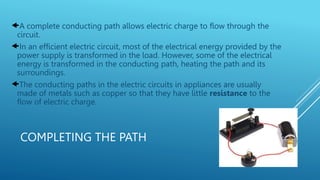
The electrical energy provided by batteries and power
outlets is transformed into other forms of energy only when
the conducting path is complete. A switch in an electric
circuit allows you to have control over whether or not the
conducting path is complete.
COMPLETING THE PATH
A complete conducting path allows electric charge to flow through the
circuit.
In an efficient electric circuit, most of the electrical energy provided by the
power supply is transformed in the load. However, some of the electrical
energy is transformed in the conducting path, heating the path and its
surroundings.
The conducting paths in the electric circuits in appliances are usually
made of metals such as copper so that they have little resistance to the
flow of electric charge.
TEST YOUR KNOWLEDGE:
Make a glossary for:
- Electric circuit
- Electric charge
- Electric current
- Voltage
- Filament
Complete questions 1-6 in Chapter 10.2 of textbook
CIRCUIT DIAGRAMS: A COMMON LANGUAGE
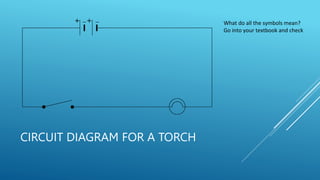
Many battery-operated devices use more than one battery.
In torches, mp3 players and cordless power tools, two or
more batteries are connected in series.
They are connected end-to-end as shown in the diagram in
this section. It is important to ensure that the positive end
of one battery is connected to the negative end of the other.
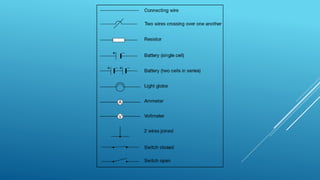
Diagrams of electric circuits need to be drawn so that
people all over the world can read them. Circuit diagrams
use straight lines for connecting leads and symbols for
other parts of circuits.
THE TORCH CIRCUIT
The power supply of a torch usually consists of two or more 1.5-volt
batteries connected in series. When two 1.5-volt batteries are connected in
series, the total voltage is 3.0 volts. Twice as much electrical energy is
available to move the electric charge around the circuit.
The load in a torch circuit is the globe. When the switch is closed, electric
current flows around the circuit. As electric charge passes through the
globe, its electrical energy is released as heat in the filament. The filament
is the coiled wire inside the globe. It is made of the metal tungsten and
glows brightly when it gets hot.
When the switch is open, the metal strip does not make contact with the
globe and the circuit is not complete
CIRCUIT DIAGRAM FOR A TORCH
What do all the symbols mean?
Go into your textbook and check
TEST YOUR KNOWLEDGE:
Complete questions 1-4 on Chapter 10.3 in textbook

25623533.pptx

  • 1.
    ELECTRICITY AT WORK Chapter10.2 & 10.3 Year 9 Science
  • 2.
    LESSON OBJECTIVES: By theend of this lesson you should be able to: Have an understanding of how electrical circuits work, how the energy is transferred and what the symbols stand for Understand the electrical charge of an object can be positive or negative Understand what static electricity is and how it is caused
  • 3.
    ELECTRICITY IN TRANSIT Abolt of lightning is clear evidence that electrical energy can move from one place to another. But to make energy useful it needs to be controlled. When you switch on a television, a computer or an mp3 player you are completing a pathway along which electrical energy flows. The pathway is called an electric circuit, in which electrical energy is transformed and used for lighting, heating, cooling and much, much more.
  • 4.
    PATHWAYS FOR ELECTRICITY electriccircuit: a path for electrons to follow, consisting of a power supply, one or more loads, and conductors joining the power supply and loads The movement of electrical energy from one place to another, whether rapidly in the form of lightning or more slowly in an electric circuit, depends on the movement of electric charge. Electric charge can be positive or negative
  • 5.
    WHAT IT MEANSTO BE CHARGED Think back to Year 8 Science: The centre of the atom is the nucleus Protons are positively charged, electrons are negatively charged Any particle or substance that has more protons than electrons is said to be positively charged. Any particle or substance that has more electrons than protons is said to be negatively charged. Any particle or substance that has equal amounts of positive and negative charge is said to be neutral. The term ‘uncharged’ is also used to describe neutral particles or substances.
  • 6.
    STATIC ELECTRICITY The electriccharge that builds up in clouds and objects such as plastic rulers and balloons is called static electricity; that is, it is not moving. When enough static electrical energy builds up it can move very quickly, as it does when lightning strikes or when you get a small electric shock when you step out of a car or touch a metal door handle.
  • 7.
    HOW DOES STATICELECTRICITY WORK?  Static electricity is the result of an imbalance between negative and positive charges in an object.  These charges can build up on the surface of an object until they find a way to be released or discharged.  An electrical charge is created when electrons are transferred to or removed from an object. Because electrons have a negative charge, when they are added to an object, it becomes negatively charged. When electrons are removed from an object, it becomes positively charged.
  • 8.
    FOR EXAMPLE  Therubbing of certain materials against one another can transfer negative charges, or electrons. For example, if you rub your shoe on the carpet, your body collects extra electrons. The electrons cling to your body until they can be released. As you reach and touch your furry friend, you get a shock. Don’t worry, it is only the surplus electrons being released from you to your unsuspecting pet  When you rub a balloon against your clothes and it sticks to the wall, you are adding a surplus of electrons (negative charges) to the surface of the balloon. The wall is now more positively charged than the balloon. As the two come in contact, the balloon will stick because of the rule that opposites attract (positive to negative).
  • 9.
    ELECTRIC CIRCUITS All electriccircuits consist of three essential items: a power supply to provide the electrical energy a load (or loads) in which electrical energy is converted into other useful forms of energy a conducting path that allows electric charge to flow around the circuit.
  • 10.
    WHERE IT ALLBEGINS The batteries (cells) used in torches and many other devices store chemical energy in the substances inside them. The chemical energy is transformed into electrical energy when a chemical reaction takes place inside the cell. The electrical energy that is used when you turn on a light switch or an appliance connected to a power point comes from a power station.
  • 11.
    CURRENT AND VOLTAGE Theflow of electric charge is called electric current. It is a measure of the amount of electric charge passing a particular point in an electric circuit every second. Even though the electric current in wires and most electrical devices is caused by the flow of negatively charged electrons, electric current is defined as the direction of the movement of positive charge. The electric current is said to flow through the circuit from the positive terminal of the power supply to the negative terminal.
  • 12.
    CURRENT AND VOLTAGE Voltageis a measure of the amount of electrical energy gained or lost by electric charge as it moves through the circuit. Voltage is also known as potential difference because it measures a change in the potential (stored) energy of charge as it moves between one place and another. When electric charge moves through a circuit, it gains electrical energy as it passes through the power supply. It loses the same amount of energy as it passes through the rest of the circuit. That is, the voltage gain across the terminals of the power supply is equal to the total voltage drop across the rest of the circuit.
  • 13.
    WHERE THE ACTIONIS The load in an electric circuit is an energy converter. It is here that most of the electrical energy carried by electric charge is transformed into useful forms of energy such as light, heat, sound and movement. In a simple torch the load is the filament, a coiled tungsten wire inside the globe. The filament glows brightly when it gets hot.
  • 14.
    SWITCHED ON The electricalenergy provided by batteries and power outlets is transformed into other forms of energy only when the conducting path is complete. A switch in an electric circuit allows you to have control over whether or not the conducting path is complete.
  • 15.
    COMPLETING THE PATH Acomplete conducting path allows electric charge to flow through the circuit. In an efficient electric circuit, most of the electrical energy provided by the power supply is transformed in the load. However, some of the electrical energy is transformed in the conducting path, heating the path and its surroundings. The conducting paths in the electric circuits in appliances are usually made of metals such as copper so that they have little resistance to the flow of electric charge.
  • 16.
    TEST YOUR KNOWLEDGE: Makea glossary for: - Electric circuit - Electric charge - Electric current - Voltage - Filament Complete questions 1-6 in Chapter 10.2 of textbook
  • 17.
    CIRCUIT DIAGRAMS: ACOMMON LANGUAGE Many battery-operated devices use more than one battery. In torches, mp3 players and cordless power tools, two or more batteries are connected in series. They are connected end-to-end as shown in the diagram in this section. It is important to ensure that the positive end of one battery is connected to the negative end of the other. Diagrams of electric circuits need to be drawn so that people all over the world can read them. Circuit diagrams use straight lines for connecting leads and symbols for other parts of circuits.
  • 19.
    THE TORCH CIRCUIT Thepower supply of a torch usually consists of two or more 1.5-volt batteries connected in series. When two 1.5-volt batteries are connected in series, the total voltage is 3.0 volts. Twice as much electrical energy is available to move the electric charge around the circuit. The load in a torch circuit is the globe. When the switch is closed, electric current flows around the circuit. As electric charge passes through the globe, its electrical energy is released as heat in the filament. The filament is the coiled wire inside the globe. It is made of the metal tungsten and glows brightly when it gets hot. When the switch is open, the metal strip does not make contact with the globe and the circuit is not complete
  • 20.
    CIRCUIT DIAGRAM FORA TORCH What do all the symbols mean? Go into your textbook and check
  • 21.
    TEST YOUR KNOWLEDGE: Completequestions 1-4 on Chapter 10.3 in textbook