How does electricity affect
our life ?
What is matter?
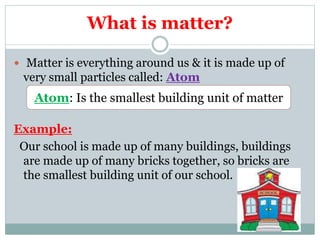
 Matter is everything around us & it is made up of
very small particles called: Atom
Example:
Our school is made up of many buildings, buildings
are made up of many bricks together, so bricks are
the smallest building unit of our school.
Atom: Is the smallest building unit of matter
What’s inside an Atom?
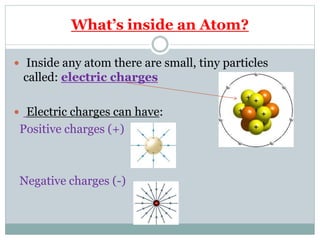
 Inside any atom there are small, tiny particles
called: electric charges
 Electric charges can have:
Positive charges (+)
Negative charges (-)
Properties of electrical charges?
 Charges interact:
{Unlike charges attract}
Positive charge & negative charge attract
{Like charges repel}
Positive repel positive & negative repel negative
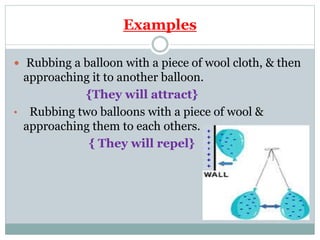
Examples
 Rubbing a balloon with a piece of wool cloth, & then
approaching it to another balloon.
{They will attract}
• Rubbing two balloons with a piece of wool &
approaching them to each others.
{ They will repel}
Charges Add up:
- When two objects touch, charges move from one
object to another.
{Negative charges moves faster than positive
charges}
A built up of charges:
- When something have more one kind of
charges than the other
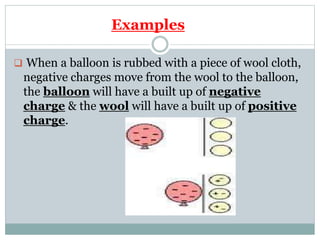
Examples
 When a balloon is rubbed with a piece of wool cloth,
negative charges move from the wool to the balloon,
the balloon will have a built up of negative
charge & the wool will have a built up of positive
charge.
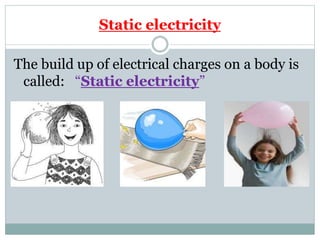
Static electricity
The build up of electrical charges on a body is
called: “Static electricity”
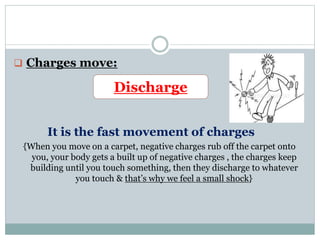
 Charges move:
It is the fast movement of charges
{When you move on a carpet, negative charges rub off the carpet onto
you, your body gets a built up of negative charges , the charges keep
building until you touch something, then they discharge to whatever
you touch & that’s why we feel a small shock}
Discharge
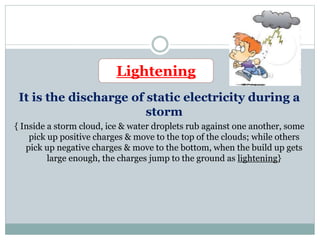
It is the discharge of static electricity during a
storm
{ Inside a storm cloud, ice & water droplets rub against one another, some
pick up positive charges & move to the top of the clouds; while others
pick up negative charges & move to the bottom, when the build up gets
large enough, the charges jump to the ground as lightening}
Lightening
Electric current
It is the flow of electric charges
{ To make an electric current, you need a path that
carry it, the path through which the electric current
flow is called: A circuit}
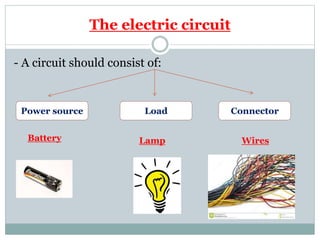
The electric circuit
- A circuit should consist of:
Power source Load Connector
Battery Lamp Wires
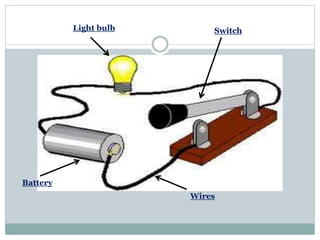
Light bulb Switch
Battery
Wires
 N.B:
- Some circuits have switches that turn the current
electricity on & off.
- The flow of electric charges through a circuit is
called: Current electricity
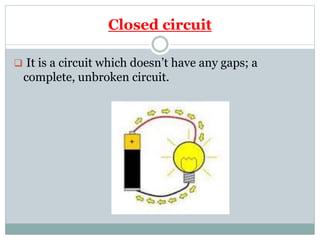
Closed circuit
 It is a circuit which doesn’t have any gaps; a
complete, unbroken circuit.
Open circuit
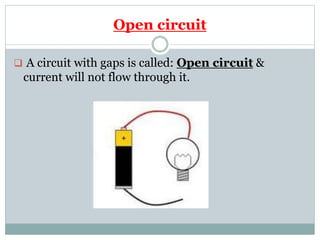
 A circuit with gaps is called: Open circuit &
current will not flow through it.
When it comes to the flow of
electric current, all materials
fall into three categories:
•insulators
•conductors
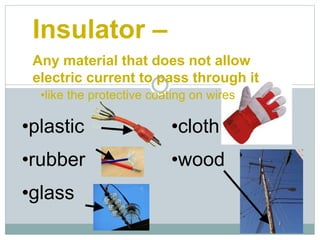
Insulator –
Any material that does not allow
electric current to pass through it
•plastic
•rubber
•glass
•cloth
•wood
•like the protective coating on wires
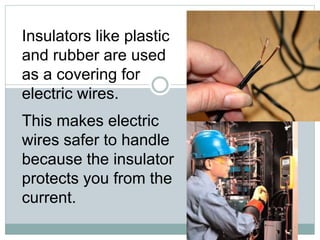
Insulators like plastic
and rubber are used
as a covering for
electric wires.
This makes electric
wires safer to handle
because the insulator
protects you from the
current.
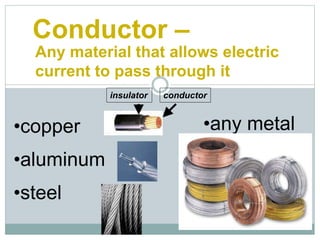
Conductor –
•copper
•aluminum
•steel
•any metal
insulator conductor
Any material that allows electric
current to pass through it
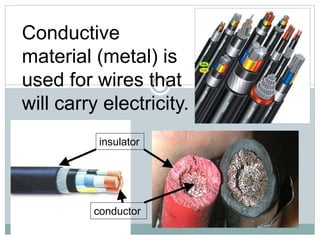
Conductive
material (metal) is
used for wires that
will carry electricity.
insulator
conductor
Most electrical devices
have a switch in the
circuit to make it easy to
close (turn on) and
open (turn off) the
circuit.
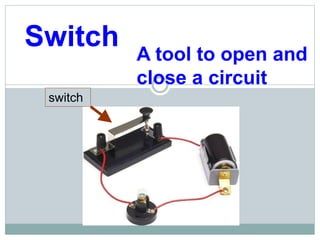
Switch A tool to open and
close a circuit
switch
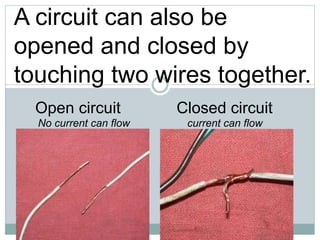
A circuit can also be
opened and closed by
touching two wires together.
Open circuit Closed circuit
No current can flow current can flow
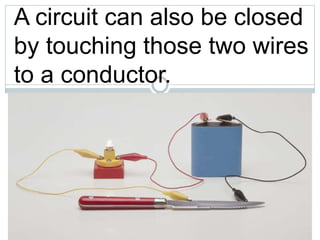
A circuit can also be closed
by touching those two wires
to a conductor.
ed circuit
current can flow
Types of circuits
Series circuit
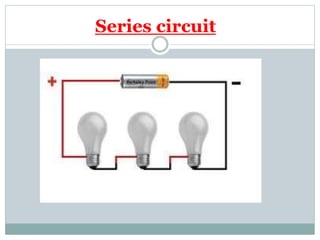
In a series circuit, the electric
current flows in the same direction
along a single path.
The same current goes through
all the loads.
Series circuit
Parallel circuit
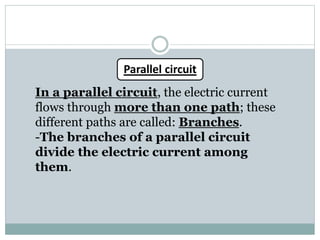
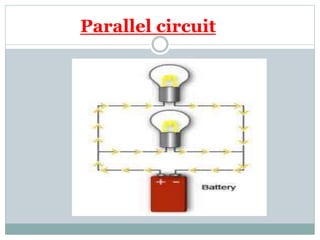
In a parallel circuit, the electric current
flows through more than one path; these
different paths are called: Branches.
-The branches of a parallel circuit
divide the electric current among
them.
Parallel circuit

How does electricity affect our life

  • 1.
    How does electricityaffect our life ?
  • 2.
    What is matter? Matter is everything around us & it is made up of very small particles called: Atom Example: Our school is made up of many buildings, buildings are made up of many bricks together, so bricks are the smallest building unit of our school. Atom: Is the smallest building unit of matter
  • 3.
    What’s inside anAtom?  Inside any atom there are small, tiny particles called: electric charges  Electric charges can have: Positive charges (+) Negative charges (-)
  • 4.
    Properties of electricalcharges?  Charges interact: {Unlike charges attract} Positive charge & negative charge attract {Like charges repel} Positive repel positive & negative repel negative
  • 5.
    Examples  Rubbing aballoon with a piece of wool cloth, & then approaching it to another balloon. {They will attract} • Rubbing two balloons with a piece of wool & approaching them to each others. { They will repel}
  • 6.
    Charges Add up: -When two objects touch, charges move from one object to another. {Negative charges moves faster than positive charges} A built up of charges: - When something have more one kind of charges than the other
  • 7.
    Examples  When aballoon is rubbed with a piece of wool cloth, negative charges move from the wool to the balloon, the balloon will have a built up of negative charge & the wool will have a built up of positive charge.
  • 8.
    Static electricity The buildup of electrical charges on a body is called: “Static electricity”
  • 9.
     Charges move: Itis the fast movement of charges {When you move on a carpet, negative charges rub off the carpet onto you, your body gets a built up of negative charges , the charges keep building until you touch something, then they discharge to whatever you touch & that’s why we feel a small shock} Discharge
  • 10.
    It is thedischarge of static electricity during a storm { Inside a storm cloud, ice & water droplets rub against one another, some pick up positive charges & move to the top of the clouds; while others pick up negative charges & move to the bottom, when the build up gets large enough, the charges jump to the ground as lightening} Lightening
  • 11.
    Electric current It isthe flow of electric charges { To make an electric current, you need a path that carry it, the path through which the electric current flow is called: A circuit}
  • 12.
    The electric circuit -A circuit should consist of: Power source Load Connector Battery Lamp Wires
  • 13.
  • 14.
     N.B: - Somecircuits have switches that turn the current electricity on & off. - The flow of electric charges through a circuit is called: Current electricity
  • 15.
    Closed circuit  Itis a circuit which doesn’t have any gaps; a complete, unbroken circuit.
  • 16.
    Open circuit  Acircuit with gaps is called: Open circuit & current will not flow through it.
  • 17.
    When it comesto the flow of electric current, all materials fall into three categories: •insulators •conductors
  • 18.
    Insulator – Any materialthat does not allow electric current to pass through it •plastic •rubber •glass •cloth •wood •like the protective coating on wires
  • 19.
    Insulators like plastic andrubber are used as a covering for electric wires. This makes electric wires safer to handle because the insulator protects you from the current.
  • 20.
    Conductor – •copper •aluminum •steel •any metal insulatorconductor Any material that allows electric current to pass through it
  • 21.
    Conductive material (metal) is usedfor wires that will carry electricity. insulator conductor
  • 22.
    Most electrical devices havea switch in the circuit to make it easy to close (turn on) and open (turn off) the circuit.
  • 23.
    Switch A toolto open and close a circuit switch
  • 24.
    A circuit canalso be opened and closed by touching two wires together. Open circuit Closed circuit No current can flow current can flow
  • 25.
    A circuit canalso be closed by touching those two wires to a conductor. ed circuit current can flow
  • 26.
    Types of circuits Seriescircuit In a series circuit, the electric current flows in the same direction along a single path. The same current goes through all the loads.
  • 27.
  • 28.
    Parallel circuit In aparallel circuit, the electric current flows through more than one path; these different paths are called: Branches. -The branches of a parallel circuit divide the electric current among them.
  • 29.