Electricity
• Charge – a physical property that can be
positive or negative
• Law of electric charge – like charges
repel, opposite charges attract
• Force between charged objects if an
electric field exist is called electric force
• 2 things affect electric force:
– Amount of charge
– Distance between the charges
• Electric field is the region around a charged
object
• An object becomes positively charged when it
loses electrons and negatively charged when it
gains electrons
• Objects become charged by friction,
conduction, induction
• Friction – when electrons are “wiped” from one
object to another (rubbing your hair with a
ballon)
•
• Conduction – electrons move from one
object to another by contact
• Induction – charges in a uncharged metal
object are rearranged without direct
contact to a charged object
• Electrical conductor – material which
allows charges to move freely
• Electrical insulator – material in which
charges can’t move freely
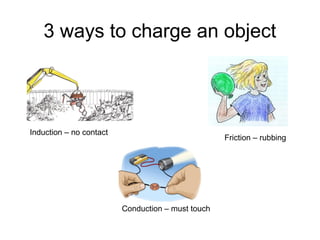
3 ways to charge an object
Induction – no contact
Friction – rubbing
Conduction – must touch
• Static electricity – electric charge at rest
on an object (static – not moving)
• Electric discharge - the loss of static
electricity as the charge moves off the
object
• Electric discharges can happen quickly
with a flash of light, a shock, or a crackling
noise (lightening)
• Electric current - the rate at which charges
pass a given point (units amperes, A)
• AC – (alternating current) the charges
continually shift direction (plug outlets)
• DC – (direct current) the charges always move
in the same direction (battery)
• Voltage - difference between two points in a
circuit (units volts, V)
• Voltage is a measure of how much work is
needed to move a charge between two points,
the higher the voltage, the more energy released
per charge (9V, 12V, 120V, 220V)
• Resistance - the opposition to the flow of
charges (units ohms,Ω (R))
• The higher the resistance, the lower the
current
• Resistance depends on the material,
length, thickness and temperature
• Superconductor – super cooled material
that lowers resistance (magnets)
• Machines can change one form of energy
to another (conversion)
• Thermocouples change thermal energy
into electric energy and photocells change
light energy to electric energy
• Electric circuits are complete closed paths
that allows electric charges to flow
• Three parts to a circuit are:
• 1. Energy source (provides electric
charge)
• 2. Wires (allows charge to flow from point
to point)
• 3. Load (changes electric energy into
other forms of energy)
• EX: radio – electrical to sound
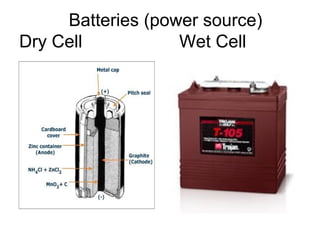
Batteries (power source)
Dry Cell Wet Cell
• Two types of circuits: series and parallel
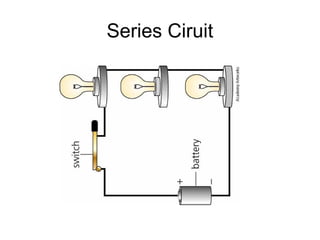
• Series: all parts are connects in a single
loop in a one way path
• All current must pass through the
complete series for circuit to work
• Any interruption causes the circuit to fail
(Xmas lights)
• Useful in burglar alarms
Series Ciruit
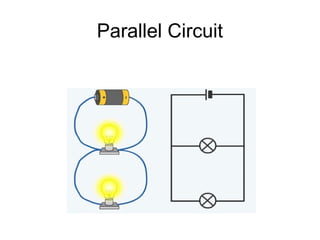
• Parallel: loads are connected side by side
and current can travel on more than one
path
• When circuit is interrupted, circuit
continues to function regardless
• Homes are wired on parallel circuits and
can have different loads in the circuit
Parallel Circuit
• Circuit failures are usually caused by over
loads or damage to the structure of the
circuit
• Fuses and circuit breaks “fail over” and
automatically break the circuit to protect
circuit and property
• Electromagnets – temporary magnets that lose
their magnetism when electric current is
removed
• Electricity can produce magnet fields and can
cause metals such as iron and steel to act like
magnets
• Generator is a device that converts mechanical
energy into electrical energy by using magnets
and a coil of wire that creates magnetic fields
• Electric motors convert electrical energy
into mechanical energy that is used to do
work
• EX: motors in house hold appliances like
blenders and washing machines

Electricity (1)

  • 1.
    Electricity • Charge –a physical property that can be positive or negative • Law of electric charge – like charges repel, opposite charges attract • Force between charged objects if an electric field exist is called electric force • 2 things affect electric force: – Amount of charge – Distance between the charges
  • 2.
    • Electric fieldis the region around a charged object • An object becomes positively charged when it loses electrons and negatively charged when it gains electrons • Objects become charged by friction, conduction, induction • Friction – when electrons are “wiped” from one object to another (rubbing your hair with a ballon) •
  • 3.
    • Conduction –electrons move from one object to another by contact • Induction – charges in a uncharged metal object are rearranged without direct contact to a charged object • Electrical conductor – material which allows charges to move freely • Electrical insulator – material in which charges can’t move freely
  • 4.
    3 ways tocharge an object Induction – no contact Friction – rubbing Conduction – must touch
  • 5.
    • Static electricity– electric charge at rest on an object (static – not moving) • Electric discharge - the loss of static electricity as the charge moves off the object • Electric discharges can happen quickly with a flash of light, a shock, or a crackling noise (lightening)
  • 6.
    • Electric current- the rate at which charges pass a given point (units amperes, A) • AC – (alternating current) the charges continually shift direction (plug outlets) • DC – (direct current) the charges always move in the same direction (battery) • Voltage - difference between two points in a circuit (units volts, V) • Voltage is a measure of how much work is needed to move a charge between two points, the higher the voltage, the more energy released per charge (9V, 12V, 120V, 220V)
  • 7.
    • Resistance -the opposition to the flow of charges (units ohms,Ω (R)) • The higher the resistance, the lower the current • Resistance depends on the material, length, thickness and temperature • Superconductor – super cooled material that lowers resistance (magnets)
  • 8.
    • Machines canchange one form of energy to another (conversion) • Thermocouples change thermal energy into electric energy and photocells change light energy to electric energy • Electric circuits are complete closed paths that allows electric charges to flow
  • 9.
    • Three partsto a circuit are: • 1. Energy source (provides electric charge) • 2. Wires (allows charge to flow from point to point) • 3. Load (changes electric energy into other forms of energy) • EX: radio – electrical to sound
  • 10.
  • 11.
    • Two typesof circuits: series and parallel • Series: all parts are connects in a single loop in a one way path • All current must pass through the complete series for circuit to work • Any interruption causes the circuit to fail (Xmas lights) • Useful in burglar alarms
  • 12.
  • 13.
    • Parallel: loadsare connected side by side and current can travel on more than one path • When circuit is interrupted, circuit continues to function regardless • Homes are wired on parallel circuits and can have different loads in the circuit
  • 14.
  • 15.
    • Circuit failuresare usually caused by over loads or damage to the structure of the circuit • Fuses and circuit breaks “fail over” and automatically break the circuit to protect circuit and property
  • 16.
    • Electromagnets –temporary magnets that lose their magnetism when electric current is removed • Electricity can produce magnet fields and can cause metals such as iron and steel to act like magnets • Generator is a device that converts mechanical energy into electrical energy by using magnets and a coil of wire that creates magnetic fields
  • 17.
    • Electric motorsconvert electrical energy into mechanical energy that is used to do work • EX: motors in house hold appliances like blenders and washing machines