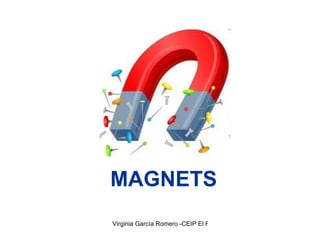
MAGNETS
Are there magnets in nature? What is magnetic in nature?
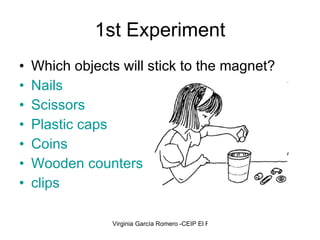
1st Experiment Which objects will stick to the magnet? Nails Scissors Plastic caps  Coins Wooden counters clips
Magnets represent an amazing world  which we can´t see.
Our senses don´t pick up  on magnets but thanks to  Science we can understand them.
Do you know that magnets are one of the most important forces which move our world? There is a magnet or and electromagnet inside an electric engine.
The Earth, the sun and the stars produce a magnetic field which we can  detect and study.
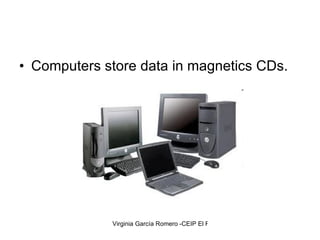
Computers store data in magnetics CDs.
Doctors can see  the inside of our bodies thanks to magnetic resonance.
Einstein said in his autobiography that  when he was five years old  he was very surprised when his father gave him a compass as a present.
Would you like to be surprised by magnets?
2nd Experiment How can we measure  the strength of a magnet?
Let´s learnt about magnets! We will  follow the historical path.
We will discover through history  how magnets and electricity joined and scientists changed their ideas and  their explanations about magnets.
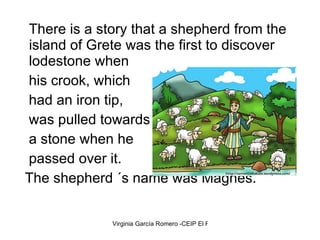
Pliny The Elder (23-79), the Natural Historian,    described the  magnetite rock and he told  about the Magnes  shepherd´story:
There is a story that a shepherd from the island of Grete was the first to discover lodestone when  his crook, which  had an iron tip, was pulled towards  a stone when he passed over it.  The shepherd ´s name was Magnes.
Platon (fouth century before Christ) The stone not only attracts iron  rings, the stone transmits its power to attract other rings. Sometimes we can see many iron objects joined with others like a chain, and all of them receive the power of the stone.
We can observe Nails are magnetized when they touch the magnets. Some objects stick to magnets. Objects will pull towards the magnets.Another name for  sticking is "attract”.
3rd Experiment To magnetize nails and to observe what´s happen.
What are temporary magnets?
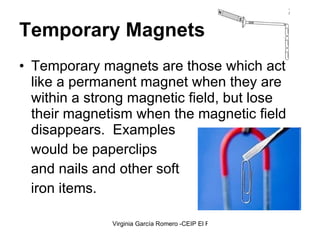
Temporary Magnets   T emporary magnets are those which act like a permanent magnet when they are within a strong magnetic field, but lose their magnetism when the magnetic field disappears.  Examples  would be paperclips  and nails and other soft iron items.
The first model of a magnetic force Tito Lucrecio Caro (99-55 B.C.) (Julio César´s contemporary) describes in his poem “The Rerum Natura”(The nature of the things) that he has seen pieces of iron move inside a bronze vessel when this vessel was approched by a magnetic stone.
4th Experiment What are permanent magnets?
Permanent Magnets   Permanent magnets are those we are most familiar with, such as the magnets hanging onto our refrigerator doors.  They are permanent in the  sense that once they are magnetized, they retain a level of magnetism.
Tito Lucrecio Caro… He describes  some pieces of iron which have been in contact with a magnetic stone, they are repeled when they are approched by the stone.
We discover a new force. Do the two ends of a magnet  have the same properties?
5th EXPERIMENT What are the two ends of a magnet like?
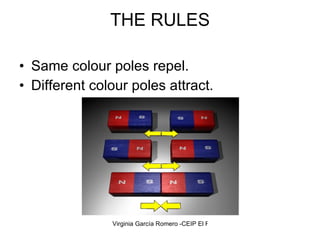
POLES All magnets have ends or sides.  Another name for these ends or sides is "poles". The two ends of the magnet are different. The red ends  are called the "north pole".  The blue ends  are called the "south pole".
THE RULES Same colour poles repel. Different colour poles attract.
6th Experiment Are human beings sensitive to magnets?
We are not sensitive to magnets so, we need instruments to detect them and study their characteristics.
A big leap in  history (XIX c.) Faraday introduced a new concept:  MAGNETIC FIELD
About Faraday Date :1791-1867 His biggest achievement was  the concept of magnetic  and electric fields.
The magnet rules Alike poles repel each other. Different poles attract each other. This happens without touching them. Why does a magnet know that there is a magnet close?
Human beings have always been interested about how magnets work. And human beings always thought that there was something that we couldn´t see but did exist. This something was the magnetic field.
The compass is the instrument which helps us to detect the magnetic field.
7th Experiment Can we make a compass?
 
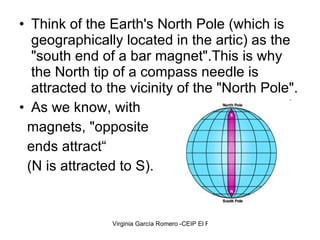
The Earth is a great magnet. Its magnetic field is like a bar magnet at its center.
The Earth is a magnet  because it contains a lot of iron.  The moon does not  have as much iron, so it is not a magnet.  Your compass would not work on the moon.”
 
What is near the Geographic North Pole, a Magnetic North or a Magnetic South?
Think of the Earth's North Pole (which is geographically located in the artic) as the "south end of a bar magnet".This is why the North tip of a compass needle is attracted to the vicinity of the "North Pole". As we know, with  magnets, "opposite ends attract“ (N is attracted to S).
The red pole of a magnet points  to the geographic North pole. A compass needle is a magnet too - so it's S end will be attracted to the "North" side of your unmarked magnet (and vice versa).
8th Experiment How does a toy lift work?
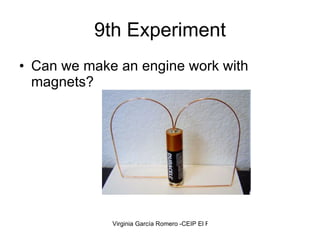
9th Experiment Can we make an engine work with magnets?
QUIZ TIME 1. Which objects will not stick to the magnet?
2. Magnets should never be held in front of which object?   a)  Telephone b)  Computers c)  Books d)  Light
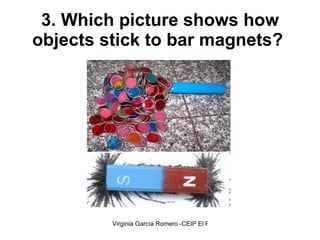
3. Which picture shows how objects stick to bar magnets?
4. What colour would a South Pole be on a magnet?   a)  Red b)  Green c)  Grey d)  Blue
5. What is another word for "not sticking"?   a)  Avoid ing b)  Attract ing c)  Repel ling d)  Running   away
Interesting links http://ed101.bu.edu/StudentDoc/current/ED101fa10/sjay0601/content1.html http:// blps.groupfusion.net /modules/ groups / homepagefiles / cms /14571/File/ Magnets%20Webquest / Magnets_Webquest.html http://www.kidskonnect.com/subject-index/15-science/90-magnets.html http://www.buzzle.com/articles/facts-about-magnets.html
http://www.csicenlaescuela.csic.es/proyectos/magnetismo.htm http://www.bbc.co.uk/schools/scienceclips/ages/7_8/magnets_springs.shtml http://www.bbc.co.uk/schools/teachers/ks2_lessonplans/science/magnets_springs.shtml
Bibliography Book:   What   Makes  A  Magnet Author:  Franklyn M. Branley Illustrator:  True Kelley Publisher:  HarperCollins Publication Date:  July 1996 Pages:  32 Pages Grade Range:  Kindergarten, First Grade and Second Grade ISBN:  978-0060264413

Magnets

  • 1.
  • 2.
    Are there magnetsin nature? What is magnetic in nature?
  • 3.
    1st Experiment Whichobjects will stick to the magnet? Nails Scissors Plastic caps Coins Wooden counters clips
  • 4.
    Magnets represent anamazing world which we can´t see.
  • 5.
    Our senses don´tpick up on magnets but thanks to Science we can understand them.
  • 6.
    Do you knowthat magnets are one of the most important forces which move our world? There is a magnet or and electromagnet inside an electric engine.
  • 7.
    The Earth, thesun and the stars produce a magnetic field which we can detect and study.
  • 8.
    Computers store datain magnetics CDs.
  • 9.
    Doctors can see the inside of our bodies thanks to magnetic resonance.
  • 10.
    Einstein said inhis autobiography that when he was five years old he was very surprised when his father gave him a compass as a present.
  • 11.
    Would you liketo be surprised by magnets?
  • 12.
    2nd Experiment Howcan we measure the strength of a magnet?
  • 13.
    Let´s learnt aboutmagnets! We will follow the historical path.
  • 14.
    We will discoverthrough history how magnets and electricity joined and scientists changed their ideas and their explanations about magnets.
  • 15.
    Pliny The Elder(23-79), the Natural Historian,   described the magnetite rock and he told about the Magnes shepherd´story:
  • 16.
    There is astory that a shepherd from the island of Grete was the first to discover lodestone when his crook, which had an iron tip, was pulled towards a stone when he passed over it. The shepherd ´s name was Magnes.
  • 17.
    Platon (fouth centurybefore Christ) The stone not only attracts iron rings, the stone transmits its power to attract other rings. Sometimes we can see many iron objects joined with others like a chain, and all of them receive the power of the stone.
  • 18.
    We can observeNails are magnetized when they touch the magnets. Some objects stick to magnets. Objects will pull towards the magnets.Another name for sticking is "attract”.
  • 19.
    3rd Experiment Tomagnetize nails and to observe what´s happen.
  • 20.
  • 21.
    Temporary Magnets T emporary magnets are those which act like a permanent magnet when they are within a strong magnetic field, but lose their magnetism when the magnetic field disappears.  Examples would be paperclips and nails and other soft iron items.
  • 22.
    The first modelof a magnetic force Tito Lucrecio Caro (99-55 B.C.) (Julio César´s contemporary) describes in his poem “The Rerum Natura”(The nature of the things) that he has seen pieces of iron move inside a bronze vessel when this vessel was approched by a magnetic stone.
  • 23.
    4th Experiment Whatare permanent magnets?
  • 24.
    Permanent Magnets Permanent magnets are those we are most familiar with, such as the magnets hanging onto our refrigerator doors.  They are permanent in the sense that once they are magnetized, they retain a level of magnetism.
  • 25.
    Tito Lucrecio Caro…He describes some pieces of iron which have been in contact with a magnetic stone, they are repeled when they are approched by the stone.
  • 26.
    We discover anew force. Do the two ends of a magnet have the same properties?
  • 27.
    5th EXPERIMENT Whatare the two ends of a magnet like?
  • 28.
    POLES All magnetshave ends or sides. Another name for these ends or sides is "poles". The two ends of the magnet are different. The red ends are called the "north pole". The blue ends are called the "south pole".
  • 29.
    THE RULES Samecolour poles repel. Different colour poles attract.
  • 30.
    6th Experiment Arehuman beings sensitive to magnets?
  • 31.
    We are notsensitive to magnets so, we need instruments to detect them and study their characteristics.
  • 32.
    A big leapin history (XIX c.) Faraday introduced a new concept: MAGNETIC FIELD
  • 33.
    About Faraday Date:1791-1867 His biggest achievement was the concept of magnetic and electric fields.
  • 34.
    The magnet rulesAlike poles repel each other. Different poles attract each other. This happens without touching them. Why does a magnet know that there is a magnet close?
  • 35.
    Human beings havealways been interested about how magnets work. And human beings always thought that there was something that we couldn´t see but did exist. This something was the magnetic field.
  • 36.
    The compass isthe instrument which helps us to detect the magnetic field.
  • 37.
    7th Experiment Canwe make a compass?
  • 38.
  • 39.
    The Earth isa great magnet. Its magnetic field is like a bar magnet at its center.
  • 40.
    The Earth isa magnet because it contains a lot of iron.  The moon does not have as much iron, so it is not a magnet.  Your compass would not work on the moon.”
  • 41.
  • 42.
    What is nearthe Geographic North Pole, a Magnetic North or a Magnetic South?
  • 43.
    Think of theEarth's North Pole (which is geographically located in the artic) as the "south end of a bar magnet".This is why the North tip of a compass needle is attracted to the vicinity of the "North Pole". As we know, with magnets, "opposite ends attract“ (N is attracted to S).
  • 44.
    The red poleof a magnet points to the geographic North pole. A compass needle is a magnet too - so it's S end will be attracted to the "North" side of your unmarked magnet (and vice versa).
  • 45.
    8th Experiment Howdoes a toy lift work?
  • 46.
    9th Experiment Canwe make an engine work with magnets?
  • 47.
    QUIZ TIME 1.Which objects will not stick to the magnet?
  • 48.
    2. Magnets shouldnever be held in front of which object? a) Telephone b) Computers c) Books d) Light
  • 49.
    3. Which pictureshows how objects stick to bar magnets?
  • 50.
    4. What colourwould a South Pole be on a magnet? a) Red b) Green c) Grey d) Blue
  • 51.
    5. What isanother word for "not sticking"? a) Avoid ing b) Attract ing c) Repel ling d) Running away
  • 52.
    Interesting links http://ed101.bu.edu/StudentDoc/current/ED101fa10/sjay0601/content1.htmlhttp:// blps.groupfusion.net /modules/ groups / homepagefiles / cms /14571/File/ Magnets%20Webquest / Magnets_Webquest.html http://www.kidskonnect.com/subject-index/15-science/90-magnets.html http://www.buzzle.com/articles/facts-about-magnets.html
  • 53.
  • 54.
    Bibliography Book: What Makes A Magnet Author: Franklyn M. Branley Illustrator: True Kelley Publisher: HarperCollins Publication Date: July 1996 Pages: 32 Pages Grade Range: Kindergarten, First Grade and Second Grade ISBN: 978-0060264413