5th Grade Physical Science
Atom
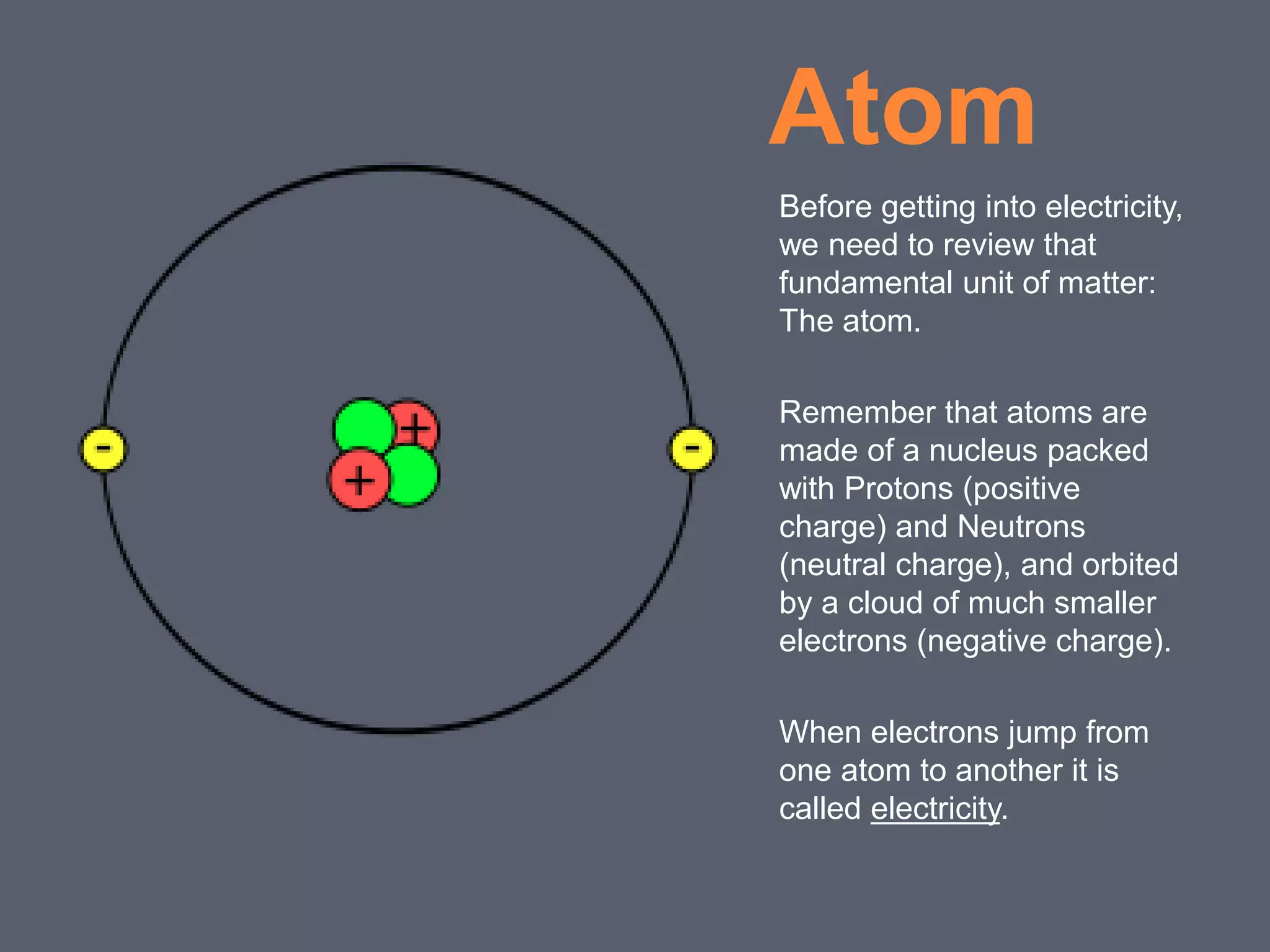
Before getting into electricity,
we need to review that
fundamental unit of matter:
The atom.
Remember that atoms are
made of a nucleus packed
with Protons (positive
charge) and Neutrons
(neutral charge), and orbited
by a cloud of much smaller
electrons (negative charge).
When electrons jump from
one atom to another it is
called electricity.
Forms of Electricity
Current Electricity Static Electricity
 Occurs when electric
current flows through a
conductor.
 Occurs when electric
charges build up on a
surface and are released
all at once.
Current Electricity
In order for electric current to flow through a conductor, like a wire, you need
two things:
• A power source to make the electricity flow, such as a battery.
• A complete path for the electric current to follow, called a
circuit.
Source: http://www.bbc.co.uk/bitesize/ks3/science/energy_electricity_forces/electric_current_voltage/revision/2/
Circuit Symbols
Symbols are used to draw diagrams of circuits, just as we use
symbols when we draw maps. This way you don’t have to draw every
piece of a circuit, you can just use the symbols instead.
Source: http://www.bbc.co.uk/bitesize/ks3/science/energy_electricity_forces/electric_current_voltage/revision/3/
Notice the difference here
between a “cell” and a
“battery”?
In physics (that’s what
you’re studying by the
way) we call a single
regular battery a “cell” in
electrical diagrams. Two
or more cells put together
are called a “battery”.
So remember:
= Cell = Battery
Circuit Diagram
Why use symbols? To make your diagram easy to both draw and read.
Source: http://www.bbc.co.uk/bitesize/ks3/science/energy_electricity_forces/electric_current_voltage/revision/3/
Let’s Try It!
Follow the directions in the activity to experiment with a circuit.
Changing Circuits
Types of Circuits
Parallel Circuit Series Circuit
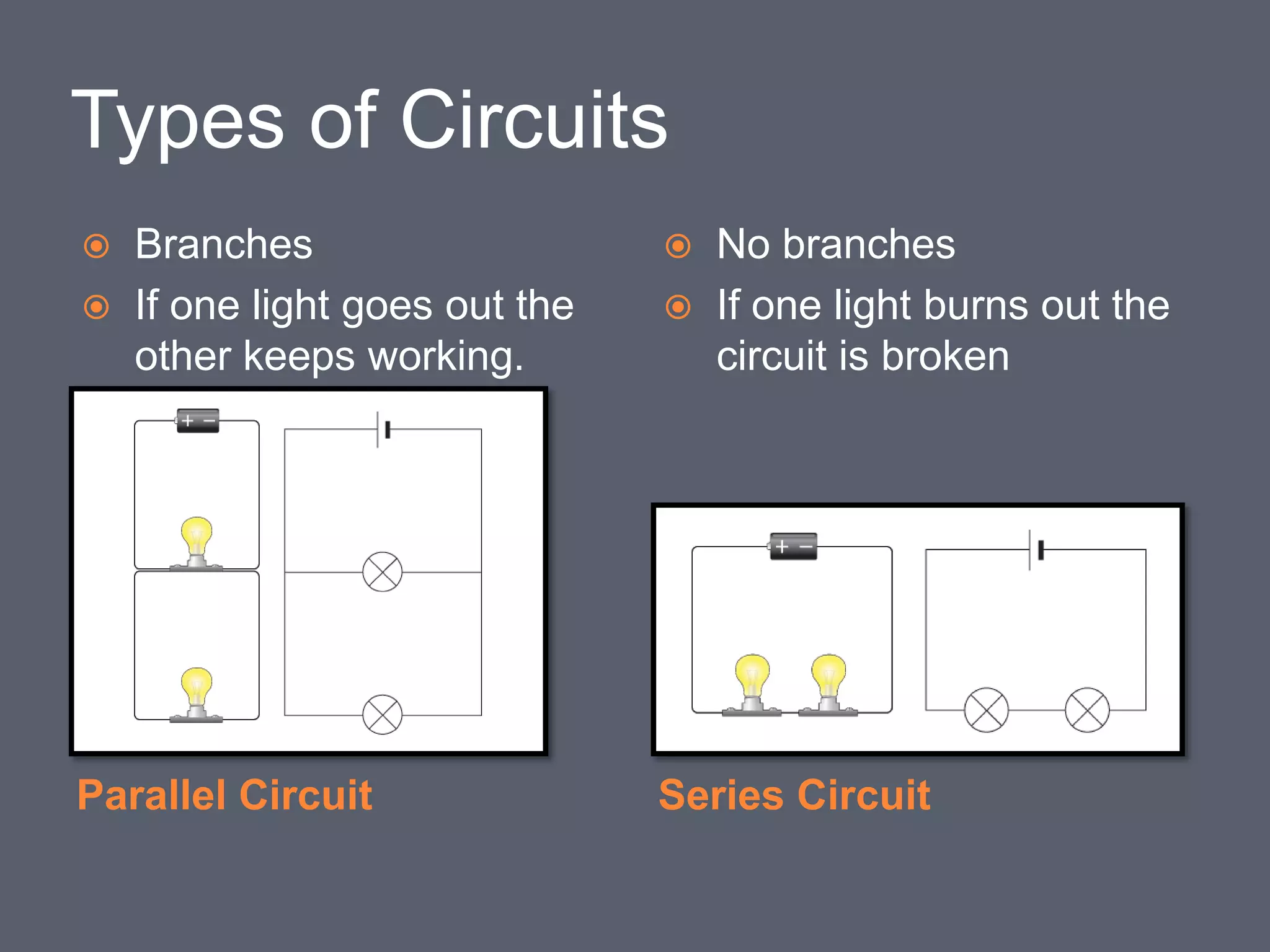
 Branches
 If one light goes out the
other keeps working.
 No branches
 If one light burns out the
circuit is broken
Series Circuit
In a series circuit, the
lamps are placed one
after another in a
series.
When one lamp is
broken the other light
goes out because
there is no longer a
complete circuit from
the battery to the lamp
and back again.
Source: http://www.bbc.co.uk/bitesize/ks3/science/energy_electricity_forces/electric_current_voltage/revision/4/
Parallel Circuit
As you can see, in a parallel circuit electricity will continue to flow through the wires
even if one bulb is broken because it can still form a complete circuit from the
battery to the working bulb and back again.
This is why our houses are wired with parallel circuits. After all, you wouldn’t want
every single light in your house to go out every time a single bulb broke would you?
Source: http://www.bbc.co.uk/bitesize/ks3/science/energy_electricity_forces/electric_current_voltage/revision/4/
Now It’s Your Turn
Using either a whiteboard, paper, or your desk (ask your
teacher!) draw a diagram of a series circuit with:
• cell
• two lights
• one switch
Next, draw a diagram of a parallel circuit with:
• a battery (not a cell!)
• two lights
• one switch
Assessment
With your assigned group / partner, use the
materials provided to actually build and test
your diagramed circuits.
Done Early?
Go above and beyond to learn
about current and voltage here:
Current & Voltage

Electricity & electric circuits

  • 1.
  • 2.
    Atom Before getting intoelectricity, we need to review that fundamental unit of matter: The atom. Remember that atoms are made of a nucleus packed with Protons (positive charge) and Neutrons (neutral charge), and orbited by a cloud of much smaller electrons (negative charge). When electrons jump from one atom to another it is called electricity.
  • 3.
    Forms of Electricity CurrentElectricity Static Electricity  Occurs when electric current flows through a conductor.  Occurs when electric charges build up on a surface and are released all at once.
  • 4.
    Current Electricity In orderfor electric current to flow through a conductor, like a wire, you need two things: • A power source to make the electricity flow, such as a battery. • A complete path for the electric current to follow, called a circuit. Source: http://www.bbc.co.uk/bitesize/ks3/science/energy_electricity_forces/electric_current_voltage/revision/2/
  • 5.
    Circuit Symbols Symbols areused to draw diagrams of circuits, just as we use symbols when we draw maps. This way you don’t have to draw every piece of a circuit, you can just use the symbols instead. Source: http://www.bbc.co.uk/bitesize/ks3/science/energy_electricity_forces/electric_current_voltage/revision/3/
  • 6.
    Notice the differencehere between a “cell” and a “battery”? In physics (that’s what you’re studying by the way) we call a single regular battery a “cell” in electrical diagrams. Two or more cells put together are called a “battery”. So remember: = Cell = Battery
  • 7.
    Circuit Diagram Why usesymbols? To make your diagram easy to both draw and read. Source: http://www.bbc.co.uk/bitesize/ks3/science/energy_electricity_forces/electric_current_voltage/revision/3/
  • 8.
    Let’s Try It! Followthe directions in the activity to experiment with a circuit. Changing Circuits
  • 9.
    Types of Circuits ParallelCircuit Series Circuit  Branches  If one light goes out the other keeps working.  No branches  If one light burns out the circuit is broken
  • 10.
    Series Circuit In aseries circuit, the lamps are placed one after another in a series. When one lamp is broken the other light goes out because there is no longer a complete circuit from the battery to the lamp and back again. Source: http://www.bbc.co.uk/bitesize/ks3/science/energy_electricity_forces/electric_current_voltage/revision/4/
  • 11.
    Parallel Circuit As youcan see, in a parallel circuit electricity will continue to flow through the wires even if one bulb is broken because it can still form a complete circuit from the battery to the working bulb and back again. This is why our houses are wired with parallel circuits. After all, you wouldn’t want every single light in your house to go out every time a single bulb broke would you? Source: http://www.bbc.co.uk/bitesize/ks3/science/energy_electricity_forces/electric_current_voltage/revision/4/
  • 12.
    Now It’s YourTurn Using either a whiteboard, paper, or your desk (ask your teacher!) draw a diagram of a series circuit with: • cell • two lights • one switch Next, draw a diagram of a parallel circuit with: • a battery (not a cell!) • two lights • one switch
  • 13.
    Assessment With your assignedgroup / partner, use the materials provided to actually build and test your diagramed circuits. Done Early? Go above and beyond to learn about current and voltage here: Current & Voltage

Editor's Notes

  • #4 Have students write down forms of electricity (if not already written in notebooks)
  • #5 Ask: Why don’t the first two bulbs light up?
  • #6 Students record symbols.
  • #10 Students record & draw types of circuits.
  • #12 Trace the path the electric current takes when a bulb is broken.
  • #13 Give students time to complete diagrams, then share with class. Check to make sure student diagrams are accurate before proceeding.