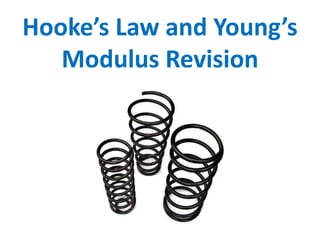
Hooke’s Law and Young’s
   Modulus Revision
Define these terms:
• Stress

• Strain

• Extension

• Length

• Compression

• Tension
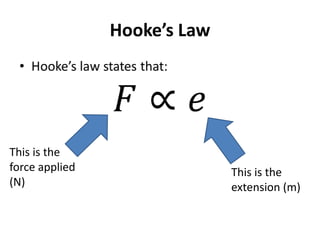
Hooke’s Law


This is the
force applied                 This is the
(N)                           extension (m)
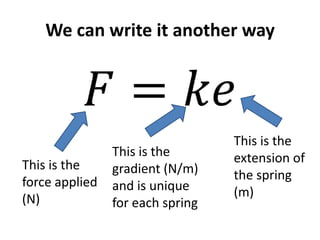
We can write it another way


                                  This is the
                This is the       extension of
This is the     gradient (N/m)
force applied                     the spring
                and is unique     (m)
(N)             for each spring
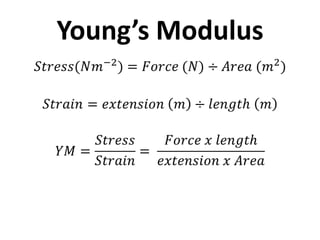
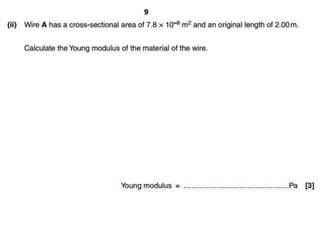
Young’s Modulus
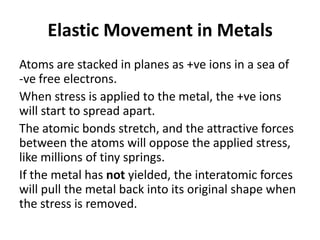
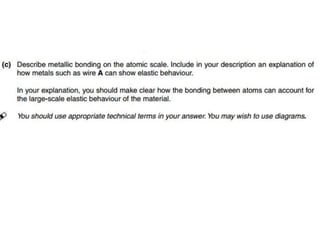
Elastic Movement in Metals
Atoms are stacked in planes as +ve ions in a sea of
-ve free electrons.
When stress is applied to the metal, the +ve ions
will start to spread apart.
The atomic bonds stretch, and the attractive forces
between the atoms will oppose the applied stress,
like millions of tiny springs.
If the metal has not yielded, the interatomic forces
will pull the metal back into its original shape when
the stress is removed.
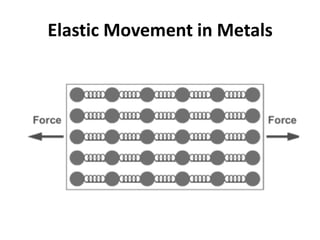
Elastic Movement in Metals
Hooke’s Law and Young’s Modulus Revision

Hooke’s Law and Young’s Modulus Revision

  • 1.
    Hooke’s Law andYoung’s Modulus Revision
  • 2.
    Define these terms: •Stress • Strain • Extension • Length • Compression • Tension
  • 3.
    Hooke’s Law This isthe force applied This is the (N) extension (m)
  • 4.
    We can writeit another way This is the This is the extension of This is the gradient (N/m) force applied the spring and is unique (m) (N) for each spring
  • 5.
  • 6.
    Elastic Movement inMetals Atoms are stacked in planes as +ve ions in a sea of -ve free electrons. When stress is applied to the metal, the +ve ions will start to spread apart. The atomic bonds stretch, and the attractive forces between the atoms will oppose the applied stress, like millions of tiny springs. If the metal has not yielded, the interatomic forces will pull the metal back into its original shape when the stress is removed.
  • 7.