Christine Mae M. Lagumbay
   Roxan M. Bahingawan
       Ernalyn Sanico
        Norjamela Ali
    Hanna Grace Dayak
Hooke's law of elasticity is an approximation that states 
that the extension of a spring is in direct proportion with 
  the load applied to it. Many materials obey this law as 
 long as the load does not exceed the material's elastic 
     limit. Materials for which Hooke's law is a useful 
approximation are known as linear-elastic or "Hookean" 
materials. Hooke's law in simple terms says that strain is 
               directly proportional to stress.
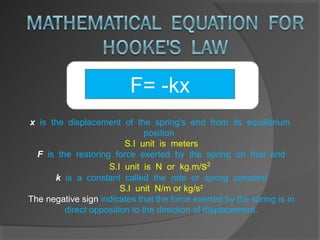
F= -kx
x  is  the  displacement  of  the  spring's  end  from  its  equilibrium  
                                  position  
                            S.I  unit  is  meters
  F  is  the  restoring  force  exerted  by  the  spring  on  that  end
                       S.I  unit  is  N  or  kg.m/s2 
        k  is  a  constant  called  the  rate  or  spring constant
                          S.I  unit  N/m or kg/s2
The negative sign indicates that the force exerted by the spring is in 
           direct opposition to the direction of displacement.
Hooke's law is named after the 
17th century British 
physicist Robert Hooke. He first 
stated this law in 1660 as 
a Latin anagram, whose solution 
he published in 1678 as Ut
tensio, sic vis, meaning, "As the 
extension, so the force".
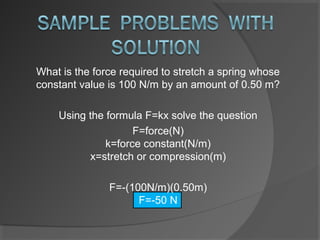
What is the force required to stretch a spring whose
constant value is 100 N/m by an amount of 0.50 m?

    Using the formula F=kx solve the question
                    F=force(N)
              k=force constant(N/m)
          x=stretch or compression(m)

               F=-(100N/m)(0.50m)
                     F=-50 N
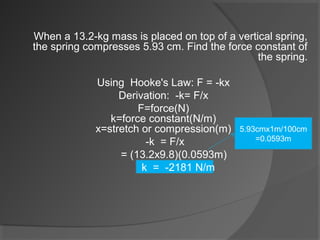
When a 13.2-kg mass is placed on top of a vertical spring,
the spring compresses 5.93 cm. Find the force constant of
                                               the spring.

             Using Hooke's Law: F = -kx
                  Derivation: -k= F/x
                      F=force(N)
                k=force constant(N/m)
             x=stretch or compression(m)   5.93cmx1m/100cm
                        -k = F/x               =0.0593m

                  = (13.2x9.8)(0.0593m)
                       k = -2181 N/m
THANK YOU FOR
   WATCHING
 God bless you!

Hooke's law