What Material Properties are Useful
• In a climbing rope?

• In a carbon fibre bike fork?

• In a bullet-proof vest?
What Material Properties are Useful
• In a climbing rope? Elasticity and strength

• In a carbon fibre bike fork? Strength and
  stiffness

• In a bullet-proof vest? Toughness and
  plasticity
Define the following
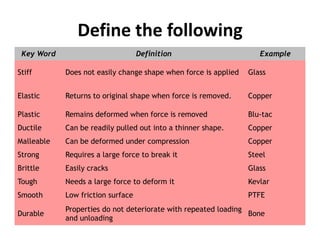
 Key Word                          Definition                       Example

Stiff       Does not easily change shape when force is applied   Glass


Elastic     Returns to original shape when force is removed.     Copper

Plastic     Remains deformed when force is removed               Blu-tac
Ductile     Can be readily pulled out into a thinner shape.      Copper
Malleable   Can be deformed under compression                    Copper
Strong      Requires a large force to break it                   Steel
Brittle     Easily cracks                                        Glass
Tough       Needs a large force to deform it                     Kevlar
Smooth      Low friction surface                                 PTFE
            Properties do not deteriorate with repeated loading
Durable                                                         Bone
            and unloading
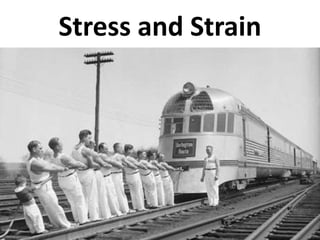
Stress and Strain
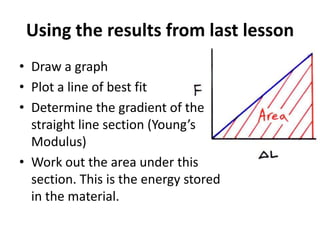
Using the results from last lesson
• Draw a graph
• Plot a line of best fit
• Determine the gradient of the
  straight line section (Young’s
  Modulus)
• Work out the area under this
  section. This is the energy stored
  in the material.
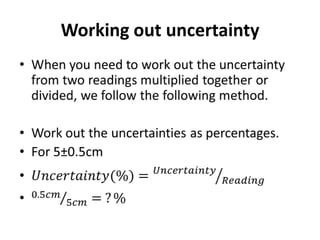
Working out uncertainty
Working out uncertainty 2
• Whether you are multiplying or dividing units, you will
  always add the uncertainties together.

• I measure the side of a cube to be 10±0.5cm

• What is its volume if all dimensions are the same?

• What is the uncertainty with that volume?

• Now place error bars on your first and last two plots on
  the graph. Assume mass has no uncertainties.
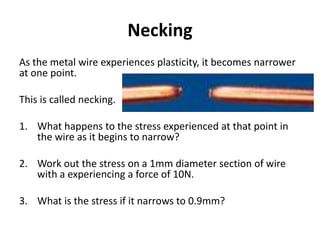
Necking
As the metal wire experiences plasticity, it becomes narrower
at one point.

This is called necking.

1. What happens to the stress experienced at that point in
   the wire as it begins to narrow?

2. Work out the stress on a 1mm diameter section of wire
   with a experiencing a force of 10N.

3. What is the stress if it narrows to 0.9mm?
Resistance
• Write a description of resistance in no more
  than 9 words
• What is the energy transfer for resistance?
  What type of energy does it convert, and into
  what?
• What is the equation that relates Voltage,
  Current and Resistance?
Resistance
• Three things determine the resistance of a
  wire:
1. Length (l) - The longer the wire the more
   difficult it is for current to flow
2. Area (A) – The wider the wire the easier it is
   for electrons to pass along it
3. Resistivity (ρ) – This is a property of the
   material
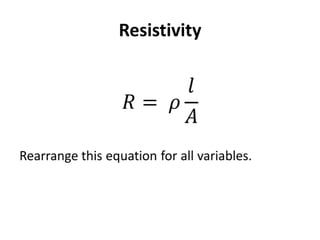
Resistivity

Young’s modulus 2

  • 1.
    What Material Propertiesare Useful • In a climbing rope? • In a carbon fibre bike fork? • In a bullet-proof vest?
  • 2.
    What Material Propertiesare Useful • In a climbing rope? Elasticity and strength • In a carbon fibre bike fork? Strength and stiffness • In a bullet-proof vest? Toughness and plasticity
  • 3.
    Define the following Key Word Definition Example Stiff Does not easily change shape when force is applied Glass Elastic Returns to original shape when force is removed. Copper Plastic Remains deformed when force is removed Blu-tac Ductile Can be readily pulled out into a thinner shape. Copper Malleable Can be deformed under compression Copper Strong Requires a large force to break it Steel Brittle Easily cracks Glass Tough Needs a large force to deform it Kevlar Smooth Low friction surface PTFE Properties do not deteriorate with repeated loading Durable Bone and unloading
  • 4.
  • 6.
    Using the resultsfrom last lesson • Draw a graph • Plot a line of best fit • Determine the gradient of the straight line section (Young’s Modulus) • Work out the area under this section. This is the energy stored in the material.
  • 7.
  • 8.
    Working out uncertainty2 • Whether you are multiplying or dividing units, you will always add the uncertainties together. • I measure the side of a cube to be 10±0.5cm • What is its volume if all dimensions are the same? • What is the uncertainty with that volume? • Now place error bars on your first and last two plots on the graph. Assume mass has no uncertainties.
  • 9.
    Necking As the metalwire experiences plasticity, it becomes narrower at one point. This is called necking. 1. What happens to the stress experienced at that point in the wire as it begins to narrow? 2. Work out the stress on a 1mm diameter section of wire with a experiencing a force of 10N. 3. What is the stress if it narrows to 0.9mm?
  • 10.
    Resistance • Write adescription of resistance in no more than 9 words • What is the energy transfer for resistance? What type of energy does it convert, and into what? • What is the equation that relates Voltage, Current and Resistance?
  • 11.
    Resistance • Three thingsdetermine the resistance of a wire: 1. Length (l) - The longer the wire the more difficult it is for current to flow 2. Area (A) – The wider the wire the easier it is for electrons to pass along it 3. Resistivity (ρ) – This is a property of the material
  • 12.