AN INTRODUCTION TO
AN INTRODUCTION TO
BONDING
BONDING
A guide for A level students
KNOCKHARDY PUBLISHING
2008
2008
SPECIFICATIONS
SPECIFICATIONS
INTRODUCTION
This Powerpoint show is one of several produced to help students understand
selected topics at AS and A2 level Chemistry. It is based on the requirements of
the AQA and OCR specifications but is suitable for other examination boards.
Individual students may use the material at home for revision purposes or it
may be used for classroom teaching if an interactive white board is available.
Accompanying notes on this, and the full range of AS and A2 topics, are
available from the KNOCKHARDY SCIENCE WEBSITE at...
www.knockhardy.org.uk/sci.htm
Navigation is achieved by...
either clicking on the grey arrows at the foot of each page
or using the left and right arrow keys on the keyboard
BONDING
BONDING
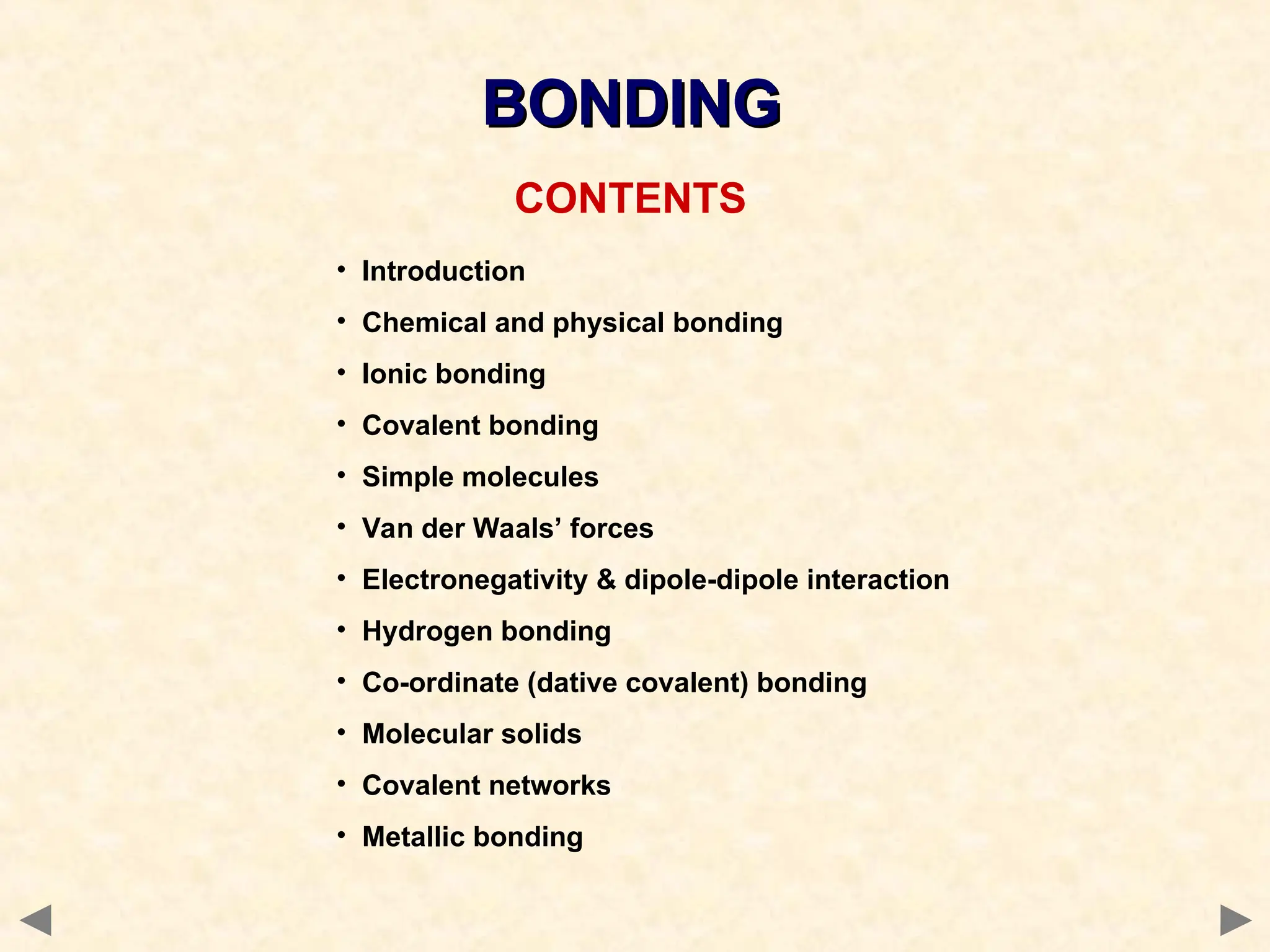
CONTENTS
• Introduction
• Chemical and physical bonding
• Ionic bonding
• Covalent bonding
• Simple molecules
• Van der Waals’ forces
• Electronegativity & dipole-dipole interaction
• Hydrogen bonding
• Co-ordinate (dative covalent) bonding
• Molecular solids
• Covalent networks
• Metallic bonding
BONDING
BONDING
STRUCTURE AND BONDING
The physical properties of a substance depend on its structure and type of
bonding present. Bonding determines the type of structure.
Basic theory
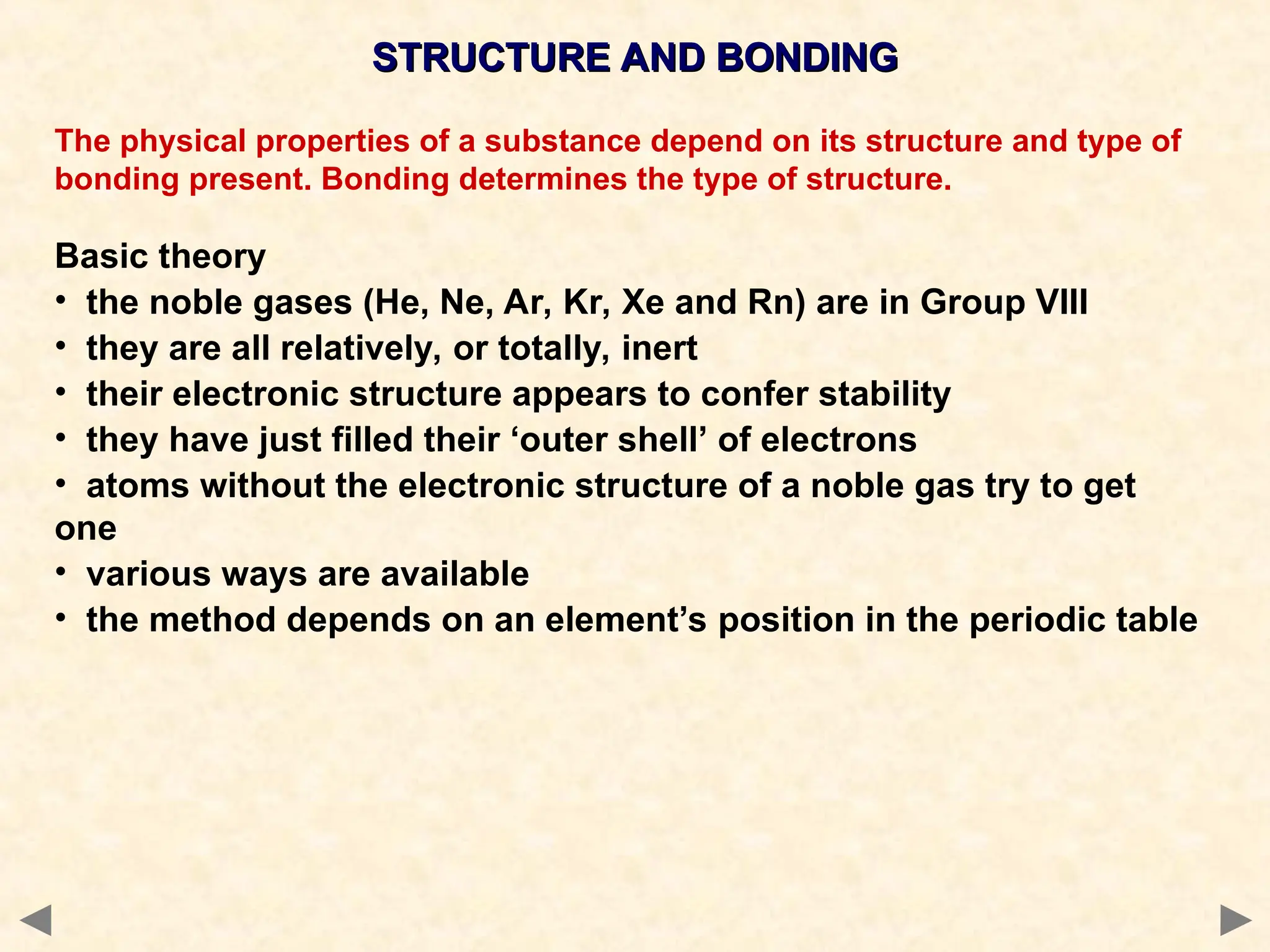
• the noble gases (He, Ne, Ar, Kr, Xe and Rn) are in Group VIII
• they are all relatively, or totally, inert
• their electronic structure appears to confer stability
• they have just filled their ‘outer shell’ of electrons
• atoms without the electronic structure of a noble gas try to get
one
• various ways are available
• the method depends on an element’s position in the periodic table
STRUCTURE AND BONDING
The physical properties of a substance depend on its structure and type
of bonding present. Bonding determines the type of structure.
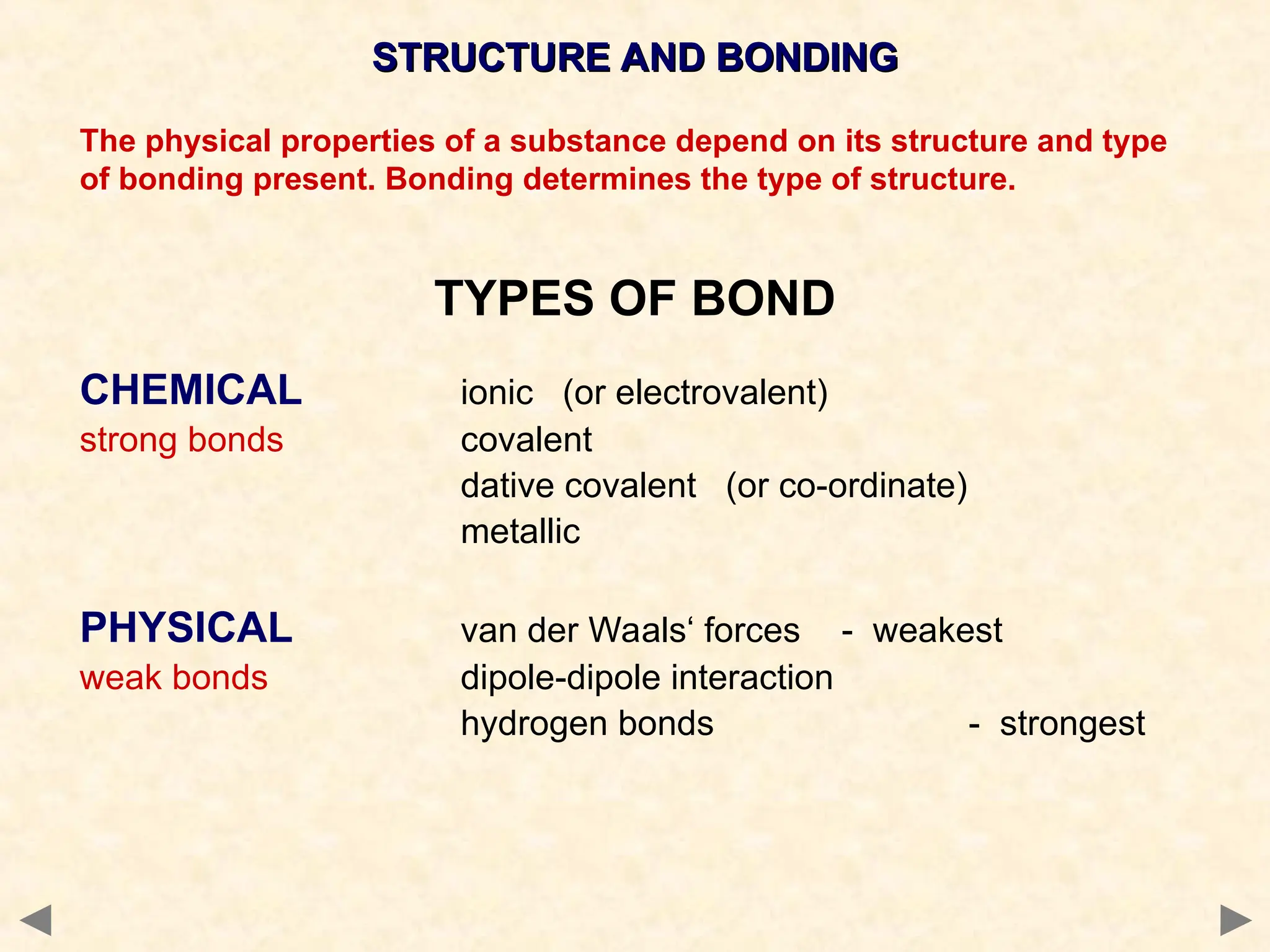
TYPES OF BOND
CHEMICAL ionic (or electrovalent)
strong bonds covalent
dative covalent (or co-ordinate)
metallic
PHYSICAL van der Waals‘ forces - weakest
weak bonds dipole-dipole interaction
hydrogen bonds - strongest
IONIC
IONIC
BONDING
BONDING
THE IONIC BOND
THE IONIC BOND
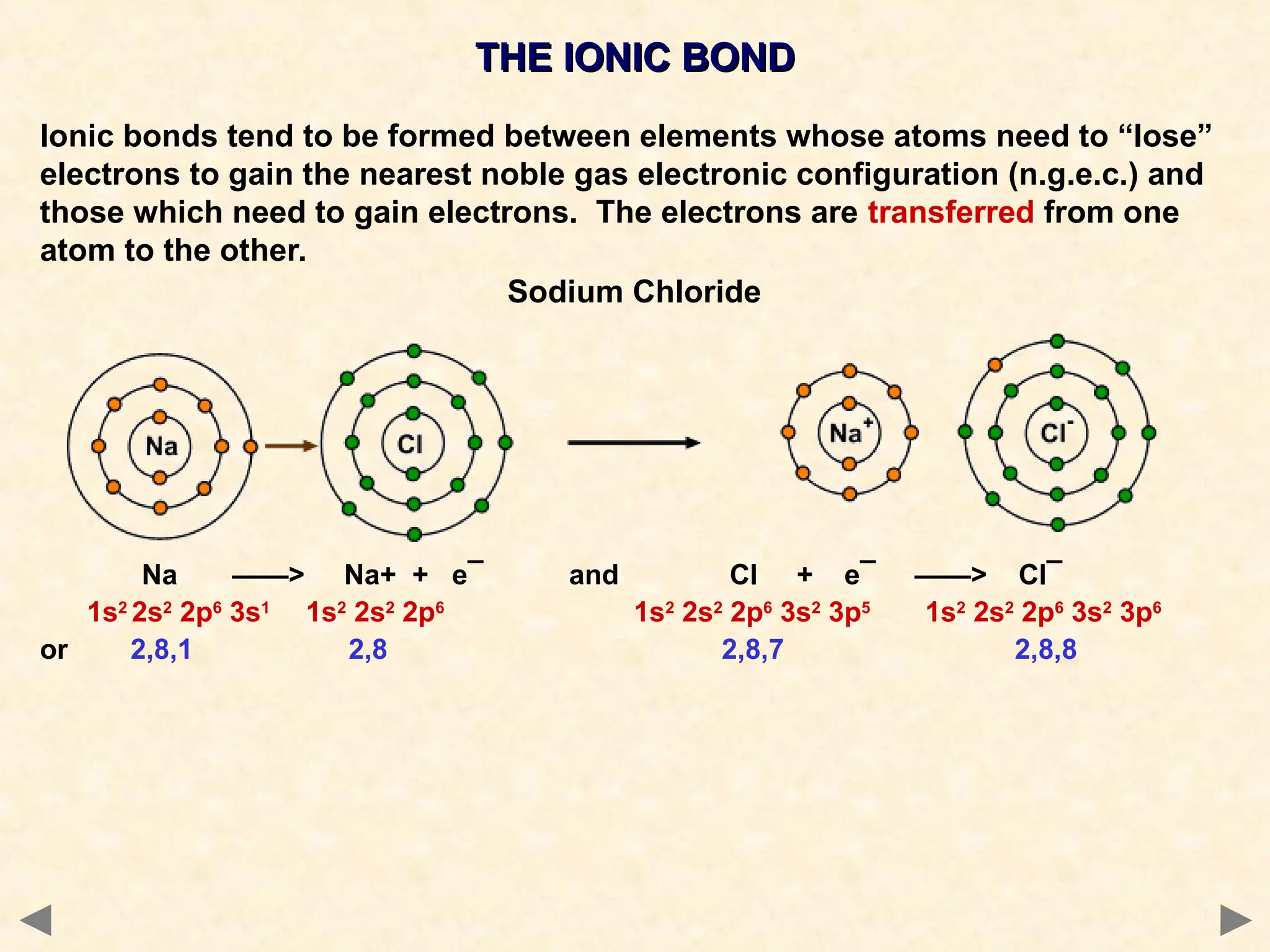
Ionic bonds tend to be formed between elements whose atoms need to “lose”
electrons to gain the nearest noble gas electronic configuration (n.g.e.c.) and
those which need to gain electrons. The electrons are transferred from one
atom to the other.
THE IONIC BOND
THE IONIC BOND
Ionic bonds tend to be formed between elements whose atoms need to “lose”
electrons to gain the nearest noble gas electronic configuration (n.g.e.c.) and
those which need to gain electrons. The electrons are transferred from one
atom to the other.
Sodium Chloride
Na ——> Na+ + e¯ and Cl + e¯ ——> Cl¯
1s2
2s2
2p6
3s1
1s2
2s2
2p6
1s2
2s2
2p6
3s2
3p5
1s2
2s2
2p6
3s2
3p6
or 2,8,1 2,8 2,8,7 2,8,8
THE IONIC BOND
THE IONIC BOND
Ionic bonds tend to be formed between elements whose atoms need to “lose”
electrons to gain the nearest noble gas electronic configuration (n.g.e.c.) and
those which need to gain electrons. The electrons are transferred from one
atom to the other.
Sodium Chloride
Na ——> Na+ + e¯ and Cl + e¯ ——> Cl¯
1s2
2s2
2p6
3s1
1s2
2s2
2p6
1s2
2s2
2p6
3s2
3p5
1s2
2s2
2p6
3s2
3p6
or 2,8,1 2,8 2,8,7 2,8,8
An electron is transferred from the 3s orbital of sodium to the 3p orbital of
chlorine; both species end up with the electronic configuration of the nearest
noble gas the resulting ions are held together in a crystal lattice by
electrostatic attraction.
ELECTRON
TRANSFER
Mg ——> Mg2+
+ 2e¯ and 2Cl + 2e¯ ——> 2 Cl¯
Mg
Cl
Cl
e¯
e¯
THE IONIC BOND
THE IONIC BOND
FORMATION OF MAGNESIUM CHLORIDE
Positive ions
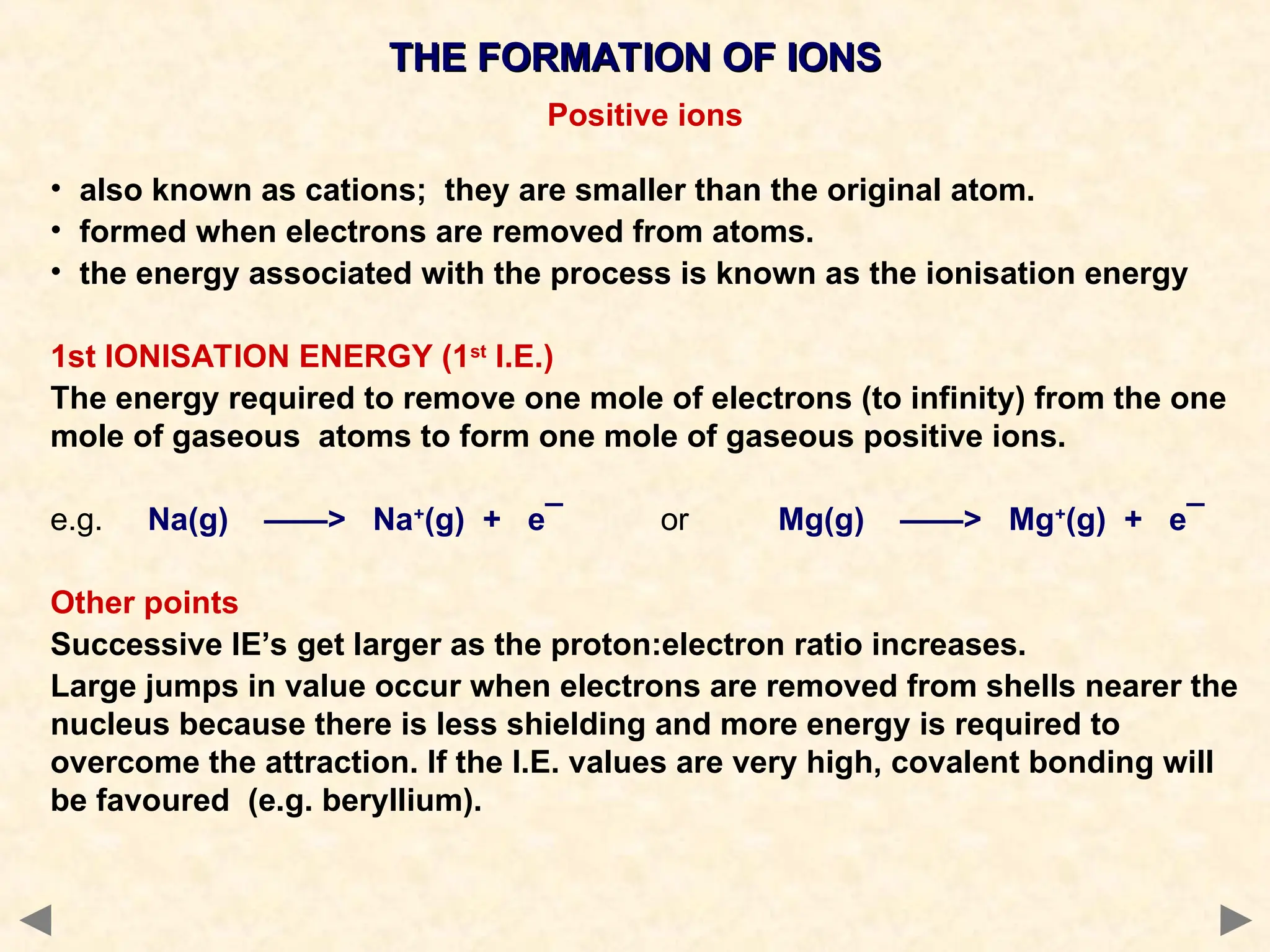
• also known as cations; they are smaller than the original atom.
• formed when electrons are removed from atoms.
• the energy associated with the process is known as the ionisation energy
1st IONISATION ENERGY (1st
I.E.)
The energy required to remove one mole of electrons (to infinity) from the one
mole of gaseous atoms to form one mole of gaseous positive ions.
e.g. Na(g) ——> Na+
(g) + e¯ or Mg(g) ——> Mg+
(g) + e¯
Other points
Successive IE’s get larger as the proton:electron ratio increases.
Large jumps in value occur when electrons are removed from shells nearer the
nucleus because there is less shielding and more energy is required to
overcome the attraction. If the I.E. values are very high, covalent bonding will
be favoured (e.g. beryllium).
THE FORMATION OF IONS
Negative ions
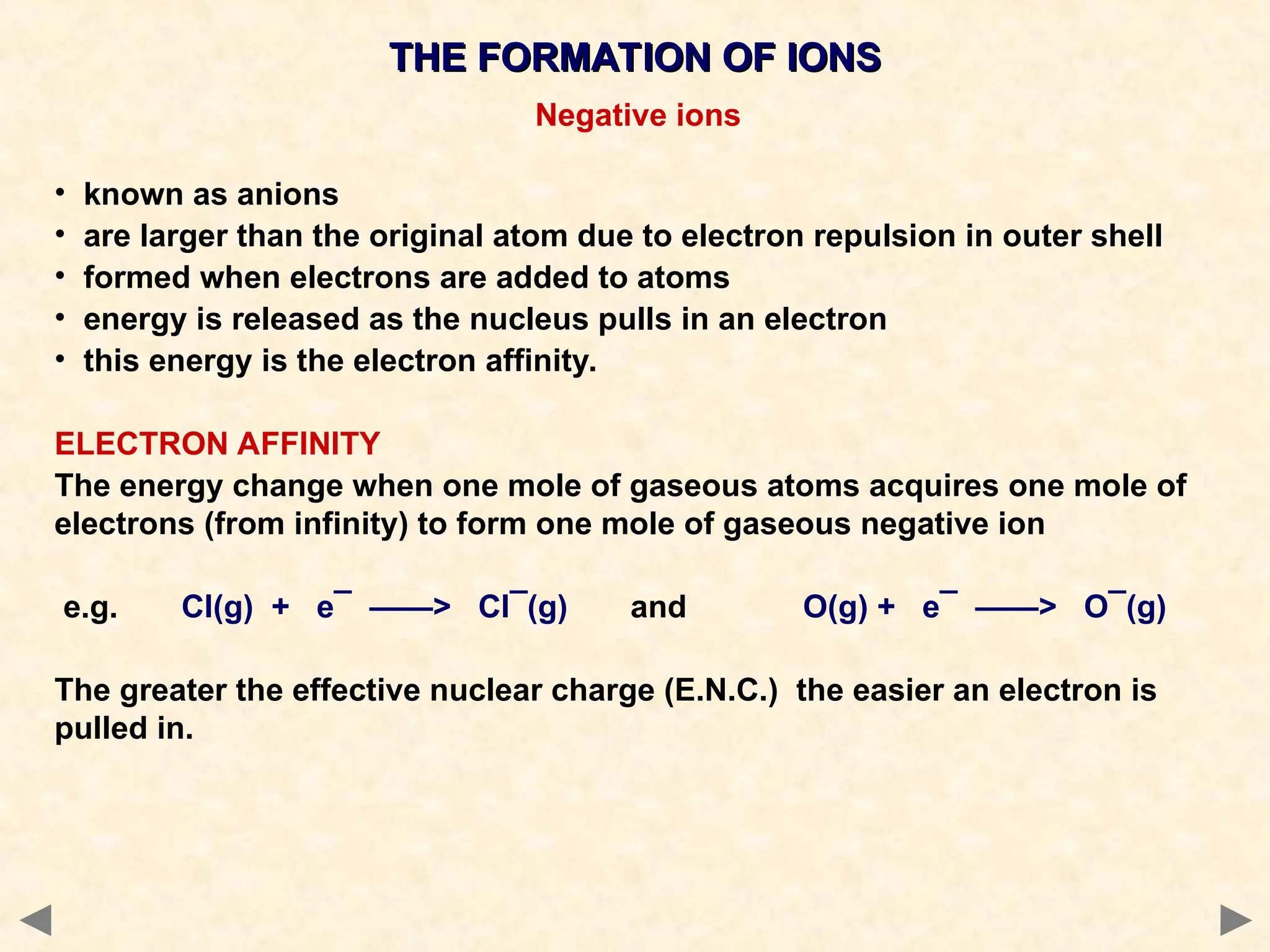
• known as anions
• are larger than the original atom due to electron repulsion in outer shell
• formed when electrons are added to atoms
• energy is released as the nucleus pulls in an electron
• this energy is the electron affinity.
ELECTRON AFFINITY
The energy change when one mole of gaseous atoms acquires one mole of
electrons (from infinity) to form one mole of gaseous negative ion
e.g. Cl(g) + e¯ ——> Cl¯(g) and O(g) + e¯ ——> O¯(g)
The greater the effective nuclear charge (E.N.C.) the easier an electron is
pulled in.
THE FORMATION OF IONS
IONIC
BONDING
Animations
SODIUM CHLORIDE
SODIUM CHLORIDE
Cl
SODIUM ATOM
2,8,1
Na
CHLORINE ATOM
2,8,7
SODIUM CHLORIDE
SODIUM CHLORIDE
Cl
SODIUM ION
2,8
Na
CHLORIDE ION
2,8,8
both species now have ‘full’ outer shells; ie they
have the electronic configuration of a noble gas
+
SODIUM CHLORIDE
SODIUM CHLORIDE
Cl
SODIUM ION
2,8
Na
CHLORIDE ION
2,8,8
Na Na+
+ e¯
2,8,1 2,8
ELECTRON TRANSFERRED
Cl + e¯ Cl¯
2,8,7 2,8,8
+
MAGNESIUM CHLORIDE
MAGNESIUM CHLORIDE
Cl
MAGNESIUM ATOM
2,8,2
Mg
CHLORINE ATOMS
2,8,7
Cl
MAGNESIUM CHLORIDE
MAGNESIUM CHLORIDE
Cl
MAGNESIUM ION
2,8
Mg
CHLORIDE IONS
2,8,8
Cl
2+
GIANT IONIC CRYSTAL LATTICE
Cl-
Chloride ion
Na+
Sodium ion
Oppositely charged ions held in a regular
3-dimensional lattice by electrostatic attraction
The arrangement of ions in a crystal lattice depends on the relative sizes of the ions
The Na+
ion is small enough relative to a Cl¯ ion to fit in the
spaces so that both ions occur in every plane.
GIANT IONIC CRYSTAL LATTICE
Each Na+
is surrounded by 6 Cl¯ (co-ordination number = 6)
and each Cl¯ is surrounded by 6 Na+
(co-ordination number = 6).
Oppositely charged ions held in a regular
3-dimensional lattice by electrostatic attraction
The arrangement of ions in a crystal lattice depends on the relative sizes of the ions
GIANT IONIC CRYSTAL LATTICE
Each Na+
is surrounded by 6 Cl¯ (co-ordination number = 6)
and each Cl¯ is surrounded by 6 Na+
(co-ordination number = 6).
Oppositely charged ions held in a regular
3-dimensional lattice by electrostatic attraction
The arrangement of ions in a crystal lattice depends on the relative sizes of the ions
Physical properties of ionic compounds
Melting point
very high A large amount of energy must be put in to overcome the
strong electrostatic attractions and separate the ions.
Strength
Very brittle Any dislocation leads to the layers moving and similar
ions being adjacent. The repulsion splits the crystal.
Electrical don’t conduct when solid - ions held strongly in the lattice
conduct when molten or in aqueous solution - the ions
become mobile and conduction takes place.
Solubility Insoluble in non-polar solvents but soluble in water
Water is a polar solvent and stabilises the separated ions.
Much energy is needed to overcome the electrostatic attraction and separate
the ions stability attained by being surrounded by polar water molecules
compensates for this
IONIC BONDING
IONIC BONDING
BRITTLE IONIC LATTICES
+ +
+ +
+ +
+ +
- -
- -
- -
- -
+ +
+ +
IF YOU MOVE A LAYER OF IONS, YOU GET IONS OF THE SAME
CHARGE NEXT TO EACH OTHER. THE LAYERS REPEL EACH
OTHER AND THE CRYSTAL BREAKS UP.
IONIC COMPOUNDS - ELECTRICAL PROPERTIES
SOLID IONIC
COMPOUNDS DO
NOT CONDUCT
ELECTRICITY
Na+
Cl- Na+
Cl-
Na+
Cl-
Na+
Cl-
Na+
Cl- Na+
Cl-
IONS ARE HELD STRONGLY TOGETHER
+ IONS CAN’T MOVE TO THE CATHODE
- IONS CAN’T MOVE TO THE ANODE
MOLTEN IONIC
COMPOUNDS DO
CONDUCT
ELECTRICITY
Na+ Cl-
Na+
Cl-
Na+
Cl-
Na+
Cl-
IONS HAVE MORE FREEDOM IN A
LIQUID SO CAN MOVE TO THE
ELECTRODES
SOLUTIONS OF IONIC
COMPOUNDS IN
WATER DO
CONDUCT
ELECTRICITY
DISSOLVING AN IONIC COMPOUND
IN WATER BREAKS UP THE
STRUCTURE SO IONS ARE FREE TO
MOVE TO THE ELECTRODES
COVALENT
COVALENT
BONDING
BONDING
Definition consists of a shared pair of electrons with one electron being
supplied by each atom either side of the bond.
compare this with dative covalent bonding
atoms are held together
because their nuclei which
have an overall positive charge
are attracted to the shared electrons
COVALENT BONDING
COVALENT BONDING
+ +
Definition consists of a shared pair of electrons with one electron being
supplied by each atom either side of the bond.
compare this with dative covalent bonding
atoms are held together
because their nuclei which
have an overall positive charge
are attracted to the shared electrons
Formation between atoms of the same element N2, O2, diamond,
graphite
between atoms of different elements CO2, SO2
on the RHS of the table;
when one of the elements is in the CCl4, SiCl4
middle of the table;
with head-of-the-group elements BeCl2
with high ionisation energies;
COVALENT BONDING
COVALENT BONDING
+ +
• atoms share electrons to get the nearest noble gas electronic configuration
• some don’t achieve an “octet” as they haven’t got enough electrons
eg Al in AlCl3
• others share only some - if they share all they will exceed their “octet”
eg NH3 and H2O
• atoms of elements in the 3rd period onwards can exceed their “octet” if
they wish as they are not restricted to eight electrons in their “outer shell”
eg PCl5 and SF6
COVALENT BONDING
COVALENT BONDING
Orbital theory
Covalent bonds are formed when orbitals, each containing one electron,
overlap. This forms a region in space where an electron pair can be found;
new molecular orbitals are formed.
SIMPLE MOLECULES
SIMPLE MOLECULES
The greater the overlap the stronger the bond.
orbital
containing 1
electron
orbital
containing 1
electron
overlap of orbitals provides
a region in space which can
contain a pair of electrons
HYDROGEN
HYDROGEN
H H
Another hydrogen atom
also needs one electron to
complete its outer shell
Hydrogen atom needs
one electron to
complete its outer shell
atoms share a pair of electrons to
form a single covalent bond
A hydrogen MOLECULE is formed
H H
H
H
WAYS TO REPRESENT THE MOLECULE
PRESSING THE SPACE BAR WILL ACTIVATE EACH STEP OF THE ANIMATION
HYDROGEN CHLORIDE
HYDROGEN CHLORIDE
Cl H
Hydrogen atom also
needs one electron
to complete its outer
shell
Chlorine atom
needs one electron
to complete its
outer shell
atoms share a pair of
electrons to form a
single covalent bond
H Cl
H Cl
WAYS TO REPRESENT THE MOLECULE
PRESSING THE SPACE BAR WILL ACTIVATE EACH STEP OF THE ANIMATION
METHANE
METHANE
C
Each hydrogen
atom needs 1
electron to
complete its
outer shell
A carbon atom needs 4
electrons to complete
its outer shell
Carbon shares all 4 of
its electrons to form 4
single covalent bonds
H
H
H
H
H C H
H
H
H C H
H
H
WAYS TO REPRESENT
THE MOLECULE
PRESSING THE SPACE BAR WILL ACTIVATE EACH STEP OF THE ANIMATION
AMMONIA
AMMONIA
N
Each hydrogen
atom needs
one electron to
complete its
outer shell
Nitrogen atom needs 3 electrons
to complete its outer shell
Nitrogen can only share 3 of its
5 electrons otherwise it will
exceed the maximum of 8
A LONE PAIR REMAINS
A LONE PAIR REMAINS
H
H
H
H N H
H
H N H
H
WAYS TO REPRESENT
THE MOLECULE
PRESSING THE SPACE BAR WILL ACTIVATE EACH STEP OF THE ANIMATION
WATER
WATER
O
Each hydrogen
atom needs
one electron to
complete its
outer shell
Oxygen atom needs 2 electrons
to complete its outer shell
Oxygen can only share 2 of its 6
electrons otherwise it will
exceed the maximum of 8
2 LONE PAIRS REMAIN
2 LONE PAIRS REMAIN
H
H
H O
H
H O
H
WAYS TO REPRESENT
THE MOLECULE
PRESSING THE SPACE BAR WILL ACTIVATE EACH STEP OF THE ANIMATION
HYDROGEN
HYDROGEN
H
H H
H H H
H H
both atoms need one electron
to complete their outer shell
atoms share a pair of electrons
to form a single covalent bond
DOT AND
CROSS
DIAGRAM
METHANE
METHANE
C
H H
H H
C
H
H
H
H
H C H
H
H
H C H
H
H
each atom needs one
electron to complete
its outer shell
atom needs four
electrons to complete
its outer shell
Carbon shares all 4 of its
electrons to form 4 single
covalent bonds
DOT AND
CROSS
DIAGRAM
AMMONIA
AMMONIA
N
H H
H
N
H
H H
H N H
H
H N H
H
each atom needs one
electron to complete
its outer shell
atom needs three
electrons to complete
its outer shell
Nitrogen can only share 3 of
its 5 electrons otherwise it will
exceed the maximum of 8
A LONE PAIR REMAINS
A LONE PAIR REMAINS
WATER
WATER
O
H
H
O
H
H
each atom needs one
electron to complete
its outer shell
atom needs two
electrons to complete
its outer shell
Oxygen can only share 2 of its
6 electrons otherwise it will
exceed the maximum of 8
TWO LONE PAIRS REMAIN
H O
H
H O
H
OXYGEN
OXYGEN
O
each atom needs two electrons
to complete its outer shell
each oxygen shares 2 of its
electrons to form a
DOUBLE COVALENT BOND
O O O
O O
Bonding Atoms are joined together within the molecule by covalent bonds.
Electrical Don’t conduct electricity as they have no mobile ions or electrons
Solubility Tend to be more soluble in organic solvents than in water;
some are hydrolysed
Boiling point Low - intermolecular forces (van der Waals’ forces) are weak;
they increase as molecules get a larger surface area
e.g. CH4 -161°C C2H6 - 88°C C3H8 -42°C
as the intermolecular forces are weak, little energy is required to
to separate molecules from each other so boiling points are low
some boiling points are higher than expected for a given mass
because you can get additional forces of attraction
SIMPLE COVALENT MOLECULES
Although the bonding within molecules is strong, that between molecules is weak.
Molecules and monatomic noble gases are subject to weak attractive forces.
Instantaneous dipole-induced dipole forces
Because electrons move quickly in orbitals, their position is
constantly changing; at any given instant they could be anywhere
in an atom. The possibility will exist that one side will have more
electrons than the other. This will give rise to a dipole...
VAN DER WAALS’ FORCES
INSTANTANEOUS DIPOLE-INDUCED DIPOLE FORCES
Although the bonding within molecules is strong, that between molecules is weak.
Molecules and monatomic noble gases are subject to weak attractive forces.
Instantaneous dipole-induced dipole forces
Because electrons move quickly in orbitals, their position is
constantly changing; at any given instant they could be anywhere
in an atom. The possibility will exist that one side will have more
electrons than the other. This will give rise to a dipole...
The dipole on one atom induces dipoles on nearby atoms
Atoms are now attracted to each other by a weak forces
The greater the number of electrons, the stronger the attraction
and the greater the energy needed to separate the particles.
VAN DER WAALS’ FORCES
INSTANTANEOUS DIPOLE-INDUCED DIPOLE FORCES
Although the bonding within molecules is strong, between molecules it is
weak. Molecules and monatomic gases are subject to weak attractive forces.
Instantaneous dipole-induced dipole forces
Electrons move quickly in orbitals, so their position is
constantly changing; at any given time they could be
Anywhere in an atom. The possibility exists that one side has
More electrons than the other. This will give rise to a dipole...
The dipole on one atom induces dipoles on others
Atoms are now attracted to each other by a weak forces
The greater the number of electrons, the stronger the attraction
and the greater the energy needed to separate the particles.
NOBLE GASES ALKANES
Electrons B pt. Electrons B pt.
He 2 -269°C CH4 10 -161°C
Ne 10 -246°C C2H6 18 - 88°C
Ar 18 -186°C C3H8 26 - 42°C
Kr 36 -152°C
VAN DER WAALS’ FORCES
INSTANTANEOUS DIPOLE-INDUCED DIPOLE FORCES
‘The ability of an atom to attract the electron pair in a covalent bond to itself’
Non-polar bond similar atoms have the same electronegativity
they will both pull on the electrons to the same extent
the electrons will be equally shared
Polar bond different atoms have different electronegativities
one will pull the electron pair closer to its end
it will be slightly more negative than average, d-
the other will be slightly less negative, or more positive, d+
a dipole is formed and the bond is said to be polar
greater electronegativity difference = greater polarity
Pauling Scale a scale for measuring electronegativity
ELECTRONEGATIVITY
ELECTRONEGATIVITY
‘The ability of an atom to attract the electron pair in a covalent bond to itself’
Pauling Scale a scale for measuring electronegativity
values increase across periods
values decrease down groups
fluorine has the highest value
H
2.1
Li Be B C N O F
1.0 1.5 2.0 2.5 3.0 3.5 4.0
Na Mg Al Si P S Cl
0.9 1.2 1.5 1.8 2.1 2.5 3.0
K Br
0.8 2.8
ELECTRONEGATIVITY
ELECTRONEGATIVITY
INCREASE
INCREASE
Occurrence occurs between molecules containing polar bonds
acts in addition to the basic van der Waals’ forces
the extra attraction between dipoles means that
more energy must be put in to separate molecules
get higher boiling points than expected for a given mass
DIPOLE-DIPOLE INTERACTION
Mr °C
CH4 16 -161
SiH4 32 -117
GeH4 77 -90
SnH4 123 -50
NH3 17 -33
PH3 34 -90
AsH3 78 -55
SbH3 125 -17
Mr °C
H2O 18 +100
H2S 34 -61
H2Se 81 -40
H2Te 130 -2
HF 20 +20
HCl 36.5 -85
HBr 81 -69
HI 128 -35
Boiling points
of hydrides
Occurrence not all molecules containing polar bonds are polar overall
if bond dipoles ‘cancel each other’ the molecule isn’t polar
if there is a ‘net dipole’ the molecule will be polar
HYDROGEN CHLORIDE TETRACHLOROMETHANE WATER
POLAR MOLECULES
POLAR MOLECULES
NET DIPOLE - POLAR NON-POLAR NET DIPOLE - POLAR
Evidence place a liquid in a burette
allow it to run out
place a charged rod alongside the stream of liquid
polar molecules are attracted by electrostatic attraction
non-polar molecules will be unaffected
POLAR MOLECULES
POLAR MOLECULES
NET DIPOLE - POLAR NON-POLAR
BOILING POINTS OF HYDRIDES
Mr °C
CH4 16 -161
SiH4 32 -117
GeH4 77 -90
SnH4 123 -50
NH3 17 -33
PH3 34 -90
AsH3 78 -55
SbH3 125 -17
Mr °C
H2O 18 +100
H2S 34 -61
H2Se 81 -40
H2Te 130 -2
HF 20 +20
HCl 36.5 -85
HBr 81 -69
HI 128 -35
GROUP
IV
GROUP
V
GROUP
VI
GROUP
VII
The values of certain hydrides are not
typical of the trend you would expect
BOILING POINTS OF HYDRIDES
Mr
BOILING
POINT
/
C°
100
0
-160
140
50 100
The boiling points of the hydrides
increase with molecular mass. CH4
has the lowest boiling point as it
is the smallest molecule.
CH4
SiH4
GeH4
PbH4
Larger molecules have greater
intermolecular forces and
therefore higher boiling points
GROUP IV
BOILING POINTS OF HYDRIDES
Mr
BOILING
POINT
/
C°
100
0
-160
140
50 100
NH3 has a higher boiling point
than expected for its molecular
mass. There must be an
additional intermolecular force.
NH3
GROUP V
BOILING POINTS OF HYDRIDES
Mr
BOILING
POINT
/
C°
100
0
-160
140
50 100
H2O has a very much higher
boiling point for its molecular
mass. There must be an
additional intermolecular force.
H2O
GROUP VI
BOILING POINTS OF HYDRIDES
Mr
BOILING
POINT
/
C°
100
0
-160
140
50 100
HF has a higher boiling point
than expected for its molecular
mass. There must be an
additional intermolecular force.
HF
GROUP VII
BOILING POINTS OF HYDRIDES
GROUP IV
GROUP V
GROUP VI
GROUP VII
Mr
BOILING
POINT
/
C°
100
0
-160
140
50 100
H2O
HF
NH3
The higher than expected boiling
points of NH3, H2O and HF are due to
intermolecular HYDROGEN BONDING
BOILING POINTS OF HYDRIDES
Mr
BOILING
POINT
/
C°
100
0
-160
140
50 100
GROUP IV
GROUP V
GROUP VI
GROUP VII
• an extension of dipole-dipole interaction
• gives rise to even higher boiling points
• bonds between H and the three most electronegative elements,
F, O and N are extremely polar
• because of the small sizes of H, F, N and O the partial charges are
concentrated in a small volume thus leading to a high charge density
• makes the intermolecular attractions greater and leads
to even higher boiling points
HYDROGEN BONDING
HYDROGEN BONDING
HYDROGEN BONDING -
HYDROGEN BONDING - ICE
ICE
each water molecule is hydrogen-bonded to 4
others in a tetrahedral formation
ice has a “diamond-like” structure
volume is larger than the liquid making it
when ice melts, the structure collapses
slightly and the molecules come closer; they
then move a little further apart as they get
more energy as they warm up
this is why…
a) water has a maximum density at 4°C
b) ice floats.
hydrogen bonding
lone pair
HYDROGEN BONDING -
HYDROGEN BONDING - ICE
ICE
hydrogen
bonding
HYDROGEN BONDING -
HYDROGEN BONDING - HF
HF
Hydrogen fluoride has a much higher boiling point than one
would expect for a molecule with a relative molecular mass of 20
Fluorine has the highest electronegativity of all and is a small
atom so the bonding with hydrogen is extremely polar
F
H
F
H
H
F
H
F
+
¯
+
¯
+
¯
+
¯
hydrogen bonding
A dative covalent bond differs from covalent bond only in its formation
Both electrons of the shared pair are provided by one species (donor) and it
shares the electrons with the acceptor
Donor species will have lone pairs in their outer shells
Acceptor species will be short of their “octet” or maximum.
Lewis base a lone pair donor
Lewis acid a lone pair acceptor
DATIVE COVALENT (CO-ORDINATE) BONDING
Ammonium ion, NH4
+
The lone pair on N is used to share
with the hydrogen ion which needs
two electrons to fill its outer shell.
The N now has a +ive charge as
- it is now sharing rather than
owning two electrons.
Boron trifluoride-ammonia NH3BF3
Boron has an incomplete shell in BF3 and can accept a share of a pair of
electrons donated by ammonia. The B becomes -ive as it is now shares a
pair of electrons (i.e. it is up one electron) it didn’t have before.
MOLECULAR
MOLECULAR
SOLIDS
SOLIDS
IODINE
At room temperature and pressure, iodine is a greyish solid. However it
doesn’t need to be warmed much in order to produce a purple vapour.
This is because iodine is composed of diatomic molecules (I2) which
exist in an ordered molecular crystal in the solid state. Each molecule is
independent of the others, only being attracted by van der Waals’ forces.
Therefore, little energy is required to separate the iodine molecules.
MOLECULAR SOLIDS
MOLECULAR SOLIDS
COVALENT NETWORKS
COVALENT NETWORKS
GIANT MOLECULES
GIANT MOLECULES
MACROMOLECULES
MACROMOLECULES
They all mean the same!
DIAMOND, GRAPHITE and SILICA
Many atoms joined together in a regular array
by a large number of covalent bonds
GENERAL PROPERTIES
MELTING POINT Very high
structure is made up of a large number of covalent bonds,
all of which need to be broken if atoms are to be separated
ELECTRICAL Don’t conduct electricity - have no mobile ions or electrons
but... Graphite conducts electricity
STRENGTH Hard - exists in a rigid tetrahedral structure
Diamond and silica (SiO2)... but
Graphite is soft
GIANT (MACRO) MOLECULES
DIAMOND
MELTING POINT VERY HIGH
many covalent bonds must be broken to separate atoms
STRENGTH STRONG
each carbon is joined to four others in a rigid structure
Coordination Number = 4
ELECTRICAL NON-CONDUCTOR
No free electrons - all 4 carbon electrons used for bonding
GIANT (MACRO) MOLECULES
GRAPHITE
MELTING POINT VERY HIGH
many covalent bonds must be broken to separate atoms
STRENGTH SOFT
each carbon is joined to three others in a layered structure
Coordination Number = 3
layers are held by weak van der Waals’ forces
can slide over each other
ELECTRICAL CONDUCTOR
Only three carbon electrons are used for bonding which
leaves the fourth to move freely along layers
layers can slide over each other
used as a lubricant and in pencils
GIANT (MACRO) MOLECULES
DIAMOND
DIAMOND GRAPHITE
GRAPHITE
GIANT (MACRO) MOLECULES
SILICA
MELTING POINT VERY HIGH
many covalent bonds must be broken to separate atoms
STRENGTH STRONG
each silicon atom is joined to four oxygens - C No. = 4
each oxygen atom are joined to two silicons - C No = 2
ELECTRICAL NON-CONDUCTOR - no mobile electrons
METALLIC
METALLIC
BONDING
BONDING
METALLIC BONDING
METALLIC BONDING
Involves a lattice of positive ions surrounded by delocalised electrons
Metal atoms achieve stability by “off-loading” electrons to attain the
electronic structure of the nearest noble gas. These electrons join up to
form a mobile cloud which prevents the newly-formed positive ions from
flying apart due to repulsion between similar charges.
METALLIC BONDING
METALLIC BONDING
Involves a lattice of positive ions surrounded by delocalised electrons
Metal atoms achieve stability by “off-loading” electrons to attain the
electronic structure of the nearest noble gas. These electrons join up to
form a mobile cloud which prevents the newly-formed positive ions from
flying apart due to repulsion between similar charges.
Atoms arrange in regular close
packed 3-dimensional crystal lattices.
METALLIC BONDING
METALLIC BONDING
Involves a lattice of positive ions surrounded by delocalised electrons
Metal atoms achieve stability by “off-loading” electrons to attain the
electronic structure of the nearest noble gas. These electrons join up to
form a mobile cloud which prevents the newly-formed positive ions from
flying apart due to repulsion between similar charges.
Atoms arrange in regular close
packed 3-dimensional crystal lattices.
The outer shell electrons of each atom
leave to join a mobile “cloud” or “sea” of
electrons which can roam throughout the
metal. The electron cloud binds the newly-
formed positive ions together.
METALLIC BOND STRENGTH
Depends on the number of outer electrons donated
to the cloud and the size of the metal atom/ion.
The strength of the metallic bonding in
sodium is relatively weak because each
atom donates one electron to the cloud.
Na
METALLIC BOND STRENGTH
Depends on the number of outer electrons donated
to the cloud and the size of the metal atom/ion.
The strength of the metallic bonding in
sodium is relatively weak because each
atom donates one electron to the cloud.
The metallic bonding in potassium is
weaker than in sodium because the
resulting ion is larger and the electron
cloud has a bigger volume to cover so
is less effective at holding the ions
together.
Na
K
METALLIC BOND STRENGTH
Depends on the number of outer electrons donated
to the cloud and the size of the metal atom/ion.
The strength of the metallic bonding in
sodium is relatively weak because each
atom donates one electron to the cloud.
The metallic bonding in potassium is
weaker than in sodium because the
resulting ion is larger and the electron
cloud has a bigger volume to cover so
is less effective at holding the ions
together.
The metallic bonding in magnesium is
stronger than in sodium because each
atom has donated two electrons to the
cloud. The greater the electron density
holds the ions together more strongly.
Na
Mg
K
METALLIC PROPERTIES
METALLIC PROPERTIES
MOBILE ELECTRON CLOUD ALLOWS THE CONDUCTION OF ELECTRICITY
For a substance to conduct electricity it must have mobile ions or electrons.
Because the ELECTRON CLOUD IS MOBILE, electrons are free to move
throughout its structure. Electrons attracted to the positive end are replaced
by those entering from the negative end.
Metals are excellent conductors of electricity
MALLEABLE CAN BE HAMMERED INTO SHEETS
DUCTILE CAN BE DRAWN INTO RODS AND WIRES
As the metal is beaten into another shape the delocalised
electron cloud continues to bind the “ions” together.
Some metals, such as gold, can be hammered into sheets thin
enough to be translucent.
METALLIC PROPERTIES
METALLIC PROPERTIES
Metals can have their shapes changed relatively easily
HIGH MELTING POINTS
Melting point is a measure of how easy it is to separate individual particles.
In metals it is a measure of how strong the electron cloud holds the + ions.
The ease of separation of ions depends on the...
ELECTRON DENSITY OF THE CLOUD
IONIC / ATOMIC SIZE
PERIODS Na (2,8,1) < Mg (2,8,2) < Al (2,8,3)
m.pt 98°C 650°C 659°C
b.pt 890°C 1110°C 2470°C
METALLIC PROPERTIES
METALLIC PROPERTIES
Na+
Al3+
Mg2+
MELTING POINT INCREASES ACROSS THE PERIOD
THE ELECTRON CLOUD DENSITY INCREASES DUE TO THE
GREATER NUMBER OF ELECTRONS DONATED PER ATOM. AS A
RESULT THE IONS ARE HELD MORE STRONGLY.
HIGH MELTING POINTS
Melting point is a measure of how easy it is to separate individual particles.
In metals it is a measure of how strong the electron cloud holds the + ions.
The ease of separation of ions depends on the...
ELECTRON DENSITY OF THE CLOUD
IONIC / ATOMIC SIZE
GROUPS Li (2,1) < Na (2,8,1) < K (2,8,8,1)
m.pt 181°C 98°C 63°C
b.pt 1313°C 890°C 774°C
METALLIC PROPERTIES
METALLIC PROPERTIES
MELTING POINT INCREASES DOWN A GROUP
IONIC RADIUS INCREASES DOWN THE GROUP. AS THE IONS GET
BIGGER THE ELECTRON CLOUD BECOMES LESS EFFECTIVE
HOLDING THEM TOGETHER SO THEY ARE EASIER TO SEPARATE.
Na+
K+
Li+
REVISION CHECK
REVISION CHECK
What should you be able to do?
Recall the different types of physical and chemical bonding
Understand how ionic, covalent, dative covalent and metallic bonding arise
Recall the different forms of covalent structures
Understand how the physical properties depend on structure and bonding
Understand how different types of physical bond have different strengths
Recall and explain the variation in the boiling points of hydrides
Balance ionic equations
Construct diagrams to represent covalent bonding
CAN YOU DO ALL OF THESE?
CAN YOU DO ALL OF THESE? YES
YES NO
NO
You need to go over the
relevant topic(s) again
Click on the button to
return to the menu
return to the menu
WELL DONE!
WELL DONE!
Try some past paper questions
© 2008 JONATHAN HOPTON & KNOCKHARDY PUBLISHING
AN INTRODUCTION TO
AN INTRODUCTION TO
BONDING
BONDING
THE END
THE END

Chemical Bonding (A level Chemistry).PPT

  • 1.
    AN INTRODUCTION TO ANINTRODUCTION TO BONDING BONDING A guide for A level students A guide for A level students KNOCKHARDY PUBLISHING KNOCKHARDY PUBLISHING 2008 2008 SPECIFICATIONS SPECIFICATIONS
  • 2.
    INTRODUCTION This Powerpoint showis one of several produced to help students understand selected topics at AS and A2 level Chemistry. It is based on the requirements of the AQA and OCR specifications but is suitable for other examination boards. Individual students may use the material at home for revision purposes or it may be used for classroom teaching if an interactive white board is available. Accompanying notes on this, and the full range of AS and A2 topics, are available from the KNOCKHARDY SCIENCE WEBSITE at... www.knockhardy.org.uk/sci.htm Navigation is achieved by... either clicking on the grey arrows at the foot of each page or using the left and right arrow keys on the keyboard BONDING BONDING
  • 3.
    CONTENTS • Introduction • Chemicaland physical bonding • Ionic bonding • Covalent bonding • Simple molecules • Van der Waals’ forces • Electronegativity & dipole-dipole interaction • Hydrogen bonding • Co-ordinate (dative covalent) bonding • Molecular solids • Covalent networks • Metallic bonding BONDING BONDING
  • 4.
    STRUCTURE AND BONDING STRUCTUREAND BONDING The physical properties of a substance depend on its structure and type of bonding present. Bonding determines the type of structure. Basic theory • the noble gases (He, Ne, Ar, Kr, Xe and Rn) are in Group VIII • they are all relatively, or totally, inert • their electronic structure appears to confer stability • they have just filled their ‘outer shell’ of electrons • atoms without the electronic structure of a noble gas try to get one • various ways are available • the method depends on an element’s position in the periodic table
  • 5.
    STRUCTURE AND BONDING STRUCTUREAND BONDING The physical properties of a substance depend on its structure and type of bonding present. Bonding determines the type of structure. TYPES OF BOND CHEMICAL ionic (or electrovalent) strong bonds covalent dative covalent (or co-ordinate) metallic PHYSICAL van der Waals‘ forces - weakest weak bonds dipole-dipole interaction hydrogen bonds - strongest
  • 6.
  • 7.
    THE IONIC BOND THEIONIC BOND Ionic bonds tend to be formed between elements whose atoms need to “lose” electrons to gain the nearest noble gas electronic configuration (n.g.e.c.) and those which need to gain electrons. The electrons are transferred from one atom to the other.
  • 8.
    THE IONIC BOND THEIONIC BOND Ionic bonds tend to be formed between elements whose atoms need to “lose” electrons to gain the nearest noble gas electronic configuration (n.g.e.c.) and those which need to gain electrons. The electrons are transferred from one atom to the other. Sodium Chloride Na ——> Na+ + e¯ and Cl + e¯ ——> Cl¯ 1s2 2s2 2p6 3s1 1s2 2s2 2p6 1s2 2s2 2p6 3s2 3p5 1s2 2s2 2p6 3s2 3p6 or 2,8,1 2,8 2,8,7 2,8,8
  • 9.
    THE IONIC BOND THEIONIC BOND Ionic bonds tend to be formed between elements whose atoms need to “lose” electrons to gain the nearest noble gas electronic configuration (n.g.e.c.) and those which need to gain electrons. The electrons are transferred from one atom to the other. Sodium Chloride Na ——> Na+ + e¯ and Cl + e¯ ——> Cl¯ 1s2 2s2 2p6 3s1 1s2 2s2 2p6 1s2 2s2 2p6 3s2 3p5 1s2 2s2 2p6 3s2 3p6 or 2,8,1 2,8 2,8,7 2,8,8 An electron is transferred from the 3s orbital of sodium to the 3p orbital of chlorine; both species end up with the electronic configuration of the nearest noble gas the resulting ions are held together in a crystal lattice by electrostatic attraction.
  • 10.
    ELECTRON TRANSFER Mg ——> Mg2+ +2e¯ and 2Cl + 2e¯ ——> 2 Cl¯ Mg Cl Cl e¯ e¯ THE IONIC BOND THE IONIC BOND FORMATION OF MAGNESIUM CHLORIDE
  • 11.
    Positive ions • alsoknown as cations; they are smaller than the original atom. • formed when electrons are removed from atoms. • the energy associated with the process is known as the ionisation energy 1st IONISATION ENERGY (1st I.E.) The energy required to remove one mole of electrons (to infinity) from the one mole of gaseous atoms to form one mole of gaseous positive ions. e.g. Na(g) ——> Na+ (g) + e¯ or Mg(g) ——> Mg+ (g) + e¯ Other points Successive IE’s get larger as the proton:electron ratio increases. Large jumps in value occur when electrons are removed from shells nearer the nucleus because there is less shielding and more energy is required to overcome the attraction. If the I.E. values are very high, covalent bonding will be favoured (e.g. beryllium). THE FORMATION OF IONS THE FORMATION OF IONS
  • 12.
    Negative ions • knownas anions • are larger than the original atom due to electron repulsion in outer shell • formed when electrons are added to atoms • energy is released as the nucleus pulls in an electron • this energy is the electron affinity. ELECTRON AFFINITY The energy change when one mole of gaseous atoms acquires one mole of electrons (from infinity) to form one mole of gaseous negative ion e.g. Cl(g) + e¯ ——> Cl¯(g) and O(g) + e¯ ——> O¯(g) The greater the effective nuclear charge (E.N.C.) the easier an electron is pulled in. THE FORMATION OF IONS THE FORMATION OF IONS
  • 13.
  • 14.
    SODIUM CHLORIDE SODIUM CHLORIDE Cl SODIUMATOM 2,8,1 Na CHLORINE ATOM 2,8,7
  • 15.
    SODIUM CHLORIDE SODIUM CHLORIDE Cl SODIUMION 2,8 Na CHLORIDE ION 2,8,8 both species now have ‘full’ outer shells; ie they have the electronic configuration of a noble gas +
  • 16.
    SODIUM CHLORIDE SODIUM CHLORIDE Cl SODIUMION 2,8 Na CHLORIDE ION 2,8,8 Na Na+ + e¯ 2,8,1 2,8 ELECTRON TRANSFERRED Cl + e¯ Cl¯ 2,8,7 2,8,8 +
  • 17.
    MAGNESIUM CHLORIDE MAGNESIUM CHLORIDE Cl MAGNESIUMATOM 2,8,2 Mg CHLORINE ATOMS 2,8,7 Cl
  • 18.
    MAGNESIUM CHLORIDE MAGNESIUM CHLORIDE Cl MAGNESIUMION 2,8 Mg CHLORIDE IONS 2,8,8 Cl 2+
  • 19.
    GIANT IONIC CRYSTALLATTICE GIANT IONIC CRYSTAL LATTICE Cl- Chloride ion Na+ Sodium ion Oppositely charged ions held in a regular 3-dimensional lattice by electrostatic attraction The arrangement of ions in a crystal lattice depends on the relative sizes of the ions The Na+ ion is small enough relative to a Cl¯ ion to fit in the spaces so that both ions occur in every plane.
  • 20.
    GIANT IONIC CRYSTALLATTICE GIANT IONIC CRYSTAL LATTICE Each Na+ is surrounded by 6 Cl¯ (co-ordination number = 6) and each Cl¯ is surrounded by 6 Na+ (co-ordination number = 6). Oppositely charged ions held in a regular 3-dimensional lattice by electrostatic attraction The arrangement of ions in a crystal lattice depends on the relative sizes of the ions
  • 21.
    GIANT IONIC CRYSTALLATTICE GIANT IONIC CRYSTAL LATTICE Each Na+ is surrounded by 6 Cl¯ (co-ordination number = 6) and each Cl¯ is surrounded by 6 Na+ (co-ordination number = 6). Oppositely charged ions held in a regular 3-dimensional lattice by electrostatic attraction The arrangement of ions in a crystal lattice depends on the relative sizes of the ions
  • 22.
    Physical properties ofionic compounds Physical properties of ionic compounds Melting point very high A large amount of energy must be put in to overcome the strong electrostatic attractions and separate the ions. Strength Very brittle Any dislocation leads to the layers moving and similar ions being adjacent. The repulsion splits the crystal. Electrical don’t conduct when solid - ions held strongly in the lattice conduct when molten or in aqueous solution - the ions become mobile and conduction takes place. Solubility Insoluble in non-polar solvents but soluble in water Water is a polar solvent and stabilises the separated ions. Much energy is needed to overcome the electrostatic attraction and separate the ions stability attained by being surrounded by polar water molecules compensates for this
  • 23.
    IONIC BONDING IONIC BONDING BRITTLEIONIC LATTICES + + + + + + + + - - - - - - - - + + + + IF YOU MOVE A LAYER OF IONS, YOU GET IONS OF THE SAME CHARGE NEXT TO EACH OTHER. THE LAYERS REPEL EACH OTHER AND THE CRYSTAL BREAKS UP.
  • 24.
    IONIC COMPOUNDS -ELECTRICAL PROPERTIES SOLID IONIC COMPOUNDS DO NOT CONDUCT ELECTRICITY Na+ Cl- Na+ Cl- Na+ Cl- Na+ Cl- Na+ Cl- Na+ Cl- IONS ARE HELD STRONGLY TOGETHER + IONS CAN’T MOVE TO THE CATHODE - IONS CAN’T MOVE TO THE ANODE MOLTEN IONIC COMPOUNDS DO CONDUCT ELECTRICITY Na+ Cl- Na+ Cl- Na+ Cl- Na+ Cl- IONS HAVE MORE FREEDOM IN A LIQUID SO CAN MOVE TO THE ELECTRODES SOLUTIONS OF IONIC COMPOUNDS IN WATER DO CONDUCT ELECTRICITY DISSOLVING AN IONIC COMPOUND IN WATER BREAKS UP THE STRUCTURE SO IONS ARE FREE TO MOVE TO THE ELECTRODES
  • 25.
  • 26.
    Definition consists ofa shared pair of electrons with one electron being supplied by each atom either side of the bond. compare this with dative covalent bonding atoms are held together because their nuclei which have an overall positive charge are attracted to the shared electrons COVALENT BONDING COVALENT BONDING + +
  • 27.
    Definition consists ofa shared pair of electrons with one electron being supplied by each atom either side of the bond. compare this with dative covalent bonding atoms are held together because their nuclei which have an overall positive charge are attracted to the shared electrons Formation between atoms of the same element N2, O2, diamond, graphite between atoms of different elements CO2, SO2 on the RHS of the table; when one of the elements is in the CCl4, SiCl4 middle of the table; with head-of-the-group elements BeCl2 with high ionisation energies; COVALENT BONDING COVALENT BONDING + +
  • 28.
    • atoms shareelectrons to get the nearest noble gas electronic configuration • some don’t achieve an “octet” as they haven’t got enough electrons eg Al in AlCl3 • others share only some - if they share all they will exceed their “octet” eg NH3 and H2O • atoms of elements in the 3rd period onwards can exceed their “octet” if they wish as they are not restricted to eight electrons in their “outer shell” eg PCl5 and SF6 COVALENT BONDING COVALENT BONDING
  • 29.
    Orbital theory Covalent bondsare formed when orbitals, each containing one electron, overlap. This forms a region in space where an electron pair can be found; new molecular orbitals are formed. SIMPLE MOLECULES SIMPLE MOLECULES The greater the overlap the stronger the bond. orbital containing 1 electron orbital containing 1 electron overlap of orbitals provides a region in space which can contain a pair of electrons
  • 30.
    HYDROGEN HYDROGEN H H Another hydrogenatom also needs one electron to complete its outer shell Hydrogen atom needs one electron to complete its outer shell atoms share a pair of electrons to form a single covalent bond A hydrogen MOLECULE is formed H H H H WAYS TO REPRESENT THE MOLECULE PRESSING THE SPACE BAR WILL ACTIVATE EACH STEP OF THE ANIMATION
  • 31.
    HYDROGEN CHLORIDE HYDROGEN CHLORIDE ClH Hydrogen atom also needs one electron to complete its outer shell Chlorine atom needs one electron to complete its outer shell atoms share a pair of electrons to form a single covalent bond H Cl H Cl WAYS TO REPRESENT THE MOLECULE PRESSING THE SPACE BAR WILL ACTIVATE EACH STEP OF THE ANIMATION
  • 32.
    METHANE METHANE C Each hydrogen atom needs1 electron to complete its outer shell A carbon atom needs 4 electrons to complete its outer shell Carbon shares all 4 of its electrons to form 4 single covalent bonds H H H H H C H H H H C H H H WAYS TO REPRESENT THE MOLECULE PRESSING THE SPACE BAR WILL ACTIVATE EACH STEP OF THE ANIMATION
  • 33.
    AMMONIA AMMONIA N Each hydrogen atom needs oneelectron to complete its outer shell Nitrogen atom needs 3 electrons to complete its outer shell Nitrogen can only share 3 of its 5 electrons otherwise it will exceed the maximum of 8 A LONE PAIR REMAINS A LONE PAIR REMAINS H H H H N H H H N H H WAYS TO REPRESENT THE MOLECULE PRESSING THE SPACE BAR WILL ACTIVATE EACH STEP OF THE ANIMATION
  • 34.
    WATER WATER O Each hydrogen atom needs oneelectron to complete its outer shell Oxygen atom needs 2 electrons to complete its outer shell Oxygen can only share 2 of its 6 electrons otherwise it will exceed the maximum of 8 2 LONE PAIRS REMAIN 2 LONE PAIRS REMAIN H H H O H H O H WAYS TO REPRESENT THE MOLECULE PRESSING THE SPACE BAR WILL ACTIVATE EACH STEP OF THE ANIMATION
  • 35.
    HYDROGEN HYDROGEN H H H H HH H H both atoms need one electron to complete their outer shell atoms share a pair of electrons to form a single covalent bond DOT AND CROSS DIAGRAM
  • 36.
    METHANE METHANE C H H H H C H H H H HC H H H H C H H H each atom needs one electron to complete its outer shell atom needs four electrons to complete its outer shell Carbon shares all 4 of its electrons to form 4 single covalent bonds DOT AND CROSS DIAGRAM
  • 37.
    AMMONIA AMMONIA N H H H N H H H HN H H H N H H each atom needs one electron to complete its outer shell atom needs three electrons to complete its outer shell Nitrogen can only share 3 of its 5 electrons otherwise it will exceed the maximum of 8 A LONE PAIR REMAINS A LONE PAIR REMAINS
  • 38.
    WATER WATER O H H O H H each atom needsone electron to complete its outer shell atom needs two electrons to complete its outer shell Oxygen can only share 2 of its 6 electrons otherwise it will exceed the maximum of 8 TWO LONE PAIRS REMAIN TWO LONE PAIRS REMAIN H O H H O H
  • 39.
    OXYGEN OXYGEN O each atom needstwo electrons to complete its outer shell each oxygen shares 2 of its electrons to form a DOUBLE COVALENT BOND O O O O O
  • 40.
    Bonding Atoms arejoined together within the molecule by covalent bonds. Electrical Don’t conduct electricity as they have no mobile ions or electrons Solubility Tend to be more soluble in organic solvents than in water; some are hydrolysed Boiling point Low - intermolecular forces (van der Waals’ forces) are weak; they increase as molecules get a larger surface area e.g. CH4 -161°C C2H6 - 88°C C3H8 -42°C as the intermolecular forces are weak, little energy is required to to separate molecules from each other so boiling points are low some boiling points are higher than expected for a given mass because you can get additional forces of attraction SIMPLE COVALENT MOLECULES SIMPLE COVALENT MOLECULES
  • 41.
    Although the bondingwithin molecules is strong, that between molecules is weak. Molecules and monatomic noble gases are subject to weak attractive forces. Instantaneous dipole-induced dipole forces Because electrons move quickly in orbitals, their position is constantly changing; at any given instant they could be anywhere in an atom. The possibility will exist that one side will have more electrons than the other. This will give rise to a dipole... VAN DER WAALS’ FORCES VAN DER WAALS’ FORCES INSTANTANEOUS DIPOLE-INDUCED DIPOLE FORCES
  • 42.
    Although the bondingwithin molecules is strong, that between molecules is weak. Molecules and monatomic noble gases are subject to weak attractive forces. Instantaneous dipole-induced dipole forces Because electrons move quickly in orbitals, their position is constantly changing; at any given instant they could be anywhere in an atom. The possibility will exist that one side will have more electrons than the other. This will give rise to a dipole... The dipole on one atom induces dipoles on nearby atoms Atoms are now attracted to each other by a weak forces The greater the number of electrons, the stronger the attraction and the greater the energy needed to separate the particles. VAN DER WAALS’ FORCES VAN DER WAALS’ FORCES INSTANTANEOUS DIPOLE-INDUCED DIPOLE FORCES
  • 43.
    Although the bondingwithin molecules is strong, between molecules it is weak. Molecules and monatomic gases are subject to weak attractive forces. Instantaneous dipole-induced dipole forces Electrons move quickly in orbitals, so their position is constantly changing; at any given time they could be Anywhere in an atom. The possibility exists that one side has More electrons than the other. This will give rise to a dipole... The dipole on one atom induces dipoles on others Atoms are now attracted to each other by a weak forces The greater the number of electrons, the stronger the attraction and the greater the energy needed to separate the particles. NOBLE GASES ALKANES Electrons B pt. Electrons B pt. He 2 -269°C CH4 10 -161°C Ne 10 -246°C C2H6 18 - 88°C Ar 18 -186°C C3H8 26 - 42°C Kr 36 -152°C VAN DER WAALS’ FORCES VAN DER WAALS’ FORCES INSTANTANEOUS DIPOLE-INDUCED DIPOLE FORCES
  • 44.
    ‘The ability ofan atom to attract the electron pair in a covalent bond to itself’ Non-polar bond similar atoms have the same electronegativity they will both pull on the electrons to the same extent the electrons will be equally shared Polar bond different atoms have different electronegativities one will pull the electron pair closer to its end it will be slightly more negative than average, d- the other will be slightly less negative, or more positive, d+ a dipole is formed and the bond is said to be polar greater electronegativity difference = greater polarity Pauling Scale a scale for measuring electronegativity ELECTRONEGATIVITY ELECTRONEGATIVITY
  • 45.
    ‘The ability ofan atom to attract the electron pair in a covalent bond to itself’ Pauling Scale a scale for measuring electronegativity values increase across periods values decrease down groups fluorine has the highest value H 2.1 Li Be B C N O F 1.0 1.5 2.0 2.5 3.0 3.5 4.0 Na Mg Al Si P S Cl 0.9 1.2 1.5 1.8 2.1 2.5 3.0 K Br 0.8 2.8 ELECTRONEGATIVITY ELECTRONEGATIVITY INCREASE INCREASE
  • 46.
    Occurrence occurs betweenmolecules containing polar bonds acts in addition to the basic van der Waals’ forces the extra attraction between dipoles means that more energy must be put in to separate molecules get higher boiling points than expected for a given mass DIPOLE-DIPOLE INTERACTION DIPOLE-DIPOLE INTERACTION Mr °C CH4 16 -161 SiH4 32 -117 GeH4 77 -90 SnH4 123 -50 NH3 17 -33 PH3 34 -90 AsH3 78 -55 SbH3 125 -17 Mr °C H2O 18 +100 H2S 34 -61 H2Se 81 -40 H2Te 130 -2 HF 20 +20 HCl 36.5 -85 HBr 81 -69 HI 128 -35 Boiling points of hydrides
  • 47.
    Occurrence not allmolecules containing polar bonds are polar overall if bond dipoles ‘cancel each other’ the molecule isn’t polar if there is a ‘net dipole’ the molecule will be polar HYDROGEN CHLORIDE TETRACHLOROMETHANE WATER POLAR MOLECULES POLAR MOLECULES NET DIPOLE - POLAR NON-POLAR NET DIPOLE - POLAR
  • 48.
    Evidence place aliquid in a burette allow it to run out place a charged rod alongside the stream of liquid polar molecules are attracted by electrostatic attraction non-polar molecules will be unaffected POLAR MOLECULES POLAR MOLECULES NET DIPOLE - POLAR NON-POLAR
  • 49.
    BOILING POINTS OFHYDRIDES BOILING POINTS OF HYDRIDES Mr °C CH4 16 -161 SiH4 32 -117 GeH4 77 -90 SnH4 123 -50 NH3 17 -33 PH3 34 -90 AsH3 78 -55 SbH3 125 -17 Mr °C H2O 18 +100 H2S 34 -61 H2Se 81 -40 H2Te 130 -2 HF 20 +20 HCl 36.5 -85 HBr 81 -69 HI 128 -35 GROUP IV GROUP V GROUP VI GROUP VII The values of certain hydrides are not typical of the trend you would expect
  • 50.
    BOILING POINTS OFHYDRIDES BOILING POINTS OF HYDRIDES Mr BOILING POINT / C° 100 0 -160 140 50 100 The boiling points of the hydrides increase with molecular mass. CH4 has the lowest boiling point as it is the smallest molecule. CH4 SiH4 GeH4 PbH4 Larger molecules have greater intermolecular forces and therefore higher boiling points GROUP IV
  • 51.
    BOILING POINTS OFHYDRIDES BOILING POINTS OF HYDRIDES Mr BOILING POINT / C° 100 0 -160 140 50 100 NH3 has a higher boiling point than expected for its molecular mass. There must be an additional intermolecular force. NH3 GROUP V
  • 52.
    BOILING POINTS OFHYDRIDES BOILING POINTS OF HYDRIDES Mr BOILING POINT / C° 100 0 -160 140 50 100 H2O has a very much higher boiling point for its molecular mass. There must be an additional intermolecular force. H2O GROUP VI
  • 53.
    BOILING POINTS OFHYDRIDES BOILING POINTS OF HYDRIDES Mr BOILING POINT / C° 100 0 -160 140 50 100 HF has a higher boiling point than expected for its molecular mass. There must be an additional intermolecular force. HF GROUP VII
  • 54.
    BOILING POINTS OFHYDRIDES BOILING POINTS OF HYDRIDES GROUP IV GROUP V GROUP VI GROUP VII Mr BOILING POINT / C° 100 0 -160 140 50 100 H2O HF NH3 The higher than expected boiling points of NH3, H2O and HF are due to intermolecular HYDROGEN BONDING
  • 55.
    BOILING POINTS OFHYDRIDES BOILING POINTS OF HYDRIDES Mr BOILING POINT / C° 100 0 -160 140 50 100 GROUP IV GROUP V GROUP VI GROUP VII
  • 56.
    • an extensionof dipole-dipole interaction • gives rise to even higher boiling points • bonds between H and the three most electronegative elements, F, O and N are extremely polar • because of the small sizes of H, F, N and O the partial charges are concentrated in a small volume thus leading to a high charge density • makes the intermolecular attractions greater and leads to even higher boiling points HYDROGEN BONDING HYDROGEN BONDING
  • 57.
    HYDROGEN BONDING - HYDROGENBONDING - ICE ICE each water molecule is hydrogen-bonded to 4 others in a tetrahedral formation ice has a “diamond-like” structure volume is larger than the liquid making it when ice melts, the structure collapses slightly and the molecules come closer; they then move a little further apart as they get more energy as they warm up this is why… a) water has a maximum density at 4°C b) ice floats. hydrogen bonding lone pair
  • 58.
    HYDROGEN BONDING - HYDROGENBONDING - ICE ICE hydrogen bonding
  • 59.
    HYDROGEN BONDING - HYDROGENBONDING - HF HF Hydrogen fluoride has a much higher boiling point than one would expect for a molecule with a relative molecular mass of 20 Fluorine has the highest electronegativity of all and is a small atom so the bonding with hydrogen is extremely polar F H F H H F H F + ¯ + ¯ + ¯ + ¯ hydrogen bonding
  • 60.
    A dative covalentbond differs from covalent bond only in its formation Both electrons of the shared pair are provided by one species (donor) and it shares the electrons with the acceptor Donor species will have lone pairs in their outer shells Acceptor species will be short of their “octet” or maximum. Lewis base a lone pair donor Lewis acid a lone pair acceptor DATIVE COVALENT (CO-ORDINATE) BONDING DATIVE COVALENT (CO-ORDINATE) BONDING Ammonium ion, NH4 + The lone pair on N is used to share with the hydrogen ion which needs two electrons to fill its outer shell. The N now has a +ive charge as - it is now sharing rather than owning two electrons.
  • 61.
    Boron trifluoride-ammonia NH3BF3 Boronhas an incomplete shell in BF3 and can accept a share of a pair of electrons donated by ammonia. The B becomes -ive as it is now shares a pair of electrons (i.e. it is up one electron) it didn’t have before.
  • 62.
  • 63.
    IODINE At room temperatureand pressure, iodine is a greyish solid. However it doesn’t need to be warmed much in order to produce a purple vapour. This is because iodine is composed of diatomic molecules (I2) which exist in an ordered molecular crystal in the solid state. Each molecule is independent of the others, only being attracted by van der Waals’ forces. Therefore, little energy is required to separate the iodine molecules. MOLECULAR SOLIDS MOLECULAR SOLIDS
  • 64.
    COVALENT NETWORKS COVALENT NETWORKS GIANTMOLECULES GIANT MOLECULES MACROMOLECULES MACROMOLECULES They all mean the same! They all mean the same!
  • 65.
    DIAMOND, GRAPHITE andSILICA Many atoms joined together in a regular array by a large number of covalent bonds GENERAL PROPERTIES MELTING POINT Very high structure is made up of a large number of covalent bonds, all of which need to be broken if atoms are to be separated ELECTRICAL Don’t conduct electricity - have no mobile ions or electrons but... Graphite conducts electricity STRENGTH Hard - exists in a rigid tetrahedral structure Diamond and silica (SiO2)... but Graphite is soft GIANT (MACRO) MOLECULES GIANT (MACRO) MOLECULES
  • 66.
    GIANT (MACRO) MOLECULES GIANT(MACRO) MOLECULES DIAMOND MELTING POINT VERY HIGH many covalent bonds must be broken to separate atoms STRENGTH STRONG each carbon is joined to four others in a rigid structure Coordination Number = 4 ELECTRICAL NON-CONDUCTOR No free electrons - all 4 carbon electrons used for bonding
  • 67.
    GIANT (MACRO) MOLECULES GIANT(MACRO) MOLECULES GRAPHITE MELTING POINT VERY HIGH many covalent bonds must be broken to separate atoms STRENGTH SOFT each carbon is joined to three others in a layered structure Coordination Number = 3 layers are held by weak van der Waals’ forces can slide over each other ELECTRICAL CONDUCTOR Only three carbon electrons are used for bonding which leaves the fourth to move freely along layers layers can slide over each other used as a lubricant and in pencils
  • 68.
    GIANT (MACRO) MOLECULES GIANT(MACRO) MOLECULES DIAMOND DIAMOND GRAPHITE GRAPHITE
  • 69.
    GIANT (MACRO) MOLECULES GIANT(MACRO) MOLECULES SILICA MELTING POINT VERY HIGH many covalent bonds must be broken to separate atoms STRENGTH STRONG each silicon atom is joined to four oxygens - C No. = 4 each oxygen atom are joined to two silicons - C No = 2 ELECTRICAL NON-CONDUCTOR - no mobile electrons
  • 70.
  • 71.
    METALLIC BONDING METALLIC BONDING Involvesa lattice of positive ions surrounded by delocalised electrons Metal atoms achieve stability by “off-loading” electrons to attain the electronic structure of the nearest noble gas. These electrons join up to form a mobile cloud which prevents the newly-formed positive ions from flying apart due to repulsion between similar charges.
  • 72.
    METALLIC BONDING METALLIC BONDING Involvesa lattice of positive ions surrounded by delocalised electrons Metal atoms achieve stability by “off-loading” electrons to attain the electronic structure of the nearest noble gas. These electrons join up to form a mobile cloud which prevents the newly-formed positive ions from flying apart due to repulsion between similar charges. Atoms arrange in regular close packed 3-dimensional crystal lattices.
  • 73.
    METALLIC BONDING METALLIC BONDING Involvesa lattice of positive ions surrounded by delocalised electrons Metal atoms achieve stability by “off-loading” electrons to attain the electronic structure of the nearest noble gas. These electrons join up to form a mobile cloud which prevents the newly-formed positive ions from flying apart due to repulsion between similar charges. Atoms arrange in regular close packed 3-dimensional crystal lattices. The outer shell electrons of each atom leave to join a mobile “cloud” or “sea” of electrons which can roam throughout the metal. The electron cloud binds the newly- formed positive ions together.
  • 74.
    METALLIC BOND STRENGTH METALLICBOND STRENGTH Depends on the number of outer electrons donated to the cloud and the size of the metal atom/ion. The strength of the metallic bonding in sodium is relatively weak because each atom donates one electron to the cloud. Na
  • 75.
    METALLIC BOND STRENGTH METALLICBOND STRENGTH Depends on the number of outer electrons donated to the cloud and the size of the metal atom/ion. The strength of the metallic bonding in sodium is relatively weak because each atom donates one electron to the cloud. The metallic bonding in potassium is weaker than in sodium because the resulting ion is larger and the electron cloud has a bigger volume to cover so is less effective at holding the ions together. Na K
  • 76.
    METALLIC BOND STRENGTH METALLICBOND STRENGTH Depends on the number of outer electrons donated to the cloud and the size of the metal atom/ion. The strength of the metallic bonding in sodium is relatively weak because each atom donates one electron to the cloud. The metallic bonding in potassium is weaker than in sodium because the resulting ion is larger and the electron cloud has a bigger volume to cover so is less effective at holding the ions together. The metallic bonding in magnesium is stronger than in sodium because each atom has donated two electrons to the cloud. The greater the electron density holds the ions together more strongly. Na Mg K
  • 77.
    METALLIC PROPERTIES METALLIC PROPERTIES MOBILEELECTRON CLOUD ALLOWS THE CONDUCTION OF ELECTRICITY For a substance to conduct electricity it must have mobile ions or electrons. Because the ELECTRON CLOUD IS MOBILE, electrons are free to move throughout its structure. Electrons attracted to the positive end are replaced by those entering from the negative end. Metals are excellent conductors of electricity
  • 78.
    MALLEABLE CAN BEHAMMERED INTO SHEETS DUCTILE CAN BE DRAWN INTO RODS AND WIRES As the metal is beaten into another shape the delocalised electron cloud continues to bind the “ions” together. Some metals, such as gold, can be hammered into sheets thin enough to be translucent. METALLIC PROPERTIES METALLIC PROPERTIES Metals can have their shapes changed relatively easily
  • 79.
    HIGH MELTING POINTS Meltingpoint is a measure of how easy it is to separate individual particles. In metals it is a measure of how strong the electron cloud holds the + ions. The ease of separation of ions depends on the... ELECTRON DENSITY OF THE CLOUD IONIC / ATOMIC SIZE PERIODS Na (2,8,1) < Mg (2,8,2) < Al (2,8,3) m.pt 98°C 650°C 659°C b.pt 890°C 1110°C 2470°C METALLIC PROPERTIES METALLIC PROPERTIES Na+ Al3+ Mg2+ MELTING POINT INCREASES ACROSS THE PERIOD THE ELECTRON CLOUD DENSITY INCREASES DUE TO THE GREATER NUMBER OF ELECTRONS DONATED PER ATOM. AS A RESULT THE IONS ARE HELD MORE STRONGLY.
  • 80.
    HIGH MELTING POINTS Meltingpoint is a measure of how easy it is to separate individual particles. In metals it is a measure of how strong the electron cloud holds the + ions. The ease of separation of ions depends on the... ELECTRON DENSITY OF THE CLOUD IONIC / ATOMIC SIZE GROUPS Li (2,1) < Na (2,8,1) < K (2,8,8,1) m.pt 181°C 98°C 63°C b.pt 1313°C 890°C 774°C METALLIC PROPERTIES METALLIC PROPERTIES MELTING POINT INCREASES DOWN A GROUP IONIC RADIUS INCREASES DOWN THE GROUP. AS THE IONS GET BIGGER THE ELECTRON CLOUD BECOMES LESS EFFECTIVE HOLDING THEM TOGETHER SO THEY ARE EASIER TO SEPARATE. Na+ K+ Li+
  • 81.
    REVISION CHECK REVISION CHECK Whatshould you be able to do? Recall the different types of physical and chemical bonding Understand how ionic, covalent, dative covalent and metallic bonding arise Recall the different forms of covalent structures Understand how the physical properties depend on structure and bonding Understand how different types of physical bond have different strengths Recall and explain the variation in the boiling points of hydrides Balance ionic equations Construct diagrams to represent covalent bonding CAN YOU DO ALL OF THESE? CAN YOU DO ALL OF THESE? YES YES NO NO
  • 82.
    You need togo over the You need to go over the relevant topic(s) again relevant topic(s) again Click on the button to Click on the button to return to the menu return to the menu
  • 83.
    WELL DONE! WELL DONE! Trysome past paper questions Try some past paper questions
  • 84.
    © 2008 JONATHANHOPTON & KNOCKHARDY PUBLISHING © 2008 JONATHAN HOPTON & KNOCKHARDY PUBLISHING AN INTRODUCTION TO AN INTRODUCTION TO BONDING BONDING THE END THE END