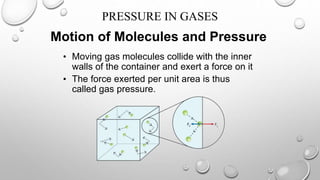
Motion of Molecules and Pressure
• Moving gas molecules collide with the inner
walls of the container and exert a force on it
• The force exerted per unit area is thus
called gas pressure.
PRESSURE IN GASES
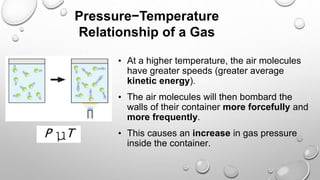
Pressure−Temperature
Relationship of a Gas
• At a higher temperature, the air molecules
have greater speeds (greater average
kinetic energy).
• The air molecules will then bombard the
walls of their container more forcefully and
more frequently.
• This causes an increase in gas pressure
inside the container.
P Tµ
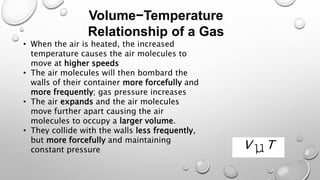
Volume−Temperature
Relationship of a Gas
• When the air is heated, the increased
temperature causes the air molecules to
move at higher speeds
• The air molecules will then bombard the
walls of their container more forcefully and
more frequently; gas pressure increases
• The air expands and the air molecules
move further apart causing the air
molecules to occupy a larger volume.
• They collide with the walls less frequently,
but more forcefully and maintaining
constant pressure V Tµ
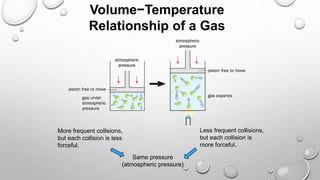
More frequent collisions,
but each collision is less
forceful.
Less frequent collisions,
but each collision is
more forceful.
Same pressure
(atmospheric pressure)
Volume−Temperature
Relationship of a Gas
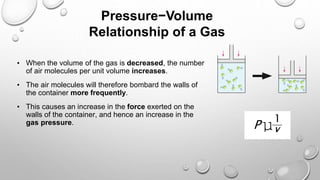
Pressure−Volume
Relationship of a Gas
• When the volume of the gas is decreased, the number
of air molecules per unit volume increases.
• The air molecules will therefore bombard the walls of
the container more frequently.
• This causes an increase in the force exerted on the
walls of the container, and hence an increase in the
gas pressure.
P V
1
µ

Pressure in gases

  • 1.
    Motion of Moleculesand Pressure • Moving gas molecules collide with the inner walls of the container and exert a force on it • The force exerted per unit area is thus called gas pressure. PRESSURE IN GASES
  • 2.
    Pressure−Temperature Relationship of aGas • At a higher temperature, the air molecules have greater speeds (greater average kinetic energy). • The air molecules will then bombard the walls of their container more forcefully and more frequently. • This causes an increase in gas pressure inside the container. P Tµ
  • 3.
    Volume−Temperature Relationship of aGas • When the air is heated, the increased temperature causes the air molecules to move at higher speeds • The air molecules will then bombard the walls of their container more forcefully and more frequently; gas pressure increases • The air expands and the air molecules move further apart causing the air molecules to occupy a larger volume. • They collide with the walls less frequently, but more forcefully and maintaining constant pressure V Tµ
  • 4.
    More frequent collisions, buteach collision is less forceful. Less frequent collisions, but each collision is more forceful. Same pressure (atmospheric pressure) Volume−Temperature Relationship of a Gas
  • 5.
    Pressure−Volume Relationship of aGas • When the volume of the gas is decreased, the number of air molecules per unit volume increases. • The air molecules will therefore bombard the walls of the container more frequently. • This causes an increase in the force exerted on the walls of the container, and hence an increase in the gas pressure. P V 1 µ

Editor's Notes

  • #2 Use the diagram to illustrate to students how gas molecules are always in constant motion (kinetic model of matter); the force exerted by a gas molecule on the wall of the container is equal to the force exerted by the wall of the container on the gas molecule (Newton’s Third Law of Motion, Chapter 3 Forces). Optional (IT Group Activity) The next two slides, Slides 22 and 23 (hidden), contain directives for an IT group activity that can be conducted in class to help students discover the relationship between gas pressure and gas temperature, as well as gas pressure and gas volume. Instead of just informing students of the various relationships, this activity will help them to construct the knowledge on their own. Computers, laptops and/or tablets with access to the Internet need to be provided to students for this activity. After going through the activity, the following slides (Slides 24 to 26; 31 to 33) will help to confirm students’ findings and correct any wrong observations. *To un-hide slides, go to ‘Normal View’ or ‘Slide Sorter’ and right click on the slide. Unselect ‘Hide Slide’.
  • #4 Explain to students that in the set-up above, the air inside the container is allowed to expand, as seen by the movement of the coloured water droplet in the glass tube. Explain to students that although there will be more forceful collisions between the faster moving gas molecules and the walls of the container, the time it takes for each collision between the walls is longer (since the distance travelled by each molecule in a larger volume increases). That is, although the gas molecules hit the walls of the container more forcefully, they hit the walls less frequently. Therefore, the gas pressure is maintained. (Note that the gas is heated slowly in this experiment so that the pressure increase (before volume expands to a value where the gas pressure is maintained) is negligible.)
  • #6 Tell students that since temperature is kept constant, the average speed of the gas molecules remains constant.