Hooke’s Law and Moments GCSE Physics
Hooke’s Law Page 45
Learning Intentions By the end of the lesson we will be able to… Understand the meaning of  elastic  and  plastic  behaviour Investigate the relationship between  force  applied and the resulting  extension State and use  Hooke’s Law  to solve problems
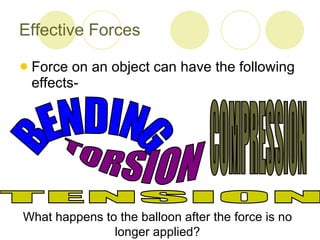
Effective Forces Force on an object can have the following effects- BENDING TENSION TORSION COMPRESSION What happens to the balloon after the force is no longer applied?
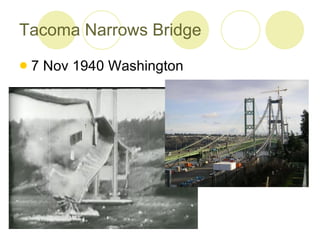
Tacoma Narrows Bridge 7 Nov 1940 Washington
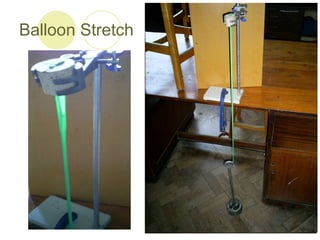
Balloon Stretch
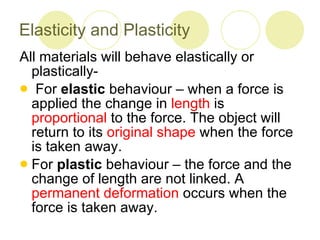
Elasticity and Plasticity All materials will behave elastically or plastically- For  elastic  behaviour – when a force is applied the change in  length  is  proportional  to the force. The object will return to its  original shape  when the force is taken away. For  plastic  behaviour – the force and the change of length are not linked. A  permanent deformation  occurs when the force is taken away.
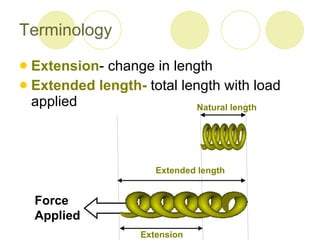
Terminology  Extension - change in length Extended length-  total length with load applied Force Applied Natural length Extended length Extension
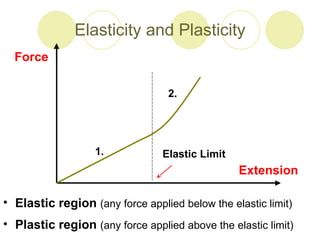
Elasticity and Plasticity Elastic Limit 1. 2. Force Extension Elastic region   (any force applied below the elastic limit) Plastic region   (any force applied above the elastic limit)
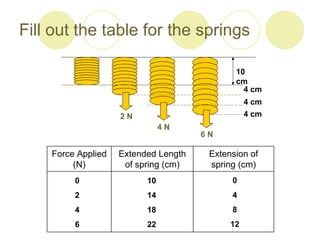
Fill out the table for the springs 4 cm 4 cm 4 cm 10 cm 2 N 4 N 6 N 10 14 18 22 0 2 4 6 0 4 8 12 Extension of spring (cm) Extended Length of spring (cm) Force Applied (N)


Hooke’s Law The extension of the object’s length will be  proportional  to the load causing that extension provided the  elastic limit is not exceeded E.g. if the  force  is doubled, the  extension  is doubled
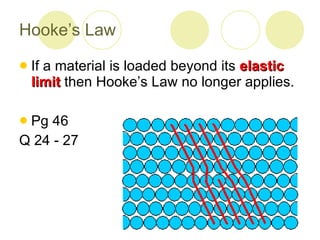
Hooke’s Law If a material is loaded beyond its  elastic limit  then Hooke’s Law no longer applies. Pg 46  Q 24 - 27
Learning Intentions By the end of the lesson we will be able to… Recognise the  turning effect  caused by a force Recall the meaning of the term  ‘moment of a force’  and the  moment equation Use the moment equation to  solve simple problems
Turning Effect of a Force (pg 46) The turning effect of a force is called a MOMENT It depends on two factors- 1.  Size of the force  acting on the object 2. The  distance  the force acts from the pivot The  PIVOT  is the point at which the rotation or turning effect occurs around (eg. The hinge of a door)
Turning Effect of a Force The greater the  distance  from  the pivot  that the  force   acts, the greater the turning effect
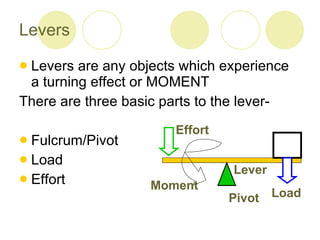
Levers Levers are any objects which experience a turning effect or MOMENT There are three basic parts to the lever- Fulcrum/Pivot Load Effort Pivot Effort Load Lever Moment
 
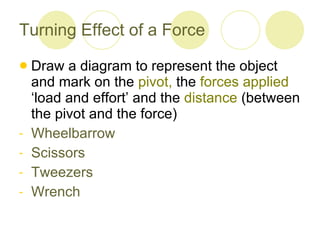
Turning Effect of a Force Draw a diagram to represent the object and mark on the  pivot,  the  forces applied  ‘load and effort’ and the  distance  (between the pivot and the force) Wheelbarrow Scissors Tweezers Wrench
Learning Intentions By the end of the lesson we will be able to… Recognise the  turning effect  caused by a force Recall the meaning of the term  ‘moment of a force’  and the  moment equation Use the moment equation to  solve simple problems


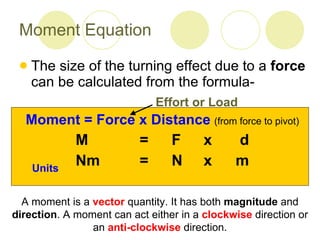
Moment Equation The size of the turning effect due to a  force  can be calculated from the formula- Moment = Force x Distance   (from force to pivot) M = F  x  d Nm  =  N  x  m Effort or Load Units A moment is a  vector  quantity. It has both  magnitude  and  direction . A moment can act either in a  clockwise  direction or an  anti-clockwise  direction.
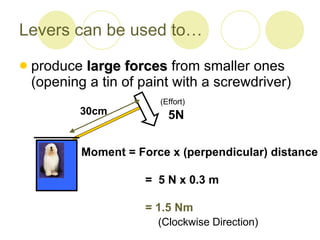
Levers can be used to…  produce  large forces  from smaller ones (opening a tin of paint with a screwdriver) Moment = Force x (perpendicular) distance =  5 N x 0.3 m = 1.5 Nm 30cm 5N (Effort) (Clockwise Direction)
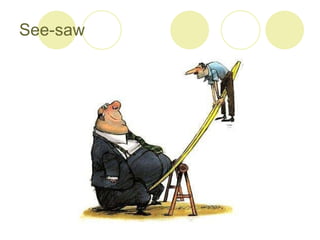
See-saw
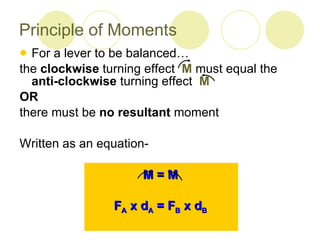
Principle of Moments For a lever to be balanced… the  clockwise  turning effect  M  must equal the  anti-clockwise  turning effect  M OR there must be  no resultant  moment Written as an equation- M = M F A  x d A  = F B  x d B
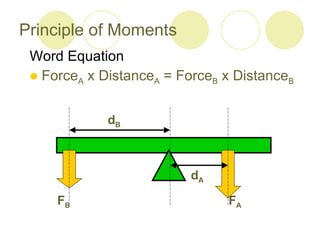
Principle of Moments Word Equation Force A  x Distance A  = Force B  x Distance B d B F B F A d A
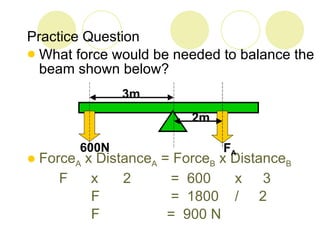
Practice Question What force would be needed to balance the beam shown below? Force A  x Distance A  = Force B  x Distance B F x 2   = 600   x   3 F   =  1800   /   2 F   =  900 N 3m 600N F A 2m

Hooke's law and Moments

  • 1.
    Hooke’s Law andMoments GCSE Physics
  • 2.
  • 3.
    Learning Intentions Bythe end of the lesson we will be able to… Understand the meaning of elastic and plastic behaviour Investigate the relationship between force applied and the resulting extension State and use Hooke’s Law to solve problems
  • 4.
    Effective Forces Forceon an object can have the following effects- BENDING TENSION TORSION COMPRESSION What happens to the balloon after the force is no longer applied?
  • 5.
    Tacoma Narrows Bridge7 Nov 1940 Washington
  • 6.
  • 7.
    Elasticity and PlasticityAll materials will behave elastically or plastically- For elastic behaviour – when a force is applied the change in length is proportional to the force. The object will return to its original shape when the force is taken away. For plastic behaviour – the force and the change of length are not linked. A permanent deformation occurs when the force is taken away.
  • 8.
    Terminology Extension- change in length Extended length- total length with load applied Force Applied Natural length Extended length Extension
  • 9.
    Elasticity and PlasticityElastic Limit 1. 2. Force Extension Elastic region (any force applied below the elastic limit) Plastic region (any force applied above the elastic limit)
  • 10.
    Fill out thetable for the springs 4 cm 4 cm 4 cm 10 cm 2 N 4 N 6 N 10 14 18 22 0 2 4 6 0 4 8 12 Extension of spring (cm) Extended Length of spring (cm) Force Applied (N)
  • 11.
  • 12.
  • 13.
  • 14.
  • 15.
    Hooke’s Law Theextension of the object’s length will be proportional to the load causing that extension provided the elastic limit is not exceeded E.g. if the force is doubled, the extension is doubled
  • 16.
    Hooke’s Law Ifa material is loaded beyond its elastic limit then Hooke’s Law no longer applies. Pg 46 Q 24 - 27
  • 17.
    Learning Intentions Bythe end of the lesson we will be able to… Recognise the turning effect caused by a force Recall the meaning of the term ‘moment of a force’ and the moment equation Use the moment equation to solve simple problems
  • 18.
    Turning Effect ofa Force (pg 46) The turning effect of a force is called a MOMENT It depends on two factors- 1. Size of the force acting on the object 2. The distance the force acts from the pivot The PIVOT is the point at which the rotation or turning effect occurs around (eg. The hinge of a door)
  • 19.
    Turning Effect ofa Force The greater the distance from the pivot that the force acts, the greater the turning effect
  • 20.
    Levers Levers areany objects which experience a turning effect or MOMENT There are three basic parts to the lever- Fulcrum/Pivot Load Effort Pivot Effort Load Lever Moment
  • 21.
  • 22.
    Turning Effect ofa Force Draw a diagram to represent the object and mark on the pivot, the forces applied ‘load and effort’ and the distance (between the pivot and the force) Wheelbarrow Scissors Tweezers Wrench
  • 23.
    Learning Intentions Bythe end of the lesson we will be able to… Recognise the turning effect caused by a force Recall the meaning of the term ‘moment of a force’ and the moment equation Use the moment equation to solve simple problems
  • 24.
  • 25.
  • 26.
  • 27.
    Moment Equation Thesize of the turning effect due to a force can be calculated from the formula- Moment = Force x Distance (from force to pivot) M = F x d Nm = N x m Effort or Load Units A moment is a vector quantity. It has both magnitude and direction . A moment can act either in a clockwise direction or an anti-clockwise direction.
  • 28.
    Levers can beused to… produce large forces from smaller ones (opening a tin of paint with a screwdriver) Moment = Force x (perpendicular) distance = 5 N x 0.3 m = 1.5 Nm 30cm 5N (Effort) (Clockwise Direction)
  • 29.
  • 30.
    Principle of MomentsFor a lever to be balanced… the clockwise turning effect M must equal the anti-clockwise turning effect M OR there must be no resultant moment Written as an equation- M = M F A x d A = F B x d B
  • 31.
    Principle of MomentsWord Equation Force A x Distance A = Force B x Distance B d B F B F A d A
  • 32.
    Practice Question Whatforce would be needed to balance the beam shown below? Force A x Distance A = Force B x Distance B F x 2 = 600 x 3 F = 1800 / 2 F = 900 N 3m 600N F A 2m

Editor's Notes

  • #5 When an external force is applied to an object, the object may resist motion. Although the object does not move the force can still have an effect on the object. This effect is important for the engineering of many structures and machines. The components of an engine, the pistons being forced apart by the chemical reactions, fuel igniting and driving the thrust of the mechanism. Incorrect design and ignorance of these forces can lead to failure! Think of all the engine failures or tyre problems that occur in F1, this is all down to engineering problems, although its difficult to get everything right in such a complex machine that is competing and pushing the boundaries of speed.
  • #6 One such catastrophic failure of structural engineering was the Tacoma Narrows Bridge. A strong wind started the bridge swaying and the effect magnified beyond control until the inevitable happened. Cue the news rail from that day back in the 1940s.
  • #7 Balloon clamped to a cork and the retort stand clamped to the desk. It’s quite obvious to represent the relationship between the force and the extension visually, judging by your eye, with the balloon stretching rather than the spring. Apply a force of 10 N and compare the extension when another 5 N are added. The extension should be increased by 50%. Half the force applied, half the extension – the relationship is proportional. Apply a larger force, 20 N and the extension is no longer proportional, in fact when another 10 N is added so 30 N is now applied the balloon hardly stretches at all! When the force is taken away, the balloon shows clearly an increase in natural length. A permanent extension has occurred. A spring also demonstrates the deformation when too much force is applied beyond a particular limit.
  • #10 Similar to the graph drawn for the spring, a straight line shows the pattern of results obtained which is regarded as a direct proportion. This region of applying force is known as the ‘elastic region’. If the force is continually added though the relationship does not stay constant. The larger the force the less the extension occurs. A permanent deformation is also observed when the force is no longer applied. This region is regarded as the ‘elastic region’. The threshold between each region is called the elastic limit.
  • #11 Handout blank copies of the table. How do the results prove that the spring obeys Hooke’s law? The force is directly proportional to the extension, to get double the extension the force applied is doubled also.
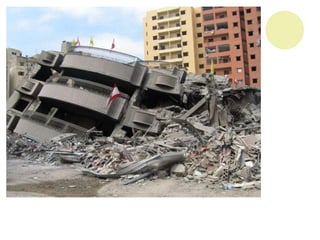
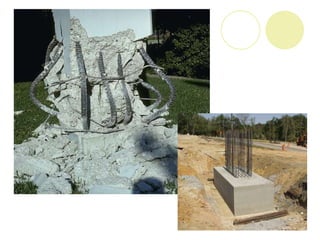
  • #12 If a force is large enough a static object which is anchored will eventually crack and possibly fail completely. Every material will be able to with-hold a limit of force but may behave plastically before collapsing and failing.
  • #13 Permanent deformation of the reinforcement of steel bars within concert
  • #17 There is no more connection between the increase in force and the extension of the object. A fracture may also appear.
  • #22 Tim and Moby explain lever… excuse the American pronunciation
  • #25 What are some of the names of the components that are considered with a turning effect of a force? Lever, pivot/fulcrum, effort, load What is the purpose of a lever? It is a simple machine which makes a job easier to do. It amplifies the force applied but this forces needs to be applied over a long distance than the load will be moved.
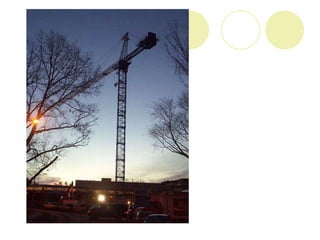
  • #26 An obvious example of a large turning effect of a force is demonstrated by construction cranes. The weight of the load lifted by the crane needs to have a counter balance to reduce any strain in the main column.
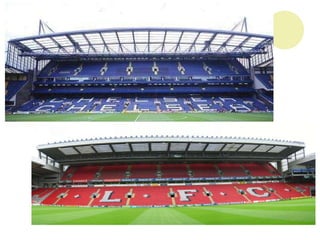
  • #27 Moments are considered for the design of many structures. It is quite apparent that a moment is caused by the cantilever roof of football stands which require large spans without obstructing any views of the pitch. At Stamford Bridge the stand has columns at the rear with struts pulling against the load force (dead weight of the roof members).
  • #30 Add to the see-saw different moments (various forces at various distances from the pivot, clockwise and anti-clockwise) The see-saw can be balanced obviously by applying the same force at the same distance from the pivot but on the other side. What if we have only half the weight, can the see-saw still be balanced? What if we have 2 3rds of the weight? A lever can be balanced as long as the moments acting in the clockwise direction are equal to the moments acting in the anti-clockwise direction.