Classical Mechanics
Topic 8: Equilibrium and Elasticity
Plasticity
Based from Sears and Zemansky’s University Physics
with Modern Physics 13th ed
Stress Strain and Elastic Moduli
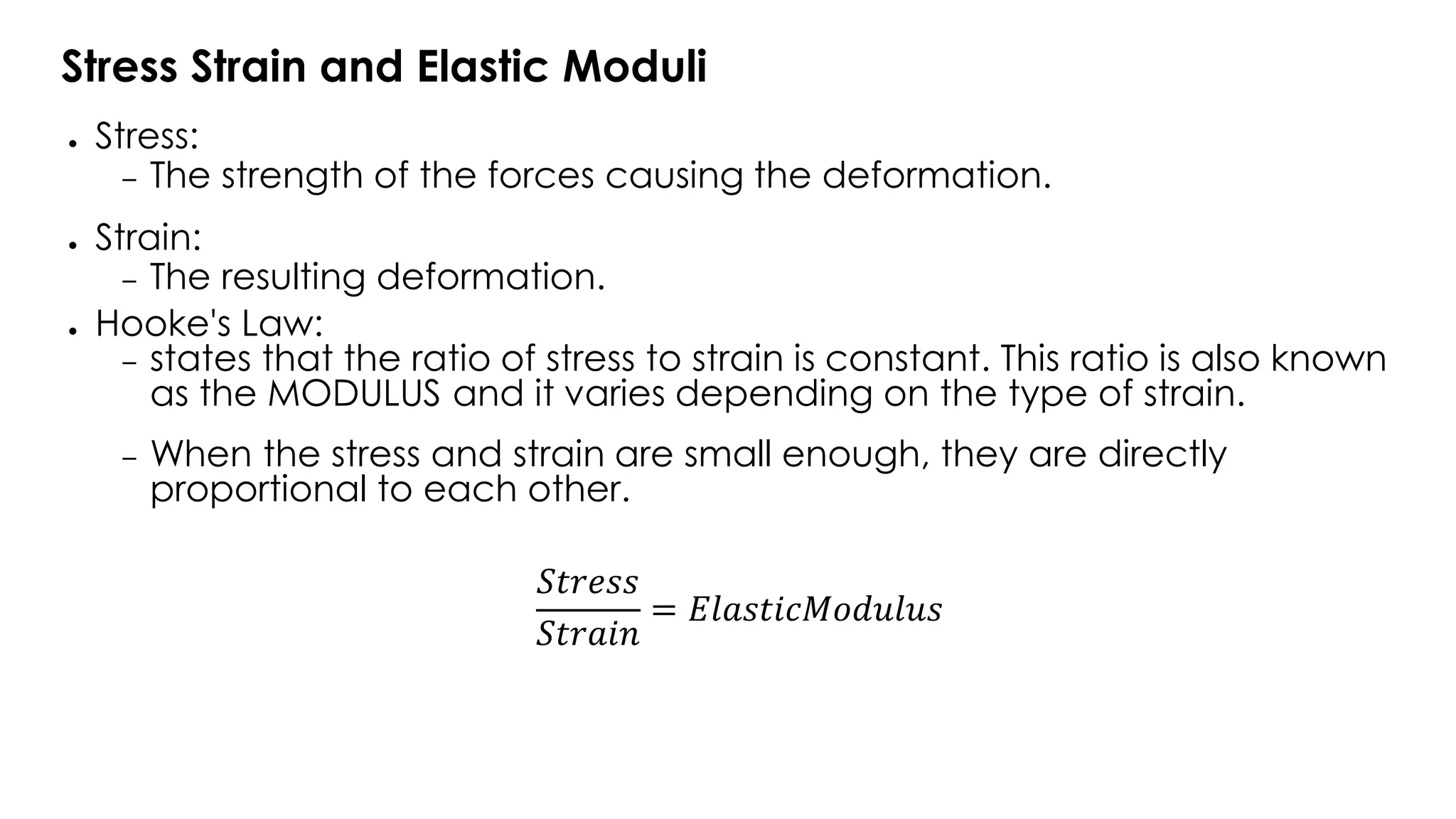
● Stress:
– The strength of the forces causing the deformation.
● Strain:
– The resulting deformation.
● Hooke's Law:
– states that the ratio of stress to strain is constant. This ratio is also known
as the MODULUS and it varies depending on the type of strain.
– When the stress and strain are small enough, they are directly
proportional to each other.
𝑆𝑡𝑟𝑒𝑠𝑠
𝑆𝑡𝑟𝑎𝑖𝑛
= 𝐸𝑙𝑎𝑠𝑡𝑖𝑐𝑀𝑜𝑑𝑢𝑙𝑢𝑠
Tensile Stress and Strain
• Object in tension – Forces of the same magnitude but opposite in directions are
applied at the object's ends (pulling the object from its ends).
S.I. unit of tensile stress is 1 [N/m2] = 1[Pa]
• Young's modulus (Y)
𝑇𝑒𝑛𝑠𝑖𝑙𝑒 𝑠𝑡𝑟𝑒𝑠𝑠 =
𝐹⊥
𝐴
𝑇𝑒𝑛𝑠𝑖𝑙𝑒 𝑠𝑡𝑟𝑎𝑖𝑛 =
𝑙 − 𝑙0
𝑙0
=
Δ𝑙
𝑙0
𝑌 =
𝑇𝑒𝑛𝑠𝑖𝑙𝑒𝑠𝑡𝑟𝑒𝑠𝑠
𝑇𝑒𝑛𝑠𝑖𝑙𝑒𝑠𝑡𝑟𝑎𝑖𝑛
=
𝐹⊥ ⋅ 𝑙0
𝐴 ⋅ Δ𝑙
Tensile Stress and Strain
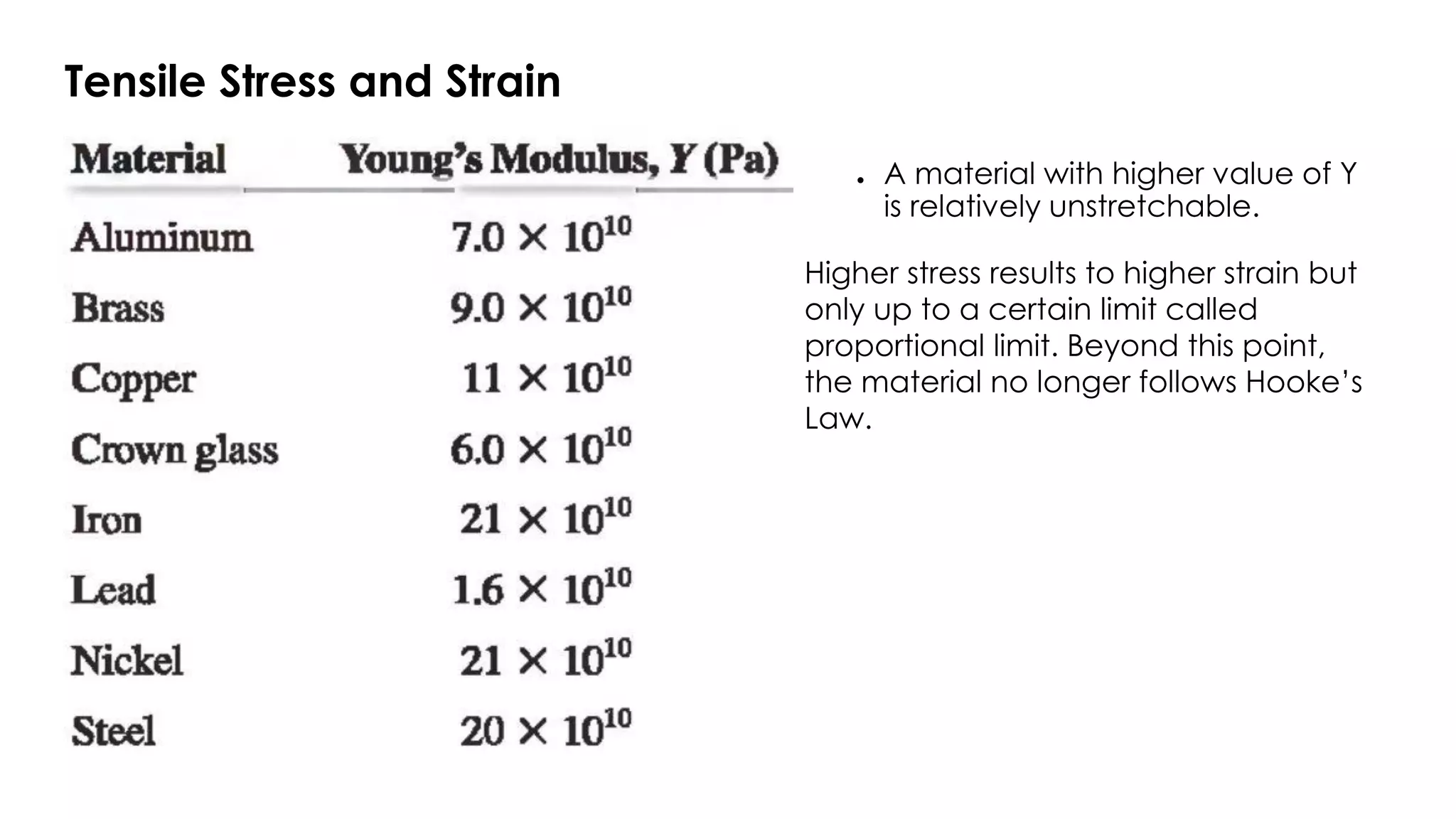
● A material with higher value of Y
is relatively unstretchable.
Higher stress results to higher strain but
only up to a certain limit called
proportional limit. Beyond this point,
the material no longer follows Hooke’s
Law.
Tensile Stress and Strain
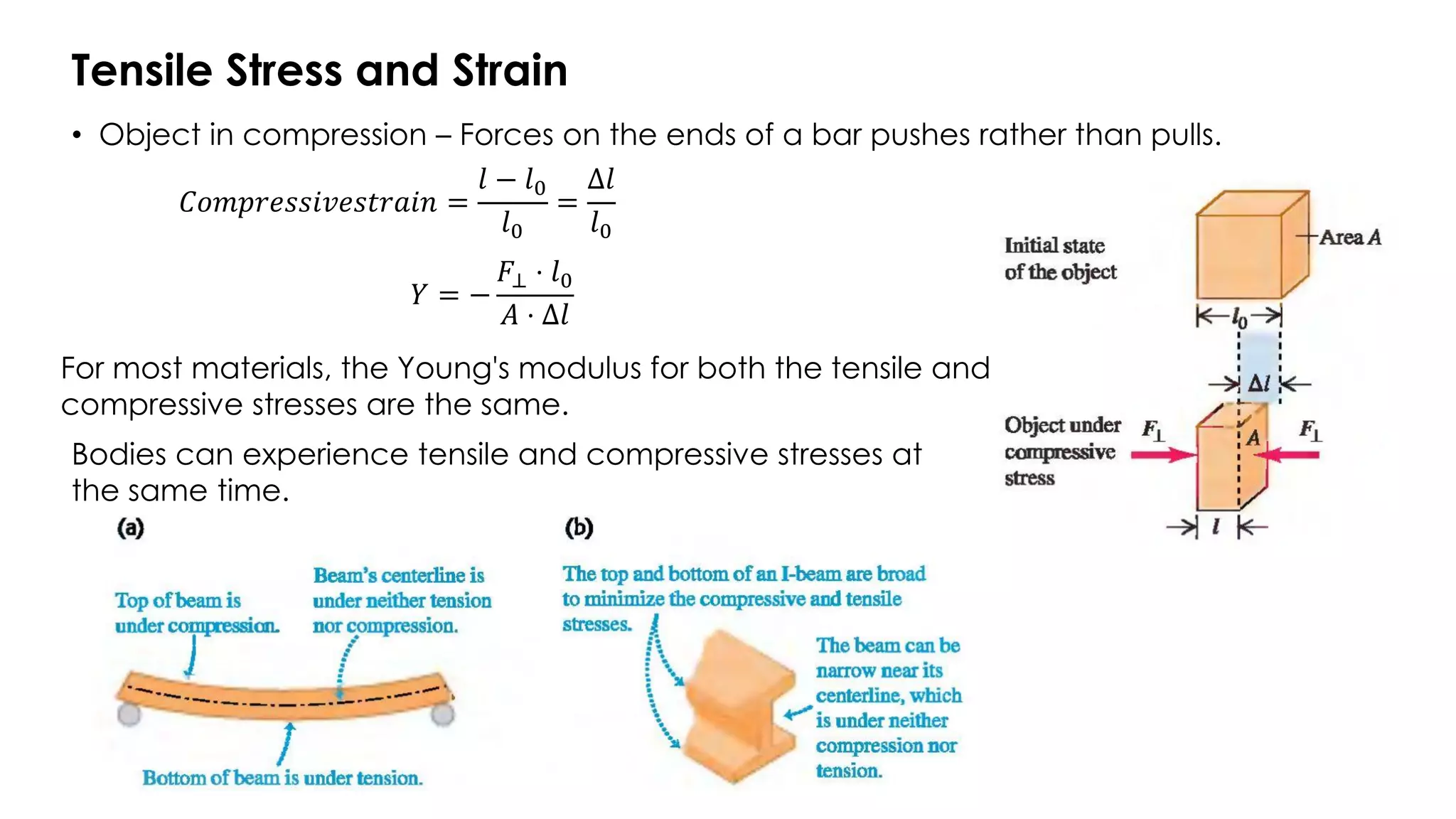
• Object in compression – Forces on the ends of a bar pushes rather than pulls.
𝐶𝑜𝑚𝑝𝑟𝑒𝑠𝑠𝑖𝑣𝑒𝑠𝑡𝑟𝑎𝑖𝑛 =
𝑙 − 𝑙0
𝑙0
=
Δ𝑙
𝑙0
𝑌 = −
𝐹⊥ ⋅ 𝑙0
𝐴 ⋅ Δ𝑙
For most materials, the Young's modulus for both the tensile and
compressive stresses are the same.
Bodies can experience tensile and compressive stresses at
the same time.
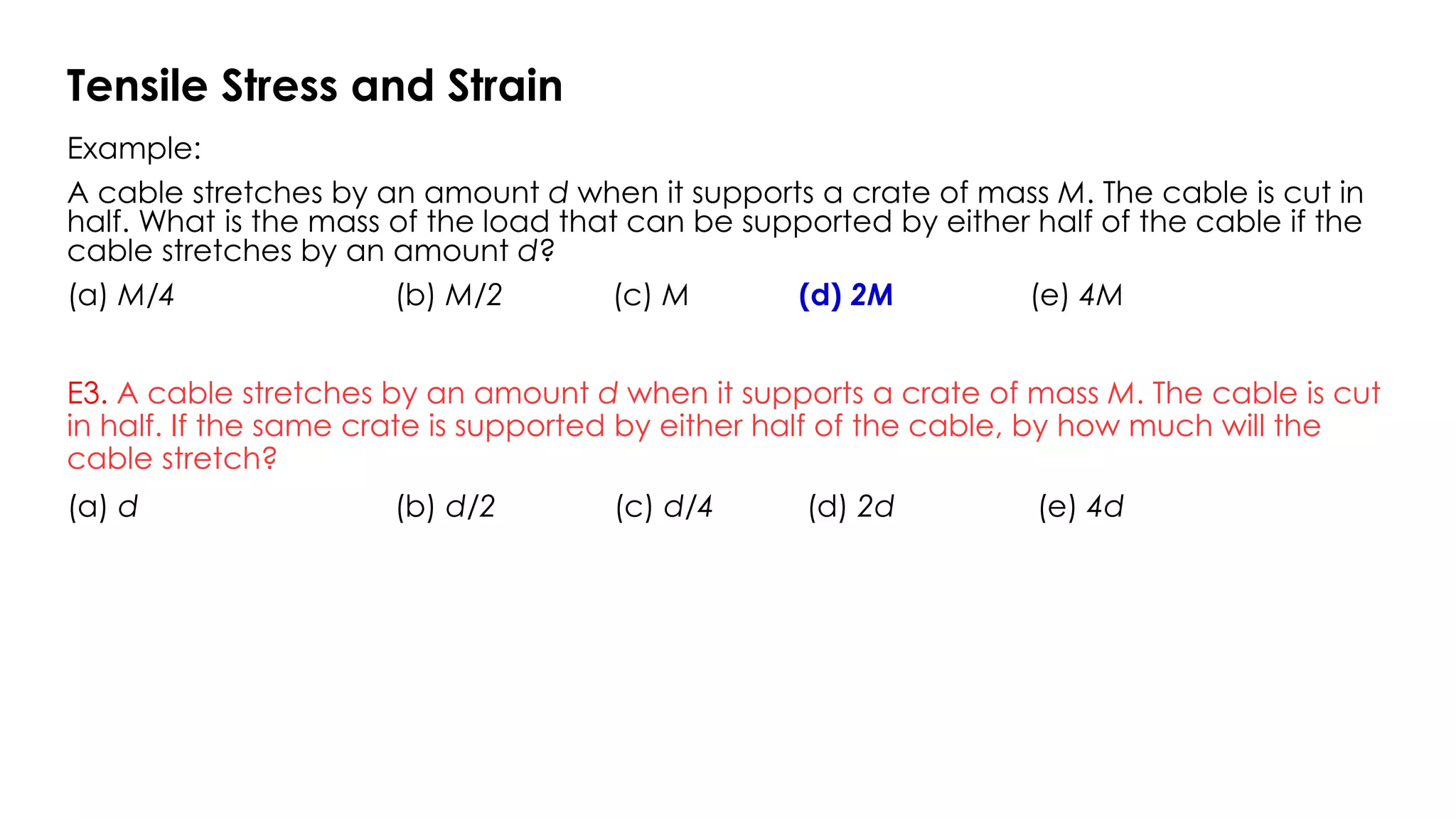
Example:
A cable stretches by an amount d when it supports a crate of mass M. The cable is cut in
half. What is the mass of the load that can be supported by either half of the cable if the
cable stretches by an amount d?
(a) M/4 (b) M/2 (c) M (d) 2M (e) 4M
E3. A cable stretches by an amount d when it supports a crate of mass M. The cable is cut
in half. If the same crate is supported by either half of the cable, by how much will the
cable stretch?
(a) d (b) d/2 (c) d/4 (d) 2d (e) 4d
Tensile Stress and Strain
Shear Stress and Strain
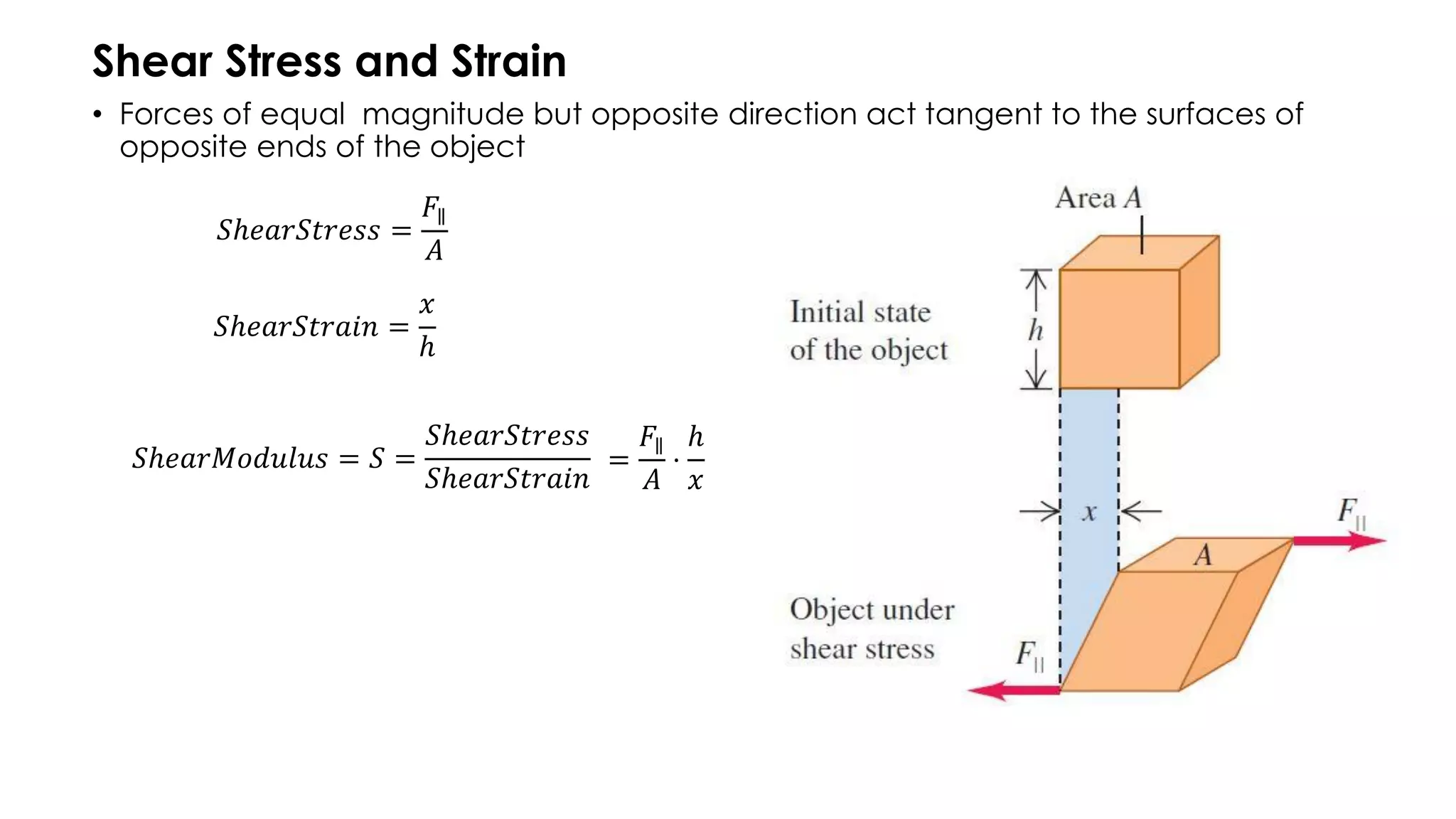
• Forces of equal magnitude but opposite direction act tangent to the surfaces of
opposite ends of the object
𝑆ℎ𝑒𝑎𝑟𝑆𝑡𝑟𝑒𝑠𝑠 =
𝐹∥
𝐴
𝑆ℎ𝑒𝑎𝑟𝑆𝑡𝑟𝑎𝑖𝑛 =
𝑥
ℎ
𝑆ℎ𝑒𝑎𝑟𝑀𝑜𝑑𝑢𝑙𝑢𝑠 = 𝑆 =
𝑆ℎ𝑒𝑎𝑟𝑆𝑡𝑟𝑒𝑠𝑠
𝑆ℎ𝑒𝑎𝑟𝑆𝑡𝑟𝑎𝑖𝑛
=
𝐹∥
𝐴
⋅
ℎ
𝑥
Elasticity and Plasticity
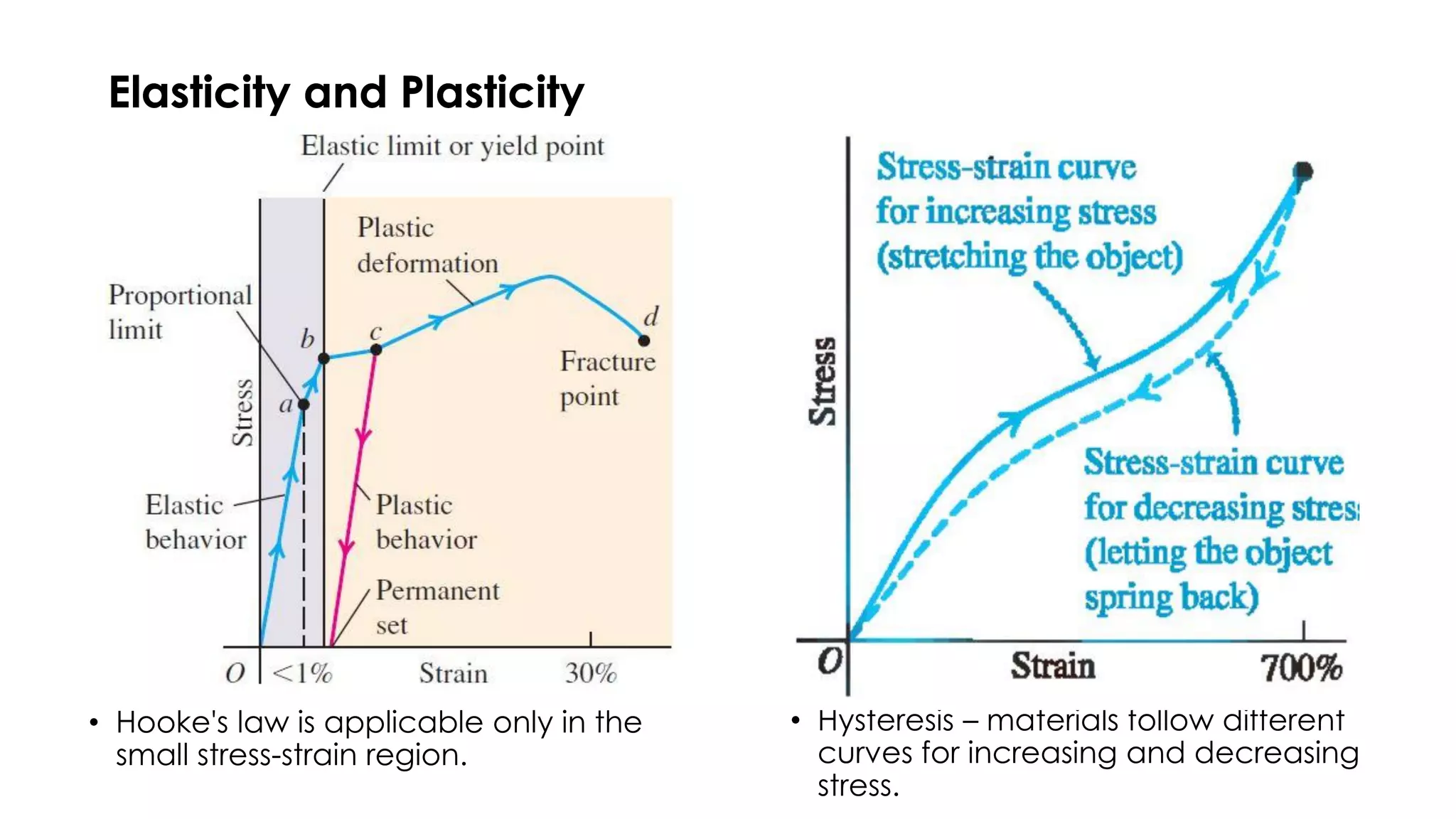
• Hooke's law is applicable only in the
small stress-strain region.
• Hysteresis – materials follow different
curves for increasing and decreasing
stress.
Elasticity and Plasticity
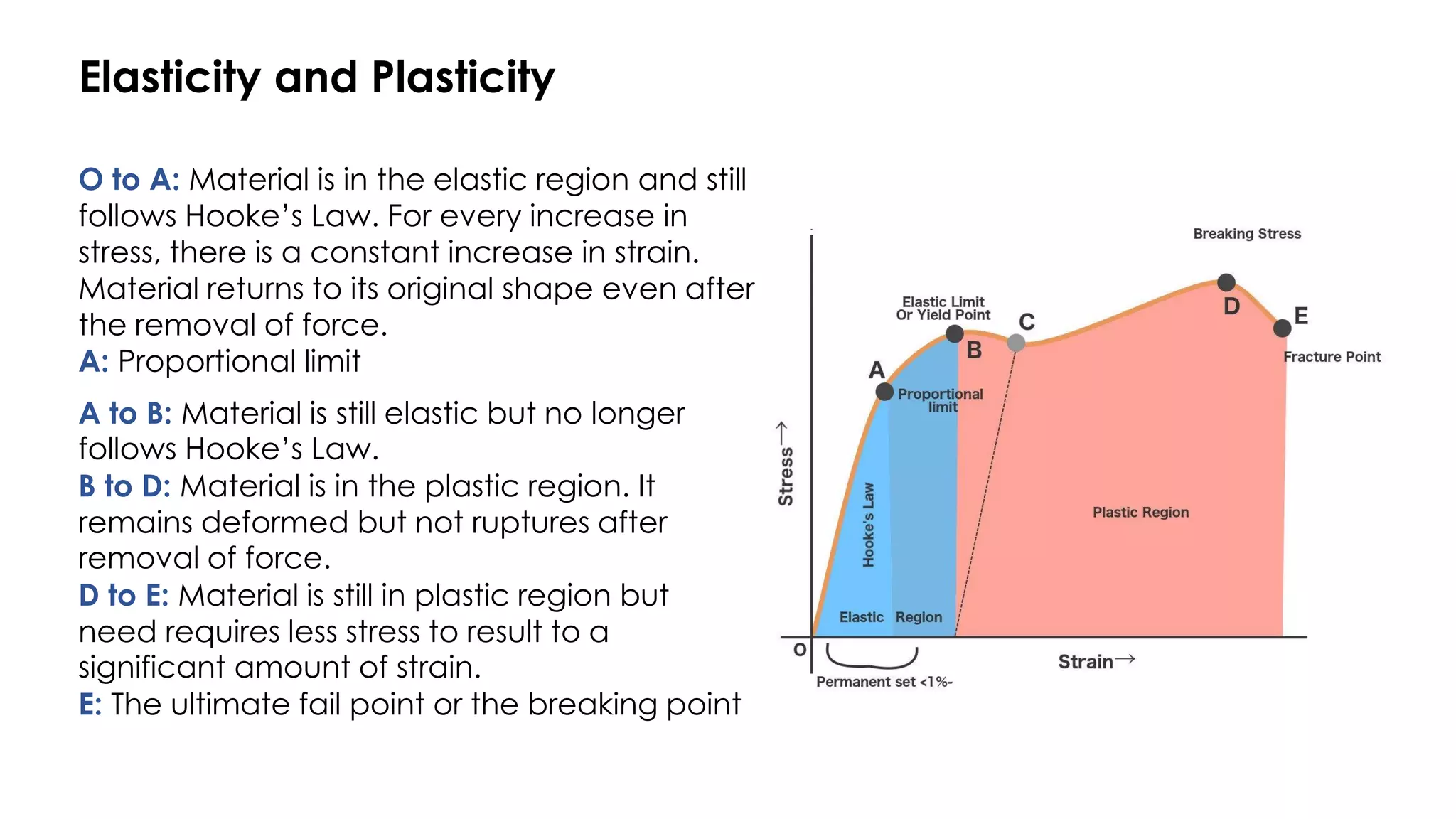
O to A: Material is in the elastic region and still
follows Hooke’s Law. For every increase in
stress, there is a constant increase in strain.
Material returns to its original shape even after
the removal of force.
A: Proportional limit
A to B: Material is still elastic but no longer
follows Hooke’s Law.
B to D: Material is in the plastic region. It
remains deformed but not ruptures after
removal of force.
D to E: Material is still in plastic region but
need requires less stress to result to a
significant amount of strain.
E: The ultimate fail point or the breaking point
Elasticity and Plasticity
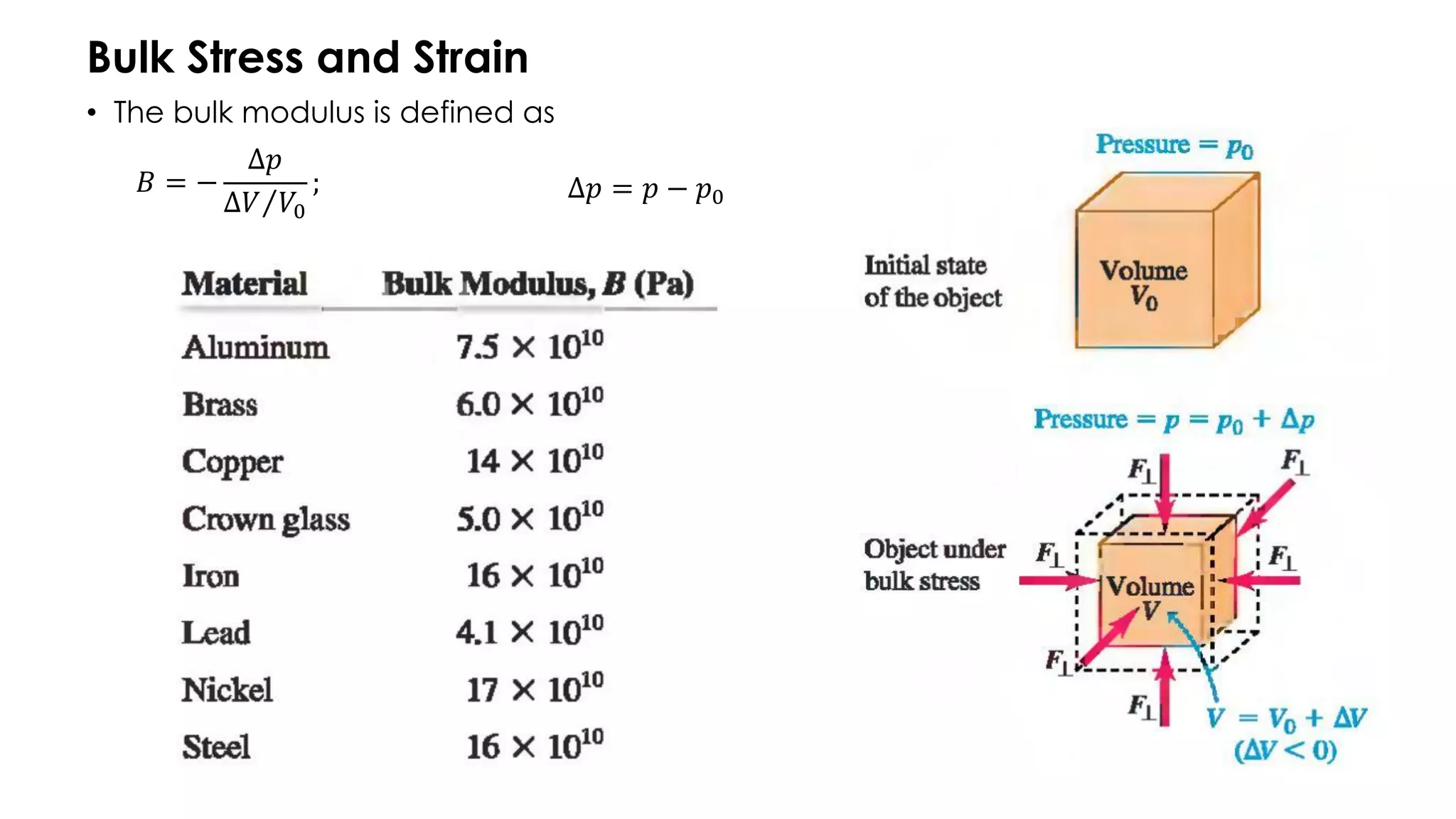
Bulk Stress and Strain
• The stress is now a uniform pressure on all sides, and
the resulting deformation is a volume change.
• S.I. unit of pressure: 1 [N/m2]=1[Pa]
• The force per unit area that the fluid exerts on the
surface of an object immersed object is called the
pressure p:
• The approximate pressure of the earth's atmosphere at
sea level:
• Where V0 is the object's initial volume and ΔV is
the change in volume.
𝑝 =
𝐹⊥
𝐴
1𝑎𝑡𝑚𝑜𝑠𝑝ℎ𝑒𝑟𝑒 = 1 𝑎𝑡𝑚 = 1.013 × 10⁵
𝑃𝑎
𝐵𝑢𝑙𝑘𝑆𝑡𝑟𝑎𝑖𝑛 =
Δ𝑉
𝑉0
Bulk Stress and Strain
• The bulk modulus is defined as
𝐵 = −
Δ𝑝
Τ
Δ𝑉 𝑉0
; Δ𝑝 = 𝑝 − 𝑝0

CM8_-Elasticity- v2.pdf

  • 1.
    Classical Mechanics Topic 8:Equilibrium and Elasticity Plasticity Based from Sears and Zemansky’s University Physics with Modern Physics 13th ed
  • 2.
    Stress Strain andElastic Moduli ● Stress: – The strength of the forces causing the deformation. ● Strain: – The resulting deformation. ● Hooke's Law: – states that the ratio of stress to strain is constant. This ratio is also known as the MODULUS and it varies depending on the type of strain. – When the stress and strain are small enough, they are directly proportional to each other. 𝑆𝑡𝑟𝑒𝑠𝑠 𝑆𝑡𝑟𝑎𝑖𝑛 = 𝐸𝑙𝑎𝑠𝑡𝑖𝑐𝑀𝑜𝑑𝑢𝑙𝑢𝑠
  • 3.
    Tensile Stress andStrain • Object in tension – Forces of the same magnitude but opposite in directions are applied at the object's ends (pulling the object from its ends). S.I. unit of tensile stress is 1 [N/m2] = 1[Pa] • Young's modulus (Y) 𝑇𝑒𝑛𝑠𝑖𝑙𝑒 𝑠𝑡𝑟𝑒𝑠𝑠 = 𝐹⊥ 𝐴 𝑇𝑒𝑛𝑠𝑖𝑙𝑒 𝑠𝑡𝑟𝑎𝑖𝑛 = 𝑙 − 𝑙0 𝑙0 = Δ𝑙 𝑙0 𝑌 = 𝑇𝑒𝑛𝑠𝑖𝑙𝑒𝑠𝑡𝑟𝑒𝑠𝑠 𝑇𝑒𝑛𝑠𝑖𝑙𝑒𝑠𝑡𝑟𝑎𝑖𝑛 = 𝐹⊥ ⋅ 𝑙0 𝐴 ⋅ Δ𝑙
  • 4.
    Tensile Stress andStrain ● A material with higher value of Y is relatively unstretchable. Higher stress results to higher strain but only up to a certain limit called proportional limit. Beyond this point, the material no longer follows Hooke’s Law.
  • 5.
    Tensile Stress andStrain • Object in compression – Forces on the ends of a bar pushes rather than pulls. 𝐶𝑜𝑚𝑝𝑟𝑒𝑠𝑠𝑖𝑣𝑒𝑠𝑡𝑟𝑎𝑖𝑛 = 𝑙 − 𝑙0 𝑙0 = Δ𝑙 𝑙0 𝑌 = − 𝐹⊥ ⋅ 𝑙0 𝐴 ⋅ Δ𝑙 For most materials, the Young's modulus for both the tensile and compressive stresses are the same. Bodies can experience tensile and compressive stresses at the same time.
  • 6.
    Example: A cable stretchesby an amount d when it supports a crate of mass M. The cable is cut in half. What is the mass of the load that can be supported by either half of the cable if the cable stretches by an amount d? (a) M/4 (b) M/2 (c) M (d) 2M (e) 4M E3. A cable stretches by an amount d when it supports a crate of mass M. The cable is cut in half. If the same crate is supported by either half of the cable, by how much will the cable stretch? (a) d (b) d/2 (c) d/4 (d) 2d (e) 4d Tensile Stress and Strain
  • 7.
    Shear Stress andStrain • Forces of equal magnitude but opposite direction act tangent to the surfaces of opposite ends of the object 𝑆ℎ𝑒𝑎𝑟𝑆𝑡𝑟𝑒𝑠𝑠 = 𝐹∥ 𝐴 𝑆ℎ𝑒𝑎𝑟𝑆𝑡𝑟𝑎𝑖𝑛 = 𝑥 ℎ 𝑆ℎ𝑒𝑎𝑟𝑀𝑜𝑑𝑢𝑙𝑢𝑠 = 𝑆 = 𝑆ℎ𝑒𝑎𝑟𝑆𝑡𝑟𝑒𝑠𝑠 𝑆ℎ𝑒𝑎𝑟𝑆𝑡𝑟𝑎𝑖𝑛 = 𝐹∥ 𝐴 ⋅ ℎ 𝑥
  • 8.
    Elasticity and Plasticity •Hooke's law is applicable only in the small stress-strain region. • Hysteresis – materials follow different curves for increasing and decreasing stress. Elasticity and Plasticity
  • 9.
    O to A:Material is in the elastic region and still follows Hooke’s Law. For every increase in stress, there is a constant increase in strain. Material returns to its original shape even after the removal of force. A: Proportional limit A to B: Material is still elastic but no longer follows Hooke’s Law. B to D: Material is in the plastic region. It remains deformed but not ruptures after removal of force. D to E: Material is still in plastic region but need requires less stress to result to a significant amount of strain. E: The ultimate fail point or the breaking point Elasticity and Plasticity
  • 10.
    Bulk Stress andStrain • The stress is now a uniform pressure on all sides, and the resulting deformation is a volume change. • S.I. unit of pressure: 1 [N/m2]=1[Pa] • The force per unit area that the fluid exerts on the surface of an object immersed object is called the pressure p: • The approximate pressure of the earth's atmosphere at sea level: • Where V0 is the object's initial volume and ΔV is the change in volume. 𝑝 = 𝐹⊥ 𝐴 1𝑎𝑡𝑚𝑜𝑠𝑝ℎ𝑒𝑟𝑒 = 1 𝑎𝑡𝑚 = 1.013 × 10⁵ 𝑃𝑎 𝐵𝑢𝑙𝑘𝑆𝑡𝑟𝑎𝑖𝑛 = Δ𝑉 𝑉0
  • 11.
    Bulk Stress andStrain • The bulk modulus is defined as 𝐵 = − Δ𝑝 Τ Δ𝑉 𝑉0 ; Δ𝑝 = 𝑝 − 𝑝0