Theories Module 22: IntelligenceAna Marques Tiffany MillardAllison MillsAnnie PhillipsLiz Larsen
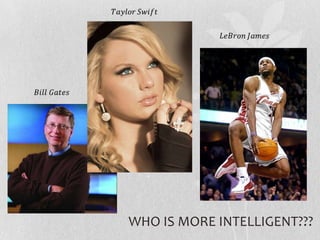
𝑇𝑎𝑦𝑙𝑜𝑟 𝑆𝑤𝑖𝑓𝑡 𝐿𝑒𝐵𝑟𝑜𝑛 𝐽𝑎𝑚𝑒𝑠 𝐵𝑖𝑙𝑙 𝐺𝑎𝑡𝑒𝑠 WHO IS MORE INTELLIGENT???
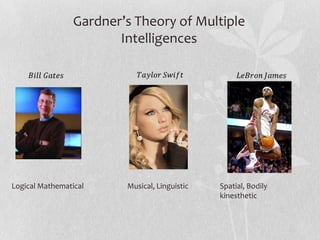
Gardner’s Theory of Multiple Intelligences𝑇𝑎𝑦𝑙𝑜𝑟 𝑆𝑤𝑖𝑓𝑡 𝐵𝑖𝑙𝑙 𝐺𝑎𝑡𝑒𝑠 𝐿𝑒𝐵𝑟𝑜𝑛 𝐽𝑎𝑚𝑒𝑠 Logical MathematicalSpatial, Bodily kinestheticMusical, Linguistic
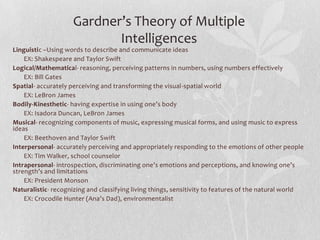
Linguistic –Using words to describe and communicate ideas      EX: Shakespeare and Taylor SwiftLogical/Mathematical- reasoning, perceiving patterns in numbers, using numbers effectively      EX: Bill GatesSpatial- accurately perceiving and transforming the visual-spatial world      EX: LeBron JamesBodily-Kinesthetic- having expertise in using one’s body      EX: Isadora Duncan, LeBron JamesMusical- recognizing components of music, expressing musical forms, and using music to express ideas      EX: Beethoven and Taylor SwiftInterpersonal- accurately perceiving and appropriately responding to the emotions of other people      EX: Tim Walker, school counselor Intrapersonal- introspection, discriminating one’s emotions and perceptions, and knowing one’s strength’s and limitations      EX: President Monson Naturalistic- recognizing and classifying living things, sensitivity to features of the natural world      EX: Crocodile Hunter (Ana’s Dad), environmentalistGardner’s Theory of Multiple Intelligences
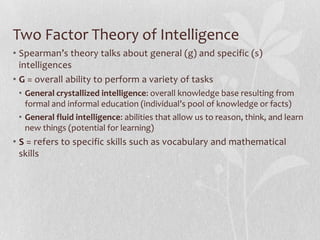
Two Factor Theory of IntelligenceSpearman’s theory talks about general (g) and specific (s) intelligencesG = overall ability to perform a variety of tasksGeneral crystallized intelligence: overall knowledge base resulting from formal and informal education (individual’s pool of knowledge or facts)General fluid intelligence: abilities that allow us to reason, think, and learn new things (potential for learning) S = refers to specific skills such as vocabulary and mathematical skills
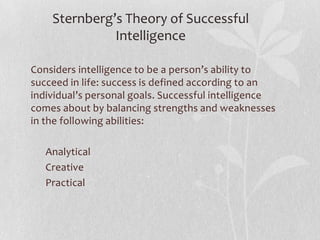
Sternberg’s Theory of Successful IntelligenceConsiders intelligence to be a person’s ability to succeed in life: success is defined according to an individual’s personal goals. Successful intelligence comes about by balancing strengths and weaknesses in the following abilities:       Analytical     Creative     Practical
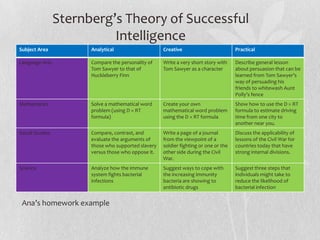
Sternberg’s Theory of Successful IntelligenceAna’s homework example
Intelligence Measured as IQ Intelligence Quotient (IQ)- score derived from several different standardized tests designed to assess intelligence. IQ scores are used in many contexts: as predictors of educational achievement or special needs. Average range is 85-115 Individually Administered IQ testsGroup Administered IQ testsFlynn Effect- phenomenon in which IQ scores have increased over successive generations throughout the world. WHY???
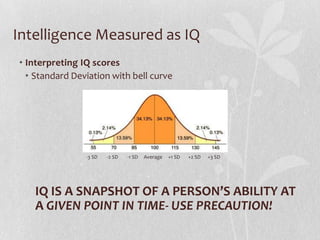
Intelligence Measured as IQ Interpreting IQ scoresStandard Deviation with bell curve IQ IS A SNAPSHOT OF A PERSON’S ABILITY AT A GIVEN POINT IN TIME- USE PRECAUTION!       -3 SD        -2 SD        -1 SD     Average     +1 SD       +2 SD      +3 SD
Learning Activity
Our purpose in teaching is to ensure that all student’s can achieve higher levels of learningUse multiple assessments Create different opportunities for the various learners

Module 22

  • 1.
    Theories Module 22:IntelligenceAna Marques Tiffany MillardAllison MillsAnnie PhillipsLiz Larsen
  • 2.
  • 3.
    Gardner’s Theory ofMultiple Intelligences𝑇𝑎𝑦𝑙𝑜𝑟 𝑆𝑤𝑖𝑓𝑡 𝐵𝑖𝑙𝑙 𝐺𝑎𝑡𝑒𝑠 𝐿𝑒𝐵𝑟𝑜𝑛 𝐽𝑎𝑚𝑒𝑠 Logical MathematicalSpatial, Bodily kinestheticMusical, Linguistic
  • 4.
    Linguistic –Using wordsto describe and communicate ideas EX: Shakespeare and Taylor SwiftLogical/Mathematical- reasoning, perceiving patterns in numbers, using numbers effectively EX: Bill GatesSpatial- accurately perceiving and transforming the visual-spatial world EX: LeBron JamesBodily-Kinesthetic- having expertise in using one’s body EX: Isadora Duncan, LeBron JamesMusical- recognizing components of music, expressing musical forms, and using music to express ideas EX: Beethoven and Taylor SwiftInterpersonal- accurately perceiving and appropriately responding to the emotions of other people EX: Tim Walker, school counselor Intrapersonal- introspection, discriminating one’s emotions and perceptions, and knowing one’s strength’s and limitations EX: President Monson Naturalistic- recognizing and classifying living things, sensitivity to features of the natural world EX: Crocodile Hunter (Ana’s Dad), environmentalistGardner’s Theory of Multiple Intelligences
  • 5.
    Two Factor Theoryof IntelligenceSpearman’s theory talks about general (g) and specific (s) intelligencesG = overall ability to perform a variety of tasksGeneral crystallized intelligence: overall knowledge base resulting from formal and informal education (individual’s pool of knowledge or facts)General fluid intelligence: abilities that allow us to reason, think, and learn new things (potential for learning) S = refers to specific skills such as vocabulary and mathematical skills
  • 6.
    Sternberg’s Theory ofSuccessful IntelligenceConsiders intelligence to be a person’s ability to succeed in life: success is defined according to an individual’s personal goals. Successful intelligence comes about by balancing strengths and weaknesses in the following abilities: Analytical Creative Practical
  • 7.
    Sternberg’s Theory ofSuccessful IntelligenceAna’s homework example
  • 8.
    Intelligence Measured asIQ Intelligence Quotient (IQ)- score derived from several different standardized tests designed to assess intelligence. IQ scores are used in many contexts: as predictors of educational achievement or special needs. Average range is 85-115 Individually Administered IQ testsGroup Administered IQ testsFlynn Effect- phenomenon in which IQ scores have increased over successive generations throughout the world. WHY???
  • 9.
    Intelligence Measured asIQ Interpreting IQ scoresStandard Deviation with bell curve IQ IS A SNAPSHOT OF A PERSON’S ABILITY AT A GIVEN POINT IN TIME- USE PRECAUTION! -3 SD -2 SD -1 SD Average +1 SD +2 SD +3 SD
  • 10.
  • 11.
    Our purpose inteaching is to ensure that all student’s can achieve higher levels of learningUse multiple assessments Create different opportunities for the various learners