Sound
• Sound means basically the mechanical
vibrations.
• These vibrations require a material
medium to travel through.
eg : Solid, liquid, gas, plasma
• Meaning Sound cannot travel through
Vacuum. (Why ?)
Sound as Wave
• Sound travels in the form of waves.
• Wave : A wave is a disturbance that
propagates through space and time,
usually with transference of energy.
• Waves travel and transfer energy from
one point to another, often with no
permanent displacement of the particles of
the medium (that is, with little or no
associated mass transport); they consist
oscillations or vibrations (of particles)
around almost fixed locations.
Types of waves
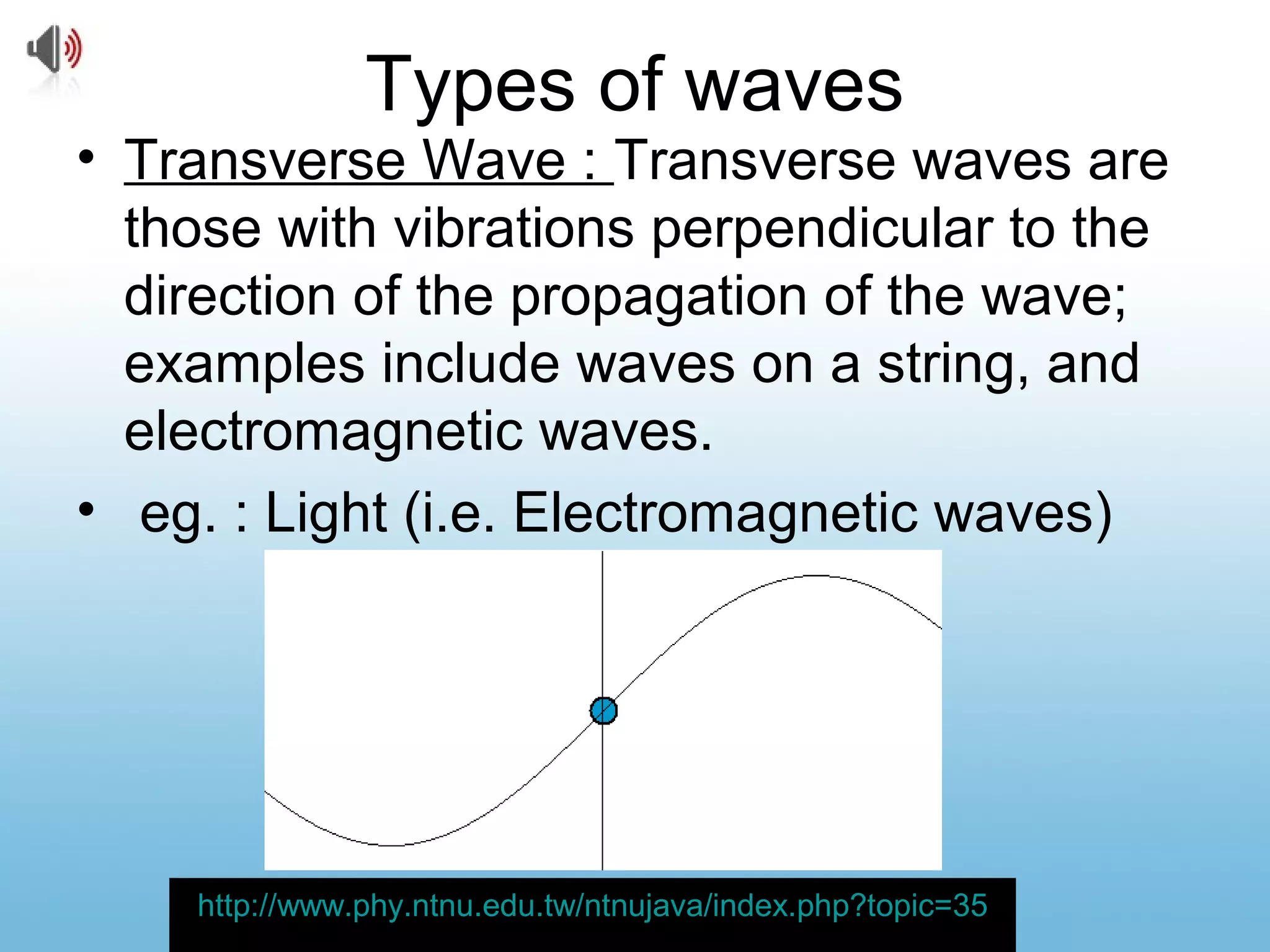
• Transverse Wave : Transverse waves are
those with vibrations perpendicular to the
direction of the propagation of the wave;
examples include waves on a string, and
electromagnetic waves.
• eg. : Light (i.e. Electromagnetic waves)
http://www.phy.ntnu.edu.tw/ntnujava/index.php?topic=35
Types of waves
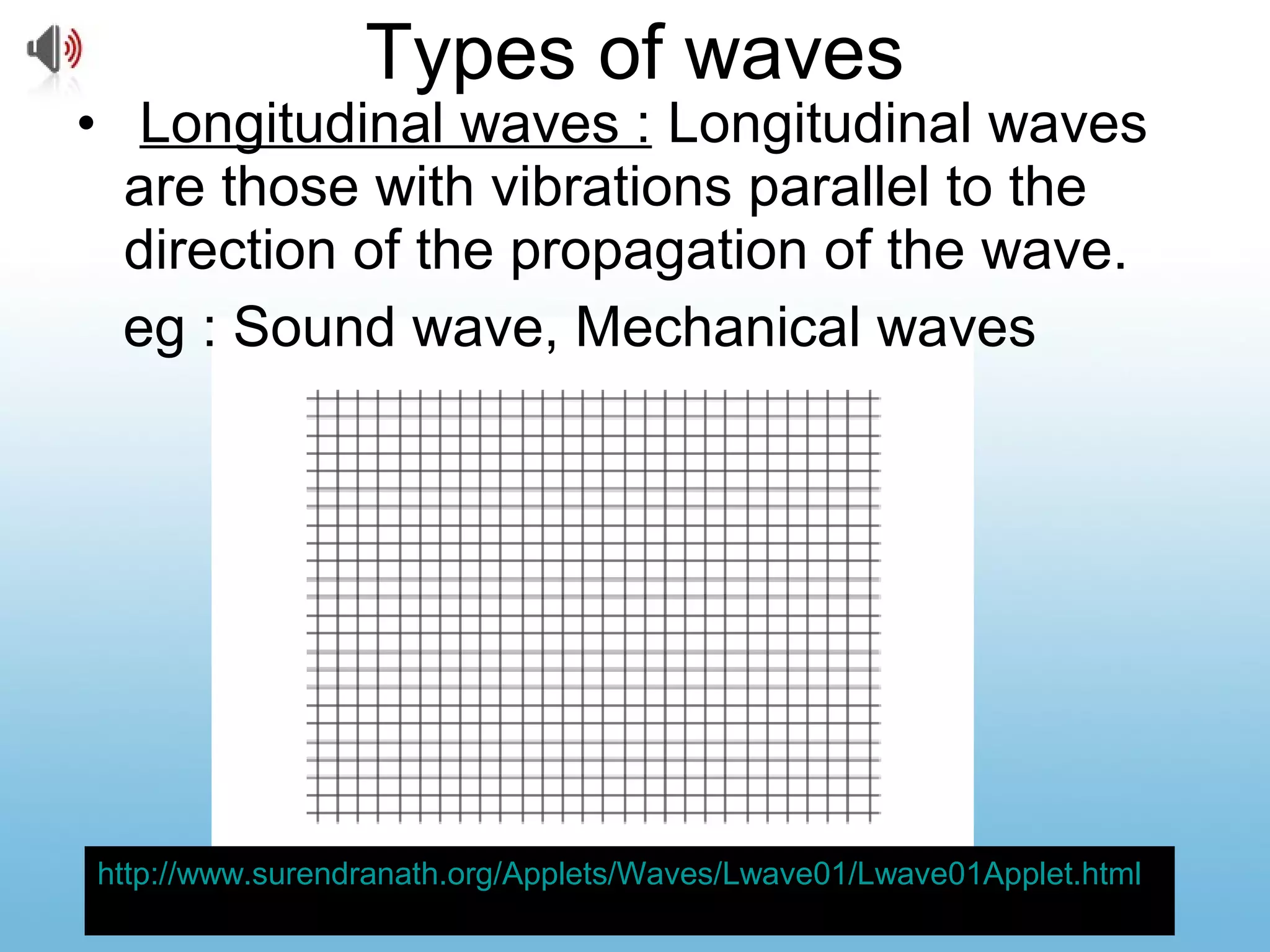
• Longitudinal waves : Longitudinal waves
are those with vibrations parallel to the
direction of the propagation of the wave.
eg : Sound wave, Mechanical waves
http://www.surendranath.org/Applets/Waves/Lwave01/Lwave01Applet.html
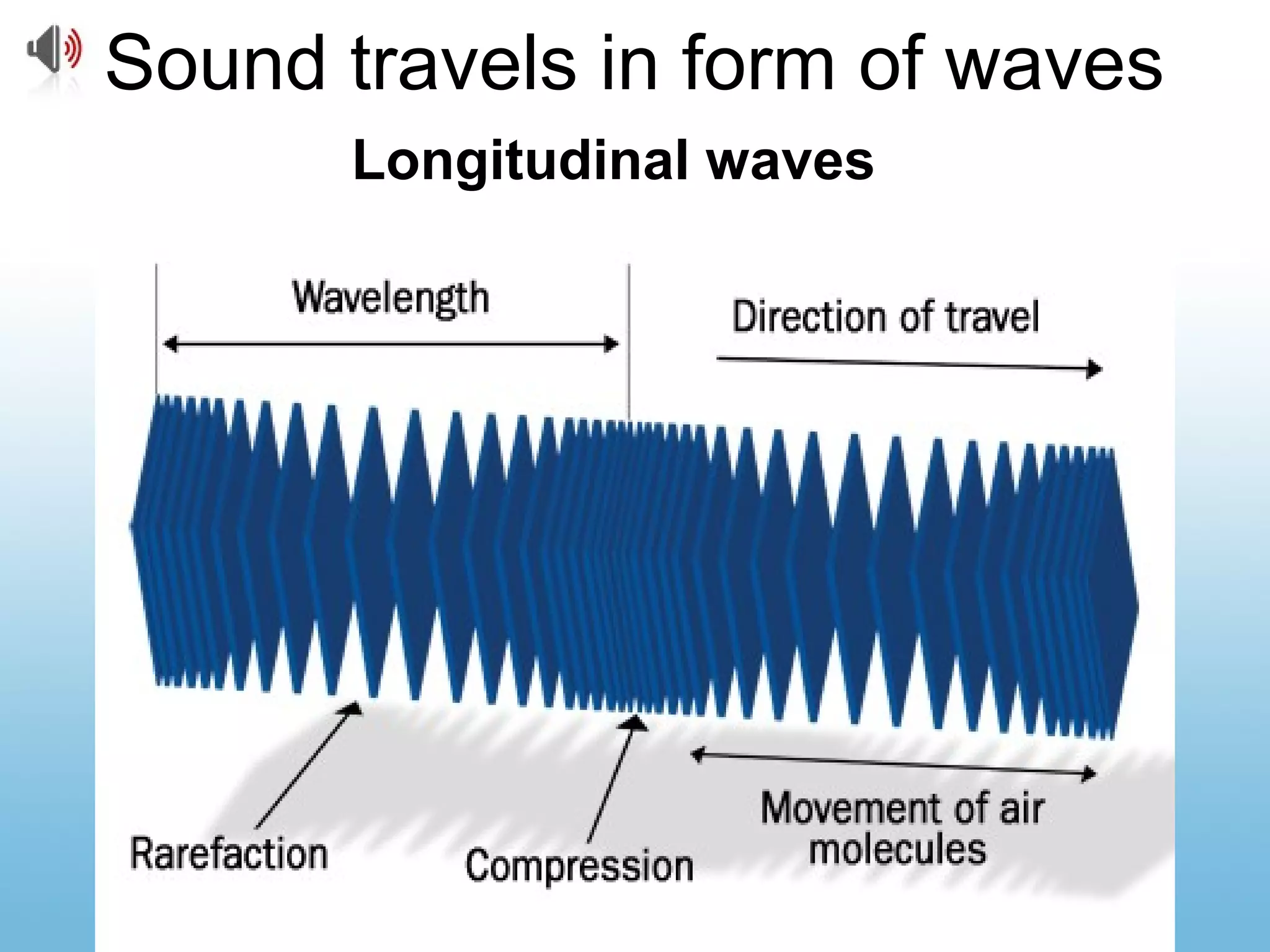
Sound travels in form of waves
Longitudinal waves
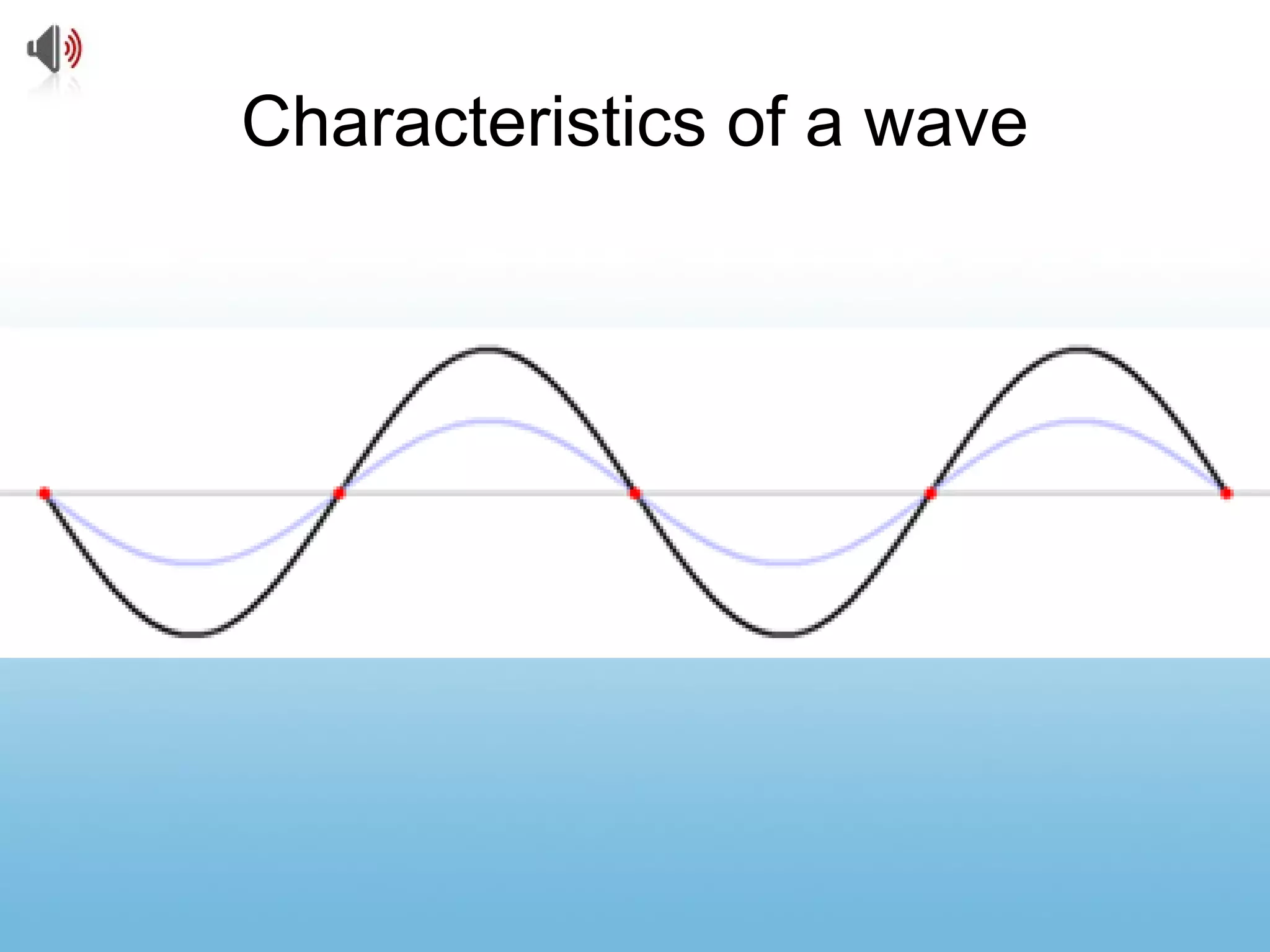
Characteristics of a wave
Characteristics of waves
Amplitude
Wavelength
Frequency
Time period
Velocity of wave
Play
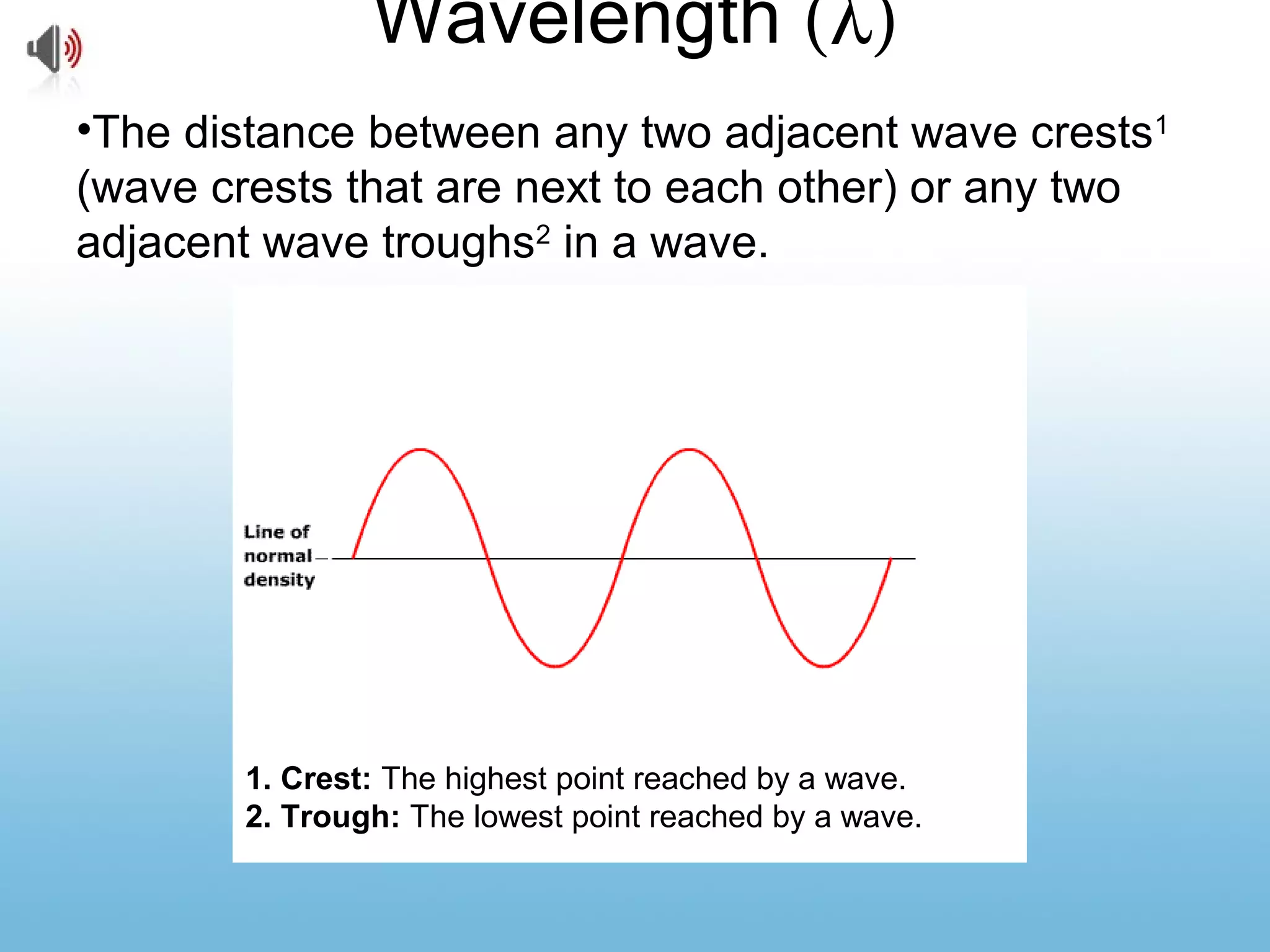
Wavelength (λ)
•The distance between any two adjacent wave crests1
(wave crests that are next to each other) or any two
adjacent wave troughs2
in a wave.
1. Crest: The highest point reached by a wave.
2. Trough: The lowest point reached by a wave.
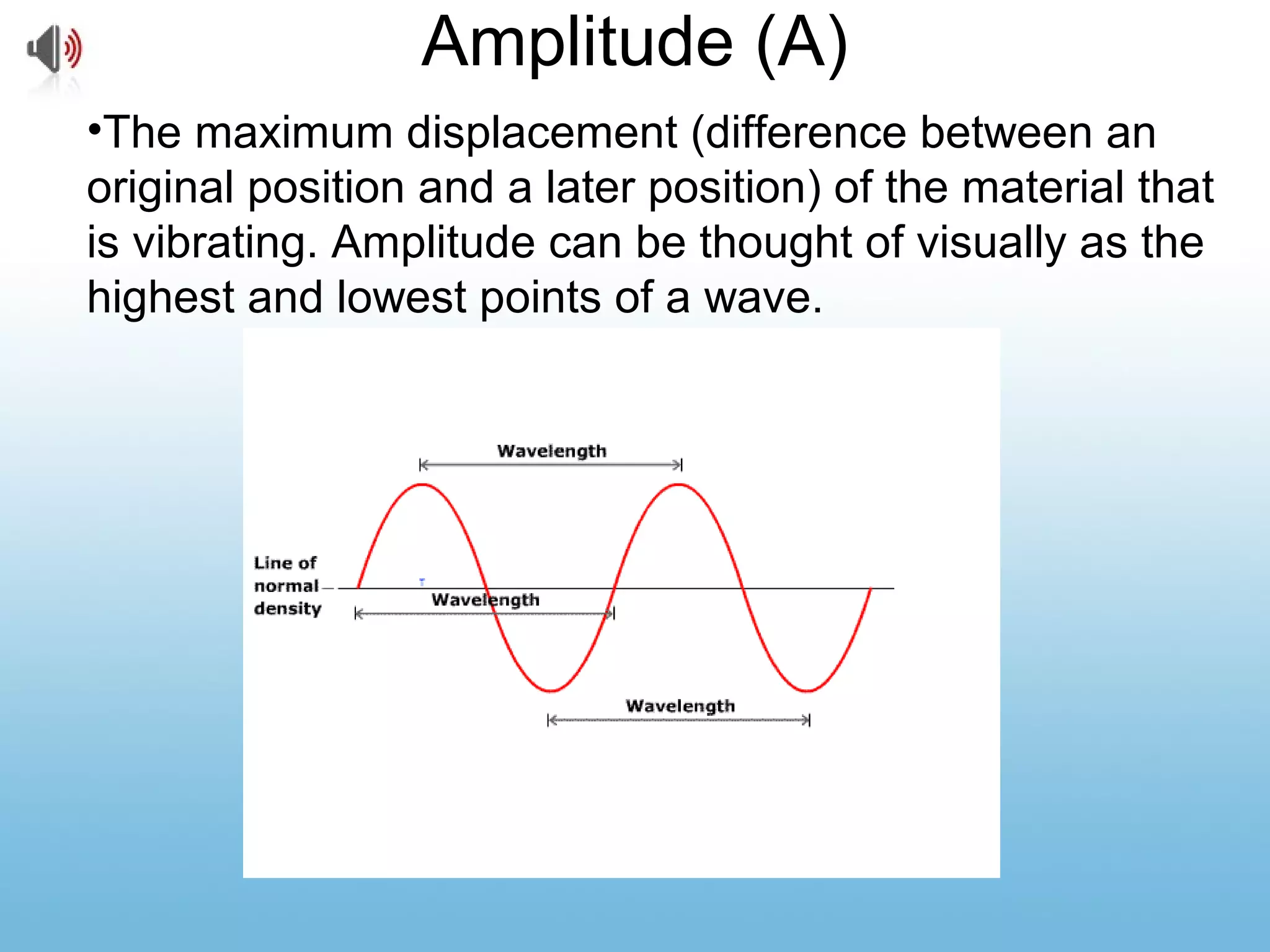
Amplitude (A)
•The maximum displacement (difference between an
original position and a later position) of the material that
is vibrating. Amplitude can be thought of visually as the
highest and lowest points of a wave.
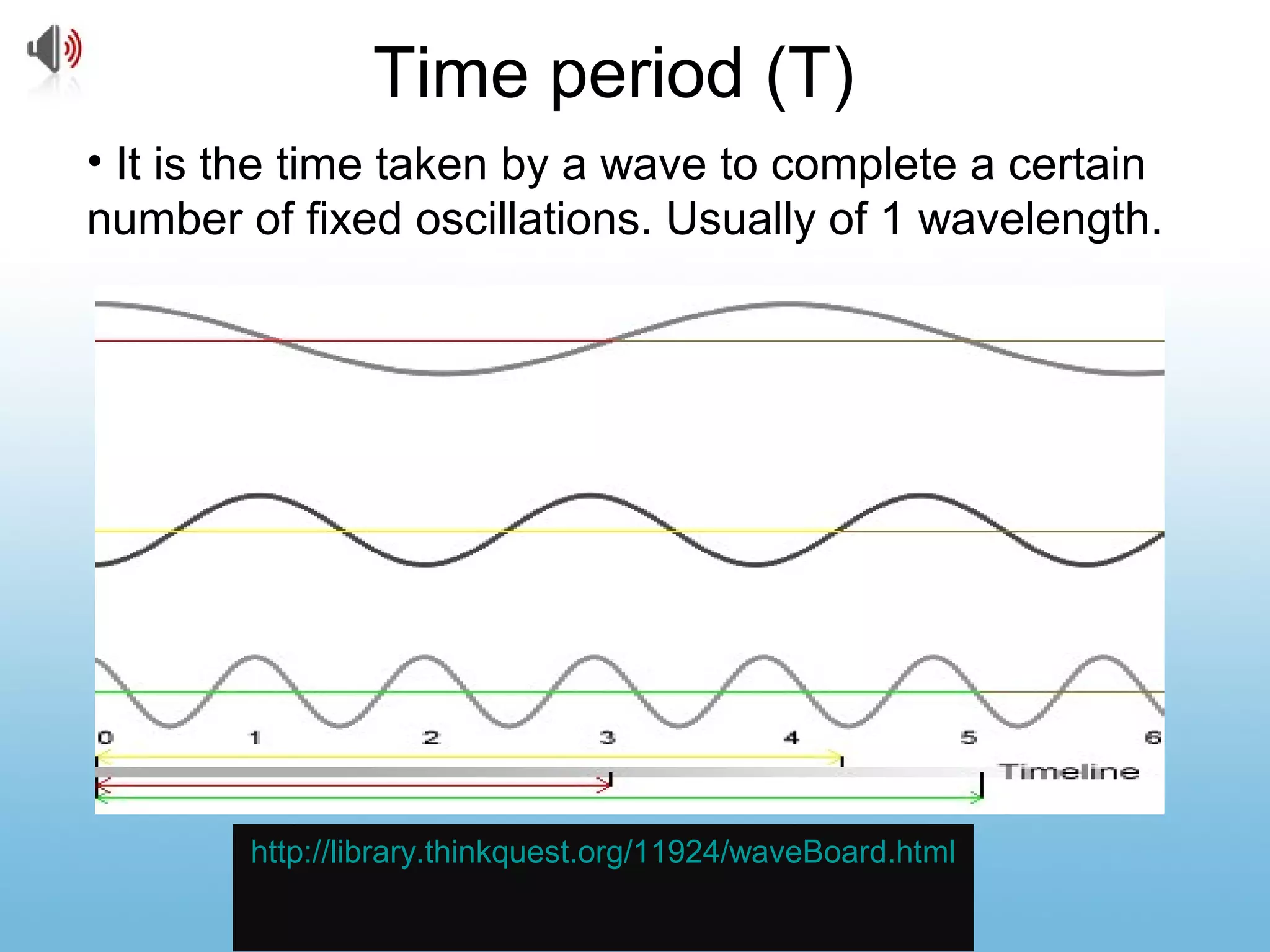
Time period (T)
http://library.thinkquest.org/11924/waveBoard.html
• It is the time taken by a wave to complete a certain
number of fixed oscillations. Usually of 1 wavelength.
Frequency (f/n)
•The number of wave crests (or wave troughs) that
pass a given point per unit of time (usually per
second).
• Frequency (f) = 1 / Time Period (T)
• SI unit of ‘f’ is Hertz (Hz).
• Hz = 1 / sec
Velocity of wave
• The distance travelled divided by the time taken.
• Velocity (v) = Distance (λ) / Time taken (T)
v = λ x f
How sound is produced
Sound travels due to vibrations
(disturbance) produced in the medium.
• Video 1
• Video 2
• Video 3
• Video 4
How sound travels
Sound travels through material medium in
the form of compression and rarefaction.
• Video 1
• Video 2
• Video 3
Speed of sound
• It is the speed with which a sound pulse
travels from the source to the observer.
• Sound travels through air at NRTP with 334
m/s.
Factor affecting speed of sound :
Density of medium : Speed of sound is
directly proportional to the density of the
medium.
Speed of sound
1 Mach (M) = 334 m/sec
• Subsonic: M < 1
• Sonic: M = 1
• Supersonic: 1 < M < 5
• Hypersonic: M > 5
Reflection of sound
• We know, <i = <r (Refer practical sheet)
• Some examples : Stethoscope,
Soundboard
• Lets see some more examples :
• Video 1
• Video 2
• Video 3
Echo
• Reflection of sound is called Echo.
• We can hear two consecutive sounds only
if there is a time gap of 1/10th
of a second
(0.1s).
• Note that this value is only for sound in air
and will be different for different mediums.
• Let us calculate the minimum distance to
hear a Echo…..
Reverberation
• Basically it is unwanted Echo.
• Reverberation in a hall can be avoided by
use of :
i. Panels made of porous & soft materials.
ii.Using floor carpets
iii.Using curtains, sofa sets etc.
Human Ear
• Human ear senses sound by the vibration of ear drums.
eg: Video 1 , Video 2, Video 3
• The human can hear all the frequencies between
20 – 20,000 Hz.
• Frequencies < 20 Hz are called Infrasonic.
eg : Whales
• Frequencies > 20,000 Hz are called Ultrasonic.
eg : Bats
Ultrasound
•As ultrasound have high frequency they have high
energy & high penetration power which makes it
helpful in many tasks.
Eg : i . To study internal organs in body.
ii. To study the development of fetus.
iii. To break kidney stones.
iv. Used in SONAR.
SONAR (SOund Navigation And Ranging) is a
technique that uses Ultrasonic frequency to
navigate, communicate with or detect other
vessels & to study the landscape.
Thank You !

Sound

  • 2.
    Sound • Sound meansbasically the mechanical vibrations. • These vibrations require a material medium to travel through. eg : Solid, liquid, gas, plasma • Meaning Sound cannot travel through Vacuum. (Why ?)
  • 3.
    Sound as Wave •Sound travels in the form of waves. • Wave : A wave is a disturbance that propagates through space and time, usually with transference of energy. • Waves travel and transfer energy from one point to another, often with no permanent displacement of the particles of the medium (that is, with little or no associated mass transport); they consist oscillations or vibrations (of particles) around almost fixed locations.
  • 4.
    Types of waves •Transverse Wave : Transverse waves are those with vibrations perpendicular to the direction of the propagation of the wave; examples include waves on a string, and electromagnetic waves. • eg. : Light (i.e. Electromagnetic waves) http://www.phy.ntnu.edu.tw/ntnujava/index.php?topic=35
  • 5.
    Types of waves •Longitudinal waves : Longitudinal waves are those with vibrations parallel to the direction of the propagation of the wave. eg : Sound wave, Mechanical waves http://www.surendranath.org/Applets/Waves/Lwave01/Lwave01Applet.html
  • 6.
    Sound travels inform of waves Longitudinal waves
  • 7.
  • 8.
  • 9.
    Wavelength (λ) •The distancebetween any two adjacent wave crests1 (wave crests that are next to each other) or any two adjacent wave troughs2 in a wave. 1. Crest: The highest point reached by a wave. 2. Trough: The lowest point reached by a wave.
  • 10.
    Amplitude (A) •The maximumdisplacement (difference between an original position and a later position) of the material that is vibrating. Amplitude can be thought of visually as the highest and lowest points of a wave.
  • 11.
    Time period (T) http://library.thinkquest.org/11924/waveBoard.html •It is the time taken by a wave to complete a certain number of fixed oscillations. Usually of 1 wavelength.
  • 12.
    Frequency (f/n) •The numberof wave crests (or wave troughs) that pass a given point per unit of time (usually per second). • Frequency (f) = 1 / Time Period (T) • SI unit of ‘f’ is Hertz (Hz). • Hz = 1 / sec
  • 13.
    Velocity of wave •The distance travelled divided by the time taken. • Velocity (v) = Distance (λ) / Time taken (T) v = λ x f
  • 14.
    How sound isproduced Sound travels due to vibrations (disturbance) produced in the medium. • Video 1 • Video 2 • Video 3 • Video 4
  • 15.
    How sound travels Soundtravels through material medium in the form of compression and rarefaction. • Video 1 • Video 2 • Video 3
  • 16.
    Speed of sound •It is the speed with which a sound pulse travels from the source to the observer. • Sound travels through air at NRTP with 334 m/s. Factor affecting speed of sound : Density of medium : Speed of sound is directly proportional to the density of the medium.
  • 17.
    Speed of sound 1Mach (M) = 334 m/sec • Subsonic: M < 1 • Sonic: M = 1 • Supersonic: 1 < M < 5 • Hypersonic: M > 5
  • 18.
    Reflection of sound •We know, <i = <r (Refer practical sheet) • Some examples : Stethoscope, Soundboard • Lets see some more examples : • Video 1 • Video 2 • Video 3
  • 19.
    Echo • Reflection ofsound is called Echo. • We can hear two consecutive sounds only if there is a time gap of 1/10th of a second (0.1s). • Note that this value is only for sound in air and will be different for different mediums. • Let us calculate the minimum distance to hear a Echo…..
  • 20.
    Reverberation • Basically itis unwanted Echo. • Reverberation in a hall can be avoided by use of : i. Panels made of porous & soft materials. ii.Using floor carpets iii.Using curtains, sofa sets etc.
  • 21.
    Human Ear • Humanear senses sound by the vibration of ear drums. eg: Video 1 , Video 2, Video 3 • The human can hear all the frequencies between 20 – 20,000 Hz. • Frequencies < 20 Hz are called Infrasonic. eg : Whales • Frequencies > 20,000 Hz are called Ultrasonic. eg : Bats
  • 22.
    Ultrasound •As ultrasound havehigh frequency they have high energy & high penetration power which makes it helpful in many tasks. Eg : i . To study internal organs in body. ii. To study the development of fetus. iii. To break kidney stones. iv. Used in SONAR. SONAR (SOund Navigation And Ranging) is a technique that uses Ultrasonic frequency to navigate, communicate with or detect other vessels & to study the landscape.
  • 23.