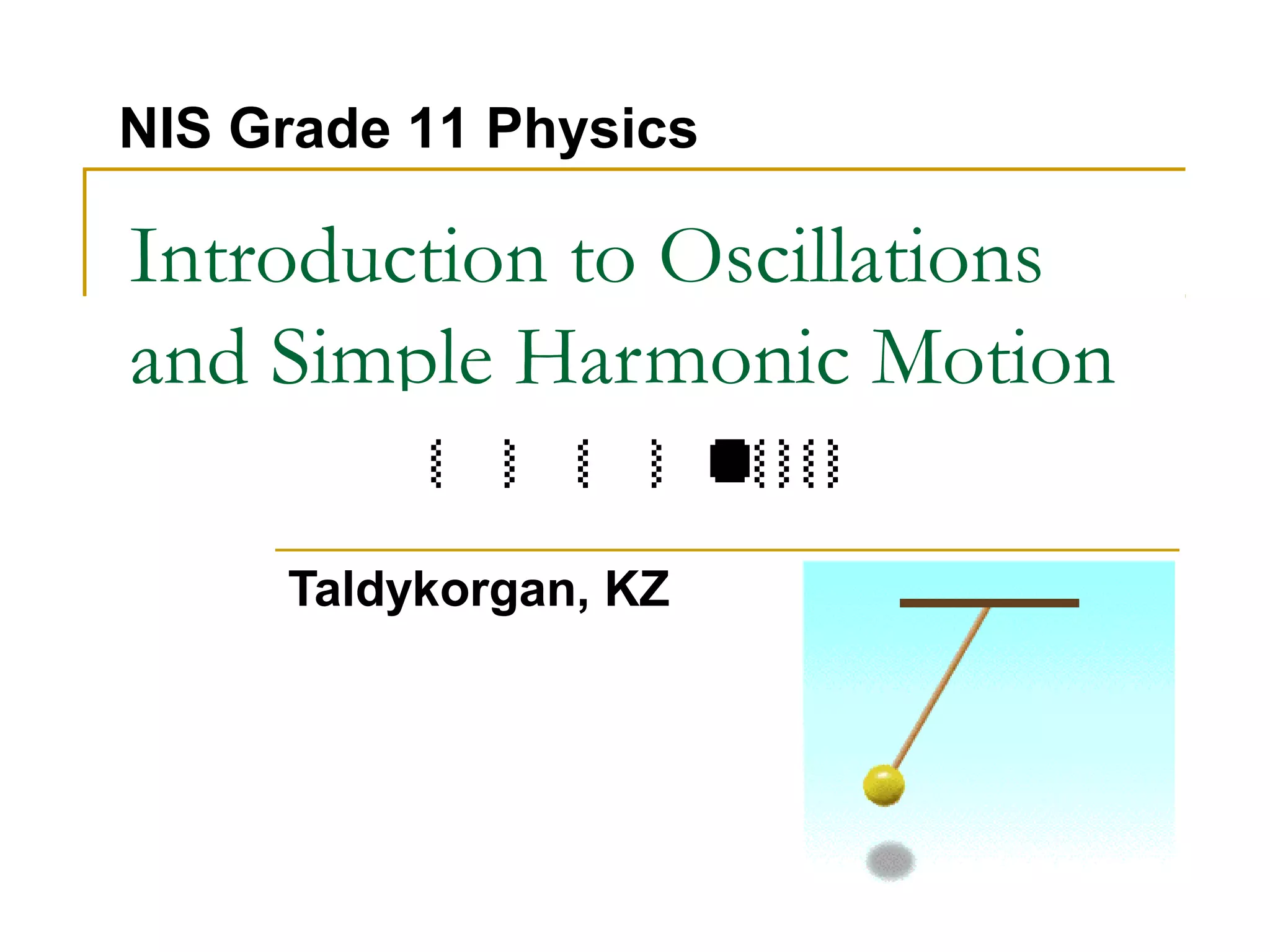
Introduction to Oscillations
and Simple Harmonic Motion
Taldykorgan, KZ
NIS Grade 11 Physics
Objectives:
 Describe examples of free oscillations.
 Describe the conditions of Simple Harmonic
Motion.
 Apply Hooke’s Law for objects moving with
simple harmonic motion.
 Describe the motion of pendulums and
calculate the length required to produce a
given frequency.
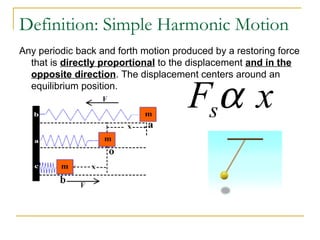
Definition: Simple Harmonic Motion
Any periodic back and forth motion produced by a restoring force
that is directly proportional to the displacement and in the
opposite direction. The displacement centers around an
equilibrium position.
xFsα
4
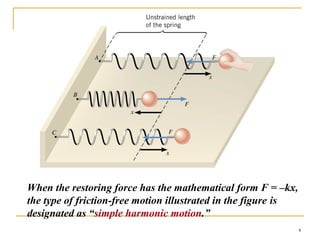
When the restoring force has the mathematical form F = –kx,
the type of friction-free motion illustrated in the figure is
designated as “simple harmonic motion.”
Springs – Hooke’s Law
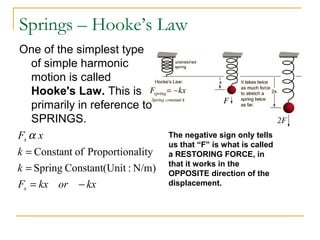
One of the simplest type
of simple harmonic
motion is called
Hooke's Law. This is
primarily in reference to
SPRINGS.
kxorkxF
k
k
xF
s
s
−=
=
=
N/m):nitConstant(USpring
alityProportionofConstant
α The negative sign only tells
us that “F” is what is called
a RESTORING FORCE, in
that it works in the
OPPOSITE direction of the
displacement.
6
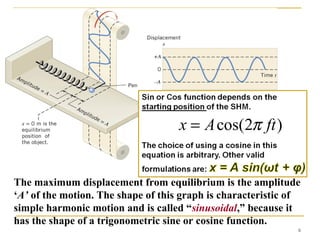
The maximum displacement from equilibrium is the amplitude
‘A’ of the motion. The shape of this graph is characteristic of
simple harmonic motion and is called “sinusoidal,” because it
has the shape of a trigonometric sine or cosine function.
cos(2 )x A ftπ=
Springs are like Waves and Circles
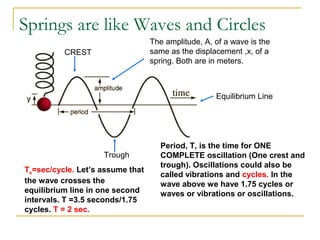
The amplitude, A, of a wave is the
same as the displacement ,x, of a
spring. Both are in meters.
CREST
Trough
Equilibrium Line
Period, T, is the time for ONE
COMPLETE oscillation (One crest and
trough). Oscillations could also be
called vibrations and cycles. In the
wave above we have 1.75 cycles or
waves or vibrations or oscillations.
Ts=sec/cycle. Let’s assume that
the wave crosses the
equilibrium line in one second
intervals. T =3.5 seconds/1.75
cycles. T = 2 sec.
Frequency
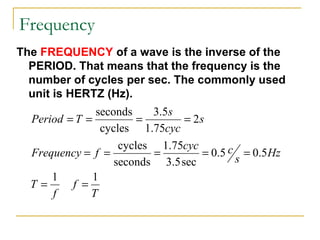
The FREQUENCY of a wave is the inverse of the
PERIOD. That means that the frequency is the
number of cycles per sec. The commonly used
unit is HERTZ (Hz).
T
f
f
T
Hz
s
ccyc
fFrequency
s
cyc
s
TPeriod
11
5.05.0
sec5.3
75.1
seconds
cycles
2
75.1
5.3
cycles
seconds
==
=====
====
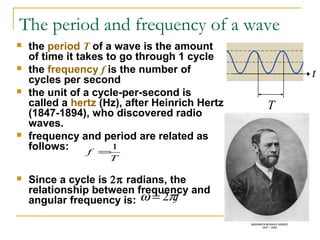
The period and frequency of a wave
 the period T of a wave is the amount
of time it takes to go through 1 cycle
 the frequency f is the number of
cycles per second
 the unit of a cycle-per-second is
called a hertz (Hz), after Heinrich Hertz
(1847-1894), who discovered radio
waves.
 frequency and period are related as
follows:
 Since a cycle is 2π radians, the
relationship between frequency and
angular frequency is:
T
f
1
=
fπω 2=
T
t
10
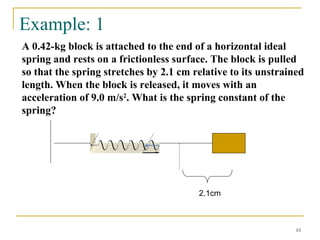
Example: 1
A 0.42-kg block is attached to the end of a horizontal ideal
spring and rests on a frictionless surface. The block is pulled
so that the spring stretches by 2.1 cm relative to its unstrained
length. When the block is released, it moves with an
acceleration of 9.0 m/s2
. What is the spring constant of the
spring?
2.1cm
2.1cm
11
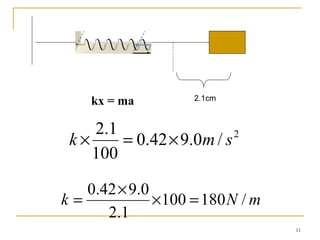
kx = ma
2
/0.942.0
100
1.2
smk ×=×
mNk /180100
1.2
0.942.0
=×
×
=
12
Energy and Simple Harmonic 
Motion
A spring also has potential
energy when the spring is
stretched or compressed,
which we refer to as elastic
potential energy. Because of
elastic potential energy, a
stretched or compressed
spring can do work on an
object that is attached to the
spring.
13
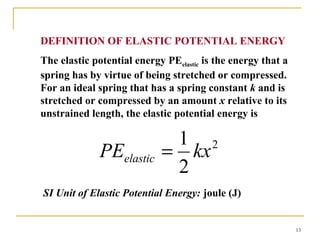
DEFINITION OF ELASTIC POTENTIAL ENERGY
The elastic potential energy PEelastic is the energy that a
spring has by virtue of being stretched or compressed.
For an ideal spring that has a spring constant k and is
stretched or compressed by an amount x relative to its
unstrained length, the elastic potential energy is
SI Unit of Elastic Potential Energy: joule (J)
2
2
1
kxPEelastic =
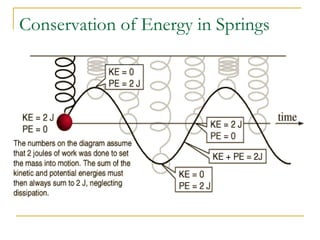
Conservation of Energy in Springs
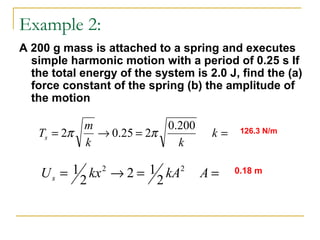
Example 2:
A 200 g mass is attached to a spring and executes
simple harmonic motion with a period of 0.25 s If
the total energy of the system is 2.0 J, find the (a)
force constant of the spring (b) the amplitude of
the motion
==→= k
kk
m
Ts
200.0
225.02 ππ
==→= AkAkxUs
22
2
12
2
1
126.3 N/m
0.18 m
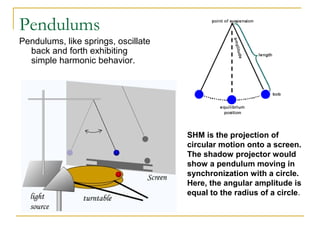
Pendulums
Pendulums, like springs, oscillate
back and forth exhibiting
simple harmonic behavior.
SHM is the projection of
circular motion onto a screen.
The shadow projector would
show a pendulum moving in
synchronization with a circle.
Here, the angular amplitude is
equal to the radius of a circle.
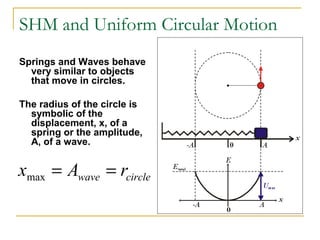
SHM and Uniform Circular Motion
Springs and Waves behave
very similar to objects
that move in circles.
The radius of the circle is
symbolic of the
displacement, x, of a
spring or the amplitude,
A, of a wave.
circlewave rAx ==max
18
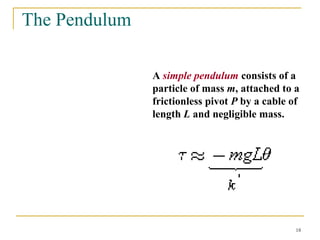
The Pendulum
A simple pendulum consists of a
particle of mass m, attached to a
frictionless pivot P by a cable of
length L and negligible mass.
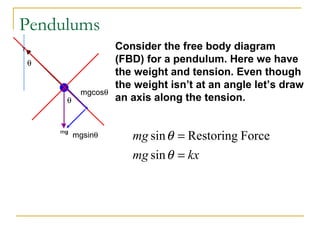
Pendulums
Consider the free body diagram
(FBD) for a pendulum. Here we have
the weight and tension. Even though
the weight isn’t at an angle let’s draw
an axis along the tension.θ
θ
mgcosθ
mgsinθ
kxmg
mg
=
=
θ
θ
sin
ForceRestoringsin
Pendulums
kxmg
mg
=
=
θ
θ
sin
ForceRestoringsin
k
m
T
g
l
k
m
klmg
smallif
Lkmg
AmplitudeLs
L
s
R
s
spring π
θθθ
θθ
θ
θ
2
,sin
sin
=
=
=
=≅
=
==
==
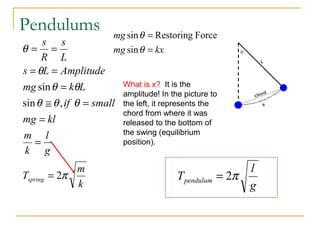
What is x? It is the
amplitude! In the picture to
the left, it represents the
chord from where it was
released to the bottom of
the swing (equilibrium
position).
g
l
Tpendulum π2=
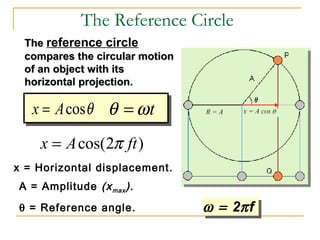
TheThe reference circle
compares the circular motioncompares the circular motion
of an object with itsof an object with its
horizontal projection.horizontal projection.
ω = 2πf
The Reference Circle
cos(2 )x A ftπ=
cosx A θ= tθ ω=
x = Horizontal displacement.
A = Amplitude (xmax).
θ = Reference angle.
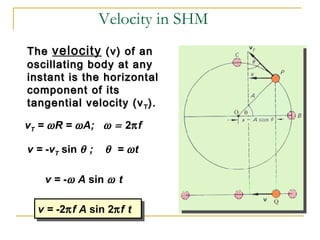
Velocity in SHM
TheThe velocity (v) of an(v) of an
oscillating body at anyoscillating body at any
instant is the horizontalinstant is the horizontal
component of itscomponent of its
tangential velocity (vtangential velocity (vTT ).).
vT = ωR = ωA; ω = 2πf
v = -vT sin θ ; θ = ωt
v = -ω A sin ω t
v = -2πf A sin 2πf tv = -2πf A sin 2πf t
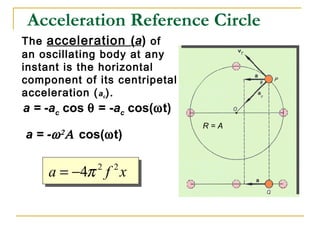
The acceleration (a) of
an oscillating body at any
instant is the horizontal
component of its centripetal
acceleration (ac).
Acceleration Reference Circle
a = -ac cos θ = -ac cos(ωt)
2 2 2
2
;c c
v R
a a R
R R
ω
ω= = =
R = A
a = -ω2
Α cos(ωt)
2 2
4 cos(2 )a f A ftπ π= − 2 2
4a f xπ= −
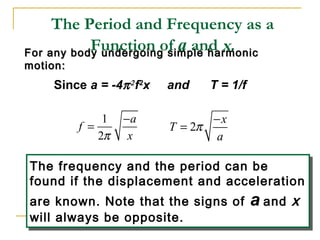
The Period and Frequency as a
Function of a and x.For any body undergoing simple harmonicFor any body undergoing simple harmonic
motion:motion:
Since a = -4π2
f2
x and T = 1/f
1
2
a
f
xπ
−
= 2
x
T
a
π
−
=
The frequency and the period can be
found if the displacement and acceleration
are known. Note that the signs of a and x
will always be opposite.
The frequency and the period can be
found if the displacement and acceleration
are known. Note that the signs of a and x
will always be opposite.
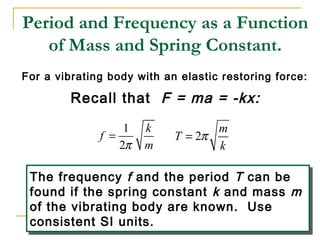
Period and Frequency as a Function
of Mass and Spring Constant.
For a vibrating body with an elastic restoring force:
Recall that F = ma = -kx:
1
2
k
f
mπ
= 2
m
T
k
π=
The frequency f and the period T can be
found if the spring constant k and mass m
of the vibrating body are known. Use
consistent SI units.
The frequency f and the period T can be
found if the spring constant k and mass m
of the vibrating body are known. Use
consistent SI units.
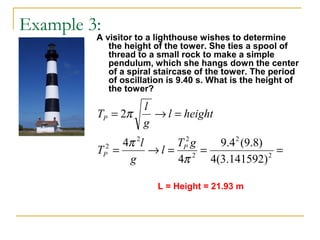
Example 3:
A visitor to a lighthouse wishes to determine
the height of the tower. She ties a spool of
thread to a small rock to make a simple
pendulum, which she hangs down the center
of a spiral staircase of the tower. The period
of oscillation is 9.40 s. What is the height of
the tower?
===→=
=→=
2
2
2
22
2
)141592.3(4
)8.9(4.9
4
4
2
π
π
π
gT
l
g
l
T
heightl
g
l
T
P
P
P
L = Height = 21.93 m
Graphical Analysis of
Simple Harmonic Motion
NIS, Taldykorgan Grade 11 Physics
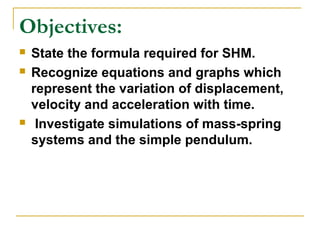
Objectives:
 State the formula required for SHM.
 Recognize equations and graphs which
represent the variation of displacement,
velocity and acceleration with time.
 Investigate simulations of mass-spring
systems and the simple pendulum.
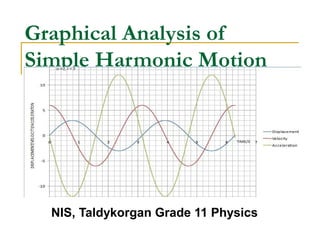
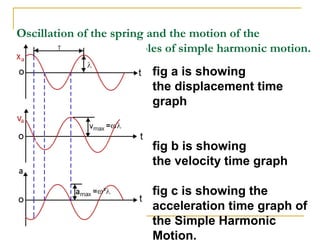
Oscillation of the spring and the motion of the
pendulum are the examples of simple harmonic motion.
fig a is showing
the displacement time
graph
fig b is showing
the velocity time graph
fig c is showing the
acceleration time graph of
the Simple Harmonic
Motion.
Simple Harmonic Motion References
 http://www.physics.uoguelph.ca/tutorials/shm/Q.shm.html
 http://www.youtube.com/watch?v=bPtlRf6dg8c
The Fizzics Organization: A level tutorials and Your tube play list:
 https://www.youtube.com/playlist?
list=PLLKB_7Zd6lePXgOD1QBgl3d6D14x6mc_p
Simple Harmonic Motion @ www.ThePhysicsCafe.com
 http://www.youtube.com/watch?v=SZ541Luq4nE
Many slides have been modified from Paul E.Tippens, Professor of
Physics, Southern Polytechnic State University :
 https://www.google.me/url?
sa=t&rct=j&q=&esrc=s&source=web&cd=1&cad=rja&uact=8&ved=0
CBsQFjAA&url=http%3A%2F%2Fhighered.mheducation.com
%2Fsites%2Fdl%2Ffree%2F007301267x
%2F294279%2FChapter14.ppt&ei=C6x_VJ6FIYL_ygPM-
YKQCA&usg=AFQjCNGa4CRKUgdcYzFFfad6QWOfq_NAsQ&bvm
=bv.80642063,d.bGQ

Introduction to oscillations and simple harmonic motion

  • 1.
    Introduction to Oscillations andSimple Harmonic Motion Taldykorgan, KZ NIS Grade 11 Physics
  • 2.
    Objectives:  Describe examplesof free oscillations.  Describe the conditions of Simple Harmonic Motion.  Apply Hooke’s Law for objects moving with simple harmonic motion.  Describe the motion of pendulums and calculate the length required to produce a given frequency.
  • 3.
    Definition: Simple HarmonicMotion Any periodic back and forth motion produced by a restoring force that is directly proportional to the displacement and in the opposite direction. The displacement centers around an equilibrium position. xFsα
  • 4.
    4 When the restoringforce has the mathematical form F = –kx, the type of friction-free motion illustrated in the figure is designated as “simple harmonic motion.”
  • 5.
    Springs – Hooke’sLaw One of the simplest type of simple harmonic motion is called Hooke's Law. This is primarily in reference to SPRINGS. kxorkxF k k xF s s −= = = N/m):nitConstant(USpring alityProportionofConstant α The negative sign only tells us that “F” is what is called a RESTORING FORCE, in that it works in the OPPOSITE direction of the displacement.
  • 6.
    6 The maximum displacementfrom equilibrium is the amplitude ‘A’ of the motion. The shape of this graph is characteristic of simple harmonic motion and is called “sinusoidal,” because it has the shape of a trigonometric sine or cosine function. cos(2 )x A ftπ=
  • 7.
    Springs are likeWaves and Circles The amplitude, A, of a wave is the same as the displacement ,x, of a spring. Both are in meters. CREST Trough Equilibrium Line Period, T, is the time for ONE COMPLETE oscillation (One crest and trough). Oscillations could also be called vibrations and cycles. In the wave above we have 1.75 cycles or waves or vibrations or oscillations. Ts=sec/cycle. Let’s assume that the wave crosses the equilibrium line in one second intervals. T =3.5 seconds/1.75 cycles. T = 2 sec.
  • 8.
    Frequency The FREQUENCY ofa wave is the inverse of the PERIOD. That means that the frequency is the number of cycles per sec. The commonly used unit is HERTZ (Hz). T f f T Hz s ccyc fFrequency s cyc s TPeriod 11 5.05.0 sec5.3 75.1 seconds cycles 2 75.1 5.3 cycles seconds == ===== ====
  • 9.
    The period andfrequency of a wave  the period T of a wave is the amount of time it takes to go through 1 cycle  the frequency f is the number of cycles per second  the unit of a cycle-per-second is called a hertz (Hz), after Heinrich Hertz (1847-1894), who discovered radio waves.  frequency and period are related as follows:  Since a cycle is 2π radians, the relationship between frequency and angular frequency is: T f 1 = fπω 2= T t
  • 10.
    10 Example: 1 A 0.42-kg blockis attached to the end of a horizontal ideal spring and rests on a frictionless surface. The block is pulled so that the spring stretches by 2.1 cm relative to its unstrained length. When the block is released, it moves with an acceleration of 9.0 m/s2 . What is the spring constant of the spring? 2.1cm
  • 11.
    2.1cm 11 kx = ma 2 /0.942.0 100 1.2 smk×=× mNk /180100 1.2 0.942.0 =× × =
  • 12.
    12 Energy and Simple Harmonic  Motion A spring alsohas potential energy when the spring is stretched or compressed, which we refer to as elastic potential energy. Because of elastic potential energy, a stretched or compressed spring can do work on an object that is attached to the spring.
  • 13.
    13 DEFINITION OF ELASTICPOTENTIAL ENERGY The elastic potential energy PEelastic is the energy that a spring has by virtue of being stretched or compressed. For an ideal spring that has a spring constant k and is stretched or compressed by an amount x relative to its unstrained length, the elastic potential energy is SI Unit of Elastic Potential Energy: joule (J) 2 2 1 kxPEelastic =
  • 14.
  • 15.
    Example 2: A 200g mass is attached to a spring and executes simple harmonic motion with a period of 0.25 s If the total energy of the system is 2.0 J, find the (a) force constant of the spring (b) the amplitude of the motion ==→= k kk m Ts 200.0 225.02 ππ ==→= AkAkxUs 22 2 12 2 1 126.3 N/m 0.18 m
  • 16.
    Pendulums Pendulums, like springs,oscillate back and forth exhibiting simple harmonic behavior. SHM is the projection of circular motion onto a screen. The shadow projector would show a pendulum moving in synchronization with a circle. Here, the angular amplitude is equal to the radius of a circle.
  • 17.
    SHM and UniformCircular Motion Springs and Waves behave very similar to objects that move in circles. The radius of the circle is symbolic of the displacement, x, of a spring or the amplitude, A, of a wave. circlewave rAx ==max
  • 18.
    18 The Pendulum A simplependulum consists of a particle of mass m, attached to a frictionless pivot P by a cable of length L and negligible mass.
  • 19.
    Pendulums Consider the freebody diagram (FBD) for a pendulum. Here we have the weight and tension. Even though the weight isn’t at an angle let’s draw an axis along the tension.θ θ mgcosθ mgsinθ kxmg mg = = θ θ sin ForceRestoringsin
  • 20.
    Pendulums kxmg mg = = θ θ sin ForceRestoringsin k m T g l k m klmg smallif Lkmg AmplitudeLs L s R s spring π θθθ θθ θ θ 2 ,sin sin = = = =≅ = == == What isx? It is the amplitude! In the picture to the left, it represents the chord from where it was released to the bottom of the swing (equilibrium position). g l Tpendulum π2=
  • 21.
    TheThe reference circle comparesthe circular motioncompares the circular motion of an object with itsof an object with its horizontal projection.horizontal projection. ω = 2πf The Reference Circle cos(2 )x A ftπ= cosx A θ= tθ ω= x = Horizontal displacement. A = Amplitude (xmax). θ = Reference angle.
  • 22.
    Velocity in SHM TheThevelocity (v) of an(v) of an oscillating body at anyoscillating body at any instant is the horizontalinstant is the horizontal component of itscomponent of its tangential velocity (vtangential velocity (vTT ).). vT = ωR = ωA; ω = 2πf v = -vT sin θ ; θ = ωt v = -ω A sin ω t v = -2πf A sin 2πf tv = -2πf A sin 2πf t
  • 23.
    The acceleration (a)of an oscillating body at any instant is the horizontal component of its centripetal acceleration (ac). Acceleration Reference Circle a = -ac cos θ = -ac cos(ωt) 2 2 2 2 ;c c v R a a R R R ω ω= = = R = A a = -ω2 Α cos(ωt) 2 2 4 cos(2 )a f A ftπ π= − 2 2 4a f xπ= −
  • 24.
    The Period andFrequency as a Function of a and x.For any body undergoing simple harmonicFor any body undergoing simple harmonic motion:motion: Since a = -4π2 f2 x and T = 1/f 1 2 a f xπ − = 2 x T a π − = The frequency and the period can be found if the displacement and acceleration are known. Note that the signs of a and x will always be opposite. The frequency and the period can be found if the displacement and acceleration are known. Note that the signs of a and x will always be opposite.
  • 25.
    Period and Frequencyas a Function of Mass and Spring Constant. For a vibrating body with an elastic restoring force: Recall that F = ma = -kx: 1 2 k f mπ = 2 m T k π= The frequency f and the period T can be found if the spring constant k and mass m of the vibrating body are known. Use consistent SI units. The frequency f and the period T can be found if the spring constant k and mass m of the vibrating body are known. Use consistent SI units.
  • 26.
    Example 3: A visitorto a lighthouse wishes to determine the height of the tower. She ties a spool of thread to a small rock to make a simple pendulum, which she hangs down the center of a spiral staircase of the tower. The period of oscillation is 9.40 s. What is the height of the tower? ===→= =→= 2 2 2 22 2 )141592.3(4 )8.9(4.9 4 4 2 π π π gT l g l T heightl g l T P P P L = Height = 21.93 m
  • 27.
    Graphical Analysis of SimpleHarmonic Motion NIS, Taldykorgan Grade 11 Physics
  • 28.
    Objectives:  State theformula required for SHM.  Recognize equations and graphs which represent the variation of displacement, velocity and acceleration with time.  Investigate simulations of mass-spring systems and the simple pendulum.
  • 29.
    Oscillation of thespring and the motion of the pendulum are the examples of simple harmonic motion. fig a is showing the displacement time graph fig b is showing the velocity time graph fig c is showing the acceleration time graph of the Simple Harmonic Motion.
  • 30.
    Simple Harmonic MotionReferences  http://www.physics.uoguelph.ca/tutorials/shm/Q.shm.html  http://www.youtube.com/watch?v=bPtlRf6dg8c The Fizzics Organization: A level tutorials and Your tube play list:  https://www.youtube.com/playlist? list=PLLKB_7Zd6lePXgOD1QBgl3d6D14x6mc_p Simple Harmonic Motion @ www.ThePhysicsCafe.com  http://www.youtube.com/watch?v=SZ541Luq4nE Many slides have been modified from Paul E.Tippens, Professor of Physics, Southern Polytechnic State University :  https://www.google.me/url? sa=t&rct=j&q=&esrc=s&source=web&cd=1&cad=rja&uact=8&ved=0 CBsQFjAA&url=http%3A%2F%2Fhighered.mheducation.com %2Fsites%2Fdl%2Ffree%2F007301267x %2F294279%2FChapter14.ppt&ei=C6x_VJ6FIYL_ygPM- YKQCA&usg=AFQjCNGa4CRKUgdcYzFFfad6QWOfq_NAsQ&bvm =bv.80642063,d.bGQ

Editor's Notes

  • #18 from Paul E.Tippens, Professor of Physics, Southern Polytechnic State University
  • #21 from Paul E.Tippens, Professor of Physics, Southern Polytechnic State University
  • #22 from Paul E.Tippens, Professor of Physics, Southern Polytechnic State University
  • #23 from Paul E.Tippens, Professor of Physics, Southern Polytechnic State University
  • #24 from Paul E.Tippens, Professor of Physics, Southern Polytechnic State University
  • #25 from Paul E.Tippens, Professor of Physics, Southern Polytechnic State University
  • #26 from Paul E.Tippens, Professor of Physics, Southern Polytechnic State University