Ch. 2: Mechanical Properties of Materials
 Contents:
1. Introduction.
2. Young’s Modulus: Elasticity in Length.
3. Shear Modulus: Elasticity of shape.
4. Bulk Modulus: Volume Elasticity.
1
Introduction
• All objects are deformable to some extent.
• It is possible to change the shape or the size (or both) of an object by applying external
forces.
• As these changes take place, internal forces in the object resist the deformation.
• We shall discuss the deformation of solids in terms of the concepts of stress and strain.
• Stress is the external force acting on an object per unit cross sectional area.
• The result of a stress is strain, which is a measure of the degree of deformation.
• For sufficiently small stresses, stress is proportional to strain; the constant of proportionality
depends on the material being deformed and on the nature of the deformation.
2
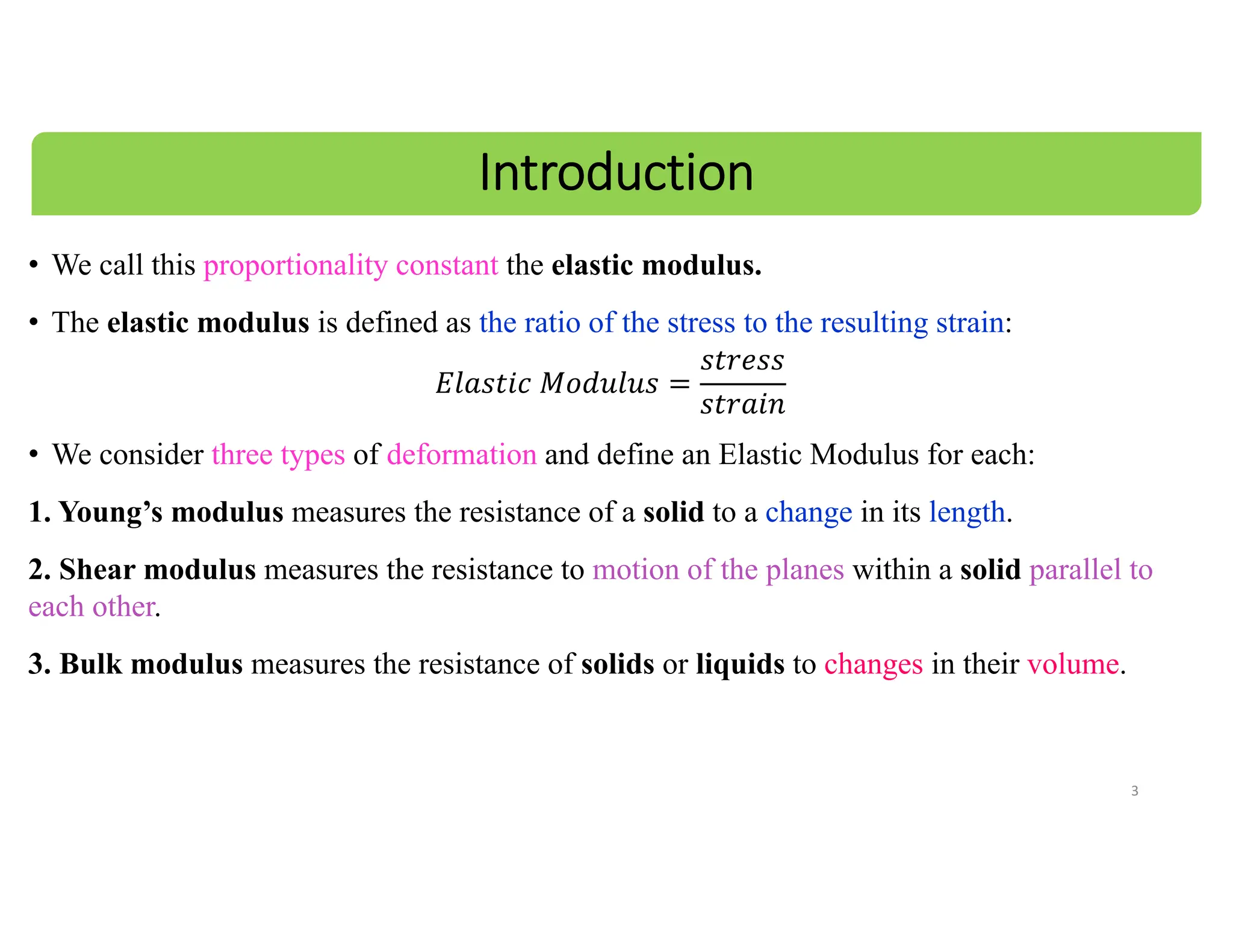
• We call this proportionality constant the elastic modulus.
• The elastic modulus is defined as the ratio of the stress to the resulting strain:
𝐸𝑙𝑎𝑠𝑡𝑖𝑐 𝑀𝑜𝑑𝑢𝑙𝑢𝑠
𝑠𝑡𝑟𝑒𝑠𝑠
𝑠𝑡𝑟𝑎𝑖𝑛
• We consider three types of deformation and define an Elastic Modulus for each:
1. Young’s modulus measures the resistance of a solid to a change in its length.
2. Shear modulus measures the resistance to motion of the planes within a solid parallel to
each other.
3. Bulk modulus measures the resistance of solids or liquids to changes in their volume.
3
Introduction
4
Young’s Modulus: Elasticity in Length
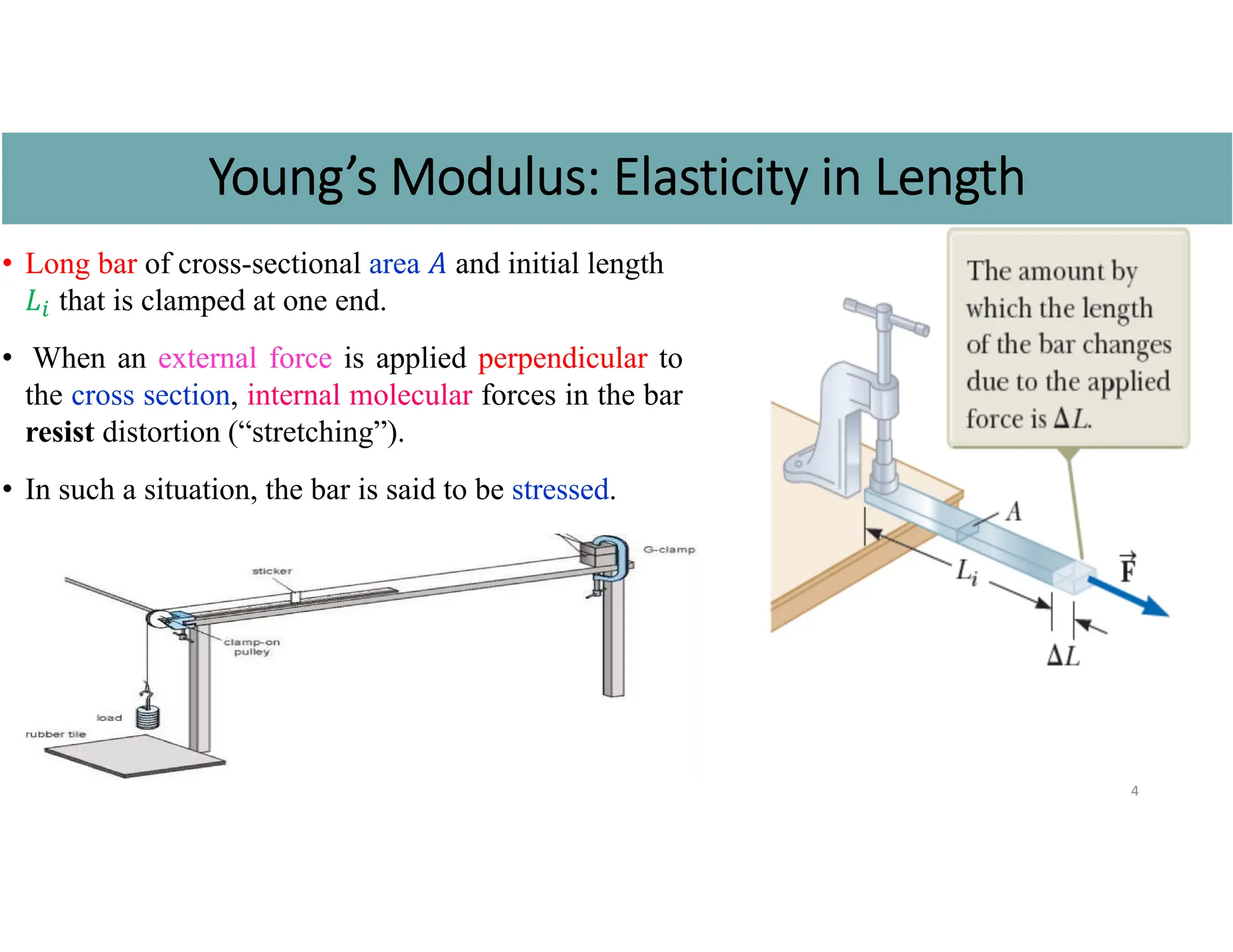
• Long bar of cross-sectional area 𝐴 and initial length
𝐿 that is clamped at one end.
• When an external force is applied perpendicular to
the cross section, internal molecular forces in the bar
resist distortion (“stretching”).
• In such a situation, the bar is said to be stressed.
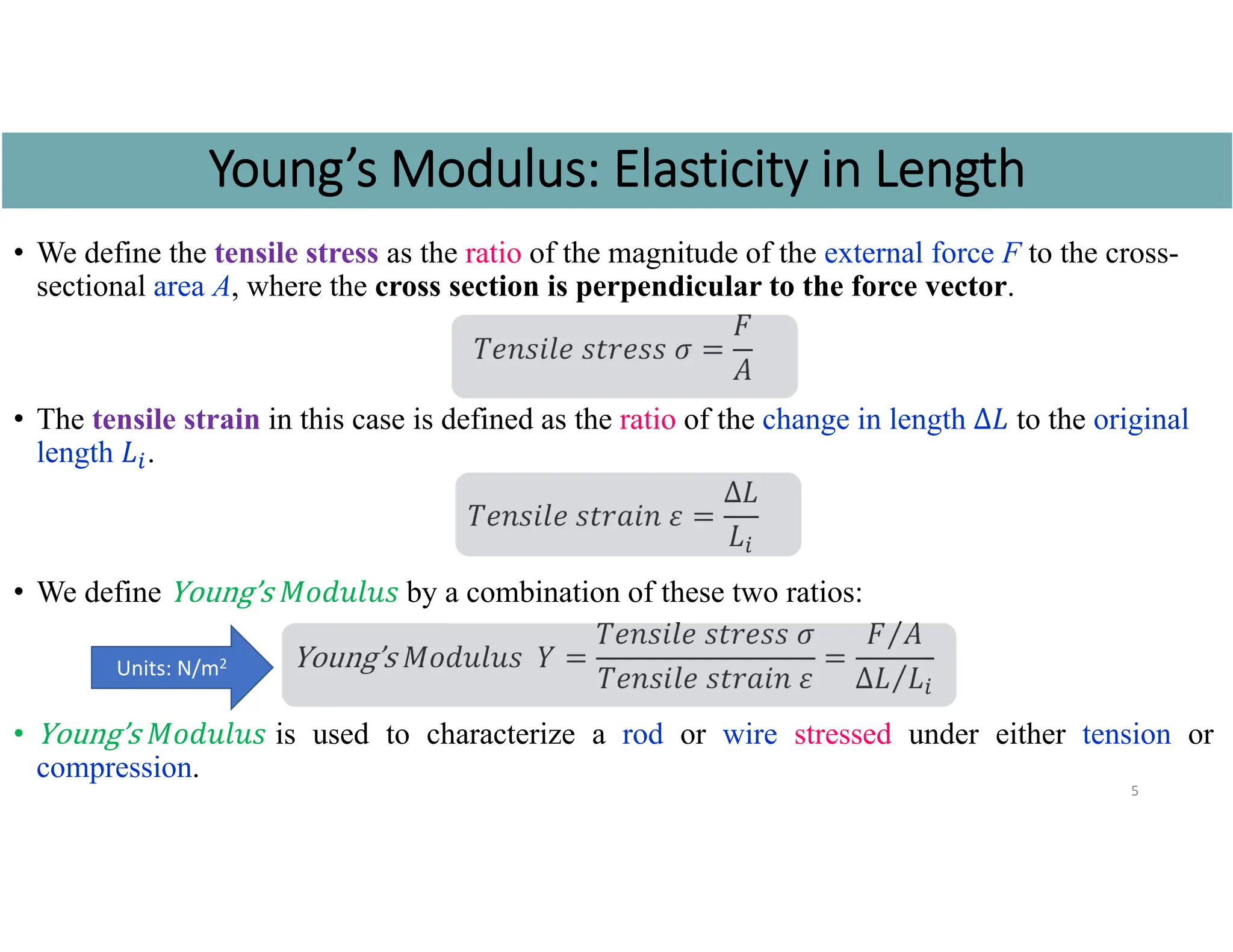
• We define the tensile stress as the ratio of the magnitude of the external force F to the cross-
sectional area A, where the cross section is perpendicular to the force vector.
𝑇𝑒𝑛𝑠𝑖𝑙𝑒 𝑠𝑡𝑟𝑒𝑠𝑠 𝜎
𝐹
𝐴
• The tensile strain in this case is defined as the ratio of the change in length ∆𝐿 to the original
length 𝐿 .
𝑇𝑒𝑛𝑠𝑖𝑙𝑒 𝑠𝑡𝑟𝑎𝑖𝑛 𝜀
∆𝐿
𝐿
• We define Young’s 𝑀𝑜𝑑𝑢𝑙𝑢𝑠 by a combination of these two ratios:
Young’s 𝑀𝑜𝑑𝑢𝑙𝑢𝑠 𝑌
𝑇𝑒𝑛𝑠𝑖𝑙𝑒 𝑠𝑡𝑟𝑒𝑠𝑠 𝜎
𝑇𝑒𝑛𝑠𝑖𝑙𝑒 𝑠𝑡𝑟𝑎𝑖𝑛 𝜀
𝐹 𝐴
⁄
∆𝐿 𝐿
⁄
• Young’s 𝑀𝑜𝑑𝑢𝑙𝑢𝑠 is used to characterize a rod or wire stressed under either tension or
compression.
5
Young’s Modulus: Elasticity in Length
Units: N/m2
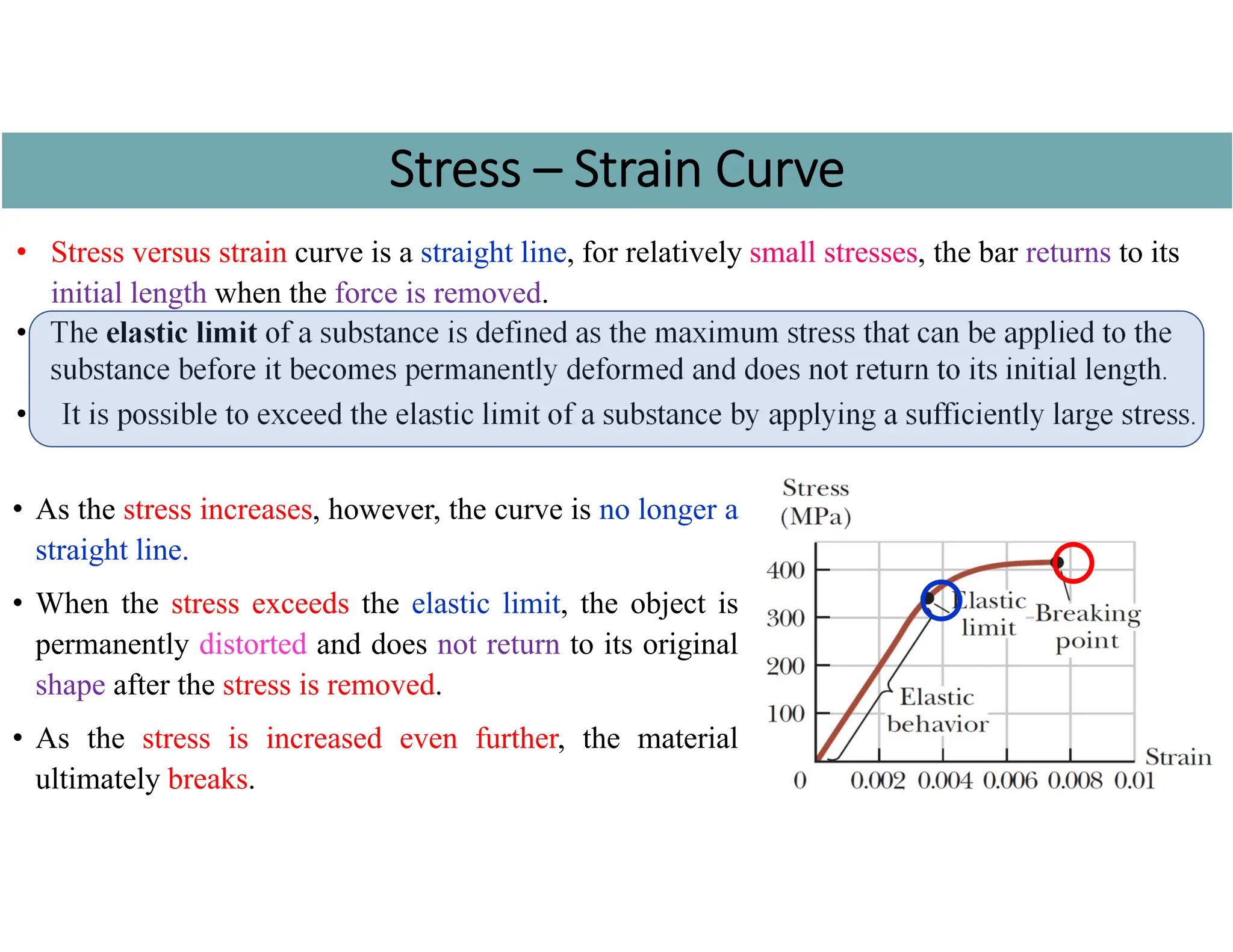
• As the stress increases, however, the curve is no longer a
straight line.
• When the stress exceeds the elastic limit, the object is
permanently distorted and does not return to its original
shape after the stress is removed.
• As the stress is increased even further, the material
ultimately breaks. 6
Stress – Strain Curve
• Stress versus strain curve is a straight line, for relatively small stresses, the bar returns to its
initial length when the force is removed.
• The elastic limit of a substance is defined as the maximum stress that can be applied to the
substance before it becomes permanently deformed and does not return to its initial length.
• It is possible to exceed the elastic limit of a substance by applying a sufficiently large stress.
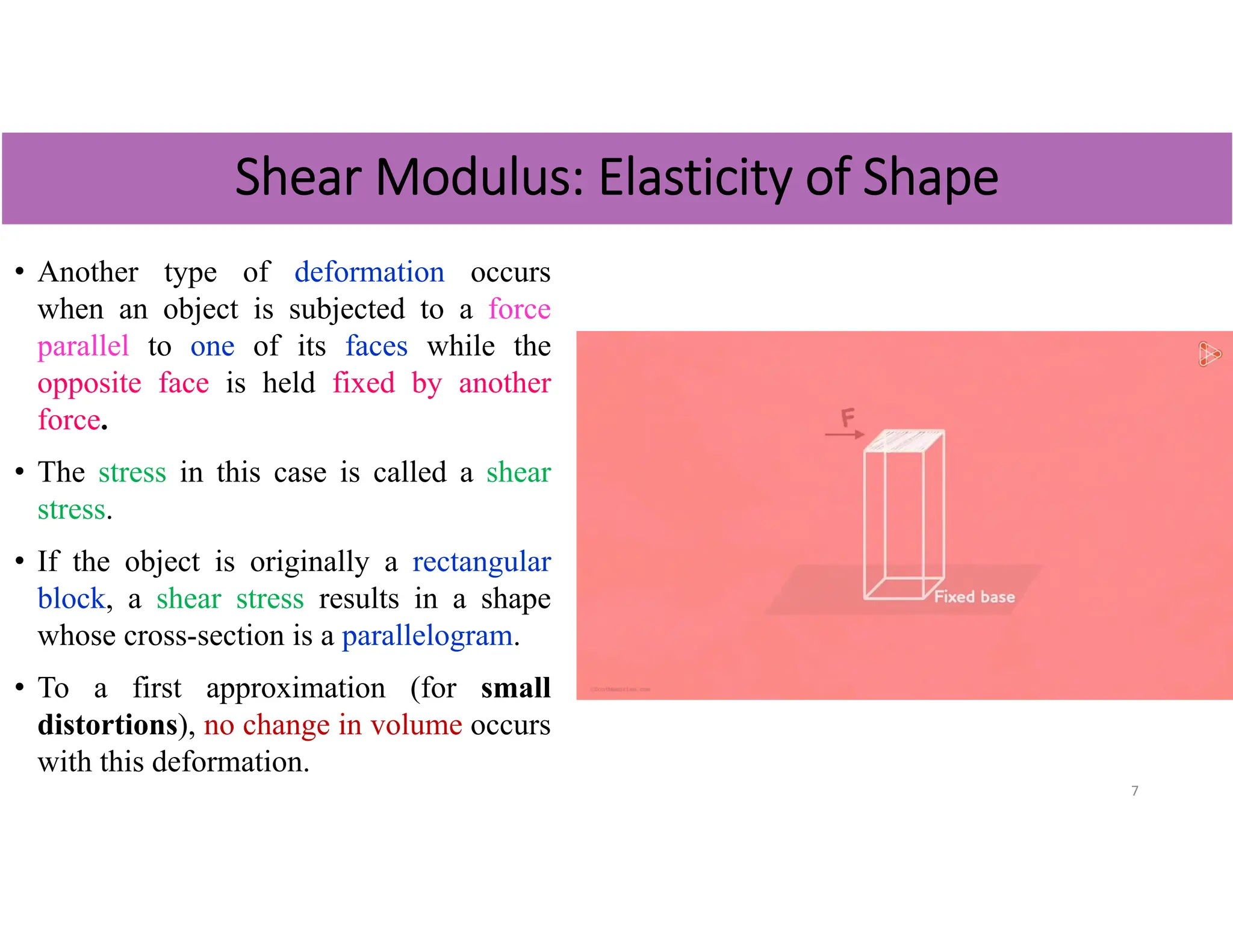
• Another type of deformation occurs
when an object is subjected to a force
parallel to one of its faces while the
opposite face is held fixed by another
force.
• The stress in this case is called a shear
stress.
• If the object is originally a rectangular
block, a shear stress results in a shape
whose cross-section is a parallelogram.
• To a first approximation (for small
distortions), no change in volume occurs
with this deformation.
7
Shear Modulus: Elasticity of Shape
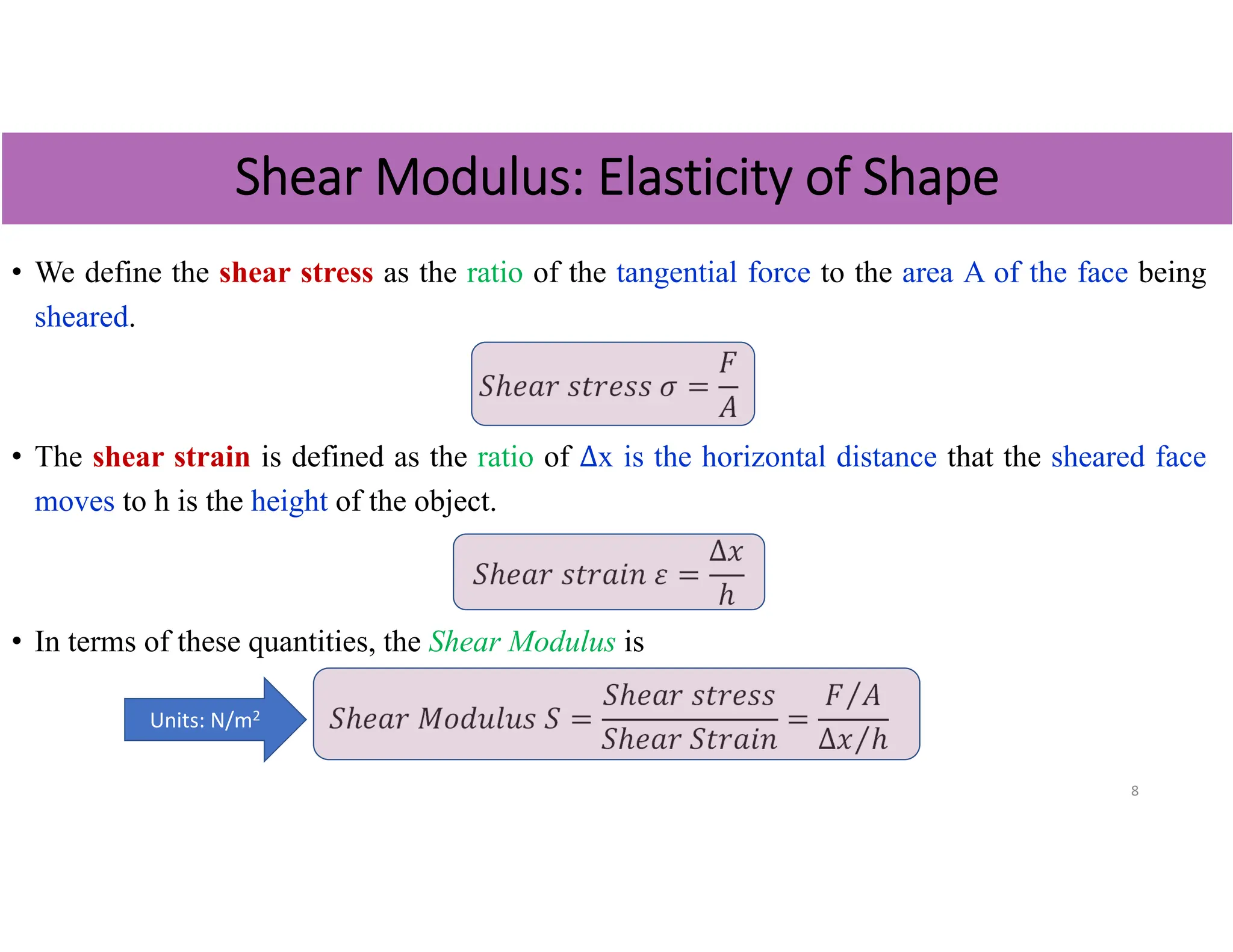
• We define the shear stress as the ratio of the tangential force to the area A of the face being
sheared.
𝑆ℎ𝑒𝑎𝑟 𝑠𝑡𝑟𝑒𝑠𝑠 𝜎
𝐹
𝐴
• The shear strain is defined as the ratio of ∆x is the horizontal distance that the sheared face
moves to h is the height of the object.
𝑆ℎ𝑒𝑎𝑟 𝑠𝑡𝑟𝑎𝑖𝑛 𝜀
∆𝑥
ℎ
• In terms of these quantities, the Shear Modulus is
𝑆ℎ𝑒𝑎𝑟 𝑀𝑜𝑑𝑢𝑙𝑢𝑠 𝑆
𝑆ℎ𝑒𝑎𝑟 𝑠𝑡𝑟𝑒𝑠𝑠
𝑆ℎ𝑒𝑎𝑟 𝑆𝑡𝑟𝑎𝑖𝑛
𝐹 𝐴
⁄
∆𝑥 ℎ
⁄
8
Shear Modulus: Elasticity of Shape
Units: N/m2
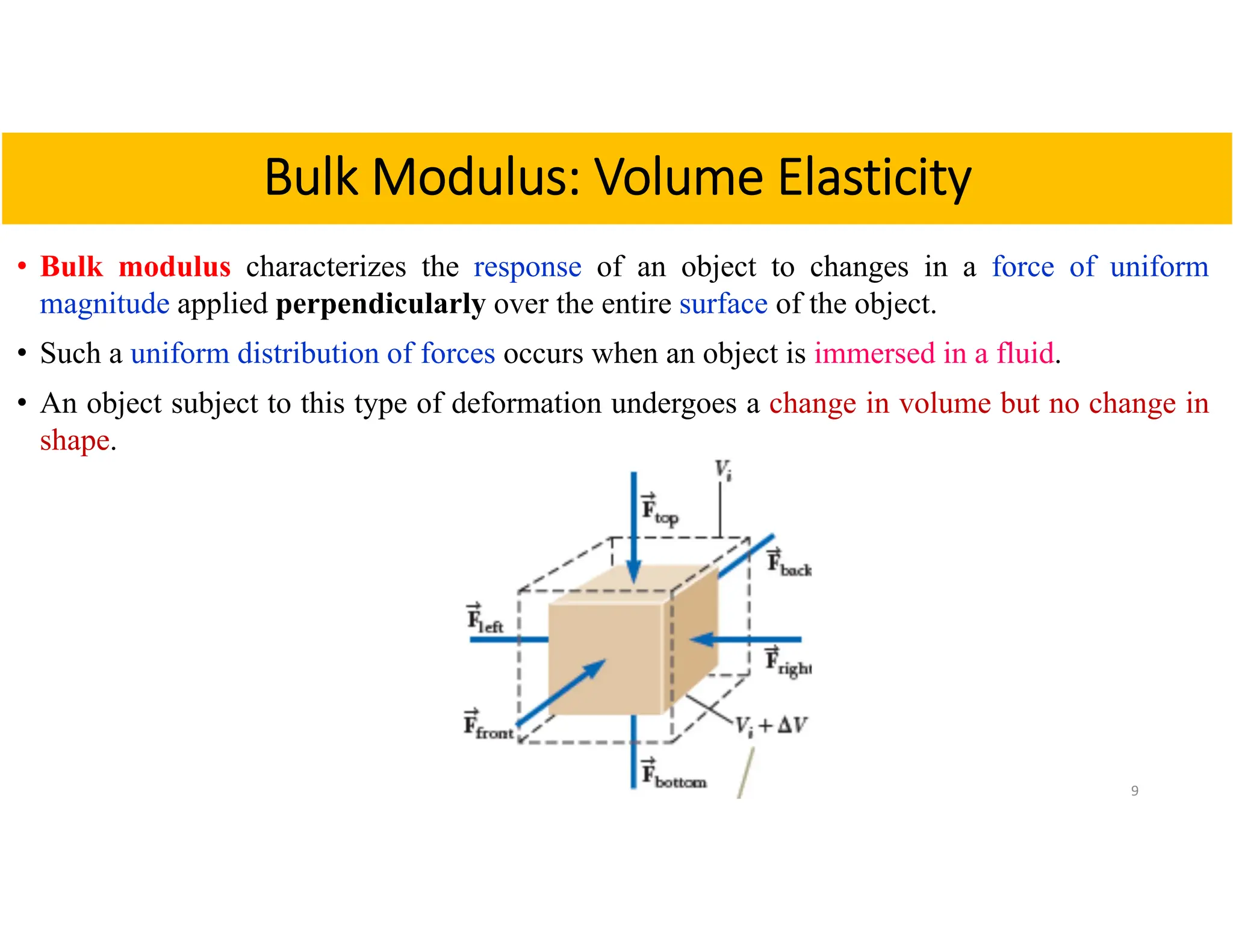
• Bulk modulus characterizes the response of an object to changes in a force of uniform
magnitude applied perpendicularly over the entire surface of the object.
• Such a uniform distribution of forces occurs when an object is immersed in a fluid.
• An object subject to this type of deformation undergoes a change in volume but no change in
shape.
9
Bulk Modulus: Volume Elasticity
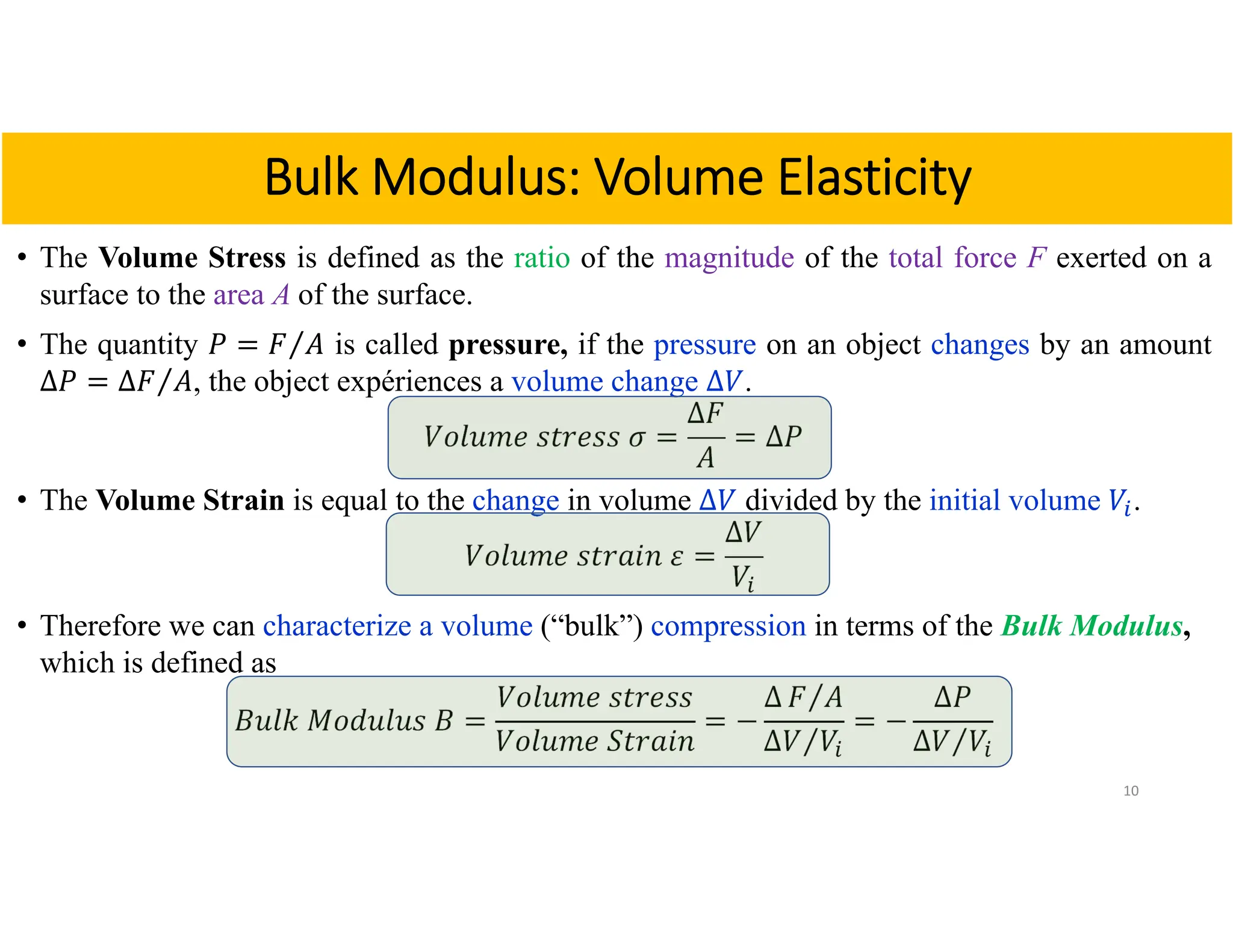
• The Volume Stress is defined as the ratio of the magnitude of the total force F exerted on a
surface to the area A of the surface.
• The quantity 𝑃 𝐹 𝐴
⁄ is called pressure, if the pressure on an object changes by an amount
∆𝑃 ∆𝐹 𝐴
⁄ , the object expériences a volume change ∆𝑉.
𝑉𝑜𝑙𝑢𝑚𝑒 𝑠𝑡𝑟𝑒𝑠𝑠 𝜎
∆𝐹
𝐴
∆𝑃
• The Volume Strain is equal to the change in volume ∆𝑉 divided by the initial volume 𝑉 .
𝑉𝑜𝑙𝑢𝑚𝑒 𝑠𝑡𝑟𝑎𝑖𝑛 𝜀
∆𝑉
𝑉
• Therefore we can characterize a volume (“bulk”) compression in terms of the Bulk Modulus,
which is defined as
𝐵𝑢𝑙𝑘 𝑀𝑜𝑑𝑢𝑙𝑢𝑠 𝐵
𝑉𝑜𝑙𝑢𝑚𝑒 𝑠𝑡𝑟𝑒𝑠𝑠
𝑉𝑜𝑙𝑢𝑚𝑒 𝑆𝑡𝑟𝑎𝑖𝑛
∆ 𝐹 𝐴
⁄
∆𝑉 𝑉
⁄
∆𝑃
∆𝑉 𝑉
⁄
10
Bulk Modulus: Volume Elasticity
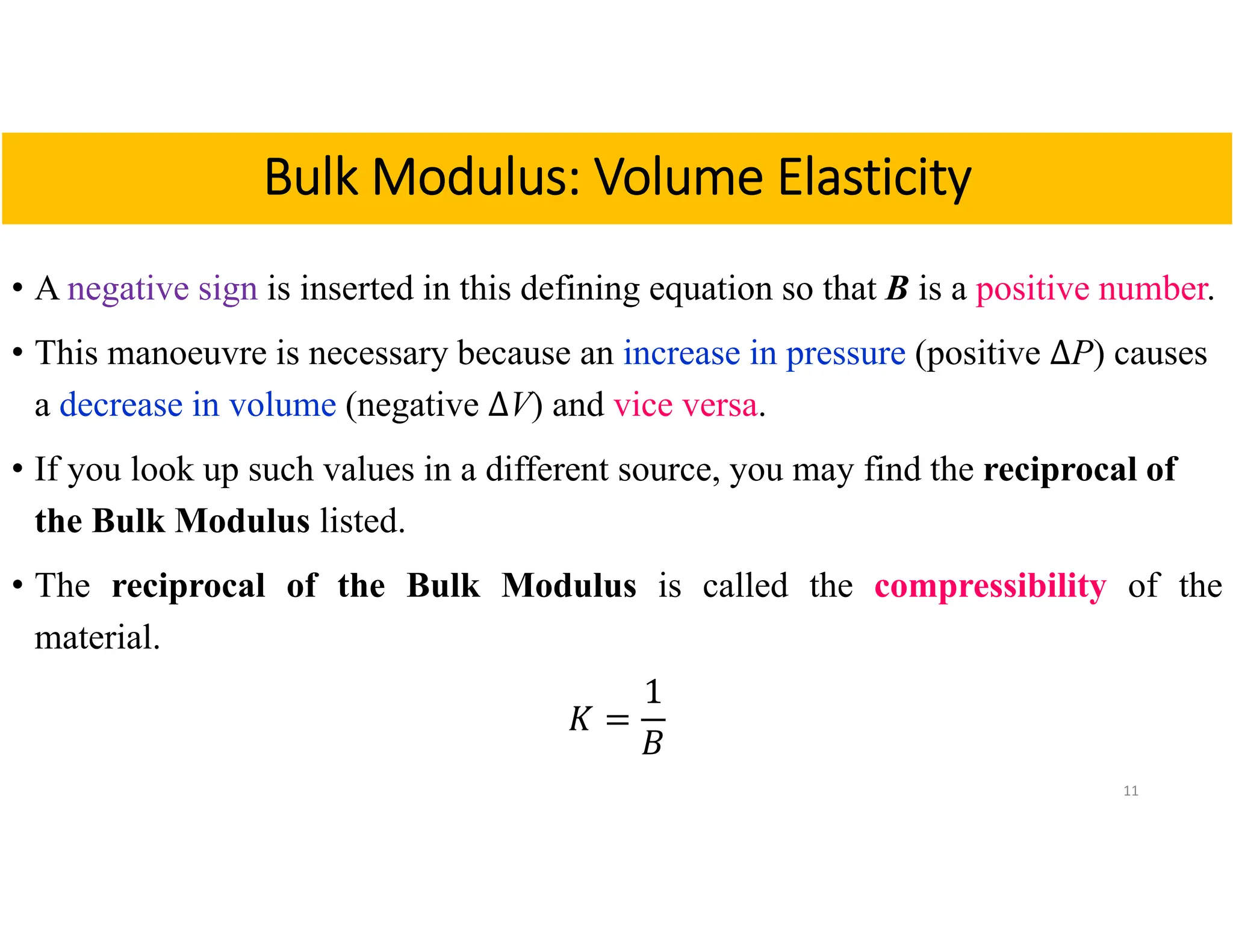
• A negative sign is inserted in this defining equation so that B is a positive number.
• This manoeuvre is necessary because an increase in pressure (positive ∆P) causes
a decrease in volume (negative ∆V) and vice versa.
• If you look up such values in a different source, you may find the reciprocal of
the Bulk Modulus listed.
• The reciprocal of the Bulk Modulus is called the compressibility of the
material.
𝐾
1
𝐵
11
Bulk Modulus: Volume Elasticity
12
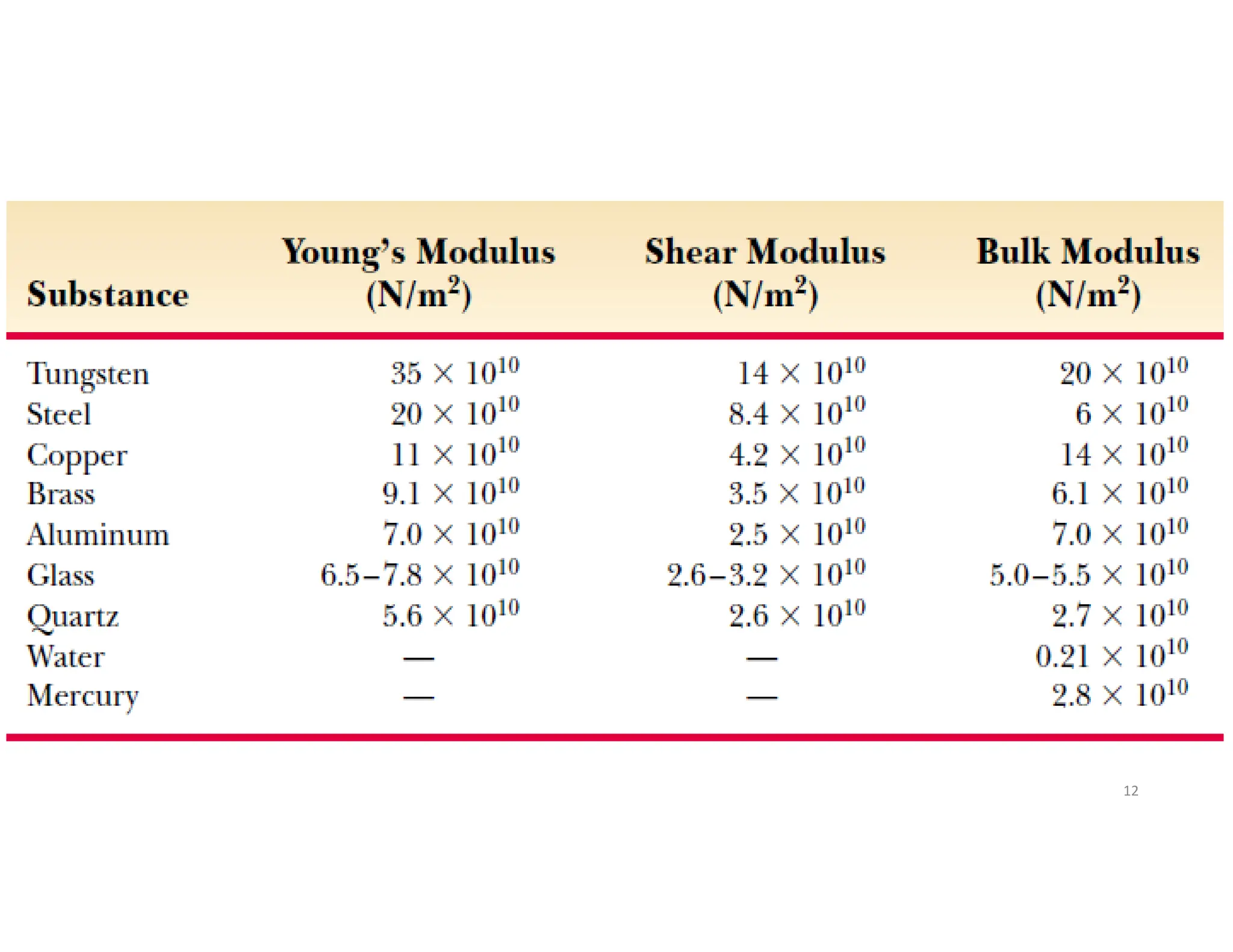
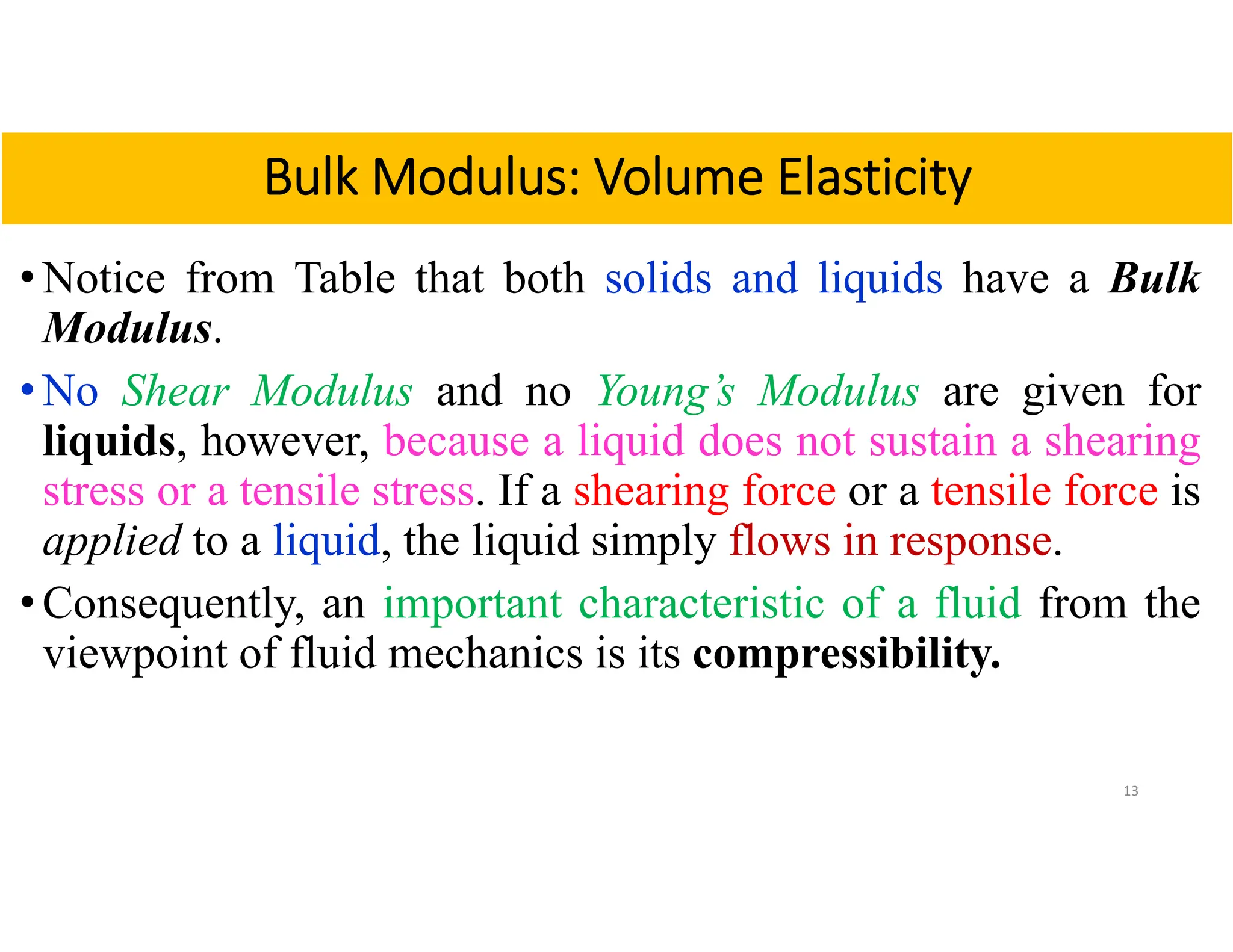
• Notice from Table that both solids and liquids have a Bulk
Modulus.
• No Shear Modulus and no Young’s Modulus are given for
liquids, however, because a liquid does not sustain a shearing
stress or a tensile stress. If a shearing force or a tensile force is
applied to a liquid, the liquid simply flows in response.
• Consequently, an important characteristic of a fluid from the
viewpoint of fluid mechanics is its compressibility.
13
Bulk Modulus: Volume Elasticity
14
Ductile and Brittle Materials
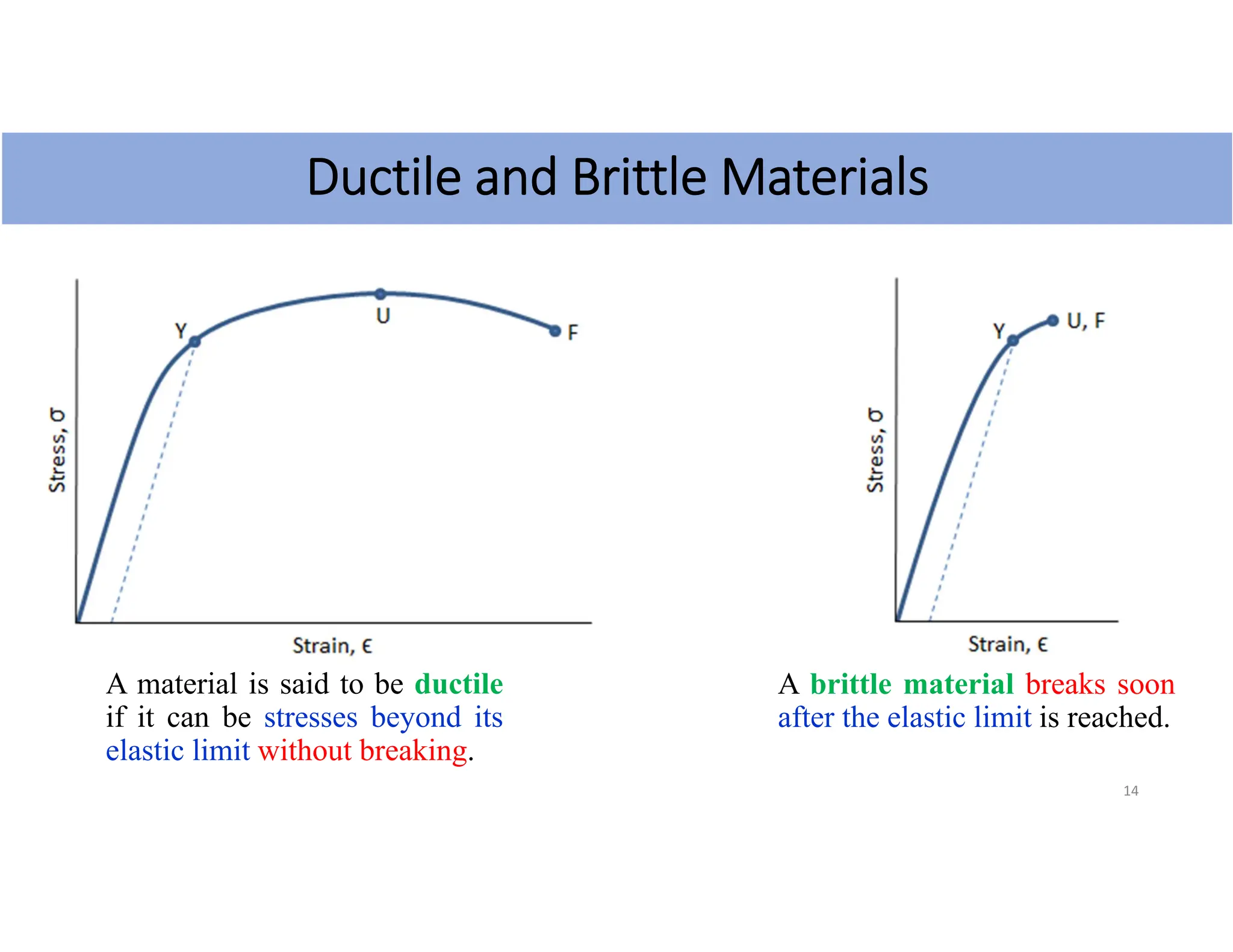
A brittle material breaks soon
after the elastic limit is reached.
A material is said to be ductile
if it can be stresses beyond its
elastic limit without breaking.
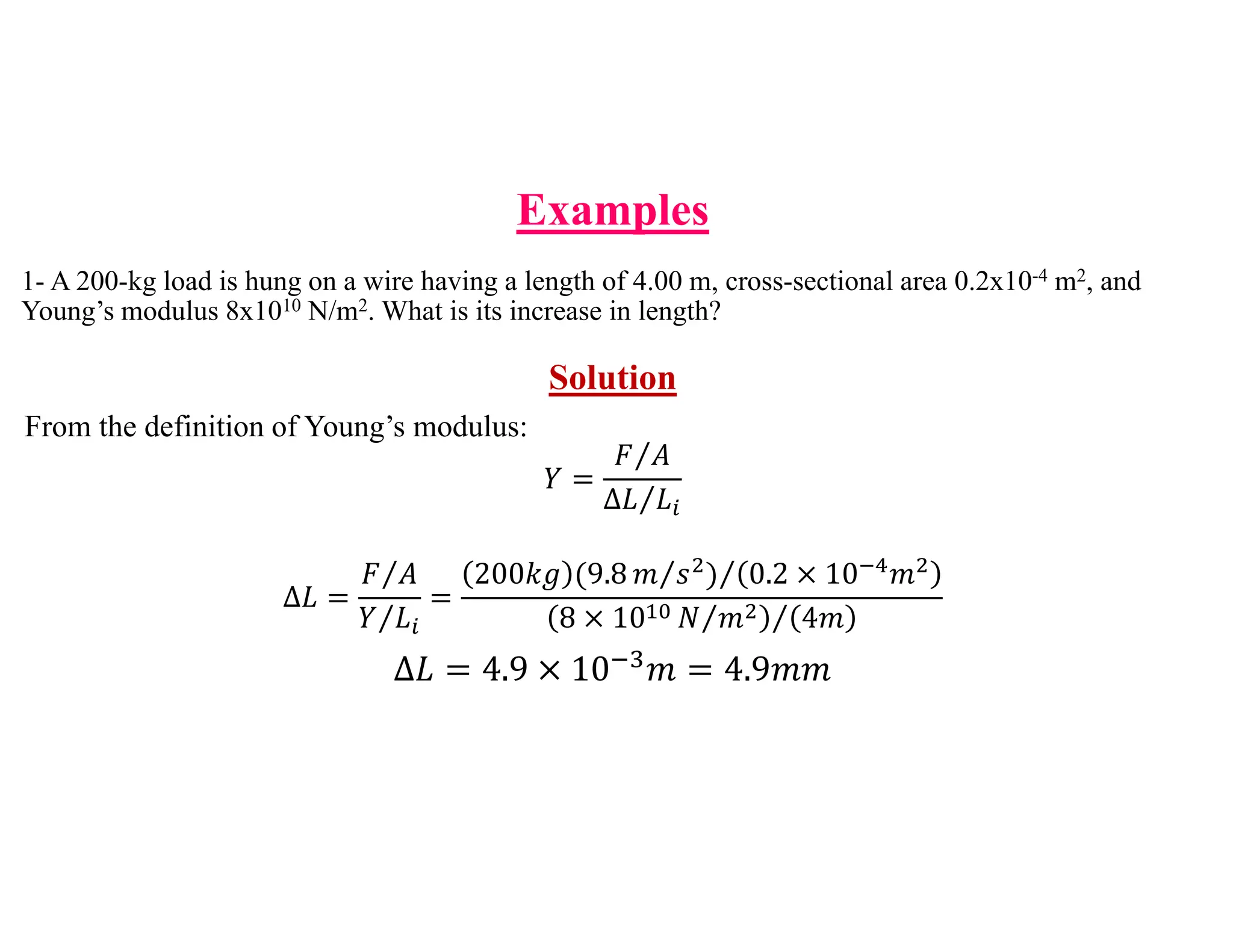
1- A 200-kg load is hung on a wire having a length of 4.00 m, cross-sectional area 0.2x10⁻⁴ m2, and
Young’s modulus 8x10¹⁰ N/m2. What is its increase in length?
Solution
From the definition of Young’s modulus:
𝑌
𝐹 𝐴
⁄
∆𝐿 𝐿
⁄
∆𝐿
𝐹 𝐴
⁄
𝑌 𝐿
⁄
200𝑘𝑔 9.8 𝑚 𝑠
⁄ 0.2 10 𝑚
⁄
8 10 𝑁 𝑚
⁄ 4𝑚
⁄
∆𝐿 4.9 10 𝑚 4.9𝑚𝑚
Examples
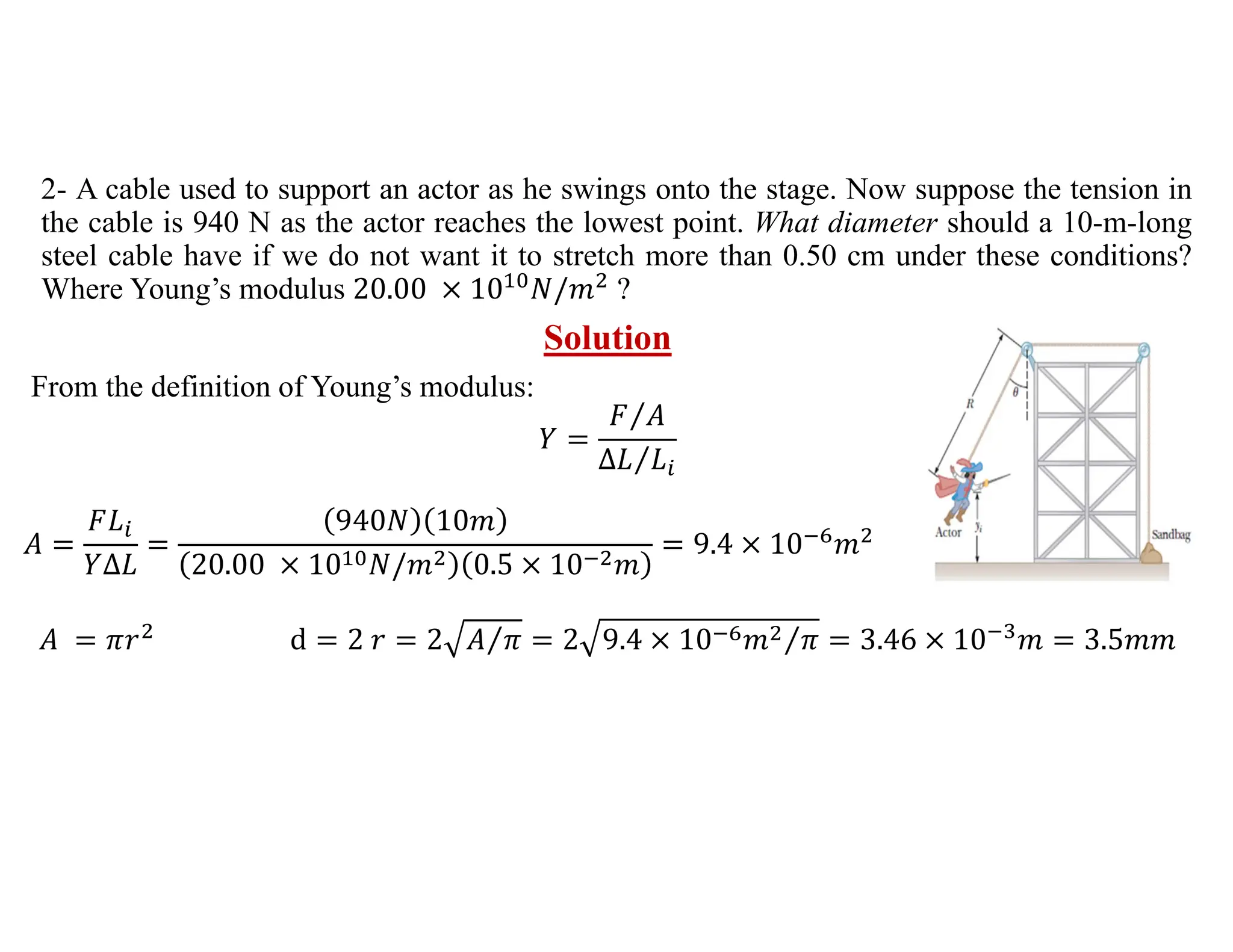
2- A cable used to support an actor as he swings onto the stage. Now suppose the tension in
the cable is 940 N as the actor reaches the lowest point. What diameter should a 10-m-long
steel cable have if we do not want it to stretch more than 0.50 cm under these conditions?
Where Young’s modulus 20.00 10 𝑁/𝑚 ?
Solution
From the definition of Young’s modulus:
𝑌
𝐹 𝐴
⁄
∆𝐿 𝐿
⁄
𝐴
𝐹𝐿
𝑌∆𝐿
940𝑁 10𝑚
20.00 10 𝑁/𝑚 0.5 10 𝑚
9.4 10 𝑚
𝐴 𝜋𝑟 d 2 𝑟 2 𝐴 𝜋
⁄ 2 9.4 10 𝑚 𝜋
⁄ 3.46 10 𝑚 3.5𝑚𝑚
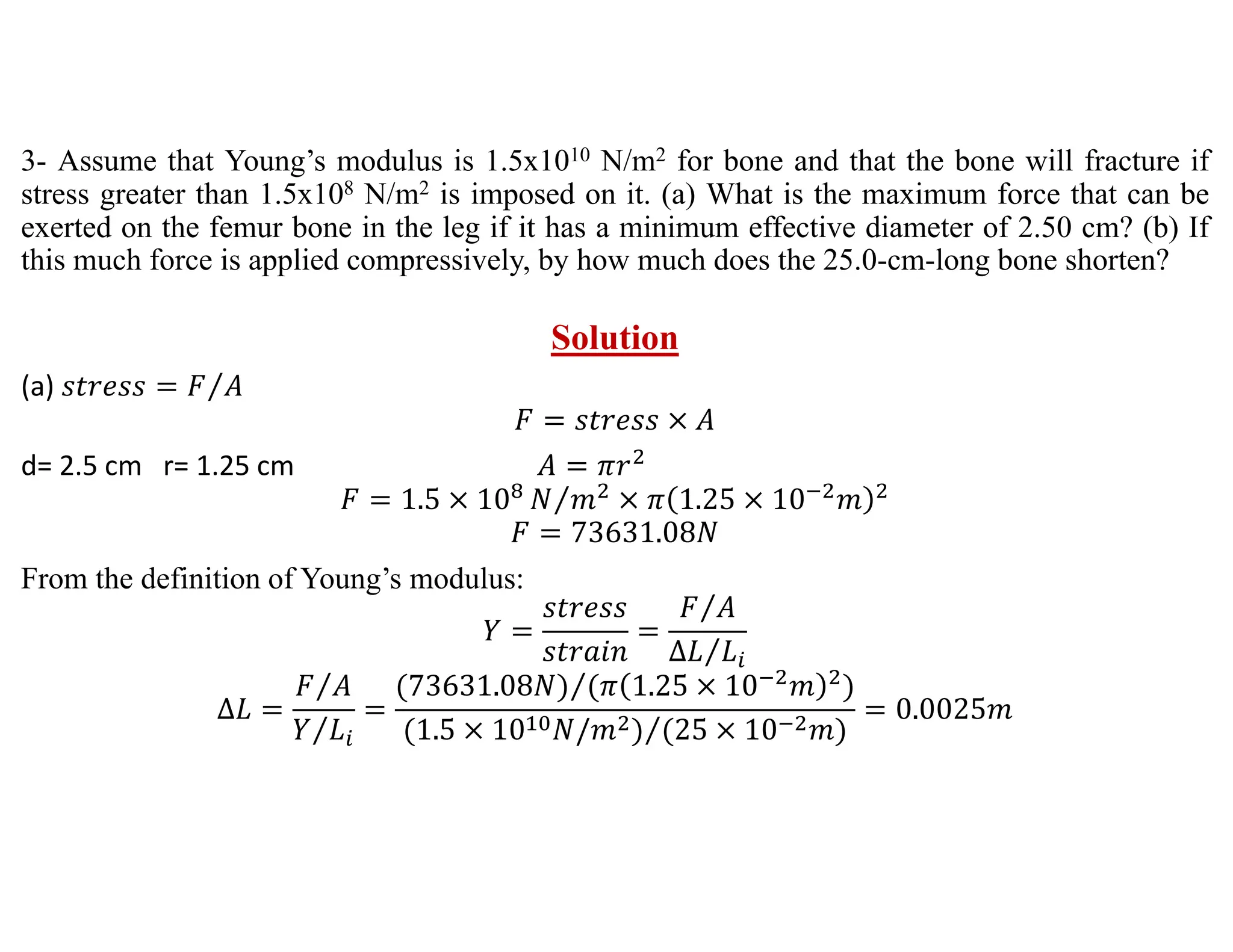
3- Assume that Young’s modulus is 1.5x10¹⁰ N/m2 for bone and that the bone will fracture if
stress greater than 1.5x10⁸ N/m2 is imposed on it. (a) What is the maximum force that can be
exerted on the femur bone in the leg if it has a minimum effective diameter of 2.50 cm? (b) If
this much force is applied compressively, by how much does the 25.0-cm-long bone shorten?
Solution
(a) 𝑠𝑡𝑟𝑒𝑠𝑠 𝐹 𝐴
⁄
𝐹 𝑠𝑡𝑟𝑒𝑠𝑠 𝐴
d= 2.5 cm r= 1.25 cm 𝐴 𝜋𝑟
𝐹 1.5 10 𝑁 𝑚
⁄ 𝜋 1.25 10 𝑚
𝐹 73631.08𝑁
From the definition of Young’s modulus:
𝑌
𝑠𝑡𝑟𝑒𝑠𝑠
𝑠𝑡𝑟𝑎𝑖𝑛
𝐹 𝐴
⁄
∆𝐿 𝐿
⁄
∆𝐿
𝐹 𝐴
⁄
𝑌 𝐿
⁄
73631.08𝑁 𝜋 1.25 10 𝑚
⁄
1.5 10 𝑁/𝑚 25 10 𝑚
⁄
0.0025𝑚
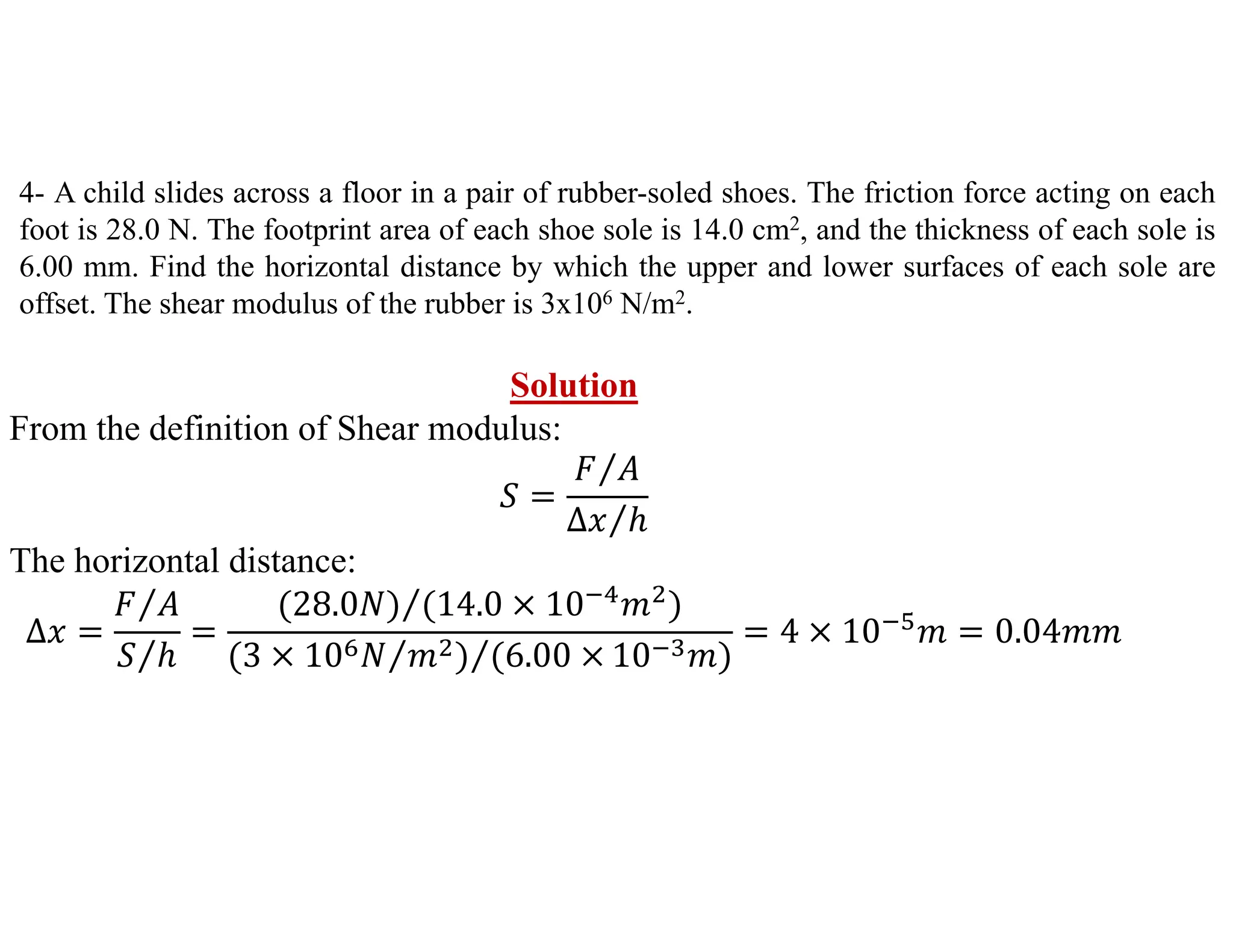
4- A child slides across a floor in a pair of rubber-soled shoes. The friction force acting on each
foot is 28.0 N. The footprint area of each shoe sole is 14.0 cm2, and the thickness of each sole is
6.00 mm. Find the horizontal distance by which the upper and lower surfaces of each sole are
offset. The shear modulus of the rubber is 3x10⁶ N/m2.
Solution
From the definition of Shear modulus:
𝑆
𝐹 𝐴
⁄
∆𝑥 ℎ
⁄
The horizontal distance:
∆𝑥
𝐹 𝐴
⁄
𝑆 ℎ
⁄
28.0𝑁 14.0 10 𝑚
⁄
3 10 𝑁 𝑚
⁄ 6.00
⁄ 10 𝑚
4 10 𝑚 0.04𝑚𝑚
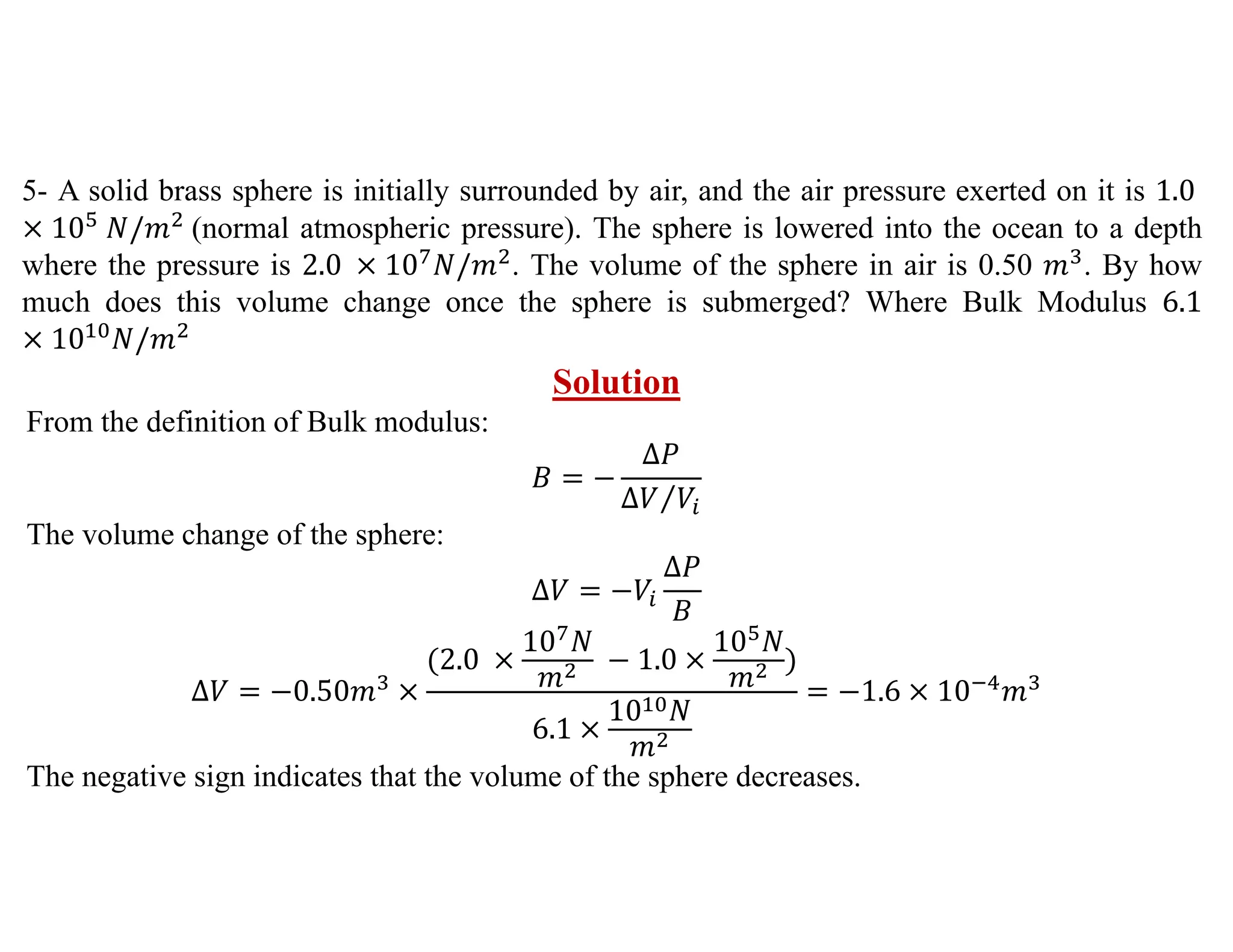
5- A solid brass sphere is initially surrounded by air, and the air pressure exerted on it is 1.0
10 𝑁/𝑚 (normal atmospheric pressure). The sphere is lowered into the ocean to a depth
where the pressure is 2.0 10 𝑁/𝑚 . The volume of the sphere in air is 0.50 𝑚 . By how
much does this volume change once the sphere is submerged? Where Bulk Modulus 6.1
10 𝑁/𝑚
Solution
From the definition of Bulk modulus:
𝐵
∆𝑃
∆𝑉 𝑉
⁄
The volume change of the sphere:
∆𝑉 𝑉
∆𝑃
𝐵
∆𝑉 0.50𝑚
2.0
10 𝑁
𝑚
1.0
10 𝑁
𝑚
6.1
10 𝑁
𝑚
1.6 10 𝑚
The negative sign indicates that the volume of the sphere decreases.

Ch2_Mechanical Properties of Materials.pdf

  • 1.
    Ch. 2: MechanicalProperties of Materials  Contents: 1. Introduction. 2. Young’s Modulus: Elasticity in Length. 3. Shear Modulus: Elasticity of shape. 4. Bulk Modulus: Volume Elasticity. 1
  • 2.
    Introduction • All objectsare deformable to some extent. • It is possible to change the shape or the size (or both) of an object by applying external forces. • As these changes take place, internal forces in the object resist the deformation. • We shall discuss the deformation of solids in terms of the concepts of stress and strain. • Stress is the external force acting on an object per unit cross sectional area. • The result of a stress is strain, which is a measure of the degree of deformation. • For sufficiently small stresses, stress is proportional to strain; the constant of proportionality depends on the material being deformed and on the nature of the deformation. 2
  • 3.
    • We callthis proportionality constant the elastic modulus. • The elastic modulus is defined as the ratio of the stress to the resulting strain: 𝐸𝑙𝑎𝑠𝑡𝑖𝑐 𝑀𝑜𝑑𝑢𝑙𝑢𝑠 𝑠𝑡𝑟𝑒𝑠𝑠 𝑠𝑡𝑟𝑎𝑖𝑛 • We consider three types of deformation and define an Elastic Modulus for each: 1. Young’s modulus measures the resistance of a solid to a change in its length. 2. Shear modulus measures the resistance to motion of the planes within a solid parallel to each other. 3. Bulk modulus measures the resistance of solids or liquids to changes in their volume. 3 Introduction
  • 4.
    4 Young’s Modulus: Elasticityin Length • Long bar of cross-sectional area 𝐴 and initial length 𝐿 that is clamped at one end. • When an external force is applied perpendicular to the cross section, internal molecular forces in the bar resist distortion (“stretching”). • In such a situation, the bar is said to be stressed.
  • 5.
    • We definethe tensile stress as the ratio of the magnitude of the external force F to the cross- sectional area A, where the cross section is perpendicular to the force vector. 𝑇𝑒𝑛𝑠𝑖𝑙𝑒 𝑠𝑡𝑟𝑒𝑠𝑠 𝜎 𝐹 𝐴 • The tensile strain in this case is defined as the ratio of the change in length ∆𝐿 to the original length 𝐿 . 𝑇𝑒𝑛𝑠𝑖𝑙𝑒 𝑠𝑡𝑟𝑎𝑖𝑛 𝜀 ∆𝐿 𝐿 • We define Young’s 𝑀𝑜𝑑𝑢𝑙𝑢𝑠 by a combination of these two ratios: Young’s 𝑀𝑜𝑑𝑢𝑙𝑢𝑠 𝑌 𝑇𝑒𝑛𝑠𝑖𝑙𝑒 𝑠𝑡𝑟𝑒𝑠𝑠 𝜎 𝑇𝑒𝑛𝑠𝑖𝑙𝑒 𝑠𝑡𝑟𝑎𝑖𝑛 𝜀 𝐹 𝐴 ⁄ ∆𝐿 𝐿 ⁄ • Young’s 𝑀𝑜𝑑𝑢𝑙𝑢𝑠 is used to characterize a rod or wire stressed under either tension or compression. 5 Young’s Modulus: Elasticity in Length Units: N/m2
  • 6.
    • As thestress increases, however, the curve is no longer a straight line. • When the stress exceeds the elastic limit, the object is permanently distorted and does not return to its original shape after the stress is removed. • As the stress is increased even further, the material ultimately breaks. 6 Stress – Strain Curve • Stress versus strain curve is a straight line, for relatively small stresses, the bar returns to its initial length when the force is removed. • The elastic limit of a substance is defined as the maximum stress that can be applied to the substance before it becomes permanently deformed and does not return to its initial length. • It is possible to exceed the elastic limit of a substance by applying a sufficiently large stress.
  • 7.
    • Another typeof deformation occurs when an object is subjected to a force parallel to one of its faces while the opposite face is held fixed by another force. • The stress in this case is called a shear stress. • If the object is originally a rectangular block, a shear stress results in a shape whose cross-section is a parallelogram. • To a first approximation (for small distortions), no change in volume occurs with this deformation. 7 Shear Modulus: Elasticity of Shape
  • 8.
    • We definethe shear stress as the ratio of the tangential force to the area A of the face being sheared. 𝑆ℎ𝑒𝑎𝑟 𝑠𝑡𝑟𝑒𝑠𝑠 𝜎 𝐹 𝐴 • The shear strain is defined as the ratio of ∆x is the horizontal distance that the sheared face moves to h is the height of the object. 𝑆ℎ𝑒𝑎𝑟 𝑠𝑡𝑟𝑎𝑖𝑛 𝜀 ∆𝑥 ℎ • In terms of these quantities, the Shear Modulus is 𝑆ℎ𝑒𝑎𝑟 𝑀𝑜𝑑𝑢𝑙𝑢𝑠 𝑆 𝑆ℎ𝑒𝑎𝑟 𝑠𝑡𝑟𝑒𝑠𝑠 𝑆ℎ𝑒𝑎𝑟 𝑆𝑡𝑟𝑎𝑖𝑛 𝐹 𝐴 ⁄ ∆𝑥 ℎ ⁄ 8 Shear Modulus: Elasticity of Shape Units: N/m2
  • 9.
    • Bulk moduluscharacterizes the response of an object to changes in a force of uniform magnitude applied perpendicularly over the entire surface of the object. • Such a uniform distribution of forces occurs when an object is immersed in a fluid. • An object subject to this type of deformation undergoes a change in volume but no change in shape. 9 Bulk Modulus: Volume Elasticity
  • 10.
    • The VolumeStress is defined as the ratio of the magnitude of the total force F exerted on a surface to the area A of the surface. • The quantity 𝑃 𝐹 𝐴 ⁄ is called pressure, if the pressure on an object changes by an amount ∆𝑃 ∆𝐹 𝐴 ⁄ , the object expériences a volume change ∆𝑉. 𝑉𝑜𝑙𝑢𝑚𝑒 𝑠𝑡𝑟𝑒𝑠𝑠 𝜎 ∆𝐹 𝐴 ∆𝑃 • The Volume Strain is equal to the change in volume ∆𝑉 divided by the initial volume 𝑉 . 𝑉𝑜𝑙𝑢𝑚𝑒 𝑠𝑡𝑟𝑎𝑖𝑛 𝜀 ∆𝑉 𝑉 • Therefore we can characterize a volume (“bulk”) compression in terms of the Bulk Modulus, which is defined as 𝐵𝑢𝑙𝑘 𝑀𝑜𝑑𝑢𝑙𝑢𝑠 𝐵 𝑉𝑜𝑙𝑢𝑚𝑒 𝑠𝑡𝑟𝑒𝑠𝑠 𝑉𝑜𝑙𝑢𝑚𝑒 𝑆𝑡𝑟𝑎𝑖𝑛 ∆ 𝐹 𝐴 ⁄ ∆𝑉 𝑉 ⁄ ∆𝑃 ∆𝑉 𝑉 ⁄ 10 Bulk Modulus: Volume Elasticity
  • 11.
    • A negativesign is inserted in this defining equation so that B is a positive number. • This manoeuvre is necessary because an increase in pressure (positive ∆P) causes a decrease in volume (negative ∆V) and vice versa. • If you look up such values in a different source, you may find the reciprocal of the Bulk Modulus listed. • The reciprocal of the Bulk Modulus is called the compressibility of the material. 𝐾 1 𝐵 11 Bulk Modulus: Volume Elasticity
  • 12.
  • 13.
    • Notice fromTable that both solids and liquids have a Bulk Modulus. • No Shear Modulus and no Young’s Modulus are given for liquids, however, because a liquid does not sustain a shearing stress or a tensile stress. If a shearing force or a tensile force is applied to a liquid, the liquid simply flows in response. • Consequently, an important characteristic of a fluid from the viewpoint of fluid mechanics is its compressibility. 13 Bulk Modulus: Volume Elasticity
  • 14.
    14 Ductile and BrittleMaterials A brittle material breaks soon after the elastic limit is reached. A material is said to be ductile if it can be stresses beyond its elastic limit without breaking.
  • 15.
    1- A 200-kgload is hung on a wire having a length of 4.00 m, cross-sectional area 0.2x10⁻⁴ m2, and Young’s modulus 8x10¹⁰ N/m2. What is its increase in length? Solution From the definition of Young’s modulus: 𝑌 𝐹 𝐴 ⁄ ∆𝐿 𝐿 ⁄ ∆𝐿 𝐹 𝐴 ⁄ 𝑌 𝐿 ⁄ 200𝑘𝑔 9.8 𝑚 𝑠 ⁄ 0.2 10 𝑚 ⁄ 8 10 𝑁 𝑚 ⁄ 4𝑚 ⁄ ∆𝐿 4.9 10 𝑚 4.9𝑚𝑚 Examples
  • 16.
    2- A cableused to support an actor as he swings onto the stage. Now suppose the tension in the cable is 940 N as the actor reaches the lowest point. What diameter should a 10-m-long steel cable have if we do not want it to stretch more than 0.50 cm under these conditions? Where Young’s modulus 20.00 10 𝑁/𝑚 ? Solution From the definition of Young’s modulus: 𝑌 𝐹 𝐴 ⁄ ∆𝐿 𝐿 ⁄ 𝐴 𝐹𝐿 𝑌∆𝐿 940𝑁 10𝑚 20.00 10 𝑁/𝑚 0.5 10 𝑚 9.4 10 𝑚 𝐴 𝜋𝑟 d 2 𝑟 2 𝐴 𝜋 ⁄ 2 9.4 10 𝑚 𝜋 ⁄ 3.46 10 𝑚 3.5𝑚𝑚
  • 17.
    3- Assume thatYoung’s modulus is 1.5x10¹⁰ N/m2 for bone and that the bone will fracture if stress greater than 1.5x10⁸ N/m2 is imposed on it. (a) What is the maximum force that can be exerted on the femur bone in the leg if it has a minimum effective diameter of 2.50 cm? (b) If this much force is applied compressively, by how much does the 25.0-cm-long bone shorten? Solution (a) 𝑠𝑡𝑟𝑒𝑠𝑠 𝐹 𝐴 ⁄ 𝐹 𝑠𝑡𝑟𝑒𝑠𝑠 𝐴 d= 2.5 cm r= 1.25 cm 𝐴 𝜋𝑟 𝐹 1.5 10 𝑁 𝑚 ⁄ 𝜋 1.25 10 𝑚 𝐹 73631.08𝑁 From the definition of Young’s modulus: 𝑌 𝑠𝑡𝑟𝑒𝑠𝑠 𝑠𝑡𝑟𝑎𝑖𝑛 𝐹 𝐴 ⁄ ∆𝐿 𝐿 ⁄ ∆𝐿 𝐹 𝐴 ⁄ 𝑌 𝐿 ⁄ 73631.08𝑁 𝜋 1.25 10 𝑚 ⁄ 1.5 10 𝑁/𝑚 25 10 𝑚 ⁄ 0.0025𝑚
  • 18.
    4- A childslides across a floor in a pair of rubber-soled shoes. The friction force acting on each foot is 28.0 N. The footprint area of each shoe sole is 14.0 cm2, and the thickness of each sole is 6.00 mm. Find the horizontal distance by which the upper and lower surfaces of each sole are offset. The shear modulus of the rubber is 3x10⁶ N/m2. Solution From the definition of Shear modulus: 𝑆 𝐹 𝐴 ⁄ ∆𝑥 ℎ ⁄ The horizontal distance: ∆𝑥 𝐹 𝐴 ⁄ 𝑆 ℎ ⁄ 28.0𝑁 14.0 10 𝑚 ⁄ 3 10 𝑁 𝑚 ⁄ 6.00 ⁄ 10 𝑚 4 10 𝑚 0.04𝑚𝑚
  • 19.
    5- A solidbrass sphere is initially surrounded by air, and the air pressure exerted on it is 1.0 10 𝑁/𝑚 (normal atmospheric pressure). The sphere is lowered into the ocean to a depth where the pressure is 2.0 10 𝑁/𝑚 . The volume of the sphere in air is 0.50 𝑚 . By how much does this volume change once the sphere is submerged? Where Bulk Modulus 6.1 10 𝑁/𝑚 Solution From the definition of Bulk modulus: 𝐵 ∆𝑃 ∆𝑉 𝑉 ⁄ The volume change of the sphere: ∆𝑉 𝑉 ∆𝑃 𝐵 ∆𝑉 0.50𝑚 2.0 10 𝑁 𝑚 1.0 10 𝑁 𝑚 6.1 10 𝑁 𝑚 1.6 10 𝑚 The negative sign indicates that the volume of the sphere decreases.