
Week 10, Lesson 2 Mechanical Properties of Matter 1 
Mechanical Properties of Matter 
Week 10, Lesson 2 
• 
States of Matter 
• 
Density, Hooke’s Law & Elasticity 
• 
Specific Gravity, Bulk Modulus & Shear Modulus 
• 
Pressures in Fluids (Fluids at Rest) 
References/Reading Preparation: 
Schaum’s Outline Ch. 12 
Principles of Physics by Beuche – Ch.9
Week 10, Lesson 2 Mechanical Properties of Matter 2 
Mechanical Properties of Matter 
Introduction: 
All materials are composed of atoms. The force between atoms 
is basically electrical in nature (stemming from the fact that atoms 
are composed of charged particles). 
The way in which these atoms are arranged and in what combination 
ultimately determines a material’s bulk behavior. 
It is these properties of bulk matter, often referred to as mechanical 
properties, that are of interest. 
In this section, we will study mechanical properties such as density, 
elasticity, and fluid pressure and flow.
Week 10, Lesson 2 Mechanical Properties of Matter 3 
States of Matter 
The world around us is composed of three recognizable types of 
materials: solids, liquids, and gases. 
We call these types the three states of matter. 
The fundamental difference between them lies in the way that forces 
act between the atoms or molecules composing the substance.
Week 10, Lesson 2 Mechanical Properties of Matter 4 
In gases, the interatomic forces are practically nonexistent, allowing 
individual gas atoms (or molecules) to move independently. 
This freedom of motion allows the gas to fill any available volume. 
In liquids and solids these interatomic forces are strong enough 
so that external forces cannot significantly change the volume 
occupied by a given solid or liquid sample. 
Thus we say that solids and liquids are nearly incompressible.
Week 10, Lesson 2 Mechanical Properties of Matter 5 
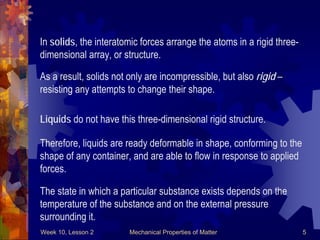
In solids, the interatomic forces arrange the atoms in a rigid three- 
dimensional array, or structure. 
As a result, solids not only are incompressible, but also rigid – 
resisting any attempts to change their shape. 
Liquids do not have this three-dimensional rigid structure. 
Therefore, liquids are ready deformable in shape, conforming to the 
shape of any container, and are able to flow in response to applied 
forces. 
The state in which a particular substance exists depends on the 
temperature of the substance and on the external pressure 
surrounding it.
Week 10, Lesson 2 Mechanical Properties of Matter 6 
Density 
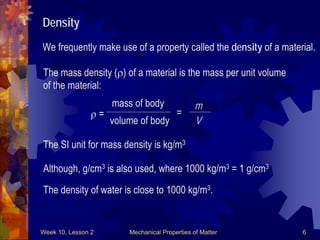
We frequently make use of a property called the density of a material. 
The mass density () of a material is the mass per unit volume 
of the material: 
 = 
mass of body 
volume of body 
= 
m 
V 
The SI unit for mass density is kg/m3 
Although, g/cm3 is also used, where 1000 kg/m3 = 1 g/cm3 
The density of water is close to 1000 kg/m3.
Week 10, Lesson 2 Mechanical Properties of Matter 7 
Specific Gravity 
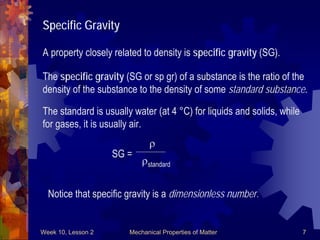
A property closely related to density is specific gravity (SG). 
The specific gravity (SG or sp gr) of a substance is the ratio of the 
density of the substance to the density of some standard substance. 
The standard is usually water (at 4 °C) for liquids and solids, while 
for gases, it is usually air. 
SG = 
 
standard 
Notice that specific gravity is a dimensionless number.
Week 10, Lesson 2 Mechanical Properties of Matter 8 
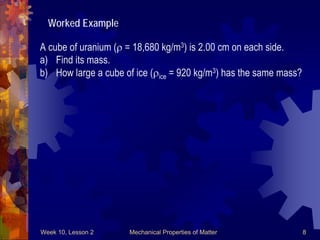
Worked Example 
A cube of uranium ( = 18,680 kg/m3) is 2.00 cm on each side. 
a) 
Find its mass. 
b) 
How large a cube of ice (ice = 920 kg/m3) has the same mass?
Week 10, Lesson 2 Mechanical Properties of Matter 9 
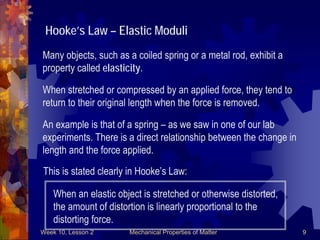
Hooke’s Law – Elastic Moduli 
Many objects, such as a coiled spring or a metal rod, exhibit a 
property called elasticity. 
When stretched or compressed by an applied force, they tend to 
return to their original length when the force is removed. 
An example is that of a spring – as we saw in one of our lab 
experiments. There is a direct relationship between the change in 
length and the force applied. 
This is stated clearly in Hooke’s Law: 
When an elastic object is stretched or otherwise distorted, 
the amount of distortion is linearly proportional to the 
distorting force.
Week 10, Lesson 2 Mechanical Properties of Matter 10 
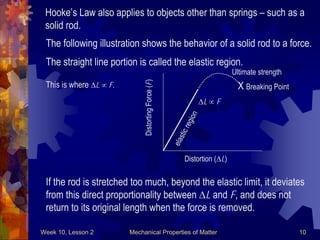
The following illustration shows the behavior of a solid rod to a force. 
Distorting Force (F) 
Distortion (L) 
L  F 
elastic region 
The straight line portion is called the elastic region. 
This is where L  F. 
If the rod is stretched too much, beyond the elastic limit, it deviates 
from this direct proportionality between L and F, and does not 
return to its original length when the force is removed. 
Hooke’s Law also applies to objects other than springs – such as a 
solid rod. 
Ultimate strength 
X Breaking Point
Week 10, Lesson 2 Mechanical Properties of Matter 11 
The previous illustration of the behavior of a rod subjected to a force 
shows that for small deformations, the rod shows elastic behavior 
and obeys Hooke’s Law. 
To use Hooke’s Law in describing the elastic properties of solids we 
use the terms stress and strain. 
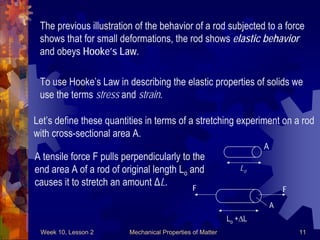
Let’s define these quantities in terms of a stretching experiment on a rod 
with cross-sectional area A. 
A 
Lo 
F 
F 
A 
A tensile force F pulls perpendicularly to the 
end area A of a rod of original length Lo and 
causes it to stretch an amount ΔL. 
Lo +L
Week 10, Lesson 2 Mechanical Properties of Matter 12 
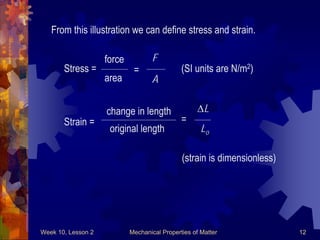
Stress = 
force 
area 
= 
F 
A 
(SI units are N/m2) 
Strain = 
change in length 
original length 
= 
L 
Lo 
From this illustration we can define stress and strain. 
(strain is dimensionless)
Week 10, Lesson 2 Mechanical Properties of Matter 13 
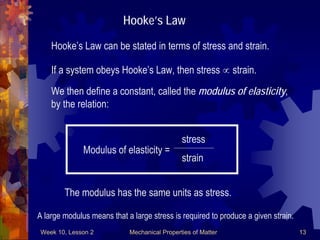
Hooke’s Law 
Hooke’s Law can be stated in terms of stress and strain. 
If a system obeys Hooke’s Law, then stress  strain. 
We then define a constant, called the modulus of elasticity, 
by the relation: 
Modulus of elasticity = 
stress 
strain 
The modulus has the same units as stress. 
A large modulus means that a large stress is required to produce a given strain.
Week 10, Lesson 2 Mechanical Properties of Matter 14 
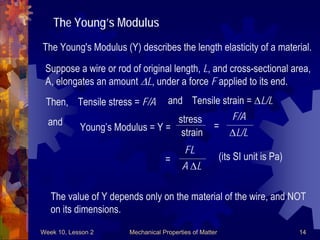
The Young’s Modulus 
The Young's Modulus (Y) describes the length elasticity of a material. 
Suppose a wire or rod of original length, L, and cross-sectional area, 
A, elongates an amount L, under a force F applied to its end. 
Then, 
Tensile stress = F/A 
and 
Tensile strain = L/L 
and 
Young’s Modulus = Y = 
stress 
strain 
= 
F/A 
L/L 
= 
FL 
A L 
(its SI unit is Pa) 
The value of Y depends only on the material of the wire, and NOT 
on its dimensions.
Week 10, Lesson 2 Mechanical Properties of Matter 15 
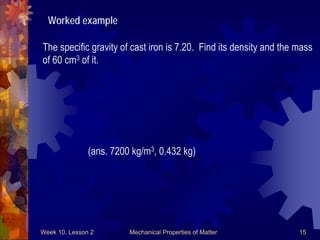
Worked example 
The specific gravity of cast iron is 7.20. Find its density and the mass 
of 60 cm3 of it. 
(ans. 7200 kg/m3, 0.432 kg)
Week 10, Lesson 2 Mechanical Properties of Matter 16 
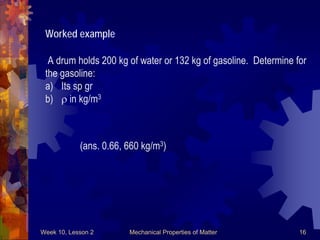
Worked example 
A drum holds 200 kg of water or 132 kg of gasoline. Determine for 
the gasoline: 
a) 
Its sp gr 
b) 
 in kg/m3 
(ans. 0.66, 660 kg/m3)
Week 10, Lesson 2 Mechanical Properties of Matter 17 
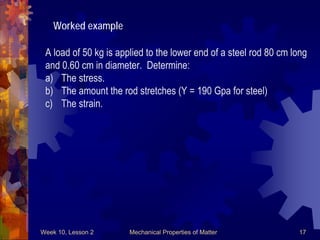
Worked example 
A load of 50 kg is applied to the lower end of a steel rod 80 cm long 
and 0.60 cm in diameter. Determine: 
a) 
The stress. 
b) 
The amount the rod stretches (Y = 190 Gpa for steel) 
c) 
The strain.

Physics 13

  • 1.
    Week 10, Lesson2 Mechanical Properties of Matter 1 Mechanical Properties of Matter Week 10, Lesson 2 • States of Matter • Density, Hooke’s Law & Elasticity • Specific Gravity, Bulk Modulus & Shear Modulus • Pressures in Fluids (Fluids at Rest) References/Reading Preparation: Schaum’s Outline Ch. 12 Principles of Physics by Beuche – Ch.9
  • 2.
    Week 10, Lesson2 Mechanical Properties of Matter 2 Mechanical Properties of Matter Introduction: All materials are composed of atoms. The force between atoms is basically electrical in nature (stemming from the fact that atoms are composed of charged particles). The way in which these atoms are arranged and in what combination ultimately determines a material’s bulk behavior. It is these properties of bulk matter, often referred to as mechanical properties, that are of interest. In this section, we will study mechanical properties such as density, elasticity, and fluid pressure and flow.
  • 3.
    Week 10, Lesson2 Mechanical Properties of Matter 3 States of Matter The world around us is composed of three recognizable types of materials: solids, liquids, and gases. We call these types the three states of matter. The fundamental difference between them lies in the way that forces act between the atoms or molecules composing the substance.
  • 4.
    Week 10, Lesson2 Mechanical Properties of Matter 4 In gases, the interatomic forces are practically nonexistent, allowing individual gas atoms (or molecules) to move independently. This freedom of motion allows the gas to fill any available volume. In liquids and solids these interatomic forces are strong enough so that external forces cannot significantly change the volume occupied by a given solid or liquid sample. Thus we say that solids and liquids are nearly incompressible.
  • 5.
    Week 10, Lesson2 Mechanical Properties of Matter 5 In solids, the interatomic forces arrange the atoms in a rigid three- dimensional array, or structure. As a result, solids not only are incompressible, but also rigid – resisting any attempts to change their shape. Liquids do not have this three-dimensional rigid structure. Therefore, liquids are ready deformable in shape, conforming to the shape of any container, and are able to flow in response to applied forces. The state in which a particular substance exists depends on the temperature of the substance and on the external pressure surrounding it.
  • 6.
    Week 10, Lesson2 Mechanical Properties of Matter 6 Density We frequently make use of a property called the density of a material. The mass density () of a material is the mass per unit volume of the material:  = mass of body volume of body = m V The SI unit for mass density is kg/m3 Although, g/cm3 is also used, where 1000 kg/m3 = 1 g/cm3 The density of water is close to 1000 kg/m3.
  • 7.
    Week 10, Lesson2 Mechanical Properties of Matter 7 Specific Gravity A property closely related to density is specific gravity (SG). The specific gravity (SG or sp gr) of a substance is the ratio of the density of the substance to the density of some standard substance. The standard is usually water (at 4 °C) for liquids and solids, while for gases, it is usually air. SG =  standard Notice that specific gravity is a dimensionless number.
  • 8.
    Week 10, Lesson2 Mechanical Properties of Matter 8 Worked Example A cube of uranium ( = 18,680 kg/m3) is 2.00 cm on each side. a) Find its mass. b) How large a cube of ice (ice = 920 kg/m3) has the same mass?
  • 9.
    Week 10, Lesson2 Mechanical Properties of Matter 9 Hooke’s Law – Elastic Moduli Many objects, such as a coiled spring or a metal rod, exhibit a property called elasticity. When stretched or compressed by an applied force, they tend to return to their original length when the force is removed. An example is that of a spring – as we saw in one of our lab experiments. There is a direct relationship between the change in length and the force applied. This is stated clearly in Hooke’s Law: When an elastic object is stretched or otherwise distorted, the amount of distortion is linearly proportional to the distorting force.
  • 10.
    Week 10, Lesson2 Mechanical Properties of Matter 10 The following illustration shows the behavior of a solid rod to a force. Distorting Force (F) Distortion (L) L  F elastic region The straight line portion is called the elastic region. This is where L  F. If the rod is stretched too much, beyond the elastic limit, it deviates from this direct proportionality between L and F, and does not return to its original length when the force is removed. Hooke’s Law also applies to objects other than springs – such as a solid rod. Ultimate strength X Breaking Point
  • 11.
    Week 10, Lesson2 Mechanical Properties of Matter 11 The previous illustration of the behavior of a rod subjected to a force shows that for small deformations, the rod shows elastic behavior and obeys Hooke’s Law. To use Hooke’s Law in describing the elastic properties of solids we use the terms stress and strain. Let’s define these quantities in terms of a stretching experiment on a rod with cross-sectional area A. A Lo F F A A tensile force F pulls perpendicularly to the end area A of a rod of original length Lo and causes it to stretch an amount ΔL. Lo +L
  • 12.
    Week 10, Lesson2 Mechanical Properties of Matter 12 Stress = force area = F A (SI units are N/m2) Strain = change in length original length = L Lo From this illustration we can define stress and strain. (strain is dimensionless)
  • 13.
    Week 10, Lesson2 Mechanical Properties of Matter 13 Hooke’s Law Hooke’s Law can be stated in terms of stress and strain. If a system obeys Hooke’s Law, then stress  strain. We then define a constant, called the modulus of elasticity, by the relation: Modulus of elasticity = stress strain The modulus has the same units as stress. A large modulus means that a large stress is required to produce a given strain.
  • 14.
    Week 10, Lesson2 Mechanical Properties of Matter 14 The Young’s Modulus The Young's Modulus (Y) describes the length elasticity of a material. Suppose a wire or rod of original length, L, and cross-sectional area, A, elongates an amount L, under a force F applied to its end. Then, Tensile stress = F/A and Tensile strain = L/L and Young’s Modulus = Y = stress strain = F/A L/L = FL A L (its SI unit is Pa) The value of Y depends only on the material of the wire, and NOT on its dimensions.
  • 15.
    Week 10, Lesson2 Mechanical Properties of Matter 15 Worked example The specific gravity of cast iron is 7.20. Find its density and the mass of 60 cm3 of it. (ans. 7200 kg/m3, 0.432 kg)
  • 16.
    Week 10, Lesson2 Mechanical Properties of Matter 16 Worked example A drum holds 200 kg of water or 132 kg of gasoline. Determine for the gasoline: a) Its sp gr b)  in kg/m3 (ans. 0.66, 660 kg/m3)
  • 17.
    Week 10, Lesson2 Mechanical Properties of Matter 17 Worked example A load of 50 kg is applied to the lower end of a steel rod 80 cm long and 0.60 cm in diameter. Determine: a) The stress. b) The amount the rod stretches (Y = 190 Gpa for steel) c) The strain.