HOOKE’S LAW
Hooke’s Law
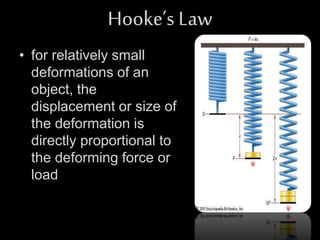
• for relatively small
deformations of an
object, the
displacement or size of
the deformation is
directly proportional to
the deforming force or
load
Hooke’s Law
• Elastic behaviour of solids according to
Hooke’s law can be explained by the fact
that small displacements of their
constituent molecules, atoms, or ions from
normal positions is also proportional to the
force that causes the displacement
Hooke’s Law
• The concept of Hooke’s Law is that the
amount of force applied to a spring or
elastic object is proportional to the amount
of deformation (length of stretch or
compression). The greater the force
applied to an elastic object, the more
deformation (stretch or compression) there
is. With less force applied, there will be
less deformation in the spring.
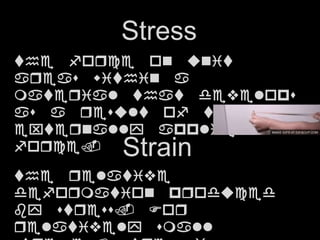
the force on unit
areas within a
material that develops
as a result of the
externally applied
force.
Stress
Strain
the relative
deformation produced
by stress. For
relatively small
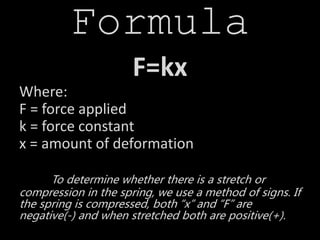
Formula
F=kx
Where:
F = force applied
k = force constant
x = amount of deformation
To determine whether there is a stretch or
compression in the spring, we use a method of signs. If
the spring is compressed, both “x” and “F” are
negative(-) and when stretched both are positive(+).
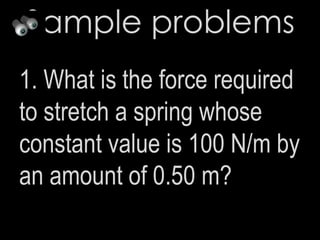
Sample problems
1. What is the force required
to stretch a spring whose
constant value is 100 N/m by
an amount of 0.50 m?
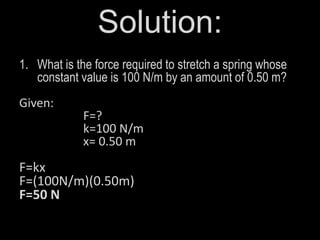
Solution:
1. What is the force required to stretch a spring whose
constant value is 100 N/m by an amount of 0.50 m?
Given:
F=?
k=100 N/m
x= 0.50 m
F=kx
F=(100N/m)(0.50m)
F=50 N
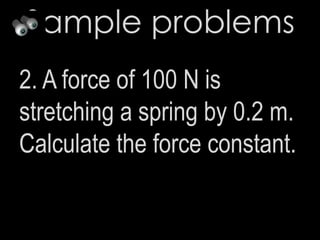
Sample problems
2. A force of 100 N is
stretching a spring by 0.2 m.
Calculate the force constant.
Solution:
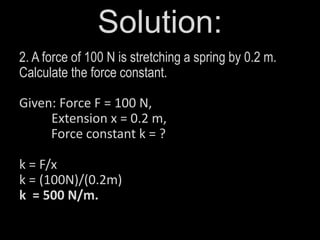
2. A force of 100 N is stretching a spring by 0.2 m.
Calculate the force constant.
Given: Force F = 100 N,
Extension x = 0.2 m,
Force constant k = ?
k = F/x
k = (100N)/(0.2m)
k = 500 N/m.
END!

Hooke’s law

  • 1.
  • 2.
    Hooke’s Law • forrelatively small deformations of an object, the displacement or size of the deformation is directly proportional to the deforming force or load
  • 3.
    Hooke’s Law • Elasticbehaviour of solids according to Hooke’s law can be explained by the fact that small displacements of their constituent molecules, atoms, or ions from normal positions is also proportional to the force that causes the displacement
  • 4.
    Hooke’s Law • Theconcept of Hooke’s Law is that the amount of force applied to a spring or elastic object is proportional to the amount of deformation (length of stretch or compression). The greater the force applied to an elastic object, the more deformation (stretch or compression) there is. With less force applied, there will be less deformation in the spring.
  • 5.
    the force onunit areas within a material that develops as a result of the externally applied force. Stress Strain the relative deformation produced by stress. For relatively small
  • 6.
    Formula F=kx Where: F = forceapplied k = force constant x = amount of deformation To determine whether there is a stretch or compression in the spring, we use a method of signs. If the spring is compressed, both “x” and “F” are negative(-) and when stretched both are positive(+).
  • 7.
    Sample problems 1. Whatis the force required to stretch a spring whose constant value is 100 N/m by an amount of 0.50 m?
  • 8.
    Solution: 1. What isthe force required to stretch a spring whose constant value is 100 N/m by an amount of 0.50 m? Given: F=? k=100 N/m x= 0.50 m F=kx F=(100N/m)(0.50m) F=50 N
  • 9.
    Sample problems 2. Aforce of 100 N is stretching a spring by 0.2 m. Calculate the force constant.
  • 10.
    Solution: 2. A forceof 100 N is stretching a spring by 0.2 m. Calculate the force constant. Given: Force F = 100 N, Extension x = 0.2 m, Force constant k = ? k = F/x k = (100N)/(0.2m) k = 500 N/m.
  • 11.