Elasticity
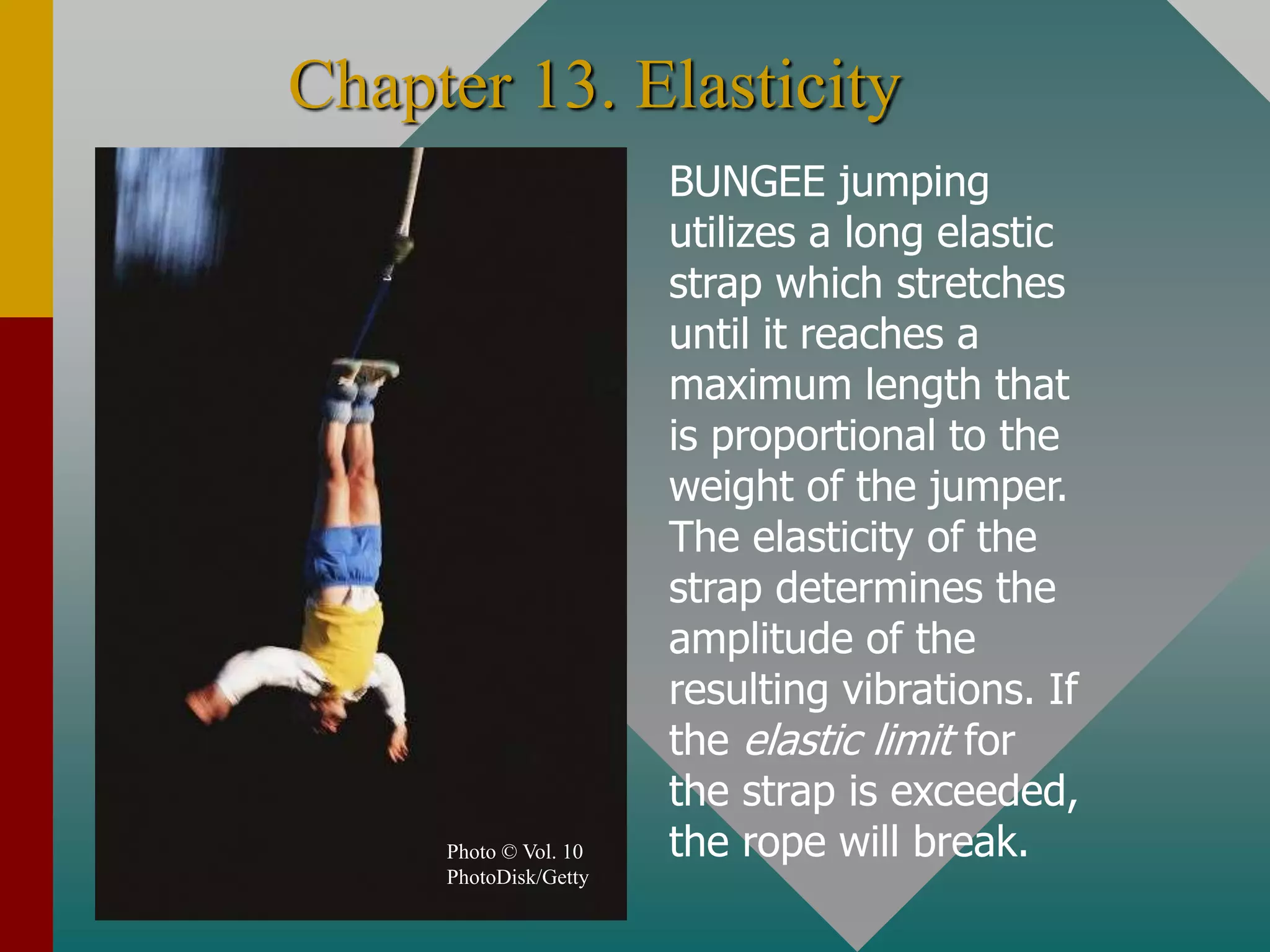
BUNGEE jumping
utilizes a long elastic
strap which stretches
until it reaches a
maximum length that
is proportional to the
weight of the jumper.
The elasticity of the
strap determines the
amplitude of the
resulting vibrations. If
the elastic limit for
the strap is exceeded,
the rope will break.
Chapter 13. Elasticity
Photo © Vol. 10
PhotoDisk/Getty
Objectives: After completion of this
module, you should be able to:
• Demonstrate your understanding of
elasticity, elastic limit, stress, strain, and
ultimate strength.
• Write and apply formulas for calculating
Young’s modulus, shear modulus, and
bulk modulus.
• Solve problems involving each of the
parameters in the above objectives.
Elastic Properties of Matter
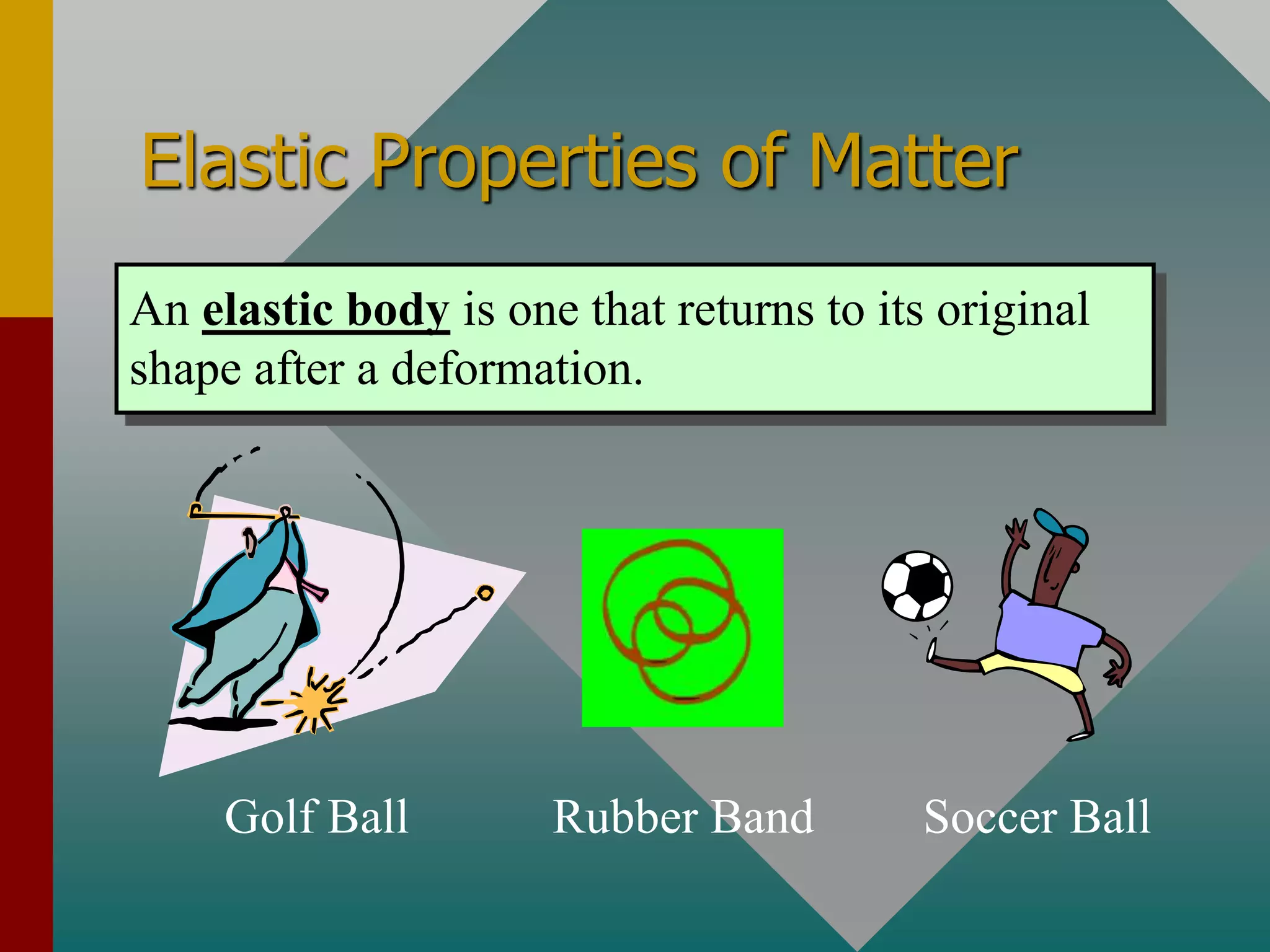
An elastic body is one that returns to its original
shape after a deformation.
Golf Ball Soccer Ball
Rubber Band
Elastic Properties of Matter
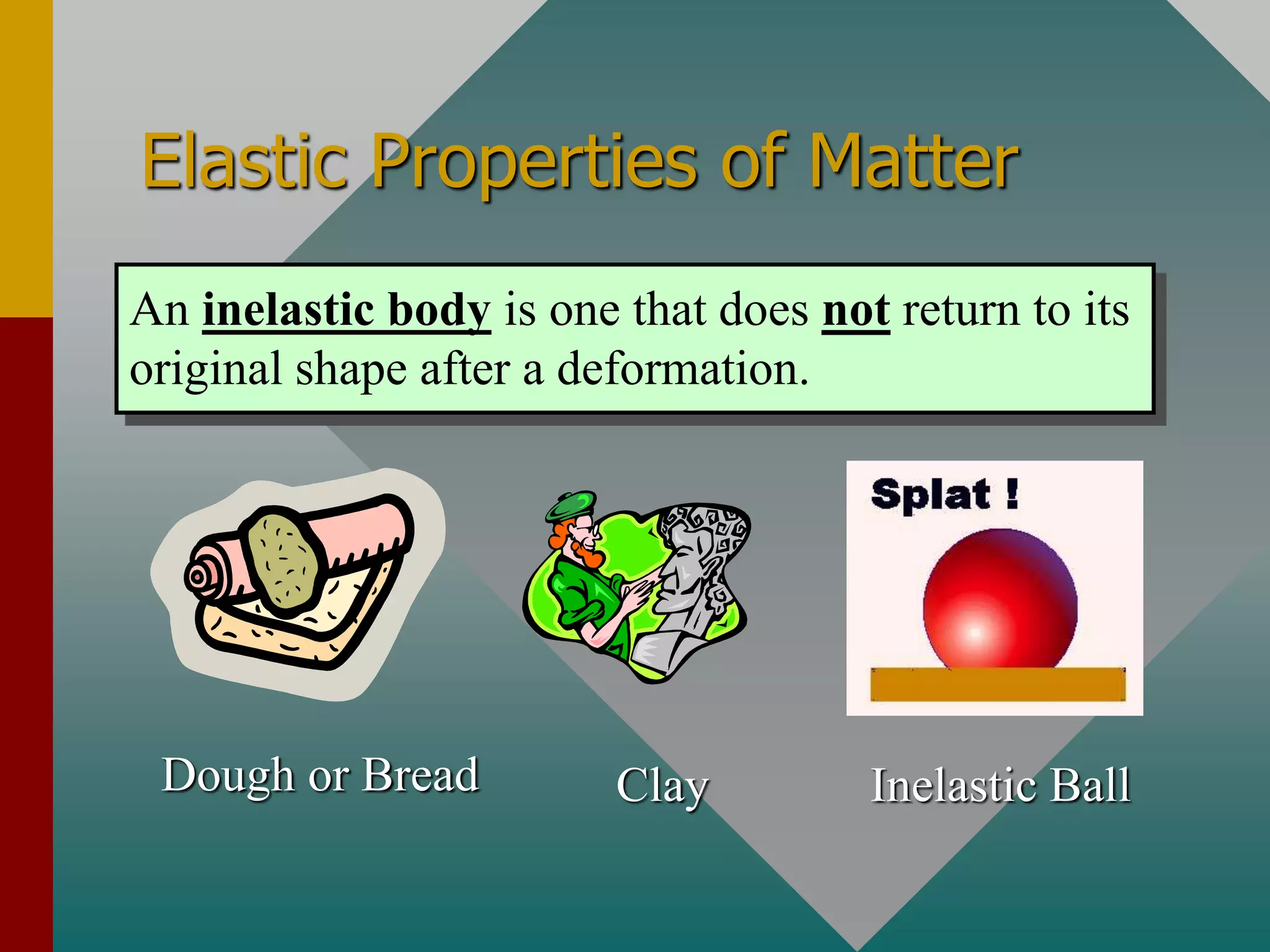
An inelastic body is one that does not return to its
original shape after a deformation.
Dough or Bread Clay Inelastic Ball
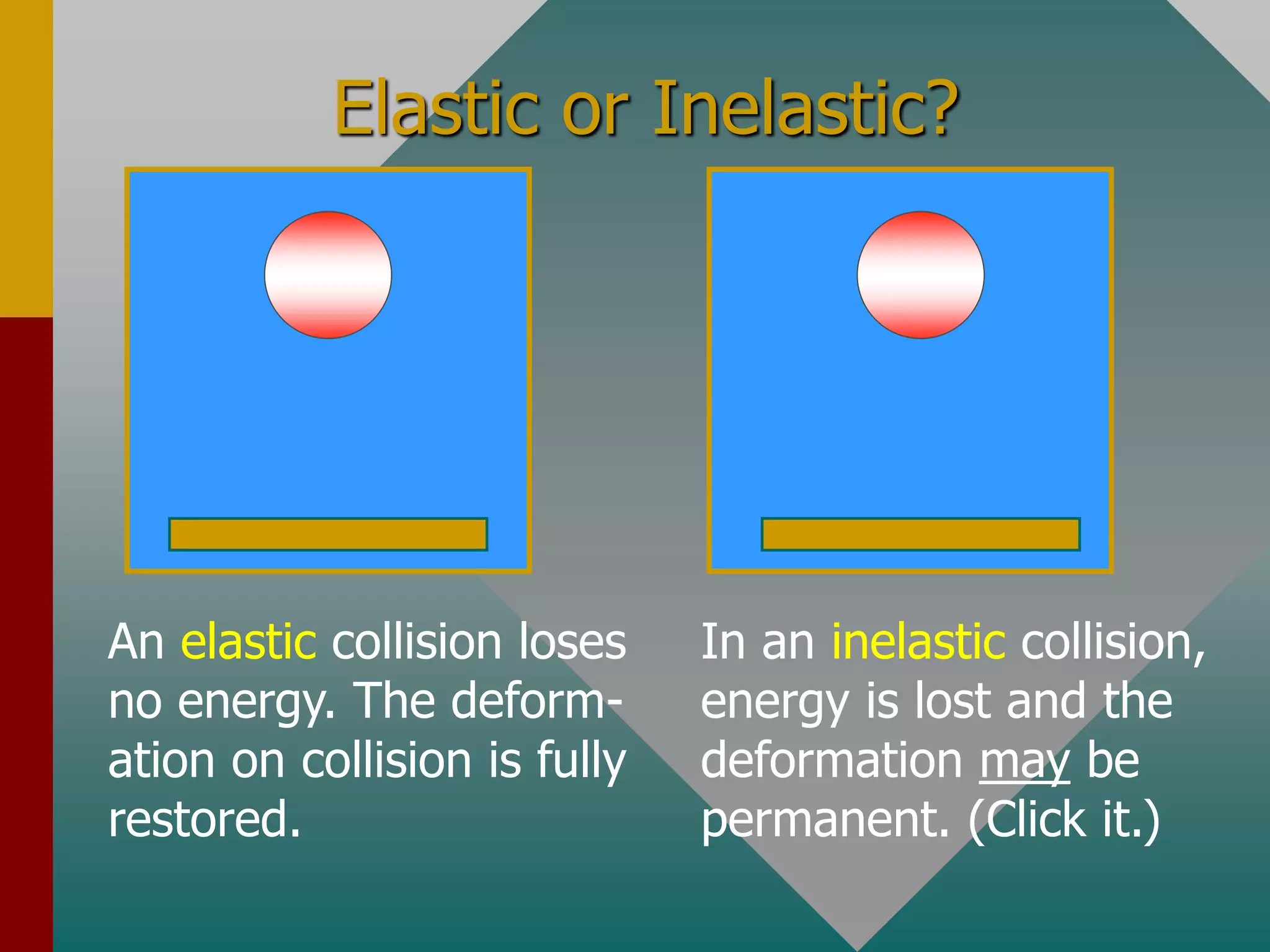
Elastic or Inelastic?
An elastic collision loses
no energy. The deform-
ation on collision is fully
restored.
In an inelastic collision,
energy is lost and the
deformation may be
permanent. (Click it.)
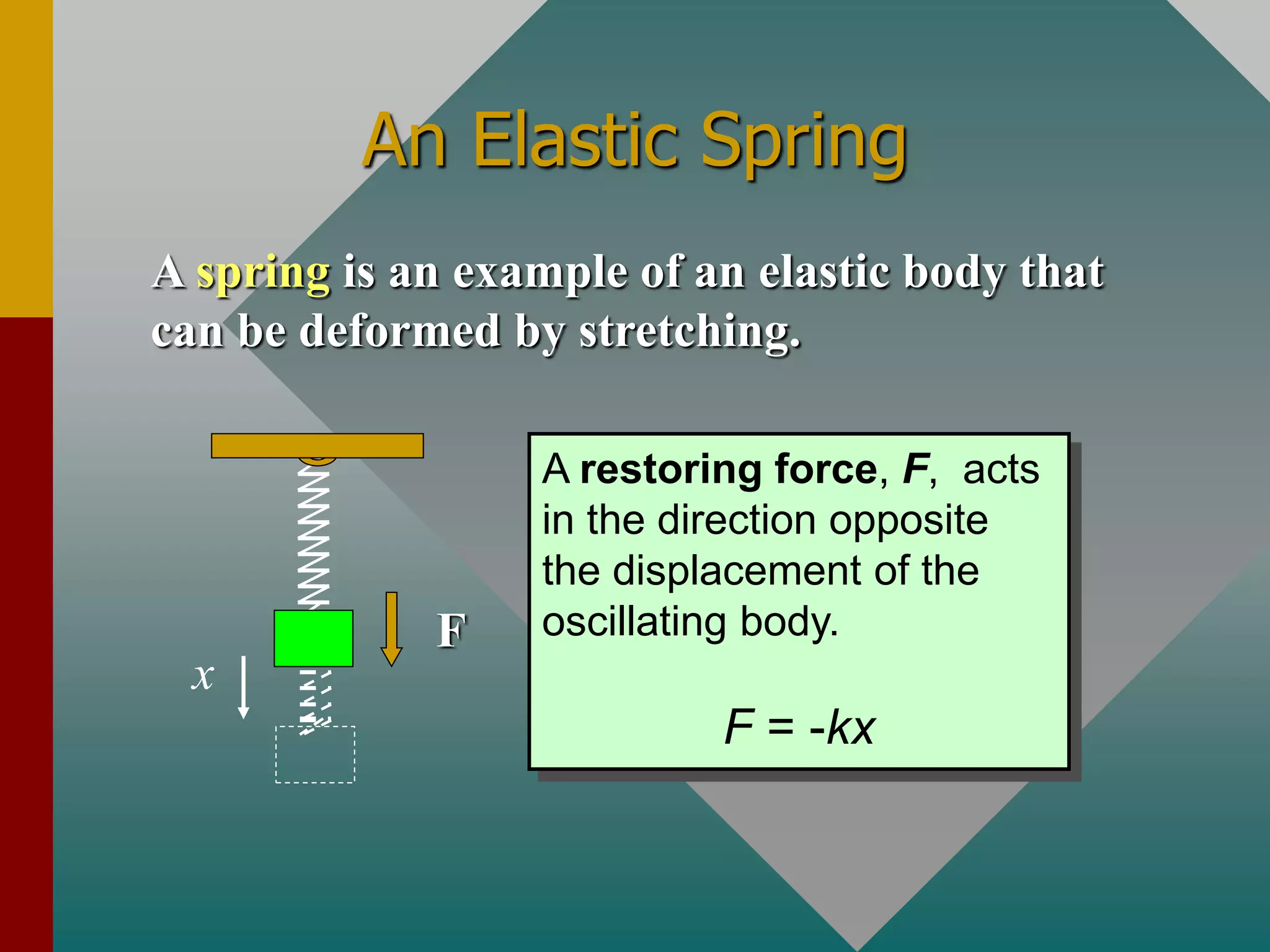
An Elastic Spring
A spring is an example of an elastic body that
can be deformed by stretching.
A restoring force, F, acts
in the direction opposite
the displacement of the
oscillating body.
F = -kx
x
F
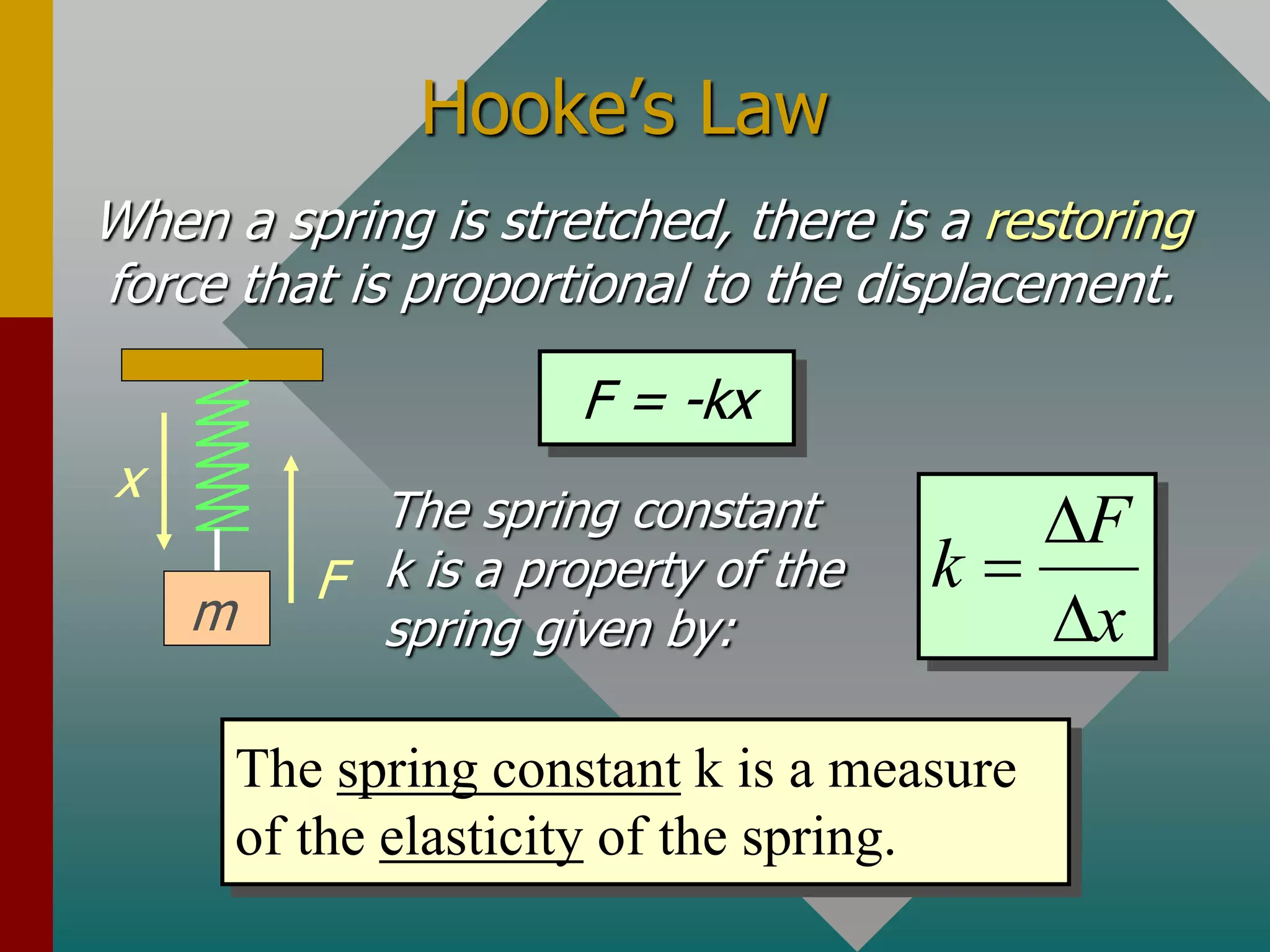
Hooke’s Law
When a spring is stretched, there is a restoring
force that is proportional to the displacement.
F = -kx
The spring constant
k is a property of the
spring given by:
F
x
m
F
k
x



The spring constant k is a measure
of the elasticity of the spring.
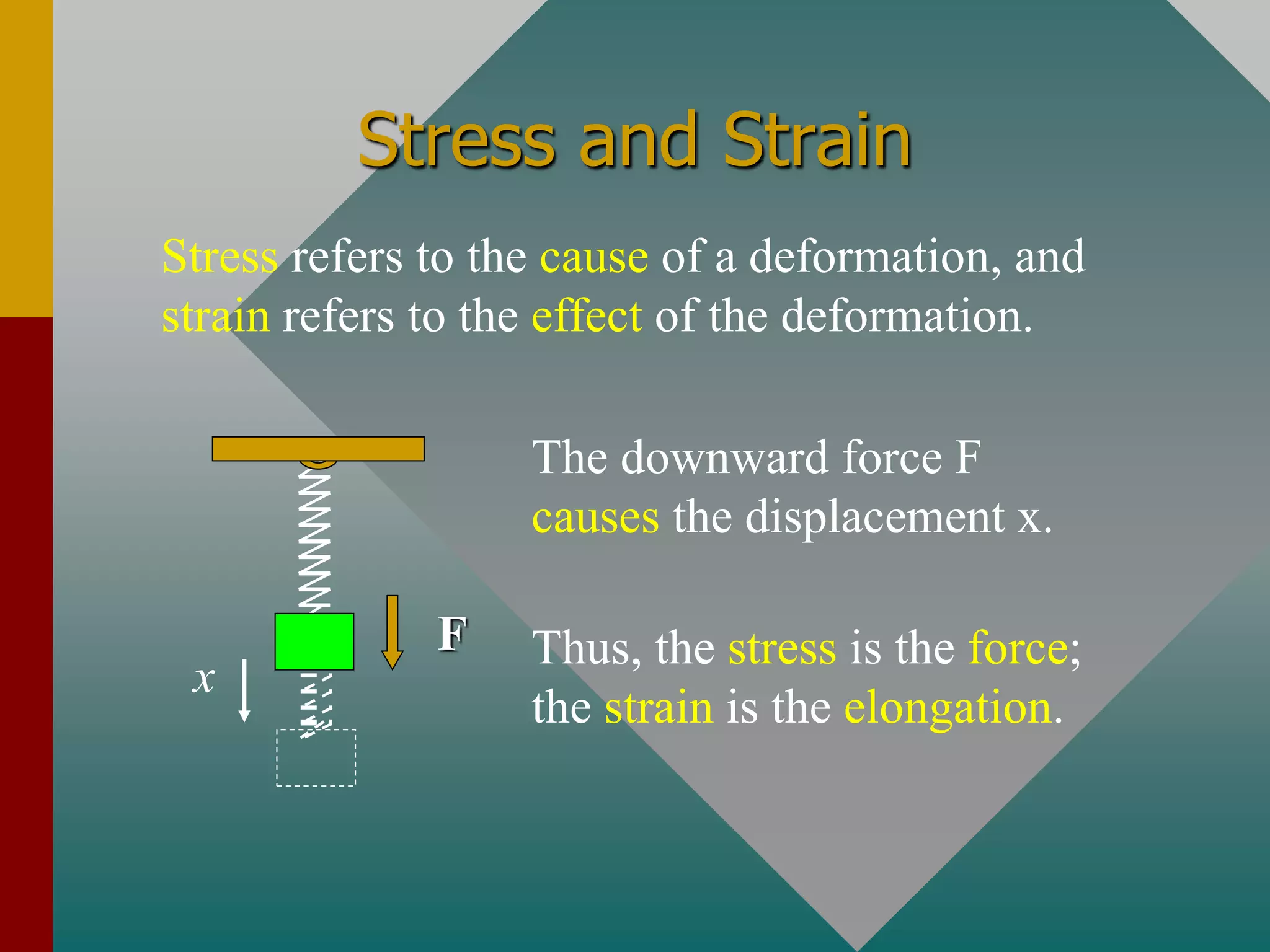
Stress and Strain
Stress refers to the cause of a deformation, and
strain refers to the effect of the deformation.
x
F
The downward force F
causes the displacement x.
Thus, the stress is the force;
the strain is the elongation.
Types of Stress
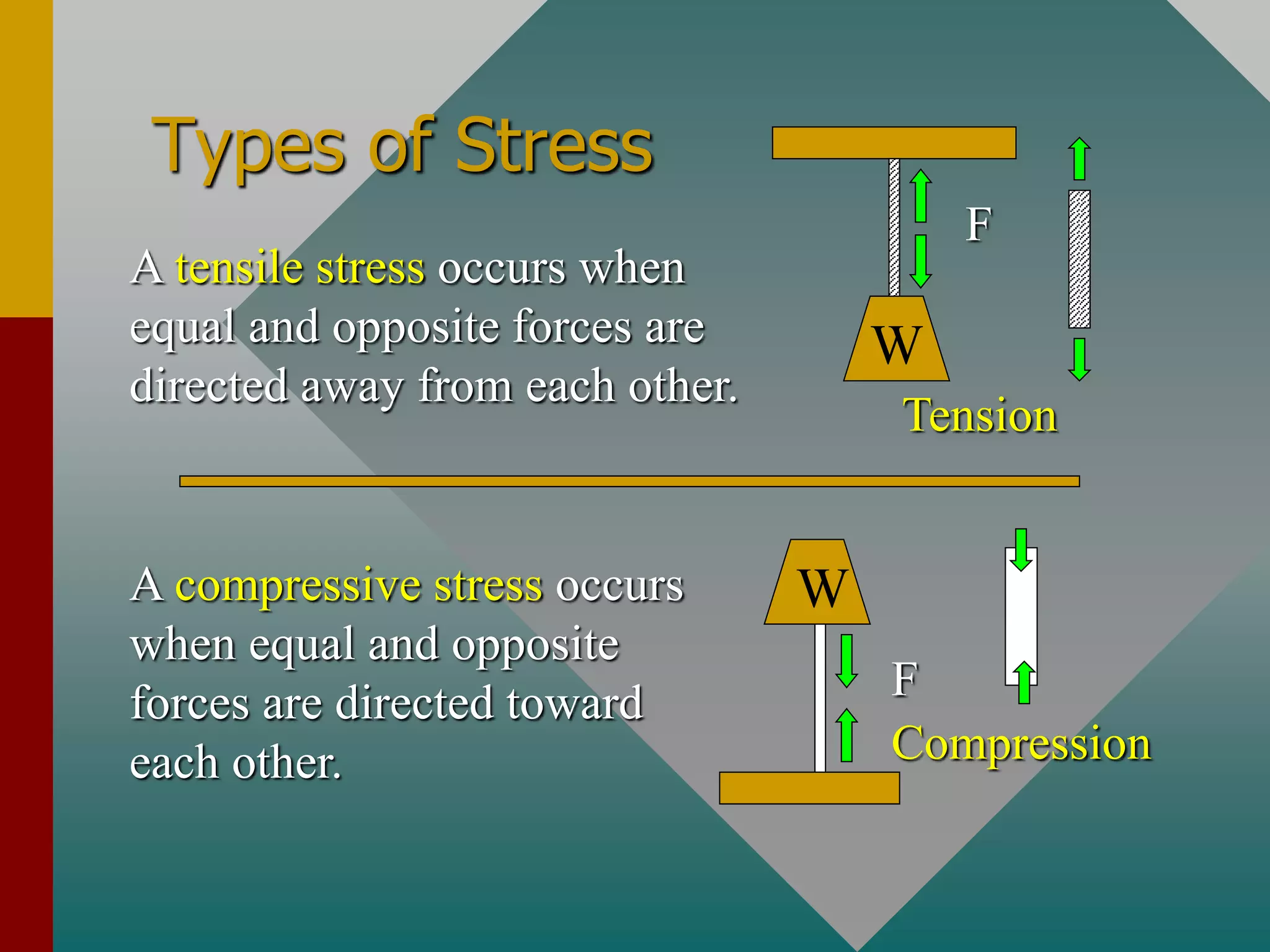
A tensile stress occurs when
equal and opposite forces are
directed away from each other.
A compressive stress occurs
when equal and opposite
forces are directed toward
each other.
F
W
Tension
F
W
Compression
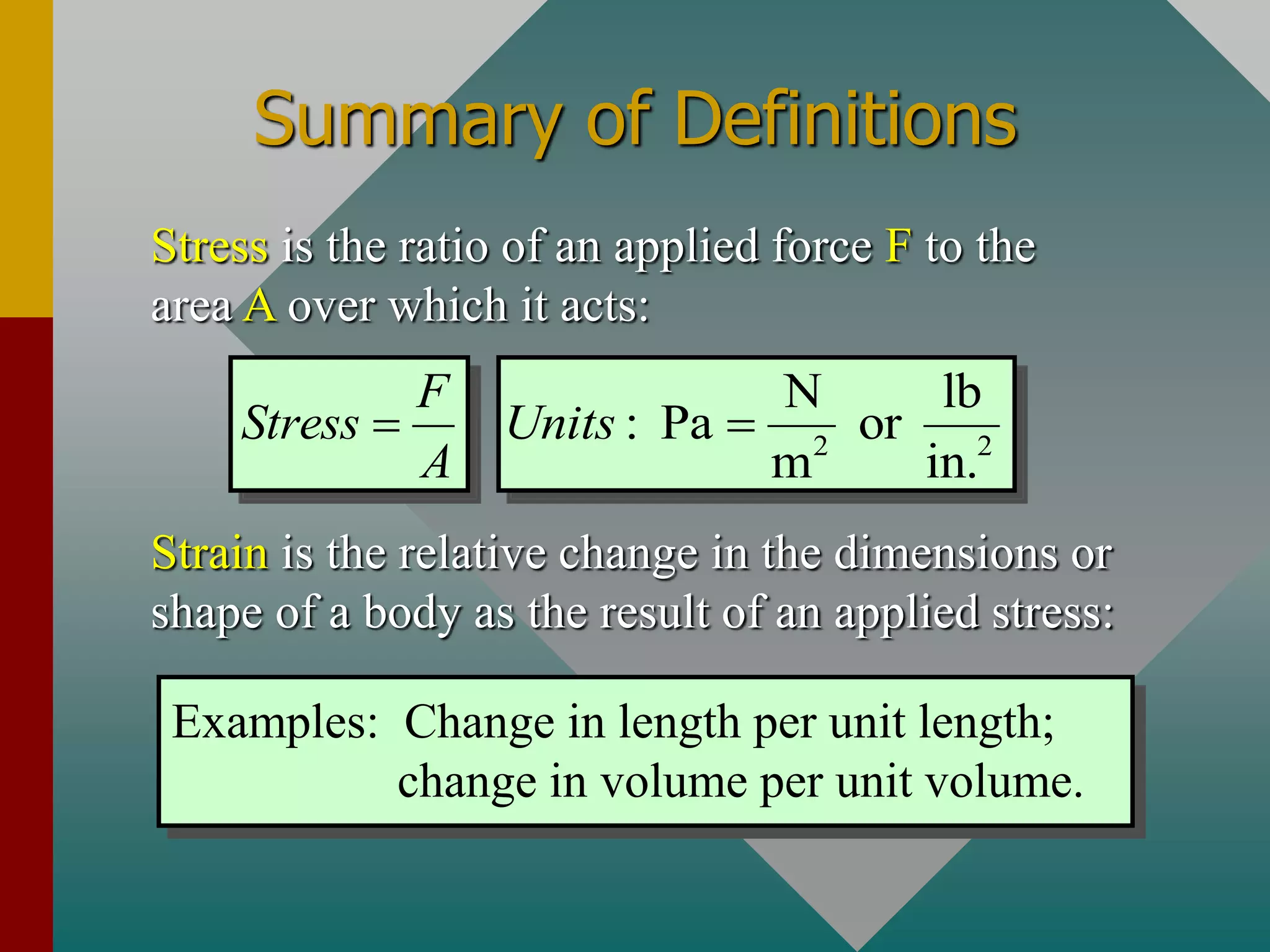
Summary of Definitions
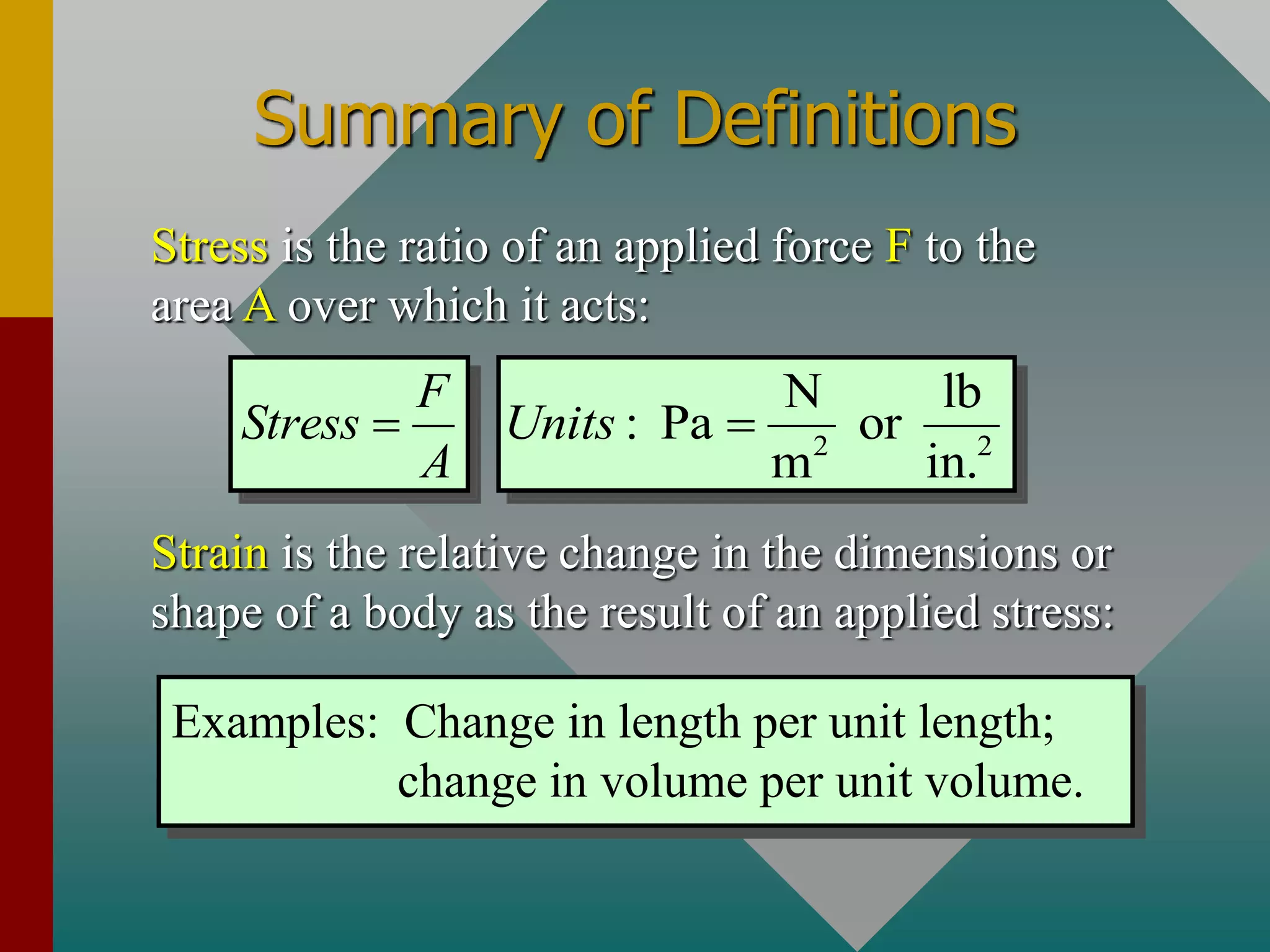
Stress is the ratio of an applied force F to the
area A over which it acts:
Strain is the relative change in the dimensions or
shape of a body as the result of an applied stress:
F
Stress
A
 2 2
N lb
: Pa or
m in.
Units 
Examples: Change in length per unit length;
change in volume per unit volume.
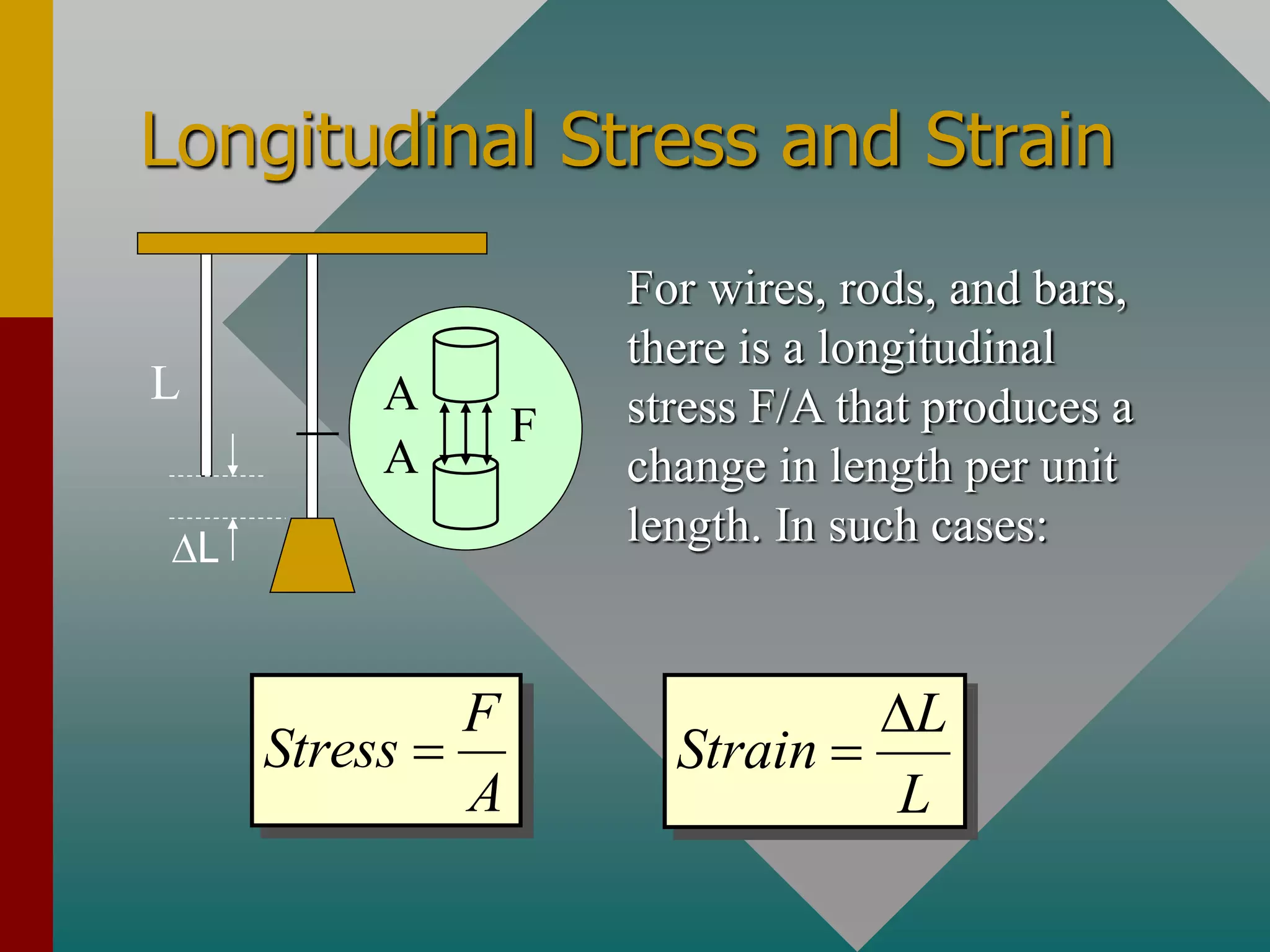
Longitudinal Stress and Strain
L
L
A
A
F
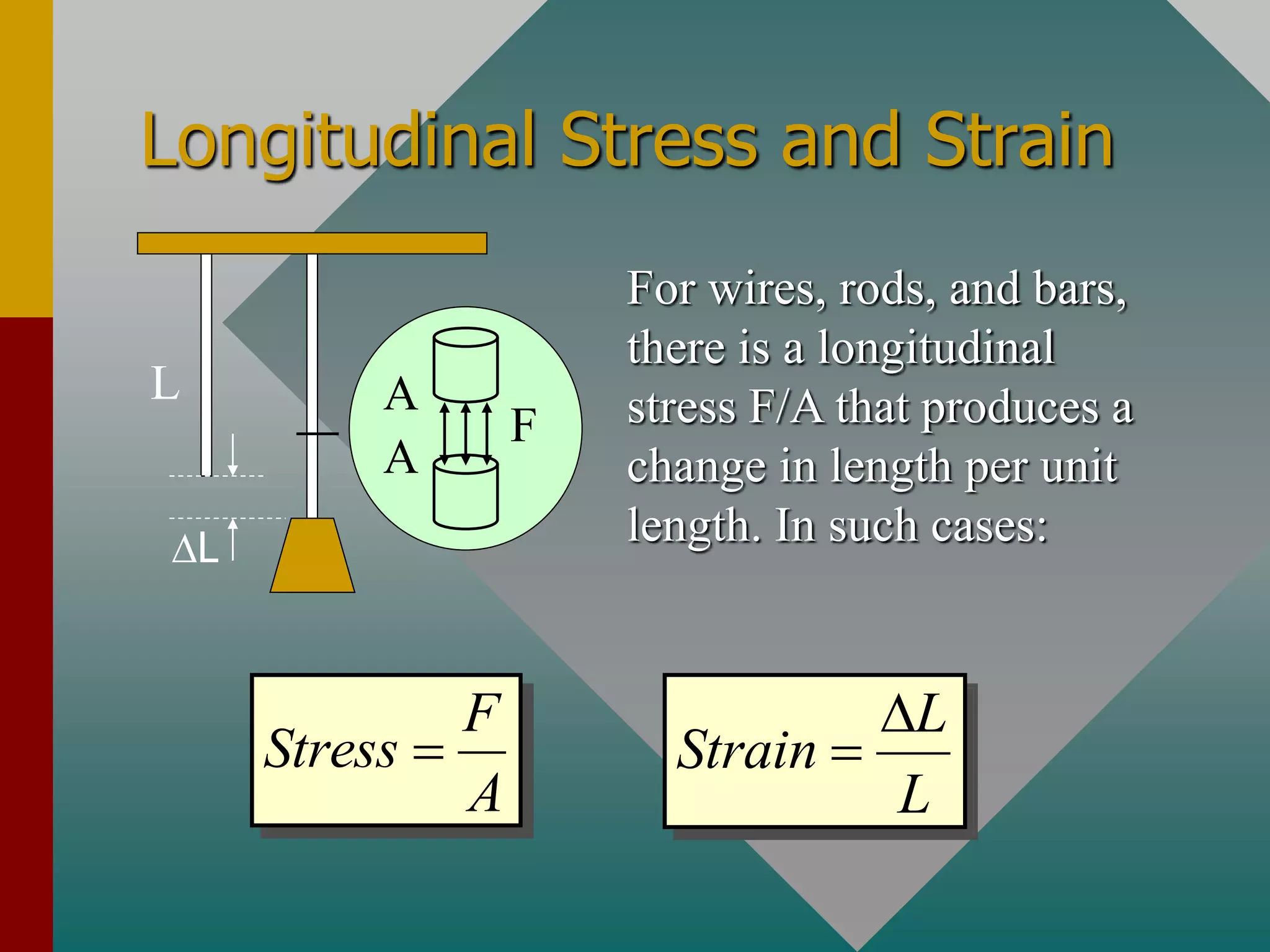
For wires, rods, and bars,
there is a longitudinal
stress F/A that produces a
change in length per unit
length. In such cases:
F
Stress
A

L
Strain
L


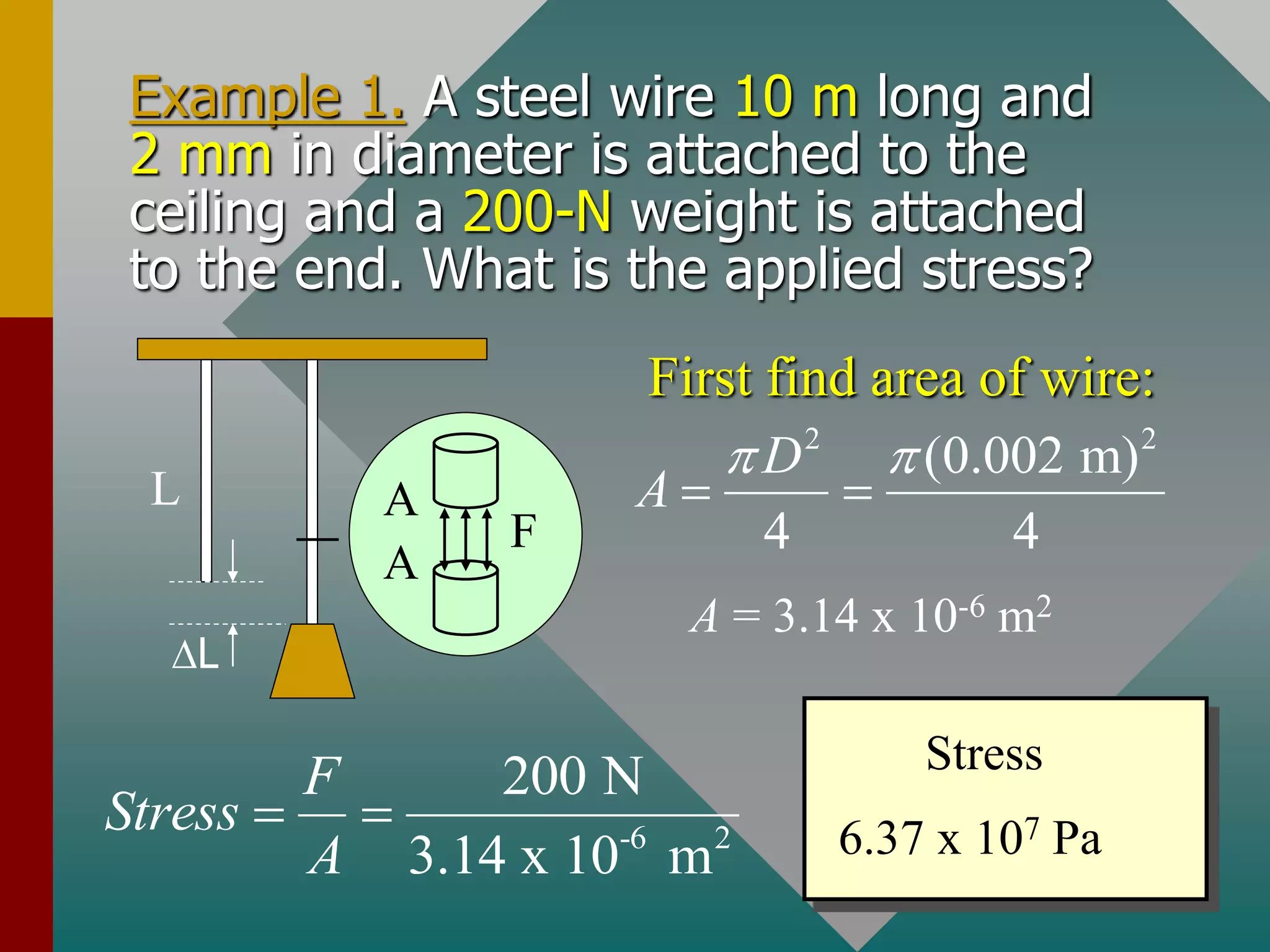
Example 1. A steel wire 10 m long and
2 mm in diameter is attached to the
ceiling and a 200-N weight is attached
to the end. What is the applied stress?
L
L
A
A
F
First find area of wire:
2 2
(0.002 m)
4 4
D
A
 
 
A = 3.14 x 10⁻⁶ m2
-6 2
200 N
3.14 x 10 m
F
Stress
A
 
Stress
6.37 x 10⁷ Pa
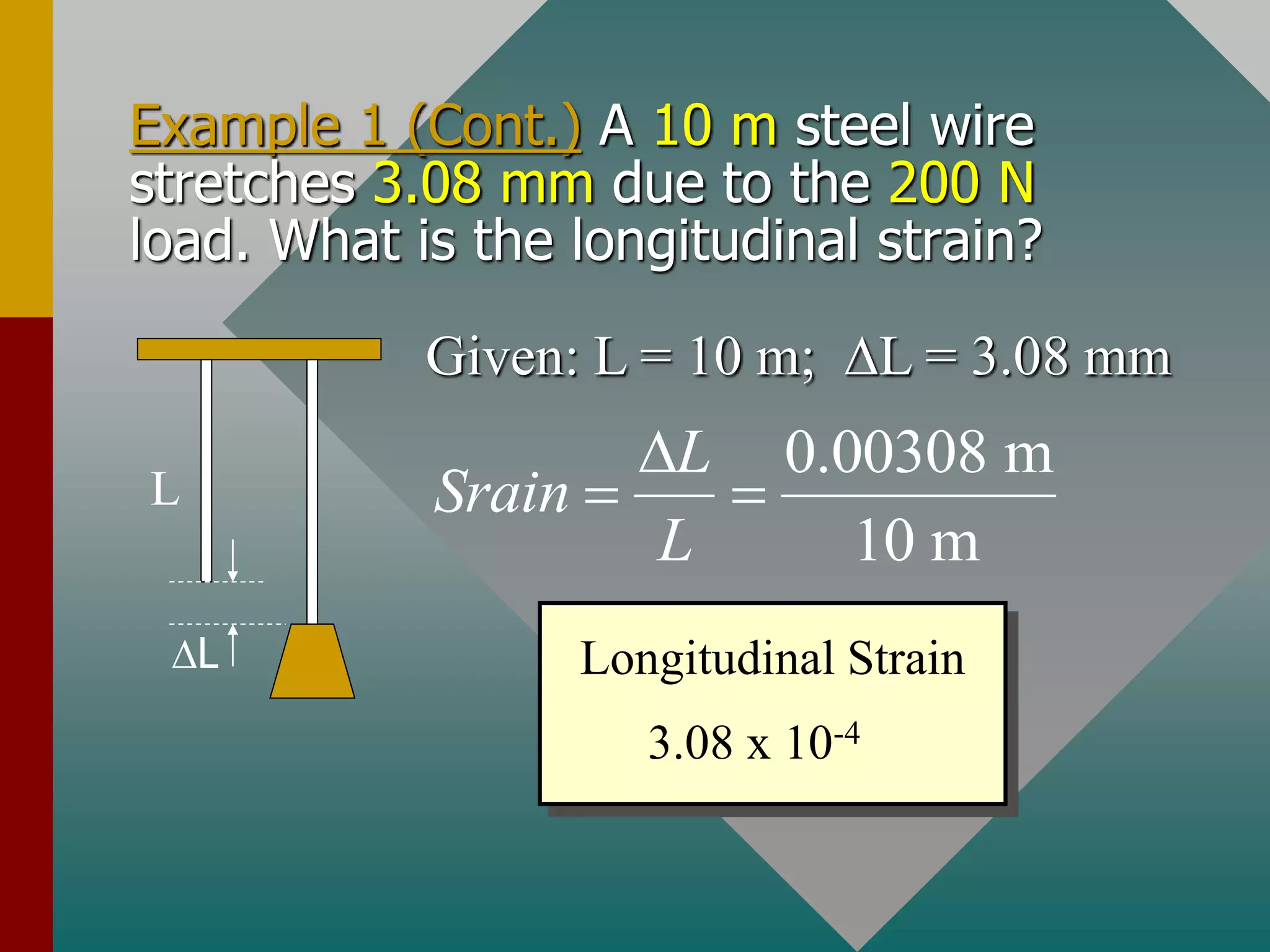
Example 1 (Cont.) A 10 m steel wire
stretches 3.08 mm due to the 200 N
load. What is the longitudinal strain?
L
L
Given: L = 10 m; L = 3.08 mm
Longitudinal Strain
3.08 x 10⁻⁴
0.00308 m
10 m
L
Srain
L

 
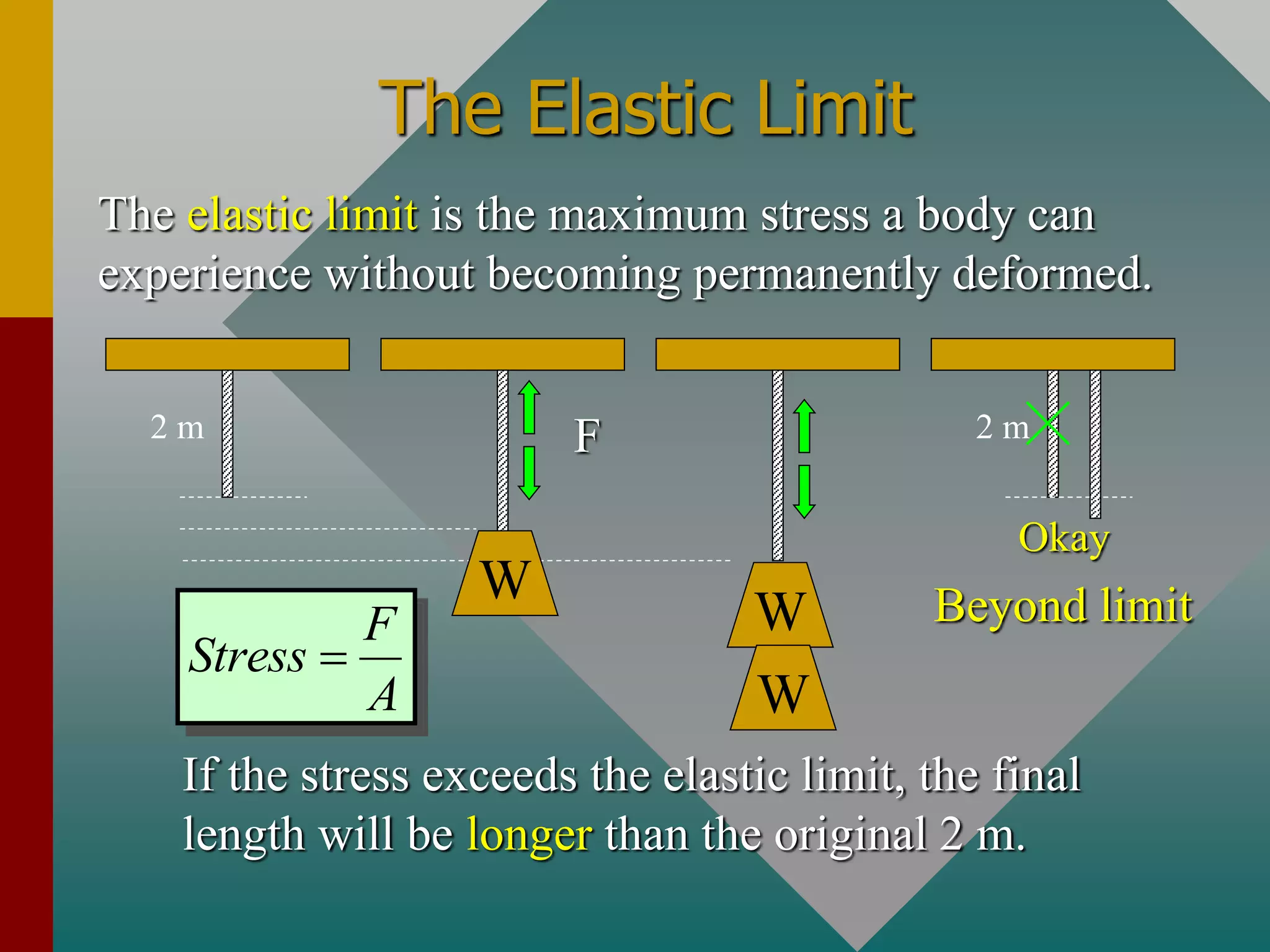
The Elastic Limit
The elastic limit is the maximum stress a body can
experience without becoming permanently deformed.
W
W
2 m
If the stress exceeds the elastic limit, the final
length will be longer than the original 2 m.
Okay
Beyond limit
F
W
2 m
F
Stress
A

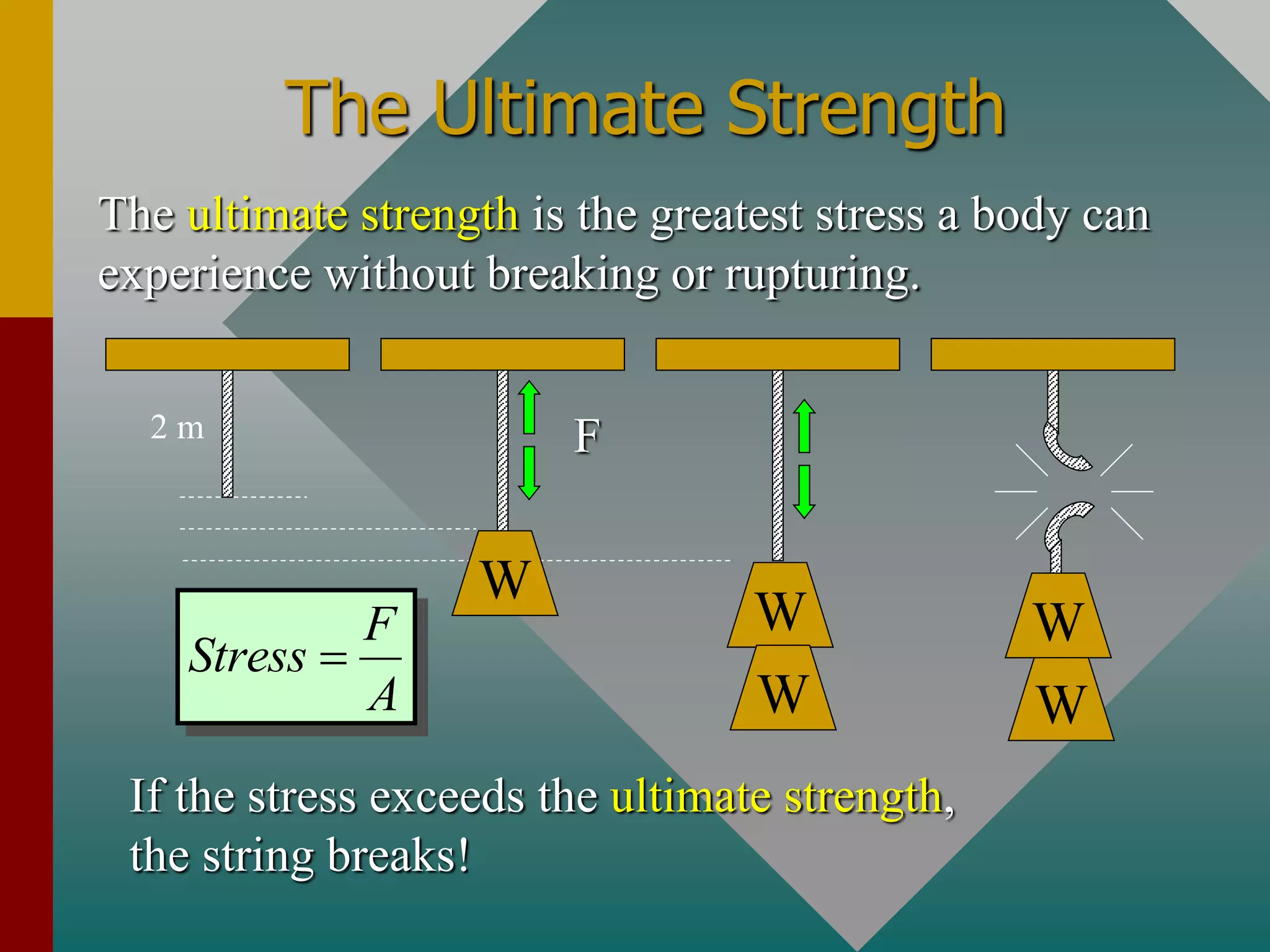
The Ultimate Strength
The ultimate strength is the greatest stress a body can
experience without breaking or rupturing.
If the stress exceeds the ultimate strength,
the string breaks!
F
W
W
W
2 m
F
Stress
A

W
W
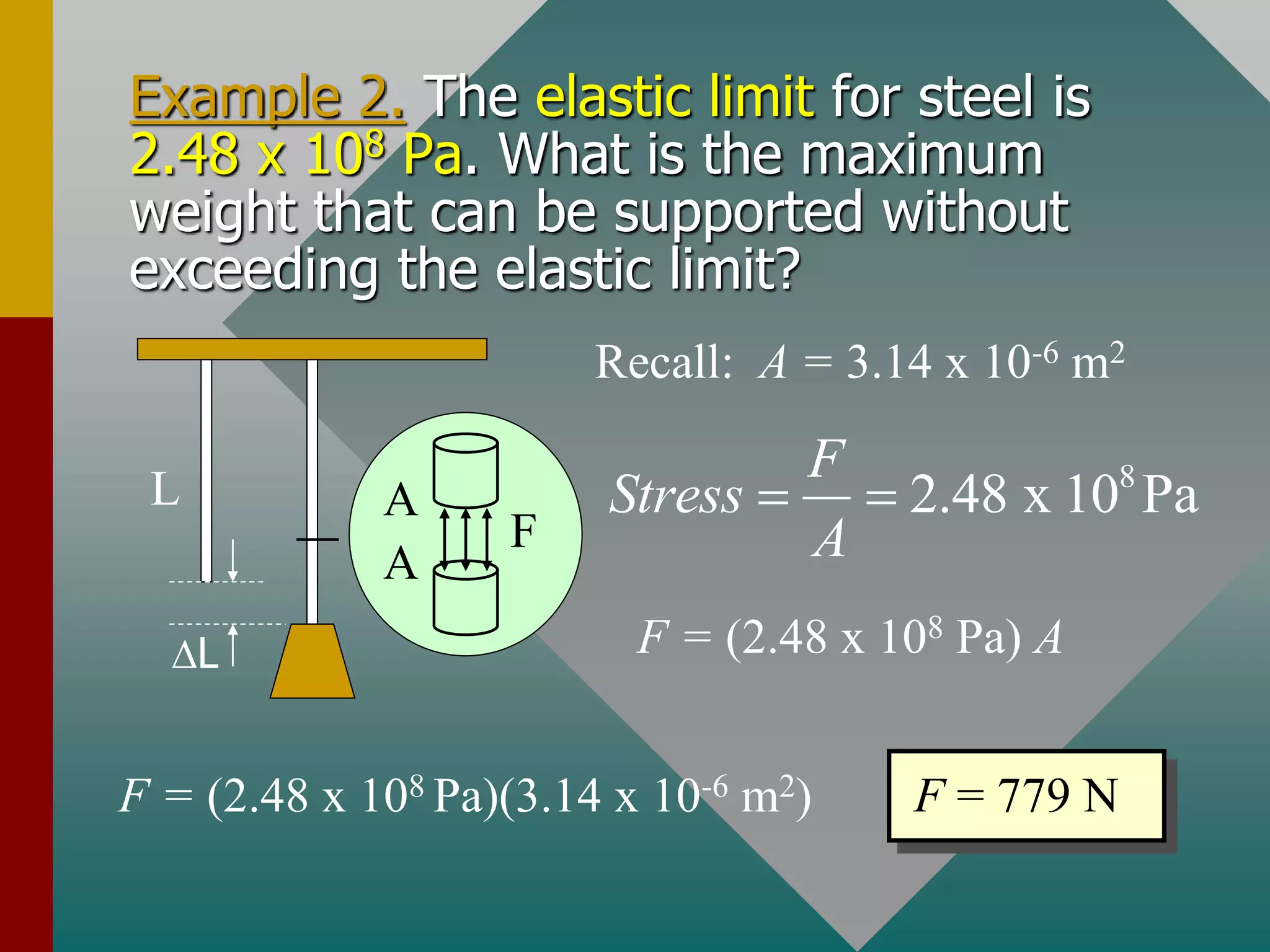
Example 2. The elastic limit for steel is
2.48 x 10⁸ Pa. What is the maximum
weight that can be supported without
exceeding the elastic limit?
L
L
A
A
F
8
2.48 x 10 Pa
F
Stress
A
 
Recall: A = 3.14 x 10⁻⁶ m2
F = (2.48 x 10⁸ Pa) A
F = (2.48 x 10⁸ Pa)(3.14 x 10⁻⁶ m2) F = 779 N
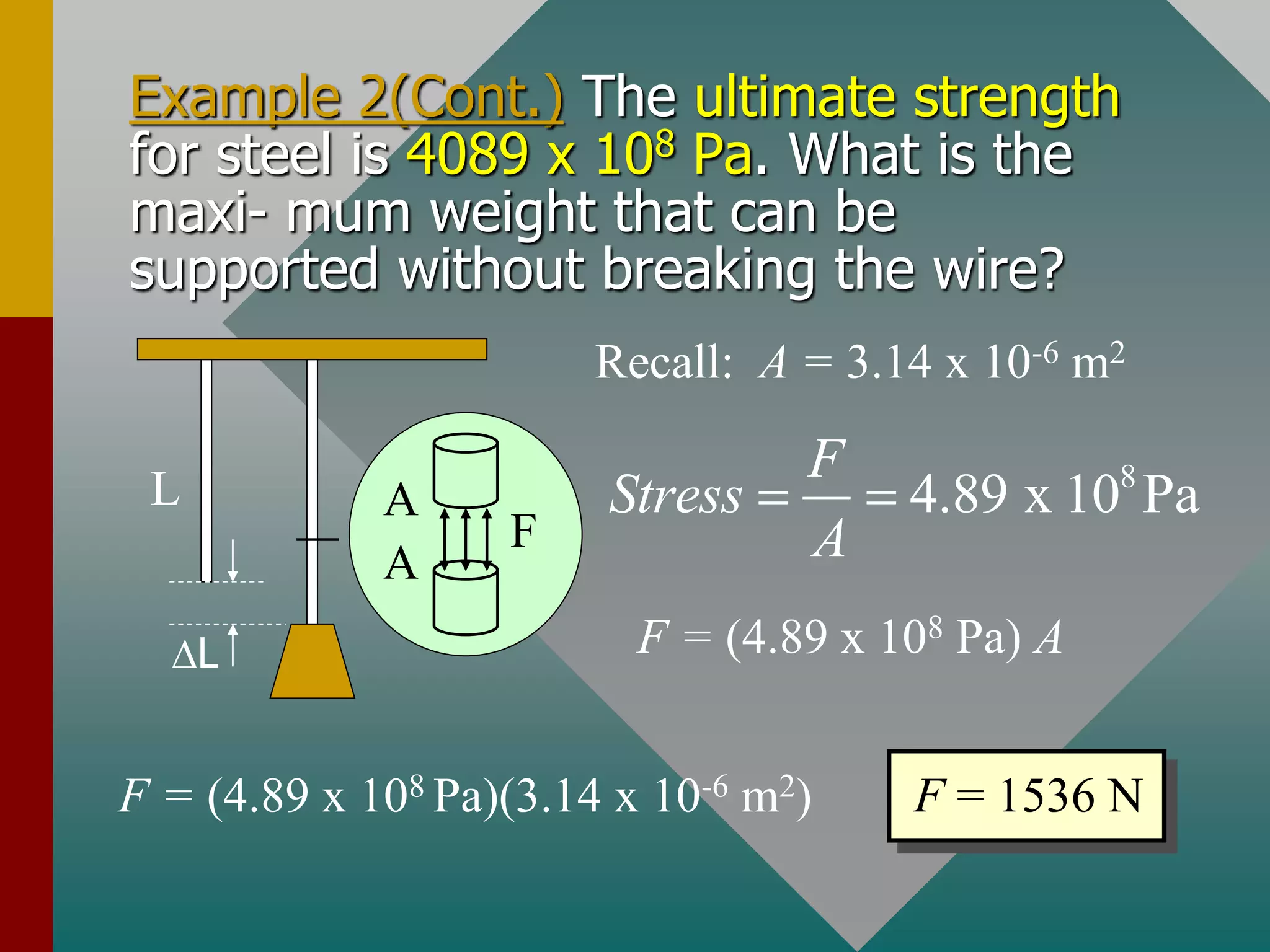
Example 2(Cont.) The ultimate strength
for steel is 4089 x 108 Pa. What is the
maxi- mum weight that can be
supported without breaking the wire?
L
L
A
A
F
8
4.89 x 10 Pa
F
Stress
A
 
Recall: A = 3.14 x 10⁻⁶ m2
F = (4.89 x 10⁸ Pa) A
F = (4.89 x 10⁸ Pa)(3.14 x 10⁻⁶ m2) F = 1536 N
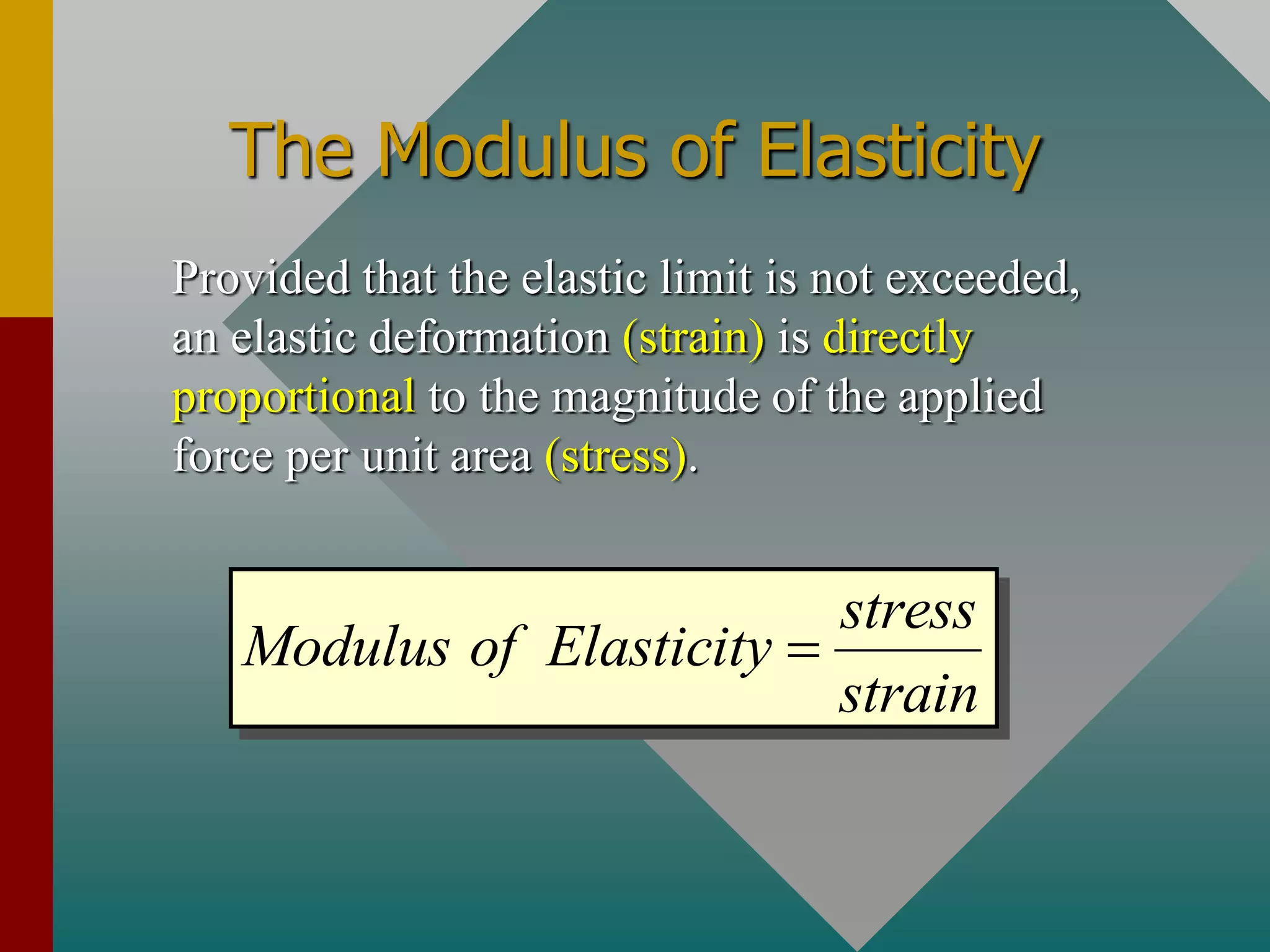
The Modulus of Elasticity
Provided that the elastic limit is not exceeded,
an elastic deformation (strain) is directly
proportional to the magnitude of the applied
force per unit area (stress).
stress
Modulus of Elasticity
strain

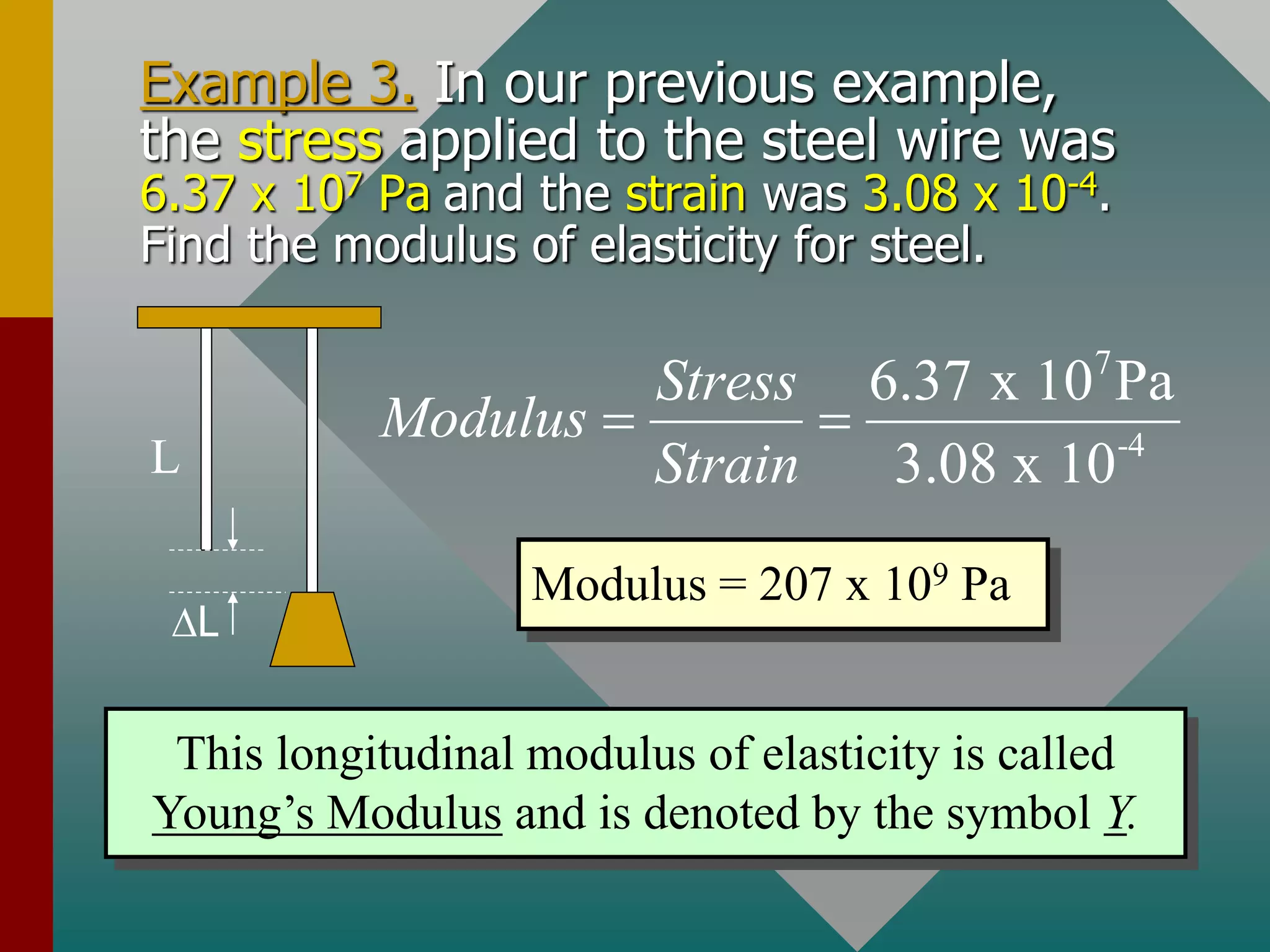
Example 3. In our previous example,
the stress applied to the steel wire was
6.37 x 10⁷ Pa and the strain was 3.08 x 10⁻⁴.
Find the modulus of elasticity for steel.
L
L
7
-4
6.37 x 10 Pa
3.08 x 10
Stress
Modulus
Strain
 
Modulus = 207 x 109 Pa
This longitudinal modulus of elasticity is called
Young’s Modulus and is denoted by the symbol Y.
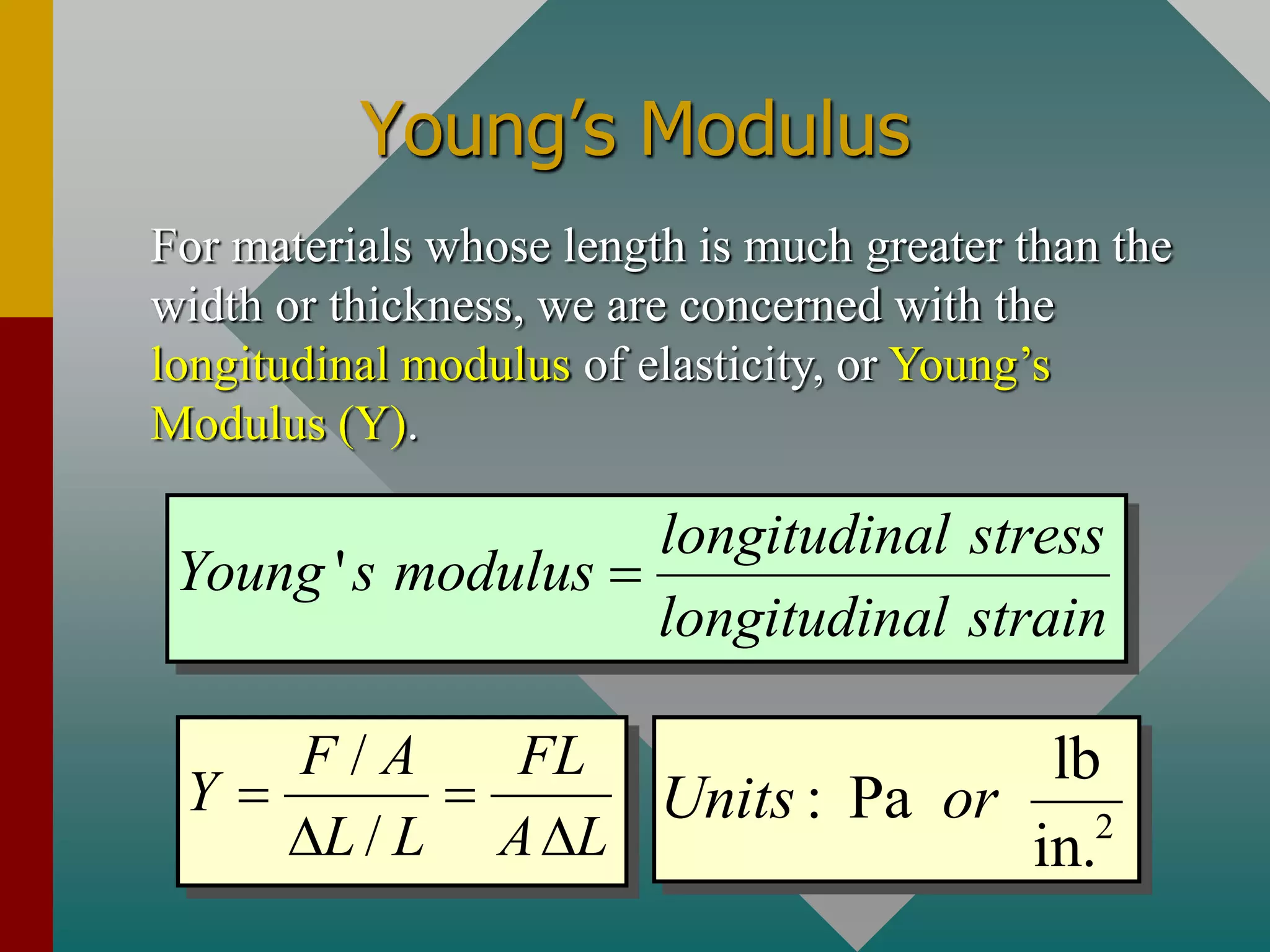
Young’s Modulus
For materials whose length is much greater than the
width or thickness, we are concerned with the
longitudinal modulus of elasticity, or Young’s
Modulus (Y).
'
longitudinal stress
Young s modulus
longitudinal strain

/
/
F A FL
Y
L L A L
 
  2
lb
: Pa
in.
Units or
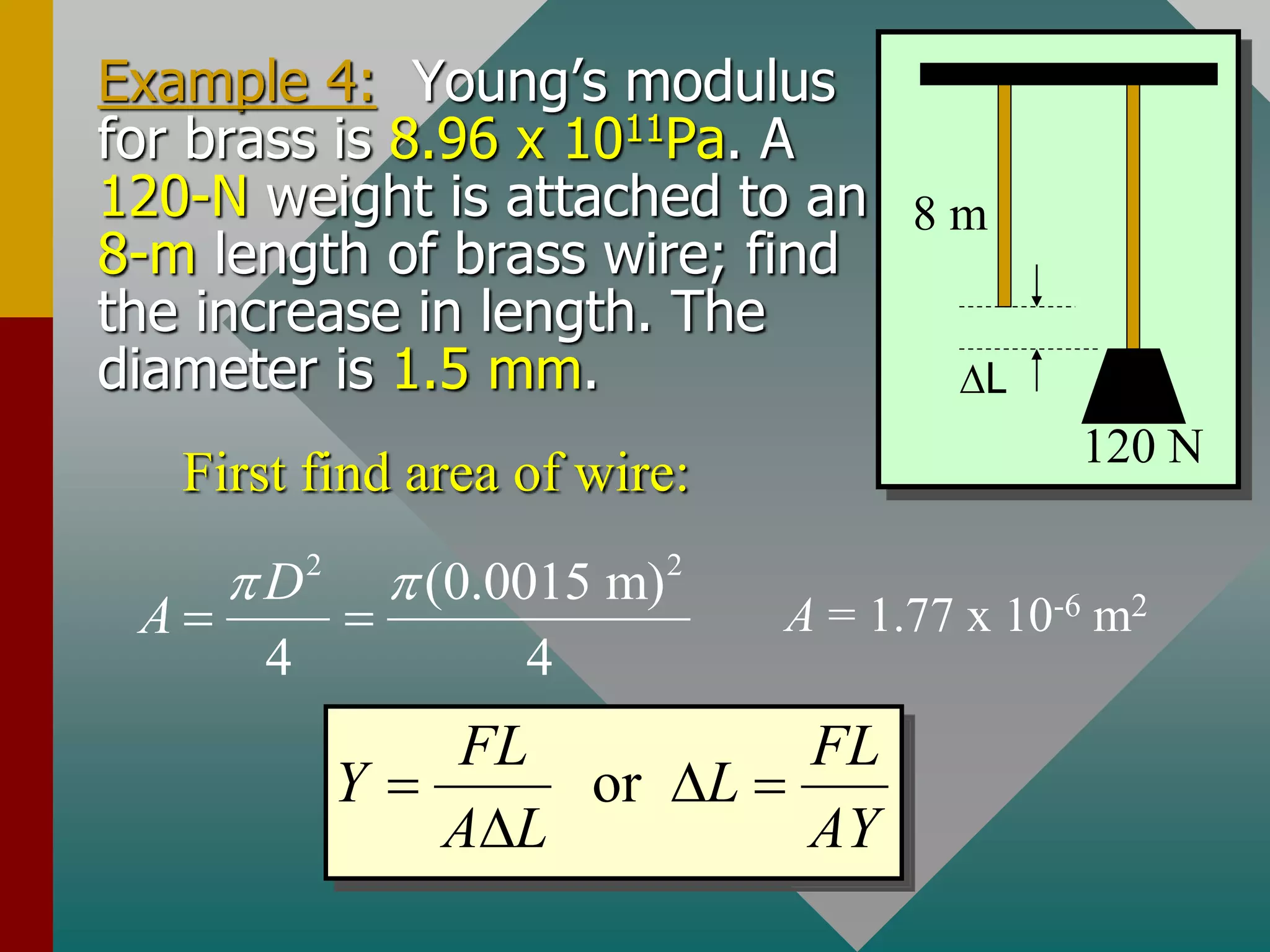
Example 4: Young’s modulus
for brass is 8.96 x 10¹¹Pa. A
120-N weight is attached to an
8-m length of brass wire; find
the increase in length. The
diameter is 1.5 mm.
8 m
L
120 N
First find area of wire:
2 2
(0.0015 m)
4 4
D
A
 
  A = 1.77 x 10⁻⁶ m2
or
FL FL
Y L
A L AY
  

Example 4: (Continued)
8 m
L
120 N
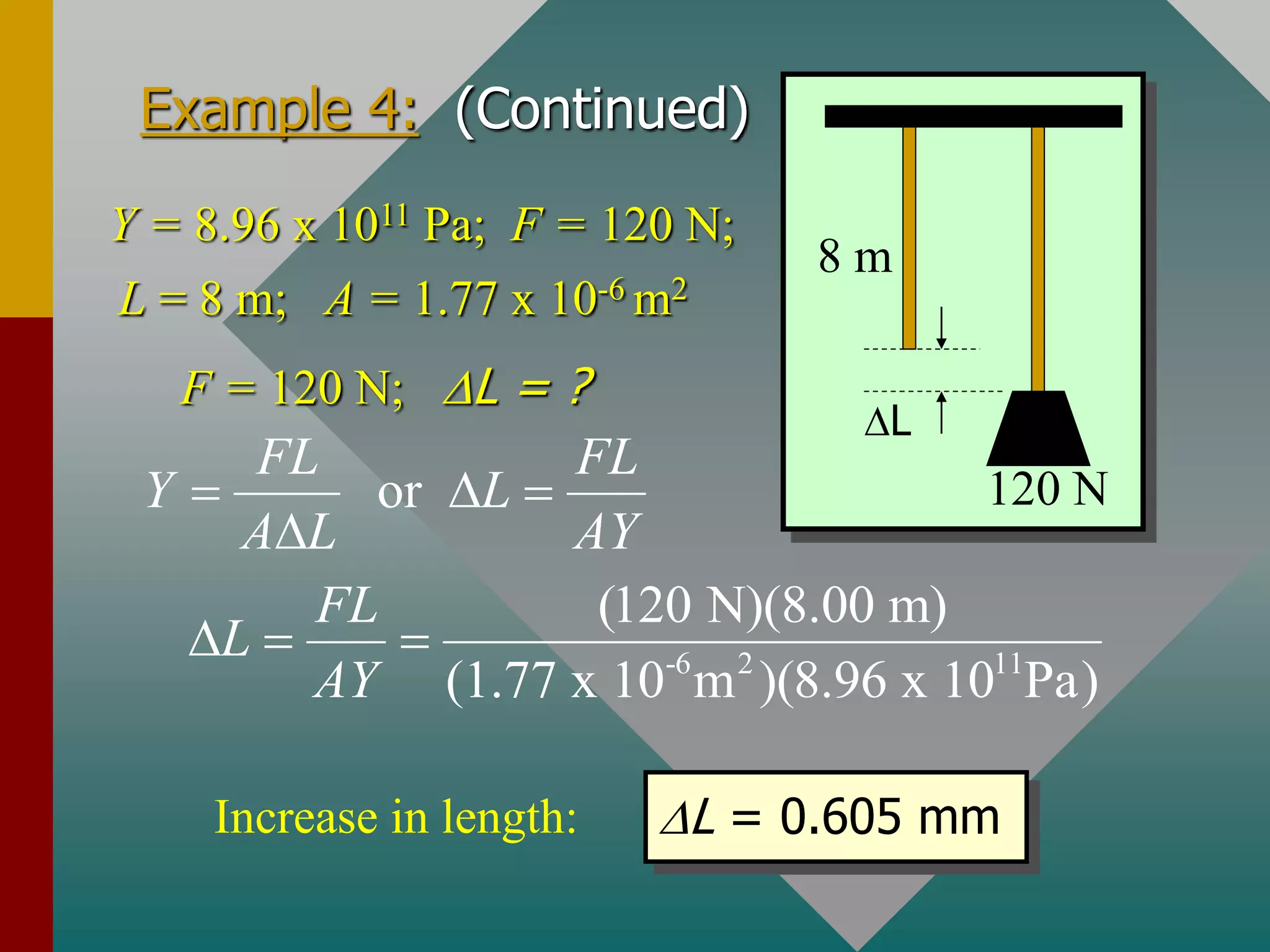
Y = 8.96 x 10¹¹ Pa; F = 120 N;
L = 8 m; A = 1.77 x 10⁻⁶ m2
F = 120 N; L = ?
or
FL FL
Y L
A L AY
  

-6 2 11
(120 N)(8.00 m)
(1.77 x 10 m )(8.96 x 10 Pa)
FL
L
AY
  
L = 0.605 mm
Increase in length:
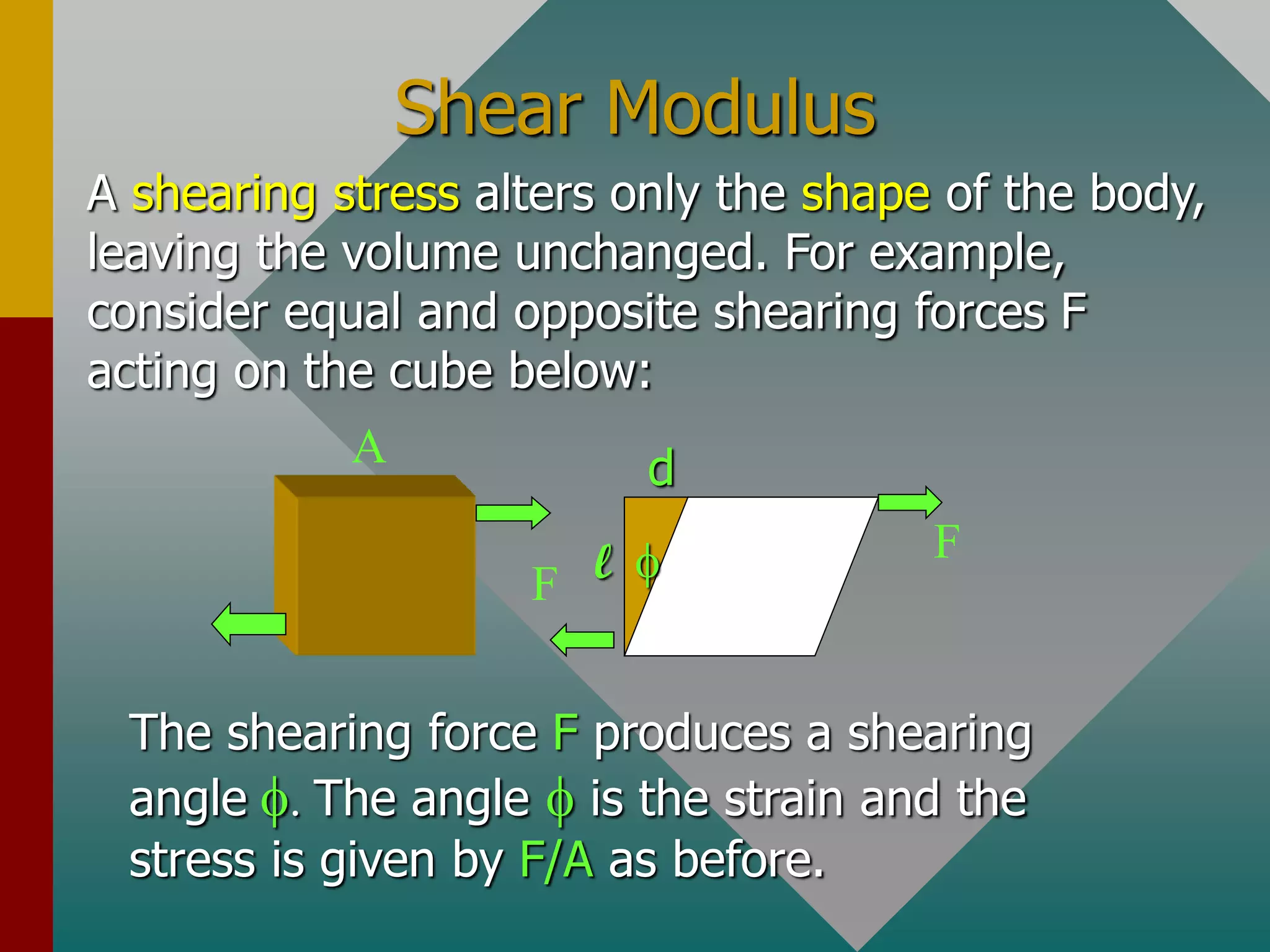
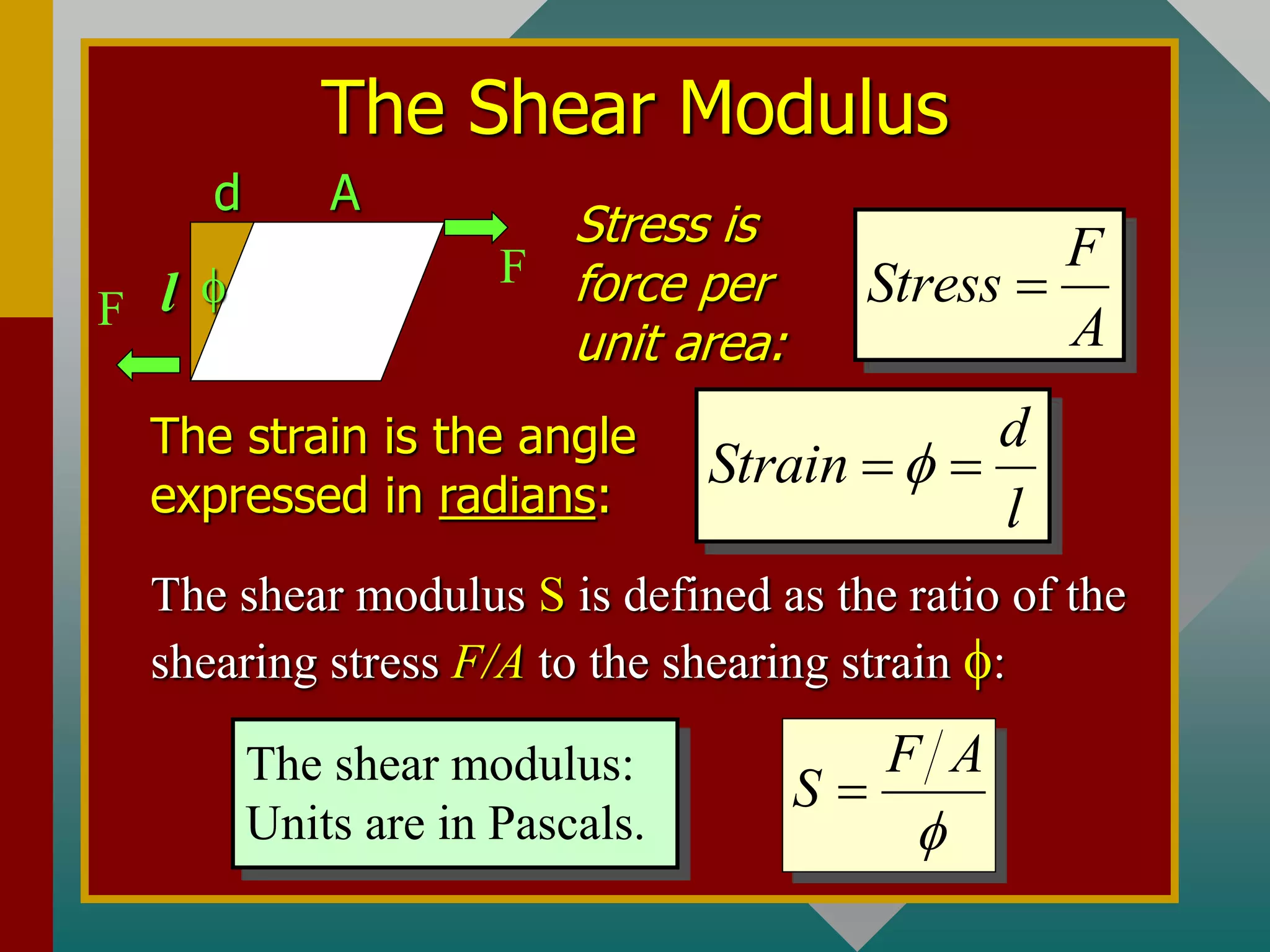
Shear Modulus
A
F
F
f
l
d
A shearing stress alters only the shape of the body,
leaving the volume unchanged. For example,
consider equal and opposite shearing forces F
acting on the cube below:
The shearing force F produces a shearing
angle f. The angle f is the strain and the
stress is given by F/A as before.
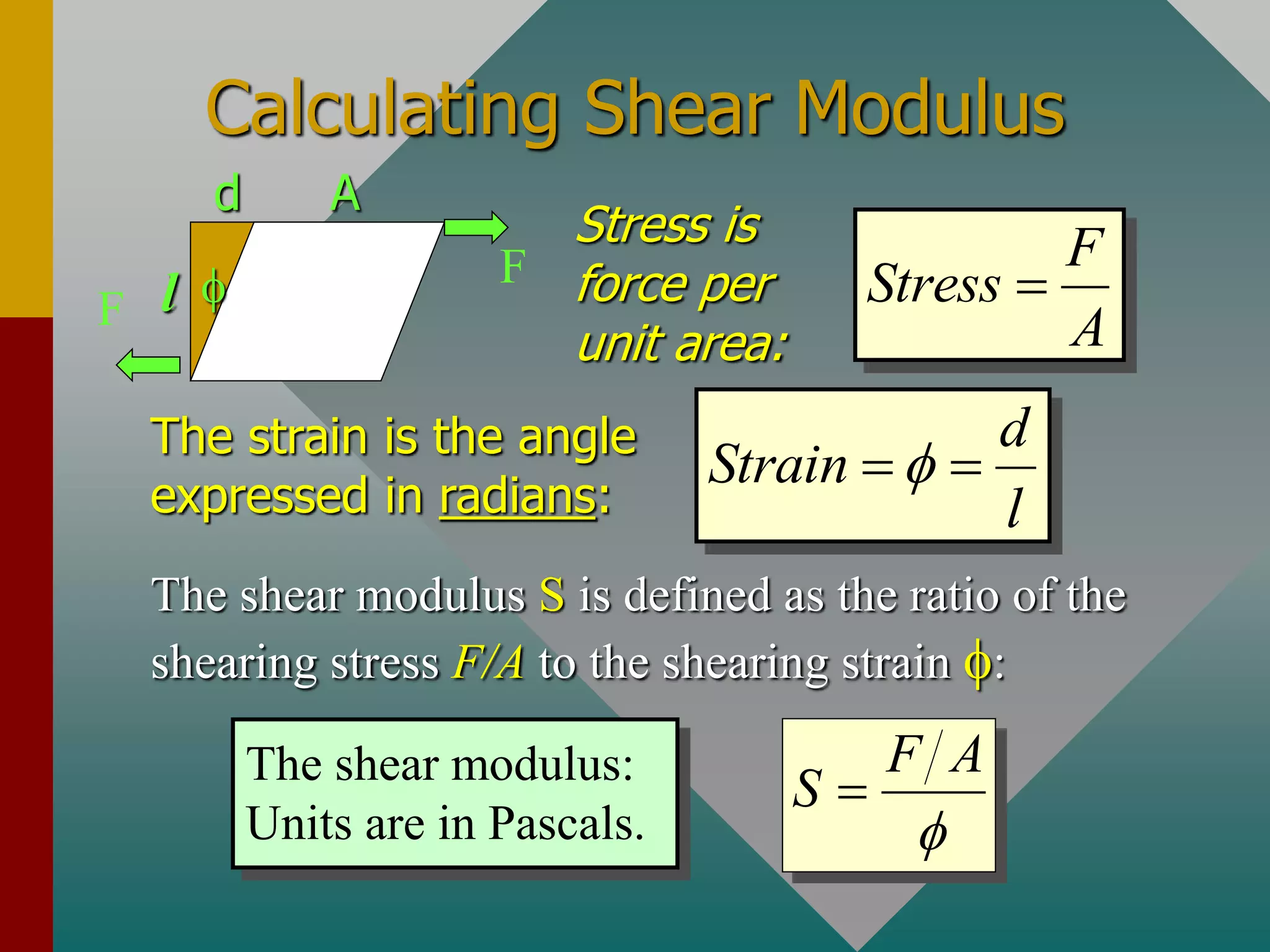
Calculating Shear Modulus
F
Stress
A

d
Strain
l
f
 
F
F
f
l
d A
The strain is the angle
expressed in radians:
Stress is
force per
unit area:
The shear modulus S is defined as the ratio of the
shearing stress F/A to the shearing strain f:
The shear modulus:
Units are in Pascals.
F A
S
f

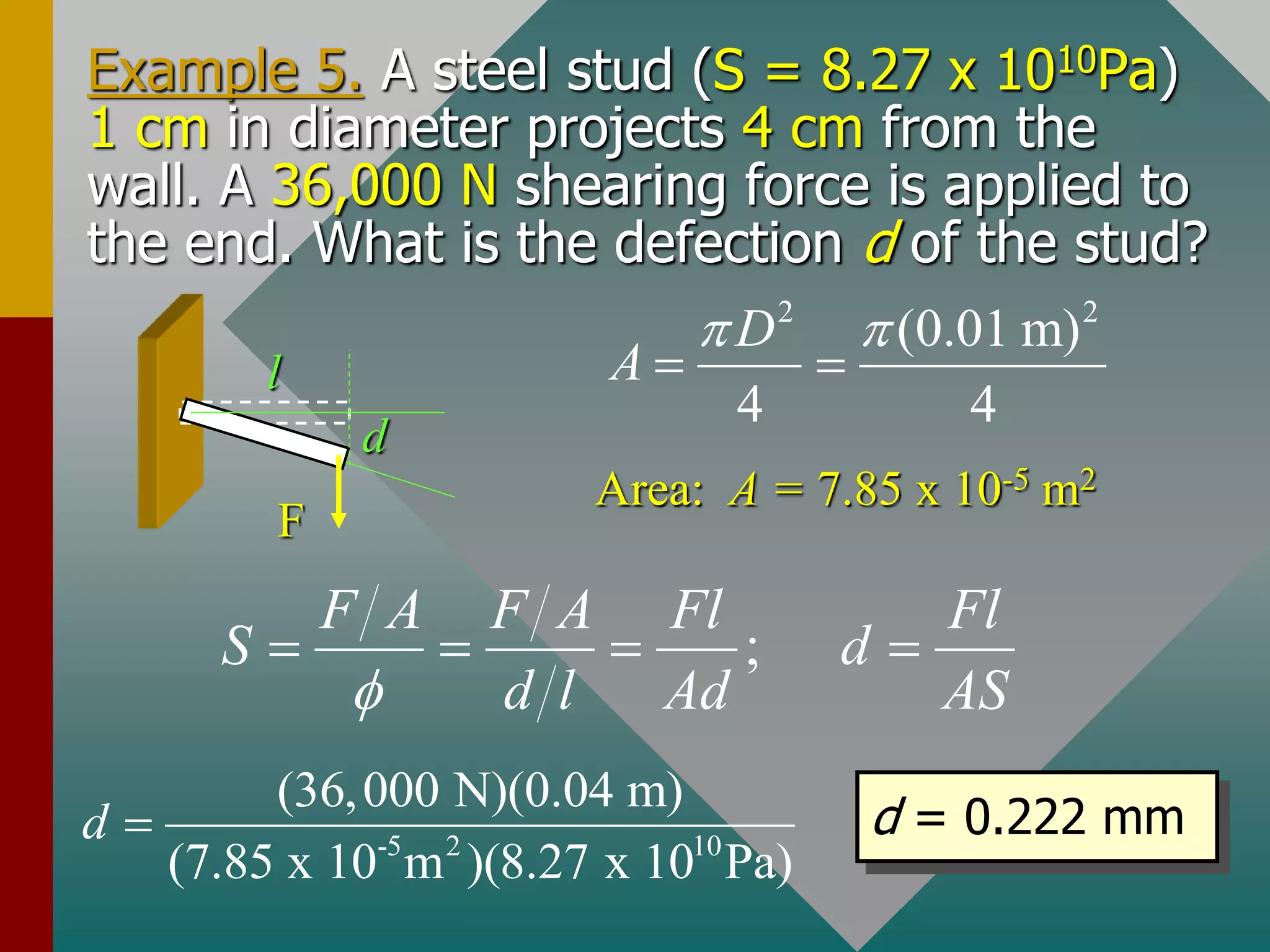
Example 5. A steel stud (S = 8.27 x 10¹⁰Pa)
1 cm in diameter projects 4 cm from the
wall. A 36,000 N shearing force is applied to
the end. What is the defection d of the stud?
d
l
F
2 2
(0.01 m)
4 4
D
A
 
 
Area: A = 7.85 x 10⁻⁵ m2
;
F A F A Fl Fl
S d
d l Ad AS
f
   
-5 2 10
(36,000 N)(0.04 m)
(7.85 x 10 m )(8.27 x 10 Pa)
d  d = 0.222 mm
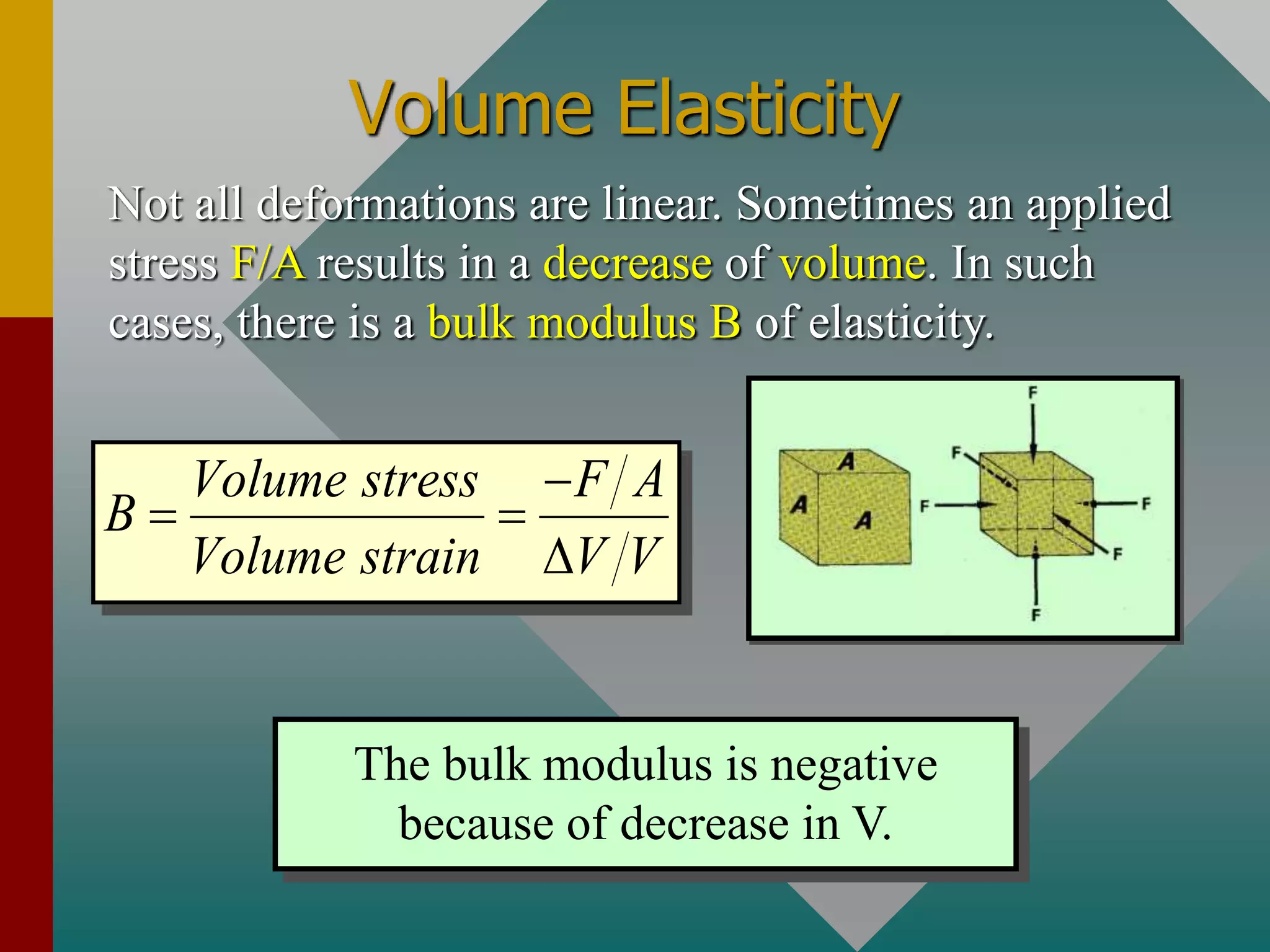
Volume Elasticity
Not all deformations are linear. Sometimes an applied
stress F/A results in a decrease of volume. In such
cases, there is a bulk modulus B of elasticity.
Volume stress F A
B
Volume strain V V

 

The bulk modulus is negative
because of decrease in V.
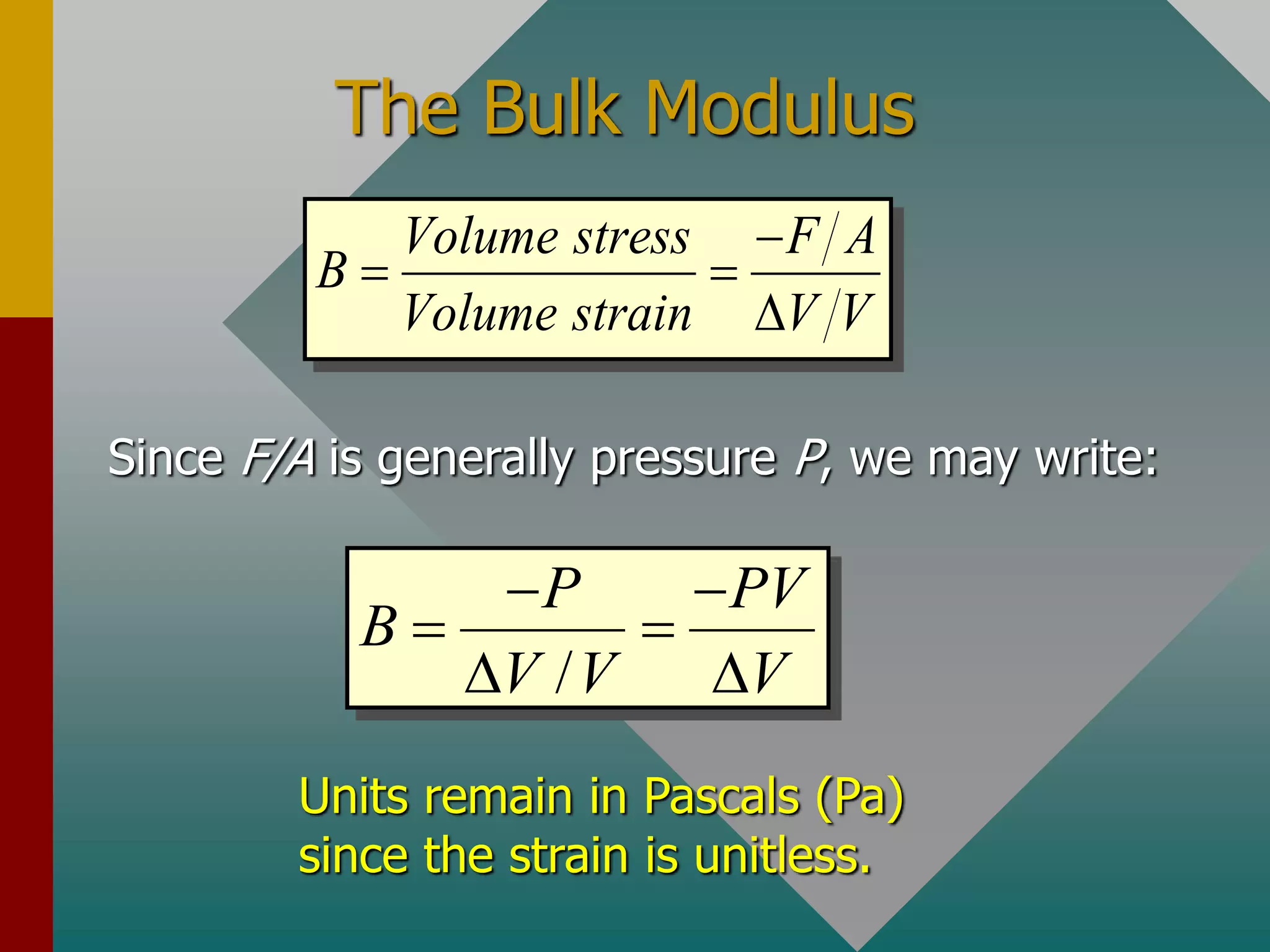
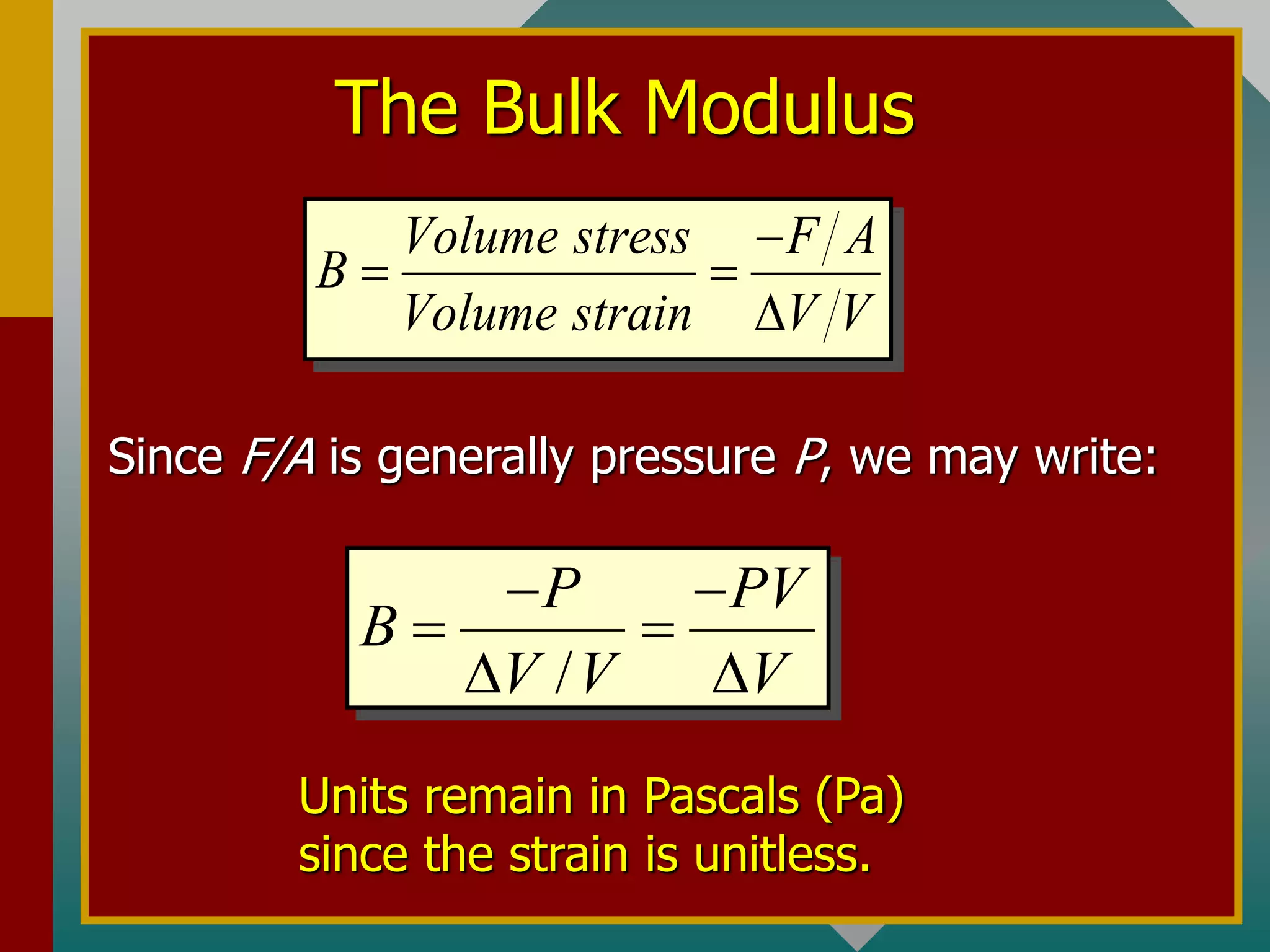
The Bulk Modulus
Volume stress F A
B
Volume strain V V

 

Since F/A is generally pressure P, we may write:
/
P PV
B
V V V
 
 
 
Units remain in Pascals (Pa)
since the strain is unitless.
Example 7. A hydrostatic press contains 5
liters of oil. Find the decrease in volume of
the oil if it is subjected to a pressure of
3000 kPa. (Assume that B = 1700 MPa.)
/
P PV
B
V V V
 
 
 
6
9
(3 x 10 Pa)(5 L)
(1.70 x 10 Pa)
PV
V
B
 
  
V = -8.82 mL
Decrease in V;
milliliters (mL):
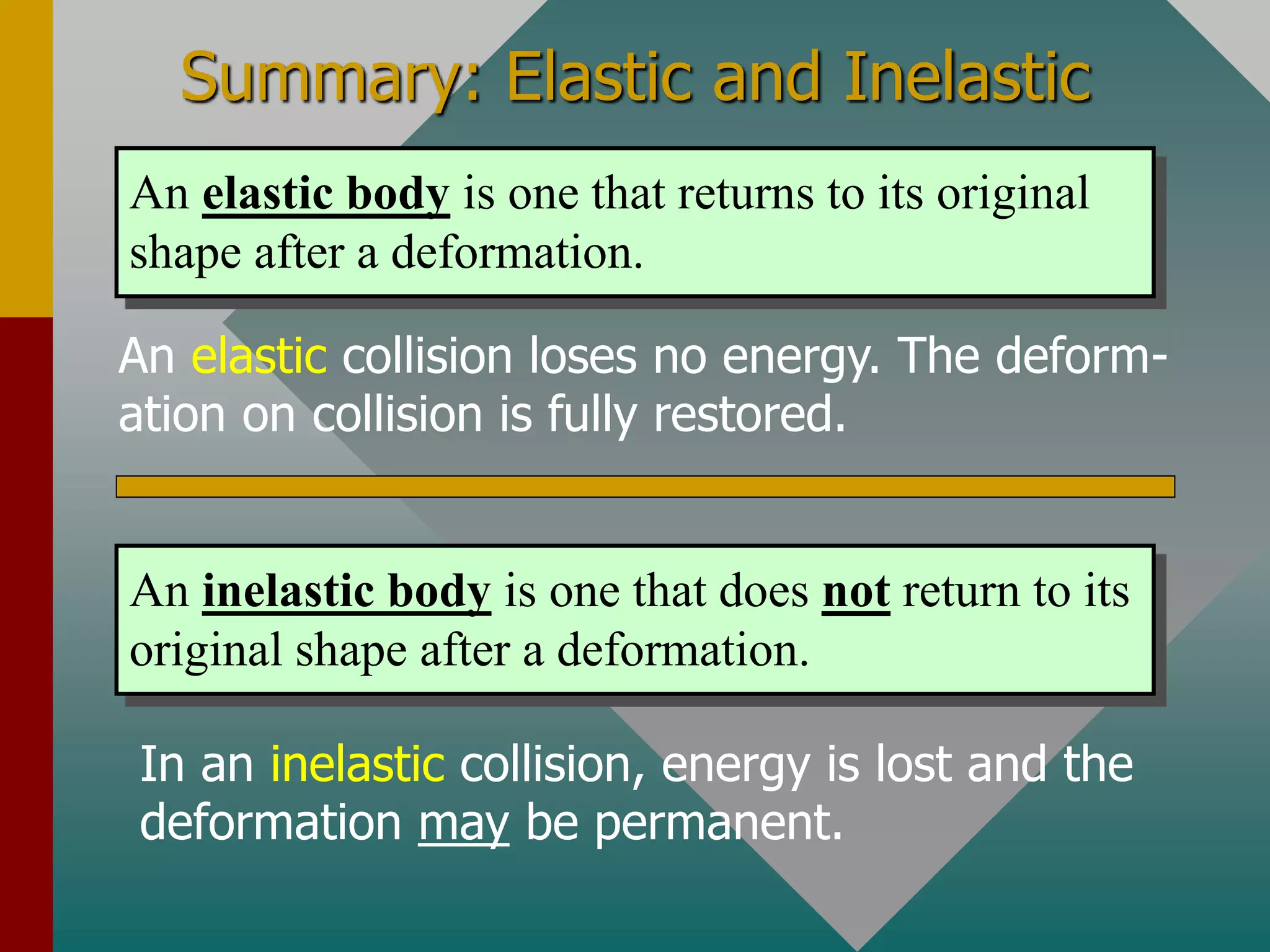
Summary: Elastic and Inelastic
An inelastic body is one that does not return to its
original shape after a deformation.
In an inelastic collision, energy is lost and the
deformation may be permanent.
An elastic collision loses no energy. The deform-
ation on collision is fully restored.
An elastic body is one that returns to its original
shape after a deformation.
A tensile stress occurs when
equal and opposite forces are
directed away from each other.
A compressive stress occurs
when equal and opposite
forces are directed toward
each other.
F
W
Tension
F
W
Compression
Summary
Types of Stress
Summary of Definitions
Stress is the ratio of an applied force F to the
area A over which it acts:
Strain is the relative change in the dimensions or
shape of a body as the result of an applied stress:
F
Stress
A
 2 2
N lb
: Pa or
m in.
Units 
Examples: Change in length per unit length;
change in volume per unit volume.
Longitudinal Stress and Strain
L
L
A
A
F
For wires, rods, and bars,
there is a longitudinal
stress F/A that produces a
change in length per unit
length. In such cases:
F
Stress
A

L
Strain
L


The Elastic Limit
The elastic limit is the maximum stress a body can
experience without becoming permanently deformed.
The ultimate strength is the greatest stress a body can
experience without breaking or rupturing.
The Ultimate Strength
Young’s Modulus
For materials whose length is much greater than the
width or thickness, we are concerned with the
longitudinal modulus of elasticity, or Young’s
Modulus Y.
'
longitudinal stress
Young s modulus
longitudinal strain

/
/
F A FL
Y
L L A L
 
  2
lb
: Pa
in.
Units or
The Shear Modulus
F
Stress
A

d
Strain
l
f
 
F
F
f
l
d A
The strain is the angle
expressed in radians:
Stress is
force per
unit area:
The shear modulus S is defined as the ratio of the
shearing stress F/A to the shearing strain f:
The shear modulus:
Units are in Pascals.
F A
S
f

The Bulk Modulus
Volume stress F A
B
Volume strain V V

 

Since F/A is generally pressure P, we may write:
/
P PV
B
V V V
 
 
 
Units remain in Pascals (Pa)
since the strain is unitless.
CONCLUSION

Elasticity

  • 1.
  • 2.
    BUNGEE jumping utilizes along elastic strap which stretches until it reaches a maximum length that is proportional to the weight of the jumper. The elasticity of the strap determines the amplitude of the resulting vibrations. If the elastic limit for the strap is exceeded, the rope will break. Chapter 13. Elasticity Photo © Vol. 10 PhotoDisk/Getty
  • 3.
    Objectives: After completionof this module, you should be able to: • Demonstrate your understanding of elasticity, elastic limit, stress, strain, and ultimate strength. • Write and apply formulas for calculating Young’s modulus, shear modulus, and bulk modulus. • Solve problems involving each of the parameters in the above objectives.
  • 4.
    Elastic Properties ofMatter An elastic body is one that returns to its original shape after a deformation. Golf Ball Soccer Ball Rubber Band
  • 5.
    Elastic Properties ofMatter An inelastic body is one that does not return to its original shape after a deformation. Dough or Bread Clay Inelastic Ball
  • 6.
    Elastic or Inelastic? Anelastic collision loses no energy. The deform- ation on collision is fully restored. In an inelastic collision, energy is lost and the deformation may be permanent. (Click it.)
  • 7.
    An Elastic Spring Aspring is an example of an elastic body that can be deformed by stretching. A restoring force, F, acts in the direction opposite the displacement of the oscillating body. F = -kx x F
  • 8.
    Hooke’s Law When aspring is stretched, there is a restoring force that is proportional to the displacement. F = -kx The spring constant k is a property of the spring given by: F x m F k x    The spring constant k is a measure of the elasticity of the spring.
  • 9.
    Stress and Strain Stressrefers to the cause of a deformation, and strain refers to the effect of the deformation. x F The downward force F causes the displacement x. Thus, the stress is the force; the strain is the elongation.
  • 10.
    Types of Stress Atensile stress occurs when equal and opposite forces are directed away from each other. A compressive stress occurs when equal and opposite forces are directed toward each other. F W Tension F W Compression
  • 11.
    Summary of Definitions Stressis the ratio of an applied force F to the area A over which it acts: Strain is the relative change in the dimensions or shape of a body as the result of an applied stress: F Stress A  2 2 N lb : Pa or m in. Units  Examples: Change in length per unit length; change in volume per unit volume.
  • 12.
    Longitudinal Stress andStrain L L A A F For wires, rods, and bars, there is a longitudinal stress F/A that produces a change in length per unit length. In such cases: F Stress A  L Strain L  
  • 13.
    Example 1. Asteel wire 10 m long and 2 mm in diameter is attached to the ceiling and a 200-N weight is attached to the end. What is the applied stress? L L A A F First find area of wire: 2 2 (0.002 m) 4 4 D A     A = 3.14 x 10⁻⁶ m2 -6 2 200 N 3.14 x 10 m F Stress A   Stress 6.37 x 10⁷ Pa
  • 14.
    Example 1 (Cont.)A 10 m steel wire stretches 3.08 mm due to the 200 N load. What is the longitudinal strain? L L Given: L = 10 m; L = 3.08 mm Longitudinal Strain 3.08 x 10⁻⁴ 0.00308 m 10 m L Srain L   
  • 15.
    The Elastic Limit Theelastic limit is the maximum stress a body can experience without becoming permanently deformed. W W 2 m If the stress exceeds the elastic limit, the final length will be longer than the original 2 m. Okay Beyond limit F W 2 m F Stress A 
  • 16.
    The Ultimate Strength Theultimate strength is the greatest stress a body can experience without breaking or rupturing. If the stress exceeds the ultimate strength, the string breaks! F W W W 2 m F Stress A  W W
  • 17.
    Example 2. Theelastic limit for steel is 2.48 x 10⁸ Pa. What is the maximum weight that can be supported without exceeding the elastic limit? L L A A F 8 2.48 x 10 Pa F Stress A   Recall: A = 3.14 x 10⁻⁶ m2 F = (2.48 x 10⁸ Pa) A F = (2.48 x 10⁸ Pa)(3.14 x 10⁻⁶ m2) F = 779 N
  • 18.
    Example 2(Cont.) Theultimate strength for steel is 4089 x 108 Pa. What is the maxi- mum weight that can be supported without breaking the wire? L L A A F 8 4.89 x 10 Pa F Stress A   Recall: A = 3.14 x 10⁻⁶ m2 F = (4.89 x 10⁸ Pa) A F = (4.89 x 10⁸ Pa)(3.14 x 10⁻⁶ m2) F = 1536 N
  • 19.
    The Modulus ofElasticity Provided that the elastic limit is not exceeded, an elastic deformation (strain) is directly proportional to the magnitude of the applied force per unit area (stress). stress Modulus of Elasticity strain 
  • 20.
    Example 3. Inour previous example, the stress applied to the steel wire was 6.37 x 10⁷ Pa and the strain was 3.08 x 10⁻⁴. Find the modulus of elasticity for steel. L L 7 -4 6.37 x 10 Pa 3.08 x 10 Stress Modulus Strain   Modulus = 207 x 109 Pa This longitudinal modulus of elasticity is called Young’s Modulus and is denoted by the symbol Y.
  • 21.
    Young’s Modulus For materialswhose length is much greater than the width or thickness, we are concerned with the longitudinal modulus of elasticity, or Young’s Modulus (Y). ' longitudinal stress Young s modulus longitudinal strain  / / F A FL Y L L A L     2 lb : Pa in. Units or
  • 22.
    Example 4: Young’smodulus for brass is 8.96 x 10¹¹Pa. A 120-N weight is attached to an 8-m length of brass wire; find the increase in length. The diameter is 1.5 mm. 8 m L 120 N First find area of wire: 2 2 (0.0015 m) 4 4 D A     A = 1.77 x 10⁻⁶ m2 or FL FL Y L A L AY    
  • 23.
    Example 4: (Continued) 8m L 120 N Y = 8.96 x 10¹¹ Pa; F = 120 N; L = 8 m; A = 1.77 x 10⁻⁶ m2 F = 120 N; L = ? or FL FL Y L A L AY     -6 2 11 (120 N)(8.00 m) (1.77 x 10 m )(8.96 x 10 Pa) FL L AY    L = 0.605 mm Increase in length:
  • 24.
    Shear Modulus A F F f l d A shearingstress alters only the shape of the body, leaving the volume unchanged. For example, consider equal and opposite shearing forces F acting on the cube below: The shearing force F produces a shearing angle f. The angle f is the strain and the stress is given by F/A as before.
  • 25.
    Calculating Shear Modulus F Stress A  d Strain l f  F F f l d A The strain is the angle expressed in radians: Stress is force per unit area: The shear modulus S is defined as the ratio of the shearing stress F/A to the shearing strain f: The shear modulus: Units are in Pascals. F A S f 
  • 26.
    Example 5. Asteel stud (S = 8.27 x 10¹⁰Pa) 1 cm in diameter projects 4 cm from the wall. A 36,000 N shearing force is applied to the end. What is the defection d of the stud? d l F 2 2 (0.01 m) 4 4 D A     Area: A = 7.85 x 10⁻⁵ m2 ; F A F A Fl Fl S d d l Ad AS f     -5 2 10 (36,000 N)(0.04 m) (7.85 x 10 m )(8.27 x 10 Pa) d  d = 0.222 mm
  • 27.
    Volume Elasticity Not alldeformations are linear. Sometimes an applied stress F/A results in a decrease of volume. In such cases, there is a bulk modulus B of elasticity. Volume stress F A B Volume strain V V     The bulk modulus is negative because of decrease in V.
  • 28.
    The Bulk Modulus Volumestress F A B Volume strain V V     Since F/A is generally pressure P, we may write: / P PV B V V V       Units remain in Pascals (Pa) since the strain is unitless.
  • 29.
    Example 7. Ahydrostatic press contains 5 liters of oil. Find the decrease in volume of the oil if it is subjected to a pressure of 3000 kPa. (Assume that B = 1700 MPa.) / P PV B V V V       6 9 (3 x 10 Pa)(5 L) (1.70 x 10 Pa) PV V B      V = -8.82 mL Decrease in V; milliliters (mL):
  • 30.
    Summary: Elastic andInelastic An inelastic body is one that does not return to its original shape after a deformation. In an inelastic collision, energy is lost and the deformation may be permanent. An elastic collision loses no energy. The deform- ation on collision is fully restored. An elastic body is one that returns to its original shape after a deformation.
  • 31.
    A tensile stressoccurs when equal and opposite forces are directed away from each other. A compressive stress occurs when equal and opposite forces are directed toward each other. F W Tension F W Compression Summary Types of Stress
  • 32.
    Summary of Definitions Stressis the ratio of an applied force F to the area A over which it acts: Strain is the relative change in the dimensions or shape of a body as the result of an applied stress: F Stress A  2 2 N lb : Pa or m in. Units  Examples: Change in length per unit length; change in volume per unit volume.
  • 33.
    Longitudinal Stress andStrain L L A A F For wires, rods, and bars, there is a longitudinal stress F/A that produces a change in length per unit length. In such cases: F Stress A  L Strain L  
  • 34.
    The Elastic Limit Theelastic limit is the maximum stress a body can experience without becoming permanently deformed. The ultimate strength is the greatest stress a body can experience without breaking or rupturing. The Ultimate Strength
  • 35.
    Young’s Modulus For materialswhose length is much greater than the width or thickness, we are concerned with the longitudinal modulus of elasticity, or Young’s Modulus Y. ' longitudinal stress Young s modulus longitudinal strain  / / F A FL Y L L A L     2 lb : Pa in. Units or
  • 36.
    The Shear Modulus F Stress A  d Strain l f  F F f l d A The strain is the angle expressed in radians: Stress is force per unit area: The shear modulus S is defined as the ratio of the shearing stress F/A to the shearing strain f: The shear modulus: Units are in Pascals. F A S f 
  • 37.
    The Bulk Modulus Volumestress F A B Volume strain V V     Since F/A is generally pressure P, we may write: / P PV B V V V       Units remain in Pascals (Pa) since the strain is unitless.
  • 38.