Name’s of Groups
   :
1. Arventa
2. Atika
3. Aulia
4. Imam
5. M. Ababil
6. Sebma
Basic Competition :
1. Analizing the connection of Hooke’s
   law with elasticity.
Indicator :
1. Determining connection of elasticity
   material’s character with Hooke’s law.
Hooke’s Law


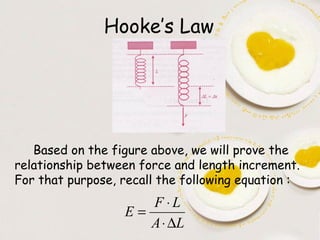
   Based on the figure above, we will prove the
relationship between force and length increment.
For that purpose, recall the following equation :
                     F ⋅L
                  E=
                     A ⋅ ∆L
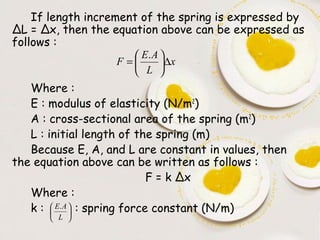
If length increment of the spring is expressed by
∆L = ∆x, then the equation above can be expressed as
follows :
                       E. A 
                   F =      ∆x
                       L 
   Where :
   E : modulus of elasticity (N/m2)
   A : cross-sectional area of the spring (m2)
   L : initial length of the spring (m)
   Because E, A, and L are constant in values, then
the equation above can be written as follows :
                              F = k ∆x
   Where :
   k :  E. A  : spring force constant (N/m)
             
        L 
According to the equation, we obtain the
relationship that length increment of a
spring is directly proportional to the force
acting upon it.
   This equation is the mathematical
representation of Robert Hooke’s
statement, then known as Hooke’s law.
Robert Hooke was an English scientist who
stated “If the pulling doesn’t exceed the
spring elasticity limit, then the length
increment of the spring is directly
proportional of its pulling force.”
The force stored energy named the potential
energy.
                          Ep = 1/2 kx2
    Definition :
    Ep = potential energy (Joule)
    k = spring contant (N/m)
    x = stretch (m)
    The difference of initial potential energy with
final potential energy known as work (w) to do by this
spring.
                       Ep2 – Ep1 = 1/2 kx2
    Definition :
    Ep1 = initial potential energy (Joule)
    Ep2 = final potential energy (Joule)
    w = work (J)
    If initial potential energy value is 0, the effort will
have value as big as the final of potential energy.
Sample problem :
1. What is the force required to stretch a
   spring whose constant value is 100 N/m
   by an amount of 0.50 m?
Solution :
1. Known :
   k = 100 N/m
   x = 0,5 m
   Question : Force (F)
   Answer : F = kx
     = 100 x 0,5
     = 50 N
Exercise :
1. A spring will increase by 10 cm in length if
   given a force of 10 N. What is the length
   increment of the spring if given a force of 7
   N?
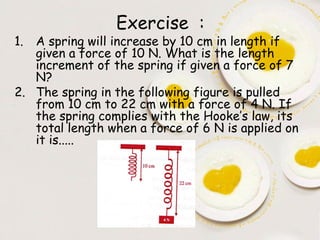
2. The spring in the following figure is pulled
   from 10 cm to 22 cm with a force of 4 N. If
   the spring complies with the Hooke’s law, its
   total length when a force of 6 N is applied on
   it is.....
3. A metal has the Young’s modulus of 4 x
   106 N/m2, its cross-sectional area is 20
   cm2 and its length 5 m. What is the
   force costant of the metal?
4. What is the spring constant, if it is
   given force of 400 N, and increases of
   4 cm in length?
5. A spring of 15 cm in length is hung
   vertically. Then it is pulled with a force
   of 0,5 N so that its length becomes 27
   cm. What is the length of the spring if
   it is pulled with a force of 0,6 N?
Hooke's law

Hooke's law

  • 1.
    Name’s of Groups : 1. Arventa 2. Atika 3. Aulia 4. Imam 5. M. Ababil 6. Sebma
  • 2.
    Basic Competition : 1.Analizing the connection of Hooke’s law with elasticity.
  • 3.
    Indicator : 1. Determiningconnection of elasticity material’s character with Hooke’s law.
  • 4.
    Hooke’s Law Based on the figure above, we will prove the relationship between force and length increment. For that purpose, recall the following equation : F ⋅L E= A ⋅ ∆L
  • 5.
    If length incrementof the spring is expressed by ∆L = ∆x, then the equation above can be expressed as follows :  E. A  F = ∆x  L  Where : E : modulus of elasticity (N/m2) A : cross-sectional area of the spring (m2) L : initial length of the spring (m) Because E, A, and L are constant in values, then the equation above can be written as follows : F = k ∆x Where : k :  E. A  : spring force constant (N/m)    L 
  • 6.
    According to theequation, we obtain the relationship that length increment of a spring is directly proportional to the force acting upon it. This equation is the mathematical representation of Robert Hooke’s statement, then known as Hooke’s law. Robert Hooke was an English scientist who stated “If the pulling doesn’t exceed the spring elasticity limit, then the length increment of the spring is directly proportional of its pulling force.”
  • 7.
    The force storedenergy named the potential energy. Ep = 1/2 kx2 Definition : Ep = potential energy (Joule) k = spring contant (N/m) x = stretch (m) The difference of initial potential energy with final potential energy known as work (w) to do by this spring. Ep2 – Ep1 = 1/2 kx2 Definition : Ep1 = initial potential energy (Joule) Ep2 = final potential energy (Joule) w = work (J) If initial potential energy value is 0, the effort will have value as big as the final of potential energy.
  • 8.
    Sample problem : 1.What is the force required to stretch a spring whose constant value is 100 N/m by an amount of 0.50 m?
  • 9.
    Solution : 1. Known: k = 100 N/m x = 0,5 m Question : Force (F) Answer : F = kx = 100 x 0,5 = 50 N
  • 10.
    Exercise : 1. Aspring will increase by 10 cm in length if given a force of 10 N. What is the length increment of the spring if given a force of 7 N? 2. The spring in the following figure is pulled from 10 cm to 22 cm with a force of 4 N. If the spring complies with the Hooke’s law, its total length when a force of 6 N is applied on it is.....
  • 11.
    3. A metalhas the Young’s modulus of 4 x 10⁶ N/m2, its cross-sectional area is 20 cm2 and its length 5 m. What is the force costant of the metal? 4. What is the spring constant, if it is given force of 400 N, and increases of 4 cm in length? 5. A spring of 15 cm in length is hung vertically. Then it is pulled with a force of 0,5 N so that its length becomes 27 cm. What is the length of the spring if it is pulled with a force of 0,6 N?