Histones or histone proteins
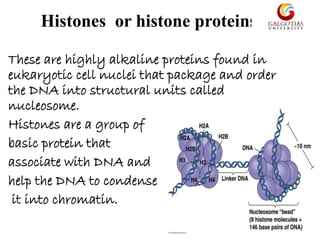
These are highly alkaline proteins found in
eukaryotic cell nuclei that package and order
the DNA into structural units called
nucleosome.
Histones are a group of
basic protein that
associate with DNA and
help the DNA to condense
it into chromatin.
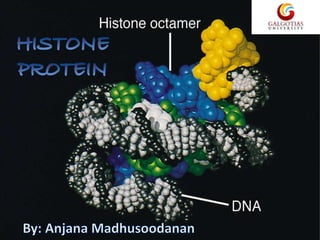
Some Histones function as spools for
the thread like DNA to wrap around.
Chromatin, under the microscope in its extended
form, hooks to beads on a string, called
nucleosome.
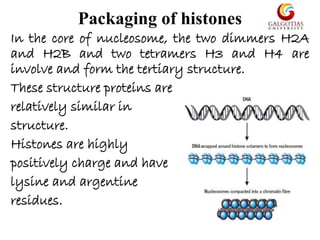
Nucleosome consist of
DNA wrapped around
eight histone protein
called histone octamer.
Classification
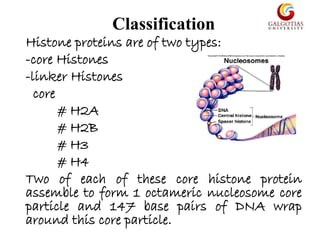
Histone proteins are of two types:
-core Histones
-linker Histones
core
# H2A
# H2B
# H3
# H4
Two of each of these core histone protein
assemble to form 1 octameric nucleosome core
particle and 147 base pairs of DNA wrap
around this core particle.
H2A is important for packaging DNA
into chromatin. Since H2A packages DNA
molecules into chromatin, the packaging
process will effect gene expression.H2A has
been correlated with DNA modification.
H2A plays a major role in determining the
overall structure of chromatin.
Inadvertently, H2A has been found to
regulate gene expression.
H2B is also involved with the structure of
the nucleosomes of the 'beads on a string' structure.
H3 is involved in the structure
of chromatin in eukaryotic cells. Featuring a main
globular domain and a long N-terminal tail.
H3 is an important protein in the emerging field
of epigenetics, where its sequence variants and
variable modification states are thought to play a
role in the dynamic and long term regulation of
genes.
Histone H4 is involved in the structure
of chromatin in eukaryotic cells.H4 is a
structural component of the nucleosome,
and is subject to covalent modification
,including acetylation and methylation,
which may alter expression of genes located
on DNA associated with its parent histone
octamer.
Linker histone includes-
H1
H5
>Histone H1 is one of the five
main histone protein families which are
components of chromatin in eukaryotic cells.
>Though highlyconserved, it is nevertheless the
most variable histone in sequence across species.
Unlike the other histones, H1 does not make
up the nucleosome "bead". Instead, it sits on top
of the structure, keeping in place the DNA that
has wrapped around the nucleosome. H1 is
present in half the amount of the other four
histones, which contribute two molecules to each
nucleosome bead.
H5 histones are individual proteins involve in
the packaging of specific region of DNA.
Packaging of histones
In the core of nucleosome, the two dimmers H2A
and H2B and two tetramers H3 and H4 are
involve and form the tertiary structure.
These structure proteins are
relatively similar in
structure.
Histones are highly
positively charge and have
lysine and argentine
residues.
Modifications in histones
Histone proteins are altered according to the
packaging in DNA .
There can be many modification that affect
how DNA is packaged.
There are three types of modifications-
>methylation (increases packaging)
>acetylation (decrease packaging)
>phosporylation (decrease packaging)
Normally histones are
positively charged but with
the modification of
methylation it becomes
hydrophobic which enable
the histone to more highly
pack.
Acetylation and
phosphorylation make the
histone more negative
which weakens the
packing ability of histones
due to repelling of
negative-negative charges.
FUNCTIONS
Compacting DNA strand
Histones act as spools around which DNA winds. This
enables the compaction necessary to fit the large genomes of
eukaryotes inside cell nuclei: the compacted molecule is
40,000 times shorter than an unpacked molecule.
Chromatin regulation
Histones undergo modifications that alter their interaction
with DNA and nuclear proteins. The H3 and H4 histones
have long tails protruding from the nucleosome, which can
be covalently modified at several places.
Histone modifications are also involved in control of
transcription.
Histone modifications act as Marking sites of DNA
damage.
THANKYOU

Histone core.pdf

  • 2.
    Histones or histoneproteins These are highly alkaline proteins found in eukaryotic cell nuclei that package and order the DNA into structural units called nucleosome. Histones are a group of basic protein that associate with DNA and help the DNA to condense it into chromatin.
  • 3.
    Some Histones functionas spools for the thread like DNA to wrap around. Chromatin, under the microscope in its extended form, hooks to beads on a string, called nucleosome. Nucleosome consist of DNA wrapped around eight histone protein called histone octamer.
  • 4.
    Classification Histone proteins areof two types: -core Histones -linker Histones core # H2A # H2B # H3 # H4 Two of each of these core histone protein assemble to form 1 octameric nucleosome core particle and 147 base pairs of DNA wrap around this core particle.
  • 5.
    H2A is importantfor packaging DNA into chromatin. Since H2A packages DNA molecules into chromatin, the packaging process will effect gene expression.H2A has been correlated with DNA modification. H2A plays a major role in determining the overall structure of chromatin. Inadvertently, H2A has been found to regulate gene expression.
  • 6.
    H2B is alsoinvolved with the structure of the nucleosomes of the 'beads on a string' structure. H3 is involved in the structure of chromatin in eukaryotic cells. Featuring a main globular domain and a long N-terminal tail. H3 is an important protein in the emerging field of epigenetics, where its sequence variants and variable modification states are thought to play a role in the dynamic and long term regulation of genes.
  • 7.
    Histone H4 isinvolved in the structure of chromatin in eukaryotic cells.H4 is a structural component of the nucleosome, and is subject to covalent modification ,including acetylation and methylation, which may alter expression of genes located on DNA associated with its parent histone octamer.
  • 8.
    Linker histone includes- H1 H5 >HistoneH1 is one of the five main histone protein families which are components of chromatin in eukaryotic cells. >Though highlyconserved, it is nevertheless the most variable histone in sequence across species.
  • 9.
    Unlike the otherhistones, H1 does not make up the nucleosome "bead". Instead, it sits on top of the structure, keeping in place the DNA that has wrapped around the nucleosome. H1 is present in half the amount of the other four histones, which contribute two molecules to each nucleosome bead. H5 histones are individual proteins involve in the packaging of specific region of DNA.
  • 10.
    Packaging of histones Inthe core of nucleosome, the two dimmers H2A and H2B and two tetramers H3 and H4 are involve and form the tertiary structure. These structure proteins are relatively similar in structure. Histones are highly positively charge and have lysine and argentine residues.
  • 11.
    Modifications in histones Histoneproteins are altered according to the packaging in DNA . There can be many modification that affect how DNA is packaged. There are three types of modifications- >methylation (increases packaging) >acetylation (decrease packaging) >phosporylation (decrease packaging)
  • 12.
    Normally histones are positivelycharged but with the modification of methylation it becomes hydrophobic which enable the histone to more highly pack. Acetylation and phosphorylation make the histone more negative which weakens the packing ability of histones due to repelling of negative-negative charges.
  • 13.
    FUNCTIONS Compacting DNA strand Histonesact as spools around which DNA winds. This enables the compaction necessary to fit the large genomes of eukaryotes inside cell nuclei: the compacted molecule is 40,000 times shorter than an unpacked molecule. Chromatin regulation Histones undergo modifications that alter their interaction with DNA and nuclear proteins. The H3 and H4 histones have long tails protruding from the nucleosome, which can be covalently modified at several places. Histone modifications are also involved in control of transcription. Histone modifications act as Marking sites of DNA damage.
  • 14.