ENZYME ENGINEERING
PRESENTED BY:
K.TAMILMUHILAN,
I M.SC BIOTECHNOLOGY,
ALAGAPPA UNIVERSITY.
CONTENT
 Enzymes
 Enzyme Engineering
 Introduction
 Objective
 Steps Involved
 Types and methods
ENZYMES
 Enzymes create chemical reaction in body.
 They actually speed up the rate of a chemical reaction to support life.
 The enzymes in your body perform very important tasks.
 Building muscles
 Destroying toxins
 Breaking down food particles during digestion
 An enzymes shape is tied to its function.
 Heat, disease or harsh chemical conditions can damage enzymes and change their shapes.
 When this happens, enzyme cannot work anymore.
ENZYME ENGINEERING
 Enzyme engineering is the process of designing enzyme by changing the
sequence of amino acids through recombinant DNA technology.
 These products will be useful as chemical , pharmaceutical, fuel, food or
agricultural additives.
 Since enzymes are proteins, enzyme engineering is a part of the larger
activity of protein engineering.
 Enzyme engineering utilizes r-DNA technology to introduce the desired
changes in amino acid sequences of enzymes
OBJECTIVES OF ENZYME ENGINEERING
 The chief objective of enzyme engineering is to produce an enzyme that is more useful for
industrial and other applications.
 The various properties of an enzyme that may be modified to achieve this objective are as
follows :-
 Improved kinetic properties.
 Elimination of allosteric regulation.
 Enhanced substrate and reaction specificity.
 Increased thermo stability.
 Alteration in optimal pH.
 Suitability for use in organic solvents.
 Increased/decreased optimal temperature.
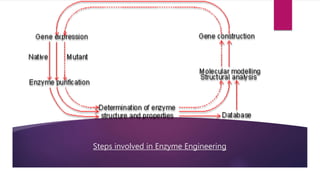
Steps involved in Enzyme Engineering
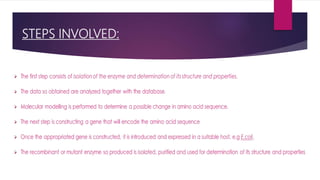
STEPS INVOLVED:
METHODS:
There are two general strategies for
enzyme engineering:
Rational design
Directed evolution
RATIONAL DESIGN
 It is the earlier approach to enzyme engineering and still is widely used.
 In rational design, scientist uses detailed knowledge of structure and function of a protein to
make desired changes.
 In general, it has a advantage of being inexpensive and technically easy.
 However, the major drawback is that a detailed structural knowledge of enzyme is often
unavailable.
 Even when available, it can be very difficult to predict the effects of various mutations since
structural information most often provide a static picture of enzyme structure.
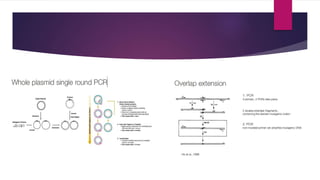
 Two methods in rational design
 Overlap extension
 Whole plasmid single round PCR
DIRECTED EVOLUTION:
 Also termed
 In vitro evolution
 Directed molecular evolution
 Acceleration evolution
 Directed evolution(DE) encompasses several molecular techniques that mimic the process
of Darwinian evolution in vitro, by combining random mutagenesis or recombinant
Technology.
 It does not uses structural data of enzyme, other than its functional properties and its
corresponding DNA sequence.
 DE is sometimes referred to irrational or semi-rational design.
Directed evolution
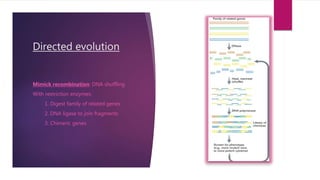
Mimick recombination: DNA shuffling
With restriction enzymes:
1. Digest family of related genes
2. DNA ligase to join fragments
3. Chimeric genes
THANK YOU😉

Enzyme engineering .pdf

  • 1.
    ENZYME ENGINEERING PRESENTED BY: K.TAMILMUHILAN, IM.SC BIOTECHNOLOGY, ALAGAPPA UNIVERSITY.
  • 2.
    CONTENT  Enzymes  EnzymeEngineering  Introduction  Objective  Steps Involved  Types and methods
  • 3.
    ENZYMES  Enzymes createchemical reaction in body.  They actually speed up the rate of a chemical reaction to support life.  The enzymes in your body perform very important tasks.  Building muscles  Destroying toxins  Breaking down food particles during digestion  An enzymes shape is tied to its function.  Heat, disease or harsh chemical conditions can damage enzymes and change their shapes.  When this happens, enzyme cannot work anymore.
  • 4.
    ENZYME ENGINEERING  Enzymeengineering is the process of designing enzyme by changing the sequence of amino acids through recombinant DNA technology.  These products will be useful as chemical , pharmaceutical, fuel, food or agricultural additives.  Since enzymes are proteins, enzyme engineering is a part of the larger activity of protein engineering.  Enzyme engineering utilizes r-DNA technology to introduce the desired changes in amino acid sequences of enzymes
  • 5.
    OBJECTIVES OF ENZYMEENGINEERING  The chief objective of enzyme engineering is to produce an enzyme that is more useful for industrial and other applications.  The various properties of an enzyme that may be modified to achieve this objective are as follows :-  Improved kinetic properties.  Elimination of allosteric regulation.  Enhanced substrate and reaction specificity.  Increased thermo stability.  Alteration in optimal pH.  Suitability for use in organic solvents.  Increased/decreased optimal temperature.
  • 6.
    Steps involved inEnzyme Engineering
  • 7.
  • 8.
    METHODS: There are twogeneral strategies for enzyme engineering: Rational design Directed evolution
  • 9.
    RATIONAL DESIGN  Itis the earlier approach to enzyme engineering and still is widely used.  In rational design, scientist uses detailed knowledge of structure and function of a protein to make desired changes.  In general, it has a advantage of being inexpensive and technically easy.  However, the major drawback is that a detailed structural knowledge of enzyme is often unavailable.  Even when available, it can be very difficult to predict the effects of various mutations since structural information most often provide a static picture of enzyme structure.  Two methods in rational design  Overlap extension  Whole plasmid single round PCR
  • 11.
    DIRECTED EVOLUTION:  Alsotermed  In vitro evolution  Directed molecular evolution  Acceleration evolution  Directed evolution(DE) encompasses several molecular techniques that mimic the process of Darwinian evolution in vitro, by combining random mutagenesis or recombinant Technology.  It does not uses structural data of enzyme, other than its functional properties and its corresponding DNA sequence.  DE is sometimes referred to irrational or semi-rational design.
  • 12.
    Directed evolution Mimick recombination:DNA shuffling With restriction enzymes: 1. Digest family of related genes 2. DNA ligase to join fragments 3. Chimeric genes
  • 13.