HISTONE
DR. P.PUNYA SANTHI
1ST
YEAR P.G.
CONTENTS
• Introduction
• Types of Histones
• Histone modification
• Histone code
• Techniques to study histone modifications
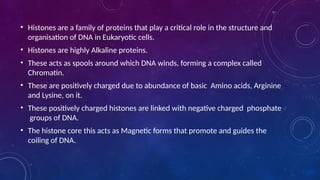
• Histones are a family of proteins that play a critical role in the structure and
organisation of DNA in Eukaryotic cells.
• Histones are highly Alkaline proteins.
• These acts as spools around which DNA winds, forming a complex called
Chromatin.
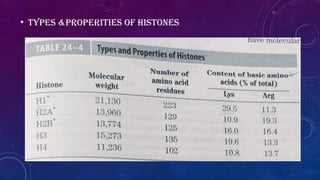
• These are positively charged due to abundance of basic Amino acids, Arginine
and Lysine, on it.
• These positively charged histones are linked with negative charged phosphate
groups of DNA.
• The histone core this acts as Magnetic forms that promote and guides the
coiling of DNA.
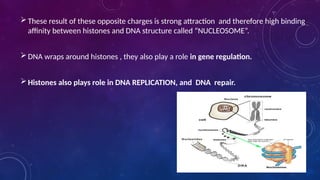
These result of these opposite charges is strong attraction and therefore high binding
affinity between histones and DNA structure called “NUCLEOSOME”.
DNA wraps around histones , they also play a role in gene regulation.
Histones also plays role in DNA REPLICATION, and DNA repair.
TYPES OF HISTONES
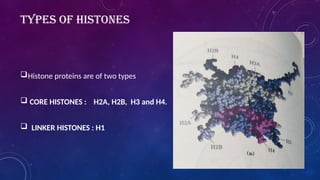
Histone proteins are of two types
 CORE HISTONES : H2A, H2B, H3 and H4.
 LINKER HISTONES : H1
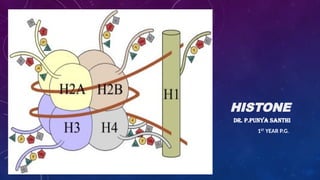
 The eight histones in the core are arranged into a H3 H4 tetramer and a pair of
H2A-H2B dimers.
 The tetramer and dimers come together to form a left-handed super helical
ramp around which the DNA wraps.
 Histone H1 is not a part of the Nucleosome core. It binds to linker DNA and it is
referred to as “ LINKER HISTONE”.
 H2 and H3 plays a major role in determing overall structure of chromatin and
longterm regulation of Genes.
 H4 is subject to covalent modification, that alter expression of genes.
• Types &properities of histones
TYPES OF HISTONE MODIFICATION
 N- terminal tails of histones are accessible for modification as they protrude from
the nucleosome and possess no specific structure.
 These undergo POST TRANSLATIONAL MODIFICATION.
 This is the crucial step in EPIGENETIC REGULATION OF GENES.
1. ACETYLATION
2. METHYLATION
3. PHOSPHORYLATION
4. UBIQUITINATION
5. SUMOYLATION
6. ADP RIBOSYLATION
It has been proposed that these modifications result in a CODE which can be read by proteins involved in
gene expression and other DNA translations.
ACETYLATION
• Means adding of Acetyl group to histone tails.
• Enzyme responsible is Histone acetyl transferases.
• Acetylation of histones results in allowing TRANSCRIPTION process.
Deacetylation of histones result in repressing TRANSCRIPTION process.
METHYLATION:
Addition of methyl groups on a substrate and the reaction catalyzed by “ histone
methyl transferases”.
methylation can result in activation or repression of gene.
PHOSPHORYLATION
• Phosphorylation is the addition of phosphate group to the molecule .
• Catalysed by various specific protein kinases where as Phosphatases mediate
removal of phosphate group.
• UBIQUITINATION :
• post translational modification of the amino group of lysine residue by
covalent attachment of one or more ubiquitin monomers.
• Ubiquitin is a76 aminoacid protein highly conserved in eukaryotes.
•
SUMOYLATION
Small Ubiquitin- like Modifier (SUMO) proteins are a family of small proteins that
attached to and detached from other proteins in cell to modify their function.
Has a role in transcription repression.
Sumoylation first reported in 2003. The putative sumoylation sites were identified
as K6/7, and to a lesser extent K16/17 of H2B, K126 of H2A and all four lysines in
the terminal tail of H4.
ADP RIBOSYLATION
Is the addition of an ADP- ribose moiety on to a protein using NAD+ as a substrate.
Is mediated by ADP ribosyl transferases
HISTONE CODE
• The histone code is a hypothesis that the transcription of genetic information
encoding in DNA is in part regulated by chemical modifications to histone
proteins, primarily on the unstructured ends.
DISEASES ASSOCIATED WITH HISTONE
MODIFICATIONS
• Rubinstein- taybi syndrome
• Coffin- lowry syndrome
TECHNIQUES TO STUDY HISTONE MODIFICATION
• Chromatin immunoprecipitation
• Mass spectrometry.
thank you

presentation on Histones and its functions

  • 1.
  • 2.
    CONTENTS • Introduction • Typesof Histones • Histone modification • Histone code • Techniques to study histone modifications
  • 3.
    • Histones area family of proteins that play a critical role in the structure and organisation of DNA in Eukaryotic cells. • Histones are highly Alkaline proteins. • These acts as spools around which DNA winds, forming a complex called Chromatin. • These are positively charged due to abundance of basic Amino acids, Arginine and Lysine, on it. • These positively charged histones are linked with negative charged phosphate groups of DNA. • The histone core this acts as Magnetic forms that promote and guides the coiling of DNA.
  • 4.
    These result ofthese opposite charges is strong attraction and therefore high binding affinity between histones and DNA structure called “NUCLEOSOME”. DNA wraps around histones , they also play a role in gene regulation. Histones also plays role in DNA REPLICATION, and DNA repair.
  • 5.
    TYPES OF HISTONES Histoneproteins are of two types  CORE HISTONES : H2A, H2B, H3 and H4.  LINKER HISTONES : H1
  • 6.
     The eighthistones in the core are arranged into a H3 H4 tetramer and a pair of H2A-H2B dimers.  The tetramer and dimers come together to form a left-handed super helical ramp around which the DNA wraps.  Histone H1 is not a part of the Nucleosome core. It binds to linker DNA and it is referred to as “ LINKER HISTONE”.  H2 and H3 plays a major role in determing overall structure of chromatin and longterm regulation of Genes.  H4 is subject to covalent modification, that alter expression of genes.
  • 7.
  • 8.
    TYPES OF HISTONEMODIFICATION  N- terminal tails of histones are accessible for modification as they protrude from the nucleosome and possess no specific structure.  These undergo POST TRANSLATIONAL MODIFICATION.  This is the crucial step in EPIGENETIC REGULATION OF GENES.
  • 9.
    1. ACETYLATION 2. METHYLATION 3.PHOSPHORYLATION 4. UBIQUITINATION 5. SUMOYLATION 6. ADP RIBOSYLATION It has been proposed that these modifications result in a CODE which can be read by proteins involved in gene expression and other DNA translations.
  • 10.
    ACETYLATION • Means addingof Acetyl group to histone tails. • Enzyme responsible is Histone acetyl transferases. • Acetylation of histones results in allowing TRANSCRIPTION process. Deacetylation of histones result in repressing TRANSCRIPTION process. METHYLATION: Addition of methyl groups on a substrate and the reaction catalyzed by “ histone methyl transferases”. methylation can result in activation or repression of gene.
  • 11.
    PHOSPHORYLATION • Phosphorylation isthe addition of phosphate group to the molecule . • Catalysed by various specific protein kinases where as Phosphatases mediate removal of phosphate group. • UBIQUITINATION : • post translational modification of the amino group of lysine residue by covalent attachment of one or more ubiquitin monomers. • Ubiquitin is a76 aminoacid protein highly conserved in eukaryotes. •
  • 12.
    SUMOYLATION Small Ubiquitin- likeModifier (SUMO) proteins are a family of small proteins that attached to and detached from other proteins in cell to modify their function. Has a role in transcription repression. Sumoylation first reported in 2003. The putative sumoylation sites were identified as K6/7, and to a lesser extent K16/17 of H2B, K126 of H2A and all four lysines in the terminal tail of H4.
  • 13.
    ADP RIBOSYLATION Is theaddition of an ADP- ribose moiety on to a protein using NAD+ as a substrate. Is mediated by ADP ribosyl transferases
  • 14.
    HISTONE CODE • Thehistone code is a hypothesis that the transcription of genetic information encoding in DNA is in part regulated by chemical modifications to histone proteins, primarily on the unstructured ends.
  • 15.
    DISEASES ASSOCIATED WITHHISTONE MODIFICATIONS • Rubinstein- taybi syndrome • Coffin- lowry syndrome
  • 16.
    TECHNIQUES TO STUDYHISTONE MODIFICATION • Chromatin immunoprecipitation • Mass spectrometry.
  • 17.