Nucleus
Dr. Sarita Nanda
History
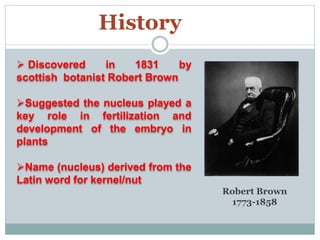
Robert Brown
1773-1858
 Discovered in 1831 by
scottish botanist Robert Brown
Suggested the nucleus played a
key role in fertilization and
development of the embryo in
plants
Name (nucleus) derived from the
Latin word for kernel/nut
Characteristics of nucleus
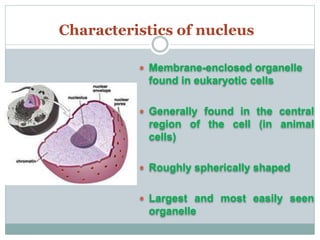
 Membrane-enclosed organelle
found in eukaryotic cells
 Generally found in the central
region of the cell (in animal
cells)
 Roughly spherically shaped
 Largest and most easily seen
organelle
Functions of nucleus
 Stores genetic information (DNA & RNA)
 DNA replication occurs in the nucleus which is
then passed to daughter cells
 Enables the synthesis of nearly all proteins
through the synthesis of RNA.
 Houses the nucleolus which is the site of
production of ribosomes
 Selective transportation of regulatory factors and
energy molecules through nuclear pores
Nuclear organization in
eukaryotes
Nucleus occupies approximately 10 % of the total cell
volume. Structural component of nucleus are:
Nuclear envelope
Nuclear matrix and nuclear lamina
Nucleoplasm
 Nucleolus
Chromatin
Nuclear Envelope
 Boundary of the nucleus that
separates the contents of the
nucleus from the cytoplasm
Provides structural framework of
the nucleus
Act as a barrier that prevent the
free passage of molecules between
nucleus and cytoplasm
Consist of two membranes : outer
and inner membrane
Nuclear Envelope (contd
Thickness of each membrane is around 7-8 nm,
encloses a perinuclear space between them (20-40
nm thick)
 Outer membrane continues with ER membrane has
ribosomes attached on it
 Inner membrane have proteins which bind the
underlying nuclear lamina.
Have number of pores called as nuclear pore
comples, required for transport of molecules between
nucleus and cytoplasm.
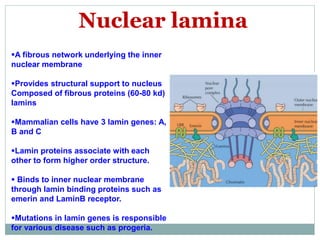
Nuclear lamina
A fibrous network underlying the inner
nuclear membrane
Provides structural support to nucleus
Composed of fibrous proteins (60-80 kd)
lamins
Mammalian cells have 3 lamin genes: A,
B and C
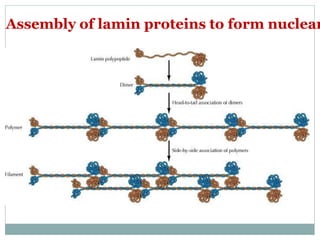
Lamin proteins associate with each
other to form higher order structure.
 Binds to inner nuclear membrane
through lamin binding proteins such as
emerin and LaminB receptor.
Mutations in lamin genes is responsible
for various disease such as progeria.
Assembly of lamin proteins to form nuclear
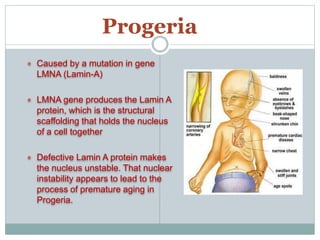
Progeria
 Caused by a mutation in gene
LMNA (Lamin-A)
 LMNA gene produces the Lamin A
protein, which is the structural
scaffolding that holds the nucleus
of a cell together
 Defective Lamin A protein makes
the nucleus unstable. That nuclear
instability appears to lead to the
process of premature aging in
Progeria.
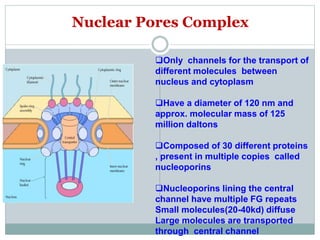
Nuclear Pores Complex
Only channels for the transport of
different molecules between
nucleus and cytoplasm
Have a diameter of 120 nm and
approx. molecular mass of 125
million daltons
Composed of 30 different proteins
, present in multiple copies called
nucleoporins
Nucleoporins lining the central
channel have multiple FG repeats
Small molecules(20-40kd) diffuse
Large molecules are transported
through central channel
Nuclear Pores Complex (contd.)
Consists of eight spokes arranged around a central
channel
spokes are connected to rings at the nuclear and
cytoplasmic surface
Spoke ring assembly is anchored in nuclear envelope
at the site of fusion of inner and outer nuclear membrane
Protein filaments extend from both sides giving a
basket like apperance on the nuclear side
Transport of proteins to and from the nu
Proteins needs to be transported to nucleus have a
specific amino acid sequence known as nuclear
localization signal (NLS)
NLS is recognized by the nuclear transport receptor
which directs their transport through nuclear pore complex
NLS first identified in SV 40 by Alan Smith and
colleagues in 1984
NLS are short sequence of amino acids rich in basic
amino acids( lysine and arginine)
Could be present as a single stretch (eg. SV40), or as a
bipartite sequence(eg. Nucleoplasmin)
Import of proteins to the nucleu
1. NLS of cargo protein is recognized by nuclear transport receptor
importins, resulting in formation of cargo-impotin complex.
2. The complex of cargo protein and importins docks with the
cytoplasmic filament of NPC and complex moves through nuclear
pore complex
3. Once inside the nucleus RanGTP binds to the complex and fascilitate
the release of cargo protein
4. Importin-Ran/GTP complex than exported back through nuclear pore
complex
5. In the cytoplasm GTP is hydrolyzed to GDP by Ran GAP releasing the
importin which can be used again
6. Ran GDP is transported back to nucleus by its own transporter NTF2
Import of proteins to the nucle
Export of proteins from nucleus
1.Proteins to be exported from nucleus have nuclear export signals
(NES), they bind to exportins and RaGTP forming a complex.
2. The complex moves to cytoplasm where GTP is hydrolyzed to GDP
fascilitating the release of cargo protein and exportin
3. Exporins and Ran GDP are transported back to the nucleus
Regulation of nuclear protein im
Import of proteins such as transcription factor is
regulated in by two mechaisms:
1.In one mechanism transcription factors such as
NF-kB bound to some inhibitory proteins (IkB) which
masks their NLS, so they remain in cytoplasm,
whenever some signal is their ,inhibitory protein is
phosphorylated and degraded and the protein can be
transorted to nucleus
2. In another mechanism transcription factor is itself
posphorylated (eg. Pho4), which prevents its
transport to the nucleus.
Transport of RNAs from nucle
Internal organization of
nucleus
Loose network of nuclear lamina extends to the
interior of nucleus
These lamins serves as site of chromatin
attachment
Chromatin within the nucleus is organized into
large loops of DNA
Specific region of loops are bound to lamin matrix
bylamin binding proteins in chromatin
Chromosome and chromatin
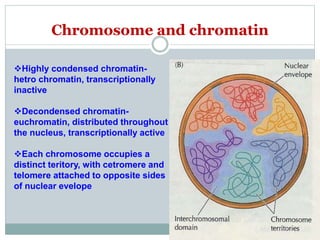
Highly condensed chromatin-
hetro chromatin, transcriptionally
inactive
Decondensed chromatin-
euchromatin, distributed throughout
the nucleus, transcriptionally active
Each chromosome occupies a
distinct teritory, with cetromere and
telomere attached to opposite sides
of nuclear evelope
Sub-compartments within nu
Have distinct region for various processes
Contains multiple clustered site for DNA replication
Speckles: storage site for splicing comonents
PML bodies: site for transcriptionaly regulatory proteins
Involved in acute promyelocytic leukemia
 Cajal bodies: enriched in small RNPs, functions as site
of RNP assembly and processing
Nucleolus: site for ribosome synthesis
Nucleolus
 Largest structure present inside the boundaries of the
nucleus
 Dark staining zone in center of nucleus
 Site of rRNA trascription and processing
 Main components are ribonucleic acid (RNA),
deoxyribonucleic acid (DNA) and proteins
 Known as ribosome production factory
Ribosomal rRNA genes
Nucleolus has genes for 5.8s, 18s and 28s rRNA
Ribosomal rRNA genes are present in tandom arrray
Around 200 copies of genes coding for 5.8s, 18s and 28s rRNA,
present on chromosome 13, 14, 15, 21 and 22
5s rRNA gene is present outside nucleolus on chromosome1 in a
tandom array
5.8s, 18s and 28s are transcribed as a single unit by RNA
polymerase 1, yielding 45s pre-rRNA.
Pre-rRNA is processed to 18s rRNA of 40s subunit and 5.8s, 28s
rRNA of 60 s subunit of ribosomes
Processing of rRNA genes
Ribosome assembly

Nucleus

  • 1.
  • 2.
    History Robert Brown 1773-1858  Discoveredin 1831 by scottish botanist Robert Brown Suggested the nucleus played a key role in fertilization and development of the embryo in plants Name (nucleus) derived from the Latin word for kernel/nut
  • 3.
    Characteristics of nucleus Membrane-enclosed organelle found in eukaryotic cells  Generally found in the central region of the cell (in animal cells)  Roughly spherically shaped  Largest and most easily seen organelle
  • 4.
    Functions of nucleus Stores genetic information (DNA & RNA)  DNA replication occurs in the nucleus which is then passed to daughter cells  Enables the synthesis of nearly all proteins through the synthesis of RNA.  Houses the nucleolus which is the site of production of ribosomes  Selective transportation of regulatory factors and energy molecules through nuclear pores
  • 5.
    Nuclear organization in eukaryotes Nucleusoccupies approximately 10 % of the total cell volume. Structural component of nucleus are: Nuclear envelope Nuclear matrix and nuclear lamina Nucleoplasm  Nucleolus Chromatin
  • 6.
    Nuclear Envelope  Boundaryof the nucleus that separates the contents of the nucleus from the cytoplasm Provides structural framework of the nucleus Act as a barrier that prevent the free passage of molecules between nucleus and cytoplasm Consist of two membranes : outer and inner membrane
  • 7.
    Nuclear Envelope (contd Thicknessof each membrane is around 7-8 nm, encloses a perinuclear space between them (20-40 nm thick)  Outer membrane continues with ER membrane has ribosomes attached on it  Inner membrane have proteins which bind the underlying nuclear lamina. Have number of pores called as nuclear pore comples, required for transport of molecules between nucleus and cytoplasm.
  • 8.
    Nuclear lamina A fibrousnetwork underlying the inner nuclear membrane Provides structural support to nucleus Composed of fibrous proteins (60-80 kd) lamins Mammalian cells have 3 lamin genes: A, B and C Lamin proteins associate with each other to form higher order structure.  Binds to inner nuclear membrane through lamin binding proteins such as emerin and LaminB receptor. Mutations in lamin genes is responsible for various disease such as progeria.
  • 9.
    Assembly of laminproteins to form nuclear
  • 10.
    Progeria  Caused bya mutation in gene LMNA (Lamin-A)  LMNA gene produces the Lamin A protein, which is the structural scaffolding that holds the nucleus of a cell together  Defective Lamin A protein makes the nucleus unstable. That nuclear instability appears to lead to the process of premature aging in Progeria.
  • 11.
    Nuclear Pores Complex Onlychannels for the transport of different molecules between nucleus and cytoplasm Have a diameter of 120 nm and approx. molecular mass of 125 million daltons Composed of 30 different proteins , present in multiple copies called nucleoporins Nucleoporins lining the central channel have multiple FG repeats Small molecules(20-40kd) diffuse Large molecules are transported through central channel
  • 12.
    Nuclear Pores Complex(contd.) Consists of eight spokes arranged around a central channel spokes are connected to rings at the nuclear and cytoplasmic surface Spoke ring assembly is anchored in nuclear envelope at the site of fusion of inner and outer nuclear membrane Protein filaments extend from both sides giving a basket like apperance on the nuclear side
  • 13.
    Transport of proteinsto and from the nu Proteins needs to be transported to nucleus have a specific amino acid sequence known as nuclear localization signal (NLS) NLS is recognized by the nuclear transport receptor which directs their transport through nuclear pore complex NLS first identified in SV 40 by Alan Smith and colleagues in 1984 NLS are short sequence of amino acids rich in basic amino acids( lysine and arginine) Could be present as a single stretch (eg. SV40), or as a bipartite sequence(eg. Nucleoplasmin)
  • 14.
    Import of proteinsto the nucleu 1. NLS of cargo protein is recognized by nuclear transport receptor importins, resulting in formation of cargo-impotin complex. 2. The complex of cargo protein and importins docks with the cytoplasmic filament of NPC and complex moves through nuclear pore complex 3. Once inside the nucleus RanGTP binds to the complex and fascilitate the release of cargo protein 4. Importin-Ran/GTP complex than exported back through nuclear pore complex 5. In the cytoplasm GTP is hydrolyzed to GDP by Ran GAP releasing the importin which can be used again 6. Ran GDP is transported back to nucleus by its own transporter NTF2
  • 15.
    Import of proteinsto the nucle
  • 16.
    Export of proteinsfrom nucleus 1.Proteins to be exported from nucleus have nuclear export signals (NES), they bind to exportins and RaGTP forming a complex. 2. The complex moves to cytoplasm where GTP is hydrolyzed to GDP fascilitating the release of cargo protein and exportin 3. Exporins and Ran GDP are transported back to the nucleus
  • 17.
    Regulation of nuclearprotein im Import of proteins such as transcription factor is regulated in by two mechaisms: 1.In one mechanism transcription factors such as NF-kB bound to some inhibitory proteins (IkB) which masks their NLS, so they remain in cytoplasm, whenever some signal is their ,inhibitory protein is phosphorylated and degraded and the protein can be transorted to nucleus 2. In another mechanism transcription factor is itself posphorylated (eg. Pho4), which prevents its transport to the nucleus.
  • 18.
  • 19.
    Internal organization of nucleus Loosenetwork of nuclear lamina extends to the interior of nucleus These lamins serves as site of chromatin attachment Chromatin within the nucleus is organized into large loops of DNA Specific region of loops are bound to lamin matrix bylamin binding proteins in chromatin
  • 20.
    Chromosome and chromatin Highlycondensed chromatin- hetro chromatin, transcriptionally inactive Decondensed chromatin- euchromatin, distributed throughout the nucleus, transcriptionally active Each chromosome occupies a distinct teritory, with cetromere and telomere attached to opposite sides of nuclear evelope
  • 21.
    Sub-compartments within nu Havedistinct region for various processes Contains multiple clustered site for DNA replication Speckles: storage site for splicing comonents PML bodies: site for transcriptionaly regulatory proteins Involved in acute promyelocytic leukemia  Cajal bodies: enriched in small RNPs, functions as site of RNP assembly and processing Nucleolus: site for ribosome synthesis
  • 22.
    Nucleolus  Largest structurepresent inside the boundaries of the nucleus  Dark staining zone in center of nucleus  Site of rRNA trascription and processing  Main components are ribonucleic acid (RNA), deoxyribonucleic acid (DNA) and proteins  Known as ribosome production factory
  • 23.
    Ribosomal rRNA genes Nucleolushas genes for 5.8s, 18s and 28s rRNA Ribosomal rRNA genes are present in tandom arrray Around 200 copies of genes coding for 5.8s, 18s and 28s rRNA, present on chromosome 13, 14, 15, 21 and 22 5s rRNA gene is present outside nucleolus on chromosome1 in a tandom array 5.8s, 18s and 28s are transcribed as a single unit by RNA polymerase 1, yielding 45s pre-rRNA. Pre-rRNA is processed to 18s rRNA of 40s subunit and 5.8s, 28s rRNA of 60 s subunit of ribosomes
  • 24.
  • 25.