Post-translational
Modification
Changes in Polypeptide Chains
Translation
• Translation is the synthesis of protein from an mRNA
template.
• This process involves several key molecules including:
1. mRNA
2. Ribosome
3. tRNA
4. Release Factor
Changes after Translation
• Peptide chain undergoes folding
• Some amino acids might be changed
• Carbohydrates or lipids can be added
• Peptide can be activated by addition or removal of
some residue (acetate, phosphate, methyl etc.)
• Changes in the Hydrogen bond proclivity which
results in secondary and tertiary structures
PTMs
The chemical modification of a protein after its
translation is known as Post-Translational Modification.
They regulate activity, localization and interaction with
other cellular molecules such as proteins, nucleic acids,
lipids and cofactors.
PTMs
• Amino-Terminal and Carboxyl-Terminal
Modifications
• Loss of Signal Sequences
• Modification of Individual Amino acids
• Attachment of Carbohydrate Side Chains
• Proteolytic Processing
• Formation of Disulfide Cross-Links
Types of PTMs
A. Trimming
B. Covalent Modification
C. Ubiquitination
Trimming
• Removal of a part of the translated sequence.
Proteases Protein activation.
• Portions of the protein chain must be removed by
specialized endoproteases.
• Some precursor proteins are cleaved in the
endoplasmic reticulum or the Golgi apparatus; others
are cleaved in developing secretory vesicles.
Phosphorylation
• Addition of phosphate group to a protein.
• It occurs on the hydroxyl groups of serine,
threonine, less frequently, tyrosine residues in a
protein.
• The phosphorylation may increase or decrease the
functional activity of the protein.
Protein kinases
• ATP + protein phosphoprotein + ADP
Examples
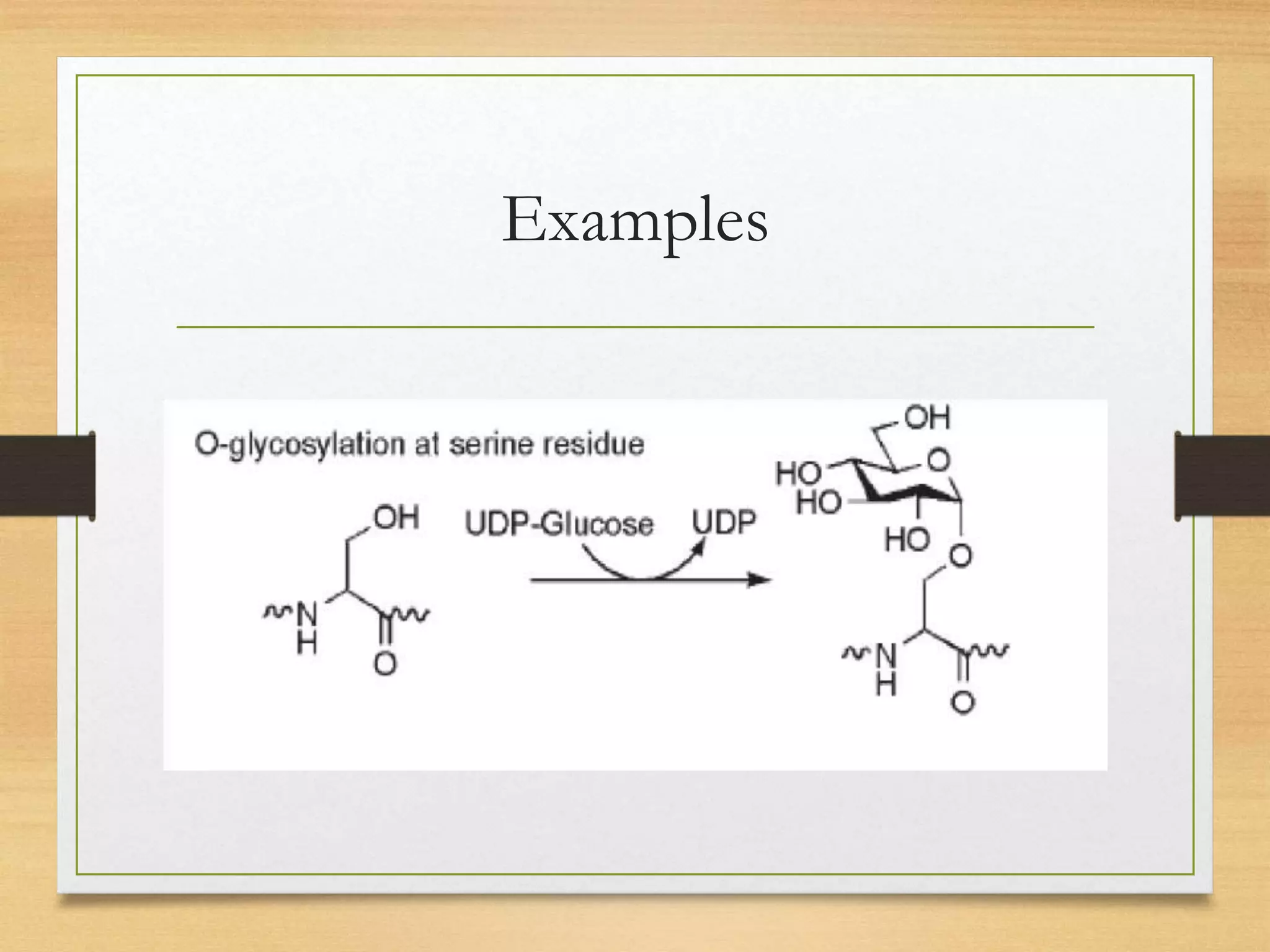
Glycosylation
• Addition of glycosyl group or carbohydrate group to
a protein.
• Glycosylation is also used to target proteins to the
matrix of lysosomes.
• It is built sequentially on the hydroxyl groups of
serine, threonine, or hydroxylysine (O-linked). N-
glycosylation occurs in the endoplasmic reticulum
and O-glycosyation in the Golgi.
Examples
Classes of glycan
• N-Linked glycans – attached to nitrogen of
Asparagine or arginine side chains.
• O-Linked glycans – attached to hydroxy oxygen of
serine,threonine
• Phospho glycans – linked through the phosphate of
serine.
• C-Linked glycans – Rare form, Sugar is added to a
carbon on tryptophan side chain.
Protein Folding
• Proteins must fold to assume their functional, native
state. Folding can be spontaneous (as a result of the
primary structure) or facilitated by proteins known as
chaperones.
• Foldings of AA give protein a structure.
Protein degradation
• Ubiquintation
Ubiquitin is a small regulatory protein that can be attached to
the proteins and label them for destruction.
Proteins that are defective (for example, misfolded) are often
marked for destruction by ubiquitination
Effects in cell cycle regulation, control of proliferation and
differentiation, programmed cell death (apoptosis), DNA
repair, immune and inflammatory processes and organelle
biogenesis.
Ubiquitination
Importance of PTMs
• Help in utilizing identical proteins for different
cellular functions in different cell types.
• Regulation of particular protein sequence behavior in
most of the eukaryotic organisms.
• Play an important part in modifying the end product
of expression.
• Contribute towards biological processes and diseased
conditions.
Post-translational regulation
Once a polypeptide chain is assembled, it still requires
two major "finishing steps" before it becomes
functional.
I. Chemical modification
II. Folding
Chemical modification
Chemical modification involves three steps
a) Modification of amino acid residues into other
types.
b) Addition of organic units (such as sugars or lipids)
to specific amino acids.
c) Enzymatic cleavage of one or more amino acids
from a region of the polypeptide chain
Abundance of collagen
The abundance of collagen in the extracellular
structures of humans and other mammals makes
disorders of collagen deposition.
Atherosclerosis-a disease involving stiffening of the
arteries, is related to an over-deposition of collagen.
Fibrosis-involving hardening of the tissues, is related
to excessive collagen synthesis.
Progressive Systemic Sclerosis
(Scleroderma]
• A disease of the vascular and immune systems, and a
severe connective tissue disorder.

post-translational modification

  • 1.
  • 2.
    Translation • Translation isthe synthesis of protein from an mRNA template. • This process involves several key molecules including: 1. mRNA 2. Ribosome 3. tRNA 4. Release Factor
  • 3.
    Changes after Translation •Peptide chain undergoes folding • Some amino acids might be changed • Carbohydrates or lipids can be added • Peptide can be activated by addition or removal of some residue (acetate, phosphate, methyl etc.) • Changes in the Hydrogen bond proclivity which results in secondary and tertiary structures
  • 4.
    PTMs The chemical modificationof a protein after its translation is known as Post-Translational Modification. They regulate activity, localization and interaction with other cellular molecules such as proteins, nucleic acids, lipids and cofactors.
  • 5.
    PTMs • Amino-Terminal andCarboxyl-Terminal Modifications • Loss of Signal Sequences • Modification of Individual Amino acids • Attachment of Carbohydrate Side Chains • Proteolytic Processing • Formation of Disulfide Cross-Links
  • 6.
    Types of PTMs A.Trimming B. Covalent Modification C. Ubiquitination
  • 7.
    Trimming • Removal ofa part of the translated sequence. Proteases Protein activation. • Portions of the protein chain must be removed by specialized endoproteases. • Some precursor proteins are cleaved in the endoplasmic reticulum or the Golgi apparatus; others are cleaved in developing secretory vesicles.
  • 8.
    Phosphorylation • Addition ofphosphate group to a protein. • It occurs on the hydroxyl groups of serine, threonine, less frequently, tyrosine residues in a protein. • The phosphorylation may increase or decrease the functional activity of the protein. Protein kinases • ATP + protein phosphoprotein + ADP
  • 9.
  • 10.
    Glycosylation • Addition ofglycosyl group or carbohydrate group to a protein. • Glycosylation is also used to target proteins to the matrix of lysosomes. • It is built sequentially on the hydroxyl groups of serine, threonine, or hydroxylysine (O-linked). N- glycosylation occurs in the endoplasmic reticulum and O-glycosyation in the Golgi.
  • 11.
  • 12.
    Classes of glycan •N-Linked glycans – attached to nitrogen of Asparagine or arginine side chains. • O-Linked glycans – attached to hydroxy oxygen of serine,threonine • Phospho glycans – linked through the phosphate of serine. • C-Linked glycans – Rare form, Sugar is added to a carbon on tryptophan side chain.
  • 13.
    Protein Folding • Proteinsmust fold to assume their functional, native state. Folding can be spontaneous (as a result of the primary structure) or facilitated by proteins known as chaperones. • Foldings of AA give protein a structure.
  • 14.
    Protein degradation • Ubiquintation Ubiquitinis a small regulatory protein that can be attached to the proteins and label them for destruction. Proteins that are defective (for example, misfolded) are often marked for destruction by ubiquitination Effects in cell cycle regulation, control of proliferation and differentiation, programmed cell death (apoptosis), DNA repair, immune and inflammatory processes and organelle biogenesis.
  • 15.
  • 16.
    Importance of PTMs •Help in utilizing identical proteins for different cellular functions in different cell types. • Regulation of particular protein sequence behavior in most of the eukaryotic organisms. • Play an important part in modifying the end product of expression. • Contribute towards biological processes and diseased conditions.
  • 17.
    Post-translational regulation Once apolypeptide chain is assembled, it still requires two major "finishing steps" before it becomes functional. I. Chemical modification II. Folding
  • 18.
    Chemical modification Chemical modificationinvolves three steps a) Modification of amino acid residues into other types. b) Addition of organic units (such as sugars or lipids) to specific amino acids. c) Enzymatic cleavage of one or more amino acids from a region of the polypeptide chain
  • 19.
    Abundance of collagen Theabundance of collagen in the extracellular structures of humans and other mammals makes disorders of collagen deposition. Atherosclerosis-a disease involving stiffening of the arteries, is related to an over-deposition of collagen. Fibrosis-involving hardening of the tissues, is related to excessive collagen synthesis.
  • 20.
    Progressive Systemic Sclerosis (Scleroderma] •A disease of the vascular and immune systems, and a severe connective tissue disorder.