Histograms
 BTEOTSSSBAT draw and
   interpret histograms
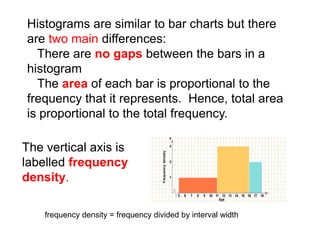
Histograms are similar to bar charts but there
are two main differences:
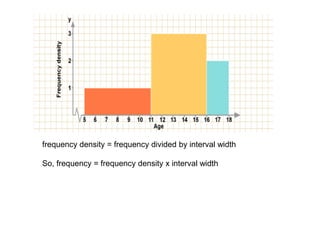
  There are no gaps between the bars in a
histogram
  The area of each bar is proportional to the
frequency that it represents. Hence, total area
is proportional to the total frequency.

The vertical axis is
labelled frequency
density.

    frequency density = frequency divided by interval width
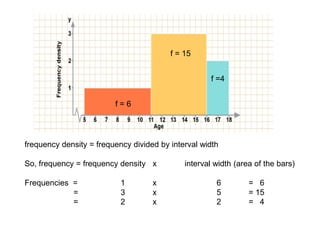
f = 15


                                                    f =4


                         f=6


frequency density = frequency divided by interval width

So, frequency = frequency density x          interval width (area of the bars)

Frequencies =              1        x                 6         = 6
            =              3        x                 5         = 15
            =              2        x                 2         = 4
frequency density = frequency divided by interval width

So, frequency = frequency density x interval width
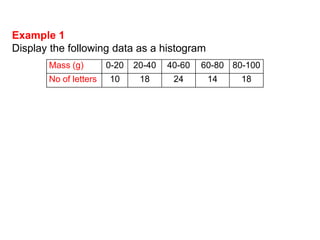
Example 1
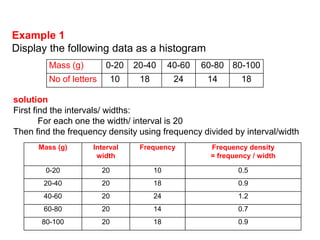
Display the following data as a histogram
       Mass (g)        0-20   20-40   40-60   60-80 80-100
       No of letters   10      18      24      14     18
Example 1
Display the following data as a histogram
         Mass (g)        0-20   20-40    40-60   60-80 80-100
         No of letters    10      18       24     14     18

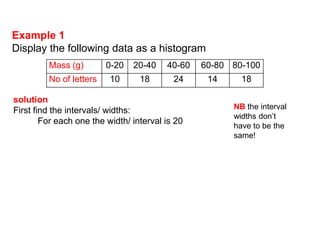
solution
First find the intervals/ widths:                      NB the interval
                                                       widths don’t
        For each one the width/ interval is 20
                                                       have to be the
                                                       same!
Example 1
Display the following data as a histogram
         Mass (g)        0-20   20-40   40-60   60-80 80-100
         No of letters   10      18      24      14       18

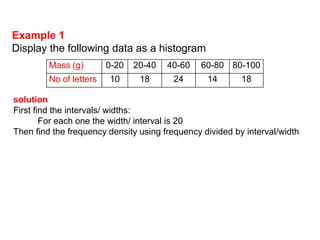
solution
First find the intervals/ widths:
        For each one the width/ interval is 20
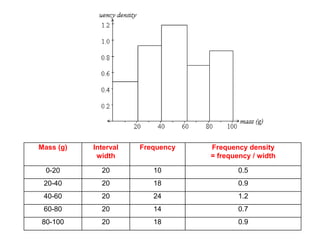
Then find the frequency density using frequency divided by interval/width
Example 1
Display the following data as a histogram
         Mass (g)         0-20     20-40      40-60   60-80 80-100
         No of letters        10    18         24      14      18

solution
First find the intervals/ widths:
        For each one the width/ interval is 20
Then find the frequency density using frequency divided by interval/width
      Mass (g)       Interval       Frequency          Frequency density
                      width                            = frequency / width

        0-20             20              10                    0.5
       20-40             20              18                    0.9
       40-60             20              24                    1.2
       60-80             20              14                    0.7
       80-100            20              18                    0.9
Mass (g)   Interval   Frequency   Frequency density
            width                 = frequency / width

  0-20       20          10               0.5
 20-40       20          18               0.9
 40-60       20          24               1.2
 60-80       20          14               0.7
80-100       20          18               0.9
Finding frequencies from a histogram
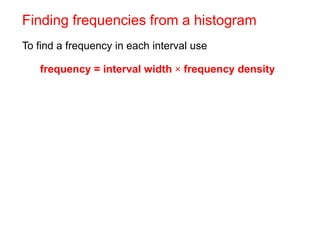
To find a frequency in each interval use

   frequency = interval width × frequency density
Example 2
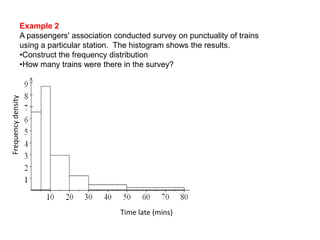
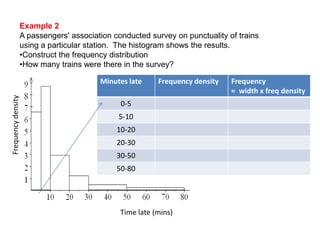
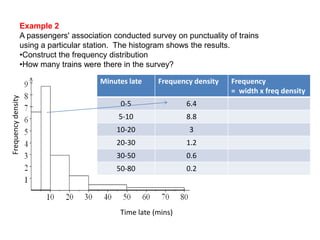
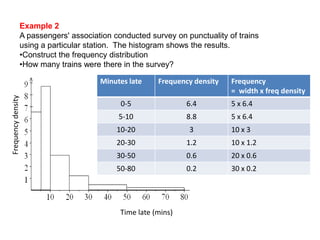
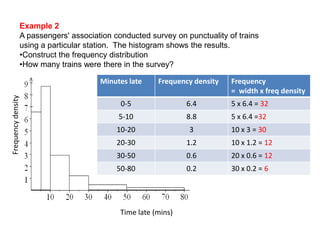
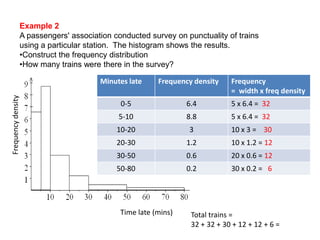
                A passengers' association conducted survey on punctuality of trains
                using a particular station. The histogram shows the results.
                •Construct the frequency distribution
                •How many trains were there in the survey?
Frequency density


                                            Time late (mins)
Example 2
                A passengers' association conducted survey on punctuality of trains
                using a particular station. The histogram shows the results.
                •Construct the frequency distribution
                •How many trains were there in the survey?

                                      Minutes late     Frequency density   Frequency
                                                                           = width x freq density
Frequency density


                                            0-5
                                           5-10
                                           10-20
                                           20-30
                                           30-50
                                           50-80


                                            Time late (mins)
Example 2
                A passengers' association conducted survey on punctuality of trains
                using a particular station. The histogram shows the results.
                •Construct the frequency distribution
                •How many trains were there in the survey?

                                      Minutes late     Frequency density   Frequency
                                                                           = width x freq density
Frequency density


                                            0-5                6.4
                                           5-10                8.8
                                           10-20               3
                                           20-30               1.2
                                           30-50               0.6
                                           50-80               0.2


                                            Time late (mins)
Example 2
                A passengers' association conducted survey on punctuality of trains
                using a particular station. The histogram shows the results.
                •Construct the frequency distribution
                •How many trains were there in the survey?

                                      Minutes late     Frequency density   Frequency
                                                                           = width x freq density
Frequency density


                                            0-5                6.4         5 x 6.4
                                           5-10                8.8         5 x 6.4
                                           10-20               3           10 x 3
                                           20-30               1.2         10 x 1.2
                                           30-50               0.6         20 x 0.6
                                           50-80               0.2         30 x 0.2


                                            Time late (mins)
Example 2
                A passengers' association conducted survey on punctuality of trains
                using a particular station. The histogram shows the results.
                •Construct the frequency distribution
                •How many trains were there in the survey?

                                      Minutes late     Frequency density   Frequency
                                                                           = width x freq density
Frequency density


                                            0-5                6.4         5 x 6.4 = 32
                                           5-10                8.8         5 x 6.4 =32
                                           10-20               3           10 x 3 = 30
                                           20-30               1.2         10 x 1.2 = 12
                                           30-50               0.6         20 x 0.6 = 12
                                           50-80               0.2         30 x 0.2 = 6


                                            Time late (mins)
Example 2
                A passengers' association conducted survey on punctuality of trains
                using a particular station. The histogram shows the results.
                •Construct the frequency distribution
                •How many trains were there in the survey?

                                      Minutes late     Frequency density    Frequency
                                                                            = width x freq density
Frequency density


                                            0-5                6.4          5 x 6.4 = 32
                                           5-10                8.8          5 x 6.4 = 32
                                           10-20               3            10 x 3 = 30
                                           20-30               1.2          10 x 1.2 = 12
                                           30-50               0.6          20 x 0.6 = 12
                                           50-80               0.2          30 x 0.2 = 6


                                            Time late (mins)    Total trains =
                                                                32 + 32 + 30 + 12 + 12 + 6 =
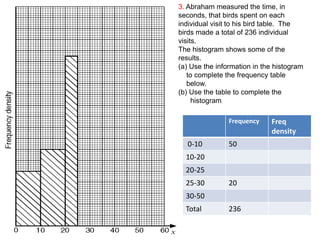
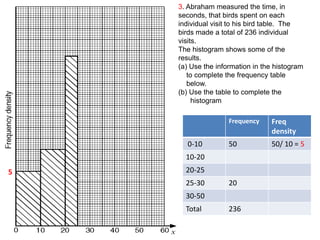
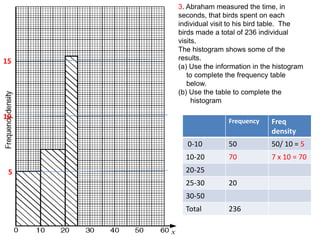
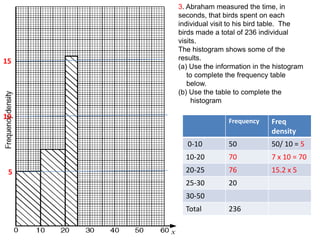
3. Abraham measured the time, in
seconds, that birds spent on each
individual visit to his bird table. The
birds made a total of 236 individual
visits.
The histogram shows some of the
results.
(a) Use the information in the histogram
   to complete the frequency table
   below.
(b) Use the table to complete the
     histogram

                Frequency    Freq
                             density
  0-10          50
  10-20
  20-25
  25-30         20
  30-50
  Total         236
3. Abraham measured the time, in
    seconds, that birds spent on each
    individual visit to his bird table. The
    birds made a total of 236 individual
    visits.
    The histogram shows some of the
    results.
    (a) Use the information in the histogram
       to complete the frequency table
       below.
    (b) Use the table to complete the
         histogram

                    Frequency    Freq
                                 density
      0-10          50           50/ 10 = 5
      10-20
5     20-25
      25-30         20
      30-50
      Total         236
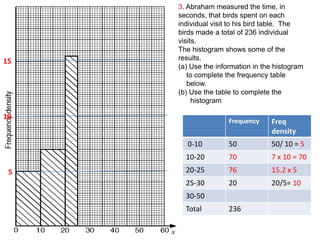
3. Abraham measured the time, in
     seconds, that birds spent on each
     individual visit to his bird table. The
     birds made a total of 236 individual
     visits.
     The histogram shows some of the
15   results.
     (a) Use the information in the histogram
        to complete the frequency table
        below.
     (b) Use the table to complete the
          histogram

10
                     Frequency    Freq
                                  density
       0-10          50           50/ 10 = 5
       10-20         70           7 x 10 = 70
 5     20-25
       25-30         20
       30-50
       Total         236
3. Abraham measured the time, in
     seconds, that birds spent on each
     individual visit to his bird table. The
     birds made a total of 236 individual
     visits.
     The histogram shows some of the
15   results.
     (a) Use the information in the histogram
        to complete the frequency table
        below.
     (b) Use the table to complete the
          histogram

10
                     Frequency    Freq
                                  density
       0-10          50           50/ 10 = 5
       10-20         70           7 x 10 = 70
 5     20-25         76           15.2 x 5
       25-30         20
       30-50
       Total         236
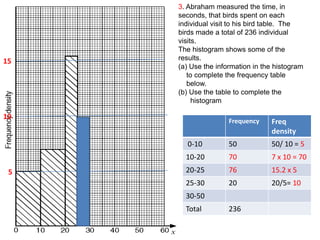
3. Abraham measured the time, in
     seconds, that birds spent on each
     individual visit to his bird table. The
     birds made a total of 236 individual
     visits.
     The histogram shows some of the
15   results.
     (a) Use the information in the histogram
        to complete the frequency table
        below.
     (b) Use the table to complete the
          histogram

10
                     Frequency    Freq
                                  density
       0-10          50           50/ 10 = 5
       10-20         70           7 x 10 = 70
 5     20-25         76           15.2 x 5
       25-30         20           20/5= 10
       30-50
       Total         236
3. Abraham measured the time, in
     seconds, that birds spent on each
     individual visit to his bird table. The
     birds made a total of 236 individual
     visits.
     The histogram shows some of the
15   results.
     (a) Use the information in the histogram
        to complete the frequency table
        below.
     (b) Use the table to complete the
          histogram

10
                     Frequency    Freq
                                  density
       0-10          50           50/ 10 = 5
       10-20         70           7 x 10 = 70
 5     20-25         76           15.2 x 5
       25-30         20           20/5= 10
       30-50
       Total         236
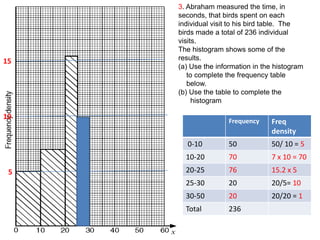
3. Abraham measured the time, in
     seconds, that birds spent on each
     individual visit to his bird table. The
     birds made a total of 236 individual
     visits.
     The histogram shows some of the
15   results.
     (a) Use the information in the histogram
        to complete the frequency table
        below.
     (b) Use the table to complete the
          histogram

10
                     Frequency    Freq
                                  density
       0-10          50           50/ 10 = 5
       10-20         70           7 x 10 = 70
 5     20-25         76           15.2 x 5
       25-30         20           20/5= 10
       30-50         20           20/20 = 1
       Total         236
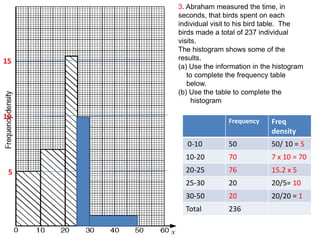
3. Abraham measured the time, in
     seconds, that birds spent on each
     individual visit to his bird table. The
     birds made a total of 237 individual
     visits.
     The histogram shows some of the
15   results.
     (a) Use the information in the histogram
        to complete the frequency table
        below.
     (b) Use the table to complete the
          histogram

10
                     Frequency    Freq
                                  density
       0-10          50           50/ 10 = 5
       10-20         70           7 x 10 = 70
 5     20-25         76           15.2 x 5
       25-30         20           20/5= 10
       30-50         20           20/20 = 1
       Total         236

Histograms

  • 1.
    Histograms BTEOTSSSBAT drawand interpret histograms
  • 2.
    Histograms are similarto bar charts but there are two main differences: There are no gaps between the bars in a histogram The area of each bar is proportional to the frequency that it represents. Hence, total area is proportional to the total frequency. The vertical axis is labelled frequency density. frequency density = frequency divided by interval width
  • 3.
    f = 15 f =4 f=6 frequency density = frequency divided by interval width So, frequency = frequency density x interval width (area of the bars) Frequencies = 1 x 6 = 6 = 3 x 5 = 15 = 2 x 2 = 4
  • 4.
    frequency density =frequency divided by interval width So, frequency = frequency density x interval width
  • 5.
    Example 1 Display thefollowing data as a histogram Mass (g) 0-20 20-40 40-60 60-80 80-100 No of letters 10 18 24 14 18
  • 6.
    Example 1 Display thefollowing data as a histogram Mass (g) 0-20 20-40 40-60 60-80 80-100 No of letters 10 18 24 14 18 solution First find the intervals/ widths: NB the interval widths don’t For each one the width/ interval is 20 have to be the same!
  • 7.
    Example 1 Display thefollowing data as a histogram Mass (g) 0-20 20-40 40-60 60-80 80-100 No of letters 10 18 24 14 18 solution First find the intervals/ widths: For each one the width/ interval is 20 Then find the frequency density using frequency divided by interval/width
  • 8.
    Example 1 Display thefollowing data as a histogram Mass (g) 0-20 20-40 40-60 60-80 80-100 No of letters 10 18 24 14 18 solution First find the intervals/ widths: For each one the width/ interval is 20 Then find the frequency density using frequency divided by interval/width Mass (g) Interval Frequency Frequency density width = frequency / width 0-20 20 10 0.5 20-40 20 18 0.9 40-60 20 24 1.2 60-80 20 14 0.7 80-100 20 18 0.9
  • 9.
    Mass (g) Interval Frequency Frequency density width = frequency / width 0-20 20 10 0.5 20-40 20 18 0.9 40-60 20 24 1.2 60-80 20 14 0.7 80-100 20 18 0.9
  • 10.
    Finding frequencies froma histogram To find a frequency in each interval use frequency = interval width × frequency density
  • 11.
    Example 2 A passengers' association conducted survey on punctuality of trains using a particular station. The histogram shows the results. •Construct the frequency distribution •How many trains were there in the survey? Frequency density Time late (mins)
  • 12.
    Example 2 A passengers' association conducted survey on punctuality of trains using a particular station. The histogram shows the results. •Construct the frequency distribution •How many trains were there in the survey? Minutes late Frequency density Frequency = width x freq density Frequency density 0-5 5-10 10-20 20-30 30-50 50-80 Time late (mins)
  • 13.
    Example 2 A passengers' association conducted survey on punctuality of trains using a particular station. The histogram shows the results. •Construct the frequency distribution •How many trains were there in the survey? Minutes late Frequency density Frequency = width x freq density Frequency density 0-5 6.4 5-10 8.8 10-20 3 20-30 1.2 30-50 0.6 50-80 0.2 Time late (mins)
  • 14.
    Example 2 A passengers' association conducted survey on punctuality of trains using a particular station. The histogram shows the results. •Construct the frequency distribution •How many trains were there in the survey? Minutes late Frequency density Frequency = width x freq density Frequency density 0-5 6.4 5 x 6.4 5-10 8.8 5 x 6.4 10-20 3 10 x 3 20-30 1.2 10 x 1.2 30-50 0.6 20 x 0.6 50-80 0.2 30 x 0.2 Time late (mins)
  • 15.
    Example 2 A passengers' association conducted survey on punctuality of trains using a particular station. The histogram shows the results. •Construct the frequency distribution •How many trains were there in the survey? Minutes late Frequency density Frequency = width x freq density Frequency density 0-5 6.4 5 x 6.4 = 32 5-10 8.8 5 x 6.4 =32 10-20 3 10 x 3 = 30 20-30 1.2 10 x 1.2 = 12 30-50 0.6 20 x 0.6 = 12 50-80 0.2 30 x 0.2 = 6 Time late (mins)
  • 16.
    Example 2 A passengers' association conducted survey on punctuality of trains using a particular station. The histogram shows the results. •Construct the frequency distribution •How many trains were there in the survey? Minutes late Frequency density Frequency = width x freq density Frequency density 0-5 6.4 5 x 6.4 = 32 5-10 8.8 5 x 6.4 = 32 10-20 3 10 x 3 = 30 20-30 1.2 10 x 1.2 = 12 30-50 0.6 20 x 0.6 = 12 50-80 0.2 30 x 0.2 = 6 Time late (mins) Total trains = 32 + 32 + 30 + 12 + 12 + 6 =
  • 17.
    3. Abraham measuredthe time, in seconds, that birds spent on each individual visit to his bird table. The birds made a total of 236 individual visits. The histogram shows some of the results. (a) Use the information in the histogram to complete the frequency table below. (b) Use the table to complete the histogram Frequency Freq density 0-10 50 10-20 20-25 25-30 20 30-50 Total 236
  • 18.
    3. Abraham measuredthe time, in seconds, that birds spent on each individual visit to his bird table. The birds made a total of 236 individual visits. The histogram shows some of the results. (a) Use the information in the histogram to complete the frequency table below. (b) Use the table to complete the histogram Frequency Freq density 0-10 50 50/ 10 = 5 10-20 5 20-25 25-30 20 30-50 Total 236
  • 19.
    3. Abraham measuredthe time, in seconds, that birds spent on each individual visit to his bird table. The birds made a total of 236 individual visits. The histogram shows some of the 15 results. (a) Use the information in the histogram to complete the frequency table below. (b) Use the table to complete the histogram 10 Frequency Freq density 0-10 50 50/ 10 = 5 10-20 70 7 x 10 = 70 5 20-25 25-30 20 30-50 Total 236
  • 20.
    3. Abraham measuredthe time, in seconds, that birds spent on each individual visit to his bird table. The birds made a total of 236 individual visits. The histogram shows some of the 15 results. (a) Use the information in the histogram to complete the frequency table below. (b) Use the table to complete the histogram 10 Frequency Freq density 0-10 50 50/ 10 = 5 10-20 70 7 x 10 = 70 5 20-25 76 15.2 x 5 25-30 20 30-50 Total 236
  • 21.
    3. Abraham measuredthe time, in seconds, that birds spent on each individual visit to his bird table. The birds made a total of 236 individual visits. The histogram shows some of the 15 results. (a) Use the information in the histogram to complete the frequency table below. (b) Use the table to complete the histogram 10 Frequency Freq density 0-10 50 50/ 10 = 5 10-20 70 7 x 10 = 70 5 20-25 76 15.2 x 5 25-30 20 20/5= 10 30-50 Total 236
  • 22.
    3. Abraham measuredthe time, in seconds, that birds spent on each individual visit to his bird table. The birds made a total of 236 individual visits. The histogram shows some of the 15 results. (a) Use the information in the histogram to complete the frequency table below. (b) Use the table to complete the histogram 10 Frequency Freq density 0-10 50 50/ 10 = 5 10-20 70 7 x 10 = 70 5 20-25 76 15.2 x 5 25-30 20 20/5= 10 30-50 Total 236
  • 23.
    3. Abraham measuredthe time, in seconds, that birds spent on each individual visit to his bird table. The birds made a total of 236 individual visits. The histogram shows some of the 15 results. (a) Use the information in the histogram to complete the frequency table below. (b) Use the table to complete the histogram 10 Frequency Freq density 0-10 50 50/ 10 = 5 10-20 70 7 x 10 = 70 5 20-25 76 15.2 x 5 25-30 20 20/5= 10 30-50 20 20/20 = 1 Total 236
  • 24.
    3. Abraham measuredthe time, in seconds, that birds spent on each individual visit to his bird table. The birds made a total of 237 individual visits. The histogram shows some of the 15 results. (a) Use the information in the histogram to complete the frequency table below. (b) Use the table to complete the histogram 10 Frequency Freq density 0-10 50 50/ 10 = 5 10-20 70 7 x 10 = 70 5 20-25 76 15.2 x 5 25-30 20 20/5= 10 30-50 20 20/20 = 1 Total 236