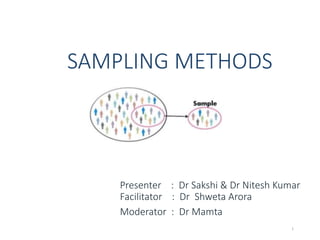
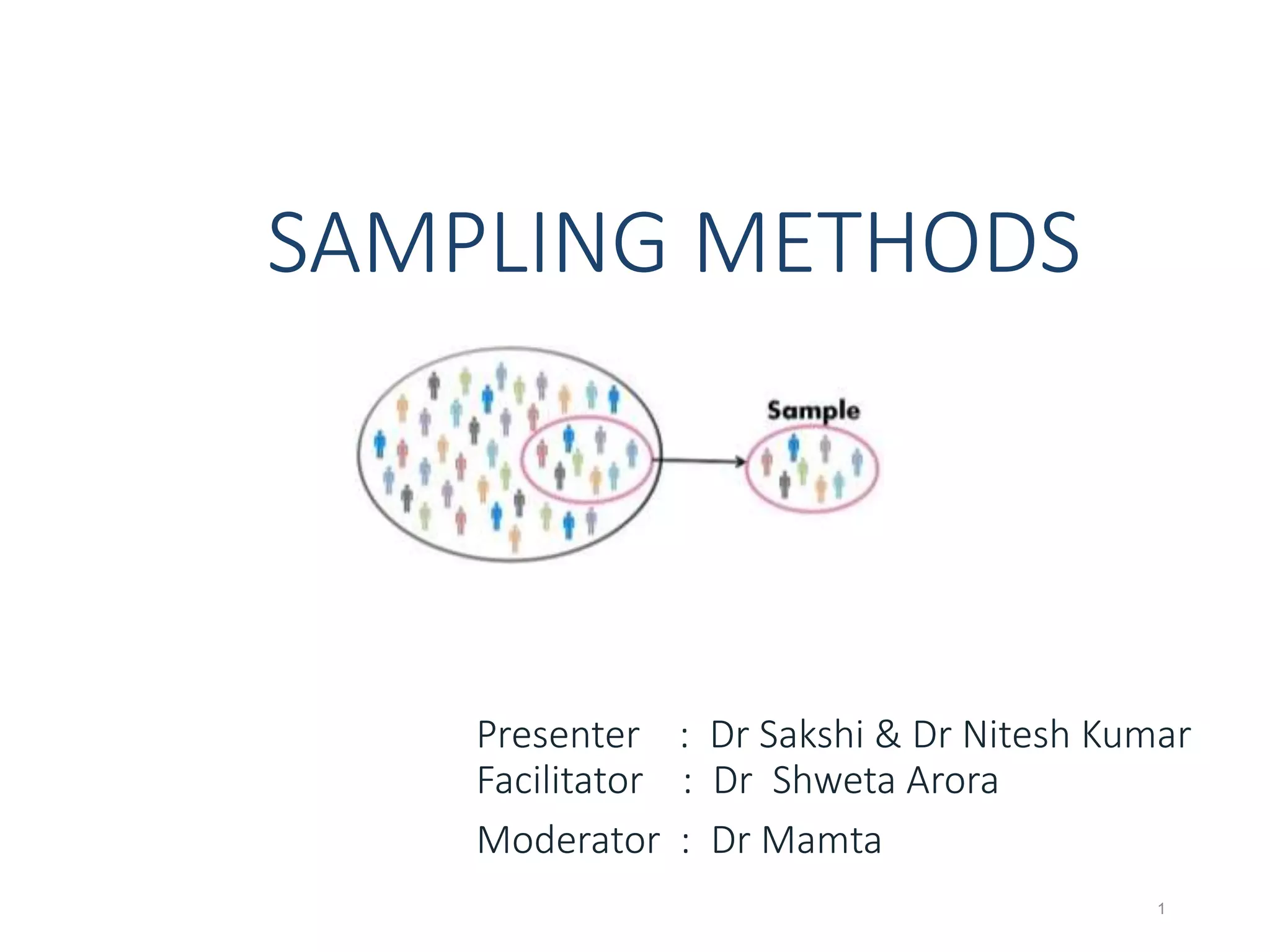
SAMPLING METHODS
Presenter : Dr Sakshi & Dr Nitesh Kumar
Facilitator : Dr Shweta Arora
Moderator : Dr Mamta
1
PLAN OF PRESENTATION
•Introduction
•Purpose of sampling?
•Definitions
•Types of sampling:-
1.Random sampling
2.Non-random sampling
•Advantages and limitation of
sampling
•References
2
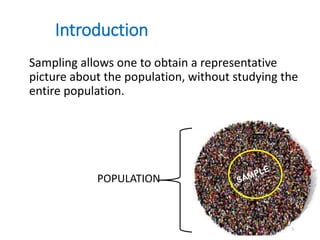
Introduction
Sampling allows one to obtain a representative
picture about the population, without studying the
entire population.
POPULATION
3
SAMPLING
The process of selecting number of individuals for a study
in such a way that the individuals represent the larger
group from which they were selected and statistical
inference based on sample results may be attributed
only to the population sampled.
John M last, Miguel Porta . A dictionary of epidemiology. 6th edition. Oxford University Press.2014
4
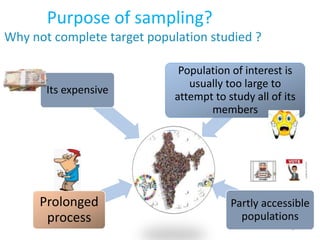
Prolonged
process
Its expensive
Population of interest is
usually too large to
attempt to study all of its
members
Partly accessible
populations
Purpose of sampling?
Why not complete target population studied ?
5
Some Other Definition In sampling
Population
Group of persons having one or more common
characteristics
Universe population
•Universe is the population about which
investigator wishes to draw a conclusion.
•Universe could be larger than target population
•Future cases are a part of universe but not of
target population
6
Other Definition In sampling
John M last, Miguel Porta . A dictionary of epidemiology. 6th edition. Oxford University Press.2014
TARGET/SOURCE/REFERENCE POPULATION
• The term is used to indicate the total population or
group from which study population is withdrawn
• And to denote a Reference population about which
inferences are desired
• Dependent on research problem and study design
eg. 1. All healthy male in country (for HIV Prevelance),
2. all patient with acute MI in delhi
7
ACTUAL POPULATION (Study population)
This term is used to indicate the population or
group from which a sample is drawn
Eg. 1. All healthy male in 5 districts of country,
2. all patient with MI in 9 districts of Delhi
Other Definition In sampling
8
Some Special Terms Used In sampling
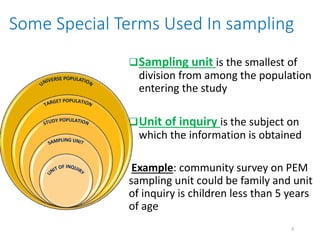
Sampling unit is the smallest of
division from among the population
entering the study
Unit of inquiry is the subject on
which the information is obtained
Example: community survey on PEM
sampling unit could be family and unit
of inquiry is children less than 5 years
of age
9
Some Special Term Used In sampling
 Sampling frame
Complete non-overlapping list of all the sampling units of
study population from which the sample is to be drawn.
 Sample frame error occurs when certain elements of the
population are accidentally omitted or not included in the
list
 Sampling Units must be mutually exclusive
10
Sampling Process
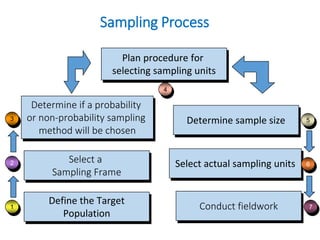
11
Define the Target
Population
Select a
Sampling Frame
Determine if a probability
or non-probability sampling
method will be chosen
Plan procedure for
selecting sampling units
Determine sample size
Select actual sampling units
Conduct fieldwork1
2
3
4
5
6
7
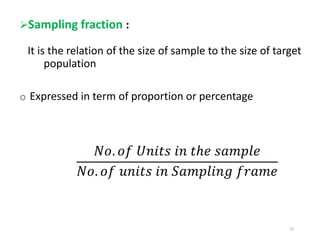
Sampling fraction :
It is the relation of the size of sample to the size of target
population
o Expressed in term of proportion or percentage
𝑁𝑜. 𝑜𝑓 𝑈𝑛𝑖𝑡𝑠 𝑖𝑛 𝑡ℎ𝑒 𝑠𝑎𝑚𝑝𝑙𝑒
𝑁𝑜. 𝑜𝑓 𝑢𝑛𝑖𝑡𝑠 𝑖𝑛 𝑆𝑎𝑚𝑝𝑙𝑖𝑛𝑔 𝑓𝑟𝑎𝑚𝑒
12
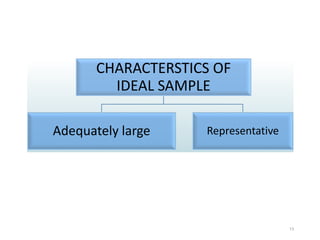
CHARACTERSTICS OF
IDEAL SAMPLE
Adequately large Representative
13
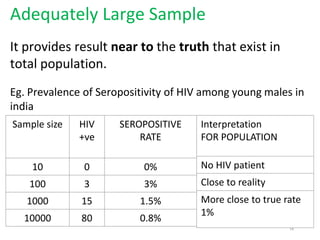
Adequately Large Sample
It provides result near to the truth that exist in
total population.
Eg. Prevalence of Seropositivity of HIV among young males in
india
Sample size HIV
+ve
SEROPOSITIVE
RATE
10 0 0%
100 3 3%
1000 15 1.5%
10000 80 0.8%
Interpretation
FOR POPULATION
No HIV patient
Close to reality
More close to true rate
1%
14
Representative
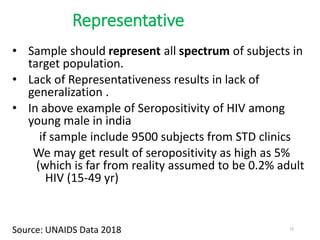
• Sample should represent all spectrum of subjects in
target population.
• Lack of Representativeness results in lack of
generalization .
• In above example of Seropositivity of HIV among
young male in india
if sample include 9500 subjects from STD clinics
We may get result of seropositivity as high as 5%
(which is far from reality assumed to be 0.2% adult
HIV (15-49 yr)
Source: UNAIDS Data 2018 15
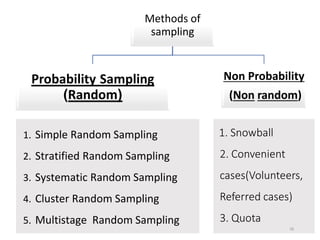
1. Snowball
2. Convenient
cases(Volunteers,
Referred cases)
3. Quota
1. Simple Random Sampling
2. Stratified Random Sampling
3. Systematic Random Sampling
4. Cluster Random Sampling
5. Multistage Random Sampling
Methods of
sampling
Probability Sampling
(Random)
Non Probability
(Non random)
16
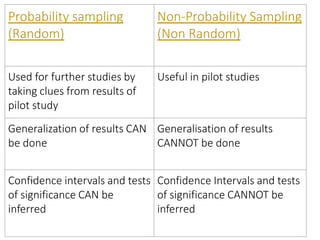
Non-Probability Sampling
(Non Random)
Useful in pilot studies
Generalisation of results
CANNOT be done
Confidence Intervals and tests
of significance CANNOT be
inferred
Probability sampling
(Random)
Used for further studies by
taking clues from results of
pilot study
Generalization of results CAN
be done
Confidence intervals and tests
of significance CAN be
inferred
17
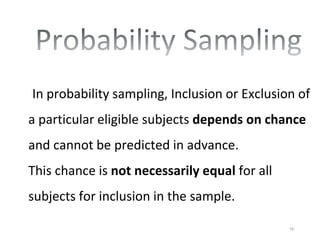
In probability sampling, Inclusion or Exclusion of
a particular eligible subjects depends on chance
and cannot be predicted in advance.
This chance is not necessarily equal for all
subjects for inclusion in the sample.
18
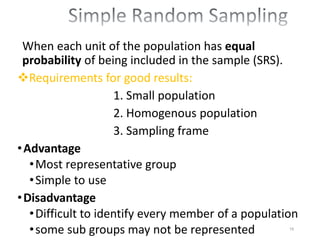
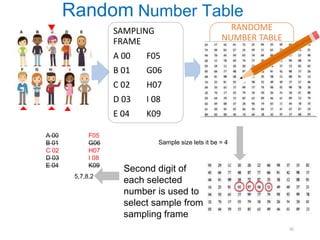
When each unit of the population has equal
probability of being included in the sample (SRS).
Requirements for good results:
1. Small population
2. Homogenous population
3. Sampling frame
•Advantage
•Most representative group
•Simple to use
•Disadvantage
•Difficult to identify every member of a population
•some sub groups may not be represented 19
SAMPLING
FRAME
A 00 F05
B 01 G06
C 02 H07
D 03 I 08
E 04 K09
RANDOME
NUMBER TABLE
Sample size lets it be = 4
Second digit of
each selected
number is used to
select sample from
sampling frame
5,7,8,2
A 00 F05
B 01 G06
C 02 H07
D 03 I 08
E 04 K09
Random Number Table
20
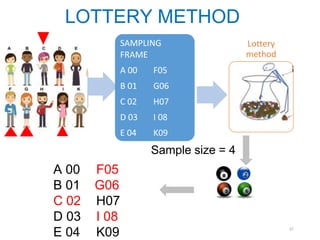
SAMPLING
FRAME
A 00 F05
B 01 G06
C 02 H07
D 03 I 08
E 04 K09
Lottery
method
Sample size = 4
A 00 F05
B 01 G06
C 02 H07
D 03 I 08
E 04 K09
LOTTERY METHOD
21
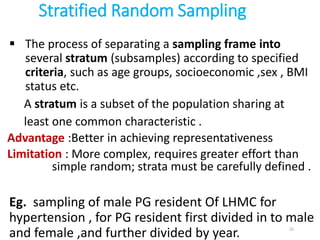
Stratified Random Sampling
 The process of separating a sampling frame into
several stratum (subsamples) according to specified
criteria, such as age groups, socioeconomic ,sex , BMI
status etc.
A stratum is a subset of the population sharing at
least one common characteristic .
Advantage :Better in achieving representativeness
Limitation : More complex, requires greater effort than
simple random; strata must be carefully defined .
Eg. sampling of male PG resident Of LHMC for
hypertension , for PG resident first divided in to male
and female ,and further divided by year. 22
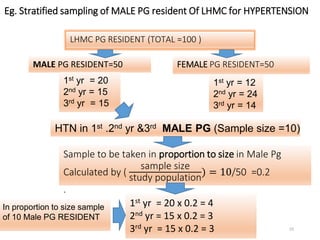
LHMC PG RESIDENT (TOTAL =100 )
MALE PG RESIDENT=50 FEMALE PG RESIDENT=50
1st yr = 20
2nd yr = 15
3rd yr = 15
1st yr = 12
2nd yr = 24
3rd yr = 14
HTN in 1st .2nd yr &3rd MALE PG (Sample size =10)
Sample to be taken in proportion to size in Male Pg
Calculated by (
sample size
study population) = 10/50 =0.2
.
1st yr = 20 x 0.2 = 4
2nd yr = 15 x 0.2 = 3
3rd yr = 15 x 0.2 = 3
In proportion to size sample
of 10 Male PG RESIDENT
Eg. Stratified sampling of MALE PG resident Of LHMC for HYPERTENSION
23
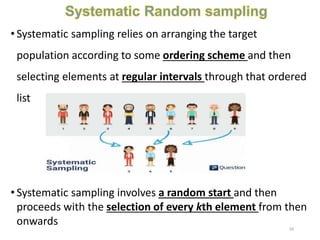
• Systematic sampling relies on arranging the target
population according to some ordering scheme and then
selecting elements at regular intervals through that ordered
list
• Systematic sampling involves a random start and then
proceeds with the selection of every kth element from then
onwards 24
• In this case,
k(skip interval)=(
Population size,N
Sample size, 𝑛
),
In k, only integer part is taken
• Eg.
Let there are N= 350 subjects of liver cirrhosis (target
population), out of which n=40 are proposed to be selected
by systematic method
In this case k=
350
40
= 8.75 (integer part ~ 8)
then select any random no out of first 8 suppose 7
then remaining numbers are
7+8=15,15+8=23,31,39,47
Systematic Random contd…
25
Systematic Random sampling contd…
ADVANTAGES:
• Easy to execute
• Very quick relative to Simple random sampling
• Does not need full frame, total no. of units in the
population is enough
DISADVANTAGES
Lead to a biased sample if periodicity or trend is
hidden in the sample
Some number will never be selected
To overcome this circular method is used**
26
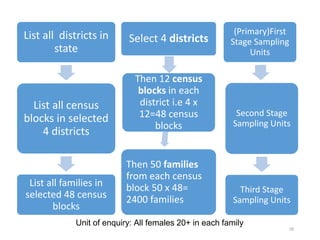
Multistage Random Sampling
When sampling is done in stages, from bigger to
smaller units ,within the unit selected at the
previous stage.
Advantages: a)fast and economical method
b)convenient
Disadvantages: not as accurate as SRS
• Eg: Study the prevalence of smoking in females of
20+ year spread in a state having 200 census blocks
within 10 districts having 10 Lakh families 27
List all districts in
state
List all census
blocks in selected
4 districts
List all families in
selected 48 census
blocks
Select 4 districts
Then 12 census
blocks in each
district i.e 4 x
12=48 census
blocks
Then 50 families
from each census
block 50 x 48=
2400 families
(Primary)First
Stage Sampling
Units
Second Stage
Sampling Units
Third Stage
Sampling Units
Unit of enquiry: All females 20+ in each family
28
Advantages of Multistage Random sampling
over Simple Random Sampling
1.Reduces cost of travel and loss of time by the survey
team.
In MRS, survey team visits 50 families in 48 block ,
In SRS for 2400 families living in 200 census blocks of
10 district in a state. Then by SRS survey team will visit
2400/200=12 families per block. (it will visit each block)
2.Full sampling frame of non selected sampling units
will not be required.
29
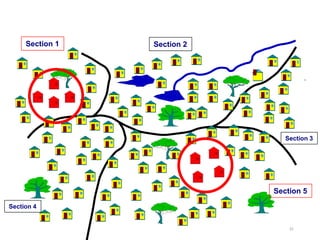
Cluster sampling
The primary sampling unit is not the individual
element, but a large cluster of elements
Appropriate when
 you can’t obtain a list of the members of the
population
 Have little knowledge of population characteristics
 Population is scattered over large geographic area
A two-step-process:
Step 1- Defined population is divided into number of
subgroups or clusters;
Step 2- random selection of sample from randomly
selected clusters 30
Section 5
Section 2Section 1
Section 3
Section 4
31
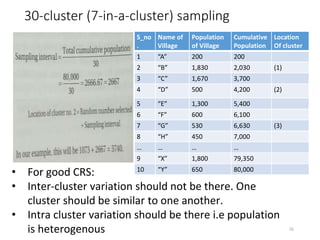
30-cluster (7-in-a-cluster) sampling
S_no
.
Name of
Village
Population
of Village
Cumulative
Population
Location
Of cluster
1 “A” 200 200
2 “B” 1,830 2,030 (1)
3 “C” 1,670 3,700
4 “D” 500 4,200 (2)
5 “E” 1,300 5,400
6 “F” 600 6,100
7 “G” 530 6,630 (3)
8 “H” 450 7,000
… … … …
9 “X” 1,800 79,350
10 “Y” 650 80,000
• For good CRS:
• Inter-cluster variation should not be there. One
cluster should be similar to one another.
• Intra cluster variation should be there i.e population
is heterogenous 32
Non Probablity Sampling
33
Non Probability Sampling
•Non Probability sampling refers to the sampling
process in which the samples are selected for a
specific purpose with a predetermined basis of
selection.
•No assurance that each subject has a chance of
being included as a sample
34
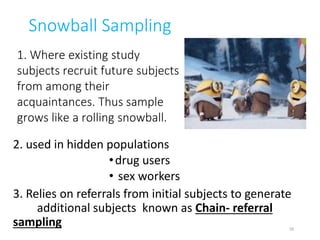
Snowball Sampling
2. used in hidden populations
•drug users
• sex workers
3. Relies on referrals from initial subjects to generate
additional subjects known as Chain- referral
sampling
1. Where existing study
subjects recruit future subjects
from among their
acquaintances. Thus sample
grows like a rolling snowball.
35
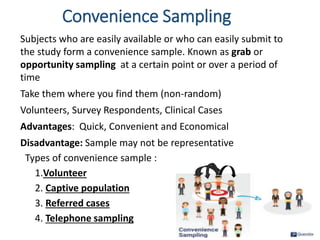
Convenience Sampling
Subjects who are easily available or who can easily submit to
the study form a convenience sample. Known as grab or
opportunity sampling at a certain point or over a period of
time
Take them where you find them (non-random)
Volunteers, Survey Respondents, Clinical Cases
Advantages: Quick, Convenient and Economical
Disadvantage: Sample may not be representative
Types of convenience sample :
1.Volunteer
2. Captive population
3. Referred cases
4. Telephone sampling
36
Quota sampling
Pre-plan number of subjects in specified categories
(e.g. 100 men, 100 women)
 Here, the subjects chosen for those categories are a
convenience sample, selected any way the interviewer
chooses
Advantage : Rapid, less cost, convenient
Disadvantage : Not possible to prove that the sample
is representative of designated population
37
How to choose amongst
Sampling methods
•Non availability of sampling frame
•Too dispersed subjects in the sample
•Less representation of specific groups
that are important
•Obtaining too many random numbers
Cluster or
Multistage
Stratified
Systematic
The method of choice is Simple Random Sampling because
it is most precise. However it is difficult to adopt due to
the following reasons:
38
Advantage of sampling ?
1.Lower cost and less demand of personnel
2.Higher speed with which result can be obtained.
3.Relatively less number of individual to be studied
then in target population
4.More reliable information due to lesser errors in
collecting and analysing
5.in some cases it’s the only feasible method for
collection of relevant data Example:sample of
blood, urine, semen and biopsies in which complete
enumeration is not possible
39
Disadvantages of Sampling
1. In case of NOT True representative
samples
2. Feeling of discrimination
3. Size too Small is Unreliable
4. Chances of Selection Bias
5. Impossibility of Sampling eg. In too
heterogenous population
40
 SAMPLING ERROR /SAMPLING FLUCTUATION
One sample from a population in all probability will be
different from the second sample. Thus, the results
obtained from one sample may not match those from
another sample.
 Systematic (Non-Sampling) Errors – These
errors result from factors such as:
Improper research design that causes response error
Errors committed in the execution of the research
Errors in recording responses
ERROR IN SAMPLING
41
References
1. Abramson JH, Abramson ZH. Research Methods in Community
Medicine: Surveys, Epidemiological Research, Programme
evaluation and clinical trials. 6th edition. Wiley publications. 2008
2. Indrayan A, Malhotra RK. Medical Biostatistics. Fourth Edition.
Chapman & Hall/Crc Biostatistics Series. 2017
3. Indrayan A. Basic Methods of Medical Research. 4th edition. AITBS
Publications. 2017
4. K. Park. Parks textbook of preventive and social medicine ;25th
edition.
5. John M last, Miguel Porta . A dictionary of epidemiology. 6th
edition. Oxford University Press.2014
6. Das R, Das PN. Biomedical research methodology. 1st edition.
Jaypee publications. 2011
7. GOEL, Manish Kumar et al. Concepts of Sample versus Population. Indian
Journal of Youth and Adolescent Health (ISSN: 2349-2880), [S.l.], v. 2, n.
1&2, p. 37-39, aug. 2015. ISSN 2349-2880. Available at:
<https://medical.adrpublications.in/index.php/IndianJ-
YouthandAdolescentHealth/article/view/225>
42
THANK YOU
43

Sampling methods

  • 1.
    SAMPLING METHODS Presenter :Dr Sakshi & Dr Nitesh Kumar Facilitator : Dr Shweta Arora Moderator : Dr Mamta 1
  • 2.
    PLAN OF PRESENTATION •Introduction •Purposeof sampling? •Definitions •Types of sampling:- 1.Random sampling 2.Non-random sampling •Advantages and limitation of sampling •References 2
  • 3.
    Introduction Sampling allows oneto obtain a representative picture about the population, without studying the entire population. POPULATION 3
  • 4.
    SAMPLING The process ofselecting number of individuals for a study in such a way that the individuals represent the larger group from which they were selected and statistical inference based on sample results may be attributed only to the population sampled. John M last, Miguel Porta . A dictionary of epidemiology. 6th edition. Oxford University Press.2014 4
  • 5.
    Prolonged process Its expensive Population ofinterest is usually too large to attempt to study all of its members Partly accessible populations Purpose of sampling? Why not complete target population studied ? 5
  • 6.
    Some Other DefinitionIn sampling Population Group of persons having one or more common characteristics Universe population •Universe is the population about which investigator wishes to draw a conclusion. •Universe could be larger than target population •Future cases are a part of universe but not of target population 6
  • 7.
    Other Definition Insampling John M last, Miguel Porta . A dictionary of epidemiology. 6th edition. Oxford University Press.2014 TARGET/SOURCE/REFERENCE POPULATION • The term is used to indicate the total population or group from which study population is withdrawn • And to denote a Reference population about which inferences are desired • Dependent on research problem and study design eg. 1. All healthy male in country (for HIV Prevelance), 2. all patient with acute MI in delhi 7
  • 8.
    ACTUAL POPULATION (Studypopulation) This term is used to indicate the population or group from which a sample is drawn Eg. 1. All healthy male in 5 districts of country, 2. all patient with MI in 9 districts of Delhi Other Definition In sampling 8
  • 9.
    Some Special TermsUsed In sampling Sampling unit is the smallest of division from among the population entering the study Unit of inquiry is the subject on which the information is obtained Example: community survey on PEM sampling unit could be family and unit of inquiry is children less than 5 years of age 9
  • 10.
    Some Special TermUsed In sampling  Sampling frame Complete non-overlapping list of all the sampling units of study population from which the sample is to be drawn.  Sample frame error occurs when certain elements of the population are accidentally omitted or not included in the list  Sampling Units must be mutually exclusive 10
  • 11.
    Sampling Process 11 Define theTarget Population Select a Sampling Frame Determine if a probability or non-probability sampling method will be chosen Plan procedure for selecting sampling units Determine sample size Select actual sampling units Conduct fieldwork1 2 3 4 5 6 7
  • 12.
    Sampling fraction : Itis the relation of the size of sample to the size of target population o Expressed in term of proportion or percentage 𝑁𝑜. 𝑜𝑓 𝑈𝑛𝑖𝑡𝑠 𝑖𝑛 𝑡ℎ𝑒 𝑠𝑎𝑚𝑝𝑙𝑒 𝑁𝑜. 𝑜𝑓 𝑢𝑛𝑖𝑡𝑠 𝑖𝑛 𝑆𝑎𝑚𝑝𝑙𝑖𝑛𝑔 𝑓𝑟𝑎𝑚𝑒 12
  • 13.
  • 14.
    Adequately Large Sample Itprovides result near to the truth that exist in total population. Eg. Prevalence of Seropositivity of HIV among young males in india Sample size HIV +ve SEROPOSITIVE RATE 10 0 0% 100 3 3% 1000 15 1.5% 10000 80 0.8% Interpretation FOR POPULATION No HIV patient Close to reality More close to true rate 1% 14
  • 15.
    Representative • Sample shouldrepresent all spectrum of subjects in target population. • Lack of Representativeness results in lack of generalization . • In above example of Seropositivity of HIV among young male in india if sample include 9500 subjects from STD clinics We may get result of seropositivity as high as 5% (which is far from reality assumed to be 0.2% adult HIV (15-49 yr) Source: UNAIDS Data 2018 15
  • 16.
    1. Snowball 2. Convenient cases(Volunteers, Referredcases) 3. Quota 1. Simple Random Sampling 2. Stratified Random Sampling 3. Systematic Random Sampling 4. Cluster Random Sampling 5. Multistage Random Sampling Methods of sampling Probability Sampling (Random) Non Probability (Non random) 16
  • 17.
    Non-Probability Sampling (Non Random) Usefulin pilot studies Generalisation of results CANNOT be done Confidence Intervals and tests of significance CANNOT be inferred Probability sampling (Random) Used for further studies by taking clues from results of pilot study Generalization of results CAN be done Confidence intervals and tests of significance CAN be inferred 17
  • 18.
    In probability sampling,Inclusion or Exclusion of a particular eligible subjects depends on chance and cannot be predicted in advance. This chance is not necessarily equal for all subjects for inclusion in the sample. 18
  • 19.
    When each unitof the population has equal probability of being included in the sample (SRS). Requirements for good results: 1. Small population 2. Homogenous population 3. Sampling frame •Advantage •Most representative group •Simple to use •Disadvantage •Difficult to identify every member of a population •some sub groups may not be represented 19
  • 20.
    SAMPLING FRAME A 00 F05 B01 G06 C 02 H07 D 03 I 08 E 04 K09 RANDOME NUMBER TABLE Sample size lets it be = 4 Second digit of each selected number is used to select sample from sampling frame 5,7,8,2 A 00 F05 B 01 G06 C 02 H07 D 03 I 08 E 04 K09 Random Number Table 20
  • 21.
    SAMPLING FRAME A 00 F05 B01 G06 C 02 H07 D 03 I 08 E 04 K09 Lottery method Sample size = 4 A 00 F05 B 01 G06 C 02 H07 D 03 I 08 E 04 K09 LOTTERY METHOD 21
  • 22.
    Stratified Random Sampling The process of separating a sampling frame into several stratum (subsamples) according to specified criteria, such as age groups, socioeconomic ,sex , BMI status etc. A stratum is a subset of the population sharing at least one common characteristic . Advantage :Better in achieving representativeness Limitation : More complex, requires greater effort than simple random; strata must be carefully defined . Eg. sampling of male PG resident Of LHMC for hypertension , for PG resident first divided in to male and female ,and further divided by year. 22
  • 23.
    LHMC PG RESIDENT(TOTAL =100 ) MALE PG RESIDENT=50 FEMALE PG RESIDENT=50 1st yr = 20 2nd yr = 15 3rd yr = 15 1st yr = 12 2nd yr = 24 3rd yr = 14 HTN in 1st .2nd yr &3rd MALE PG (Sample size =10) Sample to be taken in proportion to size in Male Pg Calculated by ( sample size study population) = 10/50 =0.2 . 1st yr = 20 x 0.2 = 4 2nd yr = 15 x 0.2 = 3 3rd yr = 15 x 0.2 = 3 In proportion to size sample of 10 Male PG RESIDENT Eg. Stratified sampling of MALE PG resident Of LHMC for HYPERTENSION 23
  • 24.
    • Systematic samplingrelies on arranging the target population according to some ordering scheme and then selecting elements at regular intervals through that ordered list • Systematic sampling involves a random start and then proceeds with the selection of every kth element from then onwards 24
  • 25.
    • In thiscase, k(skip interval)=( Population size,N Sample size, 𝑛 ), In k, only integer part is taken • Eg. Let there are N= 350 subjects of liver cirrhosis (target population), out of which n=40 are proposed to be selected by systematic method In this case k= 350 40 = 8.75 (integer part ~ 8) then select any random no out of first 8 suppose 7 then remaining numbers are 7+8=15,15+8=23,31,39,47 Systematic Random contd… 25
  • 26.
    Systematic Random samplingcontd… ADVANTAGES: • Easy to execute • Very quick relative to Simple random sampling • Does not need full frame, total no. of units in the population is enough DISADVANTAGES Lead to a biased sample if periodicity or trend is hidden in the sample Some number will never be selected To overcome this circular method is used** 26
  • 27.
    Multistage Random Sampling Whensampling is done in stages, from bigger to smaller units ,within the unit selected at the previous stage. Advantages: a)fast and economical method b)convenient Disadvantages: not as accurate as SRS • Eg: Study the prevalence of smoking in females of 20+ year spread in a state having 200 census blocks within 10 districts having 10 Lakh families 27
  • 28.
    List all districtsin state List all census blocks in selected 4 districts List all families in selected 48 census blocks Select 4 districts Then 12 census blocks in each district i.e 4 x 12=48 census blocks Then 50 families from each census block 50 x 48= 2400 families (Primary)First Stage Sampling Units Second Stage Sampling Units Third Stage Sampling Units Unit of enquiry: All females 20+ in each family 28
  • 29.
    Advantages of MultistageRandom sampling over Simple Random Sampling 1.Reduces cost of travel and loss of time by the survey team. In MRS, survey team visits 50 families in 48 block , In SRS for 2400 families living in 200 census blocks of 10 district in a state. Then by SRS survey team will visit 2400/200=12 families per block. (it will visit each block) 2.Full sampling frame of non selected sampling units will not be required. 29
  • 30.
    Cluster sampling The primarysampling unit is not the individual element, but a large cluster of elements Appropriate when  you can’t obtain a list of the members of the population  Have little knowledge of population characteristics  Population is scattered over large geographic area A two-step-process: Step 1- Defined population is divided into number of subgroups or clusters; Step 2- random selection of sample from randomly selected clusters 30
  • 31.
    Section 5 Section 2Section1 Section 3 Section 4 31
  • 32.
    30-cluster (7-in-a-cluster) sampling S_no . Nameof Village Population of Village Cumulative Population Location Of cluster 1 “A” 200 200 2 “B” 1,830 2,030 (1) 3 “C” 1,670 3,700 4 “D” 500 4,200 (2) 5 “E” 1,300 5,400 6 “F” 600 6,100 7 “G” 530 6,630 (3) 8 “H” 450 7,000 … … … … 9 “X” 1,800 79,350 10 “Y” 650 80,000 • For good CRS: • Inter-cluster variation should not be there. One cluster should be similar to one another. • Intra cluster variation should be there i.e population is heterogenous 32
  • 33.
  • 34.
    Non Probability Sampling •NonProbability sampling refers to the sampling process in which the samples are selected for a specific purpose with a predetermined basis of selection. •No assurance that each subject has a chance of being included as a sample 34
  • 35.
    Snowball Sampling 2. usedin hidden populations •drug users • sex workers 3. Relies on referrals from initial subjects to generate additional subjects known as Chain- referral sampling 1. Where existing study subjects recruit future subjects from among their acquaintances. Thus sample grows like a rolling snowball. 35
  • 36.
    Convenience Sampling Subjects whoare easily available or who can easily submit to the study form a convenience sample. Known as grab or opportunity sampling at a certain point or over a period of time Take them where you find them (non-random) Volunteers, Survey Respondents, Clinical Cases Advantages: Quick, Convenient and Economical Disadvantage: Sample may not be representative Types of convenience sample : 1.Volunteer 2. Captive population 3. Referred cases 4. Telephone sampling 36
  • 37.
    Quota sampling Pre-plan numberof subjects in specified categories (e.g. 100 men, 100 women)  Here, the subjects chosen for those categories are a convenience sample, selected any way the interviewer chooses Advantage : Rapid, less cost, convenient Disadvantage : Not possible to prove that the sample is representative of designated population 37
  • 38.
    How to chooseamongst Sampling methods •Non availability of sampling frame •Too dispersed subjects in the sample •Less representation of specific groups that are important •Obtaining too many random numbers Cluster or Multistage Stratified Systematic The method of choice is Simple Random Sampling because it is most precise. However it is difficult to adopt due to the following reasons: 38
  • 39.
    Advantage of sampling? 1.Lower cost and less demand of personnel 2.Higher speed with which result can be obtained. 3.Relatively less number of individual to be studied then in target population 4.More reliable information due to lesser errors in collecting and analysing 5.in some cases it’s the only feasible method for collection of relevant data Example:sample of blood, urine, semen and biopsies in which complete enumeration is not possible 39
  • 40.
    Disadvantages of Sampling 1.In case of NOT True representative samples 2. Feeling of discrimination 3. Size too Small is Unreliable 4. Chances of Selection Bias 5. Impossibility of Sampling eg. In too heterogenous population 40
  • 41.
     SAMPLING ERROR/SAMPLING FLUCTUATION One sample from a population in all probability will be different from the second sample. Thus, the results obtained from one sample may not match those from another sample.  Systematic (Non-Sampling) Errors – These errors result from factors such as: Improper research design that causes response error Errors committed in the execution of the research Errors in recording responses ERROR IN SAMPLING 41
  • 42.
    References 1. Abramson JH,Abramson ZH. Research Methods in Community Medicine: Surveys, Epidemiological Research, Programme evaluation and clinical trials. 6th edition. Wiley publications. 2008 2. Indrayan A, Malhotra RK. Medical Biostatistics. Fourth Edition. Chapman & Hall/Crc Biostatistics Series. 2017 3. Indrayan A. Basic Methods of Medical Research. 4th edition. AITBS Publications. 2017 4. K. Park. Parks textbook of preventive and social medicine ;25th edition. 5. John M last, Miguel Porta . A dictionary of epidemiology. 6th edition. Oxford University Press.2014 6. Das R, Das PN. Biomedical research methodology. 1st edition. Jaypee publications. 2011 7. GOEL, Manish Kumar et al. Concepts of Sample versus Population. Indian Journal of Youth and Adolescent Health (ISSN: 2349-2880), [S.l.], v. 2, n. 1&2, p. 37-39, aug. 2015. ISSN 2349-2880. Available at: <https://medical.adrpublications.in/index.php/IndianJ- YouthandAdolescentHealth/article/view/225> 42
  • 43.