Presentation of Data
(Graphical Method)


Module 6b
Basic Statistics
SRSTHS
Ms. Pegollo
Presentation of Data
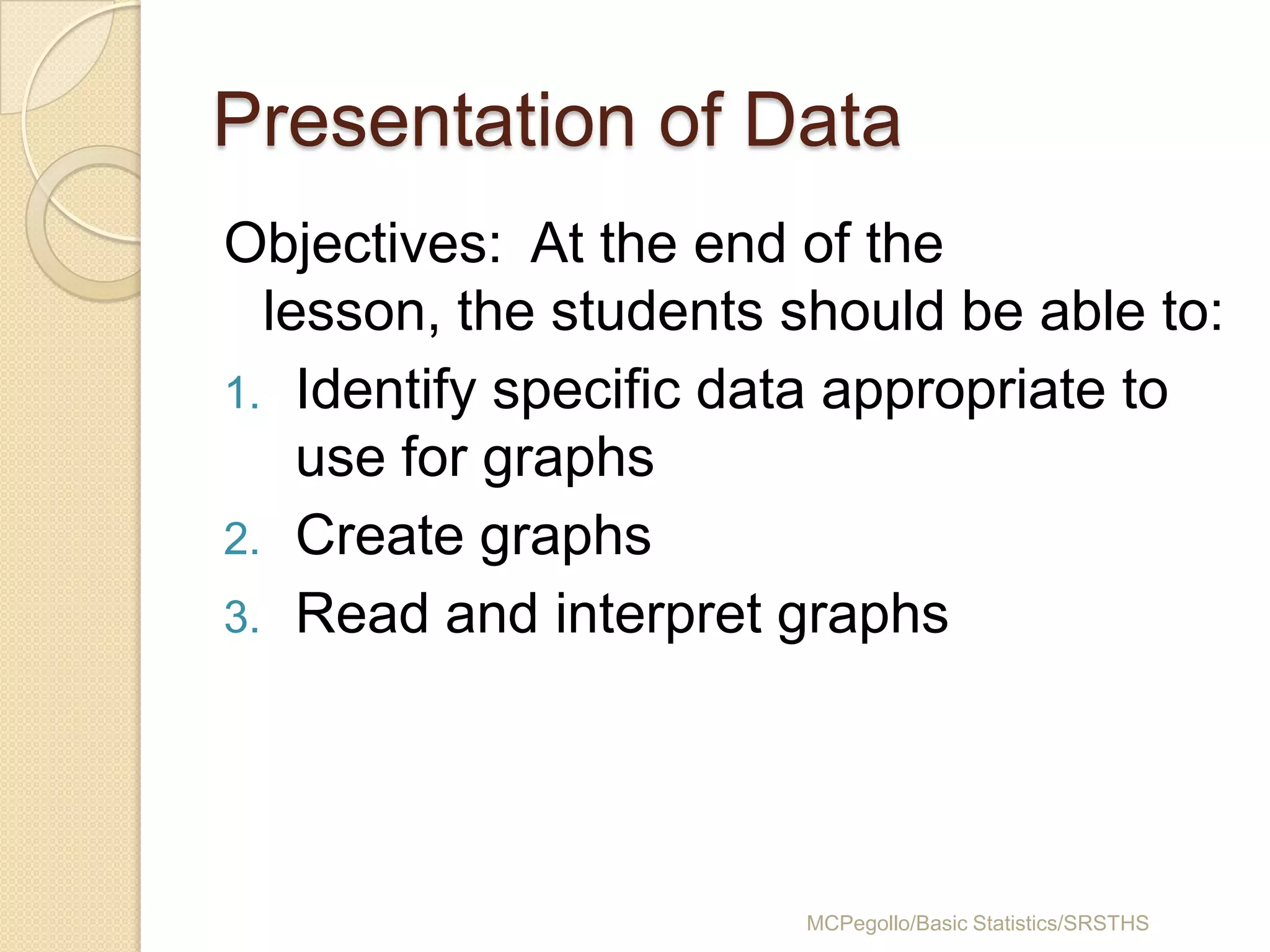
Objectives: At the end of the
  lesson, the students should be able to:
1. Identify specific data appropriate to
    use for graphs
2. Create graphs
3. Read and interpret graphs


                       MCPegollo/Basic Statistics/SRSTHS
Presentation of Data
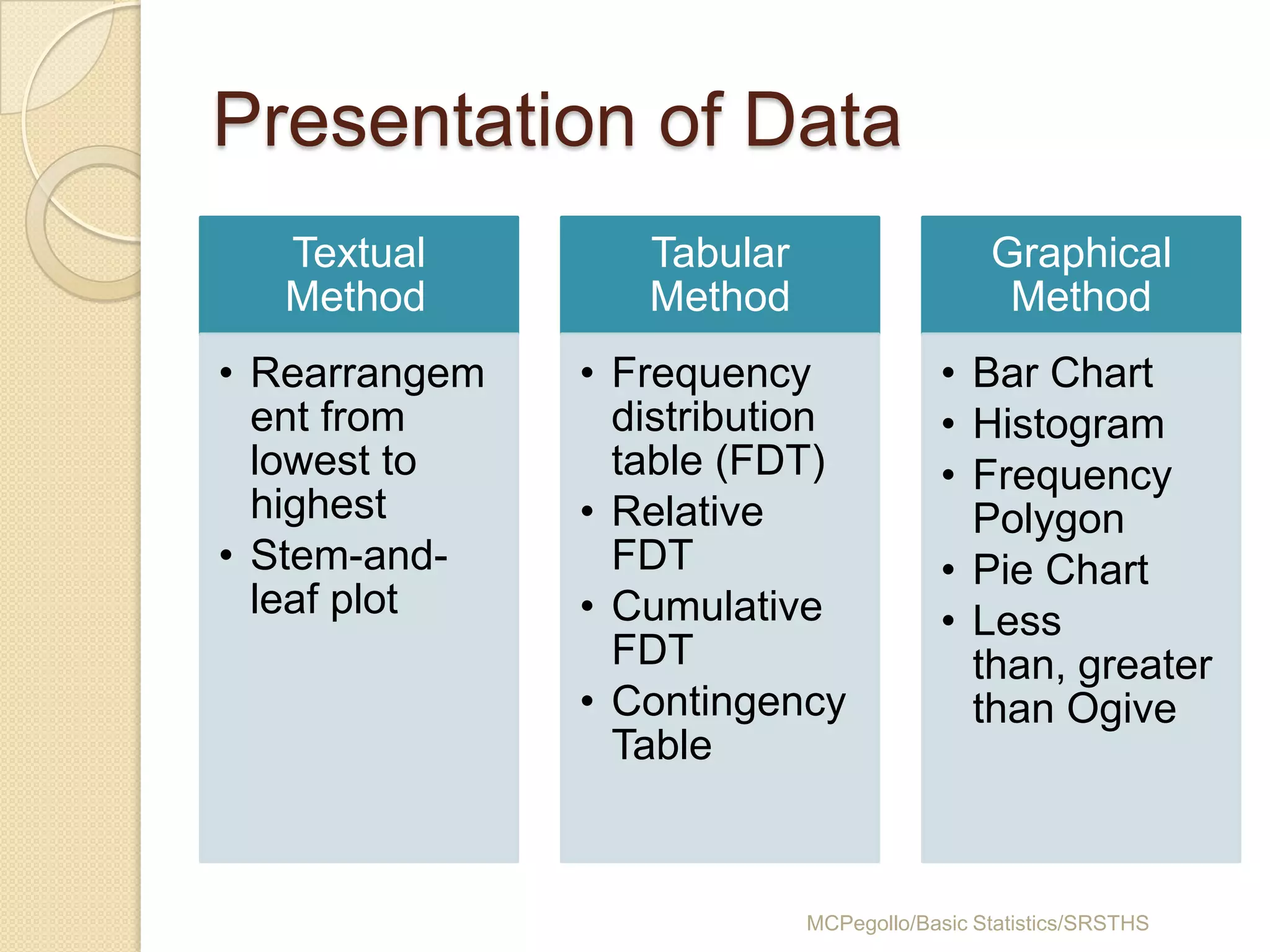
  Textual         Tabular                    Graphical
  Method          Method                      Method
• Rearrangem   • Frequency              • Bar Chart
  ent from       distribution           • Histogram
  lowest to      table (FDT)            • Frequency
  highest      • Relative                 Polygon
• Stem-and-      FDT                    • Pie Chart
  leaf plot    • Cumulative             • Less
                 FDT                      than, greater
               • Contingency              than Ogive
                 Table


                            MCPegollo/Basic Statistics/SRSTHS
Graphical Method
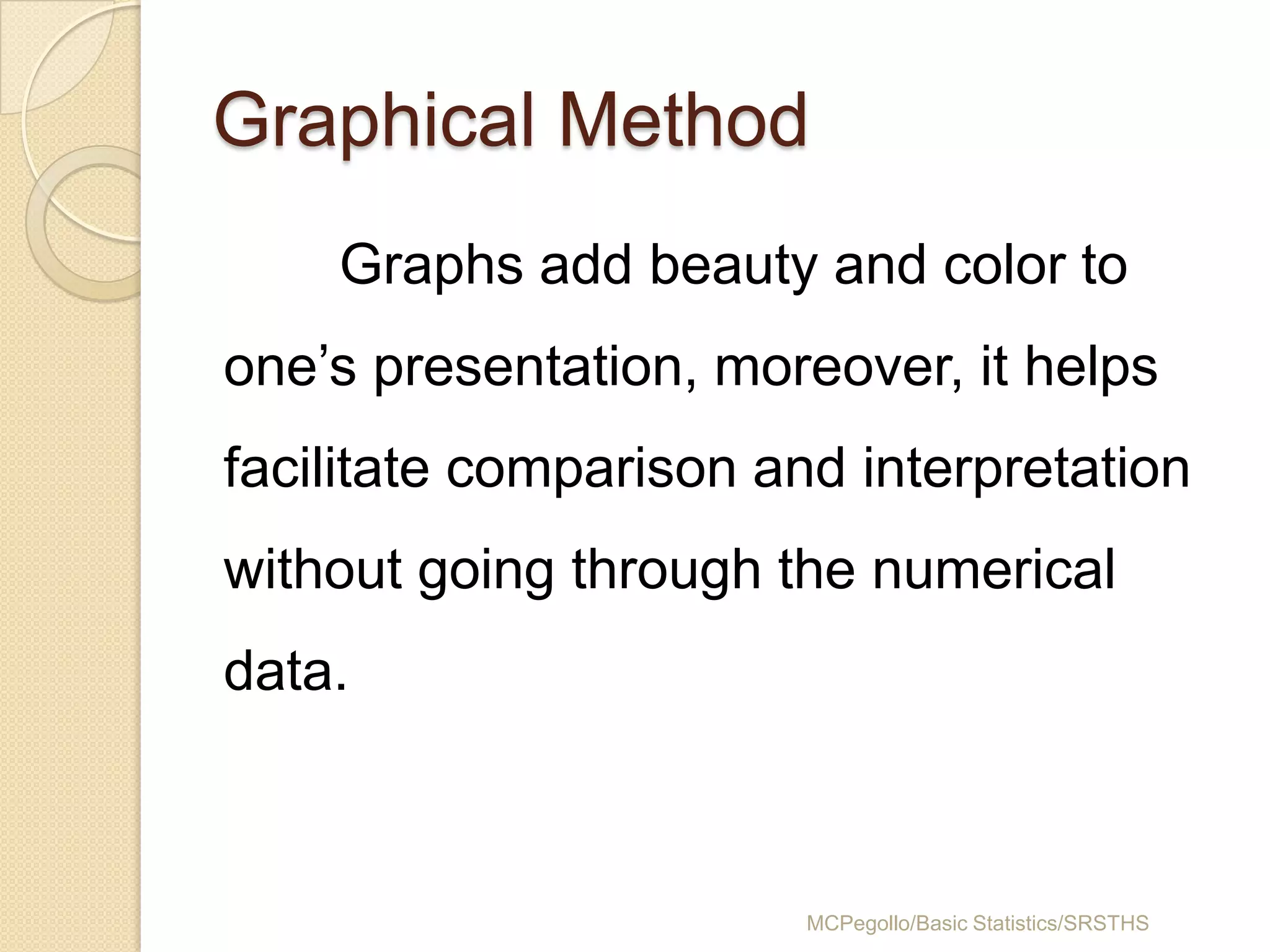
    Graphs add beauty and color to
one’s presentation, moreover, it helps
facilitate comparison and interpretation
without going through the numerical
data.


                        MCPegollo/Basic Statistics/SRSTHS
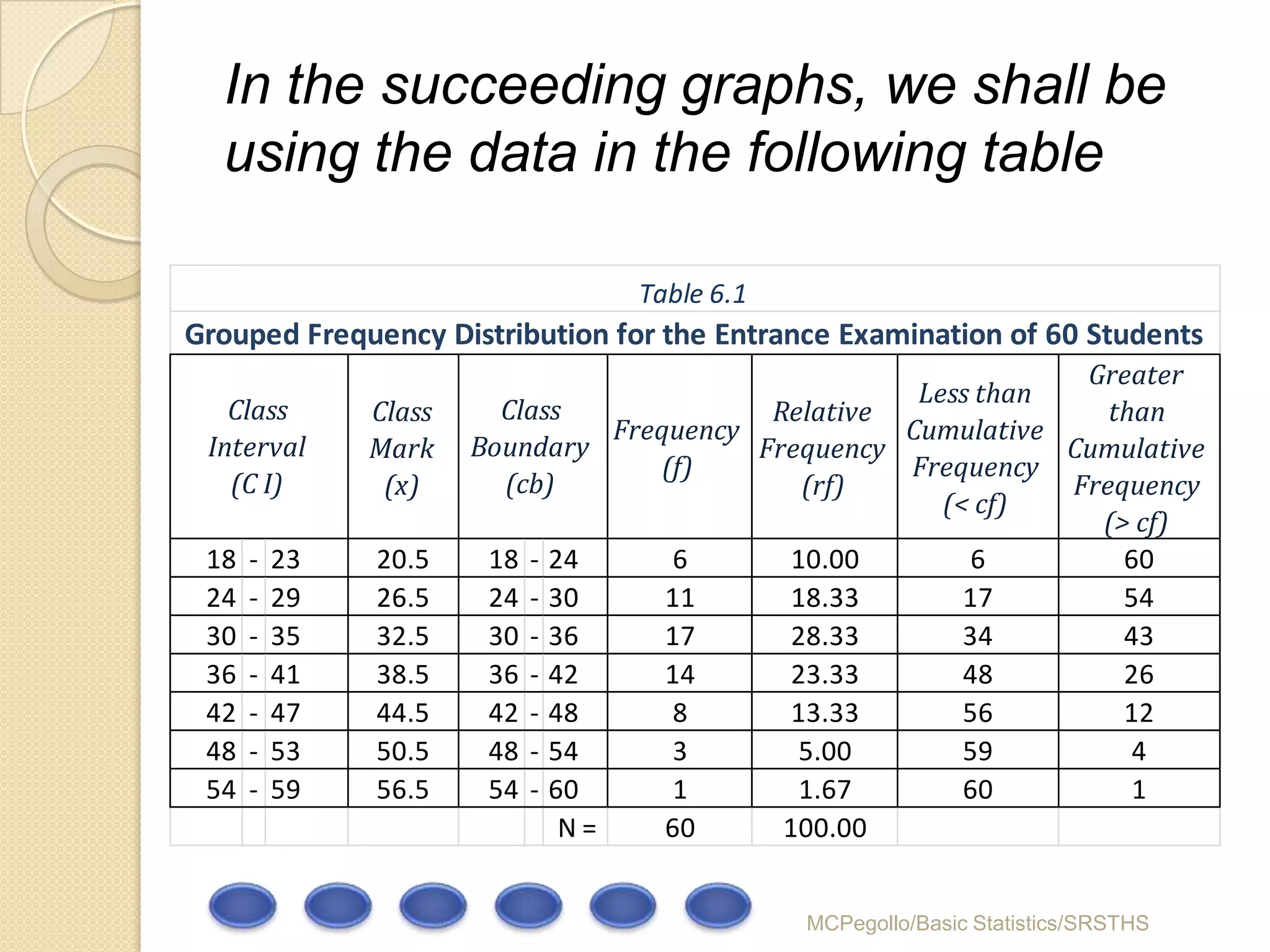
In the succeeding graphs, we shall be
  using the data in the following table

                                  Table 6.1
Grouped Frequency Distribution for the Entrance Examination of 60 Students
                                                                 Greater
                                                      Less than
   Class       Class     Class              Relative               than
                                 Frequency           Cumulative
 Interval      Mark    Boundary            Frequency            Cumulative
                                     (f)             Frequency
   (C I)        (x)      (cb)                  (rf)             Frequency
                                                        (< cf)
                                                                  (> cf)
 18   -   23   20.5     18 - 24       6       10.00       6         60
 24   -   29   26.5     24 - 30      11       18.33       17        54
 30   -   35   32.5     30 - 36      17       28.33       34        43
 36   -   41   38.5     36 - 42      14       23.33       48        26
 42   -   47   44.5     42 - 48       8       13.33       56        12
 48   -   53   50.5     48 - 54       3        5.00       59         4
 54   -   59   56.5     54 - 60       1        1.67       60         1
                              N=     60      100.00


                                              MCPegollo/Basic Statistics/SRSTHS
Bar Chart
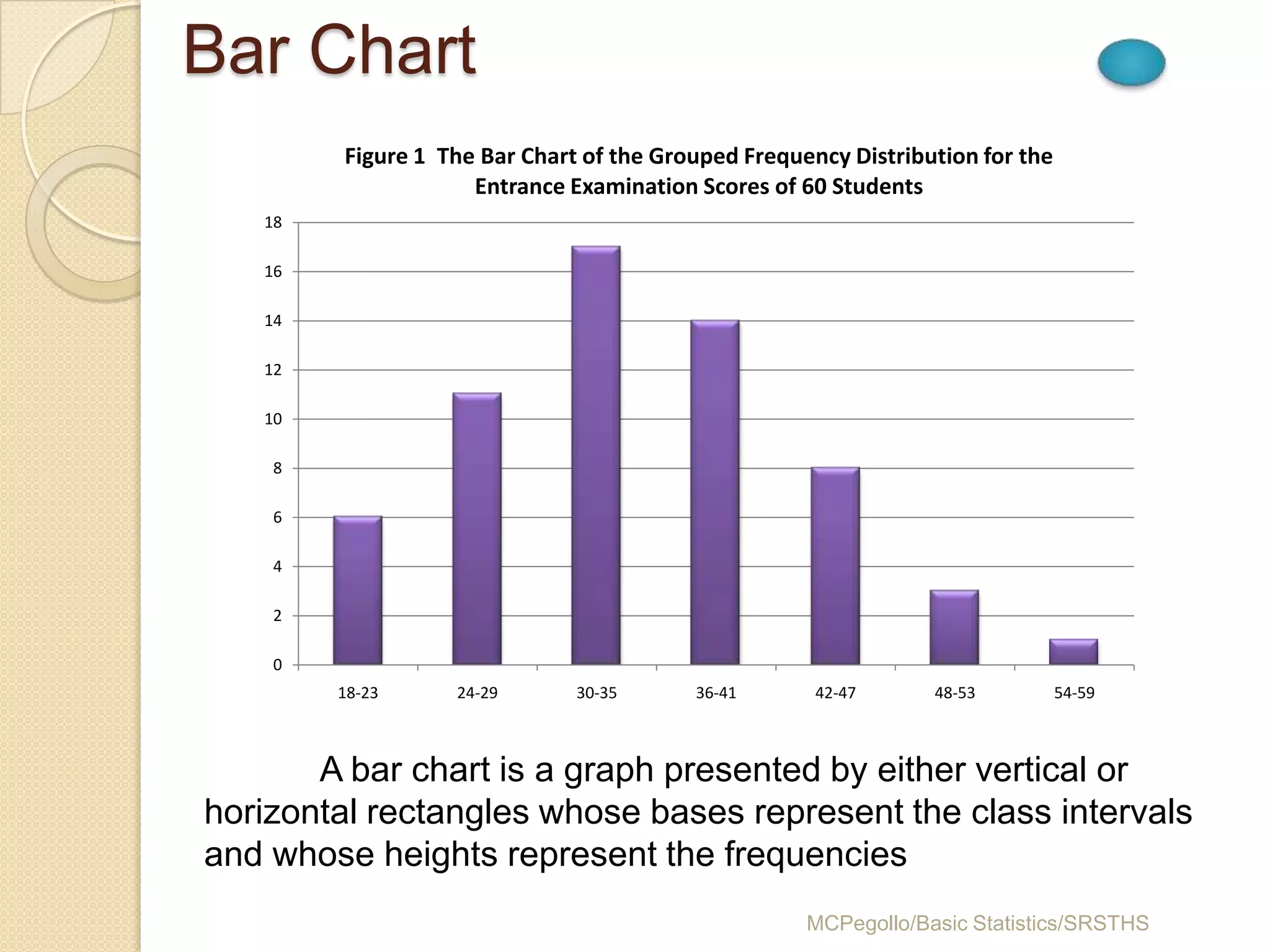
        Figure 1 The Bar Chart of the Grouped Frequency Distribution for the
                    Entrance Examination Scores of 60 Students
   18

   16

   14

   12

   10

    8

    6

    4

    2

    0
        18-23     24-29       30-35      36-41       42-47      48-53          54-59


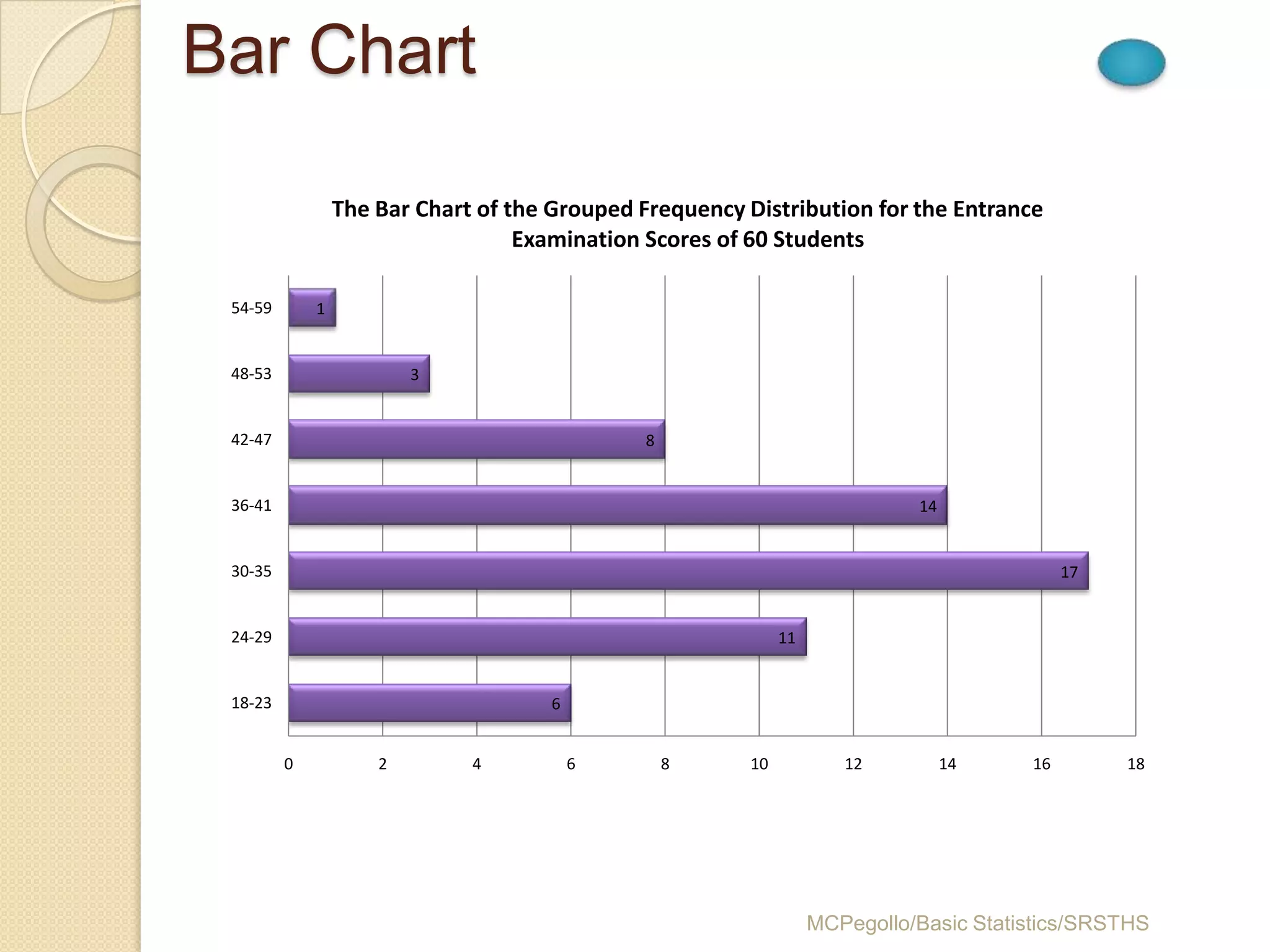
       A bar chart is a graph presented by either vertical or
horizontal rectangles whose bases represent the class intervals
and whose heights represent the frequencies
                                                    MCPegollo/Basic Statistics/SRSTHS
Bar Chart

                 The Bar Chart of the Grouped Frequency Distribution for the Entrance
                                   Examination Scores of 60 Students

 54-59       1


 48-53                   3


 42-47                                         8


 36-41                                                                       14


 30-35                                                                                       17


 24-29                                                        11


 18-23                                6


         0           2        4           6        8     10           12          14    16        18


                                                                   MCPegollo/Basic Statistics/SRSTHS
Histogram
                18

                16

                14

                12
    Frequency


                10

                 8

                 6

                 4

                 2

                 0
                      20.5     26.5      32.5      38.5          44.5        50.5       56.5
                                                Class Mark

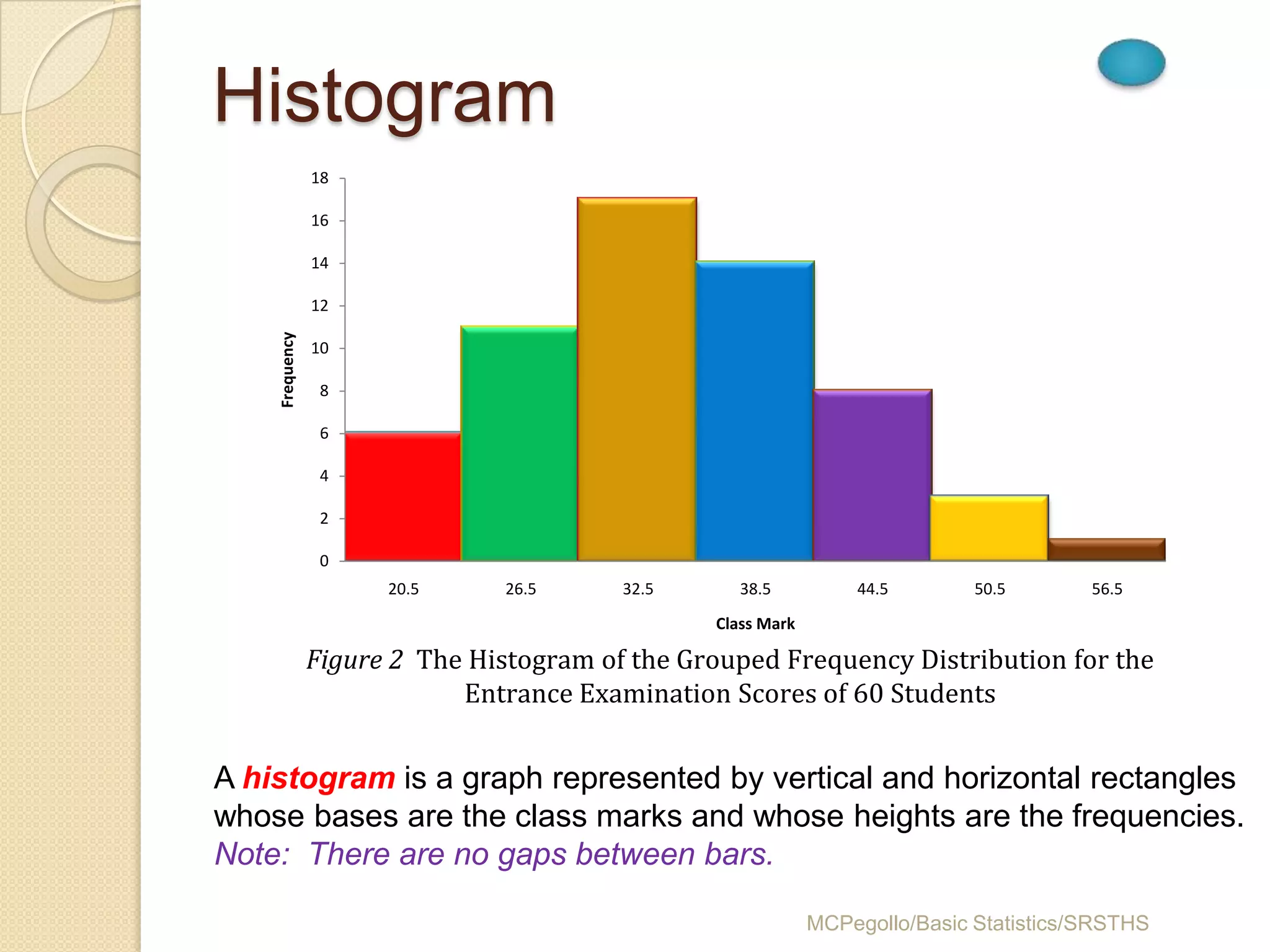
                Figure 2 The Histogram of the Grouped Frequency Distribution for the
                            Entrance Examination Scores of 60 Students


A histogram is a graph represented by vertical and horizontal rectangles
whose bases are the class marks and whose heights are the frequencies.
Note: There are no gaps between bars.

                                                             MCPegollo/Basic Statistics/SRSTHS
Frequency Polygon
    18

    16

    14

    12

    10

    8

    6

    4

    2

    0
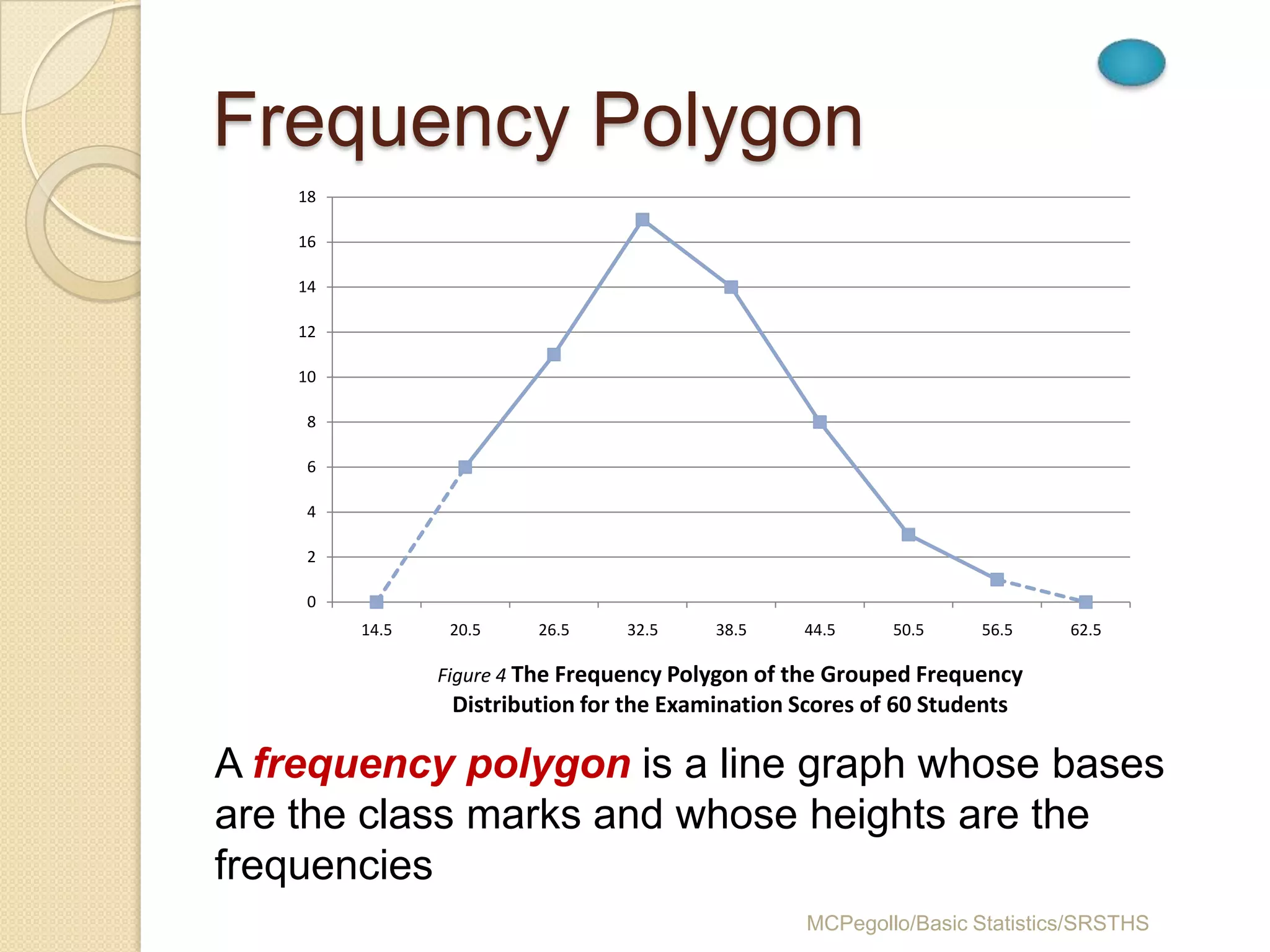
         14.5    20.5    26.5    32.5     38.5     44.5    50.5     56.5    62.5

                Figure 4 The Frequency Polygon of the Grouped Frequency
                 Distribution for the Examination Scores of 60 Students

A frequency polygon is a line graph whose bases
are the class marks and whose heights are the
frequencies
                                                   MCPegollo/Basic Statistics/SRSTHS
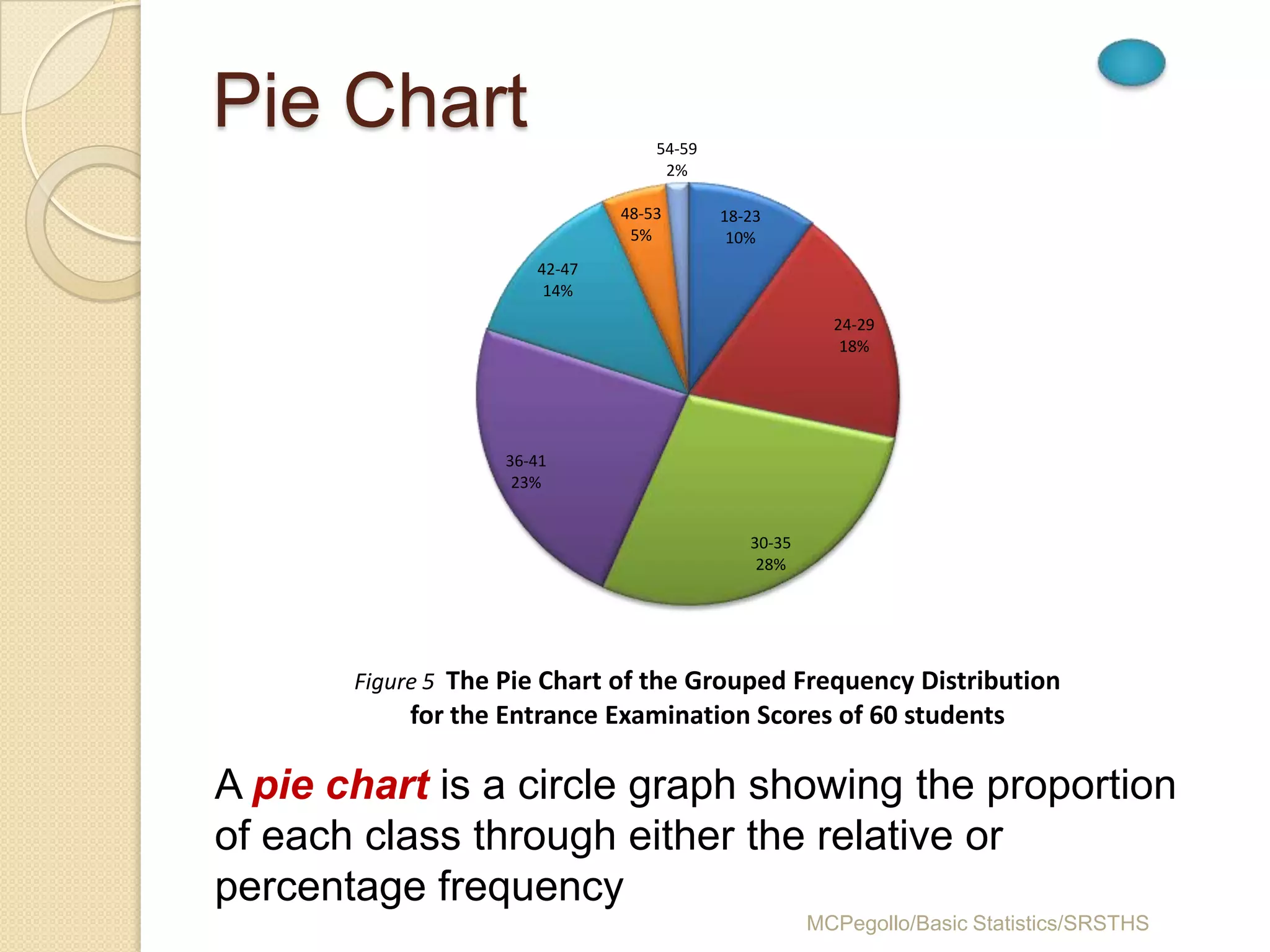
Pie Chart                         54-59
                                   2%

                              48-53       18-23
                               5%          10%
                      42-47
                       14%
                                                       24-29
                                                        18%


                   36-41
                    23%


                                             30-35
                                              28%


       Figure 5 The Pie Chart of the Grouped Frequency Distribution
           for the Entrance Examination Scores of 60 students

A pie chart is a circle graph showing the proportion
of each class through either the relative or
percentage frequency
                                                     MCPegollo/Basic Statistics/SRSTHS
Ogive
        70


        60


        50


        40


        30


        20


        10


        0
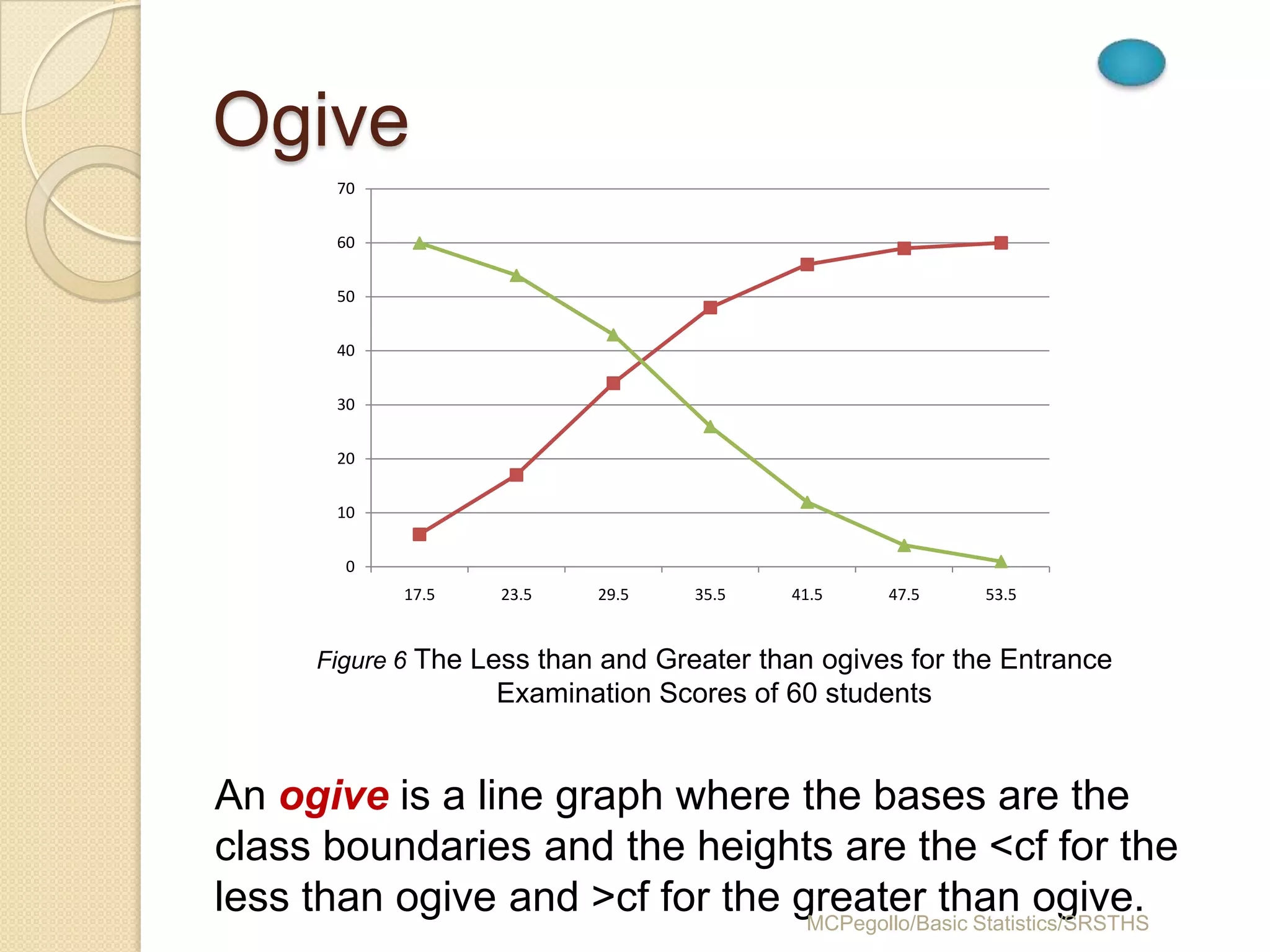
             17.5   23.5    29.5   35.5    41.5    47.5   53.5


      Figure 6 The Less than and Greater than ogives for the Entrance
                    Examination Scores of 60 students


An ogive is a line graph where the bases are the
class boundaries and the heights are the <cf for the
less than ogive and >cf for the greater than ogive.
                                 MCPegollo/Basic Statistics/SRSTHS
Quiz
Which parts of the FDT are used in
constructing the following:
1. Bar Chart
2. Histogram
3. Frequency Polygon
4. Pie Chart
5. Ogive


                      MCPegollo/Basic Statistics/SRSTHS
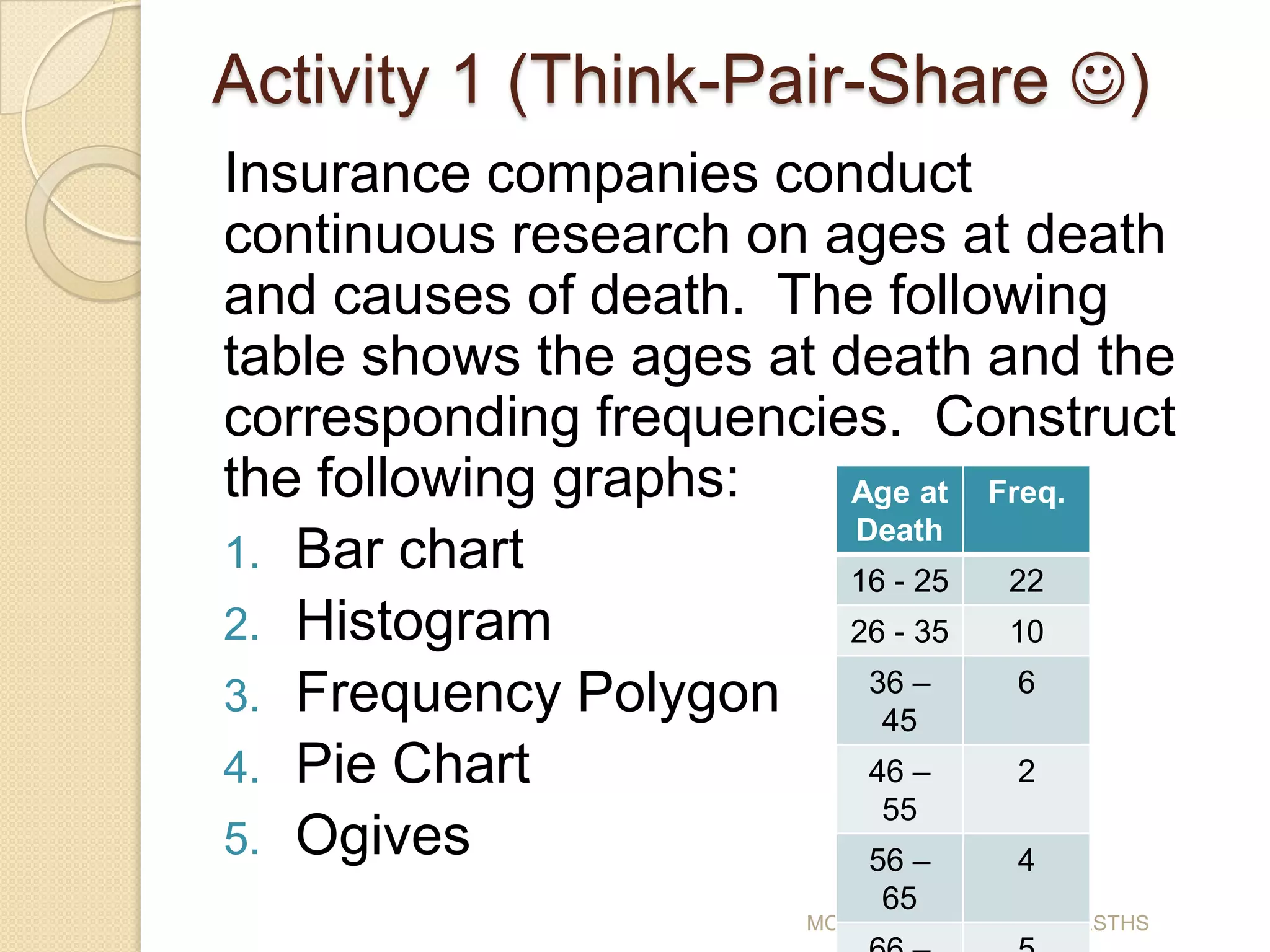
Activity 1 (Think-Pair-Share )
Insurance companies conduct
continuous research on ages at death
and causes of death. The following
table shows the ages at death and the
corresponding frequencies. Construct
the following graphs:    Age at Freq.
                         Death
1. Bar chart
                         16 - 25 22
2. Histogram             26 - 35 10
                          36 –    6
3. Frequency Polygon       45
4. Pie Chart              46 –    2
                           55
5. Ogives                 56 –    4
                             65
                      MCPegollo/Basic Statistics/SRSTHS
Due on Feb. 3
Activity 2 (Pair Project)  Use short bond papers
                           Mention sampling technique
                           and data gathering method
                           used.
    Gather data(interval or ratio level only)
    from 50 members in your batch. Using
    Microsoft Excel, construct a/an
    1. Complete FDT
    2. Bar chart
    3. Histogram
    4. Frequency Polygon
    5. Pie Chart
    6. Ogive
                            MCPegollo/Basic Statistics/SRSTHS

Presentationofdatamod6b

  • 1.
    Presentation of Data (GraphicalMethod) Module 6b Basic Statistics SRSTHS Ms. Pegollo
  • 2.
    Presentation of Data Objectives:At the end of the lesson, the students should be able to: 1. Identify specific data appropriate to use for graphs 2. Create graphs 3. Read and interpret graphs MCPegollo/Basic Statistics/SRSTHS
  • 3.
    Presentation of Data Textual Tabular Graphical Method Method Method • Rearrangem • Frequency • Bar Chart ent from distribution • Histogram lowest to table (FDT) • Frequency highest • Relative Polygon • Stem-and- FDT • Pie Chart leaf plot • Cumulative • Less FDT than, greater • Contingency than Ogive Table MCPegollo/Basic Statistics/SRSTHS
  • 4.
    Graphical Method Graphs add beauty and color to one’s presentation, moreover, it helps facilitate comparison and interpretation without going through the numerical data. MCPegollo/Basic Statistics/SRSTHS
  • 5.
    In the succeedinggraphs, we shall be using the data in the following table Table 6.1 Grouped Frequency Distribution for the Entrance Examination of 60 Students Greater Less than Class Class Class Relative than Frequency Cumulative Interval Mark Boundary Frequency Cumulative (f) Frequency (C I) (x) (cb) (rf) Frequency (< cf) (> cf) 18 - 23 20.5 18 - 24 6 10.00 6 60 24 - 29 26.5 24 - 30 11 18.33 17 54 30 - 35 32.5 30 - 36 17 28.33 34 43 36 - 41 38.5 36 - 42 14 23.33 48 26 42 - 47 44.5 42 - 48 8 13.33 56 12 48 - 53 50.5 48 - 54 3 5.00 59 4 54 - 59 56.5 54 - 60 1 1.67 60 1 N= 60 100.00 MCPegollo/Basic Statistics/SRSTHS
  • 6.
    Bar Chart Figure 1 The Bar Chart of the Grouped Frequency Distribution for the Entrance Examination Scores of 60 Students 18 16 14 12 10 8 6 4 2 0 18-23 24-29 30-35 36-41 42-47 48-53 54-59 A bar chart is a graph presented by either vertical or horizontal rectangles whose bases represent the class intervals and whose heights represent the frequencies MCPegollo/Basic Statistics/SRSTHS
  • 7.
    Bar Chart The Bar Chart of the Grouped Frequency Distribution for the Entrance Examination Scores of 60 Students 54-59 1 48-53 3 42-47 8 36-41 14 30-35 17 24-29 11 18-23 6 0 2 4 6 8 10 12 14 16 18 MCPegollo/Basic Statistics/SRSTHS
  • 8.
    Histogram 18 16 14 12 Frequency 10 8 6 4 2 0 20.5 26.5 32.5 38.5 44.5 50.5 56.5 Class Mark Figure 2 The Histogram of the Grouped Frequency Distribution for the Entrance Examination Scores of 60 Students A histogram is a graph represented by vertical and horizontal rectangles whose bases are the class marks and whose heights are the frequencies. Note: There are no gaps between bars. MCPegollo/Basic Statistics/SRSTHS
  • 9.
    Frequency Polygon 18 16 14 12 10 8 6 4 2 0 14.5 20.5 26.5 32.5 38.5 44.5 50.5 56.5 62.5 Figure 4 The Frequency Polygon of the Grouped Frequency Distribution for the Examination Scores of 60 Students A frequency polygon is a line graph whose bases are the class marks and whose heights are the frequencies MCPegollo/Basic Statistics/SRSTHS
  • 10.
    Pie Chart 54-59 2% 48-53 18-23 5% 10% 42-47 14% 24-29 18% 36-41 23% 30-35 28% Figure 5 The Pie Chart of the Grouped Frequency Distribution for the Entrance Examination Scores of 60 students A pie chart is a circle graph showing the proportion of each class through either the relative or percentage frequency MCPegollo/Basic Statistics/SRSTHS
  • 11.
    Ogive 70 60 50 40 30 20 10 0 17.5 23.5 29.5 35.5 41.5 47.5 53.5 Figure 6 The Less than and Greater than ogives for the Entrance Examination Scores of 60 students An ogive is a line graph where the bases are the class boundaries and the heights are the <cf for the less than ogive and >cf for the greater than ogive. MCPegollo/Basic Statistics/SRSTHS
  • 12.
    Quiz Which parts ofthe FDT are used in constructing the following: 1. Bar Chart 2. Histogram 3. Frequency Polygon 4. Pie Chart 5. Ogive MCPegollo/Basic Statistics/SRSTHS
  • 13.
    Activity 1 (Think-Pair-Share) Insurance companies conduct continuous research on ages at death and causes of death. The following table shows the ages at death and the corresponding frequencies. Construct the following graphs: Age at Freq. Death 1. Bar chart 16 - 25 22 2. Histogram 26 - 35 10 36 – 6 3. Frequency Polygon 45 4. Pie Chart 46 – 2 55 5. Ogives 56 – 4 65 MCPegollo/Basic Statistics/SRSTHS
  • 14.
    Due on Feb.3 Activity 2 (Pair Project) Use short bond papers Mention sampling technique and data gathering method used. Gather data(interval or ratio level only) from 50 members in your batch. Using Microsoft Excel, construct a/an 1. Complete FDT 2. Bar chart 3. Histogram 4. Frequency Polygon 5. Pie Chart 6. Ogive MCPegollo/Basic Statistics/SRSTHS