Introduction to  Biology Copyright Cmassengale
Biology – The Study of Life Life arose more than  3.5 billion years ago First organisms (living things) were  single celled Only life on Earth for millions of years Organisms changed over time  (evolved ) Copyright Cmassengale
New  organisms  arose from older  kinds Today there are  millions  of species They inhabit  almost every region  of Earth today Copyright Cmassengale
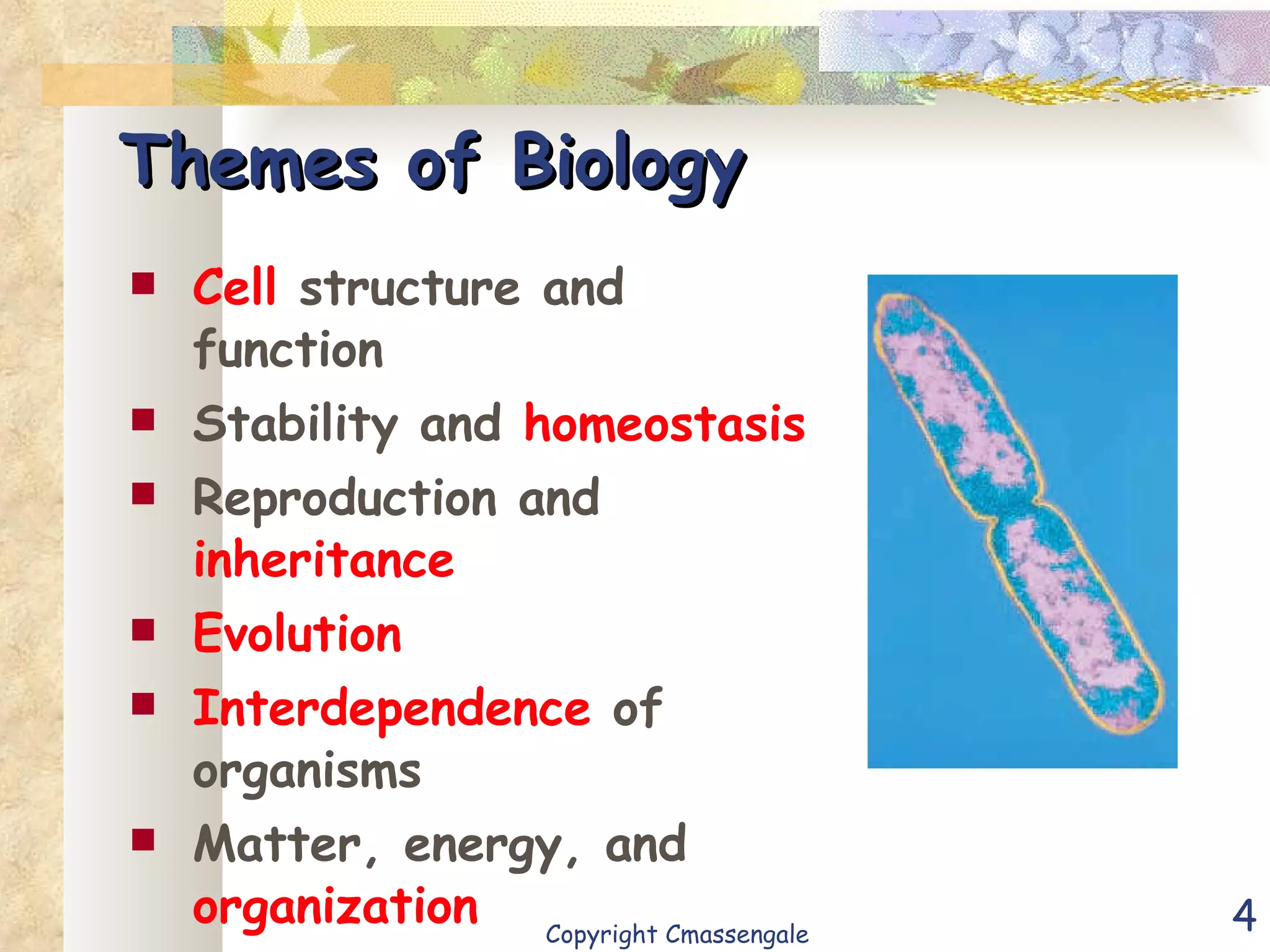
Themes of Biology Cell  structure and function Stability and  homeostasis   Reproduction and  inheritance Evolution Interdependence  of organisms Matter, energy, and  organization Copyright Cmassengale
Cell Structure and Function Cell  basic unit of life All organisms are  made of and develop from cells Some composed of only a single cell  (unicellular)  which is usually   identical to parent Copyright Cmassengale
Cells Most organisms are composed of many cells  (multicellular) Cells are  different  (undergo differentiation) Cells are  small   Cells are  highly organized Copyright Cmassengale
Cells contain specialized structures  (organelles)  that carry out the cell’s life processes Many  different kinds of cells  exist All cells surrounded by a  plasma membrane Contain a set of instructions  called  DNA   (genetic information) Copyright Cmassengale
Stability and Homeostasis Organisms must Maintain very stable internal conditions -  HOMEOSTASIS Temperature, water content, chemical content , etc. must be maintained Copyright Cmassengale
Reproduction and Inheritance All organisms produce new organisms like themselves  REPRODUCE Organisms transmit hereditary information to their offspring  INHERITANCE Copyright Cmassengale
DNA Genetic Information in  all cells Deoxyribonucleic Acid DNA contains instructions for traits  GENES Make the structures and complex chemicals necessary for life  PROTEINS DNA in every body cell  (SOMATIC CELLS ) is exactly alike Copyright Cmassengale
Sexual Reproduction Hereditary information from  two different organisms  of the same species are combined Egg and sperm     zygote (fertilized egg) Zygote contains hereditary information from  both parents Copyright Cmassengale
Asexual Reproduction Hereditary information from  one,  usually unicellular,  organism  that divides Resulting cells  contain  identical hereditary  information Genetic information from  single parent Copyright Cmassengale
Evolution Populations of organisms  change (evolve ) over generations (time) Explains how many different kinds of organisms came into existence  SPECIES Explains how  modern  organisms are  related  to  past  organisms Copyright Cmassengale
Explains why  organisms look and behave  the way they do Provides a basis for exploring the  relationships among  different groups of organisms Copyright Cmassengale
Natural Selection Natural selection is the  driving force in evolution Organisms that have certain  favorable traits  are better able to  successfully reproduce  than organisms that lack these traits Copyright Cmassengale
Natural Selection Survival of organisms with favorable traits cause a  gradual change in populations over many generations Also Called  “Survival of the Fittest” Copyright Cmassengale
Interdependence of Organisms Interaction of organisms with one another and with their environment  ECOLOGY Insects  depend and  flowers  DEPEND on each other for food & pollination  COEVOLUTION Copyright Cmassengale
All organisms need substances such as  nutrients, water, and gases  from the environment The  stability of the environment  depends on the healthy functioning of organisms in that environment Copyright Cmassengale
Matter, Energy and Organization Living things are  highly organized Require a  constant supply of energy  to maintain their orderly state Copyright Cmassengale
Energy ALL energy comes from the  SUN  (directly or indirectly) Photosynthesis  is the process by which some organisms capture the energy from the  sun (solar)  and transform it into  energy (chemical)  that can be used by living things Copyright Cmassengale
Autotrophs Organisms that make their own food are called  autotrophs Phototrophs  – use solar energy (photosynthesis) to get energy Convert  H 2 O and CO 2   into  sugar and O2 Chemotrophs  – use different chemical processes to get energy Copyright Cmassengale
Heterotrophs Organisms that must take in food to meet their energy needs are called  heterotrophs Consume autotrophs  (herbivores),  other heterotrophs  (carnivores)  or both  (omnivores)  for their energy needs Complex chemicals are broken down and  reassembled into chemicals  and structures needed by organisms  Copyright Cmassengale
The World of Biology   Chapter 1.2 Copyright Cmassengale
Characteristics of Life Copyright Cmassengale
Cells All living things are composed of  cells In multicellular organisms, many are  specialized  to perform specific functions Cells are always very  small The size of multi-celled organisms depends on  the number of cells NOT their size Copyright Cmassengale
Organization Organized at both the  molecular and cellular levels Take in substances from the environment and organize them in complex ways Specific cell structures  (organelles)  carry out particular functions Copyright Cmassengale
Copyright Cmassengale
In  multicellular organisms,  cells and groups of cells (tissues) are organized by their function Cells     tissues Tissues     organs Organs   systems Systems    ORGANISM Copyright Cmassengale
Energy Use Use energy in a process called  metabolism Sum of all chemical processes Require energy to maintain their molecular and cellular organization, grow and reproduce Copyright Cmassengale
Homeostasis Maintain  stable internal conditions Temperature, pH, etc. Copyright Cmassengale
Growth Grow occurs as the result of  cell division and cell enlargement Cell division  is the formation of two cells from a  preexisting cell New cells enlarge as they mature When a cell grows to a size where its  surface area isn’t big enough for its volume , the cell divides Copyright Cmassengale
The  process by which an adult organism arise  is called  development Repeated cell divisions and  cell differentiation Development Copyright Cmassengale
Reproduction All species have the  ability to reproduce Not essential to survival of individual  but is essential for continuation of a species Copyright Cmassengale
Responsiveness Respond to stimuli  in the external environment Detect and respond to changes in  light, heat, sound and chemical and mechanical contact Coordinates it’s responses Copyright Cmassengale
Evolve Ability to adapt to their environment through the process of  evolution Favorable characteristics  are selected for and passed on to offspring Called  adaptations Driven by natural selection or  “survival of the fittest” Copyright Cmassengale
Scientific Method   Chapter 1.3 Copyright Cmassengale
Observation – STEP 1 Employing your  five senses  to perceive objects or events Copyright Cmassengale
Asking a Question Based on observations;  one or more questions are generated Copyright Cmassengale
Forming a Hypothesis – STEP 2 A statement is  testable  if evidence can be collected that either does or doesn’t support it It can never be proven beyond doubt Often must be  refined and revised or discarded Copyright Cmassengale
The Hypothesis --- Is a statement made in advance that states the results that will be obtained from testing the hypothesis Often written in the form of an  “if-then” statement Copyright Cmassengale
Experimenting – STEP 3 Testing a hypothesis  or prediction by gathering data under  controlled conditions   – conducting a controlled experiment Based on a comparison of a  control  grou p  with an  experimental group Copyright Cmassengale
Both groups are identical  except for one factor  ( independent variable ) Observations and measurements are taken for a particular factor ( dependent variable ) in both groups Driven by or results from independent variable Copyright Cmassengale
Measuring Involves  quantitative data  that can be measured in  numbers  &/or  qualitative data  information that isn’t numbers Sampling Technique of using a  sample  – a small part – to  represent the entire population Copyright Cmassengale
Organizing Data – STEP 4 Involves placing observations and measurement (data) in order Graphs, charts, tables, or maps Copyright Cmassengale
Analyzing Data – STEP 4 cont) Collected and organized data must be analyzed Process of  determining whether data are reliable or whether they support or do not support a hypothesis  or prediction  Copyright Cmassengale
Conclusion – STEP 5 Conclusions are made on the basis of facts, not observations Often  drawn from data  gathered from a study or experiment Should  support the hypothesis Should be  re-testable Copyright Cmassengale
Communication – STEP 6 Scientists must  share the results of their studies  with other scientists (peers) Publish  findings in  journals Present their findings at  scientific meetings Scientists must be  unbiased Should not tamper with their data Only publish & report tested & proven ideas Copyright Cmassengale
Communication Sharing of information  is essential to scientific process Subject to examination and  verification  by other scientists Allows scientists to build on the work of others Copyright Cmassengale
Theories A  theory  may be formed after many related hypotheses have been tested and supported with experimental evidence A  broad and comprehensive statement of what is thought to be true Supported by  considerable evidence Ties together related hypotheses Copyright Cmassengale
Laws A  Statement of fact  that concisely explains an action or group of actions e.g. Law of Gravity Accepted to be true Universal May be expressed as a math equation e.g. E=mc 2 Copyright Cmassengale
MICROSCOPES Copyright Cmassengale
Microscopy and Measurement Microscopes –  produce an enlarged image of an object Used to study organisms, cells, and cell parts Increase in apparent size is called  magnification The ability to show details clearly is called  resolution Microscopes vary in both magnification and resolution Copyright Cmassengale
Copyright Cmassengale
Compound Light Microscopes Specimen  mounted on a  glass slide Must be thinly sliced or very small Pair of  lenses Ocular  lens (eye piece) Objective  lens (nose piece) Can be used to study  LIVE specimens Copyright Cmassengale
Magnification  determined by multiplying power of both lenses Eyepiece 10X times Objective power (20X, 40X…) Highest  Maximum magnification is around  1000X Copyright Cmassengale
Electron Microscope Transmission EM (TEM) Uses a  beam of electrons  to produce an enlarged image of very thinly sliced specimen on screen or photographic plate Image focused by  magnetic lenses 200,000X magnification Cannot be used to view living specimens Copyright Cmassengale
Scanning EM (SEM) 3D   image Specimens  not sliced for viewing Surface sprayed with fine metal coating Also uses electron beam and fluorescent screen or photographic plates 100,000X magnification Cannot be used to view living specimens Copyright Cmassengale
MEASUREMENTS Copyright Cmassengale
Measurements We will be using  SI units or metric  system when possible --- the WHOLE world uses it except us (USA) Copyright Cmassengale
Copyright Cmassengale

Introduction to biology

  • 1.
    Introduction to Biology Copyright Cmassengale
  • 2.
    Biology – TheStudy of Life Life arose more than 3.5 billion years ago First organisms (living things) were single celled Only life on Earth for millions of years Organisms changed over time (evolved ) Copyright Cmassengale
  • 3.
    New organisms arose from older kinds Today there are millions of species They inhabit almost every region of Earth today Copyright Cmassengale
  • 4.
    Themes of BiologyCell structure and function Stability and homeostasis Reproduction and inheritance Evolution Interdependence of organisms Matter, energy, and organization Copyright Cmassengale
  • 5.
    Cell Structure andFunction Cell basic unit of life All organisms are made of and develop from cells Some composed of only a single cell (unicellular) which is usually identical to parent Copyright Cmassengale
  • 6.
    Cells Most organismsare composed of many cells (multicellular) Cells are different (undergo differentiation) Cells are small Cells are highly organized Copyright Cmassengale
  • 7.
    Cells contain specializedstructures (organelles) that carry out the cell’s life processes Many different kinds of cells exist All cells surrounded by a plasma membrane Contain a set of instructions called DNA (genetic information) Copyright Cmassengale
  • 8.
    Stability and HomeostasisOrganisms must Maintain very stable internal conditions - HOMEOSTASIS Temperature, water content, chemical content , etc. must be maintained Copyright Cmassengale
  • 9.
    Reproduction and InheritanceAll organisms produce new organisms like themselves REPRODUCE Organisms transmit hereditary information to their offspring INHERITANCE Copyright Cmassengale
  • 10.
    DNA Genetic Informationin all cells Deoxyribonucleic Acid DNA contains instructions for traits GENES Make the structures and complex chemicals necessary for life PROTEINS DNA in every body cell (SOMATIC CELLS ) is exactly alike Copyright Cmassengale
  • 11.
    Sexual Reproduction Hereditaryinformation from two different organisms of the same species are combined Egg and sperm  zygote (fertilized egg) Zygote contains hereditary information from both parents Copyright Cmassengale
  • 12.
    Asexual Reproduction Hereditaryinformation from one, usually unicellular, organism that divides Resulting cells contain identical hereditary information Genetic information from single parent Copyright Cmassengale
  • 13.
    Evolution Populations oforganisms change (evolve ) over generations (time) Explains how many different kinds of organisms came into existence SPECIES Explains how modern organisms are related to past organisms Copyright Cmassengale
  • 14.
    Explains why organisms look and behave the way they do Provides a basis for exploring the relationships among different groups of organisms Copyright Cmassengale
  • 15.
    Natural Selection Naturalselection is the driving force in evolution Organisms that have certain favorable traits are better able to successfully reproduce than organisms that lack these traits Copyright Cmassengale
  • 16.
    Natural Selection Survivalof organisms with favorable traits cause a gradual change in populations over many generations Also Called “Survival of the Fittest” Copyright Cmassengale
  • 17.
    Interdependence of OrganismsInteraction of organisms with one another and with their environment ECOLOGY Insects depend and flowers DEPEND on each other for food & pollination COEVOLUTION Copyright Cmassengale
  • 18.
    All organisms needsubstances such as nutrients, water, and gases from the environment The stability of the environment depends on the healthy functioning of organisms in that environment Copyright Cmassengale
  • 19.
    Matter, Energy andOrganization Living things are highly organized Require a constant supply of energy to maintain their orderly state Copyright Cmassengale
  • 20.
    Energy ALL energycomes from the SUN (directly or indirectly) Photosynthesis is the process by which some organisms capture the energy from the sun (solar) and transform it into energy (chemical) that can be used by living things Copyright Cmassengale
  • 21.
    Autotrophs Organisms thatmake their own food are called autotrophs Phototrophs – use solar energy (photosynthesis) to get energy Convert H 2 O and CO 2 into sugar and O2 Chemotrophs – use different chemical processes to get energy Copyright Cmassengale
  • 22.
    Heterotrophs Organisms thatmust take in food to meet their energy needs are called heterotrophs Consume autotrophs (herbivores), other heterotrophs (carnivores) or both (omnivores) for their energy needs Complex chemicals are broken down and reassembled into chemicals and structures needed by organisms Copyright Cmassengale
  • 23.
    The World ofBiology Chapter 1.2 Copyright Cmassengale
  • 24.
    Characteristics of LifeCopyright Cmassengale
  • 25.
    Cells All livingthings are composed of cells In multicellular organisms, many are specialized to perform specific functions Cells are always very small The size of multi-celled organisms depends on the number of cells NOT their size Copyright Cmassengale
  • 26.
    Organization Organized atboth the molecular and cellular levels Take in substances from the environment and organize them in complex ways Specific cell structures (organelles) carry out particular functions Copyright Cmassengale
  • 27.
  • 28.
    In multicellularorganisms, cells and groups of cells (tissues) are organized by their function Cells  tissues Tissues  organs Organs  systems Systems  ORGANISM Copyright Cmassengale
  • 29.
    Energy Use Useenergy in a process called metabolism Sum of all chemical processes Require energy to maintain their molecular and cellular organization, grow and reproduce Copyright Cmassengale
  • 30.
    Homeostasis Maintain stable internal conditions Temperature, pH, etc. Copyright Cmassengale
  • 31.
    Growth Grow occursas the result of cell division and cell enlargement Cell division is the formation of two cells from a preexisting cell New cells enlarge as they mature When a cell grows to a size where its surface area isn’t big enough for its volume , the cell divides Copyright Cmassengale
  • 32.
    The processby which an adult organism arise is called development Repeated cell divisions and cell differentiation Development Copyright Cmassengale
  • 33.
    Reproduction All specieshave the ability to reproduce Not essential to survival of individual but is essential for continuation of a species Copyright Cmassengale
  • 34.
    Responsiveness Respond tostimuli in the external environment Detect and respond to changes in light, heat, sound and chemical and mechanical contact Coordinates it’s responses Copyright Cmassengale
  • 35.
    Evolve Ability toadapt to their environment through the process of evolution Favorable characteristics are selected for and passed on to offspring Called adaptations Driven by natural selection or “survival of the fittest” Copyright Cmassengale
  • 36.
    Scientific Method Chapter 1.3 Copyright Cmassengale
  • 37.
    Observation – STEP1 Employing your five senses to perceive objects or events Copyright Cmassengale
  • 38.
    Asking a QuestionBased on observations; one or more questions are generated Copyright Cmassengale
  • 39.
    Forming a Hypothesis– STEP 2 A statement is testable if evidence can be collected that either does or doesn’t support it It can never be proven beyond doubt Often must be refined and revised or discarded Copyright Cmassengale
  • 40.
    The Hypothesis ---Is a statement made in advance that states the results that will be obtained from testing the hypothesis Often written in the form of an “if-then” statement Copyright Cmassengale
  • 41.
    Experimenting – STEP3 Testing a hypothesis or prediction by gathering data under controlled conditions – conducting a controlled experiment Based on a comparison of a control grou p with an experimental group Copyright Cmassengale
  • 42.
    Both groups areidentical except for one factor ( independent variable ) Observations and measurements are taken for a particular factor ( dependent variable ) in both groups Driven by or results from independent variable Copyright Cmassengale
  • 43.
    Measuring Involves quantitative data that can be measured in numbers &/or qualitative data information that isn’t numbers Sampling Technique of using a sample – a small part – to represent the entire population Copyright Cmassengale
  • 44.
    Organizing Data –STEP 4 Involves placing observations and measurement (data) in order Graphs, charts, tables, or maps Copyright Cmassengale
  • 45.
    Analyzing Data –STEP 4 cont) Collected and organized data must be analyzed Process of determining whether data are reliable or whether they support or do not support a hypothesis or prediction Copyright Cmassengale
  • 46.
    Conclusion – STEP5 Conclusions are made on the basis of facts, not observations Often drawn from data gathered from a study or experiment Should support the hypothesis Should be re-testable Copyright Cmassengale
  • 47.
    Communication – STEP6 Scientists must share the results of their studies with other scientists (peers) Publish findings in journals Present their findings at scientific meetings Scientists must be unbiased Should not tamper with their data Only publish & report tested & proven ideas Copyright Cmassengale
  • 48.
    Communication Sharing ofinformation is essential to scientific process Subject to examination and verification by other scientists Allows scientists to build on the work of others Copyright Cmassengale
  • 49.
    Theories A theory may be formed after many related hypotheses have been tested and supported with experimental evidence A broad and comprehensive statement of what is thought to be true Supported by considerable evidence Ties together related hypotheses Copyright Cmassengale
  • 50.
    Laws A Statement of fact that concisely explains an action or group of actions e.g. Law of Gravity Accepted to be true Universal May be expressed as a math equation e.g. E=mc 2 Copyright Cmassengale
  • 51.
  • 52.
    Microscopy and MeasurementMicroscopes – produce an enlarged image of an object Used to study organisms, cells, and cell parts Increase in apparent size is called magnification The ability to show details clearly is called resolution Microscopes vary in both magnification and resolution Copyright Cmassengale
  • 53.
  • 54.
    Compound Light MicroscopesSpecimen mounted on a glass slide Must be thinly sliced or very small Pair of lenses Ocular lens (eye piece) Objective lens (nose piece) Can be used to study LIVE specimens Copyright Cmassengale
  • 55.
    Magnification determinedby multiplying power of both lenses Eyepiece 10X times Objective power (20X, 40X…) Highest Maximum magnification is around 1000X Copyright Cmassengale
  • 56.
    Electron Microscope TransmissionEM (TEM) Uses a beam of electrons to produce an enlarged image of very thinly sliced specimen on screen or photographic plate Image focused by magnetic lenses 200,000X magnification Cannot be used to view living specimens Copyright Cmassengale
  • 57.
    Scanning EM (SEM)3D image Specimens not sliced for viewing Surface sprayed with fine metal coating Also uses electron beam and fluorescent screen or photographic plates 100,000X magnification Cannot be used to view living specimens Copyright Cmassengale
  • 58.
  • 59.
    Measurements We willbe using SI units or metric system when possible --- the WHOLE world uses it except us (USA) Copyright Cmassengale
  • 60.
  • 61.
  • 62.