In a non-evolving population allele
frequencies are preserved (they are said
to be in Hardy-Weinberg equilibrium), but:
natural populations are rarely in Hardy-
Weinberg equilibrium
However it provides a useful model to
measure if evolutionary forces are
acting on a population
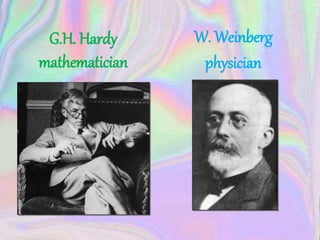
G.H. Hardy
mathematician
W. Weinberg
physician
Hardy-Weinberg theory
Counting Alleles
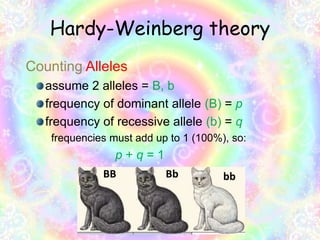
assume 2 alleles = B, b
frequency of dominant allele (B) = p
frequency of recessive allele (b) = q
frequencies must add up to 1 (100%), so:
p + q = 1
bbBbBB
Hardy-Weinberg theory
Counting Genotypes
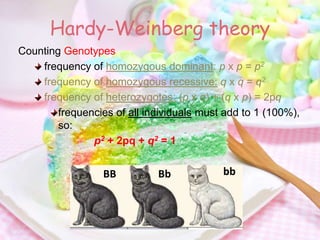
frequency of homozygous dominant: p x p = p2
frequency of homozygous recessive: q x q = q2
frequency of heterozygotes: (p x q) + (q x p) = 2pq
frequencies of all individuals must add to 1 (100%),
so:
p2 + 2pq + q2 = 1
BB Bb bb
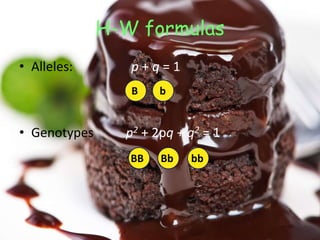
H-W formulas
• Alleles: p + q = 1
• Genotypes p2 + 2pq + q2 = 1
B b
BB Bb bb
• population:
100 cats
• 84 black, 16
white
• How many of
each genotype?
• p2 + 2pq + q2
= 1
• q2 (bb): 16/100 = .16
• q (b): √.16 = 0.4
• p (B): 1 - 0.4 = 0.6
• Now work out
genotype
frequencies
p2=0.36
2pq=0.48
q2=0.16
Using Hardy-Weinberg equation
BB Bb bb
Hardy Weinberg problems
Now have a go at sorting out some:
Allele frequencies
Genotype frequencies
Phenotype frequencies
And use the frequencies to make
deductions about data

Hardy weinberg theory

  • 2.
    In a non-evolvingpopulation allele frequencies are preserved (they are said to be in Hardy-Weinberg equilibrium), but: natural populations are rarely in Hardy- Weinberg equilibrium However it provides a useful model to measure if evolutionary forces are acting on a population
  • 3.
  • 4.
    Hardy-Weinberg theory Counting Alleles assume2 alleles = B, b frequency of dominant allele (B) = p frequency of recessive allele (b) = q frequencies must add up to 1 (100%), so: p + q = 1 bbBbBB
  • 5.
    Hardy-Weinberg theory Counting Genotypes frequencyof homozygous dominant: p x p = p2 frequency of homozygous recessive: q x q = q2 frequency of heterozygotes: (p x q) + (q x p) = 2pq frequencies of all individuals must add to 1 (100%), so: p2 + 2pq + q2 = 1 BB Bb bb
  • 6.
    H-W formulas • Alleles:p + q = 1 • Genotypes p2 + 2pq + q2 = 1 B b BB Bb bb
  • 7.
    • population: 100 cats •84 black, 16 white • How many of each genotype? • p2 + 2pq + q2 = 1 • q2 (bb): 16/100 = .16 • q (b): √.16 = 0.4 • p (B): 1 - 0.4 = 0.6 • Now work out genotype frequencies p2=0.36 2pq=0.48 q2=0.16 Using Hardy-Weinberg equation BB Bb bb
  • 8.
    Hardy Weinberg problems Nowhave a go at sorting out some: Allele frequencies Genotype frequencies Phenotype frequencies And use the frequencies to make deductions about data