Evolution Diversity of Life
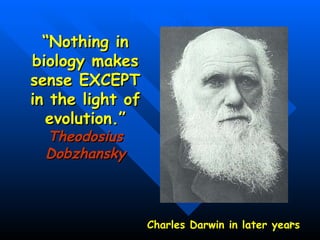
“ Nothing in biology makes sense EXCEPT in the light of evolution.”  Theodosius Dobzhansky Evolution Charles Darwin in later years
History of Evolutionary Thought
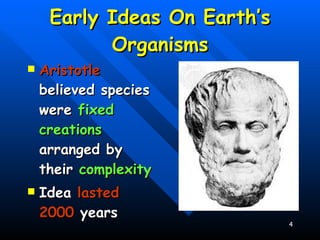
Early Ideas On Earth’s Organisms Aristotle  believed species were  fixed creations  arranged by their  complexity Idea  lasted 2000  years
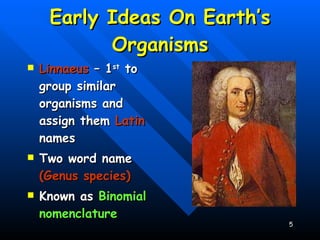
Early Ideas On Earth’s Organisms Linnaeus  – 1 st  to group similar organisms and assign them  Latin  names Two word name  (Genus species) Known as  Binomial nomenclature
Contributor’s to Darwin’s thinking included: Charles Lyell – uniformintarianism  (geologic processes still changing Earth) Georges Cuvier –  species extinction (Catastrophism) Thomas Malthus –  struggle for existence (resources) :
Contributor’s to Darwin’s thinking included: James Hutton -  Gradualism Jean Baptiste Lamarck –  Inheritance of acquired Characteristics   and   Law of Use and Disuse Alfred Russel Wallace –  organisms evolved from common ancestors :
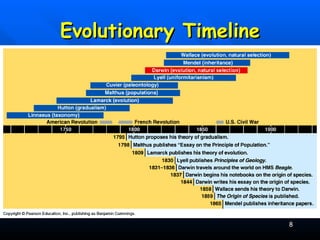
Evolutionary Timeline
Catastrophism Idea proposed by  George Cuvier Studied fossil in  sedimentary rock strata  of Paris Found  some species completely disappeared  in more recent layers
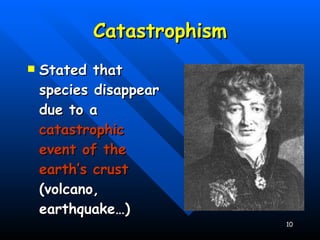
Catastrophism Stated that species disappear due to a  catastrophic event of the earth’s crust  (volcano, earthquake…)
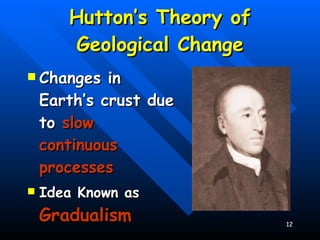
Hutton’s Theory of Geological Change James Hutton , 1795, Scottish geologist Studied  invertebrate fossils in Paris Museum Described The  Geological Forces  That Have Changed  Life   on Earth  Over Millions of Years (erosion, earthquakes, volcanoes…)
Hutton’s Theory of Geological Change Changes in Earth’s crust due to  slow continuous processes Idea Known as  Gradualism
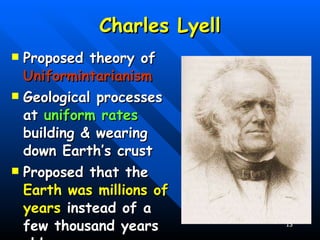
Charles Lyell Proposed theory of  Uniformintarianism Geological processes at  uniform rates  building & wearing down Earth’s crust Proposed that the  Earth was millions of years  instead of a few thousand years old
Principles of Geology Published by  Lyell  Just Before The  Beagle  Set Sail & read by Darwin Explained  Geological Processes That Shaped The Earth Helped Darwin Understand  Sea Shells In The Andes Mountains At 12,000+ Feet Expanded Earth’s Age
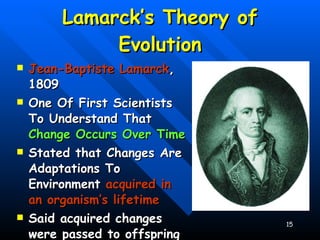
Lamarck’s Theory of Evolution Jean-Baptiste Lamarck , 1809 One Of First Scientists To Understand That  Change Occurs Over Time Stated that Changes Are Adaptations To Environment  acquired in an organism’s lifetime Said acquired changes were passed to offspring
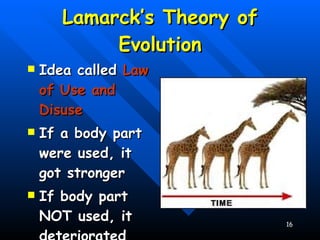
Lamarck’s Theory of Evolution Idea called  Law of Use and Disuse If a body part were used, it got stronger If body part NOT used, it deteriorated
Lamarck’s Theory of Evolution Inheritance of Acquired Characteristics Proposed That By Selective Use Or Disuse Of Organs, Organisms Acquired Or Lost Certain Traits During Their Lifetime These  Traits Could Then Be Passed On To Their Offspring Over Time This Led To  New Species
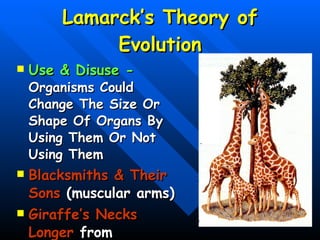
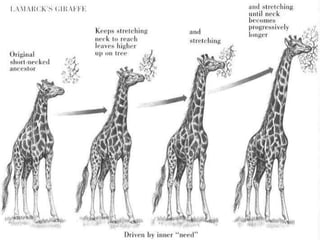
Lamarck’s Theory of Evolution Use & Disuse -  Organisms Could Change The Size Or Shape Of Organs By Using Them Or Not Using Them Blacksmiths & Their Sons  (muscular arms) Giraffe’s Necks Longer  from stretching)
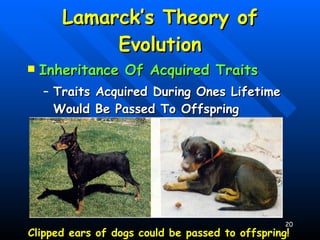
Lamarck’s Theory of Evolution Inheritance Of Acquired Traits Traits Acquired During Ones Lifetime Would Be Passed To Offspring Clipped ears of dogs could be passed to offspring!
Lamarck’s Theory of Evolution Tendency Toward Perfection Organisms Are Continually Changing and Acquiring Features That Help Them Live More Successfully In Their Environment Example:  Bird Ancestors Desired To Fly So They Tried Until Wings Developed
Lamarck’s Mistakes Lamarck Did NOT Know how traits were  inherited (Traits are passed through genes) Genes Are NOT Changed By Activities In Life Change Through  Mutation Occurs Before An Organism Is Born
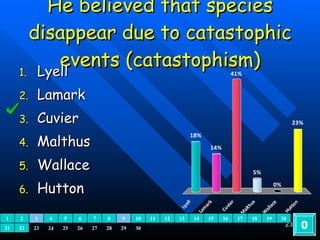
He believed that species disappear due to catastophic events (catastophism) Lyell Lamark Cuvier Malthus Wallace Hutton 0 1 2 3 4 5 6 7 8 9 10 11 12 13 14 15 16 17 18 19 20 21 22 23 24 25 26 27 28 29 30
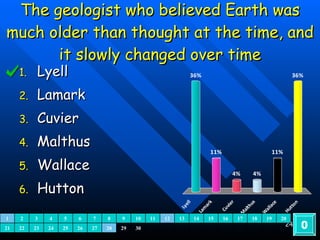
The geologist who believed Earth was much older than thought at the time, and it slowly changed over time Lyell Lamark Cuvier Malthus Wallace Hutton 0 1 2 3 4 5 6 7 8 9 10 11 12 13 14 15 16 17 18 19 20 21 22 23 24 25 26 27 28 29 30
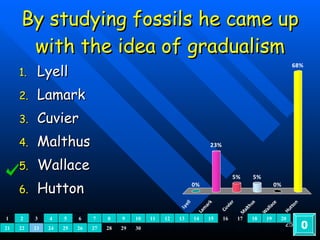
By studying fossils he came up with the idea of gradualism Lyell Lamark Cuvier Malthus Wallace Hutton 0 1 2 3 4 5 6 7 8 9 10 11 12 13 14 15 16 17 18 19 20 21 22 23 24 25 26 27 28 29 30
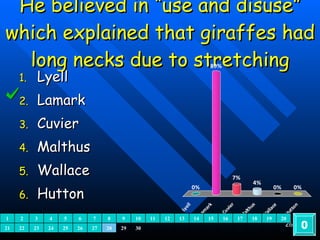
He believed in “use and disuse” which explained that giraffes had long necks due to stretching Lyell Lamark Cuvier Malthus Wallace Hutton 0 1 2 3 4 5 6 7 8 9 10 11 12 13 14 15 16 17 18 19 20 21 22 23 24 25 26 27 28 29 30
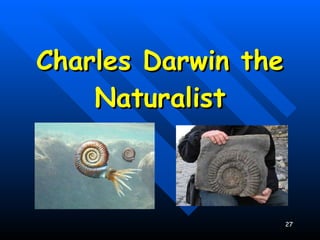
Charles Darwin the Naturalist
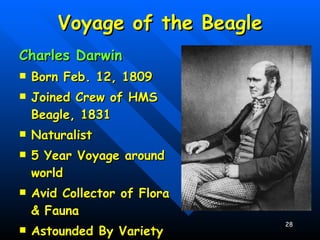
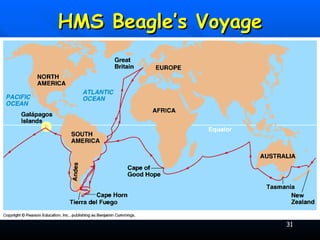
Voyage of the Beagle Charles Darwin Born Feb. 12, 1809 Joined Crew of HMS Beagle, 1831 Naturalist 5 Year Voyage around world Avid Collector of Flora & Fauna Astounded By Variety of Life
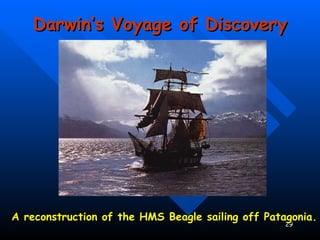
Darwin’s Voyage of Discovery A reconstruction of the HMS Beagle sailing off Patagonia.
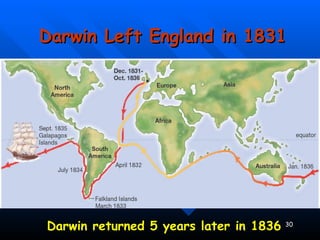
Darwin Left England in 1831 Darwin returned 5 years later in 1836
HMS Beagle’s Voyage
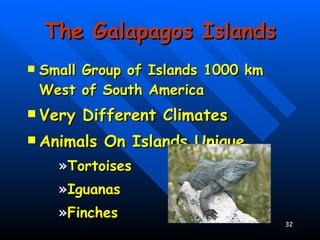
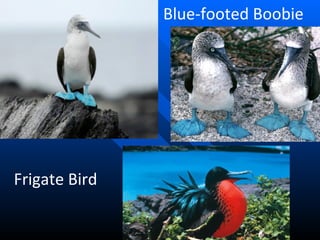
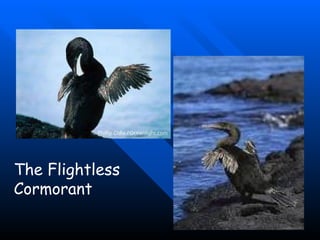
The Galapagos Islands Small Group of Islands 1000 km West of South America Very Different Climates Animals On Islands Unique Tortoises Iguanas Finches
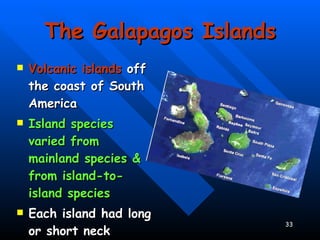
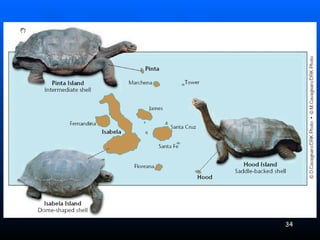
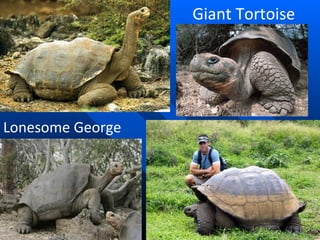
The Galapagos Islands Volcanic islands  off the coast of South America Island species varied from mainland species & from island-to-island species Each island had long or short neck tortoises
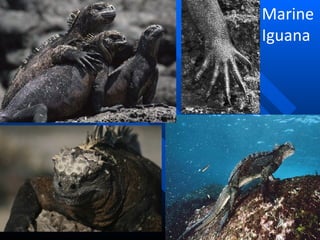
Marine Iguana
Lonesome George Giant Tortoise
Frigate Bird Blue-footed Boobie
The Flightless Cormorant
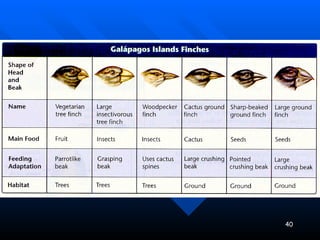
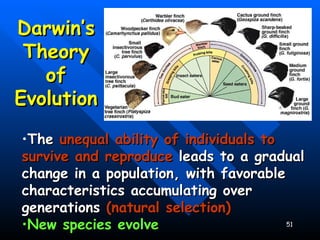
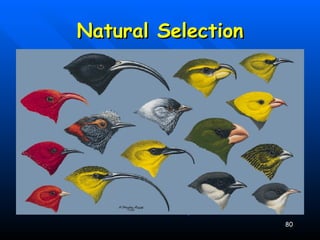
The Galapagos Islands Finches on the islands  resembled a mainland finch More types of finches appeared on the islands  where the available food was different (seeds, nuts, berries, insects…) Finches had  different types of beaks  adapted to their  type of food gathering
Darwin’s Observations & Conclusions The Struggle for Existence
Voyage of the Beagle During His Travels, Darwin Made Numerous Observations And Collected Evidence That Led Him To Propose A  Revolutionary Hypothesis  About The Way Life Changes Over Time
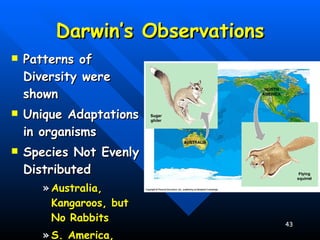
Darwin’s Observations Patterns of Diversity were shown Unique Adaptations in organisms Species Not Evenly Distributed Australia, Kangaroos, but No Rabbits S. America, Llamas
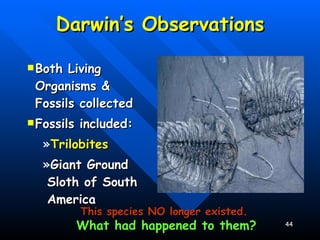
Darwin’s Observations Both Living Organisms & Fossils collected Fossils included: Trilobites Giant Ground Sloth of South America This species NO longer existed.   What had happened to them?
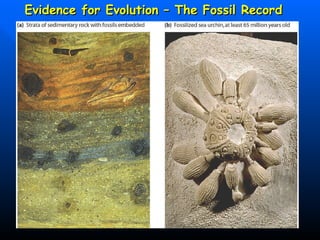
Evidence for Evolution – The Fossil Record
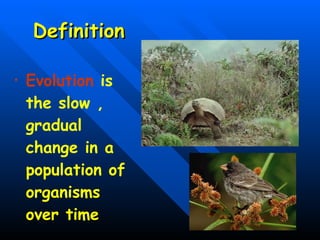
Definition Evolution  is the slow , gradual  change in a population of organisms over time
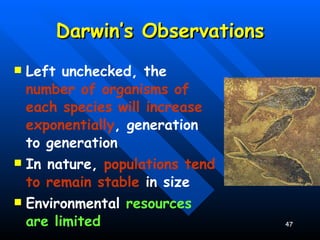
Darwin’s Observations Left unchecked, the  number of organisms of each species will increase exponentially , generation to generation In nature,  populations tend to remain stable  in size Environmental  resources are limited
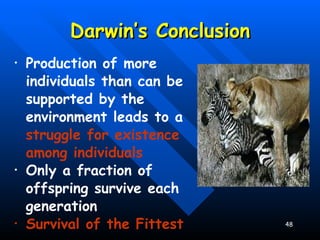
Darwin’s Conclusion Production of more individuals than can be supported by the environment leads to a  struggle for existence among individuals Only a fraction of offspring survive each generation Survival of the Fittest
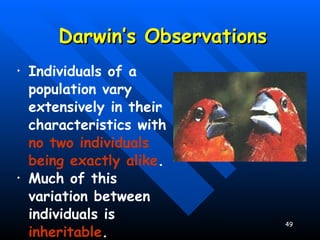
Darwin’s Observations Individuals of a population vary extensively in their characteristics with  no two individuals being exactly alike . Much of this variation between individuals is  inheritable .
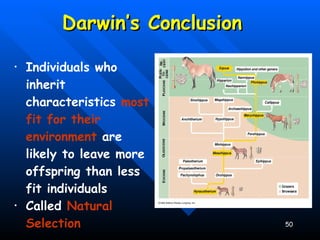
Darwin’s Conclusion Individuals who inherit characteristics  most fit for their environment  are likely to leave more offspring than less fit individuals Called  Natural Selection
The  unequal ability of individuals to survive and reproduce  leads to a gradual change in a population, with favorable characteristics accumulating over generations  (natural selection) New species evolve Darwin’s Theory of Evolution
Darwin observed, in nature populations tend to ____ in size. Grow Shrink Remain stable Vary 20 1 2 3 4 5 6 7 8 9 10 11 12 13 14 15 16 17 18 19 20 21 22 23 24 25 26 27 28 29 30
What limits population growth? Space Food Temperature All of the above None of the above 20 1 2 3 4 5 6 7 8 9 10 11 12 13 14 15 16 17 18 19 20 21 22 23 24 25 26 27 28 29 30
______ states that individuals who inherit characteristics most fit for their environment are likely to have more offspring. Evolutionary theory Directional selection Natural selection Stabilizing selection 20 1 2 3 4 5 6 7 8 9 10 11 12 13 14 15 16 17 18 19 20 21 22 23 24 25 26 27 28 29 30
What is the driving force behind evolution? Time Energy The Sun Natural Selection 20 1 2 3 4 5 6 7 8 9 10 11 12 13 14 15 16 17 18 19 20 21 22 23 24 25 26 27 28 29 30
Ideas That Shaped Darwin’s Thinking Thomas Malthus
Population Growth Thomas Malthus , 1798 Economist Observed  Babies Being Born Faster Than People Were Dying Population size  limited by resources  such as the Food Supply
The Struggle for Existence Malthus’ Influence: High Birth Rates & Limited Resources Would Force Life & Death Competition Each Species Struggles For : Food Living Space Mates
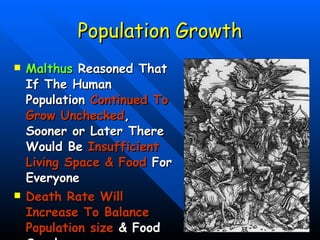
Population Growth Malthus  Reasoned That If The Human Population  Continued To Grow Unchecked , Sooner or Later There Would Be  Insufficient Living Space & Food  For Everyone Death Rate Will Increase To Balance Population size  & Food Supply
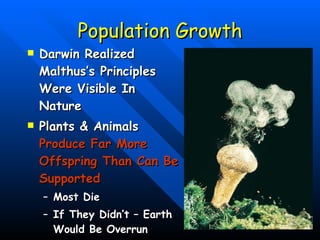
Population Growth Darwin Realized Malthus’s Principles Were Visible In Nature Plants & Animals  Produce Far More Offspring Than Can Be Supported Most Die If They Didn’t – Earth Would Be Overrun
Darwin’s Theory of Evolution Organisms Change Over Time
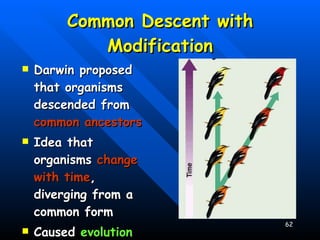
Common Descent with Modification Darwin proposed that organisms descended from  common ancestors Idea that organisms  change with time , diverging from a common form Caused  evolution of new species
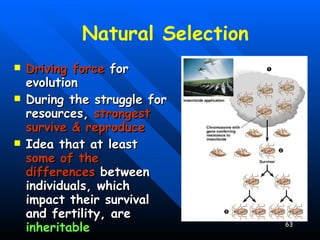
Natural Selection Driving force  for evolution During the struggle for resources,  strongest survive & reproduce Idea that at least  some of the differences  between individuals, which impact their survival and fertility, are  inheritable   .
Origin of Species Darwin Presents His Case
Publication of “On The Origin of Species” Upon His Return To England, Darwin Developed His Observations Into The Theory of Evolution But He  Did Not Publish For 25 Years  –  Why?
Publication of “On The Origin of Species” Darwin Knew That His Theory Would Be  Extremely Controversial  And Would Be Attacked His Theory  Challenged Established Religious & Scientific Beliefs , Particularly About The Creation Of Man
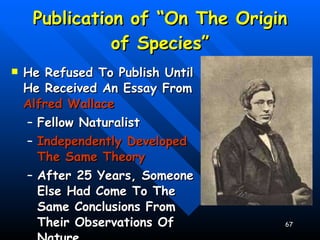
Publication of “On The Origin of Species” He Refused To Publish Until He Received An Essay From  Alfred Wallace Fellow Naturalist Independently Developed The Same Theory After 25 Years, Someone Else Had Come To The Same Conclusions From Their Observations Of Nature
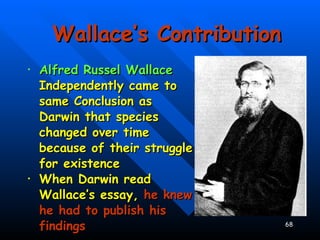
Wallace’s Contribution Alfred Russel Wallace  Independently came to same Conclusion as Darwin that species changed over time because of their struggle for existence When Darwin read Wallace’s essay,  he knew he had to publish his findings
Publication of “On The Origin of Species” Darwin Presented Wallace’s Essay & Some Of His Work At A Scientific Conference of the  Linnaean Society  in July of  1858 Then He Started On his book  “Origin of Species” It Took Darwin 18 Months To Complete The Book
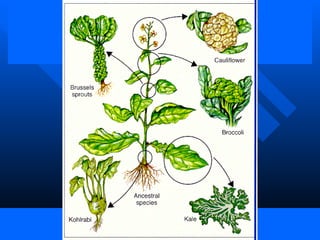
Natural Variation and Artificial Selection Abandoned The Idea  That Species Were Perfect & Unchanging Observed  Significant Variation in All Species  Observed Observed  Farmers Use Variation  To Improve Crops & Livestock  Called  Selective Breeding
Natural Variation and Artificial Selection Natural Variation Differences Among Individuals Of A Species Artificial Selection Selective Breeding To Enhance Desired Traits Among Stock or Crops
Natural Variation and Artificial Selection Key Concept: In  Artificial Selection ,  Nature Provided The Variation Among Different Organisms, And Humans Selected Those Variations That They Found Useful
Origin of Species Concepts and Controversy
Evolution By Natural Selection Concepts The Struggle for Existence  (compete for food, mates, space, water, etc.) Survival of the Fittest  (strongest able to survive and reproduce) Descent with Modification  (new species arise from common ancestor replacing less fit species)
Survival of the Fittest Fitness Ability of an Individual To Survive &  Reproduce Adaptation Inherited Characteristic That Increases an Organisms Chance for Survival
Survival of the Fittest Adaptations Can Be: Physical Speed, Camouflage, Claws, Quills, etc. Behavioral Solitary, Herds, Packs, Activity, etc.
Survival of the Fittest Fitness  Is Central To The Process Of Evolution Individuals With Low Fitness Die Produce Few Offspring Survival of the Fittest AKA  Natural Selection
Survival of the Fittest Key Concept Over Time, Natural Selection Results In Changes In The Inherited Characteristics Of A Population. These Changes Increase A Species Fitness In Its Environment
Natural Selection Cannot Be Seen Directly It Can Only Be Observed As Changes In A Population Over Many Successive Generations Radiation Fossil Record
Descent With Modification Takes Place Over  Long Periods  of Time Natural Selection Can Be  Observed  As Changes In Body Structures Ecological Niches Habitats
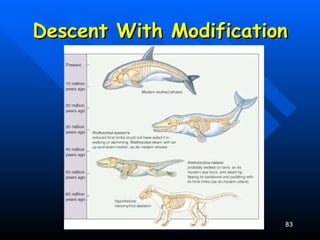
Descent With Modification Species  Today Look Different  From Their Ancestors Each Living Species Has Descended With Changes From Other Species Over Time
Descent With Modification
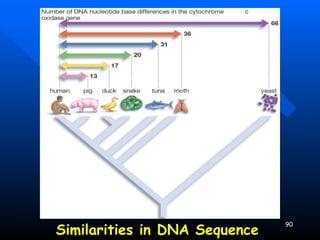
Descent With Modification Implies All Living Organisms Are Related Single Tree of Life DNA, Body Structures, Energy Sources Common Descent All Species, Living & Extinct, Were Derived From Common Ancestors
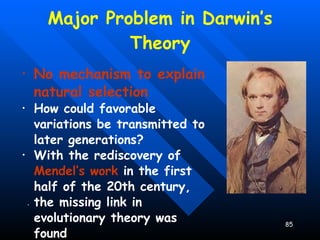
Major Problem in Darwin’s Theory No mechanism to explain natural selection How could favorable variations be transmitted to later generations? With the rediscovery of  Mendel’s work  in the first half of the 20th century, the missing link in evolutionary theory was found .
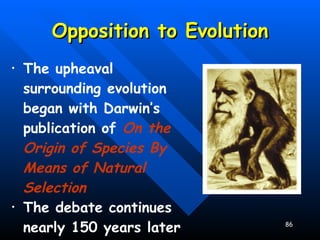
Opposition to Evolution The upheaval surrounding evolution began with Darwin’s publication of  On the Origin of Species By Means of Natural Selection The debate continues nearly 150 years later
Theory of Evolution Today Supporting Evidence
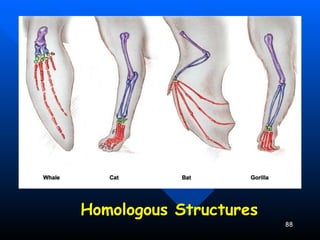
Homologous Structures
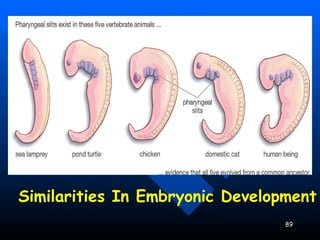
Evidence for Evolution - Comparative Embryology Similarities In Embryonic Development
Similarities in DNA Sequence
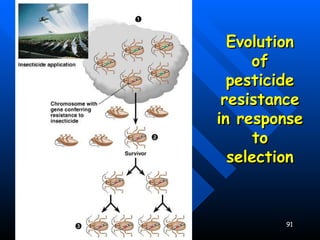
Evolution of pesticide resistance in response to selection
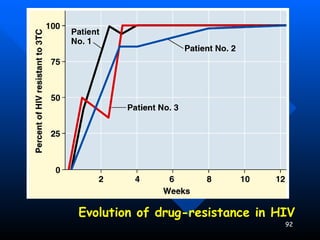
Evidence for Evolution – Evolution Observed Evolution of drug-resistance in HIV
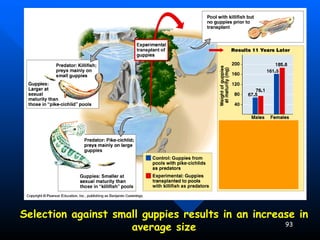
Evidence for Evolution – Evolution Observed Selection against small guppies results in an increase in average size
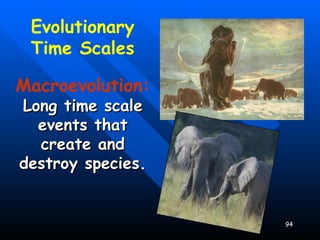
Evolutionary Time Scales Macroevolution:   Long time scale events that create and destroy species.
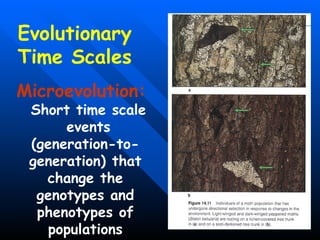
Microevolution: Short time scale  events (generation-to-generation) that change the genotypes and phenotypes of populations Evolutionary Time Scales
Evidence of Evolution Key Concept Darwin Argued That Living Things Have Been Evolving On Earth For  Millions of Years . Evidence For This Process Could Be Found In: The  Fossil Record The  Geographical Distribution  of Living Species Homologous Structures  of Living Organisms Similarities In  Early Development
Fossil Record Earth is  Billions of Years Old Fossils In Different Layers of Rock (sedimentary Rock Strata) Showed Evidence Of Gradual Change Over Time
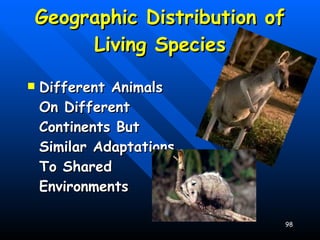
Geographic Distribution of Living Species Different Animals On Different Continents But Similar Adaptations To Shared Environments
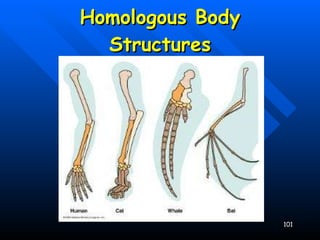
Homologous Body Structures Scientists Noticed Animals With Backbones (Vertebrates) Had Similar Bone Structure May  Differ In Form or Function Limb Bones Develop In Similar Patterns Arms, Wings, Legs, Flippers
Homologous Body Structures Structures That Have Different Mature Forms But Develop From The Same Embryonic Tissues Strong Evidence That  All Four-Limbed Animals With Backbones Descended, With Modification, From A  Common Ancestor Help Scientist Group Animals
Homologous Body Structures
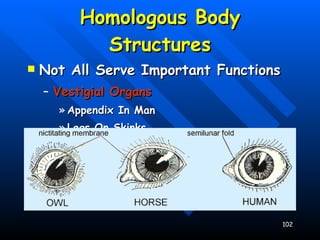
Homologous Body Structures Not All Serve Important Functions Vestigial Organs Appendix In Man Legs On Skinks
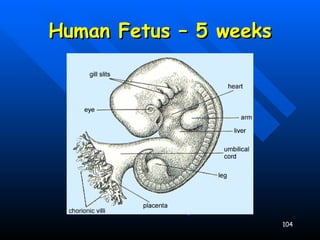
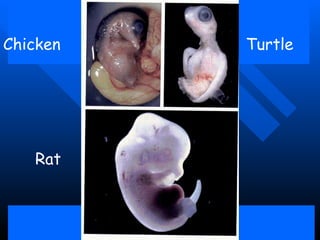
Similarities In Early Development Embryonic Structures Of Different Species Show Significant Similarities Embryo  – early stages of vertebrate development
Human Fetus – 5 weeks
Chicken Turtle Rat
Review
Darwin's Theory Individual Organisms In Nature Differ From One Another. Some Of This Variation Is Inherited Organisms In Nature Produce More Offspring Than Can Survive, And Many Of These Offspring Do No Reproduce
Darwin's Theory Because More Organisms Are Produced Than Can Survive, Members Of Each Species Must Compete For Limited Resources Because Each Organism Is Unique, Each Has Different Advantages & Disadvantages In The Struggle For Existence
Darwin's Theory Individuals Best Suited To Their Environment Survive & Reproduce Successfully – Passing Their Traits To Their Offspring. Species Change Over Time. Over Long Periods, Natural Selection Causes Changes That May Eventually Lead To New Species
Darwin's Theory Species Alive Today Have Descended With Modifications From Species That Lived In The Past All Organisms On Earth Are United Into A Single Tree Of Life By Common Descent
Evolution Simulation http://www2.edc.org/weblabs/NaturalSelection/NaturalSelectionMenu.html
Lamark’s explanation for the modification of species depended on Inheritance of acquired characteristics Convergent evolution The law of superposition Natural selection 20 1 2 3 4 5 6 7 8 9 10 11 12 13 14 15 16 17 18 19 20 21 22 23 24 25 26 27 28 29 30
The idea that processes occurring now on Earth are much the same as those that occurred long ago is called Uniformitarianism Relativism Evolutionarianism Convergent evolution 20 1 2 3 4 5 6 7 8 9 10 11 12 13 14 15 16 17 18 19 20 21 22 23 24 25 26 27 28 29 30
The observation that organisms arise in locations where similar, extinct organisms lived is called Superposition Biogeography Uniformitarianism evolution 20 1 2 3 4 5 6 7 8 9 10 11 12 13 14 15 16 17 18 19 20 21 22 23 24 25 26 27 28 29 30
The similarities in the Galapagos finches implied Coevolution Convergent evolution Adaptive radiation Descent from different remote ancestors 20 1 2 3 4 5 6 7 8 9 10 11 12 13 14 15 16 17 18 19 20 21 22 23 24 25 26 27 28 29 30
Difference in reproductive success is An acquired trait Adaptive radiation Natural selection Coevolution  20 1 2 3 4 5 6 7 8 9 10 11 12 13 14 15 16 17 18 19 20 21 22 23 24 25 26 27 28 29 30
Great similarity between species implies Recent common ancestry Remote common ancestry Successful reproduction Extinction  20 1 2 3 4 5 6 7 8 9 10 11 12 13 14 15 16 17 18 19 20 21 22 23 24 25 26 27 28 29 30
Features that were useful in ancestors but are no longer useful are called Analogous features Homologous features Unexpressed genes Vestigial features 20 1 2 3 4 5 6 7 8 9 10 11 12 13 14 15 16 17 18 19 20 21 22 23 24 25 26 27 28 29 30
Similar features in different species that originated in a shared ancestor are called Vestigial features Analogous features Homologous features Unexpressed genes 20 1 2 3 4 5 6 7 8 9 10 11 12 13 14 15 16 17 18 19 20 21 22 23 24 25 26 27 28 29 30
A humming bird and a humming moth have a number of superficial features in common with each other.  This is an example of Divergent evolution Coevolution Convergent evolution Superposition  20 1 2 3 4 5 6 7 8 9 10 11 12 13 14 15 16 17 18 19 20 21 22 23 24 25 26 27 28 29 30

Darwin evolution revised with turning point qs

  • 1.
  • 2.
    “ Nothing inbiology makes sense EXCEPT in the light of evolution.” Theodosius Dobzhansky Evolution Charles Darwin in later years
  • 3.
  • 4.
    Early Ideas OnEarth’s Organisms Aristotle believed species were fixed creations arranged by their complexity Idea lasted 2000 years
  • 5.
    Early Ideas OnEarth’s Organisms Linnaeus – 1 st to group similar organisms and assign them Latin names Two word name (Genus species) Known as Binomial nomenclature
  • 6.
    Contributor’s to Darwin’sthinking included: Charles Lyell – uniformintarianism (geologic processes still changing Earth) Georges Cuvier – species extinction (Catastrophism) Thomas Malthus – struggle for existence (resources) :
  • 7.
    Contributor’s to Darwin’sthinking included: James Hutton - Gradualism Jean Baptiste Lamarck – Inheritance of acquired Characteristics and Law of Use and Disuse Alfred Russel Wallace – organisms evolved from common ancestors :
  • 8.
  • 9.
    Catastrophism Idea proposedby George Cuvier Studied fossil in sedimentary rock strata of Paris Found some species completely disappeared in more recent layers
  • 10.
    Catastrophism Stated thatspecies disappear due to a catastrophic event of the earth’s crust (volcano, earthquake…)
  • 11.
    Hutton’s Theory ofGeological Change James Hutton , 1795, Scottish geologist Studied invertebrate fossils in Paris Museum Described The Geological Forces That Have Changed Life on Earth Over Millions of Years (erosion, earthquakes, volcanoes…)
  • 12.
    Hutton’s Theory ofGeological Change Changes in Earth’s crust due to slow continuous processes Idea Known as Gradualism
  • 13.
    Charles Lyell Proposedtheory of Uniformintarianism Geological processes at uniform rates building & wearing down Earth’s crust Proposed that the Earth was millions of years instead of a few thousand years old
  • 14.
    Principles of GeologyPublished by Lyell Just Before The Beagle Set Sail & read by Darwin Explained Geological Processes That Shaped The Earth Helped Darwin Understand Sea Shells In The Andes Mountains At 12,000+ Feet Expanded Earth’s Age
  • 15.
    Lamarck’s Theory ofEvolution Jean-Baptiste Lamarck , 1809 One Of First Scientists To Understand That Change Occurs Over Time Stated that Changes Are Adaptations To Environment acquired in an organism’s lifetime Said acquired changes were passed to offspring
  • 16.
    Lamarck’s Theory ofEvolution Idea called Law of Use and Disuse If a body part were used, it got stronger If body part NOT used, it deteriorated
  • 17.
    Lamarck’s Theory ofEvolution Inheritance of Acquired Characteristics Proposed That By Selective Use Or Disuse Of Organs, Organisms Acquired Or Lost Certain Traits During Their Lifetime These Traits Could Then Be Passed On To Their Offspring Over Time This Led To New Species
  • 18.
    Lamarck’s Theory ofEvolution Use & Disuse - Organisms Could Change The Size Or Shape Of Organs By Using Them Or Not Using Them Blacksmiths & Their Sons (muscular arms) Giraffe’s Necks Longer from stretching)
  • 20.
    Lamarck’s Theory ofEvolution Inheritance Of Acquired Traits Traits Acquired During Ones Lifetime Would Be Passed To Offspring Clipped ears of dogs could be passed to offspring!
  • 21.
    Lamarck’s Theory ofEvolution Tendency Toward Perfection Organisms Are Continually Changing and Acquiring Features That Help Them Live More Successfully In Their Environment Example: Bird Ancestors Desired To Fly So They Tried Until Wings Developed
  • 22.
    Lamarck’s Mistakes LamarckDid NOT Know how traits were inherited (Traits are passed through genes) Genes Are NOT Changed By Activities In Life Change Through Mutation Occurs Before An Organism Is Born
  • 23.
    He believed thatspecies disappear due to catastophic events (catastophism) Lyell Lamark Cuvier Malthus Wallace Hutton 0 1 2 3 4 5 6 7 8 9 10 11 12 13 14 15 16 17 18 19 20 21 22 23 24 25 26 27 28 29 30
  • 24.
    The geologist whobelieved Earth was much older than thought at the time, and it slowly changed over time Lyell Lamark Cuvier Malthus Wallace Hutton 0 1 2 3 4 5 6 7 8 9 10 11 12 13 14 15 16 17 18 19 20 21 22 23 24 25 26 27 28 29 30
  • 25.
    By studying fossilshe came up with the idea of gradualism Lyell Lamark Cuvier Malthus Wallace Hutton 0 1 2 3 4 5 6 7 8 9 10 11 12 13 14 15 16 17 18 19 20 21 22 23 24 25 26 27 28 29 30
  • 26.
    He believed in“use and disuse” which explained that giraffes had long necks due to stretching Lyell Lamark Cuvier Malthus Wallace Hutton 0 1 2 3 4 5 6 7 8 9 10 11 12 13 14 15 16 17 18 19 20 21 22 23 24 25 26 27 28 29 30
  • 27.
  • 28.
    Voyage of theBeagle Charles Darwin Born Feb. 12, 1809 Joined Crew of HMS Beagle, 1831 Naturalist 5 Year Voyage around world Avid Collector of Flora & Fauna Astounded By Variety of Life
  • 29.
    Darwin’s Voyage ofDiscovery A reconstruction of the HMS Beagle sailing off Patagonia.
  • 30.
    Darwin Left Englandin 1831 Darwin returned 5 years later in 1836
  • 31.
  • 32.
    The Galapagos IslandsSmall Group of Islands 1000 km West of South America Very Different Climates Animals On Islands Unique Tortoises Iguanas Finches
  • 33.
    The Galapagos IslandsVolcanic islands off the coast of South America Island species varied from mainland species & from island-to-island species Each island had long or short neck tortoises
  • 35.
  • 36.
  • 37.
  • 38.
  • 39.
    The Galapagos IslandsFinches on the islands resembled a mainland finch More types of finches appeared on the islands where the available food was different (seeds, nuts, berries, insects…) Finches had different types of beaks adapted to their type of food gathering
  • 41.
    Darwin’s Observations &Conclusions The Struggle for Existence
  • 42.
    Voyage of theBeagle During His Travels, Darwin Made Numerous Observations And Collected Evidence That Led Him To Propose A Revolutionary Hypothesis About The Way Life Changes Over Time
  • 43.
    Darwin’s Observations Patternsof Diversity were shown Unique Adaptations in organisms Species Not Evenly Distributed Australia, Kangaroos, but No Rabbits S. America, Llamas
  • 44.
    Darwin’s Observations BothLiving Organisms & Fossils collected Fossils included: Trilobites Giant Ground Sloth of South America This species NO longer existed. What had happened to them?
  • 45.
    Evidence for Evolution– The Fossil Record
  • 46.
    Definition Evolution is the slow , gradual change in a population of organisms over time
  • 47.
    Darwin’s Observations Leftunchecked, the number of organisms of each species will increase exponentially , generation to generation In nature, populations tend to remain stable in size Environmental resources are limited
  • 48.
    Darwin’s Conclusion Productionof more individuals than can be supported by the environment leads to a struggle for existence among individuals Only a fraction of offspring survive each generation Survival of the Fittest
  • 49.
    Darwin’s Observations Individualsof a population vary extensively in their characteristics with no two individuals being exactly alike . Much of this variation between individuals is inheritable .
  • 50.
    Darwin’s Conclusion Individualswho inherit characteristics most fit for their environment are likely to leave more offspring than less fit individuals Called Natural Selection
  • 51.
    The unequalability of individuals to survive and reproduce leads to a gradual change in a population, with favorable characteristics accumulating over generations (natural selection) New species evolve Darwin’s Theory of Evolution
  • 52.
    Darwin observed, innature populations tend to ____ in size. Grow Shrink Remain stable Vary 20 1 2 3 4 5 6 7 8 9 10 11 12 13 14 15 16 17 18 19 20 21 22 23 24 25 26 27 28 29 30
  • 53.
    What limits populationgrowth? Space Food Temperature All of the above None of the above 20 1 2 3 4 5 6 7 8 9 10 11 12 13 14 15 16 17 18 19 20 21 22 23 24 25 26 27 28 29 30
  • 54.
    ______ states thatindividuals who inherit characteristics most fit for their environment are likely to have more offspring. Evolutionary theory Directional selection Natural selection Stabilizing selection 20 1 2 3 4 5 6 7 8 9 10 11 12 13 14 15 16 17 18 19 20 21 22 23 24 25 26 27 28 29 30
  • 55.
    What is thedriving force behind evolution? Time Energy The Sun Natural Selection 20 1 2 3 4 5 6 7 8 9 10 11 12 13 14 15 16 17 18 19 20 21 22 23 24 25 26 27 28 29 30
  • 56.
    Ideas That ShapedDarwin’s Thinking Thomas Malthus
  • 57.
    Population Growth ThomasMalthus , 1798 Economist Observed Babies Being Born Faster Than People Were Dying Population size limited by resources such as the Food Supply
  • 58.
    The Struggle forExistence Malthus’ Influence: High Birth Rates & Limited Resources Would Force Life & Death Competition Each Species Struggles For : Food Living Space Mates
  • 59.
    Population Growth Malthus Reasoned That If The Human Population Continued To Grow Unchecked , Sooner or Later There Would Be Insufficient Living Space & Food For Everyone Death Rate Will Increase To Balance Population size & Food Supply
  • 60.
    Population Growth DarwinRealized Malthus’s Principles Were Visible In Nature Plants & Animals Produce Far More Offspring Than Can Be Supported Most Die If They Didn’t – Earth Would Be Overrun
  • 61.
    Darwin’s Theory ofEvolution Organisms Change Over Time
  • 62.
    Common Descent withModification Darwin proposed that organisms descended from common ancestors Idea that organisms change with time , diverging from a common form Caused evolution of new species
  • 63.
    Natural Selection Drivingforce for evolution During the struggle for resources, strongest survive & reproduce Idea that at least some of the differences between individuals, which impact their survival and fertility, are inheritable .
  • 64.
    Origin of SpeciesDarwin Presents His Case
  • 65.
    Publication of “OnThe Origin of Species” Upon His Return To England, Darwin Developed His Observations Into The Theory of Evolution But He Did Not Publish For 25 Years – Why?
  • 66.
    Publication of “OnThe Origin of Species” Darwin Knew That His Theory Would Be Extremely Controversial And Would Be Attacked His Theory Challenged Established Religious & Scientific Beliefs , Particularly About The Creation Of Man
  • 67.
    Publication of “OnThe Origin of Species” He Refused To Publish Until He Received An Essay From Alfred Wallace Fellow Naturalist Independently Developed The Same Theory After 25 Years, Someone Else Had Come To The Same Conclusions From Their Observations Of Nature
  • 68.
    Wallace’s Contribution AlfredRussel Wallace Independently came to same Conclusion as Darwin that species changed over time because of their struggle for existence When Darwin read Wallace’s essay, he knew he had to publish his findings
  • 69.
    Publication of “OnThe Origin of Species” Darwin Presented Wallace’s Essay & Some Of His Work At A Scientific Conference of the Linnaean Society in July of 1858 Then He Started On his book “Origin of Species” It Took Darwin 18 Months To Complete The Book
  • 70.
    Natural Variation andArtificial Selection Abandoned The Idea That Species Were Perfect & Unchanging Observed Significant Variation in All Species Observed Observed Farmers Use Variation To Improve Crops & Livestock Called Selective Breeding
  • 71.
    Natural Variation andArtificial Selection Natural Variation Differences Among Individuals Of A Species Artificial Selection Selective Breeding To Enhance Desired Traits Among Stock or Crops
  • 72.
    Natural Variation andArtificial Selection Key Concept: In Artificial Selection , Nature Provided The Variation Among Different Organisms, And Humans Selected Those Variations That They Found Useful
  • 74.
    Origin of SpeciesConcepts and Controversy
  • 75.
    Evolution By NaturalSelection Concepts The Struggle for Existence (compete for food, mates, space, water, etc.) Survival of the Fittest (strongest able to survive and reproduce) Descent with Modification (new species arise from common ancestor replacing less fit species)
  • 76.
    Survival of theFittest Fitness Ability of an Individual To Survive & Reproduce Adaptation Inherited Characteristic That Increases an Organisms Chance for Survival
  • 77.
    Survival of theFittest Adaptations Can Be: Physical Speed, Camouflage, Claws, Quills, etc. Behavioral Solitary, Herds, Packs, Activity, etc.
  • 78.
    Survival of theFittest Fitness Is Central To The Process Of Evolution Individuals With Low Fitness Die Produce Few Offspring Survival of the Fittest AKA Natural Selection
  • 79.
    Survival of theFittest Key Concept Over Time, Natural Selection Results In Changes In The Inherited Characteristics Of A Population. These Changes Increase A Species Fitness In Its Environment
  • 80.
    Natural Selection CannotBe Seen Directly It Can Only Be Observed As Changes In A Population Over Many Successive Generations Radiation Fossil Record
  • 81.
    Descent With ModificationTakes Place Over Long Periods of Time Natural Selection Can Be Observed As Changes In Body Structures Ecological Niches Habitats
  • 82.
    Descent With ModificationSpecies Today Look Different From Their Ancestors Each Living Species Has Descended With Changes From Other Species Over Time
  • 83.
  • 84.
    Descent With ModificationImplies All Living Organisms Are Related Single Tree of Life DNA, Body Structures, Energy Sources Common Descent All Species, Living & Extinct, Were Derived From Common Ancestors
  • 85.
    Major Problem inDarwin’s Theory No mechanism to explain natural selection How could favorable variations be transmitted to later generations? With the rediscovery of Mendel’s work in the first half of the 20th century, the missing link in evolutionary theory was found .
  • 86.
    Opposition to EvolutionThe upheaval surrounding evolution began with Darwin’s publication of On the Origin of Species By Means of Natural Selection The debate continues nearly 150 years later
  • 87.
    Theory of EvolutionToday Supporting Evidence
  • 88.
  • 89.
    Evidence for Evolution- Comparative Embryology Similarities In Embryonic Development
  • 90.
  • 91.
    Evolution of pesticideresistance in response to selection
  • 92.
    Evidence for Evolution– Evolution Observed Evolution of drug-resistance in HIV
  • 93.
    Evidence for Evolution– Evolution Observed Selection against small guppies results in an increase in average size
  • 94.
    Evolutionary Time ScalesMacroevolution: Long time scale events that create and destroy species.
  • 95.
    Microevolution: Short timescale events (generation-to-generation) that change the genotypes and phenotypes of populations Evolutionary Time Scales
  • 96.
    Evidence of EvolutionKey Concept Darwin Argued That Living Things Have Been Evolving On Earth For Millions of Years . Evidence For This Process Could Be Found In: The Fossil Record The Geographical Distribution of Living Species Homologous Structures of Living Organisms Similarities In Early Development
  • 97.
    Fossil Record Earthis Billions of Years Old Fossils In Different Layers of Rock (sedimentary Rock Strata) Showed Evidence Of Gradual Change Over Time
  • 98.
    Geographic Distribution ofLiving Species Different Animals On Different Continents But Similar Adaptations To Shared Environments
  • 99.
    Homologous Body StructuresScientists Noticed Animals With Backbones (Vertebrates) Had Similar Bone Structure May Differ In Form or Function Limb Bones Develop In Similar Patterns Arms, Wings, Legs, Flippers
  • 100.
    Homologous Body StructuresStructures That Have Different Mature Forms But Develop From The Same Embryonic Tissues Strong Evidence That All Four-Limbed Animals With Backbones Descended, With Modification, From A Common Ancestor Help Scientist Group Animals
  • 101.
  • 102.
    Homologous Body StructuresNot All Serve Important Functions Vestigial Organs Appendix In Man Legs On Skinks
  • 103.
    Similarities In EarlyDevelopment Embryonic Structures Of Different Species Show Significant Similarities Embryo – early stages of vertebrate development
  • 104.
  • 105.
  • 106.
  • 107.
    Darwin's Theory IndividualOrganisms In Nature Differ From One Another. Some Of This Variation Is Inherited Organisms In Nature Produce More Offspring Than Can Survive, And Many Of These Offspring Do No Reproduce
  • 108.
    Darwin's Theory BecauseMore Organisms Are Produced Than Can Survive, Members Of Each Species Must Compete For Limited Resources Because Each Organism Is Unique, Each Has Different Advantages & Disadvantages In The Struggle For Existence
  • 109.
    Darwin's Theory IndividualsBest Suited To Their Environment Survive & Reproduce Successfully – Passing Their Traits To Their Offspring. Species Change Over Time. Over Long Periods, Natural Selection Causes Changes That May Eventually Lead To New Species
  • 110.
    Darwin's Theory SpeciesAlive Today Have Descended With Modifications From Species That Lived In The Past All Organisms On Earth Are United Into A Single Tree Of Life By Common Descent
  • 111.
  • 112.
    Lamark’s explanation forthe modification of species depended on Inheritance of acquired characteristics Convergent evolution The law of superposition Natural selection 20 1 2 3 4 5 6 7 8 9 10 11 12 13 14 15 16 17 18 19 20 21 22 23 24 25 26 27 28 29 30
  • 113.
    The idea thatprocesses occurring now on Earth are much the same as those that occurred long ago is called Uniformitarianism Relativism Evolutionarianism Convergent evolution 20 1 2 3 4 5 6 7 8 9 10 11 12 13 14 15 16 17 18 19 20 21 22 23 24 25 26 27 28 29 30
  • 114.
    The observation thatorganisms arise in locations where similar, extinct organisms lived is called Superposition Biogeography Uniformitarianism evolution 20 1 2 3 4 5 6 7 8 9 10 11 12 13 14 15 16 17 18 19 20 21 22 23 24 25 26 27 28 29 30
  • 115.
    The similarities inthe Galapagos finches implied Coevolution Convergent evolution Adaptive radiation Descent from different remote ancestors 20 1 2 3 4 5 6 7 8 9 10 11 12 13 14 15 16 17 18 19 20 21 22 23 24 25 26 27 28 29 30
  • 116.
    Difference in reproductivesuccess is An acquired trait Adaptive radiation Natural selection Coevolution 20 1 2 3 4 5 6 7 8 9 10 11 12 13 14 15 16 17 18 19 20 21 22 23 24 25 26 27 28 29 30
  • 117.
    Great similarity betweenspecies implies Recent common ancestry Remote common ancestry Successful reproduction Extinction 20 1 2 3 4 5 6 7 8 9 10 11 12 13 14 15 16 17 18 19 20 21 22 23 24 25 26 27 28 29 30
  • 118.
    Features that wereuseful in ancestors but are no longer useful are called Analogous features Homologous features Unexpressed genes Vestigial features 20 1 2 3 4 5 6 7 8 9 10 11 12 13 14 15 16 17 18 19 20 21 22 23 24 25 26 27 28 29 30
  • 119.
    Similar features indifferent species that originated in a shared ancestor are called Vestigial features Analogous features Homologous features Unexpressed genes 20 1 2 3 4 5 6 7 8 9 10 11 12 13 14 15 16 17 18 19 20 21 22 23 24 25 26 27 28 29 30
  • 120.
    A humming birdand a humming moth have a number of superficial features in common with each other. This is an example of Divergent evolution Coevolution Convergent evolution Superposition 20 1 2 3 4 5 6 7 8 9 10 11 12 13 14 15 16 17 18 19 20 21 22 23 24 25 26 27 28 29 30

Editor's Notes

  • #7 From 1830 to 1833 his multi-volume Principles of Geology was published. The work's subtitle was "An attempt to explain the former changes of the Earth's surface by reference to causes now in operation", and this explains Lyell's impact on science. He drew his explanations from field studies conducted directly before he went to work on the founding geology text. [3] He was, along with the earlier John Playfair , the major advocate of James Hutton 's idea of uniformitarianism , that the earth was shaped entirely by slow-moving forces still in operation today, acting over a very long period of time. This was in contrast to catastrophism , a geologic idea of abrupt changes, which had been adapted in England to support belief in Noah's flood Cuvier was a major figure in natural sciences research in the early 19th century, and was instrumental in establishing the fields of comparative anatomy and paleontology through his work in comparing living animals with fossils. He is well known for establishing extinction as a fact, being the most influential proponent of catastrophism in geology in the early 19th century, and opposing the evolutionary theories of Lamarck Between 1798 and 1826 Malthus published six editions of his famous treatise, An Essay on the Principle of Population , updating each edition to incorporate new material, to address criticism, and to convey changes in his own perspectives on the subject. He wrote the original text in reaction to the optimism of his father and his father's associates (notably Rousseau) regarding the future improvement of society. Malthus also constructed his case as a specific response to writings of William Godwin (1756–1836) and of the Marquis de Condorcet (1743–1794). Malthus regarded ideals of future improvement in the lot of humanity with skepticism, considering that throughout history a segment of every human population seemed relegated to poverty. He explained this phenomenon by arguing that population growth generally expanded in times and in regions of plenty until the size of the population relative to the primary resources caused distress
  • #8 Hutton also advocated uniformitarianism for living creatures too – evolution , in a sense  – and even suggested natural selection as a possible mechanism affecting them: "...if an organised body is not in the situation and circumstances best adapted to its sustenance and propagation, then, in conceiving an indefinite variety among the individuals of that species, we must be assured, that, on the one hand, those which depart most from the best adapted constitution, will be the most liable to perish, while, on the other hand, those organised bodies, which most approach to the best constitution for the present circumstances, will be best adapted to continue, in preserving themselves and multiplying the individuals of their race." – Investigation of the Principles of Knowledge , volume 2. [38] Hutton gave the example that where dogs survived through "swiftness of foot and quickness of sight... the most defective in respect of those necessary qualities, would be the most subject to perish, and that those who employed them in greatest perfection... would be those who would remain, to preserve themselves, and to continue the race". Equally, if an acute sense of smell were "more necessary to the sustenance of the animal... the same principle [would] change the qualities of the animal, and.. produce a race of well scented hounds, instead of those who catch their prey by swiftness". The same "principle of variation" would influence "every species of plant, whether growing in a forest or a meadow". He came to his ideas as the result of experiments in plant and animal breeding , Lamarck stressed two main themes in his biological work. The first was that the environment gives rise to changes in animals. He cited examples of blindness in moles, the presence of teeth in mammals and the absence of teeth in birds as evidence of this principle. The second principle was that life was structured in an orderly manner and that many different parts of all bodies make it possible for the organic movements of animals. [14] Although he was not the first thinker to advocate organic evolution, he was the first to develop a truly coherent evolutionary theory Alfred Russel Wallace , OM , FRS (8 January 1823 – 7 November 1913) was a British naturalist , explorer, geographer, anthropologist and biologist. He is best known for independently proposing a theory of evolution due to natural selection that prompted Charles Darwin to publish his own theory. Wallace did extensive fieldwork, first in the Amazon River basin and then in the Malay Archipelago , where he identified the Wallace Line that divides the Indonesian archipelago into two distinct parts, one in which animals closely related to those of Australia are common, and one in which the species are largely of Asian origin. He was considered the 19th century's leading expert on the geographical distribution of animal species and is sometimes called the "father of biogeography ". [1] Wallace was one of the leading evolutionary thinkers of the 19th century and made a number of other contributions to the development of evolutionary theory besides being co-discoverer of natural selection. These included the concept of warning colouration in animals, and the Wallace effect , a hypothesis on how natural selection could contribute to speciation by encouraging the development of barriers against hybridization .