CAPACITOR
INVENTOR
Ewald Georg Von Kleist
October 1745
Q: What is Capacitor?
“A device used to store electric
charge is called a Capacitor”
It consist of two conductors
usually in form of Parallel plates
placed near to near other and
separated byVacuum, air or some
dielectric. Such a capacitor is called
Parallel plate capacitor.
When a plate of such
capacitor is connected to battery of
voltage V, the plate connected to
positive terminal gains (+Q) charge
and other connected to negative
terminal of battery gain (–Q) charge
in equal amount. These charges
appear on the inner surface of the
plates due to attraction.
Let Q be the magnitude of the
charge on either of the plate. It is found that
Q stored by capacitor is directly
proportional to the potential difference V,
(1)
Where C is constant called “Capacitance”
“The ability of a capacitor to store charge
called Capacitance”
Its value depends upon:
•The Geometry of Capacitor
•Medium between the plates
•Separation between the plates
From Eq. (1)
C=Q/V = Coulomb/volt=Farad
“The Capacitance of a capacitor
is one Farad,If a charge of one coulomb,
given to one plates of parallelplate
capacitor; produce a potential difference
of one volt between them”
Consider a parallel plate capacitor consisting
of two parallel metallic plates each of area “A” and
separated by a distance d. The distance between the
plates is small then their size. So the electric field E is
uniform and confined in the region between plates. Let
air or vacuum be present as a medium between plates.
Then capacitance of parallel plate capacitor is given by
CVAC = Q/V (1)
Where Q is the charge and V is the potential difference
Between the plates. Since E is uniform so potential is
given by
V = Ed (2)
By electric intensity between two oppositely
charged plates is given by;
E= /єo (3)
Putting the value of E in Eq. (2)
Then,
V= d/єo (4)
If Q is the charge on either of the plates of area A,
then surface charge density is given by,
= Q/A
So eq. (4) becomes,
V = Qd/Aєo
Now using this value of V in Eq. (1) we get,
CVAC =Q/Qd/Aєo
CVAC = QAєo/Qd
CVAC =Aєo/d (5)
Thus capacitance of parallel plate
capacitor depends upon the nature of
medium, area of plates, and separation
between plates. Capacitance is directly
proportional to area of plates and
inversely proportional to separation of
the plates.
Dielectric Outside electric field:
The dielectric is
originally electrically neutral in the absence of an external
electric field.
Dielectric Inside electric field:
When a dielectric is
placed in external electric field, the charges arise as
a result of redistribution of positive and negative
charges within the dielectric material, the charges
are known as induced or polarized charges and
phenomenon is called Electric Polarization.
The increase in capacitance of capacitor is
due to polarization of dielectric. The dielectric consists of
atoms and molecules having same number of negative and
positive charges. In these atoms and molecules, the centers of
positive and negative charges coincide with each other.
When this dielectric is placed in an electric field
between the plates of a capacitor, the negative charges
(electrons) are attracted towards the positively charged plate
and positive charges (nuclei) towards the negatively charged
plate of the capacitor. The electrons in the dielectric are not
electrons and nuclei undergo a slight displacement. Due to
the displacement, one end of molecule show positive charge
and other end has equal amount of negative charges, but as a
whole, the molecules are still neutral – Molecule in this case
act as a dipole.
“Two equal and opposite charges separated by a small
distance make a dipole”
Thus a molecule of a dielectric become
dipoles and are said to be dipole. The effect of the
polarization of electric is shown, the positively charged
plate attracts the positive end of polar molecule.
Due to polarization on electric field is setup inside
and outside the dielectric charge reduces from plates so the
surface charge density also reduces.
= Q/A
As surface charge density reduces then electric field
intensity is
E = /єo
So the net external electric field between the plates of is
reduced & decrease to potential difference,
E = V/d
C = Q/V
Since “Q” remains constant so, when V decreases the
value of “C” increases, Thus the polarization of
dielectric increases the capacitance of capacitor.
In an insulating material called dielectric of relative
permittivity “єr “is inserted between plates. Then
the capacitance of a capacitor is increased by the
factor єr called Dielectric Constant.
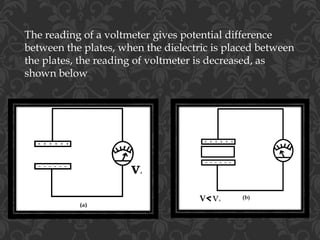
Consider an experimental demonstration
in which a charged capacitor is connected to a
voltmeter.
The reading of a voltmeter gives potential difference
between the plates, when the dielectric is placed between
the plates, the reading of voltmeter is decreased, as
shown below
C = Q/V
Since Q remains constant so, when V decreases the
value of “C” increased.
Cmed = Aєoєr /d (6)
So capacitance depends upon:
 Area
 Separation between plates
 Medium
Divide Eq. (6) by Eq. (5), we get
Cmed /Cvac = єr (7)
Thus dielectric coefficient or dielectric constant is
defined as,
“The Ratio of capacitance of Parallel Plate
capacitor with an insulating substance as a medium
between plates to its capacitance with vacuum as a
medium between them”
Capacitor

Capacitor

  • 3.
  • 4.
    INVENTOR Ewald Georg VonKleist October 1745
  • 5.
    Q: What isCapacitor? “A device used to store electric charge is called a Capacitor”
  • 7.
    It consist oftwo conductors usually in form of Parallel plates placed near to near other and separated byVacuum, air or some dielectric. Such a capacitor is called Parallel plate capacitor.
  • 8.
    When a plateof such capacitor is connected to battery of voltage V, the plate connected to positive terminal gains (+Q) charge and other connected to negative terminal of battery gain (–Q) charge in equal amount. These charges appear on the inner surface of the plates due to attraction.
  • 9.
    Let Q bethe magnitude of the charge on either of the plate. It is found that Q stored by capacitor is directly proportional to the potential difference V, (1) Where C is constant called “Capacitance”
  • 10.
    “The ability ofa capacitor to store charge called Capacitance” Its value depends upon: •The Geometry of Capacitor •Medium between the plates •Separation between the plates From Eq. (1) C=Q/V = Coulomb/volt=Farad
  • 11.
    “The Capacitance ofa capacitor is one Farad,If a charge of one coulomb, given to one plates of parallelplate capacitor; produce a potential difference of one volt between them”
  • 12.
    Consider a parallelplate capacitor consisting of two parallel metallic plates each of area “A” and separated by a distance d. The distance between the plates is small then their size. So the electric field E is uniform and confined in the region between plates. Let air or vacuum be present as a medium between plates. Then capacitance of parallel plate capacitor is given by CVAC = Q/V (1) Where Q is the charge and V is the potential difference Between the plates. Since E is uniform so potential is given by V = Ed (2)
  • 13.
    By electric intensitybetween two oppositely charged plates is given by; E= /єo (3) Putting the value of E in Eq. (2) Then, V= d/єo (4) If Q is the charge on either of the plates of area A, then surface charge density is given by, = Q/A So eq. (4) becomes, V = Qd/Aєo
  • 14.
    Now using thisvalue of V in Eq. (1) we get, CVAC =Q/Qd/Aєo CVAC = QAєo/Qd CVAC =Aєo/d (5)
  • 16.
    Thus capacitance ofparallel plate capacitor depends upon the nature of medium, area of plates, and separation between plates. Capacitance is directly proportional to area of plates and inversely proportional to separation of the plates.
  • 17.
    Dielectric Outside electricfield: The dielectric is originally electrically neutral in the absence of an external electric field. Dielectric Inside electric field: When a dielectric is placed in external electric field, the charges arise as a result of redistribution of positive and negative charges within the dielectric material, the charges are known as induced or polarized charges and phenomenon is called Electric Polarization.
  • 18.
    The increase incapacitance of capacitor is due to polarization of dielectric. The dielectric consists of atoms and molecules having same number of negative and positive charges. In these atoms and molecules, the centers of positive and negative charges coincide with each other. When this dielectric is placed in an electric field between the plates of a capacitor, the negative charges (electrons) are attracted towards the positively charged plate and positive charges (nuclei) towards the negatively charged plate of the capacitor. The electrons in the dielectric are not electrons and nuclei undergo a slight displacement. Due to the displacement, one end of molecule show positive charge and other end has equal amount of negative charges, but as a whole, the molecules are still neutral – Molecule in this case act as a dipole.
  • 19.
    “Two equal andopposite charges separated by a small distance make a dipole” Thus a molecule of a dielectric become dipoles and are said to be dipole. The effect of the polarization of electric is shown, the positively charged plate attracts the positive end of polar molecule. Due to polarization on electric field is setup inside and outside the dielectric charge reduces from plates so the surface charge density also reduces. = Q/A As surface charge density reduces then electric field intensity is E = /єo So the net external electric field between the plates of is reduced & decrease to potential difference, E = V/d C = Q/V
  • 20.
    Since “Q” remainsconstant so, when V decreases the value of “C” increases, Thus the polarization of dielectric increases the capacitance of capacitor.
  • 21.
    In an insulatingmaterial called dielectric of relative permittivity “єr “is inserted between plates. Then the capacitance of a capacitor is increased by the factor єr called Dielectric Constant. Consider an experimental demonstration in which a charged capacitor is connected to a voltmeter.
  • 22.
    The reading ofa voltmeter gives potential difference between the plates, when the dielectric is placed between the plates, the reading of voltmeter is decreased, as shown below
  • 23.
    C = Q/V SinceQ remains constant so, when V decreases the value of “C” increased. Cmed = Aєoєr /d (6) So capacitance depends upon:  Area  Separation between plates  Medium Divide Eq. (6) by Eq. (5), we get Cmed /Cvac = єr (7) Thus dielectric coefficient or dielectric constant is defined as, “The Ratio of capacitance of Parallel Plate capacitor with an insulating substance as a medium between plates to its capacitance with vacuum as a medium between them”