Unit-2Unit-2
MagnetostaticsMagnetostatics
Mr. HIMANSHU DIWAKAR
Assistant Professor
Department of ECE
If charges are moving with constant velocity, a static
magnetic (or magnetostatic) field is produced. Thus,
magnetostatic fields originate from currents (for
instance, direct currents in current-carrying wires).
Most of the equations we have derived for the electric
fields may be readily used to obtain corresponding
equations for magnetic fields if the equivalent
analogous quantities are substituted.
MagnetostaticsMagnetostatics
π
=
4
1
k
The magnetic field intensity dH
produced at a point P by the
differential current element Idl is
proportional to the product of Idl
and the sine of the angle
between the element and the line
joining P to the element and is
inversely proportional to the
square of the distance R between
P and the element.IN SI units, , so
α
2
R
sinIdl
kdH
α
=
2
R4
sinIdl
kdH
π
α
=
MagnetostaticsMagnetostatics
Biot – Savart’s Law
Using the definition of cross product
we can represent the previous equation in vector form as
The direction of can be determined by the right-hand rule
or by the right-handed screw rule.
If the position of the field point is specified by and the
position of the source point by
where is the unit vector directed from the source point to
the field point, and is the distance between these two
points.
)sin( nABaABBA θ=×
32
44 R
RdlI
R
adlI
Hd r
ππ
×
=
×
= RR = R
Rar =
r′
rre ′
rr ′−
r
32
4
)]([
4
)(
rr
rrdlI
rr
adlI
Hd r
′−
′−×
=
′−
×
=
ππ
Hd
MagnetostaticsMagnetostatics
The field
produced by a
wire can be found
adding up the
fields produced
by a large number
of current
elements placed
head to tail along
the wire (the
principle of
superposition).
MagnetostaticsMagnetostatics
Types of Current Distributions
 Line current density (current) - occurs for infinitesimally
thin filamentary bodies (i.e., wires of negligible diameter).
 Surface current density (current per unit width) - occurs
when body is perfectly conducting.
 Volume current density (current per unit cross sectional
area) - most general.
GETGI
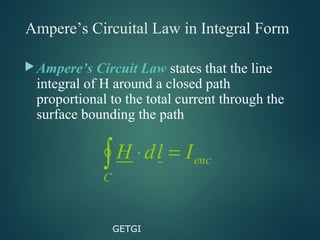
Ampere’s Circuital Law in Integral Form
Ampere’s Circuit Law states that the line
integral of H around a closed path
proportional to the total current through the
surface bounding the path
GETGI
enc
C
IldH =⋅∫
Ampere’s Circuital Law in Integral Form
(Cont’d)
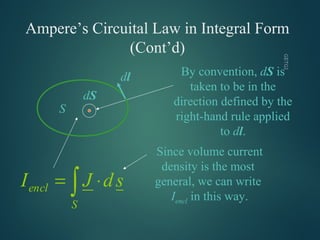
By convention, dS is
taken to be in the
direction defined by the
right-hand rule applied
to dl.
∫ ⋅=
S
encl sdJI
Since volume current
density is the most
general, we can write
Iencl in this way.
S
dl
dS
Applying Stokes’s Theorem to Ampere’s
Law
GETGI
∫
∫∫
⋅==
⋅×∇=⋅
S
encl
SC
sdJI
sdHldH
⇒ Because the above must hold for any
surface S, we must have
JH =×∇ Differential form
of Ampere’s Law
Ampere’s Law in Differential Form
Ampere’s law in differential form
implies that the B-field is
conservative outside of regions
where current is flowing.
GETGI
Applications of Ampere’s Law
 Ampere’s law in integral form is an integral equation
for the unknown magnetic flux density resulting from
a given current distribution.
GETGI
encl
C
IldH =⋅∫
known
unknown
Applications of Ampere’s Law
(Cont’d)
In general, solutions to integral equations
must be obtained using numerical
techniques.
However, for certain symmetric current
distributions closed form solutions to
Ampere’s law can be obtained.
GETGI
Applications of Ampere’s Law
(Cont’d)
 Closed form solution to Ampere’s law relies on our
ability to construct a suitable family of Amperian paths.
 An Amperian path is a closed contour to which the
magnetic flux density is tangential and over which equal
to a constant value.
GETGI
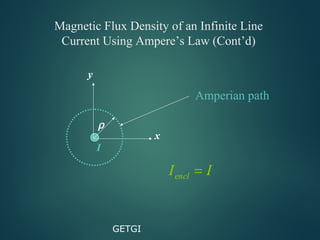
Magnetic Flux Density of an Infinite Line
Current Using Ampere’s Law
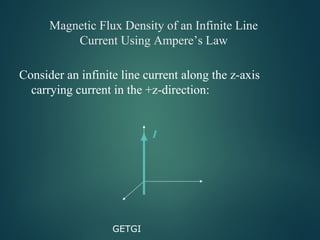
Consider an infinite line current along the z-axis
carrying current in the +z-direction:
GETGI
I
Magnetic Flux Density of an Infinite Line
Current Using Ampere’s Law (Cont’d)
(1) Assume from symmetry and the right-hand rule the
form of the field
(2) Construct a family of Amperian paths
GETGI
φφ HaH ˆ=
circles of radius ρ where
∞≤≤ ρ0
Magnetic Flux Density of an Infinite Line
Current Using Ampere’s Law (Cont’d)
GETGI
Amperian path
IIencl =
I
ρ
x
y
Magnetic Flux Density of an Infinite Line Current
Using Ampere’s Law (Cont’d)
(4) For each Amperian path, evaluate the integral
GETGI
HlldH
C
=⋅∫
ρπφ 2HldH
C
=⋅∫
magnitude of H
on Amperian
path.
length
of Amperian
path.
Magnetic Flux Density of an Infinite Line Current
Using Ampere’s Law (Cont’d)
(5) Solve for B on each Amperian path
GETGI
l
I
H encl
=
ρπ
φ
2
ˆ
I
aH =
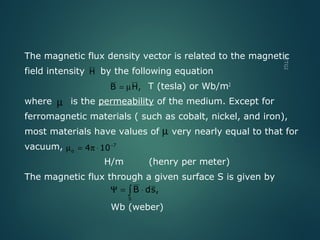
The magnetic flux density vector is related to the magnetic
field intensity by the following equation
T (tesla) or Wb/m2
where is the permeability of the medium. Except for
ferromagnetic materials ( such as cobalt, nickel, and iron),
most materials have values of very nearly equal to that for
vacuum,
H/m (henry per meter)
The magnetic flux through a given surface S is given by
Wb (weber)
H
,HB µ=
µ
7
o 104 −
⋅π=µ
∫ ⋅=Ψ
S
,sdB
µ
0=•∫s
sdB
Law of conservation of magnetic flux
Law of conservation of
magnetic flux or Gauss’s
law for magnetostatic field
JB
B
0
0
µ=×∇
=•∇
0=•∇ J
There are no magnetic flow sources, and
the magnetic flux lines always close upon
themselves
Forces due to magnetic field
There are three ways in which force due to magnetic
fields can be experienced
1.Due to moving charge particle in a B field
2.On a current element in an external field
3.Between two current elements
Force on a Moving Charge
 A moving point charge placed in a magnetic field
experiences a force given by
GETGI
BvQ
The force experienced
by the point charge is
in the direction into the
paper.
B
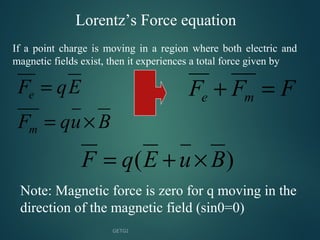
BuqFm ×=
BuqF
EqF
m
e
×=
= FFF me =+
)( BuEqF ×+=
Lorentz’s Force equation
Note: Magnetic force is zero for q moving in the
direction of the magnetic field (sin0=0)
If a point charge is moving in a region where both electric and
magnetic fields exist, then it experiences a total force given by
One can tell if a magneto-static field is present because it
exerts forces on moving charges and on currents. If a current
element is located in a magnetic field , it experiences a
force
This force, acting on current element , is in a direction
perpendicular to the current element and also perpendicular
to . It is largest when and the wire are perpendicular.
Idl B
dF=Idl×B
B
Idl
B
__
uQlId ⇔
Magnetic Force on a current element
FORCE ON A CURRENT ELEMENT
 The total force exerted on a circuit C carrying current I
that is immersed in a magnetic flux density B is given
by
GETGI
∫ ×=
C
BldIF
Force between two current
elements
 Experimental facts:
 Two parallel wires carrying
current in the same
direction attract.
 Two parallel wires carrying
current in the opposite
directions repel.
GETGI
× ×
I1 I2
F12F21
× •
I1 I2
F12F21
Force between two current
elements
 Experimental facts:
 A short current-carrying wire
oriented perpendicular to a
long current-carrying wire
experiences no force.
GETGI
×
I1
F12 = 0
I2
Force between two current
elements
 Experimental facts:
 The magnitude of the force is inversely proportional
to the distance squared.
 The magnitude of the force is proportional to the
product of the currents carried by the two wires.
GETGI

Magnetostatics 3rd 1

  • 1.
  • 2.
    If charges aremoving with constant velocity, a static magnetic (or magnetostatic) field is produced. Thus, magnetostatic fields originate from currents (for instance, direct currents in current-carrying wires). Most of the equations we have derived for the electric fields may be readily used to obtain corresponding equations for magnetic fields if the equivalent analogous quantities are substituted. MagnetostaticsMagnetostatics
  • 3.
    π = 4 1 k The magnetic fieldintensity dH produced at a point P by the differential current element Idl is proportional to the product of Idl and the sine of the angle between the element and the line joining P to the element and is inversely proportional to the square of the distance R between P and the element.IN SI units, , so α 2 R sinIdl kdH α = 2 R4 sinIdl kdH π α = MagnetostaticsMagnetostatics Biot – Savart’s Law
  • 4.
    Using the definitionof cross product we can represent the previous equation in vector form as The direction of can be determined by the right-hand rule or by the right-handed screw rule. If the position of the field point is specified by and the position of the source point by where is the unit vector directed from the source point to the field point, and is the distance between these two points. )sin( nABaABBA θ=× 32 44 R RdlI R adlI Hd r ππ × = × = RR = R Rar = r′ rre ′ rr ′− r 32 4 )]([ 4 )( rr rrdlI rr adlI Hd r ′− ′−× = ′− × = ππ Hd MagnetostaticsMagnetostatics
  • 5.
    The field produced bya wire can be found adding up the fields produced by a large number of current elements placed head to tail along the wire (the principle of superposition). MagnetostaticsMagnetostatics
  • 6.
    Types of CurrentDistributions  Line current density (current) - occurs for infinitesimally thin filamentary bodies (i.e., wires of negligible diameter).  Surface current density (current per unit width) - occurs when body is perfectly conducting.  Volume current density (current per unit cross sectional area) - most general. GETGI
  • 7.
    Ampere’s Circuital Lawin Integral Form Ampere’s Circuit Law states that the line integral of H around a closed path proportional to the total current through the surface bounding the path GETGI enc C IldH =⋅∫
  • 8.
    Ampere’s Circuital Lawin Integral Form (Cont’d) By convention, dS is taken to be in the direction defined by the right-hand rule applied to dl. ∫ ⋅= S encl sdJI Since volume current density is the most general, we can write Iencl in this way. S dl dS
  • 9.
    Applying Stokes’s Theoremto Ampere’s Law GETGI ∫ ∫∫ ⋅== ⋅×∇=⋅ S encl SC sdJI sdHldH ⇒ Because the above must hold for any surface S, we must have JH =×∇ Differential form of Ampere’s Law
  • 10.
    Ampere’s Law inDifferential Form Ampere’s law in differential form implies that the B-field is conservative outside of regions where current is flowing. GETGI
  • 11.
    Applications of Ampere’sLaw  Ampere’s law in integral form is an integral equation for the unknown magnetic flux density resulting from a given current distribution. GETGI encl C IldH =⋅∫ known unknown
  • 12.
    Applications of Ampere’sLaw (Cont’d) In general, solutions to integral equations must be obtained using numerical techniques. However, for certain symmetric current distributions closed form solutions to Ampere’s law can be obtained. GETGI
  • 13.
    Applications of Ampere’sLaw (Cont’d)  Closed form solution to Ampere’s law relies on our ability to construct a suitable family of Amperian paths.  An Amperian path is a closed contour to which the magnetic flux density is tangential and over which equal to a constant value. GETGI
  • 14.
    Magnetic Flux Densityof an Infinite Line Current Using Ampere’s Law Consider an infinite line current along the z-axis carrying current in the +z-direction: GETGI I
  • 15.
    Magnetic Flux Densityof an Infinite Line Current Using Ampere’s Law (Cont’d) (1) Assume from symmetry and the right-hand rule the form of the field (2) Construct a family of Amperian paths GETGI φφ HaH ˆ= circles of radius ρ where ∞≤≤ ρ0
  • 16.
    Magnetic Flux Densityof an Infinite Line Current Using Ampere’s Law (Cont’d) GETGI Amperian path IIencl = I ρ x y
  • 17.
    Magnetic Flux Densityof an Infinite Line Current Using Ampere’s Law (Cont’d) (4) For each Amperian path, evaluate the integral GETGI HlldH C =⋅∫ ρπφ 2HldH C =⋅∫ magnitude of H on Amperian path. length of Amperian path.
  • 18.
    Magnetic Flux Densityof an Infinite Line Current Using Ampere’s Law (Cont’d) (5) Solve for B on each Amperian path GETGI l I H encl = ρπ φ 2 ˆ I aH =
  • 19.
    The magnetic fluxdensity vector is related to the magnetic field intensity by the following equation T (tesla) or Wb/m2 where is the permeability of the medium. Except for ferromagnetic materials ( such as cobalt, nickel, and iron), most materials have values of very nearly equal to that for vacuum, H/m (henry per meter) The magnetic flux through a given surface S is given by Wb (weber) H ,HB µ= µ 7 o 104 − ⋅π=µ ∫ ⋅=Ψ S ,sdB µ
  • 20.
    0=•∫s sdB Law of conservationof magnetic flux Law of conservation of magnetic flux or Gauss’s law for magnetostatic field
  • 21.
  • 22.
    There are nomagnetic flow sources, and the magnetic flux lines always close upon themselves
  • 23.
    Forces due tomagnetic field There are three ways in which force due to magnetic fields can be experienced 1.Due to moving charge particle in a B field 2.On a current element in an external field 3.Between two current elements
  • 24.
    Force on aMoving Charge  A moving point charge placed in a magnetic field experiences a force given by GETGI BvQ The force experienced by the point charge is in the direction into the paper. B BuqFm ×=
  • 25.
    BuqF EqF m e ×= = FFF me=+ )( BuEqF ×+= Lorentz’s Force equation Note: Magnetic force is zero for q moving in the direction of the magnetic field (sin0=0) If a point charge is moving in a region where both electric and magnetic fields exist, then it experiences a total force given by
  • 26.
    One can tellif a magneto-static field is present because it exerts forces on moving charges and on currents. If a current element is located in a magnetic field , it experiences a force This force, acting on current element , is in a direction perpendicular to the current element and also perpendicular to . It is largest when and the wire are perpendicular. Idl B dF=Idl×B B Idl B __ uQlId ⇔ Magnetic Force on a current element
  • 27.
    FORCE ON ACURRENT ELEMENT  The total force exerted on a circuit C carrying current I that is immersed in a magnetic flux density B is given by GETGI ∫ ×= C BldIF
  • 28.
    Force between twocurrent elements  Experimental facts:  Two parallel wires carrying current in the same direction attract.  Two parallel wires carrying current in the opposite directions repel. GETGI × × I1 I2 F12F21 × • I1 I2 F12F21
  • 29.
    Force between twocurrent elements  Experimental facts:  A short current-carrying wire oriented perpendicular to a long current-carrying wire experiences no force. GETGI × I1 F12 = 0 I2
  • 30.
    Force between twocurrent elements  Experimental facts:  The magnitude of the force is inversely proportional to the distance squared.  The magnitude of the force is proportional to the product of the currents carried by the two wires. GETGI