Chapter 24
Capacitors and Dielectrics
What is Capacitance?
• Capacitance (C) is equal to the Charge (Q ) between two charges or
charged “regions” divided by the Voltage (V) in those regions.
• Here we assume equal and opposite charges (Q)
• Thus C = Q/V or Q = CV or V=Q/C
• The units of Capacitance are “Farads” after Faraday denoted F or f
• One Farad is one Volt per Coulomb
• One Farad is a large capacitance in the world of electronics
• “Capacitors” are electronic elements capable of storing charge
• Capacitors are very common in electronic devices
• All cell phones, PDA’s, computers, radio, TV’s … have them
• More common units for practical capacitors are micro-farad (10-6 f =
μf), nano-farad (10-9 f = nf) and pico-farads (10-12 f = pf)
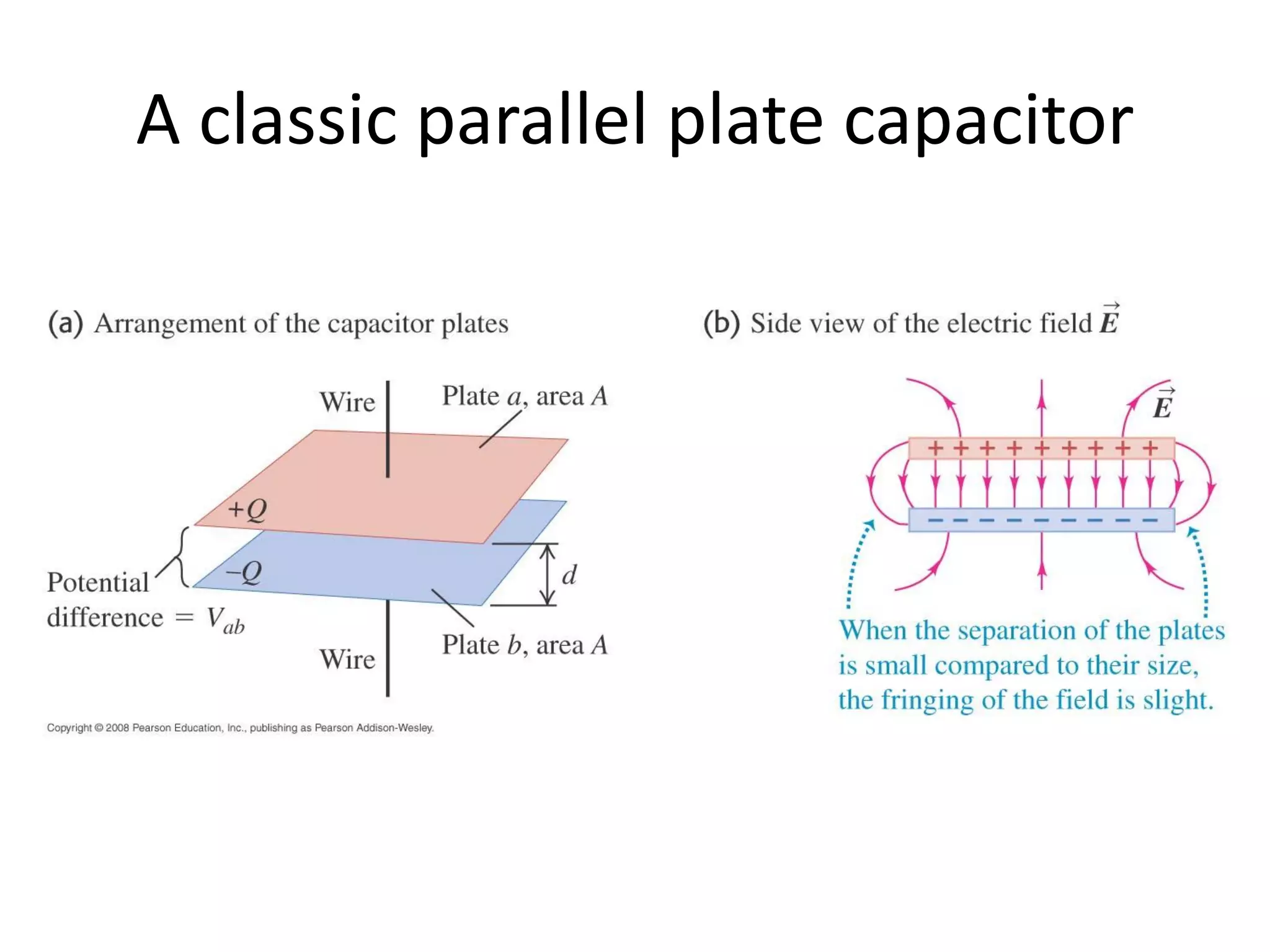
A classic parallel plate capacitor
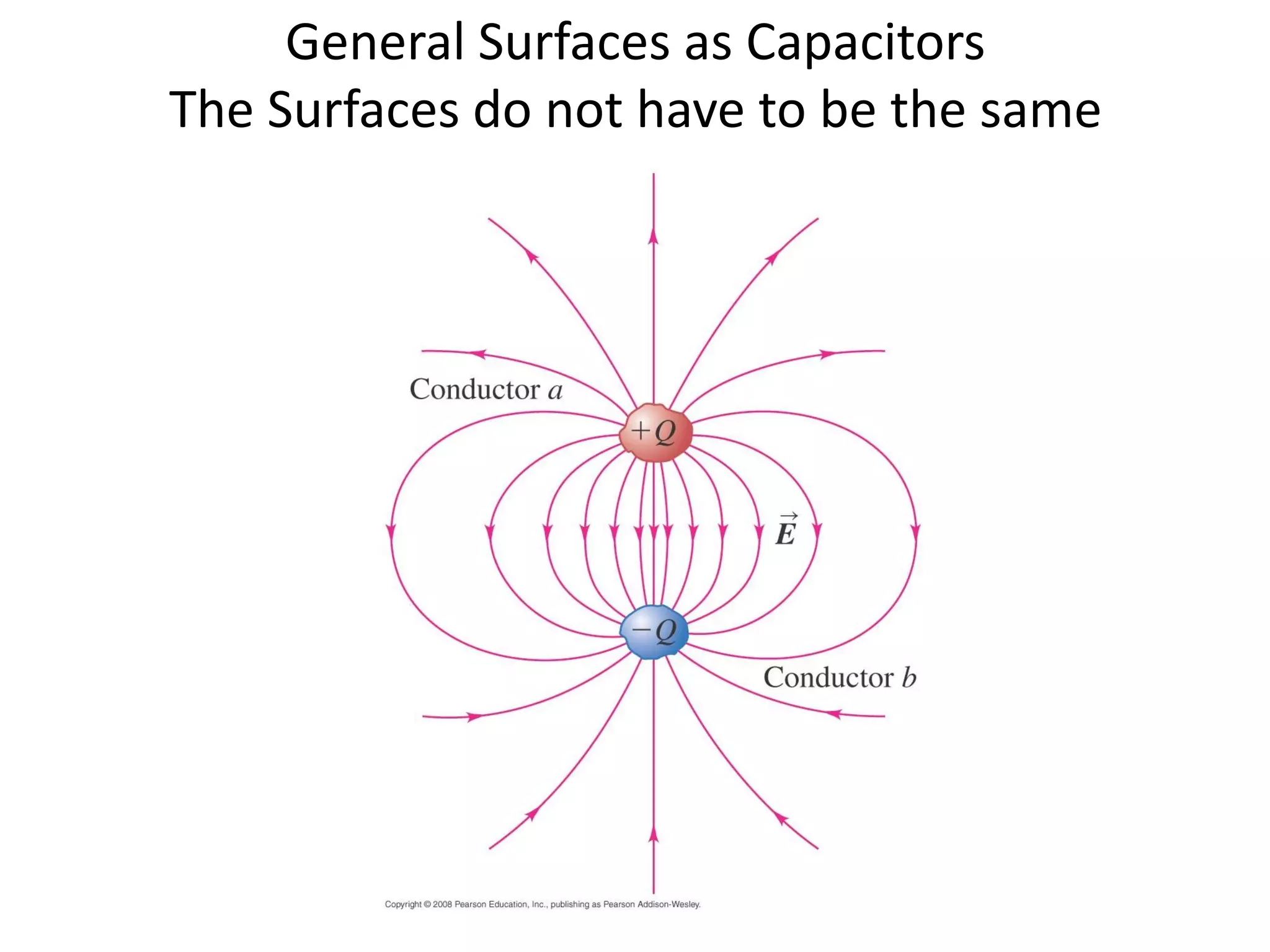
General Surfaces as Capacitors
The Surfaces do not have to be the same
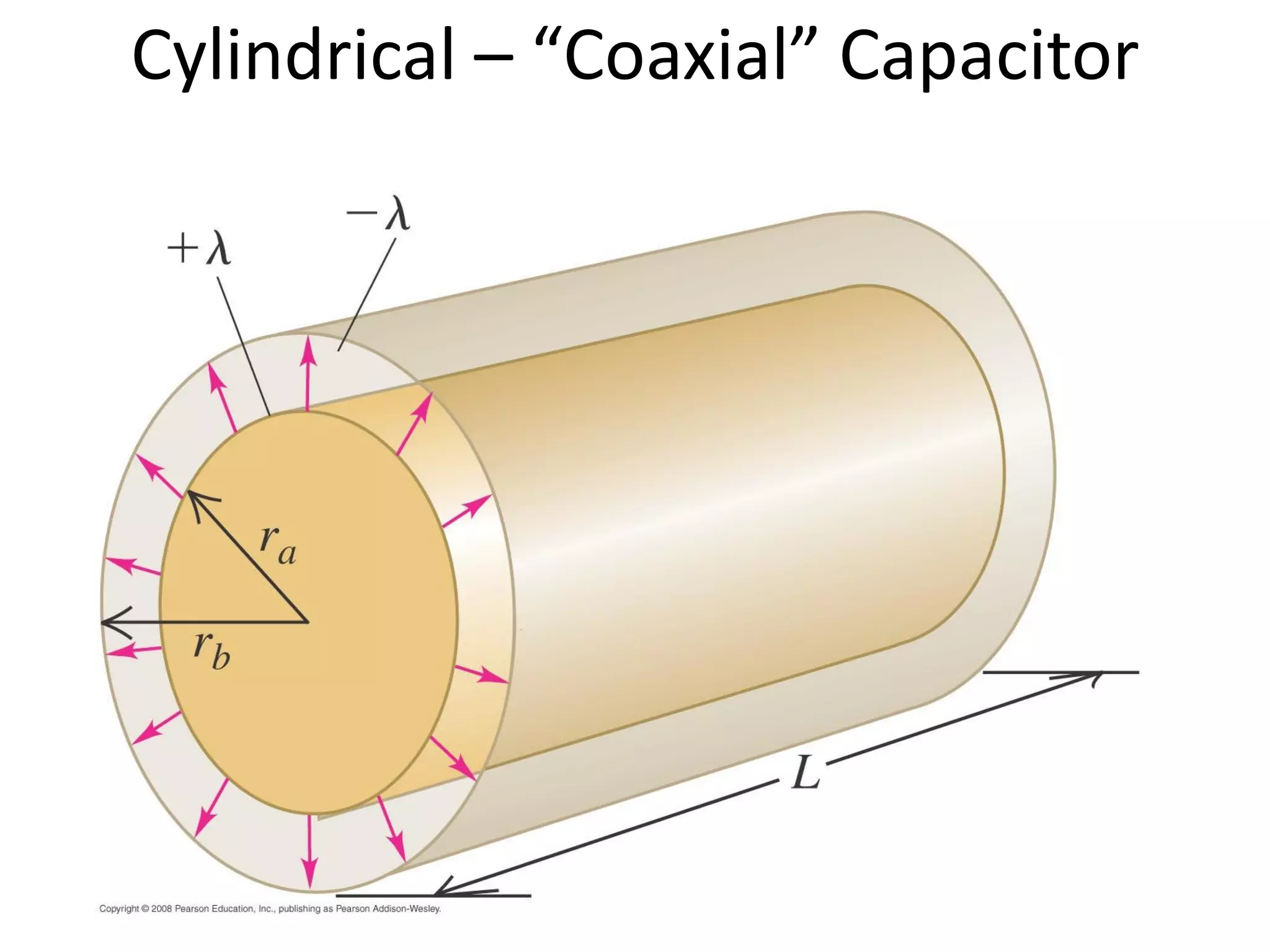
Cylindrical – “Coaxial” Capacitor
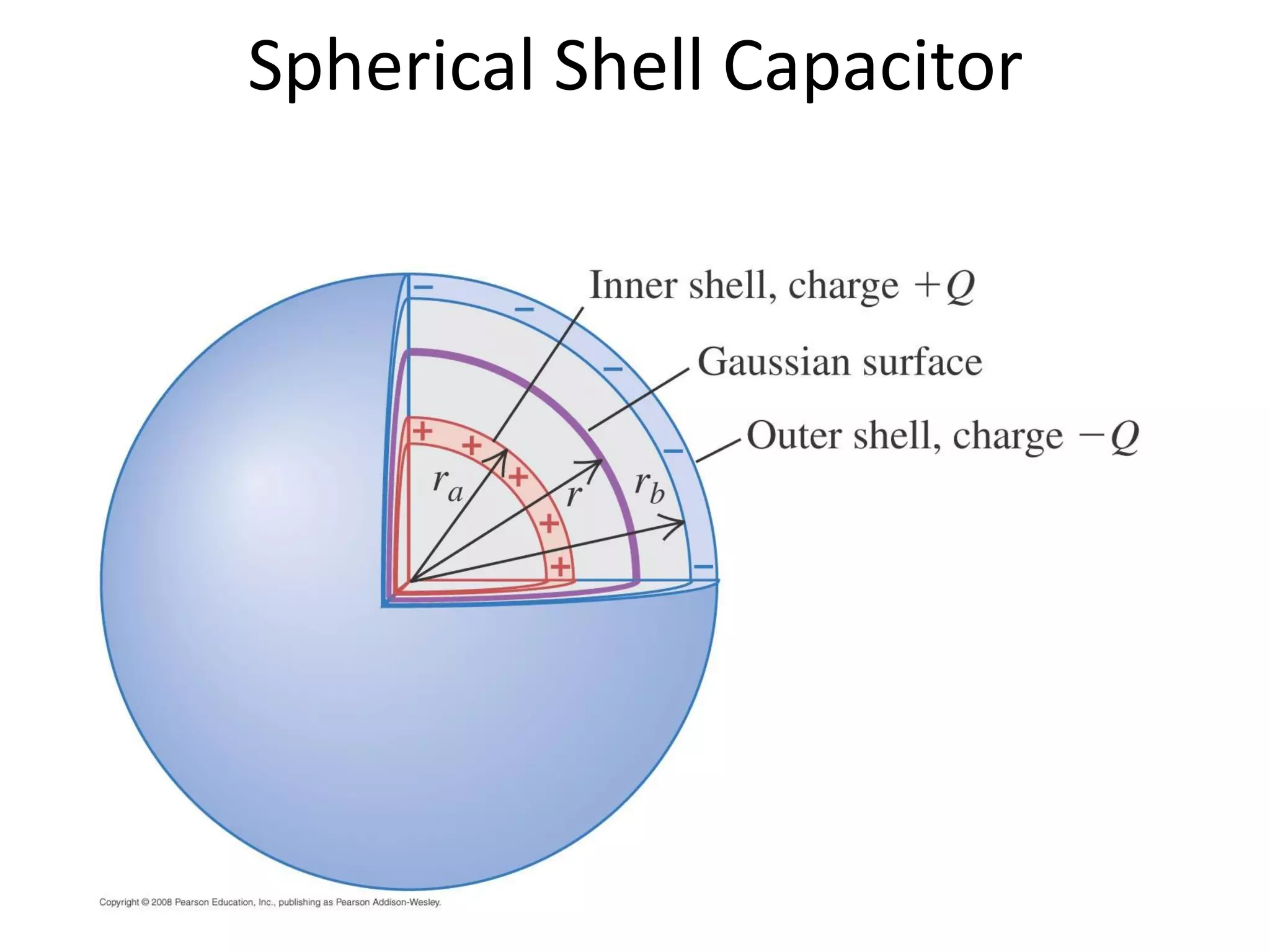
Spherical Shell Capacitor
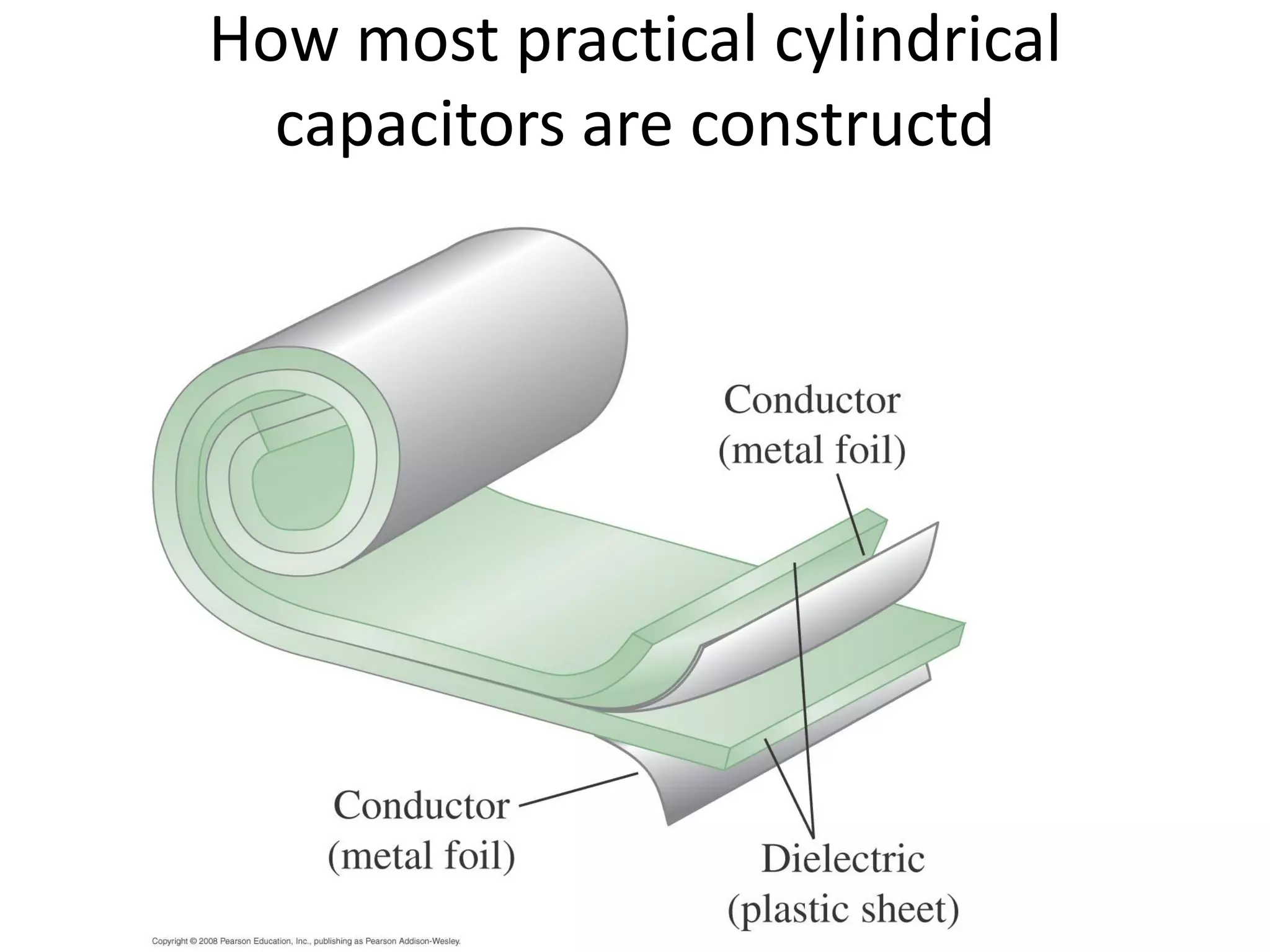
How most practical cylindrical
capacitors are constructd
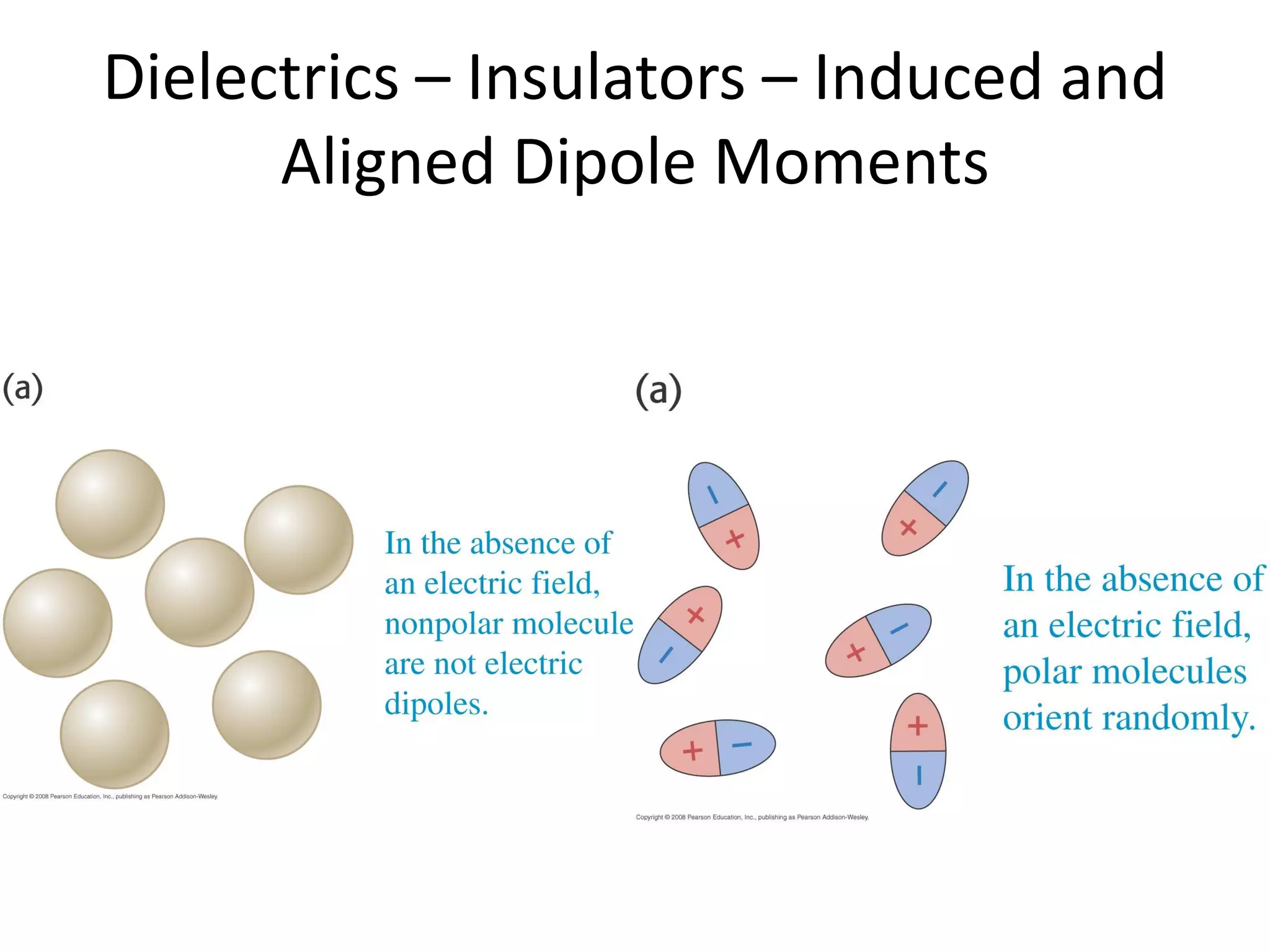
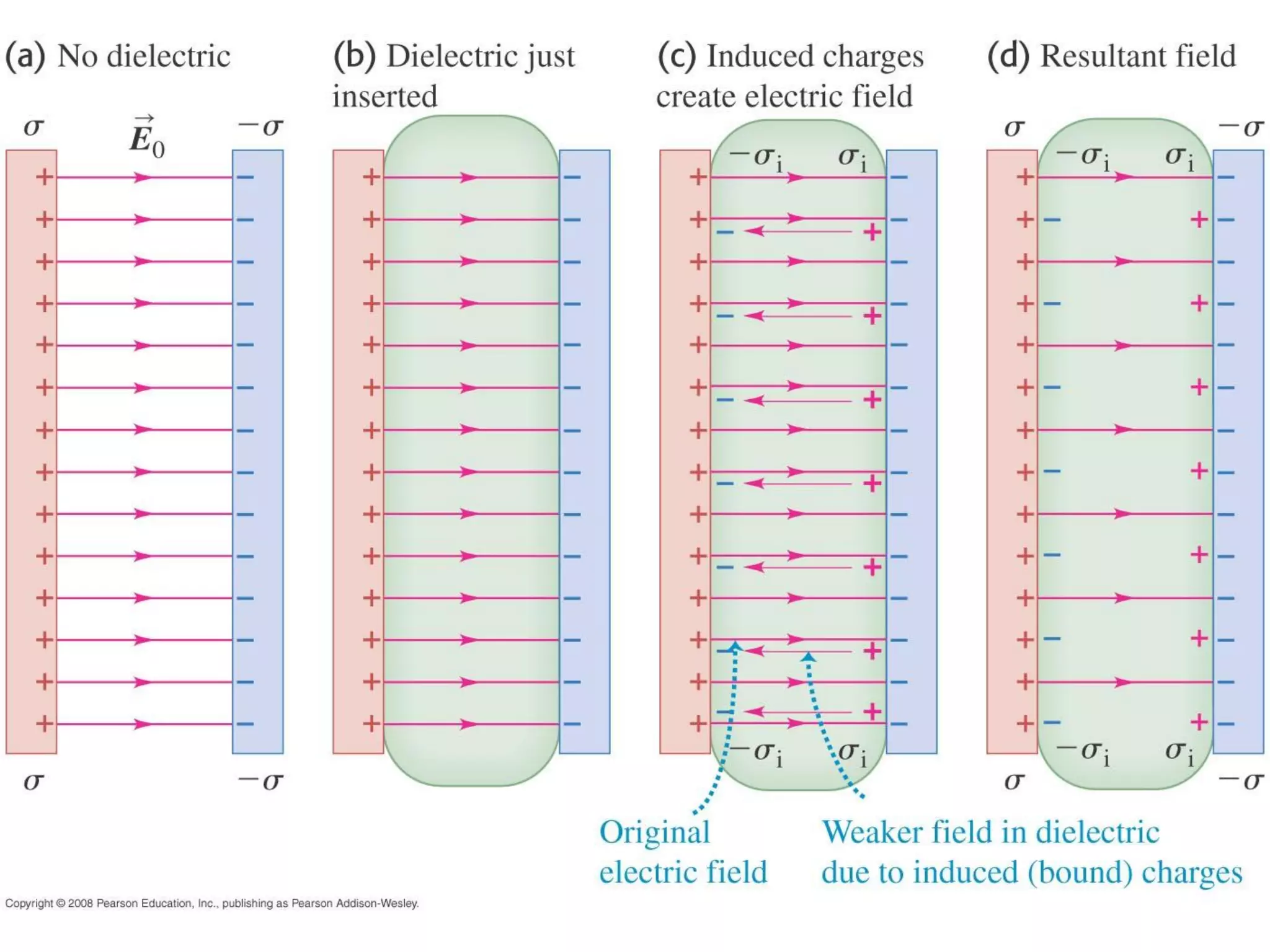
Dielectrics – Insulators – Induced and
Aligned Dipole Moments
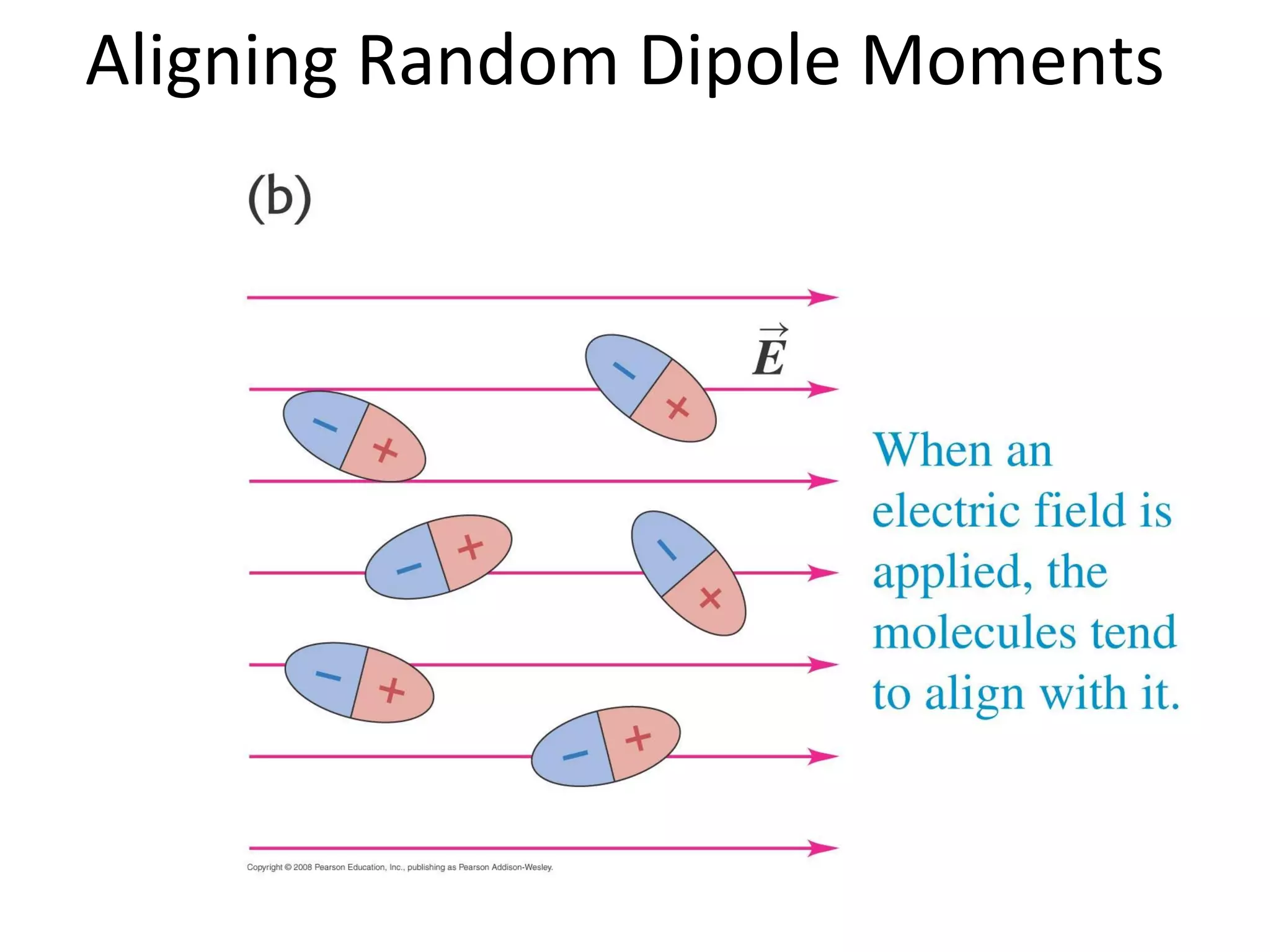
Aligning Random Dipole Moments
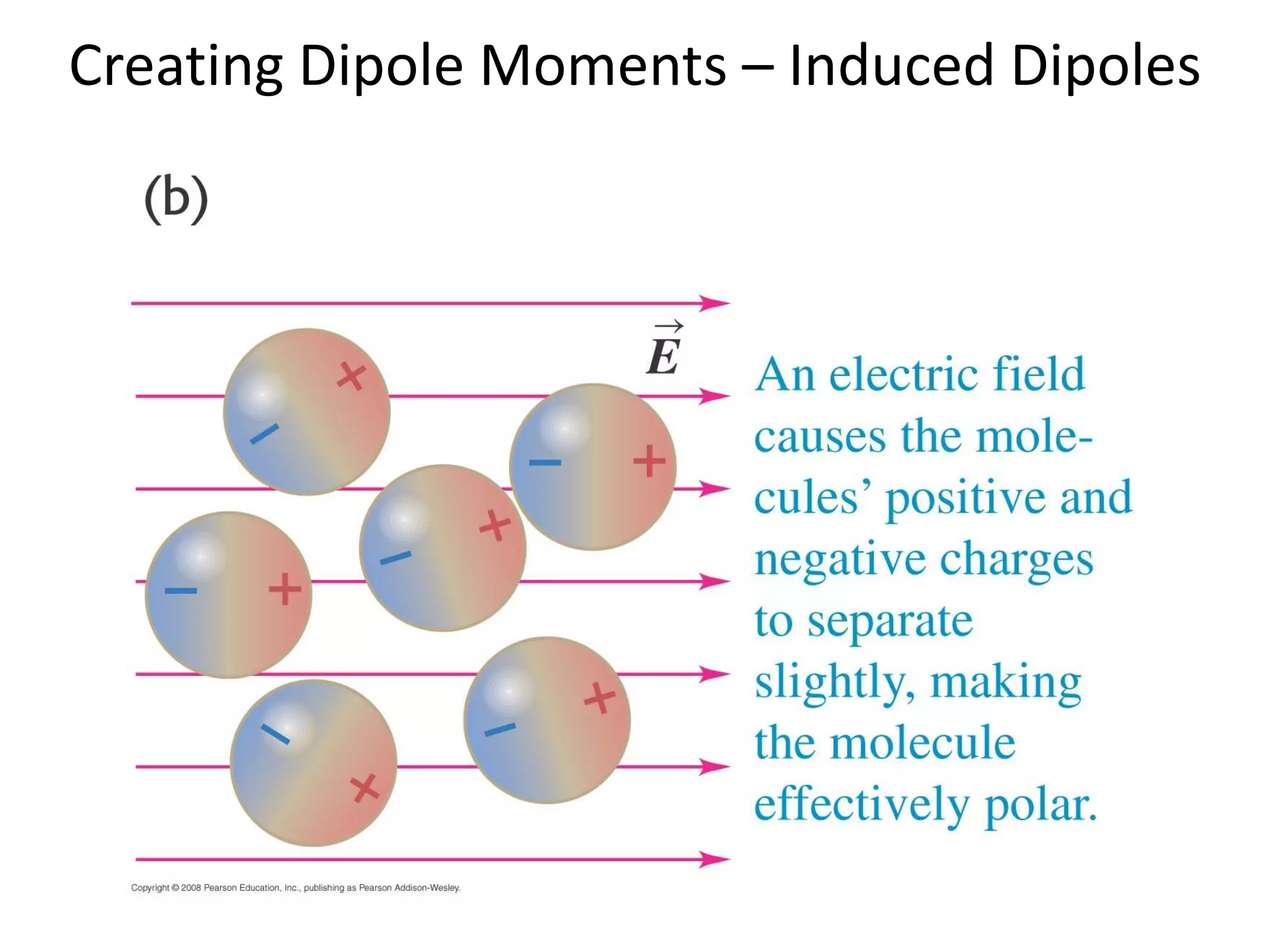
Creating Dipole Moments – Induced Dipoles
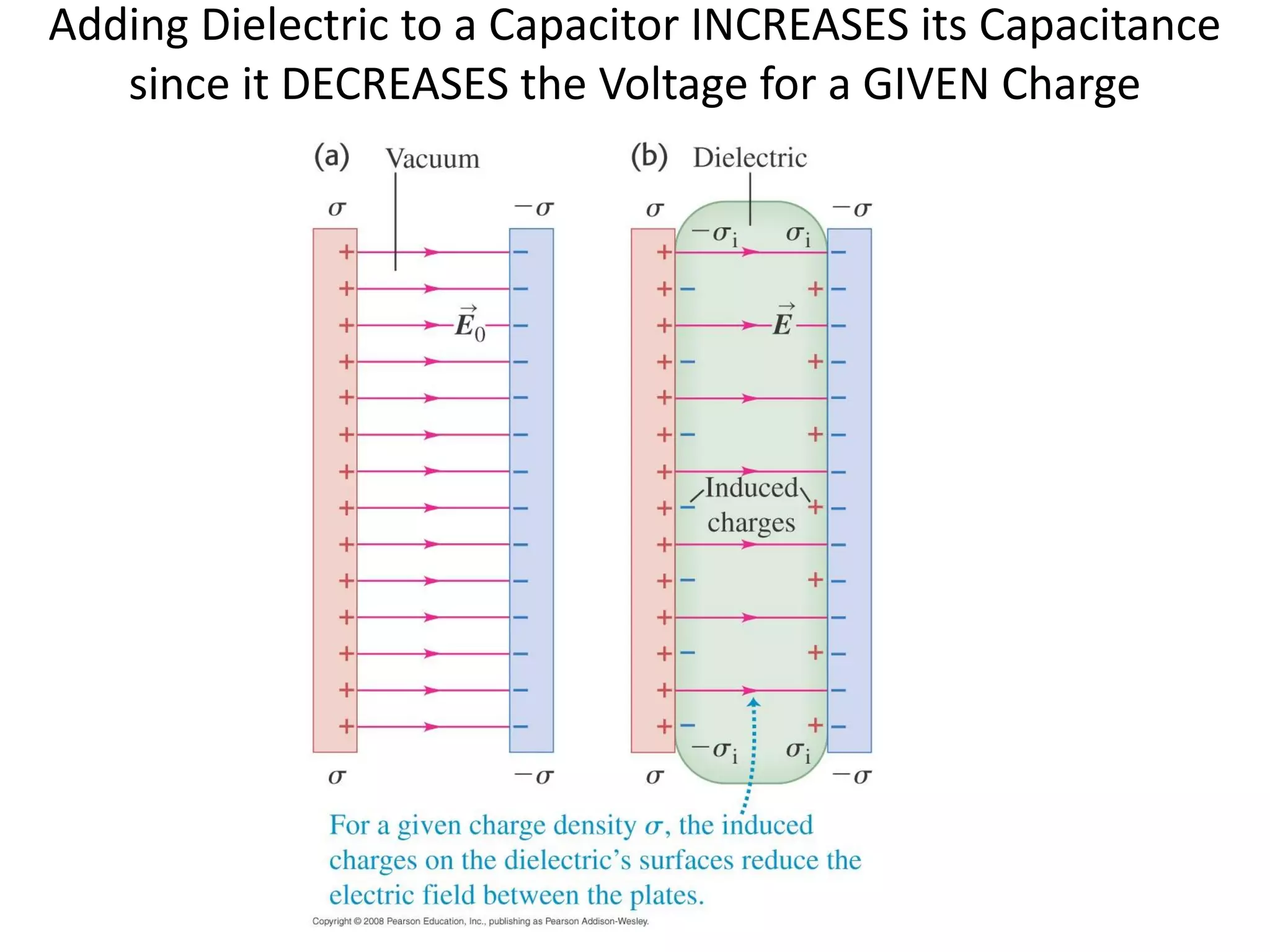
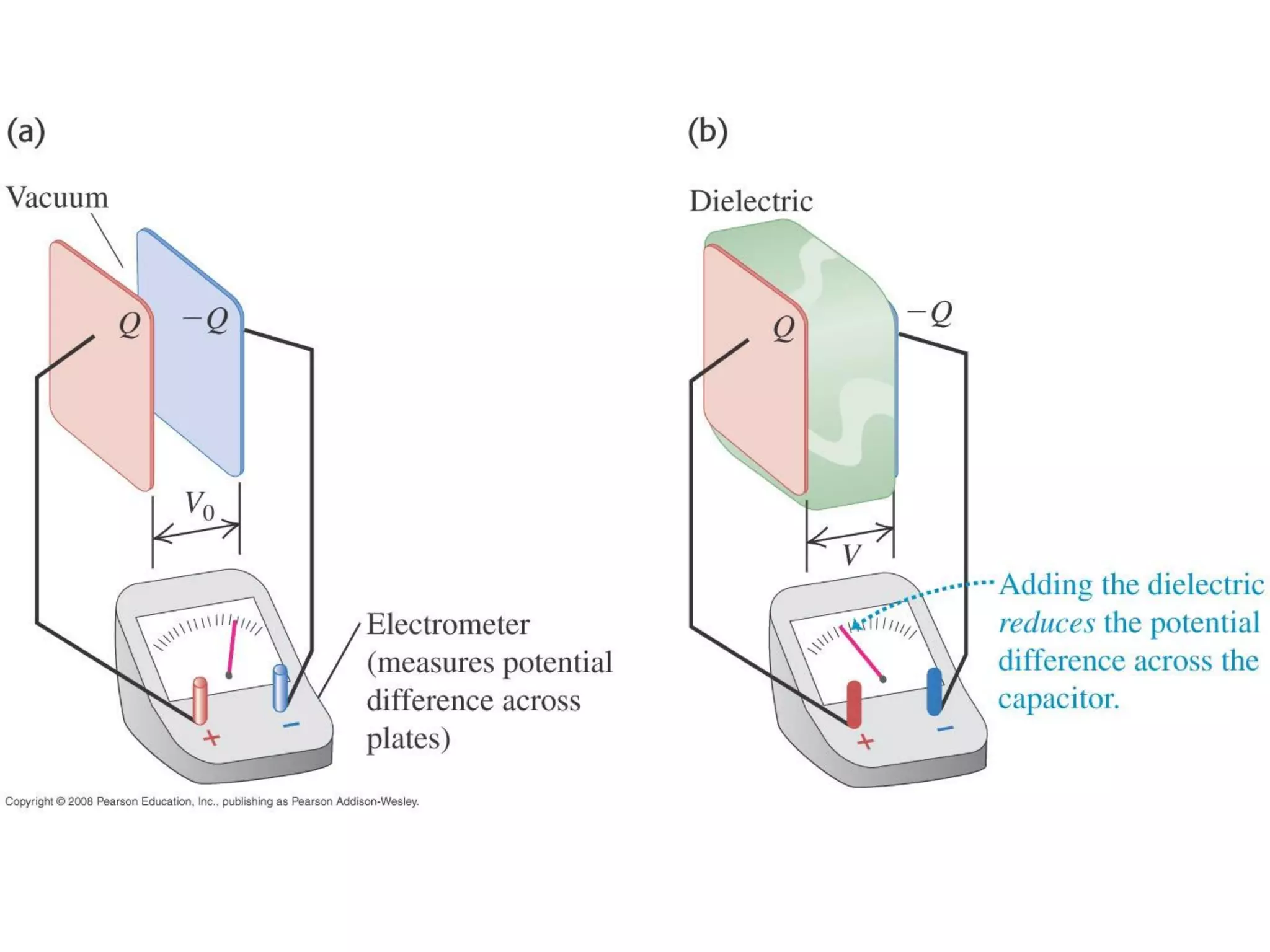
Adding Dielectric to a Capacitor INCREASES its Capacitance
since it DECREASES the Voltage for a GIVEN Charge
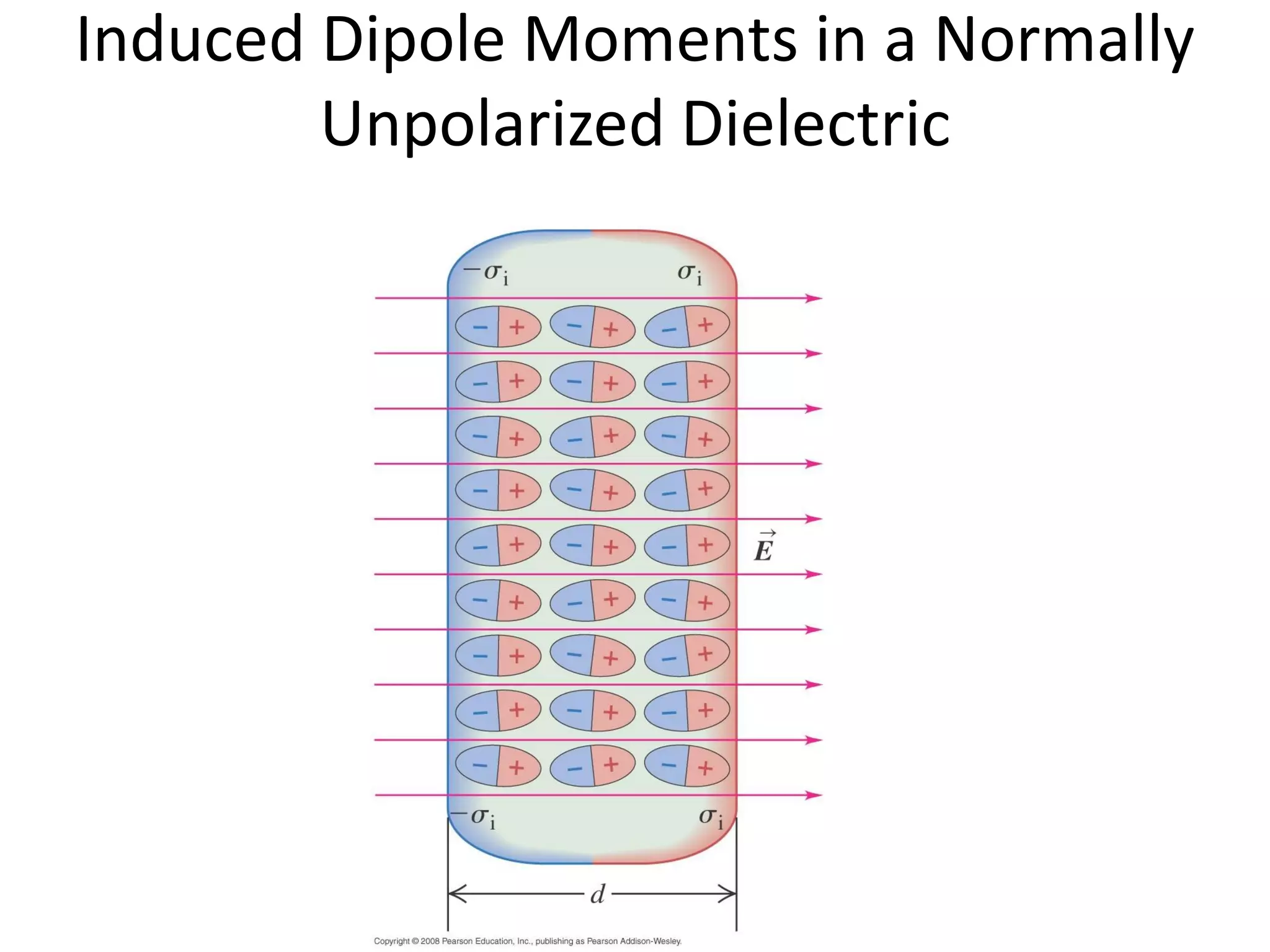
Induced Dipole Moments in a Normally
Unpolarized Dielectric
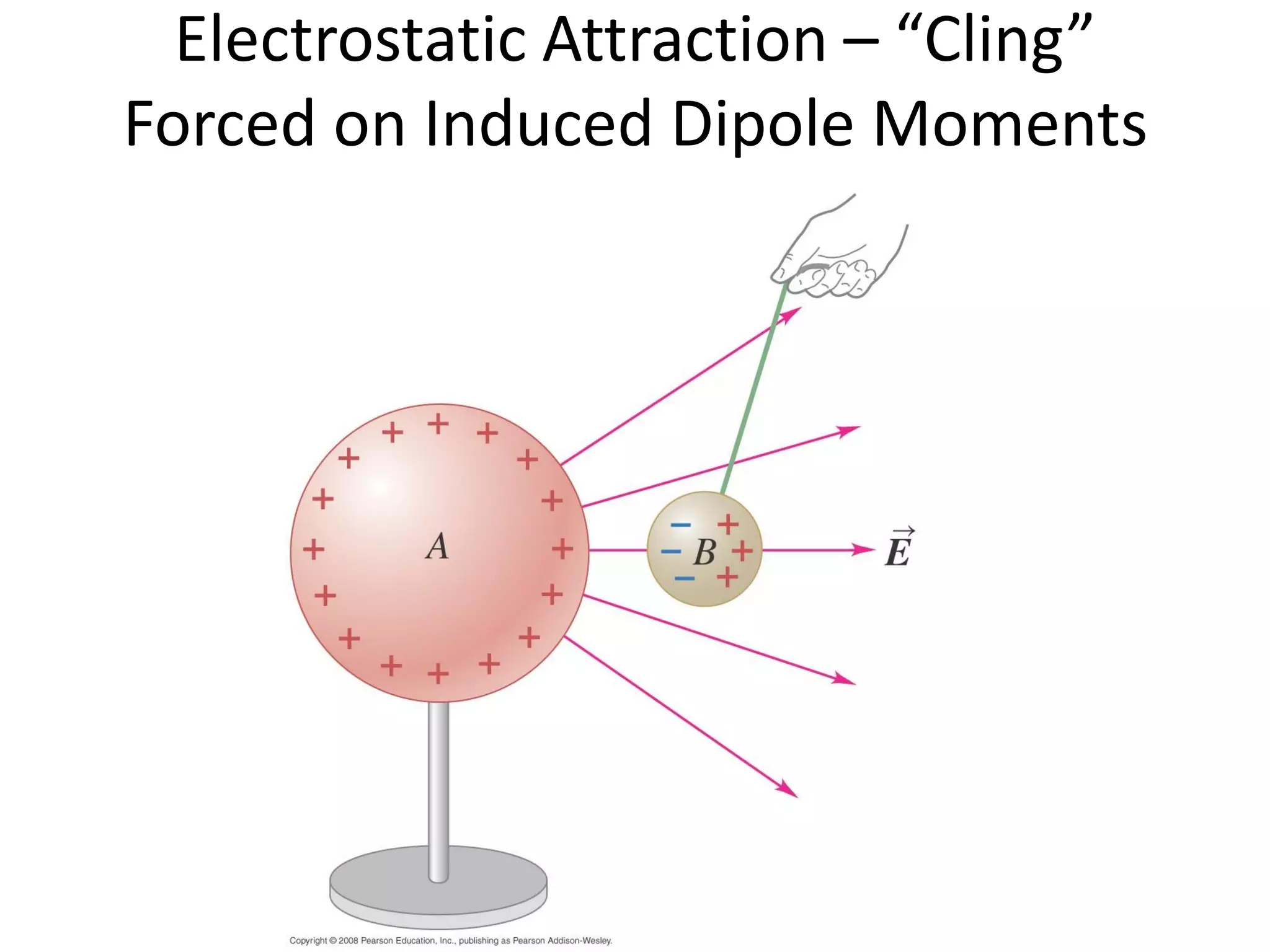
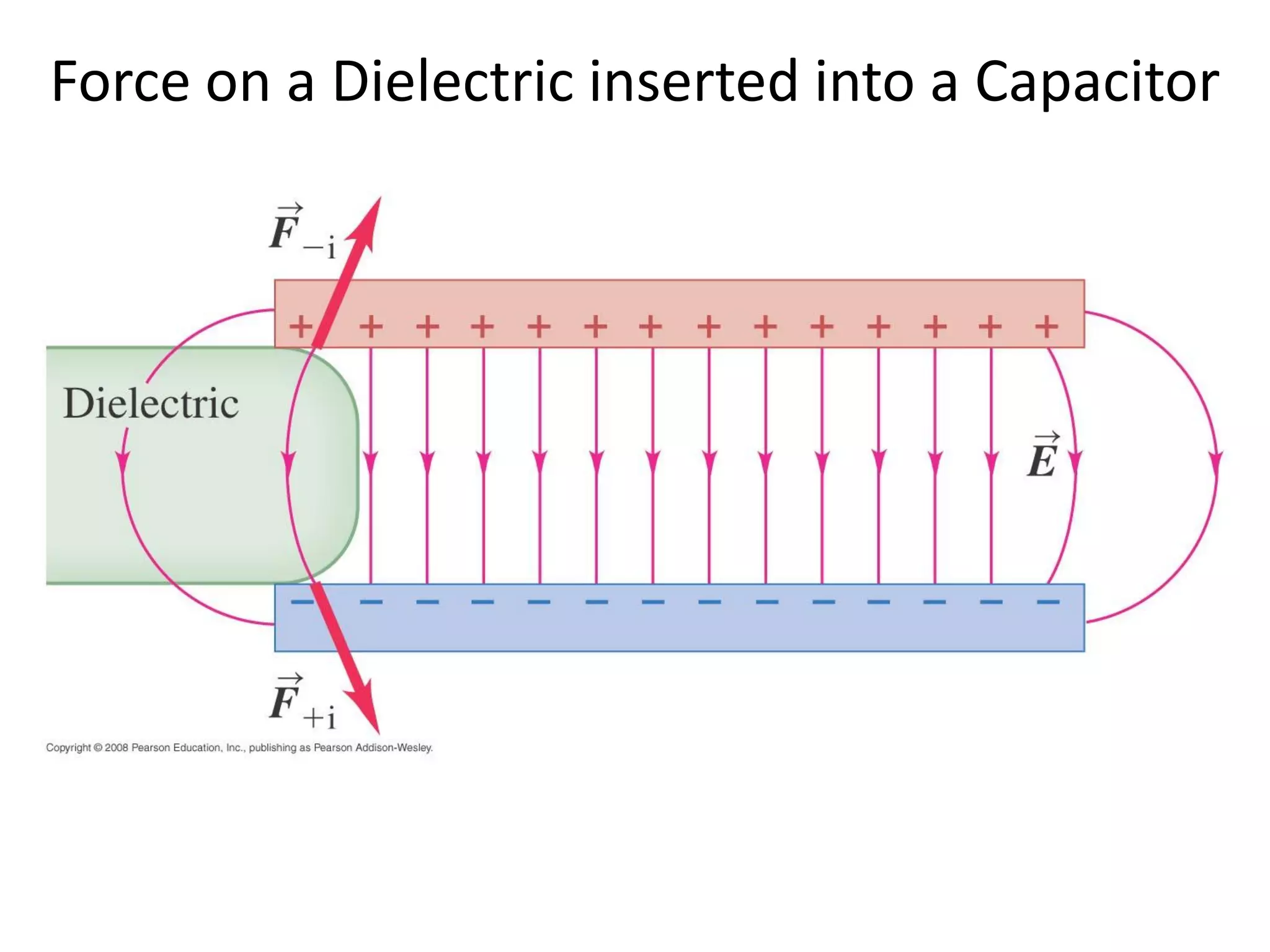
Electrostatic Attraction – “Cling”
Forced on Induced Dipole Moments
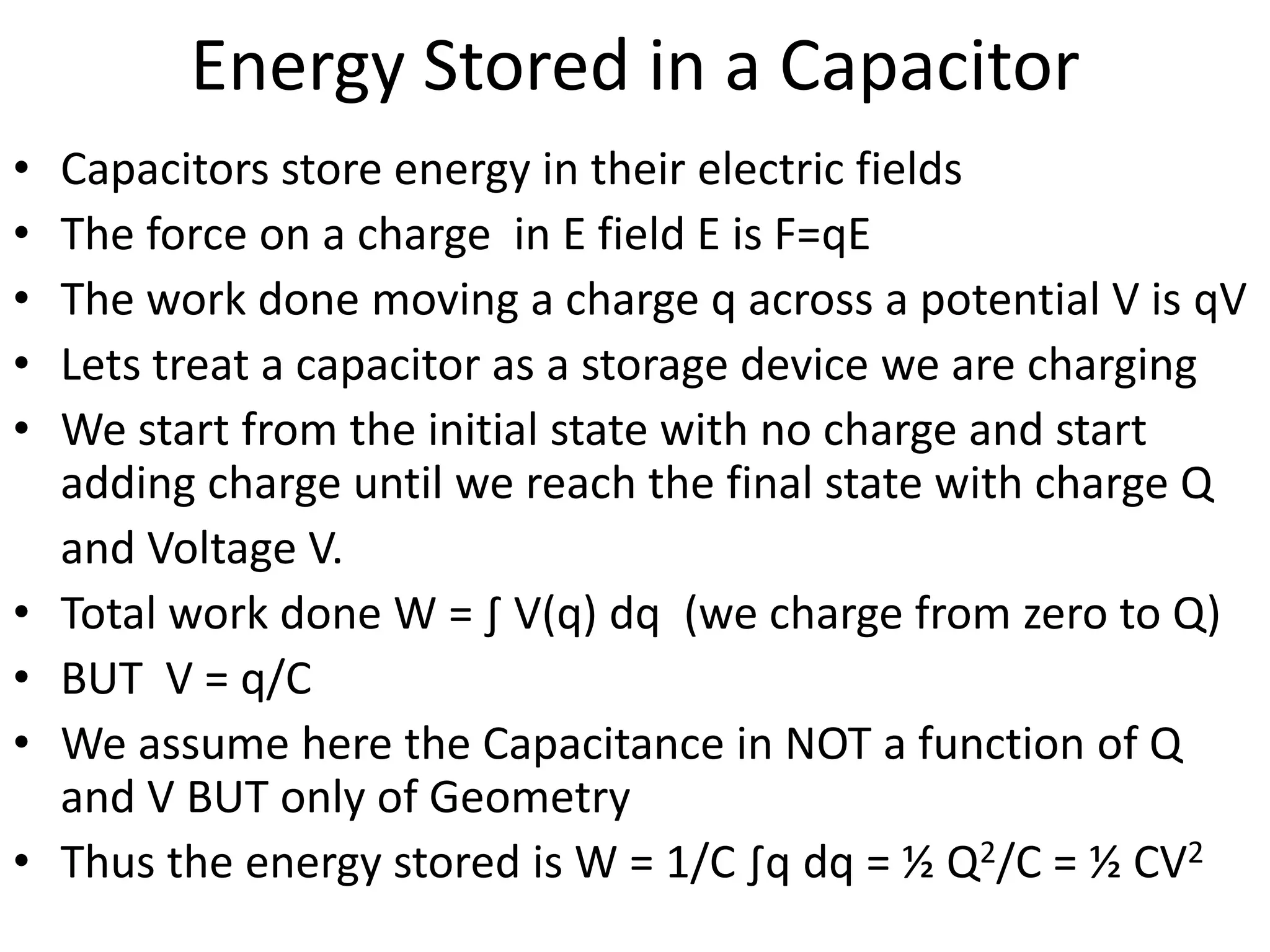
Energy Stored in a Capacitor
• Capacitors store energy in their electric fields
• The force on a charge in E field E is F=qE
• The work done moving a charge q across a potential V is qV
• Lets treat a capacitor as a storage device we are charging
• We start from the initial state with no charge and start
adding charge until we reach the final state with charge Q
and Voltage V.
• Total work done W = ∫ V(q) dq (we charge from zero to Q)
• BUT V = q/C
• We assume here the Capacitance in NOT a function of Q
and V BUT only of Geometry
• Thus the energy stored is W = 1/C ∫q dq = ½ Q2/C = ½ CV2
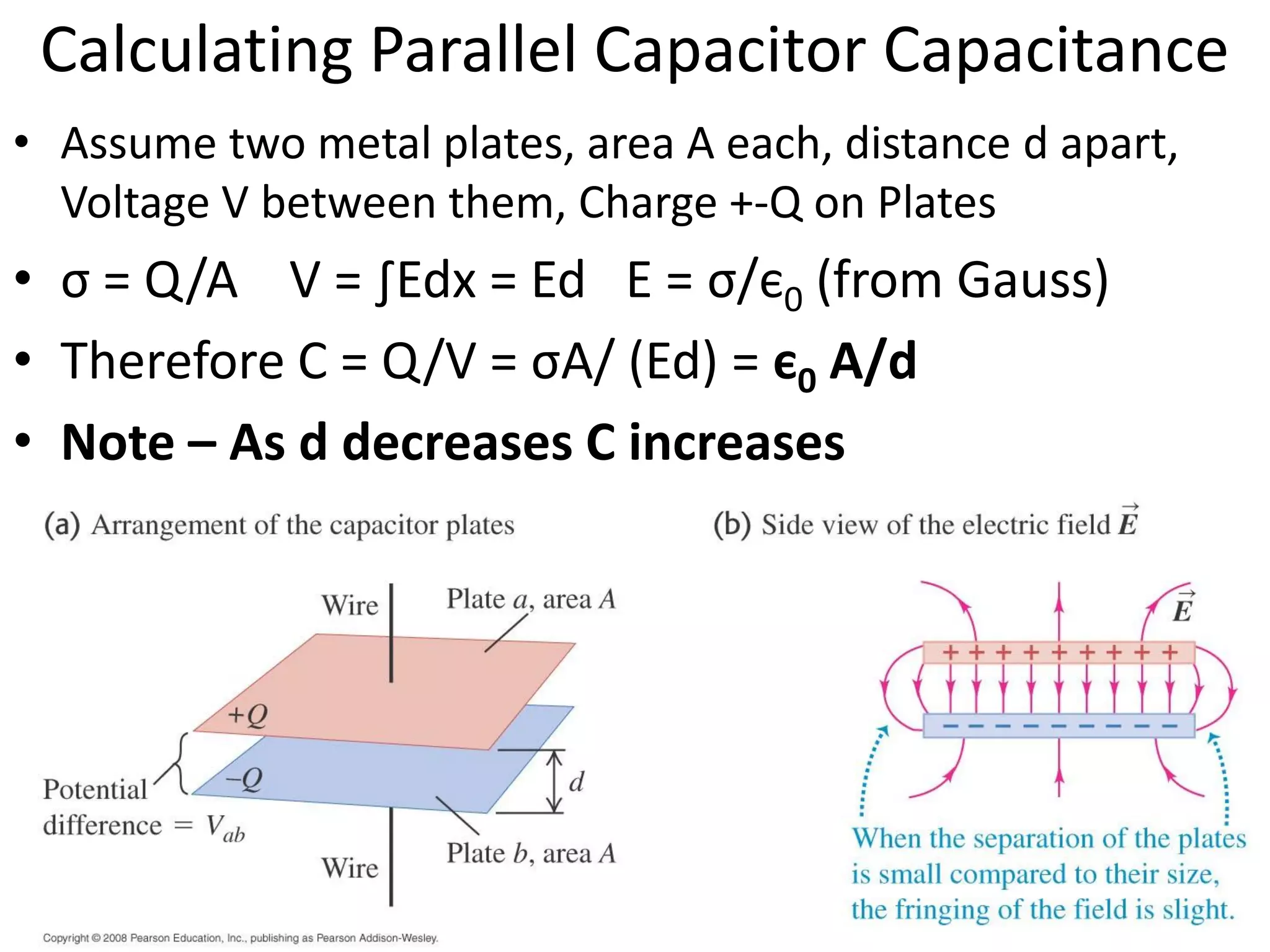
Calculating Parallel Capacitor Capacitance
• Assume two metal plates, area A each, distance d apart,
Voltage V between them, Charge +-Q on Plates
• σ = Q/A V = ∫Edx = Ed E = σ/є0 (from Gauss)
• Therefore C = Q/V = σA/ (Ed) = є0 A/d
• Note – As d decreases C increases
Force on a Dielectric inserted into a Capacitor
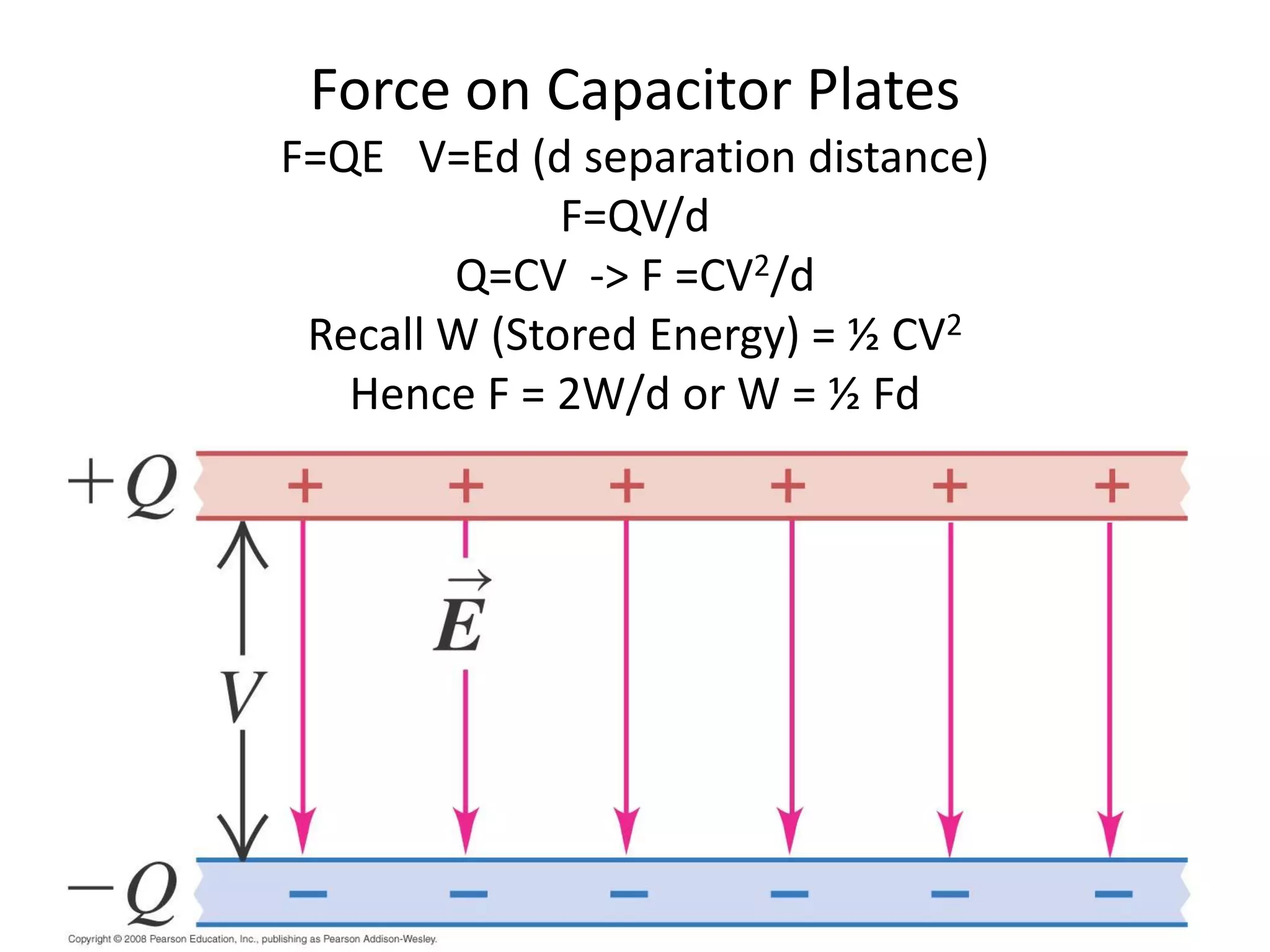
Force on Capacitor Plates
F=QE V=Ed (d separation distance)
F=QV/d
Q=CV -> F =CV2/d
Recall W (Stored Energy) = ½ CV2
Hence F = 2W/d or W = ½ Fd
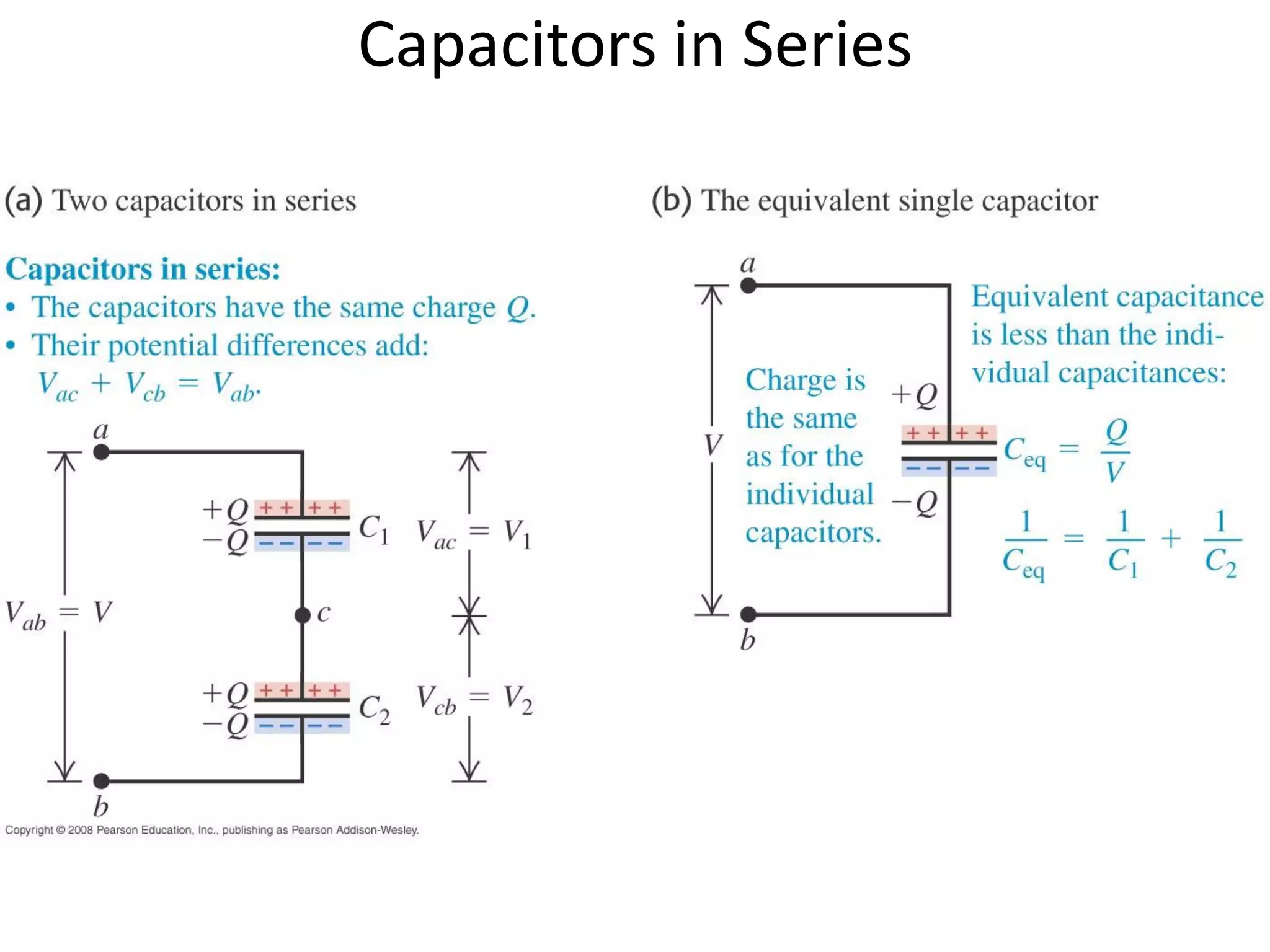
Capacitors in Series
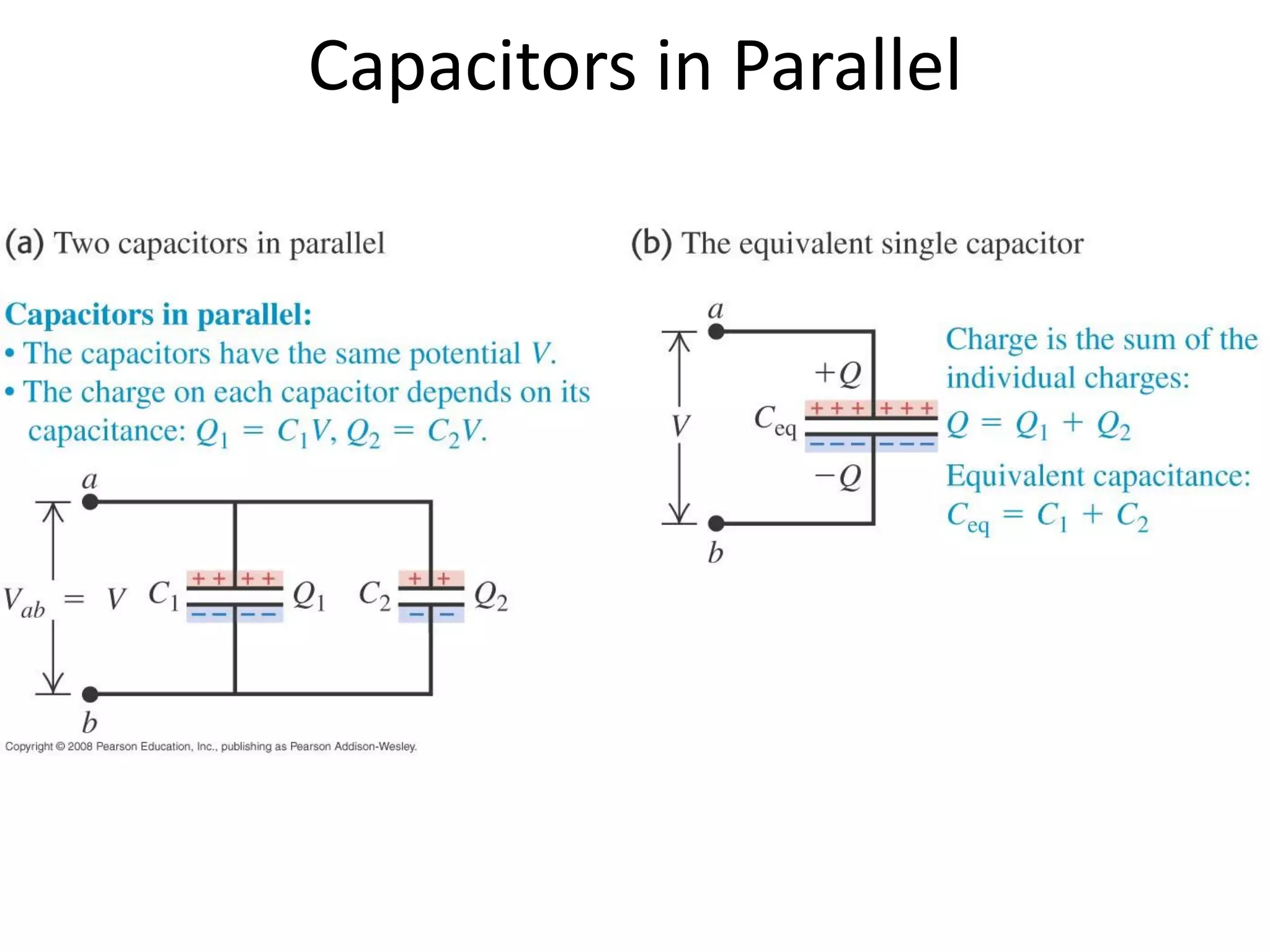
Capacitors in Parallel
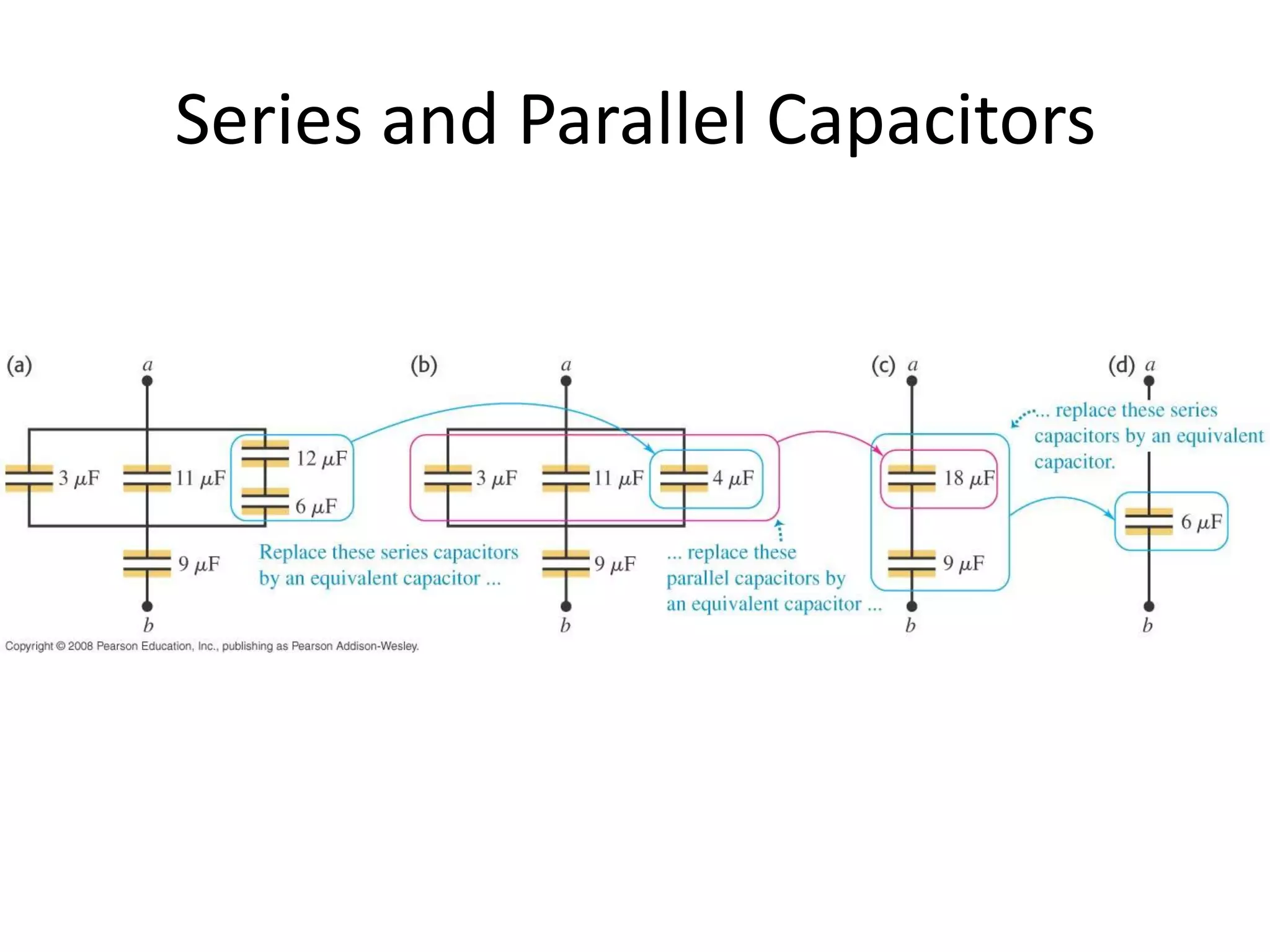
Series and Parallel Capacitors
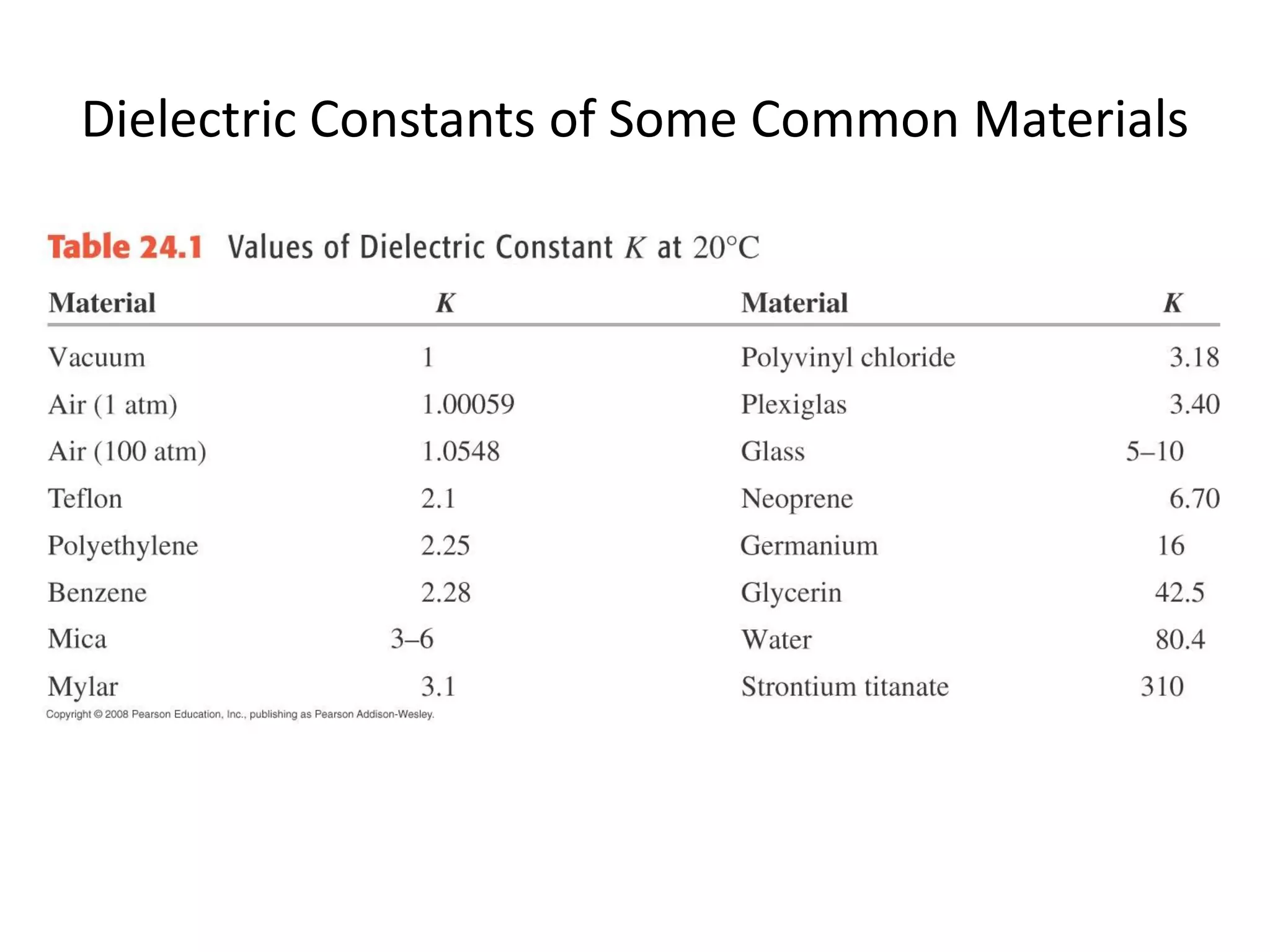
Dielectric Constants of Some Common Materials
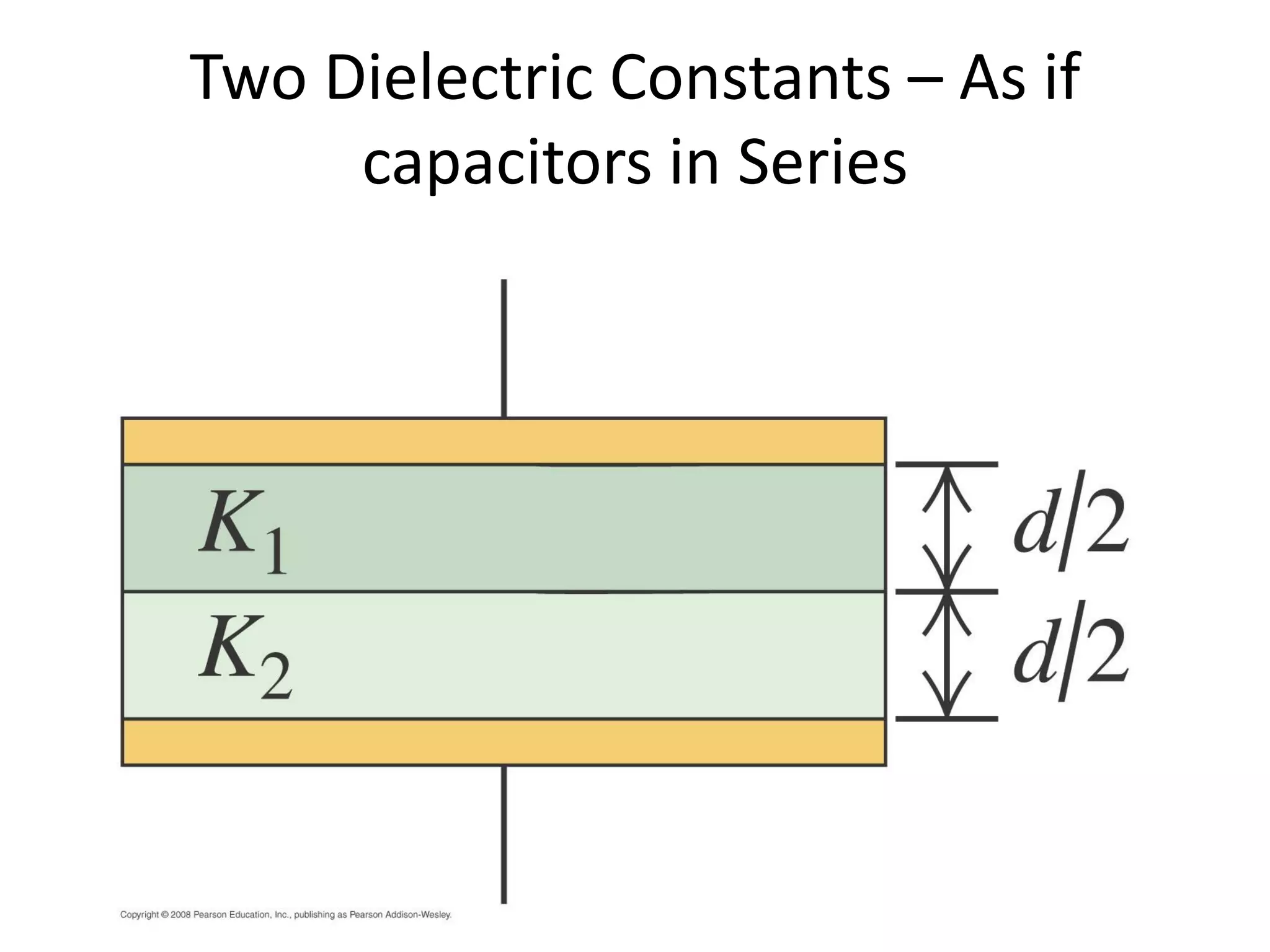
Two Dielectric Constants – As if
capacitors in Series
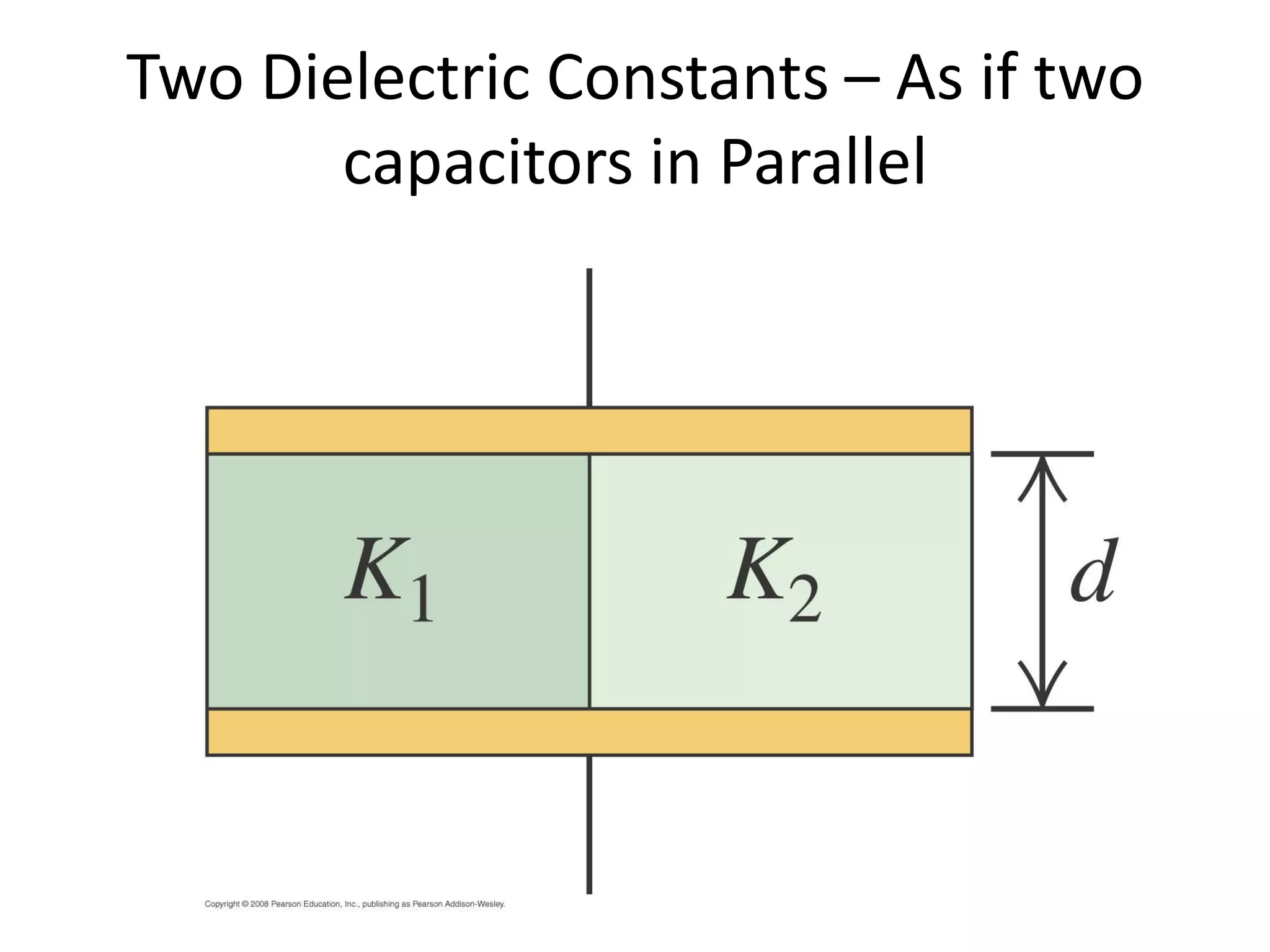
Two Dielectric Constants – As if two
capacitors in Parallel
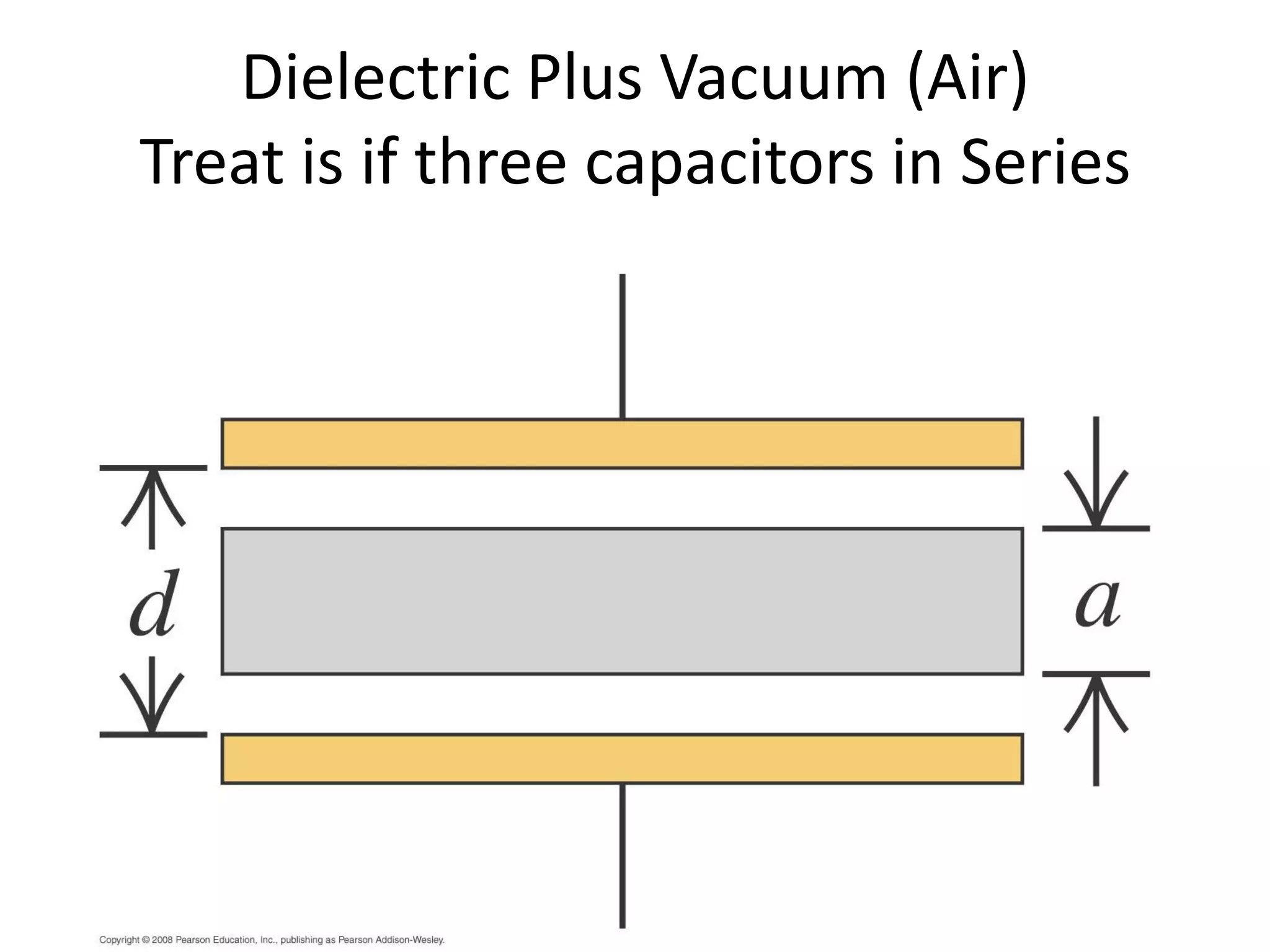
Dielectric Plus Vacuum (Air)
Treat is if three capacitors in Series
Capacitance of simple systems
Type Capacitance Comment
Parallel-plate capacitor
A: Area
d: Distance
Coaxial cable
a1: Inner radius
a2: Outer radius
l: Length
Pair of parallel wires[17]
a: Wire radius
d: Distance, d > 2a
l: Length of pair
Wire parallel to wall[17]
a: Wire radius
d: Distance, d > a
l: Wire length
Concentric spheres
a1: Inner radius
a2: Outer radius
Two spheres,
equal radius[18][19]
a: Radius
d: Distance, d > 2a
D = d/2a
γ: Euler's constant
Sphere in front of wall[18]
a: Radius
d: Distance, d > a
D = d/a
Sphere a: Radius
Circular disc a: Radius
Thin straight wire,
finite length[20][21][22]
a: Wire radius
l: Length
Λ: ln(l/a)

Chapter 24-capacitance

  • 1.
  • 2.
    What is Capacitance? •Capacitance (C) is equal to the Charge (Q ) between two charges or charged “regions” divided by the Voltage (V) in those regions. • Here we assume equal and opposite charges (Q) • Thus C = Q/V or Q = CV or V=Q/C • The units of Capacitance are “Farads” after Faraday denoted F or f • One Farad is one Volt per Coulomb • One Farad is a large capacitance in the world of electronics • “Capacitors” are electronic elements capable of storing charge • Capacitors are very common in electronic devices • All cell phones, PDA’s, computers, radio, TV’s … have them • More common units for practical capacitors are micro-farad (10-6 f = μf), nano-farad (10-9 f = nf) and pico-farads (10-12 f = pf)
  • 3.
    A classic parallelplate capacitor
  • 4.
    General Surfaces asCapacitors The Surfaces do not have to be the same
  • 5.
  • 6.
  • 7.
    How most practicalcylindrical capacitors are constructd
  • 8.
    Dielectrics – Insulators– Induced and Aligned Dipole Moments
  • 9.
  • 10.
    Creating Dipole Moments– Induced Dipoles
  • 11.
    Adding Dielectric toa Capacitor INCREASES its Capacitance since it DECREASES the Voltage for a GIVEN Charge
  • 12.
    Induced Dipole Momentsin a Normally Unpolarized Dielectric
  • 14.
    Electrostatic Attraction –“Cling” Forced on Induced Dipole Moments
  • 15.
    Energy Stored ina Capacitor • Capacitors store energy in their electric fields • The force on a charge in E field E is F=qE • The work done moving a charge q across a potential V is qV • Lets treat a capacitor as a storage device we are charging • We start from the initial state with no charge and start adding charge until we reach the final state with charge Q and Voltage V. • Total work done W = ∫ V(q) dq (we charge from zero to Q) • BUT V = q/C • We assume here the Capacitance in NOT a function of Q and V BUT only of Geometry • Thus the energy stored is W = 1/C ∫q dq = ½ Q2/C = ½ CV2
  • 16.
    Calculating Parallel CapacitorCapacitance • Assume two metal plates, area A each, distance d apart, Voltage V between them, Charge +-Q on Plates • σ = Q/A V = ∫Edx = Ed E = σ/є0 (from Gauss) • Therefore C = Q/V = σA/ (Ed) = є0 A/d • Note – As d decreases C increases
  • 18.
    Force on aDielectric inserted into a Capacitor
  • 19.
    Force on CapacitorPlates F=QE V=Ed (d separation distance) F=QV/d Q=CV -> F =CV2/d Recall W (Stored Energy) = ½ CV2 Hence F = 2W/d or W = ½ Fd
  • 20.
  • 21.
  • 22.
  • 23.
    Dielectric Constants ofSome Common Materials
  • 24.
    Two Dielectric Constants– As if capacitors in Series
  • 25.
    Two Dielectric Constants– As if two capacitors in Parallel
  • 26.
    Dielectric Plus Vacuum(Air) Treat is if three capacitors in Series
  • 27.
    Capacitance of simplesystems Type Capacitance Comment Parallel-plate capacitor A: Area d: Distance Coaxial cable a1: Inner radius a2: Outer radius l: Length Pair of parallel wires[17] a: Wire radius d: Distance, d > 2a l: Length of pair Wire parallel to wall[17] a: Wire radius d: Distance, d > a l: Wire length Concentric spheres a1: Inner radius a2: Outer radius Two spheres, equal radius[18][19] a: Radius d: Distance, d > 2a D = d/2a γ: Euler's constant Sphere in front of wall[18] a: Radius d: Distance, d > a D = d/a Sphere a: Radius Circular disc a: Radius Thin straight wire, finite length[20][21][22] a: Wire radius l: Length Λ: ln(l/a)