GUJARAT TECHNOLOGICAL UNIVERSITY
BIRLA VISHVAKARMAMAHAVIDYALAYA
(ENGINEERING COLLEGE)
VALLABH VIDYANAGAR
SUBJECT: ELEMENTS OF ELECTRICAL ENGINEERING
(CODE-2110005)
BE First Level Second Semester (Self Finance)
Topic : Charging and discharging of capacitors
Capacitors
• A capacitor is a device for storing electric
charge.
• It can be any device which can store charges.
• Basically, capacitors consists of two metal
plates separated by an insulator. The insulator
is called dielectric. (e.g. polystyrene, oil or air)
• Circuit symbol:
+
_
Dielectric
Circuit of process charging and
discharging
Charging of capacitors
• When a capacitor is connected across a battery, electrons flow
from the negative terminal of the battery to a plate of the
capacitor connected to it. At the same rate, electrons flow
from the other plate of the capacitor to the positive terminal
of the battery. This gives a flow of current as the capacitor is
being charged.
• As charges accumulate on the plates of the capacitor, electric
potential built across the plates. This hinders further
accumulation of charges and makes the charge up current
decreasing. When the potential difference across the plates
equals that of the battery, the current becomes zero.
Charging a Capacitor
• Voltage-charge
characteristics
• Current flow
I
t
Vc
or Q
t
)1(0
RC
t
C eVV


RC
t
oeII


Vc ∝ Q
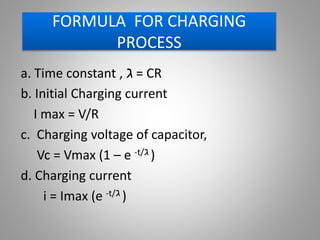
FORMULA FOR CHARGING
PROCESS
a. Time constant , ‫ג‬ = CR
b. Initial Charging current
I max = V/R
c. Charging voltage of capacitor,
Vc = Vmax (1 – e -t/‫ג‬ )
d. Charging current
i = Imax (e -t/‫ג‬ )
e. Initial rate of change potential
difference
dVc = V / CR
dt
f. Time when capacitor fully charge
t = 5‫ג‬
g. Energy stored, E = ½ CVmax2
Discharging a Capacitor
• Voltage-charge
characteristics
• Current flow
VC
or Q
t
I
t
RC
t
eQQ

 0
RC
t
oeII


Formula for discharging process
a. Time constant , ‫ג‬ = CR
b. Initial disharging current
I max = V/R
c. Disharging voltage of capacitor,Vc = Vmax (
e -t/‫ג‬ )
d. Discharging current
i = - Imax (e -t/‫ג‬ )
e. Initial rate of change
potential difference
dVc = V / CR
dt
f. Time when capacitor decrease
charge
t = 5‫ג‬
Prepared by :
Kakadiya Krushal (Production) – 130080125006
Mehul Ghodasara (Mechanical) – 130080119008
Milind Bhoya (Mechanical) – 130080119004
Thank you

Capacitors

  • 1.
    GUJARAT TECHNOLOGICAL UNIVERSITY BIRLAVISHVAKARMAMAHAVIDYALAYA (ENGINEERING COLLEGE) VALLABH VIDYANAGAR SUBJECT: ELEMENTS OF ELECTRICAL ENGINEERING (CODE-2110005) BE First Level Second Semester (Self Finance) Topic : Charging and discharging of capacitors
  • 2.
    Capacitors • A capacitoris a device for storing electric charge. • It can be any device which can store charges. • Basically, capacitors consists of two metal plates separated by an insulator. The insulator is called dielectric. (e.g. polystyrene, oil or air) • Circuit symbol: + _ Dielectric
  • 3.
    Circuit of processcharging and discharging
  • 4.
    Charging of capacitors •When a capacitor is connected across a battery, electrons flow from the negative terminal of the battery to a plate of the capacitor connected to it. At the same rate, electrons flow from the other plate of the capacitor to the positive terminal of the battery. This gives a flow of current as the capacitor is being charged. • As charges accumulate on the plates of the capacitor, electric potential built across the plates. This hinders further accumulation of charges and makes the charge up current decreasing. When the potential difference across the plates equals that of the battery, the current becomes zero.
  • 5.
    Charging a Capacitor •Voltage-charge characteristics • Current flow I t Vc or Q t )1(0 RC t C eVV   RC t oeII   Vc ∝ Q
  • 6.
    FORMULA FOR CHARGING PROCESS a.Time constant , ‫ג‬ = CR b. Initial Charging current I max = V/R c. Charging voltage of capacitor, Vc = Vmax (1 – e -t/‫ג‬ ) d. Charging current i = Imax (e -t/‫ג‬ )
  • 7.
    e. Initial rateof change potential difference dVc = V / CR dt f. Time when capacitor fully charge t = 5‫ג‬ g. Energy stored, E = ½ CVmax2
  • 8.
    Discharging a Capacitor •Voltage-charge characteristics • Current flow VC or Q t I t RC t eQQ   0 RC t oeII  
  • 9.
    Formula for dischargingprocess a. Time constant , ‫ג‬ = CR b. Initial disharging current I max = V/R c. Disharging voltage of capacitor,Vc = Vmax ( e -t/‫ג‬ ) d. Discharging current i = - Imax (e -t/‫ג‬ )
  • 10.
    e. Initial rateof change potential difference dVc = V / CR dt f. Time when capacitor decrease charge t = 5‫ג‬
  • 11.
    Prepared by : KakadiyaKrushal (Production) – 130080125006 Mehul Ghodasara (Mechanical) – 130080119008 Milind Bhoya (Mechanical) – 130080119004
  • 12.