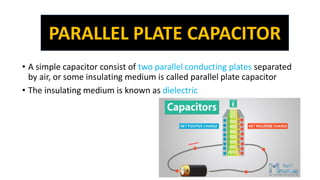
1) A capacitor is a device that stores electric charge. A simple capacitor consists of two parallel conducting plates separated by an insulating medium called a dielectric.
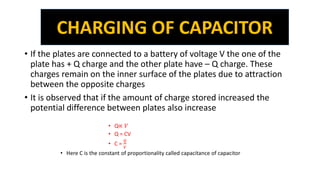
2) When a voltage is applied across the plates, positive and negative charges accumulate on the inner surfaces of each plate. The amount of charge stored is directly proportional to the voltage.
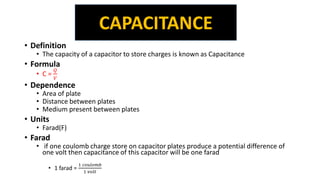
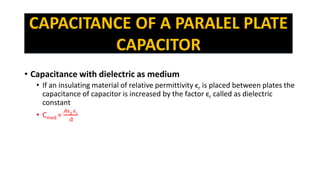
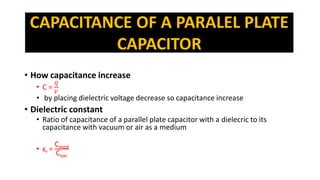
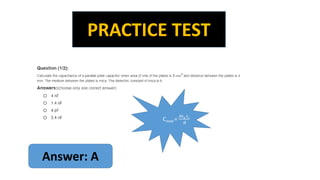
3) The capacitance of a capacitor is a measure of how much charge it can store. It is calculated as the ratio of stored charge to voltage. The capacitance increases if the plate area or dielectric constant increases, or if the distance between plates decreases.